25 137 résultats
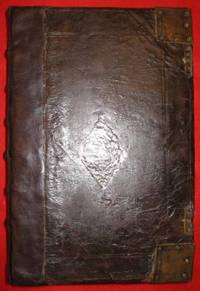
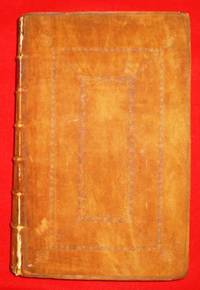
1767réf. QQ0322Printed by Mark Baskett and by the assigns of Robert Baskett 1767. Original full black morocco elaborate gilt borders to boards built up with single gilt fillet geometric roll and small tools rococo floral motifs. Geometric gilt decor to board edges; floral gilt decor to turn-ins. Raised bands to spine and elaborate gilt decor in small tools flowers stars fronds etc. Some rubbing to board and spine edges and to raised bands on spine. Board corners slightly pushed in. Mild uniform sunning to boards and spine. Minor abrasion c. 1.5cm to centre rear board. All edges gilt. Thick 4to 33 x 26.5 x 10.5cm. Hinges sound. Original marbled endpapers; front endpapers cracked at gutter. With loose slip of paper with pen inscription: 'This Bible was donated to the Community of Our Lady and St John at Alton Abbey by HRM Roundell Esq . whose late wife Louise was a member of the Corrie family. February 2005'. There is indeed the signature 'Edgar Corrie' to t.p. and 6pp. inscriptions largely genealogical records of the Corrie family to front of vol. inc. blank verso to front free endpaper and t.p. in a variety of old hands some interspersed with annotations to birth or baptismal records giving dates of death. First blank front endpage has some loss at top and bottom gutter. Dates recorded range from 1748 the birth of Edgar Corrie clearly recorded after the fact to 1894 Fanny Amos the 'loving and dearly loved friend and nurse' to a succession of Corries born in the mid-nineteenth century; possibly the only individual recorded who was not a member of the Corrie family by birth or marriage. The first page of inscriptions is not a genealogical record but a selection of biblical passages and an unattributed quotation from the 17th-century Anglo-Welsh historian James Howell 'in the conduct of human affairs it is a rule that a good conscience hath always within doors enough to reward itself' see Epistolae Ho-Elianae: The Familiar Letters of James Howell 1907 Vol. III p. 3. The collected inscriptions are signed 'E.C. 14th March 1799'; Corrie concludes at the bottom of the page 'I earnestly recommend the serious consideration of all the above texts & truths to each & to all of my Children' the second page of inscriptions records ten children to Corrie and his wife Ann Falkner. Edgar Corrie 1748-1819 prominent Scottish merchant in Liverpool business partner with John Gladstone father of the prime minister from 1787-1801. Corrie was a clandestine abolitionist: he wrote to Lord Hawkesbury in February 1788 with 'a long attack on the conduct of the slave trade in Liverpool' but asked that his name should be concealed from all except the Prime Minister William Pitt as it would 'cause him "irreparable prejudice" in the town if his letter became known' F. E. Sanderson “The Liverpool Abolitionists” in R. Anstey and P. E. H. Hair eds. Liverpool the African Slave Trade and Abolition 1989 pp. 215-16. No pagination. Decorated initials. Text printed in double columns. Separate dated t.p. for NT. Index to rear. The Apocrypha is listed in contents but it was issued without. Lacking the additional engraved title page mentioned by Darlow & Moule as are many other copies in ESTC & OCLC. Large paper copy considerably larger than the 24.1 x 18.8 size mentioned in Darlow & Moule. An imposing Baskett bible in handsome original binding with interesting provenance. Darlow & Moule 1180; ESTC T93100. Robust packaging. Tracking can be added to overseas orders on request. Used books are exempt from USA tariffs. Binding sound text unmarked. Very Good. c. 3000pp. 33 x 27 x 10 cm. Printed by Mark Baskett and by the assigns of Robert Baskett Hardcover
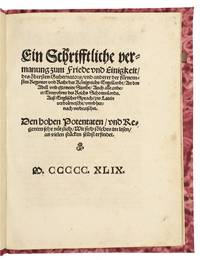
1549réf. 5178Erfurt: Gervasius und Wolffgangus Sthürmer gebrüder 1549. SOLE GERMAN EDITION. Printed by the brothers Gervasius and Wolfgang Stürmer. Hardcover. Fine. Bound in modern quarter vellum and marbled boards. A very good copy with broad margins with some faint marginal foxing mainly in the upper margin and a small faint damp-stain in the lower corner of the final 3 leaves. Translation of title: "A written exhortation to peace and unity from the Lord Protector and other leading regents and councilors of the Kingdom of England addressed to the nobility the common estates and all other inhabitants of the Kingdom of Scotland. Translated from English into Latin and subsequently into German. Highly useful to exalted potentates and rulers-as becomes evident in many passages upon reading." This is a German translation via an intermediate Latin version of Edward Seymour Duke of Somerset's "An Epistle or Exhortacion to Unitie & Peace" - the Lord Protector's open letter to the Scots urging them to honor the Treaty of Greenwich and accept the marriage of the English boy-king Edward VI to the infant Mary Queen of Scots. English troops were already prosecuting a war in Scotland. By refusing the marriage the Scots would show that they "preferred discord to unity war to peace." The letter is dated 5 February in the second year of King Edward VI's reign 1548. The English edition ESTC S110952 was printed at London in early 1548 most likely February since the Latin edition was also printed in London on 5 March ESTC S117203. In North America the English edition is held by Folger and Huntington; the Latin by Huntington only. I have not traced a copy of the German edition in North America. Edward Seymour was the brother of Queen Jane Seymour the third wife of King Henry VIII. Following Henry's death in 1547 he became Lord Protector of the realm for the young King Edward VI who was still a minor. As regent of England Seymour openly promoted Protestantism a stance that antagonized conservative Catholics-including Princess Mary the young king's eldest half-sister and successor. Seymour's military campaign against Scotland-an attempt to force a marriage between Edward VI and the Scottish Queen Mary Stuart at that time only an infant-ended in financial disaster for England. Increasingly unpopular among the nobility Seymour was overthrown in December 1549 and beheaded on Tower Hill on January 22 1552. On 1st July 1543 in the reign of King Henry VIII the Treaties of Greenwich were signed between England and Scotland. Part of the agreement was that Henry's five-year-old heir Edward and the princess Mary Stuart later Mary Queen of Scots should eventually be married. The Scots repudiated the treaties in December 1543. Henry's response was the war that later came to be known as the "Rough Wooing." It began with the sack of Edinburgh and Leith in May 1544 and continued into Edward VI's reign. In the end it pushed Scotland toward France. Mary then only four years old was betrothed to the Dauphin and sent to France under the Treaty of Haddington. "The timing of the Somerset's Epistle was important. In February 1548 the English were masters of Scotland; two invasions were about to be launched one up the River Nith to Drumlanrig another to Haddington. Furthermore it was becoming apparent that considerable French aid would shortly be sent to Scotland. At this critical juncture Somerset hoped to lay before the Scots the fullest and most moderate case he could and the Epistle was a direct comment on the circumstances at that time. Though short it was complicated with three basic elements: the exposition of the justness of the English case an elaboration of the advantages of the union and a demonstration of the lack of any alternative course of action. "The Epistle was the high water mark of the English propaganda campaign aimed at the Scots. Events were rapidly outstripping the presses. By June the French were disembarking at Leith by July Haddington was besieged and by August Mary had embarked for France the betrothed of the Dauphin. Scottish collaborators rapidly melted away. Consequently it is not surprising that no subsequent piece of propaganda can be seriously thought to be directed at a Scottish audience. "Efforts were made to insure that the Epistle had as wide a readership as possible. To begin with four different editions were printed: an English version in octavo and quarto executed by Grafton and two Latin editions by Wolf. Every other piece of propaganda had only one edition. Moreover the pamphlet was widely circulated. "Not only was the Epistle seen in Scotland. The Emperor read one of the Latin editions and did not find all of it to his liking. German Protestant concern has no more striking piece of evidence than a German translation of Wolf's Latin edition printed in Erfurt in 1549."Merriman The Rough Wooings Mary Queen of Scots p. 274-279 Somerset's Epistle present the English as Scotland's benefactors rather than its conquerors. As victors who have "overcome you in war and now become masters of the better part of your realm" they could have dictated terms but instead they come as "a father deals with his son an elder brother with a younger or a skilled physician with the sick" and ask the Scots to regard them "rather as friends than foes rather as brothers than masters." Centuries of war between the two kingdoms are truly lamentable because the two nations which share a common tongue and inhabit the same island are separated only by "the rival dominion that divides them." The natural conclusion is that they should where possible become a single realm under one rule. Since two hereditary realms cannot merge "without the downfall of one of them - except through the bond of marriage" the marriage of Edward and Mary offers the only means to effect the union of England and Scotland preserving "the rights of both" nations. Seymour sees the hand of Providence at work. King James V's two sons had died leaving only the infant Mary and Henry VIII had only sired one son by Jane Seymour. England promises to give up any title of conqueror and -remarkably- to set aside "the glorious English name itself" so that both peoples would resume "the old common name of Britons." Scottish laws would stand as England France and Rome all tolerated regional diversity of law and Mary would become "an heir in England as well." Against this the epistle sets the danger of relying on France. Foreign troops would "defile your houses waste your lands" and carry off the Queen to marry wherever it suited them. "This foreign help will be your shame this garrison your ruin even victory itself your bondage." The epistle closes with the promise of free trade between both kingdoms. Scottish merchants who register with border officers and pledge to the cause will receive safe-conduct into England to trade "exactly as though they were His Majesty's own subjects." A united Britain it is promised would have "the sea our wall brotherly love our garrison God Himself our protector.". Gervasius und Wolffgangus Sthürmer, gebrüder hardcover
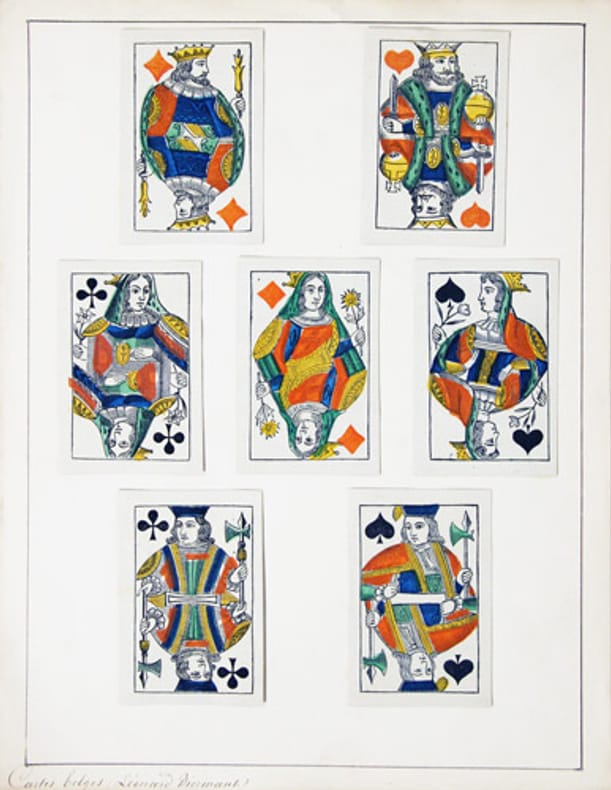
réf. 101137aafin-Folio, cartes, enveloppes etc. proprement montées sur des bristols blancs, souvent avec légendes manuscrites (origine, nom du fabricant), avec quelques brochures, cartes postales, lettres, entre les feuilles.
1896réf. 1812240048Boston Mass. : Published by the New-England Historic Genealogical Society 1896. First Edition. Hardcover. Very Good. Signed. The Tan Book series: Massachusetts Genealogy 182 volume set. Hardcovers. A massive collection of many of the towns in Tan Book series. Census information births marriages deaths. Contains the Vital Records of the following Massachusetts towns: Acton; Alford; Amesbury; Andover vols 1-2; Arlington; Ashfield; Ashburnham; Athol; Barre; Becket; Bedford; Beverly vols 1-2; Billerica; Brimfield; Bolton; Boxford; Bradford; Brockton; Brookfield; Burlington; Canton; Carlisle; Cambridge Vols 1-2; Charlemont; Charlestown Vol 1. Newer printing; Charlton; Chatham NP 1991; Chelmsford; Chelsea NP; Chester; Cohasset; Conway; Dalton; Danvers vols 1-2; Dartmouth Vos. 1-3; Deerfield; Dennis Vols. 1-3 np; Dorchester South; Douglas; Dracut; Dudley; Dunstable; Edgartown 2 vols; Essex; Falmouth Picton Press 1993; Framingham; Gardner; Gloucester vols. 1-3; Grafton; Granville; Great Barrington; Greenfield; Groton vols. 1-2; Hamilton; Harvard; Harwich Harwick Historical Soc 1982; Haverhill vols. 1-2; Heath; Hinsdale; Holden; Holliston; Hopkinton; Hubbardston; Hull; Ipswich Vols. 1-2; Lee; Leicester; Leominster; Lexington; Lowell Vols. 1-4; Lynn Vols. 1-2; Kingston; Malden; Marblehead Vols. 1-3; Marlborough; Manchester; Medford; Methuen; Middleborough Mass. Soc. Mayflower Desc. 1986 Vols 1-2; Middleton; Middlefield Vols. 1-4; Nantucket Vols. 1 3-5; New Ashford; New Bedford Vols. 1-2; New Braintree; Newbury vols. 1-2; Newton; Northbridge; Norton; Oakham; Palmer; Pelham; Pembroke; Petersham; Phillipston; Princeton; Plympton; Reading; Richmond; Rowley; Roxbury Vols. 1-2; Royalston; Rutland; Salem Vols. 1-6; Salisbury; Saugus; Shelburne; Shirley; Shrewsbury; Southborough; Southbridge Holbrook NP; Spencer; Stoneham; Stoughton; Stow; Sturbridge; Sudbury; Sutton; Taunton Vols. 1-3 vol 1; Templeton; Tewksbury; Tisbury; Topsfield; Tyngsborough; Tyringham; Webster Holbrook np; Wakefield; Warren; Washington; Wayland; Wenham; Westborough; West Bridgewater; West Boylston; Westford; Westminster; West Newbury; Westport; West Stockbridge; Weymouth Vols. 1-2; Winchendon; Windsor; Williamstown; Worthington; Upton; Uxbridge. Note: 9 of the volumes later printings as indicated. This is an oversized or heavy book which requires additional postage for international delivery outside the US. Boston, Mass. : Published by the New-England Historic Genealogical Society, hardcover
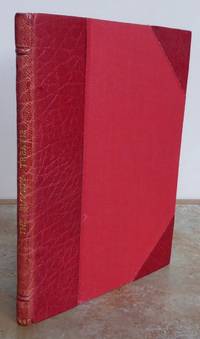
1660réf. 44488London: Printed for James Davis and are to be sold at the Grey-hound in St. Pauls Church-yard 1660. 1st Edition Abbott 1043; Wing G351. Later binding by Riviere & Son full red morocco triple gilt border rule to boards. AEG. Spine with elaborate gilt tooling five raised bands. Gilt stamped title to spine. Gilt dentelles. Very minor binding wear. Age-toning to eps & text paper. A handsome & pleasing VG - Nr Fine volume. 8 131 13 pp. A6 blank. 12 pages of bookseller offerings conclude volume. Engraved frontispiece restored lower corner. 12mo; A6 B - G12 A1 = Frontis. 5-1/2" x 3-1/4" 14 cm x 8.3 cm. Printed for James Davis, and are to be sold at the Grey-hound in St. Pauls Church-yard hardcover books
Madrid, Bernardo de Villa-Diego, 1680, 20 x 15 cm., pergamino de época, 8 hojas incluso portada a dos tintas + 70 págs. (Obra extremadamente rara que narra una conspiración ficticia perpetrada en Inglaterra en 1678, atribuida a miembros de la Iglesia católica con el fin de desacreditarlos en un escándalo público y basada en un supuesto complot papista que pretendía asesinar al rey Carlos II de Inglaterra y reemplazarlo por Jacobo II, su hermano de confesión católica). (Extremely rare. This Manifesto dated London, 3 January 1679 (p.39) and translated into Castilian by July of the same year, appeared at the height of the panic about the popish plot. Commissioned by a man of importance ("un gran sujeto"), the translation aimed to publicize the facts about the persecution of Catholics. The work provides detailed biographies of the principal inventor of the plot - Titus Oates, and of other key witnesses -- William Bedloe and his brother, Miles Prance and Stephen Dugdale. The details of the supposed conspiracy to assassinate the King are examined and the claims of the witnesses challenged. Particular attention is paid to the activities of Oates and the Bedloes in Spain, and their characters and conduct are discredited. The assertions of the Manifesto are supported by the evidence provided in five "Instruments": sworn testimonies by various Spaniards, English Merchants in Bilbao, a letter by Oates himself relating to the Bedloes and a letter of the Rector of the Irish College in Salamanca).
1833First Edition. Original board with paper label on front, as issued, 8vo, 54 pages ; 22 cm. In English with Hebrew. Singerman 564; Rosenbach 368; Bruntjen 21148; Goldman-Kinsberg 183. Goldman notes, Joshua Seixas, the son of Gershom Mendes Seixas (the minister of New York's Shearith Israel congregation), was born in New York in 1802....He taught in Shearith Israel's Hebrew school in the mid-1820s and he established the congregation's first choir. Seixas moved to Charlestown, MA, in the early 1830s and gave lessons in Hebrew. Among his pupils were Harvard students. Seixas began referring to himself as James while in Charlestown...Seixas then settled in Hudson, OH. He offered private Hebrew classes to students at Oberlin College, and later at Western Reserve University...He also taught groups of Mormons- the center of the movement at the time was in Kirtland, OH- and among his students were Joseph Smith, the founder of Mormonism, and Orson Hyde, another early leader of the movement." This is presumably the very edition of his book that he would have used with his Mormon students there. "Seixas left Ohio in 1836 and he was living in Staten Island, NY, by 1838.....a few of his many children remained within the community; others did not....Seixas's grammar was reviewed favorably in its time (Goldman, 'Joshua/James Seixas," 72), though Chomsky later criticized it (Chomsky [1958], 133-4). In addition, the printer, Gould, was a relative of Joseph Smith, who is descendant of Zaccheus Gould by the marriage of Samuel Smith and Priscilla Gould. The Smiths came from Topsfield, near Andover, where Gould had his press. For detailed analysis of Seixas' relationship with the founders of the Mormon church, see Rick Grunder's 2015 essay "A Teacher for the Temple: The Infectious Exuberance of Joshua Seixas" (www.rickgrunder.com/seixas.pdf). SUBJECT(S): Hebrew language -- Grammar. OCLC: 4821518. Period ownership signiture. Bookplate on rear pastedown. Lacks backstrip. Some foxing and staining, Good Condition (AMR-65-31A)
réf. 224241S.l., 1756 in-12, viij pp., 160 pp., veau fauve marbré, dos lisse cloisonné et fleuronné, pièce de titre cerise, encadrement de triple filet doré sur les plats, armes au centre, simple filet doré sur les coupes, tranches rouges (reliure de l'époque). Ex-libris gratté.
3 volumes in-8 (192 x 124 mm), plein veau tabac moucheté de l'époque, dos lisses richement ornés d'un décor de compartiments cloisonnés de roulettes en losange, fer central à l'urne répété et filets dorés, palettes en tête et pied, pièces de titre et de tomaison de maroquin bordeaux et olive, coiffes guillochées or, filet sur les coupes, tranches rouges, garde de papier d'Augsbourg, (4), xvj, 268, iii p. - (4), 275, (1) bl., iii p. - et (4), 299, (1) bl., iii p. Rare première et unique édition française de l’édition collective des principaux traités politiques du philosophe et théoricien du républicanisme James Harrington (1611-1677), traduits par l’historien et juriste Pierre-François Henry (1759-1833). Modèle pour la France révolutionnaire, l’ouvrage est publié fort à propos pendant les événements. L'édition renferme le texte intégral d' "Océana", "d'un point de vue sociologique ou politique, l'une des utopies les plus remarquables. 'Le plus savant de tous les utopistes' (cf. Ruyer, p. 180 sq. et Servier), le seul à présenter son budget et celui dont le but était la démocratie, sans corruption ni bureaucratie" (Valette, 'Utopies', n°145). "Ce qui distingue avant tout l'utopie des autres ouvrages de théorie politique, c'est que la société idéale y prend corps dans un espace concret, peuplé de personnes que l’on se représente en train de vaquer à leurs tâches quotidiennes" (cf. M.-I. Ducrocq, 'L’utopie de républicaine de Harrington…', "R.P.M.A.", Université de Rouen, 2013, p.31-42). 'The Commonwealth of Oceana' parut en 1656 à Londres durant la période "républicaine" qui s'étend de l'exécution de Charles Ier à la restauration par son fils Charles II. L'ouvrage est dédié à Oliver Cromwell, bien que celui-ci fit censurer la première version du livre. L'oeuvre, qui demeure un grand oublié dans l'histoire de la philosophie politique en France, est d'une importance fondamentale pour la genèse et l'émergence des régimes représentatifs modernes. Les idées exposées par Harrington ont directement inspiré les constituants de plusieurs états américains et, en France, Sieyès et la Constitution de l'an VIII dont il fut le principal artisan. (BnF, 'Utopie', p. 121. Hartig et Soboul, 'Utopie', n°78. Versins, 'Utopies', p. 408). Quelques rousseurs et petites brunissures éparses. Infimes traces de restaurations à la reliure. Bel exemplaire, très frais, très bien relié à l'époque.
1755réf. 58878ABHalle, Francken, 1755-60. 4to. Mit gest. Frontispiz, 11 gest. Porträts, 2 gest. Faltkarten, 10 gest. Tabellen und 11 gest. Titelvignetten. Marmorierte Lederbände der Zeit mit rotem Rückenschild, reicher -vergoldung, Marmorpapiervorsätzen.
1611réf. 805London: Robert Barker 1611. Leather Bound. Very Good . 9 x 13 1/4 inches. Folio. 78 of 80 pages. Lacking title page. Griffiths 1611/2. Bound with: The Bible: That is The holy Scriptures contained in the Old & New Testament. London: Robert Barker 1612. 4 362 OT 361-444 Apocrypha 135 NT 7 tables leaves. Collates as A 4 leaves A-Lll in 6s Mmm - Ooo in 8s Ppp - Eeee in 6s Ffff 4 leaves. Engraved title page with old repair to closed tear at bottom. Full page woodcut of Garden of Eden presentwith loss to lower outer corner of image. B6 with old manuscript repair to loss at outer corner. Lacks 2Z3.4 Isaiah 17:13-24:18. Herbert 312. STC 2218. NT with separate title page dated 1611. Printed in two column Roman type. Bound with: Sternhold Thomas and John Hopkins. The Whole Booke of Psalmes: Collected into English Meeter. London: Printed for the Company of Stationers 1612. 114 6 of 8 pages. Collates as A-K in 6s L 1 of 2 leaves lacking index. STC 2539. Endpapers with 17th and 18th Century owners' inscriptions. Some marginal soiling and minor dampstains. Bound in contemporary brown calf with blindstamped arabesque centerpiece on covers brass corner pieces catches and clasps now lacking. Covers with old repairs and modern professional rebacking. A very good collection of the BCP of James I with the Geneva/Breeches Bible and Psalmes in folio with brass hardware. More complete than the copy located in Hills. Robert Barker unknown
1967réf. List2885Sheffield United Kingdom 1967. 20 x 30 inch poster on heavy cardstock. Some staining and scuffing pinholes and some tears at edges fine contrast; overall excellent. A poster advertising Stevie Wonder at Sheffield’s Mojo Club in October 1967. Wonder would have been just seventeen at the time though he had already dropped “Little” from his stage name. The Mojo Club in working-class Sheffield was the project of brothers Peter and Geoff Stringfellow; the pair had previously worked as promoters and were preternaturally talented having booked the Beatles for April of 1962 shortly before the release of “Love Me Do”.1 Stevie Wonder would be the last live act at the Mojo as it was shut down by the city three days later on October 10. 1 Steve Walker “The King Mojo Club” 2020 https://www.kingmojostory.com. unknown
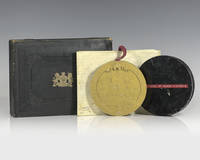
réf. 108053Rare wax Great Seal of Queen Victoria presented with a large elaborately illustrated patent granted to William Edward Newton. Housed in a custom metal case the patent measures 7 inches in diameter and depicts Queen Victoria on the Royal Throne flanked by two ladies in waiting. The seal is affixed to the patent with a red braided twine. Partially printed on vellum the patent is dated 1858 and grants William Edward Newton the rights to his invention which made "improvements in the hanging and arranging of cylindrical conical or spiral steel railroad springs for Railway carriages" with elaborate engraved royal and botanical headpieces and borders and the original blue paper seal. Housed in the original royal presentation box with gilt royal coat of arms. In near fine condition. hardcover
1815réf. 55149ABLondon, Ackermann, 1815 -17. First Edition ! 3 Volumes. 8°, 295,285,299 S.,3 handcolor. Titelblätter, 96 handcolor. Aquatintarad. Hochfeine, blindgeprägte Leineneinbände, orange-braun mit aufwendiger, bildlicher Rü.-Vergoldung. Kopfgoldschnitt. Sehr dekorative Reihe. Ecken leicht bestoss., Besitzereintrag von alter Hand auf Titelbl., minim. stockfl., guter Zustand.
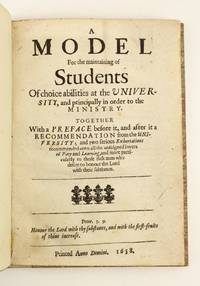
1658réf. ST16442s.l.: s.n. Printed Anno Domini 1658. FIRST EDITION. 190 x 135 mm. 7 1/2 x 5 3/8". 3 p.l. 14 pp. complete. 20th century vellum-backed marbled boards flat spine with vertical titling. Front pastedown with bookplate of the Fox Pointe Collection. Wing P-2842B; ESTC R207754. ◆Text lightly washed and pressed but still crisp faint foxing to lower edge of title page otherwise a fine fresh copy in an unworn binding. Written by an opinionated English cleric this is an extraordinarily rare pamphlet proposing an unusual fund to support young 17th century scholars. According to DNB the scheme outlined in the present work was meant "to support the university studies of young men of promise seeking entry into the ministry." The plan "was approved by John Worthington and Anthony Tuckney and had the support also of John Arrowsmith DD Ralph Cudworth William Dillingham DD and Benjamin Whichcote. The fund raised about £900 and it appears that William Sherlock afterwards dean of St Paul's received assistance from this fund during his studies at Peterhouse Cambridge until 1660 when he graduated BA. Those entrusted with administering the fund sent Poole regular reports on students interviewed and the ratings they had received in philosophy logic and languages. The scheme was abandoned at the Restoration." Poole 1624 - 79 was the author of a number of controversialist pamphlets on subjects ranging from Unitarianism to preaching by lay persons before undertaking his major work: a synthesis of critical biblical commentaries "Synopsis criticorum aliorumque sacrae scripturae interpretum." This is one of his scarcest writings: ESTC lists seven copies two in North America while ABPC and RBH record just two copies at auction. s.n. Printed Anno Domini unknown
réf. 461727-1733 À La Haye, chez Alexandre de Rogissart, 1727-1733.
1750réf. 0009001London England Britain UK. Good. 1750. Vellum. On offer is an exemplary and rare Latin copy of the Thirty-Nine Articles of Religion the defining statements of doctrines and practices of the Church of England and one of the most important religious documents of history. While the Articles themselves were formulated in the mid-1500s this particular book dates back to c.1700. The Articles were issued in both Latin and English. The entirety of this book is written in Latin. There is a vellum cover still fully intact though there are small tears at the ends and discoloration due to age. Written on the front cover and continued on the back are a table of contents for all 39 articles. They begin with I. De Fide in sacrosanctam Trinitatem. and ending with XXIX. De Christiani Juramento. The writing is still extremely clear. Smudging or discoloration of the text throughout the entire book is non-existent. The book is roughly 160 pages long. It has been sewed together using a 3-hole pamphlet stitching. There are also some anomalies throughout. Many pages contain tiny pieces of paper sewn in that have extra writing on them. One of them reads Christ a true sacrifice vide Eph: 20 which translates to Christs sacrifice see: Ephesians: 20. Another reads vide Art: XXI. Prop: V. These little notes seem to be addendums and cross-references that the owner most probably put in himself. While most pages are fully filled with text a few pages are mostly blank with some writing on the top De sexta propositione and a blank space under which the owner meant to continue writing but did not. History: When Henry VIII broke with the Roman Catholic Church and was excommunicated in 1538 he formed a new Church of England which would be headed by the monarch himself rather than the pope. The Thirty-nine Articles of Religion were initiated by the Convocation of 1563 under the direction of Matthew Parker the Archbishop of Canterbury. The articles pulled back from some of the more extreme Calvinist thinking and created the peculiar English reformed doctrine. Adherence to the Articles was made a legal requirement by the English Parliament in 1571 and incorporated into the Anglican Book of Common Prayer. Although not the end of the struggle between Catholic and Protestant monarchs and citizens the book helped to standardize the English language and was to have a lasting effect on religion in the United Kingdom and elsewhere through its wide use. ; Manuscript; 8vo - over 7¾" - 9¾" tall; KEYWORDS: HISTORY OF THIRTY-NINE ARTICLES OF RELIGION 39 ARTICLES XXXIX ARTICLES ANGLICAN CHURCH CHURCH OF ENGLAND LATIN BOOK HENRY VIII THOMAS CRANMER EXCOMMUNICATION NON VERNACULAR RELIGION RELIGIOUS DOCUMENT PROTESTANT REFORMATION UNITED . hardcover
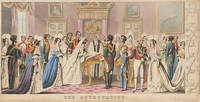
réf. 110370London Fores 1840. . Hand-coloured aquatint panorama heightened with gum arabic c. 10.5 x 626 cm. on conjoined sheets and folding concertina-style split into 2 parts with first half attached to front board and second part to rear one fold reinforced some light soiling; folding into modern cloth folder preserving original upper cover titled and decorated in gilt and with metal clasp with publisher's original paper label to front pastedown upper cover rubbed and a little stained lacking lower clasp Fine panorama of Queen Victoria's wedding to Prince Albert of Saxe-Coburg-Gotha in 1840 at the Chapel Royal at St. James's Palace resplendent with the pomp and ceremony one might expect from the first marriage of a reigning English Queen since Queen Mary in 1554. Queen Victoria was just 21 at the time and her husband a few months younger. They were married for 21 years during which time they had 9 children. Abbey Life 546; Bobins 1304 this copy. London, Fores, 1840. hardcover
réf. 53659London Printed for J.C. 1645. TITLE CONTINUED: Who hath brought in 4. of the Kings collonels to the Parliament; with the whole proceedings of Rupert's perambulation from the King at Newark and his return to Woodstock with 400. Horse. And how cruelly they used Captain Pickering during the treatie; who by the help of Collonel Willis Collonel Honywood Collonel Fisher and Collonel Roulston is now returned safe to the Parliament and hath brought them in from the King. With Rupert's letter to the King about a bloody massacre. Die Saturn. Decemb. 13. 1645. Appointed to be printed and is published according to order. CIVIL WAR PAMPHLET 1645 FIRST EDITION small 4to approximately 175 x 130 mm 7 x 5 inches pages: 1-8 ornamental title page modern half morocco over cloth sides by Bayntun of Bath gilt title and date to spine new cream endpapers speckled edges padded out with blank paper gilt lettered red leather book label of Austin Smith to top of front pastedown contemporary old ink marginalia to fore margin of last page and a pointing hand in opposite margin. A very good crisp pamphlet. George Thomason Catalogue of the Pamphlets Books Relating to the Civil War 1640-1661 Volume 1 page 403 Oct. No. E 311. 27; ESTC R200645 lists 6 copies; Wing Short-Title Catalogue Volume 1 page 162 No.3294. MORE IMAGES ATTACHED TO THIS LISTING ALL ZOOMABLE FURTHER IMAGES ON REQUEST. Postage at cost and all parcels sent fully tracked and fully insured. London, Printed for J.C., 1645. hardcover
1835réf. 291674London: Willaim Darton and Son 1835. Half Leather. Very Good binding. Darton's Counties of England complete with 42 decorative engraved map 3 of which are folding with original hand-coloring. The maps have attractive vignettes of sights within each county and references to the "Hundreds" and "Market Towns and Market Days". Some offsetting as is usual. This is a later state of "Complete Atlas of the English Counties" begun by Thomas Dix of North Walsham and completed by William Darton in 1822. Undated but the imprint on most maps reads "London: William Darton & Son 58 Holborn Hill" which was Darton's company name only between 1835 and 1837. Rebacked in calf with a new spine label. Very Good binding. Willaim Darton and Son unknown books
réf. 108053Rare wax Great Seal of Queen Victoria presented with a large elaborately illustrated patent granted to William Edward Newton. Housed in a custom metal case the patent measures 7 inches in diameter and depicts Queen Victoria on the Royal Throne flanked by two ladies in waiting. The seal is affixed to the patent with a red braided twine. Partially printed on vellum the patent is dated 1858 and grants William Edward Newton the rights to his invention which made "improvements in the hanging and arranging of cylindrical conical or spiral steel railroad springs for Railway carriages" with elaborate engraved royal and botanical headpieces and borders and the original blue paper seal. Housed in the original royal presentation box with gilt royal coat of arms. In near fine condition. hardcover books
1633réf. 457London: Robert Barker and Assignes of John Bill 1633. Leather Bound. Very Good. 9 1/2 x 13 3/4 inches. Folio. 2 ffep A - b 4 leaf quires B - H 6 leaf quires I 4 leaf quire. Title page cropped and relaid with loss to imprint. Marginal loss to A3 not affecting text. Griffiths 1633/2. Bound with: The Holy Bible Containing the Old Testament and the New Authorised/KJV version. London: Robert Barker and Assignes of John Bill 1633. 10 327 numbered leaves OT 328-403 of 404 Apocrypha 406-507 NT. Engraved title to Bible closely cropped at fore-edge. Lower half of last leaf of preface A8 lacking. Folio 1 of OT with lower marginal loss affecting text. 163 with loss of lower quarter. Old repairs to marginal tears on a few pages. Occasional closed tear or marginal loss with no loss of text and minor soiling and old marking. Folio 108 misnumbered 118 117 as 61 148 as 184 152 as 154 216 as 215 224 as 223 225 as 226 232 as 231 233 as 237 234 as 238 235 as 246 then resuming at 236 as 240 due to the misfoliation noted in Herbert 249 as 242 302 as 281 379 as 378 392 as 372 452 as 470. The general title reflects the alteration of "1632" to "1633" noted in Herbert. NT colophon dated 1632. Herbert 466. Bound with: Sternhold Thomas and John Hopkins. The Whole Booke of Psalmes Collected into English Meeter. London: Printed by R. Badger for the Company of Stationers 1632. Title page 1 - 114 numbered pages 2 rfep. 35 and 36 misnumbered. ESTCS122383. All edges rouged. Marbled endpapers. Front pastedown with armorial bookplate of Thomas Whitmore and 1 ffep with 18th Century Whitmore family records. Bound in later Georgian full paneled reverse calf. Spine with six raised bands and red morocco spine label with gilt "Holy Bible" and border. Chipping to head and tail of spine and hinges starting. Rounding to corners with minimal loss. An excellent copy of the 1552 English BCP and KJV Bible. Normally found in quarto this much scarcer folio edition in a Georgian binding. Robert Barker and Assignes of John Bill unknown
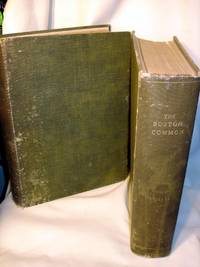
1913réf. 16729Good HCs no DJs. 2 volume set. Green-brown buckram cloth over boards gilt stamped titles on spines. Covers are scuffed with uneven fading and some spotty stains; some rubbing at spine ends and fore corners light fraying; both volumes tightly bound; interiors are clean with slight general age darkening; all leaves are supple not brittle; cover leaf of final issue has short closed tear at mid-cover. Issues run from Vol 1 No 1 April 30 1910 through Vol 3 No 37 January 11 1913 presumably a complete run. Liberal-reformist weekly newspaper ran 1910-1913. Initial editor was Edward H. Clement thereafter Livy S. Richard. 100 shareholders held 1 share each. Exec. Comm: Ralph Albertson William E. Butler Alexander M. Wilson Robert Treat Paine Jr Charles M. Cabot. Many unsigned articles on local state and national affairs - political and social; some signed articles including writers: Mayor John F. 'Honey Fitz' Fitzgerald JFK's grandfather and mentor Gov. Curtis Guild Sen. Jonathan Bourne Jr Helen Campbell Frank Chouteau Brown Livingston Wright Everett B. Mero many others. Articles on politicians sports recreation architecture national politics railroads trusts reform movements theater socialism ranked voting planning development education and schools Henry Cabot Lodge Roosevelt law and the courts sanitation health laws much more. Fairly heavily illustrated in earlier issues less so later. Large 4to; paged by issue approx 1100 total pp. Cf OCLC #10741554. Boston: Co-operative Publishing Company hardcover
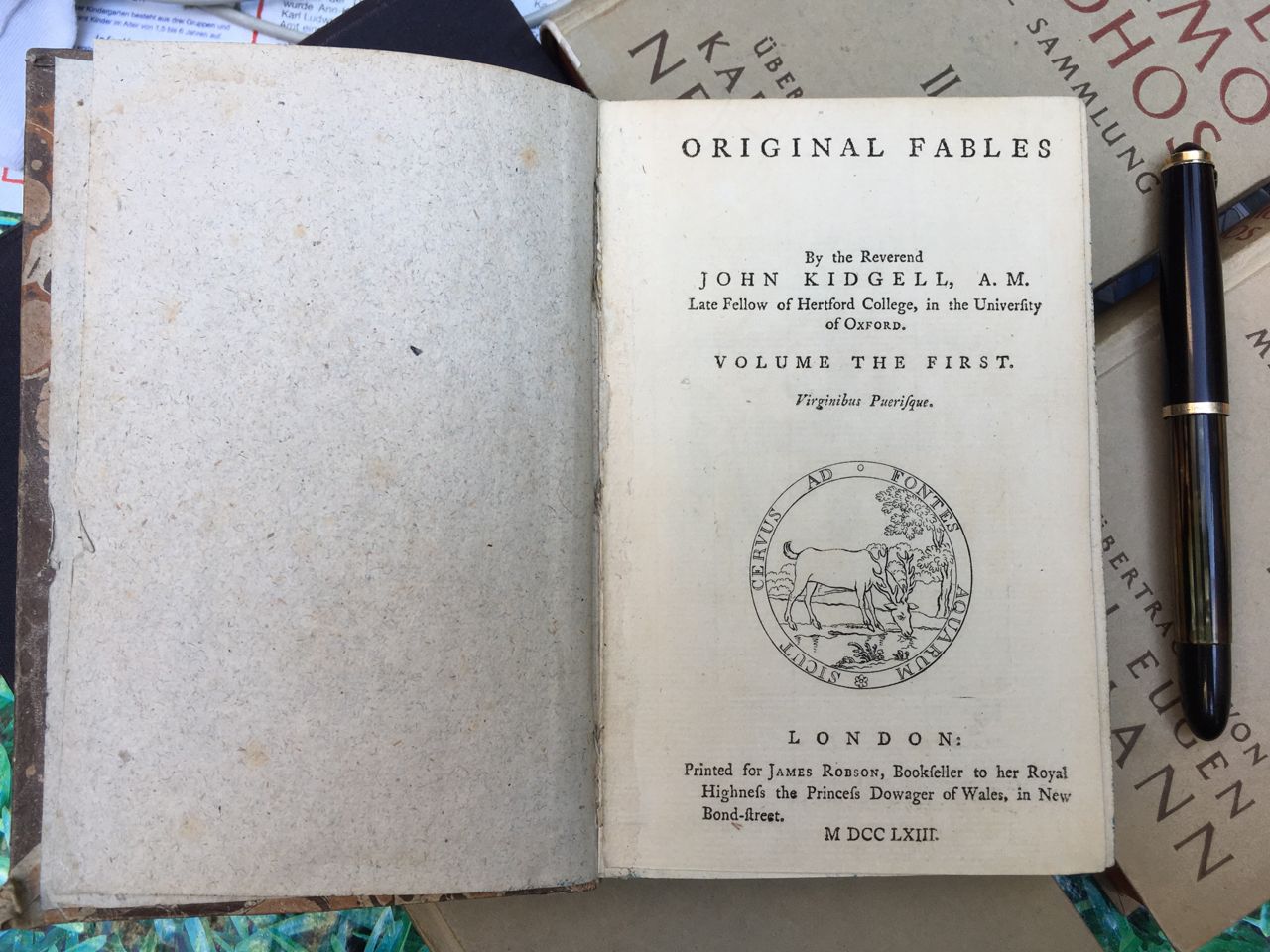
1763réf. BEL3269London, Robson, 1763. Seiten: Titel, 2-127, XVIII, (3),130-271, (dann falsch nummeriert: 262-3, 218-21), XX, zahlr. Kupferstiche, H 16 x 11 cm, marmor. Pappband der Zeit mit Rückenschild, Farbschnitt. - Einband leicht schadhaft (Ecken, Falze, Kapital, Fuss), innen wenige Flecken. Buchblock gebrochen. fest gebunden/ hardcover
18538vo., First Edition, with 10 genealogical tables in the text; original decorative ribbed dark green cloth BY BONE & SON, boards elaborately tooled at corners to an arabesque design in blind, backstrip lettered in gilt, all edges gilt, primrose endpapers, very neatly recased, a remarkably well-preserved, bright, and particularly clean copy. A FAMILY PRESENTATION COPY FROM THE AUTHOR TO HIS COUSIN THE REV. GEORGE CHILTON WITH THE FORMER'S UNSIGNED HOLOGRAPH INSCRIPTION ON FRONT FREE ENDPAPER. The author's second genealogical work, following his study of Victoria and Albert (1841) and preceding his notable 'Shakepeareana Genealogica' in 1869. George Robert Comyn Chilton, b.1825, was educated at Christ Church Oxford where he gained his BA in 1848 and MA in 1852. A student of the Inner Temple, he was called to the Bar in 1850. In 1861 he was appointed Vicar of Wanborough (Surrey) where he served until at least 1876. THIS WORK IS EXTREMELY SCARCE; PRESENTATION COPIES ARE THE MORE SO