Paul EnglandBiblio.com

réf. Bloomsbury-9781509947645Hart Publishing. Hardback. New. Hart Publishing hardcover
1860réf. 2302035Boston: Adams Sampson & Co 1860. First Edition. Hardcover. Very Good. 1st printing of this very scarce business directory covering six states: Maine New Hampshire Vermont Massachusetts Rhode Island Connecticut. 1/2 leather and boards the paper over boards containing both title and several pictorial ads. Text of listings and other info runs 912pp much of the print font quite small to accommodate thousands and thousands of listings. Following this main section are over 208pp of ads many with pictorial engravings. On the fore edge is printed in abbreviation the six states with a small thumb index to assist the reader to open up to a given state. I have named Samuel Colt to the authorship to draw attention to the fact that following page 664 Colt has four pages two leaves one a color paper. The heading is: "The Pioneers of Civilization COLT'S REVOLVING BREECH FIREARMS small pictorial device showing five firearms PISTOLS RIFLES CARBINES AND SHOT GUNS." Under this heading is "Simple Reasons for preferring Colt's Arm to all others." The second page shows a target with pin point marks on it "Col. Colt's Military and Sporting Rifles" with text. Third page is a price list. Page four prints a "CAUTION" that has to do with a discussion of patents. But of course the huge bulk of this book is the listing of thousands of businesses in New England divided state by state. Leading them are several pages of INDEX TO HEADINGS which remarkably lists each type of business with columns showing how many of each are in each of the six states. Following that is a POPULATION OF NEW ENGLAND section county by county. And there is a list of telegraph stations in the entire United State. The section listing railroads in New England. The information just goes on and on. Vg condition with moderate wear to paper on the boards removing some text but not very much. The leather spine has wear but is stable. Very scarce. Adams, Sampson, & Co hardcover
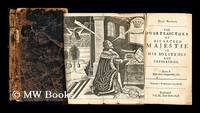
1648réf. 276357In R.M. 1648. First Edition Reprint. Softcover. Poor copy in the original stiff-card wrappers; wear and tear as with age. Missing back cover. Text remains in fine condition and without blemish. Physical description; 187 pages. Subjects; Charles I King of England 1600-1649. In R.M. paperback
1751réf. 329751London : printed by Thomas Baskett; and by the assigns of Robert Baskett 1751. 1st edition. Hardcover. Previous owner's signature. Worn copy in the original gilt-blocked cloth. Raised bands. Front board starting. Text remains clear without blemish. Physical description: unnumbered pages; 12º. Subjects: Church of England. Religion. Sacraments. Rites and Ceremonies. London : printed by Thomas Baskett; and by the assigns of Robert Baskett hardcover
1844, CONSTITUTION OF THE UNITED STATES, PROCEEDINGS OF THE CONVENTION ON THE ADOPTION OF THE CONSTITUTION OF THE UNITED STATES BY RHODE-ISLAND, PRESIDENT WASHINGTON'S ADDRESS OF SEPTEMBER, 1796, AND CONSTITUTION OF THE STATE OF RHODE-ISLAND AND PROVIDENCE PLANTATIONS.1st Edition. Original Tan Boards. 8vo. [viii], 594 pages; 24 cm. Includes: "An Act to Secure and Appropriate the Touro Jewish Synagogue Fund (pp. 476-78) . By the first quarter of the 19th century the synagogue of Newport Rhode Island (established in 1763) was used infrequently as the community there had dwindled. It was Abraham Touro's bequest to the legislature of the state for "supporting the Jewish Synagogue in the State" that spurred the town to safeguard this architectural jewel. Endowing the building, even when it was not in use, protected it. It would come into regular use again when Eastern European immigrants reconstituted the Newport Jewish community. Also includes Washingtons address as indicated in title. SUBJECT(S) : Law -- Rhode Island. OCLC lists 29 copies worldwide. Lacks backstrip and front board, some markings but overall inside pages are in about very good condition. (AMR-48-47)
1906réf. G602London, The Studio, 1906-13. Wichtigstes Bulletin des englischen Jugendstils, über Kunst und Kunstgewerbe, hier mit allen enthaltenen Beilagen und Originalgraphiken. Mit den Originallithographien von T. R. Way ?The Salute?, ?A Nocturne?, ?A Portrait Sketch? nach James McNeill Whistler, ?The Bridge of Sighs? nach C. E. Holloway, ?Study of a tiger?s head? nach John M. Swan, ?Masque aux cheveux d?or? von J. Laboureur. Ferner mit einem Originalholzschnitt ?Evening Prince?s Dock, Hull? von J. Barrie Robinson, ?The Windmill? nach E. C. Austen Brown sowie der Originalfarbradierung ?Cancalaise? von Henri Boutet. Weiterhin sind die lithographischen Reproduktionen bzw. Chromo-Xylographien japanischer Ukyo-e Holzschnitte enthalten: ?The Iris Garden? von Kiyonaga, ?Girls playing the game of Ken? von Harunobu, ?Girl in a snow-storm? von Kuniysu, der Surimono von Hokusai mit Silber- und Golddruck (montiert auf Karton), ?New-Year Card of Surimono? von Hokusai, jeweils mit dem Blindstempel des Druckers. Jahrgang 1913 mit der Beilage ?Seven Happy Days ? A Series of Drawings by Jessie M. King? mit zartem Farb- und Silberdruck. Papier teils etwas gewellt und mit Feuchtigkeitsspuren, meist aber in sehr gutem Zustand, die Graphiken ebenfalls bestens erhalten.
1816réf. 30753London Printed by J. M'Creery, Published for the Proprietor by George Jones 1816
réf. 13970851-nnew. unknown
2002réf. x-0306466015Plenum Pub Corp 2002. Hardcover. New. 1st edition. 1090 pages. 10.25x7.00x2.50 inches. Plenum Pub Corp hardcover
2023réf. Discovery-9781915508935BRILLIANCE 2023. Hardcover. New. BRILLIANCE hardcover
2023réf. Discovery-9781915508935BRILLIANCE 2023. Hardcover. New. BRILLIANCE hardcover
1823réf. ST19567-137London: George Eyre and Andrew Strahan 1823. 142 x 83 mm. 5 1/2 x 3 1/8". 22 510 pp. 1 leaf blank 81 1 pp. VERY ATTRACTIVE CONTEMPORARY RED STRAIGHT-GRAIN MOROCCO BY RUSSELL'S OF GUILDFORD their ticket on front pastedown covers with central sunburst medallion containing the Tetragrammaton within a triangle from which the dove of the Holy Spirit descends surrounded by a blind-tooled roll and multiple gilt rules foliate cornerpieces raised bands gilt-ruled compartments with floral cornerpieces gilt-rolled turn-ins all edges gilt. Housed in a very nice felt-lined cloth folding box with red morocco back gilt lettering. For the binding: Ramsden p. 144. A little soiling to leather and a couple of trivial imperfections internally but a very fine copy inside and out. This pretty little prayer book is a lovely example of provincial English bookbinding and very typical of an era in which such luxurious volumes were popular gifts among the moneyed classes. The Russell firm is recorded by Ramsden as operating in Guildford in southern England and the ticket in the present book notes that they were also booksellers stationers printers cutlers and silversmiths in addition to binders. This charming devotional work has been carefully looked after by its previous owners and comes down to us in excellent condition. George Eyre and Andrew Strahan unknown
1775réf. lib1615454BC1James Rivington 1775. Paperback. Acceptable. unbound pamphlet 86 pages James Rivington paperback
1823réf. ST19567-137London: George Eyre and Andrew Strahan 1823. 142 x 83 mm. 5 1/2 x 3 1/8". 22 510 pp. 1 leaf blank 81 1 pp. VERY ATTRACTIVE CONTEMPORARY RED STRAIGHT-GRAIN MOROCCO BY RUSSELL'S OF GUILDFORD their ticket on front pastedown covers with central sunburst medallion containing the Tetragrammaton within a triangle from which the dove of the Holy Spirit descends surrounded by a blind-tooled roll and multiple gilt rules foliate cornerpieces raised bands gilt-ruled compartments with floral cornerpieces gilt-rolled turn-ins all edges gilt. Housed in a very nice felt-lined cloth folding box with red morocco back gilt lettering. For the binding: Ramsden p. 144. A little soiling to leather and a couple of trivial imperfections internally but a very fine copy inside and out. This pretty little prayer book is a lovely example of provincial English bookbinding and very typical of an era in which such luxurious volumes were popular gifts among the moneyed classes. The Russell firm is recorded by Ramsden as operating in Guildford in southern England and the ticket in the present book notes that they were also booksellers stationers printers cutlers and silversmiths in addition to binders. This charming devotional work has been carefully looked after by its previous owners and comes down to us in excellent condition. George Eyre and Andrew Strahan unknown books
1912réf. 49647ABca. 1912. 4°. O.Halbpergament-Mappe,Schließlaschen, Goldgeprägt.Titel u.Vignette Deckel etwas fleck., Tafeln sauber u.gut erh.
London, George Virtue, Ivy-Lane, 1842, 2 tomos, 28 x 22,5 cm., plena piel de época estampada y enmarcada con cadeneta dorada, centro repujado en seco en rombos, hierros e hijos dorados, esquinas con recuadro estampado, lomos con adornos, cortes, cantos y contracantos dorados, frontis + 2 hojas + 190 págs. + 64 láminas = frontis + 2 hojas + 155 págs. + 60 láminas. (Las 126 láminas grabadas en acero. Encuadernación algo rozada por las esquinas).
1640pp. [2], 55. Signatures: A^(4)(-A1) B-G^(4) H2. There are two settings of this same edition known (no priority as to first issue, and many copies contain mixed formes). This setting has the title page with a small version of the royal arms; and on the verso a large, full page, engraved version; and the last line of D4v begins: as ever'. **Short contemporary Ms. note on title: 'This p'lament began Apr. 16, 1640 & was dissolved May 5 folowing.' Small 4to. 190 mm. Later blue boards binding; leather title strip lettered in gilt. Clean and attractive copy. Charles I (1600-1649), King of Great Britain and Ireland. In his early disputes, arguments, and battles with the Scots, tried a new tool. He resolved to call an English parliament, and to ask for means to enable him to make war effectually upon Scotland. The discovery of an attempt made by the Scottish leaders to open negotiations with the king of France led him to hope that the national English feeling would be touched. In the meanwhile the English privy councillors offered him a loan which would enable him at least to gather an army without parliamentary aid. The Short parliament of 1640 was opened by the King on 13 April with a few words indicative of the gravity of the situation, the task of more fully setting forth the royal wishes and intentions being devolved upon the Lord Keeper (Baron Finch). Under Pym's leadership the Parliament showed itself disposed to ask for redress of grievances as a condition of a grant of supply, and it subsequently refused to give money unless peace were made with the Scots. On 5 May Charles dissolved parliament by means of this Declaration. Getting money by irregular means, he proceeded to push on the war, and formed an Irish army to join the mutinous and un-warlike Royal army. Terrified and exasperated Englishmen, believed that this army would be used in England to crush their liberties. The Scots knew that the opinion in England was in their favour, and they had already entered into communication with the parliamentary leaders. On 20 Aug. they crossed the Tweed, defeated part of the royal army at Newburn on the 28th, and soon afterwards occupied Newcastle and Durham. Charles's money was by this time almost exhausted, and he was obliged to summon the English peers to meet him in a great council at York, as there was no time to get together a full parliament. The great council met on 24 Sept. It at once insisted on opening negotiations with the Scots, and sent some of its members to London to obtain a loan to support the army during the progress of the treaty. Charles had now agreed to summon another parliament, and the negotiations opened at Ripon were adjourned to London. Possibly written by John Finch, Baron Finch of Fordwich (1584-1660), Speaker of the House of Commons and Lord Keeper. STC (2nd ed.) 9262; Thomason, E.203[1]; Lincoln's Inn. Catalogue of Pamphlets, 1506-1700. The attractive First Edition of a scarce and important pamphlet. KING CHARLES I DISSOLVES THE "SHORT PARLIAMENT". **PRICE JUST REDUCED! STC 2
1838pp. viii, 151 + Half title and forty nine mounted engraved plates on India paper. Early engraved bookplate. Most plates foxed but mainly in the margins. Text slightly foxed. 4to. Original early cloth binding, rebacked preserving the original backstrip. Spine label. Binding slightly worn at extremities and a few small stains on front board. Hardbound. Jacob George Strutt (17841867) painter and etcher, studied in London, and was a contributor to the Royal Academy and British Institution at intervals between 1819 and 1858. For a few years he practiced portrait-painting, but from 1824 to 1831 exhibited studies of forest scenery, and he is now best known by two sets of etchings which he published at this period `Sylva Britannica, or portraits of Forest Trees distinguished for their Antiquity' (1822; reissued, as here, in 1838), and `Delicia Sylvarum, or grand and romantic Forest Scenery in England and Scotland' (1828). About 1831 Strutt went abroad, and, after residing for a time at Lausanne, settled in Rome. In 1851 he returned to England, but was not active after 1858. Nice copy of the First Quarto Edition, with the plates being mounted proofs on India paper. Bridson & White C537; Nissen BBI 1907. RARE. **PRICE MUCH REDUCED! PLANTS W134
1721pp. (9), 82. 12mo. in 6. [191 x 118 mm]. Fully engraved text on ninety-one plates, each with an illustration or large vignette. The handsomely decorated borders to each page appear to have been engraved and impressed separately. Full contemporary sombre black morocco binding; joints slightly worn. All edges gold. ** The Duke of Sussex's copy, with his engraved bookplate (Augustus Frederick, Prince, Duke of Sussex, 1773-1843); and with the additional ownerships of Henry White and Robert James Sells. From the Library of Edwin Wolf II. The text itself is ascribed to Laurence Howell (1664?-1720) by Halkett & Laing, but the greatest interest in this book comes from its engraved typography and decorations. John Sturt (1658-1730), was apprenticed at the age of 17 to Robert White, in whose manner he engraved a number of small portraits as frontispieces to several books. Becoming associated with John Ayres, he engraved the most important of that writing-master's books on calligraphy, and acquired celebrity for his skill in such work. The amazing skill of his engraving artistry still astonishes us. This work is probably somewhat scarcer than Sturt's more famous "Book of Common Prayer", especially in this (first?) state with single cherubs blowing horns at each side of the border of p. IX. Though some copies do have a list "Subscribers" pp. [83]-[85] - none is present here, nor does one seem to have ever been bound in the book. Maybe Sussex had some objection to some on the list? ESTC 19687. A remarkable feat of bookmaking. RARE FULLY ENGRAVED BOOK. **PRICE JUST REDUCED! W140.
1871réf. 800093ABLondon, Longmans, Green, and co., 1871. 8 vols. 22,5 x 14,5 cm. 1 Frontispiz, insgesammt über 5000 S. Dekorative Lederbände der Zeit mit reicher floraler Rückenvergoldung, 2 goldgeprägten Rückenschildern und Deckelbordüre. 8 vols.
réf. 35602064, Paris, Barba, 1821; petit in-8, demi-basane fauve, dos lisse avec décor dor., tr. marbr. (Reliure de l'époque). "334 pp., 1f.- Frontispice gravé aquarellé montrant un chef de clan, 2 planches de botanique dessinées par Bory de St-Vincent, gravées par Forestier et aquarellées, 1 carte dépliante et 3 vignettes sur boiss de Thompson. EDITION ORIGINALE. "" Ce voyage en Angleterre en juin et juillet 1821 fut inspiré, en même temps que par des questions de librairie, par le désir de faire un pèlerinage au pays d'Ossian et de Walter Scott"" Larat p.156.- Voir aussi: Magnin. Ch. Nodier naturaliste pp.279-286.- Ce livre est recherché. Le texte n'a pas été repris dans les éditions collectives. Exemplaire frais."
1790réf. mon0000118692Printed by W. Jackson and A. Ham 1790-01-01. Hardcover. Good. in x in x in. 1784 edition from W. Jackson and A. Hamilton - printers to Oxford University on worn hardback brown suede boards not sure if orgional raised bars to spine with 1798 libris plate to end paper name of owner. Good condition for age but please ask for images Printed by W. Jackson and A. Ham hardcover
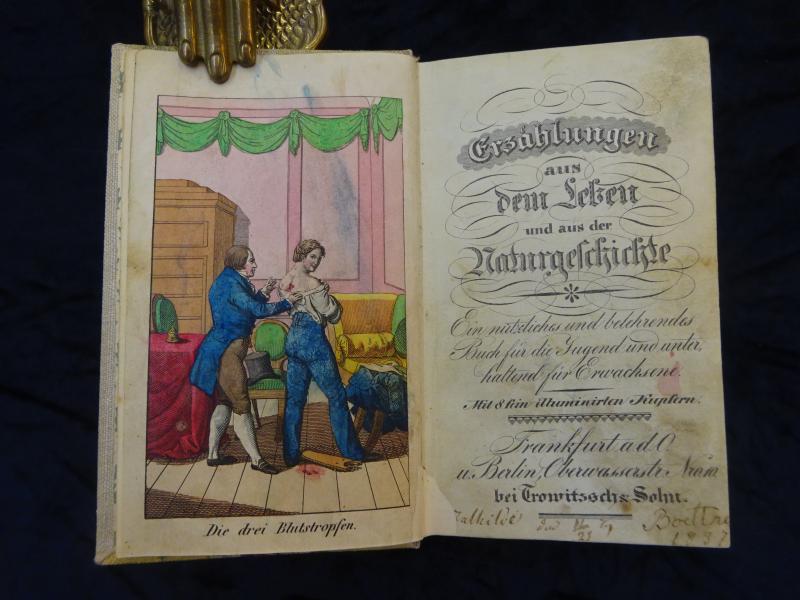
1832réf. KIBU2750Frankfurt a. d. Oder, Berlin, Trowitzsch & Sohn (1832). Kl.8°. Gest., kol. Frontispiz, gest. Titelbl., 191 S., mit 6 (von 7) gest., kol. Tafeln. Dekorativer, mit Blütengirlanden bedruckter Leinenband aus vermutlich etwas späterer Zeit in gutem Zustand, Rückenschildchen goldgeprägt, Vorsatz aus hübschem, zweifärbig gemustertem Buntpapier. Papier mäßig vergilbt und wenig fleckig. Titelblatt im Falz, eine Tafel und Blatt 143/4 fachgerecht angerändert. Buchblock an der Oberkante teilw. knapp beschnitten. Mit Notizen von alter Hand am unteren Rand des Titelblattes. Heinsius 8,214, nicht bei Klotz u. Wegehaupt, nicht im KVK und bei NUC - Rarität. Sehr seltenes Jugendbuch mit sorgfältig altkolorierten Illustrationstafeln. Die erste Erzählung 'Die drei Blutstropfen' ist von C[arl] Müchler. [3 Warenabbildungen]
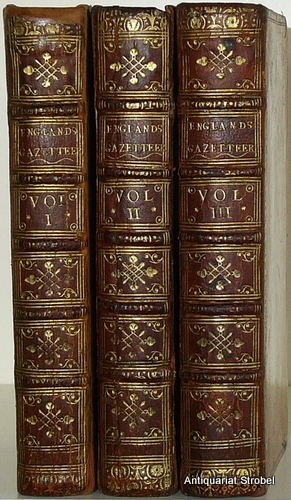
1751réf. 18282London, Knapton, Browne, Millar, Whiston and White, 1751. VIII S., 164; 167; 209 unnumerierte Bl. 8° (17 x 11 cm). Braunes Kalbleder der Zeit mit Rückentitel, Rücken- und Stehkantenvergoldung.
1738réf. ALDR0041Amsterdam, J. Wetstein & G. Smith 1738. 8°. XXXVI, (Titelblatt, Vorwort), 581 S., Titelblatt in rot u. schwarz, mit gestochener Titlblattvignette, Kopfleisten u. Initialen. Enth. außerdem.: Remarques critiques sur une dissertation qui a paru sous le titre de discours sur la liberte de penser a Mr. N. N. Sec. Part. Lederband der Zeit mit goldgeprägter Rückenverzierung, -beschriftung und Stehkantenprägung, Buchschnitt rotgesprenkelt Einabd etwas berieben, Ecken bestoßen, Stehkantenvergoldung großt. abgerieben, vorderer Einbanddeckel gelockert, Rückenleder rissig, an den Kapitalen geringfügig schadhaft, vord. Vorsatz wasserrandig, mit einer alten hadschriftl. Zahl u. einem Buchhandlungsstempel am vorderen fliegenden Vorsatzblatt. Hirsching I,239,f.; Querard 1, 276, Biogr. Univ. 9, 222. - vorliegende Gegenschrift zur grundlegenden, vielfach angefeindeten, Schrift zur Gedankenfreiheit, des englischen Philosophen Anthony Collins (1676-1729) 'Discours of free thinking' zählt zu den wichtigsten Werken zur zeitgenössischen Diskussion um Gedankenfreiheit. Vorliegend die erste französische Ausgabe dieser unter dem Pseudonym Phileleutherus Lipsiensis hrsg. 'Remarks upon a late discours of free thinking' des bedeutenden klassischen Philologen und Rektors in Cambridge, Richard Bentley (1662-1742), erschienen zusammen mit kritischen Bemerkungen zu A. Collins durch den Übersetzer Armand Boisbeleau de la Chapelle. Hirsching bezeichnet das Werk als die "wichtigste und gelehrteste Schrift" Bentleys. Grundsätzlich dürfte außerhalb Englands der französische Titel bekannter gewesen sein als das englische Original. Das seinerzeit vielzitierte, in zahlreichen Biographien und Bibliogrphien genannte und in den Bibliotheken gut vertretene, wird im Handel nur selten angeboten. (kein Eintrag im Jahrbuch der Auktionspreise 1990-2008).