23.624 risultati
1977rif. 222191977. Softbound. VG. BW illustrated wraps. Numerous bw plates. Text by Ian Jeffrey and David Mellor. Extensively illustrated. paperback books
1965rif. 101541965. Softcover. VG slight library marks. Bw wraps. 76 pp. 51 bw plates. Introductory essay chronology listing of over 300 works in the exhibition. paperback books
1984rif. 155171984. Softcover. VG sticker on cover. Color wraps. 72 pp. 30 color numerous bw plates. Four-page introduction by Craig Hartley biographic chronology catalogue of 71 annotated works mostly illustrated by beautiful plates. paperback books
1960rif. 155931960. Softcover. VG pencil on cover. Red wraps. 45 pp. 5 bw plates. Five-page introduction by Oliver Millar catalogue of 62 annotated works some pleasant plates. paperback books
1967rif. List2885Sheffield United Kingdom 1967. 20 x 30 inch poster on heavy cardstock. Some staining and scuffing pinholes and some tears at edges fine contrast; overall excellent. A poster advertising Stevie Wonder at Sheffield’s Mojo Club in October 1967. Wonder would have been just seventeen at the time though he had already dropped “Little” from his stage name. The Mojo Club in working-class Sheffield was the project of brothers Peter and Geoff Stringfellow; the pair had previously worked as promoters and were preternaturally talented having booked the Beatles for April of 1962 shortly before the release of “Love Me Do”.1 Stevie Wonder would be the last live act at the Mojo as it was shut down by the city three days later on October 10. 1 Steve Walker “The King Mojo Club” 2020 https://www.kingmojostory.com. unknown books
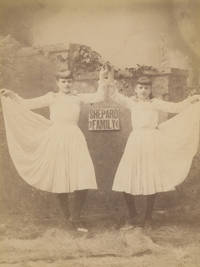
1890rif. List1620Mostly New England: Various Photographers 1890. Cabinet cards measuring 6 ½ x 4 ¼ inches. Various settings showing the band members posed with their instruments including banjos violins trumpets drum and tubas. Varying wear but generally very good with some normal age-related fading. Very Good. Originally from Lawrenceville New York the Shepard Family Band toured throughout the Northeast in the 1880s and 1890s eventually settling in South Royalton Vermont. All members of the family were apparently musically inclined: “In addition to Minnie mother and matriarch Mary “Minnie” Shepard and her husband patriarch James Monroe Shepard all of the children were pressed into service. Daughter Laura Belle the ‘violiniste’ was getting better all the time under the instruction of a ‘competent master.’ Her fans “will be astonished at the improvement in style tone and expression.” It was said of little Lessie that ‘Among lady cornetists she has no equal.’ The darling little son of the family Master Burtie could not help but please for he was well-known to be ‘The youngest Tuba soloist in the world; only nine years of age; scarcely larger than the instrument he plays.’ He was also a ‘clever comedian singer and character artist.” The baby little Flossie “a sweet little miss of four summers’ was said to be a “wonderful mimic and impersonator…a veritable little fairy.’ Daughters Kittie and Georgia were also part of the troupe.” - Henry Sheldon Museum. A very nice collection. Various Photographers unknown books
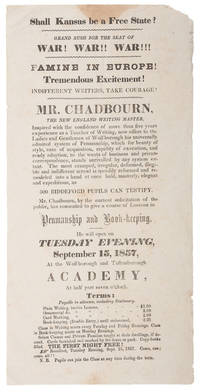
1857rif. List317New Hampshire 1857. Broadside advertisement 5 ½ x 11 inches. Very Good. An unusual advertisement for a penmanship instructor a Mr. Chadbourn announcing the opening of his academy on September 15 1857 in Wolfborough New Hampshire. The broadside states “Inspired with the confidence of more than five years experience as a Teacher of Writing now offers to the Ladies and Gentlemen of Wolfborough his universally admired system of Penmanship which for beauty of style ease of acquisition rapidity of execution and ready adaptation to the wants of business and private correspondence stands unrivalled by any system extant.” An interesting relic from the middle of the Bleeding Kansas period which would serve as a harbinger for the bloodiness of the American Civil War. A very good example with a chip with loss to upper corner and some toning to head but attractive and well preserved. Unrecorded in OCLC. unknown books
1727rif. 55069London: printed by John Baskett. and by the Assigns of Henry Hills decease'd 1727. Later edition. Hardcover. Very good. Three parts folio in fours 38 by 24 cm. 380 23 3 table pp; text in two columns. Additional engraved title page; main title in red and black; woodcut initials and ornaments. Contemporary two-tone paneled calf triple-ruled in gilt; spine with raised bands elaborately tooled in gilt morocco lettering piece; gilt inner dentelles; marbled endleaves; all edges gilt. Covers very lightly scuffed with mild traces of wear at extremities; upper joint just starting at top; occasional touches of mild mostly marginal foxing. A very good or better copy complete and handsomely bound. An uncommon and beautifully printed edition of the Book of Common Prayer "the first single manual of worship in a vernacular language directed to be used universally by and common to both priest and people" Carter and Muir. Despite early revisions and some major alterations following the Restoration the original simplicity of the language has been presevered the text remaining substantially unaltered since 1662. References: ESTC N67554 locates only 4 copies. Cf. Carter & Muir Printing and the Mind of Man 75 ed. 1549. Collation: pi1 a-c4 A-Aaa4 Bbb2 = 203 leaves. printed by John Baskett... and by the Assigns of Henry Hills, decease'd hardcover books
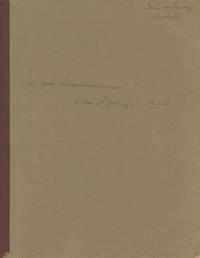
1926rif. List3141Quincy Massachusetts: unpublished 1926. 201 pp cardstock wraps. Normal wear to wraps; overall Near Fine. Alice Brackett White Coolidge 1864–1927 was a Boston socialite of the prominent Richardson family; her grandfather was merchant and Massachusetts State Legislator Jeffrey Richardson. Coolidge was also the author of three children’s books: The Bunnies of Evergreen Village 1917 The Refugees in Evergreen Village 1918 and Evergreen Village to the Rescue 1922. Offered here is Coolidge’s unpublished memoir of her early life written in 1926 titled My Early Reminiscences. The memoir recalls Coolidge’s childhood and teen years spent mainly in Massachusetts New Hampshire and Maine. Her recollections typically involve extensive descriptions of the houses at which her family stayed the scenery around them and the various families they met and visited with. Given her position in society her acquaintances are sometimes quite influential people: Princeton president John Grier Hibben enjoys Coolidge’s fishcakes; Trinity Church rector Phillips Brooks gives her grandfather an “excellent pew” in the newly-finished church; pioneering doctor Alfred Worcester mistakes red pepper for mercury in a scientific demonstration at her school; and she recalls brief correspondences with John Greenleaf Whittier and William James. Coolidge also took dance lessons from Augustus Papanti whom she describes as “one of the thinnest men I ever saw” who was “very melancholy. I hardly remember his ever smiling”; and remembers Judge Charles Devens for “his great stature his charming face his courtliness of manner and his really boyish simplicity in entering into our evening games” including a game of “mind reading” which Devens played “with zest.” One of her longtime friends was Rear Admiral John E. Pillsbury. She recalls: “Mr. Pillsbury as a young naval man a brother-in-law of my uncle Dr. Richardson used to take me out in the swan-boats on the Public Garden Pond. Later he went through all the ranks up to being retired as a Rear Admiral but time and circumstances never changed him. We always met at Thanksgiving and Christmas dinners and always talked at great length. . He was a wonderfully interesting lovable man and very modest and unassuming and shy. I always considered him one of my best friends though older by many years than I.” Another interesting New England figure Coolidge encountered was Joseph Lee. She describes Lee’s hotel in Newton: “The house where we stayed was kept by a remarkable man named Joseph Lee. He was a mulatto much above many of his kind and his wife was a handsome woman partly Indian. They did the cooking and he waited on table with a colored maid to help him. In fact there were no white women in the house. The cooking was delicious.” Lee was born enslaved in South Carolina freed in 1865 and went on to invent the automatic bread kneading and bread crumbing machines. Though nearly all of her childhood was spent in New England she also remembers being invited to visit Charles Joseph Bonaparte in Baltimore: “We had never been so far south except to Washington and I felt a curious feeling of being in a different atmosphere from any I had known. . We were met at the station by Mrs. Bonaparte in a large roomy covered vehicle with two horses. The coachman and footman were in the Bonaparte colors -- a deep wine color. The footman I well remember. He was a light-colored young negro very handsome and smiling and excited over having young ladies from the North. . All the servants were colored and lived in cabins near the house. . I never knew Mr. Bonaparte in public life so my memories of him are quite intimate and I fancy I saw much of his real self. . His mind was very active. He used to talk or listen as he walked and he moved his head in a curious way from one side to the other with a slightly rolling motion which was distinctly individual. . I never saw him irritated or excited and he was always very simple. In the group picture we had taken at the Maplewood he sat down cross-legged on the piazza floor like a boy. That was in about 1887. I suppose in public life or in law he was different but he was very equable and charming as we met him in his home and at the mountains. Most of all I admired his sweet tender ways with his flower-like wife.” This was not too long after the end of Reconstruction and Coolidge remarks on the tense atmosphere: “Mrs. Bonaparte had warned me to be careful about questions regarding the North and South as the ‘feeling’ had not yet died away. I was so glad she had warned me. A gentleman slipped in and sat down beside me to watch a parade and whispered in my ear as the bands had been playing ‘Dixie’ how glad he was to meet a Northerner. I was glad to meet him too although I remember neither his name nor face but I felt I breathed freer in his sympathetic locality. . I had no idea that this feeling still remained as far North as Baltimore and of course I remembered how our Massachusetts troops had been fired upon in Baltimore at the outset of the war but I was admonished and very wise and only returned my unremembered neighbor’s greeting with a sympathetic word and look.” Besides individuals Coolidge does cover a few historical events including the Great Boston Fire of 1872: “Oh! a horrible sight met our eyes. Back of the opposite houses in Park Square was a background of sheets of red flames and heavy black smoke rising high into the air. . On the Parade Ground all was in confusion and the sight was very sad and never-to-be-forgotten. It was literally covered with boxes and bales of furniture and sad forlorn desperate looking people crouching or sitting or standing amidst what they had saved from their homes . At night . the whole city was in darkness as there was no gas.” The family also frequently stayed at hotels in the White Mountains of New Hampshire and Coolidge recalls the “overwhelmingly tragic” effects of the 1867 sale of this land to logging companies; she writes that looking out from the Flume House in Franconia “all about were brown scarred places marking the woodchoppers’ work which was cutting away our beautiful trees for lumber”. In this memoir Coolidge supplies detailed remembrances of the private personalities of influential figures of Gilded Age New England. We find two copies of My Early Reminiscences on OCLC. Of interest to historians of the era especially as told through the perspective of a young woman. unpublished unknown books
1847rif. 275261Cincinnati: Derby Bradley & Co. Publishers 1847. First Edtion. Very Good binding. Two rather florid speeches before the Society of the Cincinnati in which the Baptist pastor Elias Magoon addresses the great oratorical lights of the Revolutionary era -- James Otis Samuel Adams John Adams Patrick Henry Alexander Hamilton and other. 91 pp.; 93-96 advertisments. In the publisher’s green cloth with titling in gold to the front board. With foxing throughout. Very Good binding. Derby, Bradley & Co. Publishers unknown books
1893rif. 3292171893. framed. near fine. Document signed July 15 1893 the day after their marriage while on their honeymoon tour. Framed with three photographs; the wedding party Victoria Mary in wedding dress and portrait of George V. Decorative Elaborate decorative frame. Please inquire for more information. George V George Frederick Ernest Albert was King of the United Kingdom and the British Dominions and Emperor of India from 6 May 1910 until his death in 1936. Mary of Teck Victoria Mary Augusta Louise Olga Pauline Claudine Agnes was Queen of the United Kingdom and the British Dominions and Empress of India from 6 May 1910 until 20 January 1936 as the wife of King-Emperor George V. unknown books
rif. 296626Liberty Loan Committee of New England. Original Poster mounted on foam board. Image measures 28" x 21 1/2" This original World War I-era poster published by the Liberty Loan Committee of New England advertises free storage for liberty bonds and discourages bond owners from selling or exchanging their bonds. Text reads "Owners with small amount of Liberty Bonds with no safe place to keep them should go to any bank trust company or safety deposit company. Where possible they will store them without charge. Beware of Speculators. Pay no attention to advertisement offering to buy Liberty Bonds. You bought them to uphold the Government during the greatest test it has ever had. When you sell your bonds you are a quitter! Do not exchange your bonds for any other bond or stock. There is no security better than Liberty Bonds. If kept until they mature they will be paid in full." Includes an illustration of a sun with eyes rising over the mountains and the caption "Save to buy and buy to keep! to-day buy that liberty bond". War loan posters like this one were produced in great volume during the First World War to encourage people to support the war effort financially. The poster is in very good condition. Liberty Loan Committee of New England unknown books
rif. 291857West Bromwich: Eld & Blackham. hardcover. very good. Many illustrations including black-and-white photographs and full page color lithographic plates. viii 648 pages thick 4to gilt-stamped and decorated red cloth a.e.g; front flyleaf lacking spine ends mended few spots of soiling to cover. West Bromwich: Eld & Blackham ca. 1885. A very good copy. Eld & Blackham unknown books
1962rif. 275049London: Royal Commission on Historical Monuments England 1962. First. hardcover. good. Mounted Color Frontis. many b/w Illus. large folding map in back pocket. 4to purple cloth front cover warped pages throughout are slightly wavy corners bumped spine faded. London: Royal Commission on Historical Monuments England 1962 Royal Commission on Historical Monuments England unknown books
1976rif. 228331N.P.: Bohemian Club 1976. hardcover. near fine. Frontispiece illustration. 57pp. Slim 8vo brown cloth. N.P.: Bohemian Club 1976. A near fine copy. The Seventy-First Grove Play of the Bohemian Club Presented July 30 1976. Bohemian Club unknown books
rif. 93620hardcover. 368pp. 8vo 3/4 leather; rubbed endpapers and flyleaves foxed text is clean. London: George Eyre and Andrew Strahan 1830. unknown books
1925rif. 54478NY: New England Hotels 1925. Tall narrow 8vo pp. not numbered but a thick volume .Copiously illustrated with maps some fold-out and photographs in ads. Flexible brown cloth. Maps with routes and comments marked in red. Mileages and descriptions of main points. Cover scuffed and somewhat worn but tight; edges little stained some leaves slightly dog-eared o/w a VG tight copy. New England Hotels unknown books
1871rif. 50518Boston 1871. self wraps 16 pp. Extracted couple of small tears good. A list of books of mostly Americana. Not in Romaine. Lists priced books from A to H with the note that the list is to be continued. Also noted that included are autographs. unknown books
1880rif. 44181Boston: New England Conservatory of Music 1880. Small 8vo pp. 48. Paper wraps. Small program leaflet laid in. Cover somewhat stained with silverfish damage o/w a VG tight copy. Lists and describes courses offered. New England Conservatory of Music unknown books
1919rif. 299249Boston: Small Maynard & Company 1919. First Edition. Hard Cover. Very Good binding/Good dust jacket. 8vo; in the publisher’s green cloth binding with titling on the upper board in gilt; in dust jacket; 349 pages; some wear to edges of the boards; some toning to the pastedowns; a bit cocked; the jacket has a 1 1/2 inch section of loss to the spine and some chipping to the edges; it is a bit soiled with some toning; it is no protected by a mylar cover. Very Good binding / Good dust jacket. Small, Maynard & Company unknown books
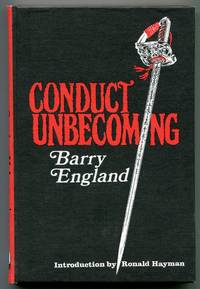
1971rif. 548929London: Heinemann 1971. Hardcover. Fine. First edition. Introduction by Ronald Hayman. Slight rubbing at spine ends else fine. Briefly Inscribed on the title page by the author: "For Michael Curtis. Barry England." Basis for the 1975 British drama film directed by Michael Anderson and starring Michael York Susannah York Richard Attenborough and Trevor Howard. Heinemann hardcover books
1971rif. 548926London: Heinemann 1971. Hardcover. Fine. First edition. Introduction by Ronald Hayman. Slight rubbing at spine ends else fine. Basis for the 1975 British drama film directed by Michael Anderson and starring Michael York Susannah York Richard Attenborough and Trevor Howard. Heinemann hardcover books
1797rif. 341884London: Printed by C. Whittingham for T. Heptinstall 1797. Hardcover. Near Fine. First edition thus. 12mo. ix 15 347 1 91 5 pp. 19 cm. Issued with a separate title page for A New Version of the Psalms of David by N. Brady and N. Tate H.D. Symonds 1796. In contemporary straight grained black morocco double fillet gilt borders on both boards gilt turn-ins gilt spine title all edges gilt marbled endpapers. Owner's name and address in neat ink on the front paste down. With an attractive contemporary dark red morocco bookplate: "Charlotte Godwin 1798" in gilt with double fillet gilt borders and decorative motif on the front pastedown. Corners bumped with moderate scattered foxing to the text pages else a beautiful fine copy with an interesting early American bookplate. The Godwin family was one of the first to settle in the Eastern Shore region of Virginia. Scarce. OCLC locates only one holding. Printed by C. Whittingham, for T. Heptinstall hardcover books
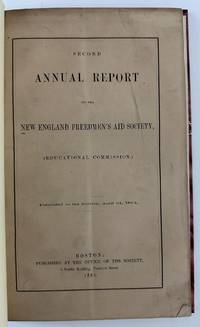
1864rif. 12679Boston: Published at the Office of the Society 1864. 86pp. Original printed wrappers bound into modern quarter morocco over marbled boards gilt spine titles. Light chipping and soiling to wrappers. Contemporary notation to header of title else internally clean. Very good plus. An account of the second year of the activities of the New England Freedmen's Aid Society NEFAS an activist group formed to assist emancipated Black Americans in may aspects of life especially with gaining academic and practical educations following the Civil War. The present work is especially important for the long section titled "Condition of the Freedmen" which occupies pages 11 to 51 about half of the total work. This section details the population state of education labor and industry opportunities general condition and more of free African Americans in several regions of the country namely the Military Department of the South Key West and the Tortugas Military Department of Virginia and North Carolina the District of Columbia the Mississippi Valley Middle Tennessee Western Arkansas and Louisiana. Interestingly a substantial subsection of the section on the Department of the South is devoted to a discussion of arable lands available to freed slaves around Beaufort and Port Royal known to modern audiences as "Forty Acres and a Mule." Regarding the land in this area the report states that "It was a matter of course that the lands should all be taken for those blacks who did not wish to turn cultivators were perfectly aware that they could sell their 40 acres for many times the government price." The organization was also notable for its mission specifically aimed at education and for the critical role women played in its work. "The New England Freedmen's Aid Society was founded in Boston in 1862 in response to an appeal.on behalf of 8000 formerly enslaved people at Port Royal SC. Originally named the Educational Commission its mission was to provide teachers and other aid for 'the industrial social intellectual moral and religious' advantage of freedmen" Massachusetts Historical Society. As was the case with many abolition and aid groups women were in the vanguard of the NEFAS. They recruited trained and even served as educators in the program. For much of the twentieth century if historians wrote about the first teachers among freed people at all they characterized them as foolish even dangerous women.who bore a heavy responsibility for the racial tension after the Civil War and whose work caused Southern educators to avoid Black education" The Freedmen's Teacher Project. Yet scholars in the 1960s and after -- particularly women and Black researchers -- have returned to the documents of the Society to uncover the serious and often intersectional work being done by both white and Black activists in Port Royal reframing "the freedmen's education movement as not primarily a gift of northern largess.but as autonomous actions of hundreds of Black communities across the South demanding access to literacy and numeracy" The Freedmen's Teacher Project. In this sense those "dangerous" women were troubling because they heard the call of Black peoples took their needs seriously and reacted accordingly. The movement was thus "largely Black-inspired abetted by female missionary teachers" whose shared goals were to prepare "former slaves for lives of freedom in a democratic America" The Freedmen's Teacher Project. The present Annual Report shows the early efforts of this Society including fundraising allocation of funds educational programs and educational gains and future goals. Included in the list of Officers are eleven white women in leadership roles; indeed women were the majority in the Committee on Teachers and the Committee on Clothing and Supplies. Among them are more well-known activists who appear in American Abolitionists and Antislavery Activists i.e. Ednah Cheney and Sarah Barrett Cabot who had raised her daughter to become a leader in the movement. Most however are lesser or unknown denoted largely by their husbands' names rather than their own. Even less visible but even more important were the unlisted Black women who were members of the group and contributors to the grassroots work. "Nearly one-fifth of the Northern teachers were Black.Black teachers were fifteen times more likely to give a few years of their lives to Southern Black education.the rest of the recruited teachers were native to the South; many had been enslaved while others were Southern free Black women and other men of color" The Freedmen's Teacher Project. The accomplishments in the report -- fundraising equipment educational gains -- can largely be attributed to their efforts. The report for the first year of the organization is exceedingly rare with only one example listed in OCLC; twelve copies of the present report appear in OCLC though no copies have appeared in modern auction records and no other copies are currently in trade. An important and scarce historical document preserving the accomplishments of a fairly short-lived intersectional activist group with vital reports on the activities of freed slaves throughout the southern part of the country. Published at the Office of the Society unknown books
1883rif. 9887Boston: New England Grocer Officer/Benjamin Johnson 1883. Octavo 22 x 14.5 cm. 240 pages. Illustrated including a color frontispiece. FIRST EDITION THUS; with the Coffee Supplement approximately 50 pages introduced by Chase & Sanborn. “This work comprises within itself all the uses of a Cyclopeadia a Manual and a Hand-book all the necessary well-ascertained and authenticated facts being condensed into the smallest space consistent with completeness and perspicuity.” Entries range from Acid Phospates to Yeast and a complete section on weights and measurements as pertains to the 19th century grocer. The coffee supplement includes material on the history cultivation and varieties of coffee as well as information on proper care and processing of the beans. Some light staining to a few leaves and some age-toning throughout. In pebbled brown cloth blind-ruled and gilt title stamped to front panel. Near very good. New England Grocer Officer/Benjamin Johnson hardcover books