1620-1623; Plymouth, New EnglandBiblio.com

réf. 0282860754.Gpaperback. Good. Access codes and supplements are not guaranteed with used items. May be an ex-library book. paperback
1841réf. 164511841. Catholic Girls' School Ugbrooke. Regulations for the Catholic Girls' School at Ugbrook 1841 a formal rule book documenting the provision and governance of Catholic education for girls from working and dependent families associated with the Ugbrooke estate in Devon. Founded in 1824 by Lady Clifford the school was principally financed by Lord Clifford with teachers reporting directly to him; surviving research indicates that tuition was effectively free for families unable to contribute and that Lord Clifford also provided medical attention and clothing for pupils. The 1841 regulations define this educational system more precisely stating that the school was intended "solely for the education of the female children" of present or former tenants servants and laborers of the Clifford family as well as tradesmen employed by the family. As such the pamphlet provides primary-source evidence for the study of girls' education Catholic schooling estate paternalism class and the institutional regulation of female childhood in early Victorian England. Catholic Girls' School Ugbrooke. Regulations for the Catholic Girls' School at Ugbrook. Chudleigh: J. E. Searle 1841. First edition. 8 2 pages. 8vo. The regulations were approved by the Right Reverend Vicar Apostolic of the Western District of England for the Catholic Girls' School at Ugbrooke Devon which was placed under the protection of the Blessed Virgin Mary and St. Joseph; the rules are dated March 25 1841. The pamphlet establishes who qualified for admission and records the formal ecclesiastical and estate framework governing the school demonstrating how educational access for girls was organized through relationships among the Catholic Church the Clifford household estate employees and their families. Ugbrooke itself had a particularly longstanding Catholic identity: the Clifford family's chapel was rededicated for Catholic worship in 1673 and Mass continued there through the period in which the girls' school operated. The regulations appeared well before universal elementary education in Britain and document a localized model in which girls from tenant servant laboring and tradesmen's families received schooling through the patronage of a Catholic landed family. The school's adoption of Joseph Lancaster's teaching system further places it within contemporary experiments in economical mass elementary instruction while its governance remained distinctly tied to the Clifford estate and Catholic religious authority. Earlier bibliographic cataloging located only two institutional copies at Emory University and the National Library of Australia although institutional holdings can change and this should not be treated as a definitive current census. No specific physical defects are supplied; overall very good. A focused primary source showing how class gender religion and estate patronage shaped access to formal education for girls in early Victorian Devon. unknown
1841réf. 164511841. Catholic Girls' School Ugbrooke. Regulations for the Catholic Girls' School at Ugbrook 1841 a formal rule book documenting the provision and governance of Catholic education for girls from working and dependent families associated with the Ugbrooke estate in Devon. Founded in 1824 by Lady Clifford the school was principally financed by Lord Clifford with teachers reporting directly to him; surviving research indicates that tuition was effectively free for families unable to contribute and that Lord Clifford also provided medical attention and clothing for pupils. The 1841 regulations define this educational system more precisely stating that the school was intended "solely for the education of the female children" of present or former tenants servants and laborers of the Clifford family as well as tradesmen employed by the family. As such the pamphlet provides primary-source evidence for the study of girls' education Catholic schooling estate paternalism class and the institutional regulation of female childhood in early Victorian England. Catholic Girls' School Ugbrooke. Regulations for the Catholic Girls' School at Ugbrook. Chudleigh: J. E. Searle 1841. First edition. 8 2 pages. 8vo. The regulations were approved by the Right Reverend Vicar Apostolic of the Western District of England for the Catholic Girls' School at Ugbrooke Devon which was placed under the protection of the Blessed Virgin Mary and St. Joseph; the rules are dated March 25 1841. The pamphlet establishes who qualified for admission and records the formal ecclesiastical and estate framework governing the school demonstrating how educational access for girls was organized through relationships among the Catholic Church the Clifford household estate employees and their families. Ugbrooke itself had a particularly longstanding Catholic identity: the Clifford family's chapel was rededicated for Catholic worship in 1673 and Mass continued there through the period in which the girls' school operated. The regulations appeared well before universal elementary education in Britain and document a localized model in which girls from tenant servant laboring and tradesmen's families received schooling through the patronage of a Catholic landed family. The school's adoption of Joseph Lancaster's teaching system further places it within contemporary experiments in economical mass elementary instruction while its governance remained distinctly tied to the Clifford estate and Catholic religious authority. Earlier bibliographic cataloging located only two institutional copies at Emory University and the National Library of Australia although institutional holdings can change and this should not be treated as a definitive current census. No specific physical defects are supplied; overall very good. A focused primary source showing how class gender religion and estate patronage shaped access to formal education for girls in early Victorian Devon. unknown books
pp. 1-291, 22 (some fold.) pls., maps, diagrs. and sections, several illus. in text, refs. Journal issue, orig. wrs. - Symposium, including 9 papers n Triassic stratigraphy and correlations and related subjects in the British Isles.
1911réf. 179470Cambridge : Cambridge University Press 1911. First Edition. Hardback. Near fine copy in the original title-printed cloth-backed boards. Handwritten Greek title to spine. Spine bands and panel edges very slightly dust-toned as with age. Corners sharp with an overall tight bright and clean impression.An unread copy with unopened pages. ; 8vo 8"" - 9"" tall; 0 pages; Description: 1v. vii pp.407-676 ; 29cm. Subjects: Bible O.T. Greek. Septuagint - Numbers - Deuteronomy - Studies and interpretation. Notes: Greek text English editorial matter. Language: English ; Modern Greek 1453-. Cambridge : Cambridge University Press hardcover
réf. 3144Paris Firmin Didot Frères 1858 in 8 (24,5x16) 1 fascicule broché, 44 pages. Bel exemplaire ( Photographies sur demande / We can send pictures of this book on simple request )
réf. 052619Paris De l'imprimerie impériale 1804 in 8 (21,5x13,5) 1 volume broché, couverture muette d'attente de l'époque, 72 pages [1], non rogné, petites rousseurs éparses et petite tâche claire sur le dernier cahier. Comte Jean Gabriel Maurice de Montgaillard, 1761-1841. Bon exemplaire ( Photographies sur demande / We can send pictures of this book on simple request )
2002réf. D06NS1136England and Co London 2002. 1st Edition. SOFTCOVER. Square Quarto size 4to in spiral bound glossy card covers. Unpaginated approx. 24pp on thick art paper plates etc __CONDITION : A a well preserved almost AS NEW very clean and tight unmarked copy. . __To see more of our Art Monographs etc type DBBARTIST in the Keywords search box __We always ship in PROTECTIVE CARD PARCELS England and Co, London paperback
réf. 16525West Indian cricket team in England 1963. A nice collection of souvenirs of a very exciting and interesting tour. The West Indies did very well indeed beating England in the test series 3-1. ONE: The signatures on four pieces of paper laid down on green 8vo paper backing with card carrying maroon and black logo of 'West Indies 1963 England'. All in good condition lightly-aged. First signature of 'G Sobers' written across 22.5 x 11.5 cm magazine photograph of Sobers at the crease. Second signature of 'W Hall' across 8 x 5 cm magazine photograph of face of 'WESLEY HALL Barbados age 25.' with swollen left eye. Third four signatures on 10 x 12 cm piece of grey paper: 'Willie Rodriguez' 'Seymour Nurse' 'D. W. Allan' and another. Fourth six signatures on 8 x 12.5 cm piece of grey paper: 'L A King' 'Joe Solomon' 'Rohan Kanhai' 'Lance Gibbs' 'C C Hunte' 'D Murray' and '<Alfred Valentine>'. The three printed items are all pamphlets. TWO: 'West Indies Touring Team v Sir Learie Constantine's XI Souvenir Brochure'. Match at the Oval on behalf of the Anglo Caribbean Social Centre Appeal Sponsored by the Standing Committee of Organisations concerned with West Indians in Britain London Region. 20pp. 8vo. Stapled on shiny art paper with the outer leaves printed in green. In good condition lightly-aged. The only copy traced at the British Museum. THREE: '1963 West Indies Cricket Tour of England Pen Pictures Records Souvenir Programme'. 8pp. 8vo. On shiny art paper. Cover printed in black and red. In fair condition lightly aged and creased. Only copy traced at the British Library. FOUR: 'England v West Indies. A record of the test matches. Presented with the Compliments of the Sunday Telegraph.' Single piece of paper printed on both sides folding to make 6pp. 8vo. Printed in blue. In good condition lightly-aged. No copy traced. West Indian cricket team in England, 1963. unknown
réf. 5082Les trésors de la littérature, les grands livres du mois, 1996 – in-8, 34 pp – broché, couv. bradel brillant, illutrations n. et b. (photographies).
réf. 47224London, Philip and Son, 1963, in 8°, cartonnage bleu de l'éditeur (légèrement fané), 301 pages ; nombreuses illustrations dans le texte en noir et 16 planches en couleurs ; quelques rares raousseurs ; traces de scotch sur les gardes.
1921Moderate wear to boards. Former owner's name on front free endpaper. Moderate foxing. Front hinge weakening; Short portraits of important politicals figures, including Winston Churchill; B&W Photographs; 8vo
1944Boards with light rubbing to extremities. Spine and boards darkened. Endpapers frail and with light chipping. First and last few pages browned ; 12mo 7" - 7½" tall; 301 pages
réf. 13975479Dordrecht: David Fouquer, 1697 in-12, [12], 228 pages. Reliure veau d'ép. en mauvais état avec important manque au dos, très bon état intérieur (VENDU EN L'ETAT). Relation de la révolte jacobite du Lancashire pour rétablit les Stuarts sur le trône.
réf. 34216London, 1713, in 12 relié pleine basane racinée, dos lisse orné, 355 pages ; frontispice et titre-gravé ; rousseurs ; reliure très frottée, plat supérieur détaché.
réf. 26787P., Ecrivains Français (Collection "Les Grands Documents Internationaux"), 1934, in 8° broché, 319 pages ; illustrations hors-texte ; couverture illustrée (fanée avec rousseurs).
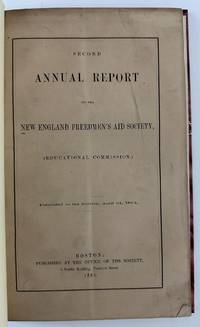
1864réf. 12679Boston: Published at the Office of the Society 1864. 86pp. Original printed wrappers bound into modern quarter morocco over marbled boards gilt spine titles. Light chipping and soiling to wrappers. Contemporary notation to header of title else internally clean. Very good plus. An account of the second year of the activities of the New England Freedmen's Aid Society NEFAS an activist group formed to assist emancipated Black Americans in may aspects of life especially with gaining academic and practical educations following the Civil War. The present work is especially important for the long section titled "Condition of the Freedmen" which occupies pages 11 to 51 about half of the total work. This section details the population state of education labor and industry opportunities general condition and more of free African Americans in several regions of the country namely the Military Department of the South Key West and the Tortugas Military Department of Virginia and North Carolina the District of Columbia the Mississippi Valley Middle Tennessee Western Arkansas and Louisiana. Interestingly a substantial subsection of the section on the Department of the South is devoted to a discussion of arable lands available to freed slaves around Beaufort and Port Royal known to modern audiences as "Forty Acres and a Mule." Regarding the land in this area the report states that "It was a matter of course that the lands should all be taken for those blacks who did not wish to turn cultivators were perfectly aware that they could sell their 40 acres for many times the government price." The organization was also notable for its mission specifically aimed at education and for the critical role women played in its work. "The New England Freedmen's Aid Society was founded in Boston in 1862 in response to an appeal.on behalf of 8000 formerly enslaved people at Port Royal SC. Originally named the Educational Commission its mission was to provide teachers and other aid for 'the industrial social intellectual moral and religious' advantage of freedmen" Massachusetts Historical Society. As was the case with many abolition and aid groups women were in the vanguard of the NEFAS. They recruited trained and even served as educators in the program. For much of the twentieth century if historians wrote about the first teachers among freed people at all they characterized them as foolish even dangerous women.who bore a heavy responsibility for the racial tension after the Civil War and whose work caused Southern educators to avoid Black education" The Freedmen's Teacher Project. Yet scholars in the 1960s and after -- particularly women and Black researchers -- have returned to the documents of the Society to uncover the serious and often intersectional work being done by both white and Black activists in Port Royal reframing "the freedmen's education movement as not primarily a gift of northern largess.but as autonomous actions of hundreds of Black communities across the South demanding access to literacy and numeracy" The Freedmen's Teacher Project. In this sense those "dangerous" women were troubling because they heard the call of Black peoples took their needs seriously and reacted accordingly. The movement was thus "largely Black-inspired abetted by female missionary teachers" whose shared goals were to prepare "former slaves for lives of freedom in a democratic America" The Freedmen's Teacher Project. The present Annual Report shows the early efforts of this Society including fundraising allocation of funds educational programs and educational gains and future goals. Included in the list of Officers are eleven white women in leadership roles; indeed women were the majority in the Committee on Teachers and the Committee on Clothing and Supplies. Among them are more well-known activists who appear in American Abolitionists and Antislavery Activists i.e. Ednah Cheney and Sarah Barrett Cabot who had raised her daughter to become a leader in the movement. Most however are lesser or unknown denoted largely by their husbands' names rather than their own. Even less visible but even more important were the unlisted Black women who were members of the group and contributors to the grassroots work. "Nearly one-fifth of the Northern teachers were Black.Black teachers were fifteen times more likely to give a few years of their lives to Southern Black education.the rest of the recruited teachers were native to the South; many had been enslaved while others were Southern free Black women and other men of color" The Freedmen's Teacher Project. The accomplishments in the report -- fundraising equipment educational gains -- can largely be attributed to their efforts. The report for the first year of the organization is exceedingly rare with only one example listed in OCLC; twelve copies of the present report appear in OCLC though no copies have appeared in modern auction records and no other copies are currently in trade. An important and scarce historical document preserving the accomplishments of a fairly short-lived intersectional activist group with vital reports on the activities of freed slaves throughout the southern part of the country. Published at the Office of the Society unknown
1864réf. 12679Boston: Published at the Office of the Society 1864. 86pp. Original printed wrappers bound into modern quarter morocco over marbled boards gilt spine titles. Light chipping and soiling to wrappers. Contemporary notation to header of title else internally clean. Very good plus. An account of the second year of the activities of the New England Freedmen's Aid Society NEFAS an activist group formed to assist emancipated Black Americans in may aspects of life especially with gaining academic and practical educations following the Civil War. The present work is especially important for the long section titled "Condition of the Freedmen" which occupies pages 11 to 51 about half of the total work. This section details the population state of education labor and industry opportunities general condition and more of free African Americans in several regions of the country namely the Military Department of the South Key West and the Tortugas Military Department of Virginia and North Carolina the District of Columbia the Mississippi Valley Middle Tennessee Western Arkansas and Louisiana. Interestingly a substantial subsection of the section on the Department of the South is devoted to a discussion of arable lands available to freed slaves around Beaufort and Port Royal known to modern audiences as "Forty Acres and a Mule." Regarding the land in this area the report states that "It was a matter of course that the lands should all be taken for those blacks who did not wish to turn cultivators were perfectly aware that they could sell their 40 acres for many times the government price." The organization was also notable for its mission specifically aimed at education and for the critical role women played in its work. "The New England Freedmen's Aid Society was founded in Boston in 1862 in response to an appeal.on behalf of 8000 formerly enslaved people at Port Royal SC. Originally named the Educational Commission its mission was to provide teachers and other aid for 'the industrial social intellectual moral and religious' advantage of freedmen" Massachusetts Historical Society. As was the case with many abolition and aid groups women were in the vanguard of the NEFAS. They recruited trained and even served as educators in the program. For much of the twentieth century if historians wrote about the first teachers among freed people at all they characterized them as foolish even dangerous women.who bore a heavy responsibility for the racial tension after the Civil War and whose work caused Southern educators to avoid Black education" The Freedmen's Teacher Project. Yet scholars in the 1960s and after -- particularly women and Black researchers -- have returned to the documents of the Society to uncover the serious and often intersectional work being done by both white and Black activists in Port Royal reframing "the freedmen's education movement as not primarily a gift of northern largess.but as autonomous actions of hundreds of Black communities across the South demanding access to literacy and numeracy" The Freedmen's Teacher Project. In this sense those "dangerous" women were troubling because they heard the call of Black peoples took their needs seriously and reacted accordingly. The movement was thus "largely Black-inspired abetted by female missionary teachers" whose shared goals were to prepare "former slaves for lives of freedom in a democratic America" The Freedmen's Teacher Project. The present Annual Report shows the early efforts of this Society including fundraising allocation of funds educational programs and educational gains and future goals. Included in the list of Officers are eleven white women in leadership roles; indeed women were the majority in the Committee on Teachers and the Committee on Clothing and Supplies. Among them are more well-known activists who appear in American Abolitionists and Antislavery Activists i.e. Ednah Cheney and Sarah Barrett Cabot who had raised her daughter to become a leader in the movement. Most however are lesser or unknown denoted largely by their husbands' names rather than their own. Even less visible but even more important were the unlisted Black women who were members of the group and contributors to the grassroots work. "Nearly one-fifth of the Northern teachers were Black.Black teachers were fifteen times more likely to give a few years of their lives to Southern Black education.the rest of the recruited teachers were native to the South; many had been enslaved while others were Southern free Black women and other men of color" The Freedmen's Teacher Project. The accomplishments in the report -- fundraising equipment educational gains -- can largely be attributed to their efforts. The report for the first year of the organization is exceedingly rare with only one example listed in OCLC; twelve copies of the present report appear in OCLC though no copies have appeared in modern auction records and no other copies are currently in trade. An important and scarce historical document preserving the accomplishments of a fairly short-lived intersectional activist group with vital reports on the activities of freed slaves throughout the southern part of the country. Published at the Office of the Society unknown books
1616Bound in modern vellum. 8vo, [14] pages+ 286 columns, [14] pages+1336 columns. In French. TItle translates as The Grand Thresor, or Dispensary, and antidotary both general and special, or particular of remedies serving the health of the human body. [Originally] Presented in Latin and Now Translated into French and Enriched with Annotations & Notes ... With a Brief and Easy Method of Extracting Faculties From Purgative Medicines. Not in Caillet, Ferguson; Krivatsy 1259 (1609), Duveen, 613 (1609). Two volumes bound together, as issued, with separate title pages. Includes tables, charts and illustrations. One of the most prolific pharmacopoeia of his time, mixing medical prescriptions and alchemy. An important early 17th Century treatise in two parts, one dealing with alchemy and the other with pharmacopoeia; this French translation wasproduced by Jean Du Val, doctor of Issoudun. The work describes a number of pharmaceutical preparations: oils that beautify the face, potions to moisten the stomach, waters that warm the chest, cerates, scents, tablets. At the end a short and easy method "d'extraire les vertus et facultez des medicaments purgatifs et de separer les formes des metaux et mineraux (to extract the virtues and facilitate purgative drugs and to separate the forms of metals and minerals). The author, Johannes Jacob Wecker was a Swiss physician and philosopher. He worked as a doctor from 1566 and wrote a number of works about medicine, some of which were in both French and Latin. Doubtless fleeing accusations of sorcery, Wecker moved to Basel after having published Les Secrets de Wecker. For a number of years, he worked as a professor of logic at the local university. He published Antidotarum generale, a work about alchemy. His work is known for the elaborate bibliography on chemistry-alchemy. He also reported the first known case of diphallia. (wikipedia) OCLC: 14298187, OCLC lists 9 copies worldwide. Faint blindstamps on blank endpapers. A few period notes in 17th Century hand on title page; ink has burned through paper in one small blank area, small hole on title page. Six pages in final essay on mineral and metals extraction include period marginalia. Worming to upper margin of 30 leaves, in a few cases just touching the top chapter title text. Some light staining to pages, Very Good Condition Overall. (Med-1-6)
1695réf. 16796La Haye, Etienne Foulque, 1695. In-12 de [10]-525 pages, plein veau brun du temps, dos à nerfs orné de filets et fleurons dorés.
1695réf. 17644La Haye, Etienne Foulque, 1695. In-12 de [1]-525 pages, pleine basane brune, dos à nerfs orné de fleurons et petits fers dorés, tranches mouchetés de rouge.
réf. 201317417Paris, Idées et calendes, s.d. ; in-4, 75 pp., cartonnage de l'éditeur. Ouvrage en bon état.
réf. 201206548Paris, Les editions braun , 1972 ; in-4, 213 pp., cartonnage de l'éditeur. Avec jaquette 146 planches dont 8 en couleur et une carte.
réf. 201112261London, Railway company - Bermrose & sons, s.d. (vers 1925) ; in-8, 184 pp., cartonnage de l'éditeur. Très bon état - en anglais - with illustrations by Reginald GREEN.
1769réf. 46404274A Amsterdam et à Paris, Prault, 1769 ; in-12, veau fauve marbré, dos orné, tranches jaspées. (Reliure de l’époque). 2 ff., IV pp., 464 pp.ÉDITION ORIGINALE. Nous n’avons pu identifier l’auteur de ce volume. Inconnu de Barbier. Décrit par Conlon 69.157. Considérations politiques, économiques et morales sur l’Angleterre de 1769. Il y est souvent question du politicien John Wilkes, alors emprisonné.Exemplaire provenant de la bibliothèque du Marquis d’Aligre (ex-libris). Né à Paris en 1726 dans une famille qui compta deux chanceliers, Aligre fut nommé Président du Parlement en 1768. Il fit plusieurs fois des remontrances au roi contre les impôts et contre les opérations ministérielles subversives. En 1788, en présence de Necker, il lut un mémoire au roi dans lequel il pronostiquait les malheurs qui, selon lui, découleraient de la convocation des États-Généraux. N’ayant pas été écouté par le roi, d’Aligre démissionna du Parlement. Le jour de la prise de la Bastille il fut arrêté mais put s’échapper grâce à un de ses anciens domestiques. Il émigra à Londres où l’attendait une fortune placée dans une banque anglaise. Il mourut en 1798 à Brunswick, laissant une fortune colossale à ses deux enfants.La pièce de titre au dos de la reliure manque, petit trou de ver au dos.