26 040 résultats
1987réf. BOOKS074124IAndover NY: Pingry Press 1987. good wraps softcover small piece invisible tape bottom spine. B&W illustrations. ISBN 0942861019 285pp. Pingry Press unknown
PARIS, Berger-Levrault - 1928 - In-8 - Broché - carte couleurs-frontispice - avant-propos & Introduction XIII & 496 pages - Bon exemplaire Envoi manuscrit de l'auteur : "souvenir de très profonde affection" 31 juillet 1928
Paris, Lib. Hachette - 1857/ 1858 - 2 volumes In 8 - brochés - de 511 pages et 340 pages + 1 grande carte dépliante de l' INDE en couleurs - T. I, sans couverture - carte dépliante très fraiche - Troisième édition revue et considérablement augmentée par le Comte de Warren ancien officier de S.M. Britannique de l' Inde. Edition la plus complète sur ces évenements - bien complet
Hardcover - 2 tomes relies en un volume in-16, VIII-318 + 329 pp., demi-veau havane, dos lisse ornement floral, tranches mouchetées (reliure de l"epoque). Dos frotte (dorure passee), coifes et coins us., mais bon exemplaire. [BU-12] Contrefaçon belge de l'edition originale.
In browned glassine cover with few small holes ; A nice brochure with numerous b&w photographs and a map. Front board with tipped in color plate ; 8vo; 32 pages
1956192p. Hardcover Very good condition, spine faded
1999réf. 60778BBParis:, Paris-Musées/Ed. de la Réunion des musées nationaux, 1999. quer- Gr.-8°. 286 S., zahlreiche zum Teil farbige Abbildungen, broschiert (gut erhalten)
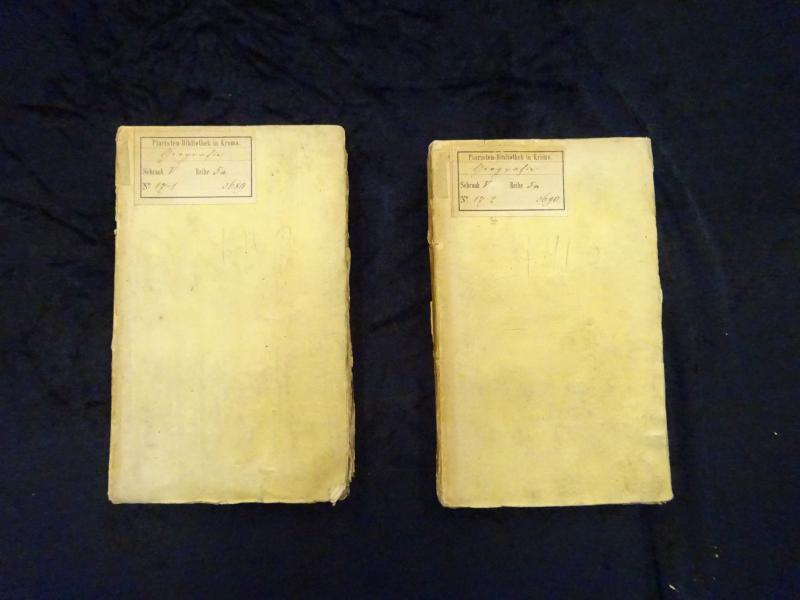
1803réf. REIS1042Leipzig, Georg Joachim Göschen 1803. 2 Bde. 8°. Gest. Frontisp., Titelbl., II S., 4, 326 S.; Titelbl., VI (=IV) S., 294 S., mit e. Skizze. Interimseinbände d. Zeit, Buchblöcke geheftet und unbeschnitten, mit biegsamen Kartondeckeln, etwas schmutzfleckig. Seiten mäßig vergilbt, zum Teil schwach stockfleckig, Blattränder verfärbt. Mit je einem gedruckten Bibliotheksschildchen mit Beschriftung von alter Hand auf den vorderen Einbanddeckeln (Piaristen-Bibliothek in Krems) und je e. Rundstempel auf den Titelblättern. Engelmann. Bibliotheca geographica 484. Vgl. ADB 17,443f. - deutsche Ausgabe der Beschreibung eines Teilgebiets von Großbritannien 'A tour through the Northern counties of England, and the borders of Scotland' verfasst von R. Warner (1763-1857), übersetzt durch den sächsischen Reiseschriftsteller Karl Gottlob Küttner (1755-1805). [3 Warenabbildungen]
196018,5x13. 308p. Lomo tocado. Trad. M. Alvarez de Toledo. Novela histórica.
2006réf. BOOKS074000ISouth Bristol ME: South Bristol Historical Soc 2006. PB. good wraps softcover FAINT DAMPSTAIN TOP EDGE. B&W illustrations. ISBN 0978659600 NOTE - faint damp stain top edge of a few rear pages - nothing stuck or ever was faintly noticeable. 155pp. South Bristol Historical Soc unknown
(ca. 12,5 x 17,5 cm). 2 Photos. Original-Photographien, rückseitig montierte Informationsblätter des Verleihs. Papier leicht gerändert, sonst gut erhalten. Altersentsprechend guter Zustand. Die zwei Photographien (schwarz/weiss, ohne Randflächen) stammen aus dem Film 'Protest' (Originaltitel: Morgan: A Suitable Case for Treatment) des tschechisch-englischen Regisseurs Karel Reisz. Beide Aufnahmen zeigen die Hauptfigur Morgan (Schauspieler: David Warner) in verschiedenen Szenen des Films. Die Original-Photos waren wohl Teil des Werbematerials für den Film, sie enthalten beide auf den Rückseiten jeweils eine montierte Information des Filmverleihs. Original-Filmfotos aus den 1960er Jahren!
1917réf. 36414Northampton MA: Picturesque Publishing Company. Very Good with no dust jacket; Boards lightly worn at head and tail of . spine and corners faint soiling to front endpapers toning to pp. 10-11 . as from newspaper clipping but no clipping laid in at present. 1917. Hardcover. Blindstamped black cloth binding with titles stamped in gilt on front boards and spine. Top edges gilt. Many photos. Publisher's note at rear indicates that this is Volume I of what is hoped to be a multi-volume series that will include 200 or more families but WorldCat does not show any subsequent volumes having been published. Northampton notables include Jonathan Edwards Chauncey H. Pierce General John L. Otis The O'Donnell Family Richard W. Irwin Haynes H. Chilson Edward H. R. Lyman Christopher Clarke and many others. ; 8vo 8" - 9" tall; 411 pages . Picturesque Publishing Company hardcover
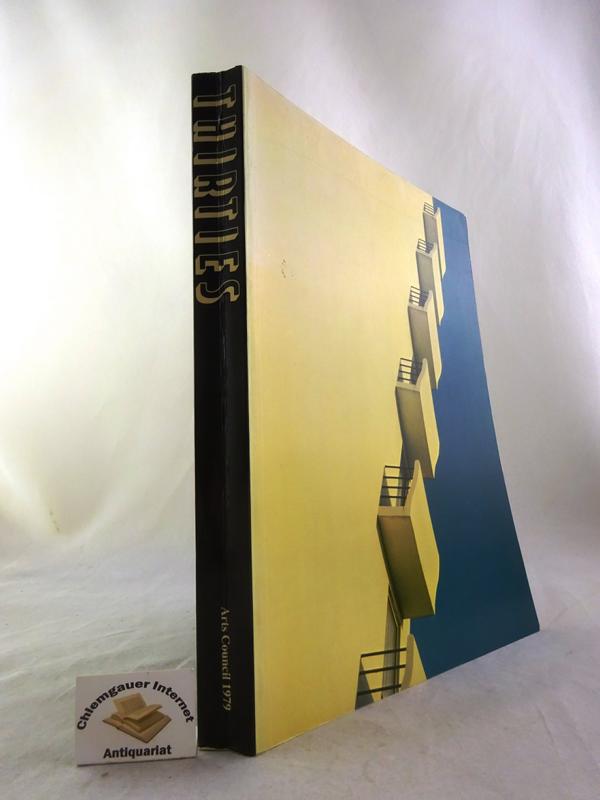
1979réf. 310587London, Arts Council of Great Britain London. Hayward Gallery., 1979. 320 Seiten. Mit zahlreichen dokumentarischen Abbildungen, teils in Farbe. Index. Originalbroschur. 28 cm
30 vols. Some forst/early editions included. Contains: As I ever saw, The bachelor, Balulalow, The birds, Consider, The contented lover, Elore lo, The first mercy, The frostbound wood, Good ale, Ha`nacker mill, Hey, troly loly lo, In an arbour green, Late summer, Mockery, Mr. Belloc`s fancy, The night, NoÙ, The passionate shepherd, Peterisms (first & second set), Piggesnie, Queen Anne, Saudades, The singer, Sweet and twenty, To the memory of a great singer, Two songs (a prayer to Saint Anthony of Padua; The sick heart), Tyrley, tyrlow.
Second edition, [4], 65, [1]pp., disbound.
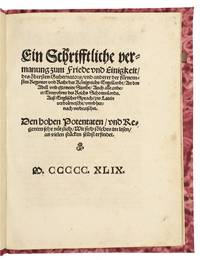
1549réf. 5178Erfurt: Gervasius und Wolffgangus Sthürmer gebrüder 1549. SOLE GERMAN EDITION. Printed by the brothers Gervasius and Wolfgang Stürmer. Hardcover. Fine. Bound in modern quarter vellum and marbled boards. A very good copy with broad margins with some faint marginal foxing mainly in the upper margin and a small faint damp-stain in the lower corner of the final 3 leaves. Translation of title: "A written exhortation to peace and unity from the Lord Protector and other leading regents and councilors of the Kingdom of England addressed to the nobility the common estates and all other inhabitants of the Kingdom of Scotland. Translated from English into Latin and subsequently into German. Highly useful to exalted potentates and rulers-as becomes evident in many passages upon reading." This is a German translation via an intermediate Latin version of Edward Seymour Duke of Somerset's "An Epistle or Exhortacion to Unitie & Peace" - the Lord Protector's open letter to the Scots urging them to honor the Treaty of Greenwich and accept the marriage of the English boy-king Edward VI to the infant Mary Queen of Scots. English troops were already prosecuting a war in Scotland. By refusing the marriage the Scots would show that they "preferred discord to unity war to peace." The letter is dated 5 February in the second year of King Edward VI's reign 1548. The English edition ESTC S110952 was printed at London in early 1548 most likely February since the Latin edition was also printed in London on 5 March ESTC S117203. In North America the English edition is held by Folger and Huntington; the Latin by Huntington only. I have not traced a copy of the German edition in North America. Edward Seymour was the brother of Queen Jane Seymour the third wife of King Henry VIII. Following Henry's death in 1547 he became Lord Protector of the realm for the young King Edward VI who was still a minor. As regent of England Seymour openly promoted Protestantism a stance that antagonized conservative Catholics-including Princess Mary the young king's eldest half-sister and successor. Seymour's military campaign against Scotland-an attempt to force a marriage between Edward VI and the Scottish Queen Mary Stuart at that time only an infant-ended in financial disaster for England. Increasingly unpopular among the nobility Seymour was overthrown in December 1549 and beheaded on Tower Hill on January 22 1552. On 1st July 1543 in the reign of King Henry VIII the Treaties of Greenwich were signed between England and Scotland. Part of the agreement was that Henry's five-year-old heir Edward and the princess Mary Stuart later Mary Queen of Scots should eventually be married. The Scots repudiated the treaties in December 1543. Henry's response was the war that later came to be known as the "Rough Wooing." It began with the sack of Edinburgh and Leith in May 1544 and continued into Edward VI's reign. In the end it pushed Scotland toward France. Mary then only four years old was betrothed to the Dauphin and sent to France under the Treaty of Haddington. "The timing of the Somerset's Epistle was important. In February 1548 the English were masters of Scotland; two invasions were about to be launched one up the River Nith to Drumlanrig another to Haddington. Furthermore it was becoming apparent that considerable French aid would shortly be sent to Scotland. At this critical juncture Somerset hoped to lay before the Scots the fullest and most moderate case he could and the Epistle was a direct comment on the circumstances at that time. Though short it was complicated with three basic elements: the exposition of the justness of the English case an elaboration of the advantages of the union and a demonstration of the lack of any alternative course of action. "The Epistle was the high water mark of the English propaganda campaign aimed at the Scots. Events were rapidly outstripping the presses. By June the French were disembarking at Leith by July Haddington was besieged and by August Mary had embarked for France the betrothed of the Dauphin. Scottish collaborators rapidly melted away. Consequently it is not surprising that no subsequent piece of propaganda can be seriously thought to be directed at a Scottish audience. "Efforts were made to insure that the Epistle had as wide a readership as possible. To begin with four different editions were printed: an English version in octavo and quarto executed by Grafton and two Latin editions by Wolf. Every other piece of propaganda had only one edition. Moreover the pamphlet was widely circulated. "Not only was the Epistle seen in Scotland. The Emperor read one of the Latin editions and did not find all of it to his liking. German Protestant concern has no more striking piece of evidence than a German translation of Wolf's Latin edition printed in Erfurt in 1549."Merriman The Rough Wooings Mary Queen of Scots p. 274-279 Somerset's Epistle present the English as Scotland's benefactors rather than its conquerors. As victors who have "overcome you in war and now become masters of the better part of your realm" they could have dictated terms but instead they come as "a father deals with his son an elder brother with a younger or a skilled physician with the sick" and ask the Scots to regard them "rather as friends than foes rather as brothers than masters." Centuries of war between the two kingdoms are truly lamentable because the two nations which share a common tongue and inhabit the same island are separated only by "the rival dominion that divides them." The natural conclusion is that they should where possible become a single realm under one rule. Since two hereditary realms cannot merge "without the downfall of one of them - except through the bond of marriage" the marriage of Edward and Mary offers the only means to effect the union of England and Scotland preserving "the rights of both" nations. Seymour sees the hand of Providence at work. King James V's two sons had died leaving only the infant Mary and Henry VIII had only sired one son by Jane Seymour. England promises to give up any title of conqueror and -remarkably- to set aside "the glorious English name itself" so that both peoples would resume "the old common name of Britons." Scottish laws would stand as England France and Rome all tolerated regional diversity of law and Mary would become "an heir in England as well." Against this the epistle sets the danger of relying on France. Foreign troops would "defile your houses waste your lands" and carry off the Queen to marry wherever it suited them. "This foreign help will be your shame this garrison your ruin even victory itself your bondage." The epistle closes with the promise of free trade between both kingdoms. Scottish merchants who register with border officers and pledge to the cause will receive safe-conduct into England to trade "exactly as though they were His Majesty's own subjects." A united Britain it is promised would have "the sea our wall brotherly love our garrison God Himself our protector.". Gervasius und Wolffgangus Sthürmer, gebrüder hardcover books
1549réf. 5178Erfurt: Gervasius und Wolffgangus Sthürmer gebrüder 1549. SOLE GERMAN EDITION. Printed by the brothers Gervasius and Wolfgang Stürmer. Hardcover. Fine. Bound in modern quarter vellum and marbled boards. A very good copy with broad margins with some faint marginal foxing mainly in the upper margin and a small faint damp-stain in the lower corner of the final 3 leaves. Translation of title: "A written exhortation to peace and unity from the Lord Protector and other leading regents and councilors of the Kingdom of England addressed to the nobility the common estates and all other inhabitants of the Kingdom of Scotland. Translated from English into Latin and subsequently into German. Highly useful to exalted potentates and rulers-as becomes evident in many passages upon reading." This is a German translation via an intermediate Latin version of Edward Seymour Duke of Somerset's "An Epistle or Exhortacion to Unitie & Peace" - the Lord Protector's open letter to the Scots urging them to honor the Treaty of Greenwich and accept the marriage of the English boy-king Edward VI to the infant Mary Queen of Scots. English troops were already prosecuting a war in Scotland. By refusing the marriage the Scots would show that they "preferred discord to unity war to peace." The letter is dated 5 February in the second year of King Edward VI's reign 1548. The English edition ESTC S110952 was printed at London in early 1548 most likely February since the Latin edition was also printed in London on 5 March ESTC S117203. In North America the English edition is held by Folger and Huntington; the Latin by Huntington only. I have not traced a copy of the German edition in North America. Edward Seymour was the brother of Queen Jane Seymour the third wife of King Henry VIII. Following Henry's death in 1547 he became Lord Protector of the realm for the young King Edward VI who was still a minor. As regent of England Seymour openly promoted Protestantism a stance that antagonized conservative Catholics-including Princess Mary the young king's eldest half-sister and successor. Seymour's military campaign against Scotland-an attempt to force a marriage between Edward VI and the Scottish Queen Mary Stuart at that time only an infant-ended in financial disaster for England. Increasingly unpopular among the nobility Seymour was overthrown in December 1549 and beheaded on Tower Hill on January 22 1552. On 1st July 1543 in the reign of King Henry VIII the Treaties of Greenwich were signed between England and Scotland. Part of the agreement was that Henry's five-year-old heir Edward and the princess Mary Stuart later Mary Queen of Scots should eventually be married. The Scots repudiated the treaties in December 1543. Henry's response was the war that later came to be known as the "Rough Wooing." It began with the sack of Edinburgh and Leith in May 1544 and continued into Edward VI's reign. In the end it pushed Scotland toward France. Mary then only four years old was betrothed to the Dauphin and sent to France under the Treaty of Haddington. "The timing of the Somerset's Epistle was important. In February 1548 the English were masters of Scotland; two invasions were about to be launched one up the River Nith to Drumlanrig another to Haddington. Furthermore it was becoming apparent that considerable French aid would shortly be sent to Scotland. At this critical juncture Somerset hoped to lay before the Scots the fullest and most moderate case he could and the Epistle was a direct comment on the circumstances at that time. Though short it was complicated with three basic elements: the exposition of the justness of the English case an elaboration of the advantages of the union and a demonstration of the lack of any alternative course of action. "The Epistle was the high water mark of the English propaganda campaign aimed at the Scots. Events were rapidly outstripping the presses. By June the French were disembarking at Leith by July Haddington was besieged and by August Mary had embarked for France the betrothed of the Dauphin. Scottish collaborators rapidly melted away. Consequently it is not surprising that no subsequent piece of propaganda can be seriously thought to be directed at a Scottish audience. "Efforts were made to insure that the Epistle had as wide a readership as possible. To begin with four different editions were printed: an English version in octavo and quarto executed by Grafton and two Latin editions by Wolf. Every other piece of propaganda had only one edition. Moreover the pamphlet was widely circulated. "Not only was the Epistle seen in Scotland. The Emperor read one of the Latin editions and did not find all of it to his liking. German Protestant concern has no more striking piece of evidence than a German translation of Wolf's Latin edition printed in Erfurt in 1549."Merriman The Rough Wooings Mary Queen of Scots p. 274-279 Somerset's Epistle present the English as Scotland's benefactors rather than its conquerors. As victors who have "overcome you in war and now become masters of the better part of your realm" they could have dictated terms but instead they come as "a father deals with his son an elder brother with a younger or a skilled physician with the sick" and ask the Scots to regard them "rather as friends than foes rather as brothers than masters." Centuries of war between the two kingdoms are truly lamentable because the two nations which share a common tongue and inhabit the same island are separated only by "the rival dominion that divides them." The natural conclusion is that they should where possible become a single realm under one rule. Since two hereditary realms cannot merge "without the downfall of one of them - except through the bond of marriage" the marriage of Edward and Mary offers the only means to effect the union of England and Scotland preserving "the rights of both" nations. Seymour sees the hand of Providence at work. King James V's two sons had died leaving only the infant Mary and Henry VIII had only sired one son by Jane Seymour. England promises to give up any title of conqueror and -remarkably- to set aside "the glorious English name itself" so that both peoples would resume "the old common name of Britons." Scottish laws would stand as England France and Rome all tolerated regional diversity of law and Mary would become "an heir in England as well." Against this the epistle sets the danger of relying on France. Foreign troops would "defile your houses waste your lands" and carry off the Queen to marry wherever it suited them. "This foreign help will be your shame this garrison your ruin even victory itself your bondage." The epistle closes with the promise of free trade between both kingdoms. Scottish merchants who register with border officers and pledge to the cause will receive safe-conduct into England to trade "exactly as though they were His Majesty's own subjects." A united Britain it is promised would have "the sea our wall brotherly love our garrison God Himself our protector.". Gervasius und Wolffgangus Sthürmer, gebrüder hardcover
1809pp. viii, 700, (4) [Publisher's advertisement] + Nine engraved plates (foxed). 8vo. Original full leather binding, boards almost detached. Frederick Augustus, Duke of York and Albany (1763-1827), was the second son of George III and Queen Charlotte. His career at court, in the House of Lords, and in the military makes fascinating reading, but it is a great controversy and scandal that most concerns us here. He had become entangled with a handsome adventuress, Mary Anne Clarke (1776-1852). The precise facts of Mary's early love life and adventures are open to speculation. It is certain that in 1803, under the name of Mrs. Clarke, she took a great house in Gloucester Place and began to entertain sumptuously, and that rumor from the first coupled her name with that of the Duke of York. She rushed into the wildest extravagances; she kept ten horses and twenty servants, including three men professed as 'cooks'; she ate off the plate which had belonged to the Duc de Berri, and her wineglasses cost two guineas each. The Duke of York had promised her 1,000 L a month, but it was very irregularly paid. She was soon much pressed by creditors, and there is no doubt that in order to get money she promised to use her influence with the Duke of York. The Duke was at that time commander-in-chief, and had enormous patronage at his disposal, and as he was known to be an easy-going man, it was believed by those about her that he would do whatever she wished. For the promise of her influence she received various sums of money, especially from officers in the army, and the matter came public knowledge at last. The man who brought up the question in the House of Commons in 1809, Colonel Gwillym Lloyd Wardle, was probably no better than herself. He brought eight charges against the Duke for wrong use of his military patronage, and won for himself a short season of popularity. But the charges were found not proven against the Duke, though there was no doubt Mrs. Clarke had received money for her influence with him, and her beauty and courage, and even the sauciness with which she stood her long examination at the bar of the House, won her many admirers. The result of the investigation was that the Duke resigned his post of commander-in-chief, to which, however, he returned in two years, and that he broke off his connection with Mrs. Clarke. This scandalous case raised a cloud of pamphlets, some of which are very amusing, and most of them full of falsehoods. Later in 1809 Colonel Wardle prosecuted Mrs. Clarke and two pamphleteers, F. and D. Wright, for libeling him, and after a trial, which did not resound to his credit, the prisoners were all found "not guilty". Mrs. Clarke next proposed to publish the letters she had received from her princely lover. This had to be stopped at all risks, and Sir Herbert Taylor bought up the letters, and offered Mrs. Clarke 7,000 L. down and a pension of 400 L. a year, and for this consideration the printed edition was destroyed, with the exception of one copy deposited at Drummond's bank. Her next publication, "A Letter to the Right Hon. William Fitzgerald," brought her into trouble, and she was condemned in 1813 to nine months' imprisonment for libel. She then settled down and devoted herself to the education of her daughters, who all married well. After 1815 she removed to Paris, where she was still sought after by the numerous admirers of her wit, to listen to her scandals of old days. Especially attentive to her was the Marquis of Londonderry. She died at Boulogne, at 76 years of age. - Paraphrased from the DNB. W141
1958réf. 44507BBLondon, Her Majesty's Stationery Office, 1958. 4°. 28 cm. VIII, 68 Seiten, ca. 150 Blatt. Original-Leinenband.
1968réf. 27940Graz, Akademische Druck- und Verlagsanstalt, 1968. 8°. 1028 S., Orig.-Ganzleinenband. Neuwertiges Exemplar.
1885réf. 61662Graz, Akademische Druck- u. Verlagsanstalt, 1968 (Unveränderter Nachdruck der Ausgabe London 1885). 8°. 1 Bl., IV, 1028 S., OLwd.
1971Previous owner's name/date inside front board. No other marks or inscriptions. A very clean very tight copy with bright unmarked boards, a little foxing to top of page edges and no bumping to corners. Dust jacket not price clipped or marked or torn or creased with tiny scratch to spine foot. 280pp. A study which describes the subtle and interesting relationships between private landowners and industry in the 18th and 19th centuries.
VG hbk in grey cloth with a picture of Lorna Doone from a painting by C.E. Brock on the front board. Illustrations by Catharine Weed Ward. 17179 eng
1890réf. 7946ABerlin, Schorer, (1890). 8°. 2 Bände. 690, 598 Seiten. Farbig illustr. OLeinenbände mit Deckel- u. Rückenvergoldung. 1. Auflage.
1911réf. 17949London, Longmans, Green and Co. 1911-12. 1 Bl. Anzeigen, XXII, 277; VIII, 363; VIII, 390 S., 1 Bl. Mit 44 Tafeln. Gr.-8° (23 x 15,5 cm). Original-Leinwand.