25 296 résultats
1934réf. 002564Norway ME: Old Squires Book Store 1934. Brown Cloth. Very Good/No Jacket. Real nice copy of a scarce Maine title. Minimal wear and soiling to covers. Inscribed signed and dated by Dr. Stephen's wife after his passing. Endpapers are a drawing of the layout of "The Old Squire's Farm". Wonderful read! Old Squires Book Store hardcover
19731st edition. Hardback in a dust jacket. VG/VG. Inscription on the inside front cover. 18345. eng
1926réf. List3141Quincy Massachusetts: unpublished 1926. 201 pp cardstock wraps. Normal wear to wraps; overall Near Fine. Alice Brackett White Coolidge 1864–1927 was a Boston socialite of the prominent Richardson family; her grandfather was merchant and Massachusetts State Legislator Jeffrey Richardson. Coolidge was also the author of three children’s books: The Bunnies of Evergreen Village 1917 The Refugees in Evergreen Village 1918 and Evergreen Village to the Rescue 1922. Offered here is Coolidge’s unpublished memoir of her early life written in 1926 titled My Early Reminiscences. The memoir recalls Coolidge’s childhood and teen years spent mainly in Massachusetts New Hampshire and Maine. Her recollections typically involve extensive descriptions of the houses at which her family stayed the scenery around them and the various families they met and visited with. Given her position in society her acquaintances are sometimes quite influential people: Princeton president John Grier Hibben enjoys Coolidge’s fishcakes; Trinity Church rector Phillips Brooks gives her grandfather an “excellent pew” in the newly-finished church; pioneering doctor Alfred Worcester mistakes red pepper for mercury in a scientific demonstration at her school; and she recalls brief correspondences with John Greenleaf Whittier and William James. Coolidge also took dance lessons from Augustus Papanti whom she describes as “one of the thinnest men I ever saw” who was “very melancholy. I hardly remember his ever smiling”; and remembers Judge Charles Devens for “his great stature his charming face his courtliness of manner and his really boyish simplicity in entering into our evening games” including a game of “mind reading” which Devens played “with zest.” One of her longtime friends was Rear Admiral John E. Pillsbury. She recalls: “Mr. Pillsbury as a young naval man a brother-in-law of my uncle Dr. Richardson used to take me out in the swan-boats on the Public Garden Pond. Later he went through all the ranks up to being retired as a Rear Admiral but time and circumstances never changed him. We always met at Thanksgiving and Christmas dinners and always talked at great length. . He was a wonderfully interesting lovable man and very modest and unassuming and shy. I always considered him one of my best friends though older by many years than I.” Another interesting New England figure Coolidge encountered was Joseph Lee. She describes Lee’s hotel in Newton: “The house where we stayed was kept by a remarkable man named Joseph Lee. He was a mulatto much above many of his kind and his wife was a handsome woman partly Indian. They did the cooking and he waited on table with a colored maid to help him. In fact there were no white women in the house. The cooking was delicious.” Lee was born enslaved in South Carolina freed in 1865 and went on to invent the automatic bread kneading and bread crumbing machines. Though nearly all of her childhood was spent in New England she also remembers being invited to visit Charles Joseph Bonaparte in Baltimore: “We had never been so far south except to Washington and I felt a curious feeling of being in a different atmosphere from any I had known. . We were met at the station by Mrs. Bonaparte in a large roomy covered vehicle with two horses. The coachman and footman were in the Bonaparte colors -- a deep wine color. The footman I well remember. He was a light-colored young negro very handsome and smiling and excited over having young ladies from the North. . All the servants were colored and lived in cabins near the house. . I never knew Mr. Bonaparte in public life so my memories of him are quite intimate and I fancy I saw much of his real self. . His mind was very active. He used to talk or listen as he walked and he moved his head in a curious way from one side to the other with a slightly rolling motion which was distinctly individual. . I never saw him irritated or excited and he was always very simple. In the group picture we had taken at the Maplewood he sat down cross-legged on the piazza floor like a boy. That was in about 1887. I suppose in public life or in law he was different but he was very equable and charming as we met him in his home and at the mountains. Most of all I admired his sweet tender ways with his flower-like wife.” This was not too long after the end of Reconstruction and Coolidge remarks on the tense atmosphere: “Mrs. Bonaparte had warned me to be careful about questions regarding the North and South as the ‘feeling’ had not yet died away. I was so glad she had warned me. A gentleman slipped in and sat down beside me to watch a parade and whispered in my ear as the bands had been playing ‘Dixie’ how glad he was to meet a Northerner. I was glad to meet him too although I remember neither his name nor face but I felt I breathed freer in his sympathetic locality. . I had no idea that this feeling still remained as far North as Baltimore and of course I remembered how our Massachusetts troops had been fired upon in Baltimore at the outset of the war but I was admonished and very wise and only returned my unremembered neighbor’s greeting with a sympathetic word and look.” Besides individuals Coolidge does cover a few historical events including the Great Boston Fire of 1872: “Oh! a horrible sight met our eyes. Back of the opposite houses in Park Square was a background of sheets of red flames and heavy black smoke rising high into the air. . On the Parade Ground all was in confusion and the sight was very sad and never-to-be-forgotten. It was literally covered with boxes and bales of furniture and sad forlorn desperate looking people crouching or sitting or standing amidst what they had saved from their homes . At night . the whole city was in darkness as there was no gas.” The family also frequently stayed at hotels in the White Mountains of New Hampshire and Coolidge recalls the “overwhelmingly tragic” effects of the 1867 sale of this land to logging companies; she writes that looking out from the Flume House in Franconia “all about were brown scarred places marking the woodchoppers’ work which was cutting away our beautiful trees for lumber”. In this memoir Coolidge supplies detailed remembrances of the private personalities of influential figures of Gilded Age New England. We find two copies of My Early Reminiscences on OCLC. Of interest to historians of the era especially as told through the perspective of a young woman. unpublished unknown books
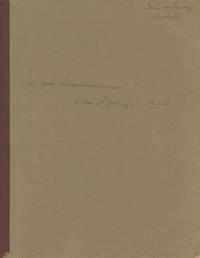
1926réf. List3141Quincy Massachusetts: unpublished 1926. 201 pp cardstock wraps. Normal wear to wraps; overall Near Fine. Alice Brackett White Coolidge 1864–1927 was a Boston socialite of the prominent Richardson family; her grandfather was merchant and Massachusetts State Legislator Jeffrey Richardson. Coolidge was also the author of three children’s books: The Bunnies of Evergreen Village 1917 The Refugees in Evergreen Village 1918 and Evergreen Village to the Rescue 1922. Offered here is Coolidge’s unpublished memoir of her early life written in 1926 titled My Early Reminiscences. The memoir recalls Coolidge’s childhood and teen years spent mainly in Massachusetts New Hampshire and Maine. Her recollections typically involve extensive descriptions of the houses at which her family stayed the scenery around them and the various families they met and visited with. Given her position in society her acquaintances are sometimes quite influential people: Princeton president John Grier Hibben enjoys Coolidge’s fishcakes; Trinity Church rector Phillips Brooks gives her grandfather an “excellent pew” in the newly-finished church; pioneering doctor Alfred Worcester mistakes red pepper for mercury in a scientific demonstration at her school; and she recalls brief correspondences with John Greenleaf Whittier and William James. Coolidge also took dance lessons from Augustus Papanti whom she describes as “one of the thinnest men I ever saw” who was “very melancholy. I hardly remember his ever smiling”; and remembers Judge Charles Devens for “his great stature his charming face his courtliness of manner and his really boyish simplicity in entering into our evening games” including a game of “mind reading” which Devens played “with zest.” One of her longtime friends was Rear Admiral John E. Pillsbury. She recalls: “Mr. Pillsbury as a young naval man a brother-in-law of my uncle Dr. Richardson used to take me out in the swan-boats on the Public Garden Pond. Later he went through all the ranks up to being retired as a Rear Admiral but time and circumstances never changed him. We always met at Thanksgiving and Christmas dinners and always talked at great length. . He was a wonderfully interesting lovable man and very modest and unassuming and shy. I always considered him one of my best friends though older by many years than I.” Another interesting New England figure Coolidge encountered was Joseph Lee. She describes Lee’s hotel in Newton: “The house where we stayed was kept by a remarkable man named Joseph Lee. He was a mulatto much above many of his kind and his wife was a handsome woman partly Indian. They did the cooking and he waited on table with a colored maid to help him. In fact there were no white women in the house. The cooking was delicious.” Lee was born enslaved in South Carolina freed in 1865 and went on to invent the automatic bread kneading and bread crumbing machines. Though nearly all of her childhood was spent in New England she also remembers being invited to visit Charles Joseph Bonaparte in Baltimore: “We had never been so far south except to Washington and I felt a curious feeling of being in a different atmosphere from any I had known. . We were met at the station by Mrs. Bonaparte in a large roomy covered vehicle with two horses. The coachman and footman were in the Bonaparte colors -- a deep wine color. The footman I well remember. He was a light-colored young negro very handsome and smiling and excited over having young ladies from the North. . All the servants were colored and lived in cabins near the house. . I never knew Mr. Bonaparte in public life so my memories of him are quite intimate and I fancy I saw much of his real self. . His mind was very active. He used to talk or listen as he walked and he moved his head in a curious way from one side to the other with a slightly rolling motion which was distinctly individual. . I never saw him irritated or excited and he was always very simple. In the group picture we had taken at the Maplewood he sat down cross-legged on the piazza floor like a boy. That was in about 1887. I suppose in public life or in law he was different but he was very equable and charming as we met him in his home and at the mountains. Most of all I admired his sweet tender ways with his flower-like wife.” This was not too long after the end of Reconstruction and Coolidge remarks on the tense atmosphere: “Mrs. Bonaparte had warned me to be careful about questions regarding the North and South as the ‘feeling’ had not yet died away. I was so glad she had warned me. A gentleman slipped in and sat down beside me to watch a parade and whispered in my ear as the bands had been playing ‘Dixie’ how glad he was to meet a Northerner. I was glad to meet him too although I remember neither his name nor face but I felt I breathed freer in his sympathetic locality. . I had no idea that this feeling still remained as far North as Baltimore and of course I remembered how our Massachusetts troops had been fired upon in Baltimore at the outset of the war but I was admonished and very wise and only returned my unremembered neighbor’s greeting with a sympathetic word and look.” Besides individuals Coolidge does cover a few historical events including the Great Boston Fire of 1872: “Oh! a horrible sight met our eyes. Back of the opposite houses in Park Square was a background of sheets of red flames and heavy black smoke rising high into the air. . On the Parade Ground all was in confusion and the sight was very sad and never-to-be-forgotten. It was literally covered with boxes and bales of furniture and sad forlorn desperate looking people crouching or sitting or standing amidst what they had saved from their homes . At night . the whole city was in darkness as there was no gas.” The family also frequently stayed at hotels in the White Mountains of New Hampshire and Coolidge recalls the “overwhelmingly tragic” effects of the 1867 sale of this land to logging companies; she writes that looking out from the Flume House in Franconia “all about were brown scarred places marking the woodchoppers’ work which was cutting away our beautiful trees for lumber”. In this memoir Coolidge supplies detailed remembrances of the private personalities of influential figures of Gilded Age New England. We find two copies of My Early Reminiscences on OCLC. Of interest to historians of the era especially as told through the perspective of a young woman. unpublished unknown
1923Small red octavo, viii, 2 leaves, 3-264 pages. Lacking jacket. || Contents: The balance of trade in impressions. -- I am interviewed by the press. -- Impressions of London. -- A clear view of the government and politics of England. -- Oxford as I see it. -- The British and the American press. -- Business in England. -- Is prohibition coming to England? -- "We have with us to-night." -- Have the English any sense of humour? England, Humor.
195918x10. 255p. Lomo algo tocado en cabeza y esquinas. Trad. R. Salto.
in-8°, VIII-280 pages, index, Hard Cover. Good. [EN-1]
1915réf. 6986Paris, Tolmer et Cie, 1915. In-4 carré non paginé, cartonnage, premier plat illustré en couleurs, dos de toile verte. Coins et bords frottés, plats un peu sali avec deux taches d'encre bleue pour le second, rousseurs éparses, haut de certaines pages légèrement gondolés.
in-8, 411 pp., broché, couverture illustree. Tres bel exemplaire. [TX-14][CA26-2]
réf. 29132102-nnew. unknown
réf. 29132102like new. unknown
in-4° 209 pages, entierement illustre en n&b, broche, couverture illustree. Bel exemplaire. [P-36]
1954réf. 255672London, Cassell an Company, 1954. IX, 354 pages. 25 plates. Originalleinen. Original coth. 23 cm
2009réf. BIBLIO-37318Folio Society London limited edition 2009. Limited edition of 500 numbered and 20 lettered copies. Quarter-bound in buckram with vegetable parchment sides blocked in gold and coloured foils all edges gilt folio in the publisher's buckram slipcase blocked in gilt on both sides with the King's arms. 36 pp with illustrated frontispiece and ornamented initial letters. On offer here is the facsimile volume only - it was originally sold in conjunction with a separate commentary volume and a CD of the music: those items are not included. Only 500 copies of the facsimile were offered for sale - one of the lowest limitations for Folio Society limited editions. From the publisher's promotional material : "Several manuscripts survive to testify to Henry's love of music but the most important is the Royal Choirbook now British Library Royal MS II E XI. This magnificent collection of motets was presented to the 27-year-old Henry and Catherine of Aragon in 1518. lt is exceptional for the sheer size and luxury of its production its exquisite and ingenious heraldic illuminations and not least its personal significance to Henry. As part of The Folio Society's commemoration of the quincentenary of his accession this Choirbook has been reproduced for the first time in facsimile a precious link with the great musical legacy of King Henry VIII.In 1515 the Venetian envoy Sebastiano Giustiniano was invited to attend High Mass in the king's private chapel at Hampton Court Palace. He wrote that it was 'gloriously sung by His Majesty's choristers whose voices are really more divine than human. They did not chant but sang like angels and as for the counter-bass voices I do not think they have their equals in the world. Indeed the choral music produced at the court of Henry VIII was thought by many to surpass what was being produced anywhere else in Europe. Fortunately the most magnifìcent musical book associated with Iienry's reign - the Royal Choirbook a book of motets composed for the young king and Queen Catherine of Aragon - has survived.This book's magnifìcent frontispiece represents the Tudor dynasty through the symbolism of roses blooming in the garden of England with the crowned rose ruling supreme. Petrus de Opitus an Italian merchant and his son Benedictus an organist were responsible for commissioning the Royal Choirbook - and the visual compliments to the king it contains are a testament to their own ambitions. Their lavish tribute extends to the musical and literary content. Copy No. 28. Facsimile as new; in a slipcase which has several minor scuffs and small indentations but is otherwise Very Good. Folio Society, London, limited edition, 2009 hardcover
1953347p., illus. Includes articles on music & dance, and educational opportunities & a biographical dictionary of musicians. Hardcover Very good condition
1968réf. 008182Self Published 1968 OVERSIZED. A Thesis Presented to the Department of Music Harvard University In Partial Fulfillment of the Requirements For the Degree of Doctor of Philosophy February 1968. vi 6 355pp; 1 357-676pp illustrated single sided sheets being a copy of the original typed thesis bound in red buckram with binding and hinges tight. INSCRIBED and SIGNED "To Lorna Marshall / from Nick". From the personal collection of Lorna Marshall 1898-2002 a well known anthropologist that lived among the !Kung people of the Kalahari Desert and author of several books based on her studies with her pencil notations and corrections throughout. Self Published hardcover
1975réf. 115352ABC Historic Publications, Dunstable, 1975. 27,5 x 21,5 cm ; broschiert
1991réf. 28635ABKrefeld., Museum Haus Lange., 1991. 4°. 28 unpaginierte S. OKarton., 28635AB 1. Auflage. Sehr gutes Exemplar.
1991réf. 28634ABKrefeld., Museum Haus Lange., 1991. 27 x 20 cm. 28 unpaginierte S. OKarton., 28634AB 1. Auflage. Umschlag marginal angestaubt. Gutes bis sehr gutes Exemplar.
1996réf. 68905ABRotterdam., Museum Boymans-van Beuningen., 1996. 28,4 x 22 cm. 72 S. Illustrierter OKarton., 68905A Erste Auflage. Einband und innen papierbedingt minimalst lichtspurig, sonst gutes bis sehr gutes Exemplar.
1833réf. LFA01435Un ouvrage de 378 pages, format 275 x 185 mm, illustré, relié cartonnage, publié en 1833-1834
1895Spine sunned with minor fraying to top. Library sticker to front board. Bookplate. Hole stamped and one small chip on title page. ; First and only edition with numerous color maps, plans and ads. Map in rear pocket ; Ex-Lib; 12mo; viii, 260 pages
1978295 pages including index and some black and white illustrations. "Some of the proceedings described in the following pages seem unjust to us, but we have to remember that these trials took place about 160 years ago. Many important reforms have been introduced both in England and France which have gone far to establish and safeguard the rights of the accused. One aspect has not changed; a criminal trial in France is more dramatic, more akin to the theatre, than in England, both in its setting and in the display of emotion." - from Foreward. Several cup rings upon back board. Small rubber stamp upon front endpaper else contents clean and unmarked. Light to moderate wear. Solid copy. Book
1935réf. 021324N.Y.: Alfred A Knopf Inc: A Borzoi Book 1935. First Edition so stated. The author's first mystery. Dust jacket illustration by Salter. Publisher's original gray cloth front and spine stamped in blue top edge stained dark blue with borzoi design to rear panel in blue stamped box A little glue bleeding apparent on the endpapers corners bumped shallow loss at spine ends and flap corners else a very sharp copy of Coxe's first of many mysteries. This copy although not marked as such comes from the auction of noted crime collector Gary Groton's collection. Coxe was named a Grand Master in 1964 by The Mystery Writers of America. In Kent Murdoch you have the maverick photographer with his ironclad though outside conventions code of ethics. You have multiple murders. You have a plethora of likely suspects. And of course you have the sassy but still at time vulnerable heroine. Kent Murdock gets mixed up in the killing of a defense attorney for a charming former bootlegger just acquitted of the murder. Is the killer the first murder victim's gangster brother looking for revenge The "femme fatale" wife of the lawyer The society semi-wastrel with whom she's having an affair His sister who proves a love interest for Murdock Or even Murdock's gold digger separated wife from whom he can't shake free -- Sharon Yang. First Edition. Hardcover. Very Good-Near Fine/Very Good-Near Fine. Illus. by Salter. Book. Alfred A Knopf Inc: A Borzoi Book
réf. 1340490072.Ghardcover. Good. Access codes and supplements are not guaranteed with used items. May be an ex-library book. hardcover