HANS JOSEF STEINBERGMareMagnum

1 837 résultats
1979EDITORI RIUNITI 1979 237 PP. PRIMA EDIZIONE. LIEVI SEGNI DEL TEMPO ALLA COPERTINA, BRUNITURE AI TAGLI, VOLUME INTONSO, MAI SFOGLIATO. Ecco un punto di riferimento essenziale nella storiografia sulla social democrazia tedesca e sul marxismo della Seconda Internazionale. Il libro di Steinberg è la ricostruzione dell'ideologia della SPD nel periodo che va dagli anni settanta alla prima guerr mondiale. Al confronto critico con la tesi corrente del kautskismo come supporto dell'integrazione fanno seguito i grandi capitoli sul revisionismo, il riformismo, il praticismo. Ma oltre a delineare il quadro delle varie «anime» della SPD - dal marxismo al darwinismo sociale- l'analisi si ferma su un materiale ormai raro come le letture degli operai socialdemocratici, che si ricavano dalla Newe Zeit, dai cataloghi delle biblioteche operaie e dalla stampa di partito. Si disegna così anche un profilo inedito dei semplici militanti di base e del loro mondo concettuale. Hans Josef Steinberg, nato a Colonia nel 1935, insegna nell'università di Brema e collabora al Forschungsinstitut della Friedrich-Ebert-Stiftung. Oltre all'introduzione a un'edizione dell'Antidühring (1967) ha scritto Widerstand und Verfolgung in Essen 1933-1945 (Hannover, 1969) e Die Reichsgrundung 1870-71 (Stuttgart, 1970). Attualmente sta curando la pubblicazione del carteggio Bernstein-Kautsky.
1958" La romantica vita di Mendelssohn".Legatura edit,sopracoperta in acetato,custodia rigida.In 8o piccolo.Buona copia.Pp.515
1934réf. 41620London: Oxford University Press 1934. Octavo. Full mid-blue cloth with titling gilt to spine. 1f. recto title verso publisher's note 4ff. 289 i colophon pp. With bust-length frontispiece portrait of the composer and occasional illustrative plates. Binding slightly worn rubbed and bumped. Oxford University Press unknown books
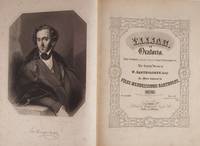
1847réf. 40967London . Bonn: Ewer & Co. Newgate Strt. . N. Simrock 1847. Large folio. Full maroon cloth with dark red leather title label gilt to spine. 1f. recto blank verso frontispiece 1f. recto engraved title within decorative border verso blank 1f. recto index verso blank iv typeset libretto 279 i blank pp. Text in English. Music engraved. Small format single-page list of errata bound in following title. The fine frontispiece portrait engraving of the composer is by A.H. Payne and W.C. Wrankmore after Hildebrand. Occasional annotations in pencil including instrument names and tempo indications. Binding slightly worn rubbed and bumped. Light uniform browning; frontispiece slightly foxed and creased at lower outer corner; foxing mainly to margins; minor soiling to blank margins of title; occasional minor soiling to lower outer corners. First English edition first issue with "Newgate Strt." address published in the same year as the first German edition published by Simrock in Bonn. MWV A25. Catalogue of the Mendelssohn Papers in the Bodleian Library III 362. Hoboken 10 253. Elijah to a libretto by J. Schubring was first performed in Birmingham England on 26 August 1846; Schubring also collaborated with Mendelssohn on his earlier oratorio St. Paul. "Mendelssohn was not the only 19th-century composer to revive the oratorio but his two completed works St Paul 1836 and Elijah 1846 were the only representatives of his time to achieve lasting popularity. . With few exceptions Mendelssohn's other sacred works lie largely in the shadow of St Paul and Elijah. . One of the most gifted and versatile prodigies Mendelssohn stood at the forefront of German music during the 1830s and 40s as conductor pianist organist and above all composer. His musical style fully developed before he was 20 drew upon a variety of influences including the complex chromatic counterpoint of Bach the formal clarity and gracefulness of Mozart and the dramatic power of Beethoven and Weber. Mendelssohn's emergence into the first rank of 19th-century German composers coincided with efforts by music historiographers to develop the concept of a Classic-Romantic dialectic in 18th and 19th-century music. To a large degree his music reflects a fundamental tension between Classicism and Romanticism in the generation of German composers after Beethoven." R. Larry Todd in Grove Music Online. Ewer & Co. Newgate Strt. ... N. Simrock unknown books
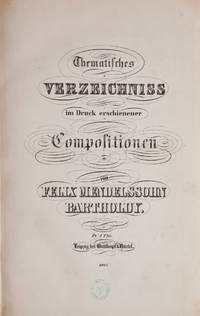
1843réf. 40969Leipzig: Breitkopf & Härtel PN 6925 1843. Octavo. Full 19th century dark green textured cloth with ruled border gilt "C.C.P" gilt to upper decorative device blindstamped to lower. 1f. recto title verso blank 63 "Compositionen ohne Ausgabe einer Opuszahl" i blank 65-83 i "Dedicationen der Werke Felix Mendelssohn-Bartholdy's" pp. Title lithographed catalogue engraved. Small publisher's oval handstamp to foot of title. Occasional annotations in pencil. Scattered staining mostly minor; small tear to upper blank margin of p. 63 repaired with archival tape to verso. OCLC 1477534799. Together with: Zweite Abtheilung. Unbound. 1f recto title verso "Bemerkung." pp. 39 i blank. 41-44. Title worn and slightly foxed and stained with tear repaired with archival tape to verso; small tears to edges. Not in OCLC. First Edition. Bound with: CHOPIN Thematisches Verzeichnis der im Druck erschienen Compositionen von Friedrich Chopin. Leipzig . Paris . London: Breitkopf & Härtel . Brandus & Co. . Wessel & Co. PN 8497 ca. 1853. 1f. recto title verso blank i-iii "Inhalt. I. Werke mit Opuszahl. II. Werke ohne Opuszhal. III. Portraits. IV. Über Chopin" iv "Dedicationen" 31 i blank 33-35 i blank pp. A few "x" marks in contemporary manuscript. Occasional minor staining and foxing. First Edition. OCLC 29298462. Binding slightly worn rubbed and bumped; spine lacking with inner edges of boards reinforced with black tape. Breitkopf & Härtel [PN 6925] unknown books
réf. 41220Blackburn Vernon. Mendelssohn. London: George Bell & Sons 1904. Small octavo. Boards. 53 pp. text 19 pp. advertisements. Binding worn; endpapers browned. Spotting and staining throughout; one signature partially split. Bell's Miniature Series of Musicians. Blunt Wilfrid. On Wings of Song: A Biography of Felix Mendelssohn. New York: Charles Scribner's Sons 1974. Large octavo. Boards. 288 pp. Profusely illustrated. Minor browning to outer edges. In worn dustjacket. Bötel Friedhold. Mendelssohns Bachrezeption und ihre Konsequenzen dargestellt an den Präludien und Fugen für Orgel op. 37. München: Emil Katzbichler 1984. Octavo. Full dark brown cloth with titling gilt to upper and spine. 134 pp. With occasional musical examples. From the library of musicologist and German professor William A. Little with his pencilled annotations and a letter from the author to Little laid in. Dahms Walter. Mendelssohn. Sechste bis Neunte Auflage. Berlin: Schuster & Loeffler 1922. Octavo. Original publisher's ivory linen-backed printed boards. 202 pp. Binding slightly worn; endpapers foxed with former owner's signature to front free endpaper. Elvers Rudolf ed. Felix Mendelssohn: A Life in Letters . Translated from the German by Craig Tomlinson. New York: Fromm 1986. Octavo. Full maroon cloth with titling gilt to spine. 334 pp. With occasional illustrations. Minor spotting to outer edges. Erskine John. Felix Mendelssohn Bartholdy: Musik-Konzepte 14/15. Octavo. Original publisher's printed wrappers. 176 pp. With contributions by Wulf Konold Hans Mayer Gerd Zacher Friedhelm Krummacher Richard Hauser Heinz-Klaus Metzger Robert Schumann and Rainer Riehn. With musical examples. Slightly worn. Small bookseller's label to verso of upper wrapper. Erskine John. Song without Words: The Story of Felix Mendelssohn. New York: Julian Messner 1941. Octavo. Boards. 205 pp. Occasional illustrations. Browned. In worn dustjacket. Gage William Leonhard ed. and trans. Life of Felix Mendelssohn Bartholdy from the German of W.A. Lampadius. With supplementary sketches by Sir Julius Benedict Henry F. Chorley Ludwig Rellstab Bayard Taylor R.W. Willis and J.S. Dwight. Additional Notes by C.L. Gruneisen . Second edition revised. London: William Reeves 1877. Octavo. Original publisher's full maroon cloth with titling gilt to spine. 243 pp. With frontispiece head-and-shoulders portrait of the composer. Publisher's catalogue and small bookseller's label laid down to front pastedown. Binding slightly worn rubbed and bumped; head and tail of spine frayed with minor loss. Uniform light browning; occasional foxing; first leaves partially detached. Inscription to head of half-title dated 1885. Hensel Sebastian. Die Familie Mendelssohn 1729-1847 nach briefen und Tagebuchern. Leipzig: Insel 1924. 2 volumes. Octavo. Full blue cloth. 417; 432 pp. With illustrative plates. Horton John. Mendelssohn Chamber Music. London: British Broadcasting Corporation 1972. Small octavo. Pictorial wrappers. 64 pp. Wrappers slightly worn. Horton John. 'The Musical Pilgrim.' The Chamber Music of Mendelssohn. London: Oxford University Press 1946. Small octavo. Illustrated wrappers. 65 pp. Binding slightly worn. Browned. Jost Christa. Mendelssohns Lieder ohne Worte. Tutzing: Hans Schneider 1988. Octavo. Full maroon cloth with titling gilt to upper and spine. 201 pp. With occasional illustrations. Frankfurter Beiträge zur Musikwissenschaft edited by the Musikwissenschaftlichen Institut der Johann Wolfgang Goethe-Universität Band 14. Kaufman Schima. Mendelssohn: "A Second Elijah." New York: Tudor 1936. Large octavo. Full blue cloth. 353 pp. With occasional illustrations. Binding slightly worn; browning to endpapers and outer edges. Lampadius W.A. Felix Mendelssohn Bartholdy: Ein Gesammtbild seines Lebens und Wirkens . Mit dem Portrait und einem facsimilirten Briefe Felix Mendelssohn Barthholdy's. Leipzig: F.E.C. Leuckart 1886. Original publisher's printed wrappers with bust-length portrait of the composer to upper. 379 pp. Unopened. Wrappers slightly worn and soiled; several chips to edges with minor loss not affecting text; split at spine. Marek George R. Gentle Genius: The Story of Felix Mendelssohn. New York: Funk & Wagnalls 1972. Large octavo. Boards. 365 pp. Profusely illustrated. Outer edges spotted. In worn dustjacket. Mendelssohn Bartholdy Carl and Paul Mendelssohn Bartholdy eds. Letters of Felix Mendelssohn Bartholdy from 1833 to 1847 . With a catalogue of all his musical compositions compiled by Dr. Julius Rietz. Translated by Lady Wallace. Second Edition. Philadelphia: Frederick Leypoldt F.W. Christern 1865. 12mo. Full black cloth titling gilt to spine. vi 421 pp. With musical examples. Binding slightly worn; binder's handstamp to rear pastedown. Mendelssohn Bartholdy Paul ed. Reisebriefe aus den Jahren 1830 bis 1832 von Felix Mendelssohn Bartholdy. Neunte Auflage. Leipzig: Hermann Mendelssohn 1882. Octavo. Full dark teal cloth with titling within decorative device gilt with ornately-blindstamped corners within blindstamped rules titling to spine gilt within decorative device gilt. 1f. recto blank verso half-title 1f. frontispiece recto blank verso photographic illustration of Mendelssohn on his death bed 1f. recto title verso blank v-vii foreword by Paul Mendelssohn Bartholdy dated Berlin March 1861 i blank 366 text 367-373 index i blank pp. 1f. publisher's advertisements. Tissue guard to photographic frontispiece. With occasional musical examples and illustrations in text. With autograph inscription signed "Hermann Mendelssohn" and other ownership notations. Binding slightly worn rubbed and bumped; upper board detached. Uniformly browned; some foxing; a few very small tears to blank edges. Volume 1 of 2 only. Moshansky Mozelle. Mendelssohn: His Life and Times. New York: Midas 1982. Large octavo. Full brown cloth. 144 pp. With occasional illustrations. Minor spotting to outer edges. Dustjacket slightly worn. Nichols Roger. Mendelssohn Remembered. London: Faber and Faber 1997. Octavo. Pictorial wrappers. 258 pp. Wrappers slightly worn. Petitpierre Jacques. The Romance of the Mendelssohns. London: Dennis Dobson 1947. Octavo. Boards. 251 pp. Illustrated. In slightly worn dustjacket. Reissmann August 1825-1903. Felix Mendelssohn-Bartholdy. Sein Leben und seine Werke . Zweite stark vermehrte und verbesserte Auflage. Mit Portrait in Stahlstich. Berlin: J. Guttentag D. Collin 1872. Octavo. Original publisher's full blindstamped maroon cloth with titling gilt to upper spine with titling and decorative stamping gilt marbled edges. 1f. recto blank verso fine bust-length portrait of Mendelssohn engraved and printed by Weger Leipzig 1f. recto title verso colophon 2ff. foreword to the first and second editions 1f. recto contents verso blank 1f. recto half-title verso blank 3-320 pp. With occasional musical examples. issue-guard to frontispiece. Binding slightly worn rubbed and bumped; head and tail of spine slightly frayed; endpapers slightly worn and soiled; handstamp "Groethuysen" to upper outer corner of free front endpaper and following leaf. Minor wear and browning; some leaves slightly creased. A German writer on music and composer Reissmann edited the Musikalisches Conversations-Lexikon an important reference on 19th century music following Hermann Mendel's death in 1876. Richter Arnd. Mendelssohn: Leben - Werke - Dokumente. Mainz München: Scott Piper 1994. Octavo. Wrappers. 425 pp. Illustrated. Schmidt Christian Martin ed. Felix Mendelssohn Bartholdy Kongreß-Bericht Berlin 1994. Wiesbaden: Breitkopf & Härtel 1997. Octavo. Original publisher's green boards. 351 pp. With occasional illustrations and musical examples. Schneider Max F. ed. Felix Mendelssohn Bartholdy: Denkmal in Wort und Bild. Basel: Amerbach-Verlag 1947. Quarto. Original publisher's red printed boards with facsimile of Mendelssohn's signature gilt to upper and titling gilt to spine. 150 pp. 8ff. facsimiles. With tipped-in illustrations within text including portraits and facsimiles of autograph musical manuscripts. Binding slightly worn. Schulz Günter ed. Glückliche jugend Briefe des jungen Komponisten. Bremen: Jacobi 1971. Octavo. Full ivory linen with paper title label to spine. 252 pp. In slightly worn dustjacket. Selden-Goth G. ed. Felix Mendelssohn Letters . With 33 Illustrations. New York: Pantheon 1945. Large octavo. Original publisher's cloth-backed decorative boards. 372 pp. With occasional illustrative plates and musical examples in text. Binding slightly worn. Uniform light browning. Stratton Stephen S. Mendelssohn. With Illustrations and Portraits. London: J. M. Dent E. P. Dutton 1901. Octavo. 307 pp. Full maroon cloth. Illustrated. Binding worn; spine faded. Browned. 34857 $5 Stresemann Wolfgang. Eine Lanze für Felix Mendelssohn. Berlin: Stapp 1984. Octavo. Full light gray cloth with titling in black to spine. 231 pp. With illustrations in text. Sutermeister Peter. Felix Mendelssohn Bartholdy Briefe einer Reise durch Deutschland Italien und die Schweiz und Lebensbild von Peter Sutermesiter. Mit Aquarellen und Zeichnungen aus Mendelssohns Reiseskizzenbüchern. Zürich: Max Niehans Verlag 1958. Octavo. Full linen with titling gilt to spine. 384 pp. With occasional illustrative plates in color tipped-in and illustrations in text. Thomas Mathias. Das Instrumentalwerk Felix Mendelssohn-Bartholdys; Eine systematisch-theoretische Untersuchung unter besonderer Berücksichtigung der zeitgenössischen Musiktheorie. Göttingen: Göttinger Musikwissenschaftliche Arbeiten 1972. Octavo. Original publisher's dark pink wrappers. 267 pp. With occasional annotations in both pencil and ink. Slightly worn; uniformly browned. Band 4. Thym Jürgen ed. Mendelssohn the Organ and the Music of the Past: Constructing Historical Legacies. Rochester: University of Rochester Press 2014. Octavo. Illustrated boards. 339 pp. With occasional illustrations. Werner Eric. Mendelssohn: A New Image of the Composer and His Age. Translated from the German by Dika Newlin. London: Collier-Macmillan 1963. Large octavo. Quarter black cloth with white boards. 545 pp. Binding slightly worn; lower joint split; slight browning to endpapers. Werner Eric. Mendelssohn: Leben und Werk in neuer Sicht. Zurich: Atlantis 1980. Large octavo. 635 pp. Occasional illustrations. Endpapers slightly browned; minor spotting to outer edges. Wolff Ernst. Felix Mendelssohn Bartholdy. Berlin: Schlesische Verlagsanstalt 1906. Large octavo. Full maroon textured cloth with titling gilt to upper and spine. 194 pp. 1f. recto bibliography verso contents 4ff. illustrations including facsimiles of autograph letters. With numerous illustrations within text including facsimiles some folding. Binding somewhat worn rubbed and bumped; joints frayed. Some signs of wear; rust marks from staples to some inner margins; several leaves detached. Berühmte Musiker Lebens- und Charakterbilder nebst Einführung in die Werke der Meister herausgegeben von Heinrich Reimann XVII. Worbs Hans Christoph. Felix Mendelssohn Bartholdy: Wesen und Wirken im Spiegel von Selbstzeugnissen und Berichten der Zeitgenossen. Leipzig: Koehler & Amelang 1958. Octavo. Original publisher's full linen with decorative device gilt to upper titling to spine. 255 pp. With occasional illustrative plates. Binding slightly worn; upper hinge reinforced with clear tape; dustjacket worn. Worbs Hans Christoph. Felix Mendelssohn Bartholdy mit Selbstzeugnissen und Bilddokumenten. Reinbek bei Hamburg: Rowohlt 1974. Octavo. Original publisher's illustrated wrappers. 152 pp. Illustrated. unknown books
1844réf. 40519Leipzig: Fr. Kistner PN 1400 1844. Folio. Modern mid-green boards with original publisher's wrappers laid down to both boards title label gilt to spine. 1f. recto title verso printed excerpt from a letter from Goethe to Mendelssohn 5- 91 i blank pp. Text in German. Engraved. With the overture arranged for piano 4-hands. Annotations in pencil to several leaves. Binding worn and soiled; corners bumped; wrappers with minor loss; free front endpaper slightly creased. Slightly worn and foxed; some corners with minor soiling; blank inner margin of title reinforced with narrow strip of paper; blank lower outer corner of title and following leaf repaired; several leaves with tape repairs to blank margins. Ex-library with small handstamp of the Städische Bühnen Erfurt Bibliothek to verso of title. First Edition. MWV D3 p. 78. Catalogue of the Mendelssohn Papers in the Bodleian Library Oxford III 372. Hoboken Collection Vol. 10 232. Krause pp. 19 28. A secular cantata with text by Goethe the present work treats efforts by the Druids to practice their springtime pagan rituals in the face of rising Christian forces. The original version was completed in 1831 first performed at the home of Mendelssohn's parents and then publicly on 10 January 1833 in Berlin at the Sing-Akademie conducted by the composer. It was later revised in 1843 as a programmatic overture. "The highlights of the 1843 subscription concerts included the première of the revised version of Die erste Walpurgisnacht on 2 February; among the audience was Berlioz then in the midst of his first concert tour who praised the score for its 'apparent confusion that is art perfected'." R. Larry Todd in Grove Music Online. Fr. Kistner [PN 1400] unknown books
1876réf. 35158Leipzig: Breitkopf & Härtel PN M.B.114 Kl.A 1876. Folio. Modern mid-blue cloth-backed marbled boards with original publisher's light blue printed upper wrapper with titling within decorative border laid down to upper board titling to spine in black. 1f. title 62 pp. Engraved. Text in German. In the series "Felix Mendelssohn Bartholdy's Werke. Kritisch durchgesehene Ausgabe von Julius Reitz. Mit Genehmigung der Originalverleger Serie 15. Grössere weltiche Gesangwerke. Klavier-Auszug." From the Breitkopf edition of Mendelssohn's Complete Works No. 114. With small oval handstamp of Viennese musicseller Ludwig Doblinger and very small publisher's handstamp to foot of title. Binding very slightly worn rubbed and bumped. Occasional light wear and foxing; gutter of title reinforced with narrow strip of paper tape. MWV M12. Antigone was staged for the court at Potsdam in Berlin on 28 October 1841. "One of the most gifted and versatile prodigies Mendelssohn stood at the forefront of German music during the 1830s and 40s as conductor pianist organist and above all composer. His musical style fully developed before he was 20 drew upon a variety of influences including the complex chromatic counterpoint of Bach the formal clarity and gracefulness of Mozart and the dramatic power of Beethoven and Weber. Mendelssohn's emergence into the first rank of 19th-century German composers coincided with efforts by music historiographers to develop the concept of a Classic-Romantic dialectic in 18th and 19th-century music. To a large degree his music reflects a fundamental tension between Classicism and Romanticism in the generation of German composers after Beethoven." R. Larry Todd in Grove Music Online. Breitkopf & Härtel [PN M.B.114 Kl.A] unknown books
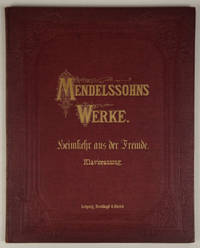
1877réf. 35155Leipzig: Breitkopf & Härtel PN M.B.122 Kl.A 1877. Folio. Original publisher's full dark red cloth with titling gilt to upper within decorative blindstamped border titling gilt to spine; dark ivory endpapers. 1 title 2-83. i blank pp. Engraved. Text in German. With "Breitkopf & Härtels Musikbücher Nr. 181" to head of upper wrapper. With Hungarian translation in ink along with marked cuts to No. 6. Terzett "O wie verschweig' ich." In the series "Felix Mendelssohn Bartholdy's Werke. Kritisch durchgesehene Ausgabe von Julius Reitz. Mit Genehmigung der Originalverleger Serie 15. Grössere weltiche Gesangwerke. Klavier-Auszug." From the Breitkopf edition of Mendelssohn's Complete Works No. 122. Together with: Heimkehr aus dem Fremde. Libretto. Leipzig: Breitkopf & Härtel 1885. 16mo. Original publisher's light gray printed wrappers. 1f. recto title verso blank 12 2 pp. publisher's catalogue of piano-vocal scores and libretti with additional publisher's catalogue to verso of upper and recto and verso of lower wrapper. Together with: An invitation to the 1931 production of the opera from the Budapest Choral and Orchestra Association Ének- és Zenekaregyesűlet partially laid down to front free endpaper signed by István Eisler for the commissioning group and with his name in ink along with a date of December 1930 to upper outer corner and handstamp of Hungarian publisher/musicseller Rózsavölgyi és társa dated December 12 1930 to lower outer corner of endpaper. Later printing. MWV L6 p. 196. Heimkehr aus der Fremde a Liederspiel in 1 act to a libretto by Karl Klingemann was given a private premiere in Berlin on 26 December 1829. The first public performance took place in Leipzig on 10 April 1851. "Mendelssohn's deft command of orchestral colour is evident throughout the work and his ability to create charming effects with the simplest of means is impressive." Clive Brown in Grove Dictionary of Opera "One of the most gifted and versatile prodigies Mendelssohn stood at the forefront of German music during the 1830s and 40s as conductor pianist organist and above all composer. His musical style fully developed before he was 20 drew upon a variety of influences including the complex chromatic counterpoint of Bach the formal clarity and gracefulness of Mozart and the dramatic power of Beethoven and Weber. Mendelssohn's emergence into the first rank of 19th-century German composers coincided with efforts by music historiographers to develop the concept of a Classic-Romantic dialectic in 18th and 19th-century music. To a large degree his music reflects a fundamental tension between Classicism and Romanticism in the generation of German composers after Beethoven." R. Larry Todd in Grove Music Online. Breitkopf & Härtel [PN M.B.122 Kl.A] unknown books
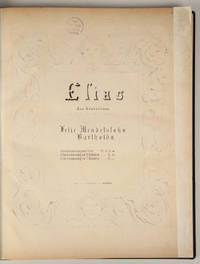
1880réf. 35203Berlin: N. Simrock PN 4648 1880. Folio. Full black cloth with original publisher's light green printed wrapper with titling within decorative border laid down to upper board. 1f. recto title verso blank 3-207 i blank pp. Text in German. Small circular handstamp of the Musik-schulen Kaiser Wien to wrapper title and several pages throughout. Binding slightly worn rubbed and bumped; wrapper slightly trimmed and lightly foxed with several minor chips and abrasions to margins. Impression to title slightly light; title and final leaf reinforced with paper tape to gutter and outer edge. Light scattered foxing throughout. First German edition later issue. MWV A25 p. 35. Not in Krause. Catalogue of the Mendelssohnb Papers in the Bodleian Library III 361 earlier issue. Hoboken 10 251 first issue. Elias an oratorio to a libretto by Julius Schubring after Kings was first performed in Birmingham on 26 August 1846. Mendelssohn made major revisions to the work following this performance introducing the new and final version in London on 16 April 1847. Mendelssohn distinguished himself in many fields and his contributions to sacred choral music are no exception. He was the most prominent advocate for the music of J.S. Bach reviving the St. Matthew Passion in 1829 and helped to reestablish the oratorio by providing two superb examples: St. Paul 1836 and Elijah 1846. "Based largely on the account in 1 Kings Elijah relates the chief events in the prophet's life: the curse of the Lord and the seven-year drought Elijah's miraculous revival of the widow's son his confrontation with the Baal worshippers and the lifting of the drought his confrontation with Ahab and Jezebel his flight to the wilderness and encounter with the Lord and his journey to Mt Horeb and ascension to heaven in a flaming chariot. As in St Paul Mendelssohn employed chorales and relied heavily upon choral numbers; noteworthy is the sheer diversity of choruses . In contrast to St Paul Mendelssohn dispensed with the narrator allowing the characters themselves to deliver the dramatic action. Elijah diverges from St Paul too in its broadly conceived musical cohesiveness; in no other work did Mendelssohn concern himself with musical structure on such a large scale." R. Larry Todd in Grove Music Online. N. Simrock [PN 4648] unknown books
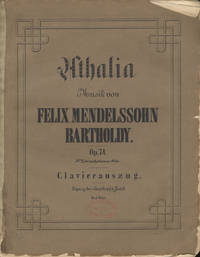
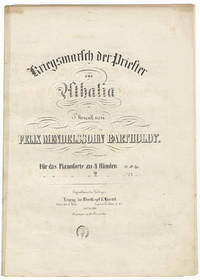
1851réf. 36208Leipzig: Breitkopf & Härtel PN 7899 1851. Folio. Original publisher's brown wrappers with titling within decorative border. 1f. recto title verso blank 3-93 i blank pp. Engraved. Text in German and French. Scharfenberg & Luis New York handstamp to blank lower margin of upper wrapper and again to lower margin of title along with publisher's stamp. Wrappers quite worn and chipped; spine reinforced with tape. Slightly browned; edges of some leaves chipped. First Edition later issue. MWV M16 p. 213. Krause 8. Catalogue of the Mendelssohn Papers in the Bodleian Library III 316. Not in Hoboken. Mendelssohn composed his incidental music for a production of Jean Racine's Athalie 1691 commissioned by King Friedrich Wilhelm IV of Prussia. It was staged for the court at the Charlottenburg Palace in Berlin on 1 December 1845. "Though little-known today the music for Athalie merits performance. Especially striking are Mendelssohn's paraphrases of chorales including Ach Gott vom Himmel sieh' darein and in a scene in which the high priest Joad describes a vision of the New Jerusalem Vom Himmel hoch. "One of the most gifted and versatile prodigies Mendelssohn stood at the forefront of German music during the 1830s and 40s as conductor pianist organist and above all composer. His musical style fully developed before he was 20 drew upon a variety of influences including the complex chromatic counterpoint of Bach the formal clarity and gracefulness of Mozart and the dramatic power of Beethoven and Weber. Mendelssohn's emergence into the first rank of 19th-century German composers coincided with efforts by music historiographers to develop the concept of a Classic-Romantic dialectic in 18th and 19th-century music. To a large degree his music reflects a fundamental tension between Classicism and Romanticism in the generation of German composers after Beethoven." R. Larry Todd in Grove Music Online. Breitkopf & Härtel [PN 7899] unknown books
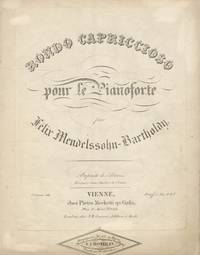
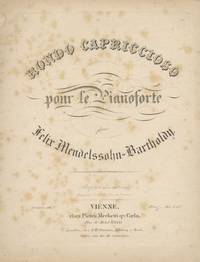
1831réf. 40960Vienne: Pietro Mechetti qm Carlo PN 2133 1831. Folio. Disbound. 1f. recto title verso blank 3-11 i blank pp. Engraved. With London agents "J.B. Cramer Addison & Beale" to foot of title. Contemporary diamond-shaped label of Swiss bookseller F. I. Rothlin to foot of title. Slightly worn browned and soiled; first and last leaves partially detached; Rothlin label very slightly trimmed at foot. First Viennese edition without Berlin agent "Ad. Mt. Schlesinger" to title. Scarce. Weinmann Mechetti p. 52. Hoboken 10 135 a later issue. Not in Krause. Pietro Mechetti qm Carlo [PN 2133] unknown books
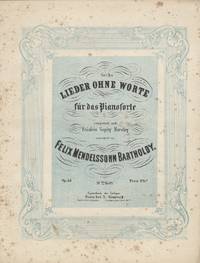
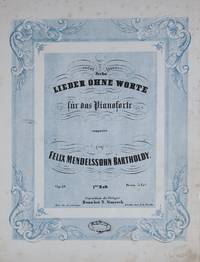
1841réf. 40964Bonn . Paris . London: bei N. Simrock . Chez Lemoine . Chez Ewer & Co. PN 3935 1841. Folio. Disbound. Contemporary dark blue paper wrappers with decorative cut paper label titled in manuscript to upper. 1f. recto title verso blank 3-21 i blank pp. Lithographed. Wrappers worn and detached. Moderate foxing to first and last leaves. Early German edition. MWV SD23 p. 478. Krause 227. Hoboken 10 222. "One of the most gifted and versatile prodigies Mendelssohn stood at the forefront of German music during the 1830s and 40s as conductor pianist organist and above all composer. His musical style fully developed before he was 20 drew upon a variety of influences including the complex chromatic counterpoint of Bach the formal clarity and gracefulness of Mozart and the dramatic power of Beethoven and Weber. Mendelssohn's emergence into the first rank of 19th-century German composers coincided with efforts by music historiographers to develop the concept of a Classic-Romantic dialectic in 18th and 19th-century music. To a large degree his music reflects a fundamental tension between Classicism and Romanticism in the generation of German composers after Beethoven . . The origins of the Lieder ohne Worte of which Mendelssohn published 36 pieces in six volumes between 1832 and 1845 two more volumes followed posthumously remain couched in mystery. Among his earliest piano lieder was one in E♭ written for Fanny's birthday in 1828 Fanny herself composed numerous examples of the genre; the idea of creating songlike piano pieces may have originated in a game Fanny and Felix played in which they apparently added texts to piano pieces. Then too the critical thought of A.B. Marx who explored in his writings of the 1820s the expressive potential and 'definiteness' of instrumental music was not without impact. Most of the lieder fall into three groups pianistic parallels to the vocal categories of solo songs duets and partsongs. The meaning of the new genre perplexed Mendelssohn's contemporaries. Schumann suggested that the composer had produced texted lieder but then suppressed the texts; when the composer's cousin Marc-André Souchay offered to give some of the lieder fanciful titles Mendelssohn replied that he had intended each lied 'just as it stands'. Only a small number of the lieder bear titles from Mendelssohn e.g. the three called Venetianisches Gondellied or his circle e.g. the 'Frühlingslied'; nevertheless later in the 19th century a host of insipid titles accrued to the lieder contributing to the view of Mendelssohn as a composer of overtly sentimental piano music for the parlour." R. Larry Todd in Grove Music Online. bei N. Simrock ... Chez Lemoine ... Chez Ewer & Co. [PN 3935] unknown books
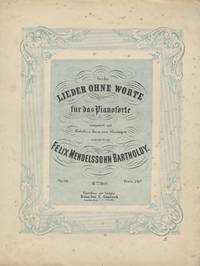
1851réf. 40963Bonn . London: bei N. Simrock . bei J. A. Novello PN 3383 1851. Folio. Disbound. Contemporary dark blue paper wrappers with manuscript title label to upper. 1f. recto title verso blank 3-19 i blank pp. Wrappers worn and detached. Moderate foxing throughout heavier to margins. First German edition later issue. MWV SD 23 p. 478. Krause 227. Hoboken 10 222. "One of the most gifted and versatile prodigies Mendelssohn stood at the forefront of German music during the 1830s and 40s as conductor pianist organist and above all composer. His musical style fully developed before he was 20 drew upon a variety of influences including the complex chromatic counterpoint of Bach the formal clarity and gracefulness of Mozart and the dramatic power of Beethoven and Weber. Mendelssohn's emergence into the first rank of 19th-century German composers coincided with efforts by music historiographers to develop the concept of a Classic-Romantic dialectic in 18th and 19th-century music. To a large degree his music reflects a fundamental tension between Classicism and Romanticism in the generation of German composers after Beethoven . . The origins of the Lieder ohne Worte of which Mendelssohn published 36 pieces in six volumes between 1832 and 1845 two more volumes followed posthumously remain couched in mystery. Among his earliest piano lieder was one in E♭ written for Fanny's birthday in 1828 Fanny herself composed numerous examples of the genre; the idea of creating songlike piano pieces may have originated in a game Fanny and Felix played in which they apparently added texts to piano pieces. Then too the critical thought of A.B. Marx who explored in his writings of the 1820s the expressive potential and 'definiteness' of instrumental music was not without impact. Most of the lieder fall into three groups pianistic parallels to the vocal categories of solo songs duets and partsongs. The meaning of the new genre perplexed Mendelssohn's contemporaries. Schumann suggested that the composer had produced texted lieder but then suppressed the texts; when the composer's cousin Marc-André Souchay offered to give some of the lieder fanciful titles Mendelssohn replied that he had intended each lied 'just as it stands'. Only a small number of the lieder bear titles from Mendelssohn e.g. the three called Venetianisches Gondellied or his circle e.g. the 'Frühlingslied'; nevertheless later in the 19th century a host of insipid titles accrued to the lieder contributing to the view of Mendelssohn as a composer of overtly sentimental piano music for the parlour." R. Larry Todd in Grove Music Online. bei N. Simrock ... bei J. A. Novello [PN 3383] unknown books
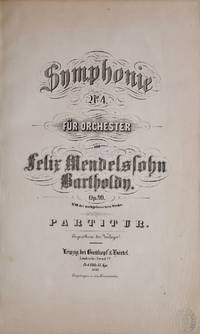
1851réf. 40958Leipzig . London: Breitkopf & Härtel . Ewer & Co. PN 8347 1851. Octavo. Contemporary dark green morocco-backed dark green cloth boards with monogrammatic device gilt to upper incorporating musical instruments. 1f. recto title verso blank 193 i blank pp. Engraved throughout. Small publisher's oval handstamp and Ewer & Co.'s blindstamp to lower outer corner of title; decorative handstamp of "The Wandering Minstrels" to blank verso of title; "Presented by" handstamp followed by signature "Hon: S. Egerton" to upper margin of first page of music. With performance markings mostly dynamics with occasional articulations in lead and blue pencil. Binding slightly worn and bumped; upper hinge partially split; endpapers browned. Occasional minor browning and staining. A very good copy overall. First Edition. MWV pp. 225-226 no. 16. Hoboken 10 no. 284. Catalog of the Mendelssohn Papers in the Bodleian Library III 734. Felix Mendelssohn Bartholdy Leipzig catalog 152. Müller-Reuter I p. 73. Fuld p. 556. Mendelssohn finished his "Italian" Symphony in Berlin on 13 March 1833 conducting its first performance in London on 13 May 1833 at a London Philharmonic Society concert. The first edition of the full score was not published until after the composer's death. "The Italian sojourn of 1830 provided the raw musical material for the Italian Symphony finished and performed in London in 1833 revised the following year but published only posthumously as Symphony no.4 in 1851. For Julius Benedict the brightly scored opening was 'warmed with the balmy air of a southern clime'. The slow movement profitably compared to the 'Marche des pèlerins' from Berlioz's nearly contemporaneous Harold en Italie begins with a haunting modal melody evidently meant to depict a religious ceremony or procession. The third movement was probably inspired by Goethe's humorous poem Lilis Park. The finale labelled 'Saltarello' begins with a characteristic hopping figure reminiscent of the saltarellos Mendelssohn heard in Rome and Naples but then introduces in its development a new conjunct figure intended according to William Rockstro as a tarantella; the two are juxtaposed in the closing bars of the score." R. Larry Todd in Grove Music Online "The Wandering Minstrels were an amateur orchestra of forty or so players drawn from the ranks of the aristocracy and military. The Earl of Wilton and his sons were leading lights in the orchestra and for many years the Earl's younger son the Honourable Seymour Egerton was conductor and president. The Wandering Minstrels conscientiously documented their activities. Their albums of posters photographs and concert programmes shine a light on a little-studied aspect of musical life in the 19th century: concerts given by noble amateurs. The albums provide information on the music performed the structure of the concerts and Victorian programming habits and show which composers - and which musical works - were popular. Mendelssohn and Gounod were the most popular composers by a long way." British Library website music blog 17 August 2012. Breitkopf & Härtel ... Ewer & Co. [PN 8347] unknown books
1851réf. 40954Bonn . Paris . London: bei N. Simrock . bei M. Schlesinger . chez J. A. Novello PN 3041 1851. 1f. recto title verso blank 3-17 i blank pp. First German edition later issue "chez" rather than "bei" J. A. Novello. MWV SD5 p. 470. Krause 216. Hoboken 10 150. Bound with: Sechs Lieder Ohne Worte Componirt und Fräulein Elise von Woringen zugeeignet . Op. 30. IItes. Heft . Eigenthum der Verleger . Pr. 3 Frs. Bonn . London . Paris: bei N. Simrock . chez N. Mori . chez Schönenberger PN 3204 ca. 1851. 1f. recto title verso blank 3-19 i blank pp. First German edition later issue. MWV SD9 p. 472. Krause 220. Hoboken 10 177. Bound with: Sechs Lieder Ohne Worte für das Pianoforte . componirt und Fräulein Rosa von Woringen zugeeignet . Op. 38. IIItes. Heft . Preis 3 Frs. Bonn . London: bei N. Simrock . bei J. A. Novello PN 3383 ca. 1851. 1f. recto title verso blank 3-19 i blank pp. First German edition later issue. MWV SD9 p. 472. Krause 220. Hoboken 10 177. Bound with: Sechs Lieder Ohne Worte für das Pianoforte . componirt und Fräulein Sophÿ Horsleÿ zugeeignet . Op. 53 . IVtes. Heft . Preis 4 Frs. Bonn . London . Paris: bei N. Simrock . Chez Ewer & Co. . Chez Lemoine PN 3935 1841. 1f. recto title verso blank 3-25 i blank pp. First German edition later issue. MWV SD23 p. 478. Krause 227. Hoboken 10 222. Bound with: Sechs Lieder Ohne Worte für das Pianoforte . componirt und Frau Dr. Clara Schumann geb. Wieck zugeeignet . Op. 62. . Vtes. Heft . Preis 3 Frs 50c. Bonn . Lyon . Mailand . London: bei N. Simrock . bei Benacci & Peschier . bei J. Lucca . bei Ewer & Co. PN 4343 ca. 1860. 1f. recto title verso blank i blank 4-19 i blank pp. First Edition early issue. MWV SD29 p. 481. Krause 231. Hoboken 10 237. Bound with: Sechs Lieder Ohne Worte für das Pianoforte . componirt und Fräulein Sophie Rosen zugeeignet . Op. 67. . VItes. Heft . Preis 3 Frs 50c. Bonn . Mailand . Paris . London: bei N. Simrock . bei J. Ricordi . bei M. Schlesinger . bei Ewer & Co. PN 4478 1845. 1f. recto title verso blank i blank 4-21 i blank pp. First Edition early issue. MWV SD32 p. 482. Krause 236. Hoboken 10 245. 6 volumes. Folio. Contemporary black cloth-backed dark blue boards with titling in manuscript to upper. Titles lithographed on blue ground within decorative blue border music engraved. Provenance Heinrich Dorn 1800-1892 noted conductor composer music critic and teacher of the Schumanns with "H. Dorn" in manuscript to upper outer corner of upper board with his small oval handstamp "H. Dorn Coeln" and handstamp "M. Schloss in Coeln" to foot of titles. Binding slightly worn and soiled with small stains to upper. Some minor foxing soiling small stains and showthrough heavier to some leaves; small dampstain to blank lower margin of final half of volume; inner margins occasionally reinforced; some minor paper repairs. "One of the most gifted and versatile prodigies Mendelssohn stood at the forefront of German music during the 1830s and 40s as conductor pianist organist and above all composer. His musical style fully developed before he was 20 drew upon a variety of influences including the complex chromatic counterpoint of Bach the formal clarity and gracefulness of Mozart and the dramatic power of Beethoven and Weber. Mendelssohn's emergence into the first rank of 19th-century German composers coincided with efforts by music historiographers to develop the concept of a Classic-Romantic dialectic in 18th and 19th-century music. To a large degree his music reflects a fundamental tension between Classicism and Romanticism in the generation of German composers after Beethoven. . The origins of the Lieder ohne Worte of which Mendelssohn published 36 pieces in six volumes between 1832 and 1845 two more volumes followed posthumously remain couched in mystery. Among his earliest piano lieder was one in E♭ written for Fanny's birthday in 1828 Fanny herself composed numerous examples of the genre; the idea of creating songlike piano pieces may have originated in a game Fanny and Felix played in which they apparently added texts to piano pieces. Then too the critical thought of A.B. Marx who explored in his writings of the 1820s the expressive potential and 'definiteness' of instrumental music was not without impact. Most of the lieder fall into three groups pianistic parallels to the vocal categories of solo songs duets and partsongs. The meaning of the new genre perplexed Mendelssohn's contemporaries. Schumann suggested that the composer had produced texted lieder but then suppressed the texts; when the composer's cousin Marc-André Souchay offered to give some of the lieder fanciful titles Mendelssohn replied that he had intended each lied 'just as it stands'. Only a small number of the lieder bear titles from Mendelssohn e.g. the three called Venetianisches Gondellied or his circle e.g. the 'Frühlingslied'; nevertheless later in the 19th century a host of insipid titles accrued to the lieder contributing to the view of Mendelssohn as a composer of overtly sentimental piano music for the parlour." R. Larry Todd in Grove Music Online Dorn "studied the piano singing and composition in Königsberg made several long journeys throughout Germany during which he met Weber in Dresden and completed his studies with Ludwig Berger Bernhard Klein and Zelter in Berlin where his first opera Rolands Knappen was produced successfully in 1826. At the same time he became a co-editor of the Berliner allgemeine Muzikzeitung for which he wrote a spirited defence of the beleaguered Gaspare Spontini. Over the next two decades he built a solid reputation as a conductor of opera holding theatre posts at Königsberg 1828 Leipzig 1829-32 where he taught counterpoint to the young Schumann Hamburg 1832 Riga 1834-43 and Cologne 1844-8. He organized the first music festival of the Russian Baltic provinces in Riga 1836 and directed the Lower Rhine music festivals 1844-7. His most prestigious appointment in 1849 after Nicolai's death was as co-conductor with Wilhelm Taubert of the Berlin Hofoper. After his retirement from that post in 1869 he remained active in Berlin for many years as a teacher and writer." Adelyn Peck Leverett revised by Christopher Fifield in Grove Music Online. bei N. Simrock ... bei M. Schlesinger ... chez J. A. Novello [PN 3041] unknown books
1831réf. 40966Vienne: Pietro Mechetti qm Carlo PN 2133 1831. Folio. Stiff marbled wrappers with manuscript title label to upper. 1f. recto title verso blank 3-11 i blank pp. Engraved. Title and final leaf moderately foxed; occasional minor foxing throughout. First Viennese edition later issue. Scarce. With London agents "J.B. Cramer Addison & Beale" and Berlin agent "Ad. Mt. Schlesinger" to foot of title. Weinmann Mechetti p. 52. Not in Krause. Hoboken 10 135 first issue. "One of the most gifted and versatile prodigies Mendelssohn stood at the forefront of German music during the 1830s and 40s as conductor pianist organist and above all composer. His musical style fully developed before he was 20 drew upon a variety of influences including the complex chromatic counterpoint of Bach the formal clarity and gracefulness of Mozart and the dramatic power of Beethoven and Weber. Mendelssohn's emergence into the first rank of 19th-century German composers coincided with efforts by music historiographers to develop the concept of a Classic-Romantic dialectic in 18th and 19th-century music. To a large degree his music reflects a fundamental tension between Classicism and Romanticism in the generation of German composers after Beethoven." R. Larry Todd in Grove Music Online. Pietro Mechetti qm Carlo [PN 2133] unknown books
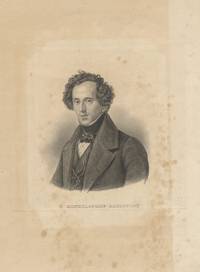
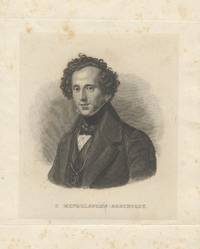
1850réf. 41200Germany 1850. Image size 146 x 124 mm; sheet size 261 x 214 mm. The composer is depicted half-length facing quarter-right. No engraver publisher or place of publication. Unevenly browned; foxed; remnants of former mount to verso. unknown books
1850réf. 41205Germany 1850. Image size 146 x 124 mm; sheet size 251 x 166 mm. The composer is depicted half-length facing quarter-right. No engraver publisher or place of publication. Slightly worn and foxed; horizontal crease to lower portion not affecting image. unknown books
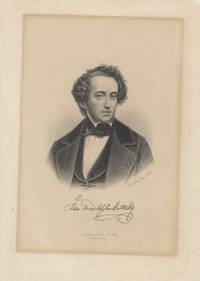
1875réf. 41198Berlin: J. Guttentags Verlags Buchhdlg. D. Collin 1875. image size 216 x 144; sheet size 238 x 170. The composer is depicted half-length facing quarter-right his head turned left with his signature printed in facsimile below image. Browned. J. Guttentags Verlags Buchhdlg. D. Collin unknown books
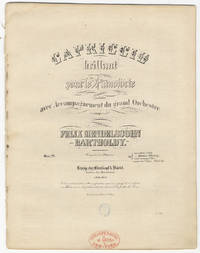
1858réf. 36212Leipzig: Breitkopf & Härtel PN 5286 1858. Folio. 1 title 2 blank 3-19 pp. Lithographed. Small oval publisher's stamp and Scharfenberg & Luis New York musicseller's stamp to foot of title. Disbound. Slightly worn; title detached; music seller's stamp very slightly cropped at lower edge. First Edition later issue. MWV 08. Krause 157 first issue. "One of the most gifted and versatile prodigies Mendelssohn stood at the forefront of German music during the 1830s and 40s as conductor pianist organist and above all composer. His musical style fully developed before he was 20 drew upon a variety of influences including the complex chromatic counterpoint of Bach the formal clarity and gracefulness of Mozart and the dramatic power of Beethoven and Weber. Mendelssohn's emergence into the first rank of 19th-century German composers coincided with efforts by music historiographers to develop the concept of a Classic-Romantic dialectic in 18th and 19th-century music. To a large degree his music reflects a fundamental tension between Classicism and Romanticism in the generation of German composers after Beethoven." R. Larry Todd in Grove Music Online. Breitkopf & Härtel [PN 5286] unknown books
1860réf. 36191Copenhague: Horneman & Erslev 1860. Folio. Disbound. 1 collective title listing within decorative lithographic border by Ch. M. Tegners 2-9 pp. Engraved. Collective title lists 19 numbers by various composers. Slightly browned and soiled. MWV U67. "One of the most gifted and versatile prodigies Mendelssohn stood at the forefront of German music during the 1830s and 40s as conductor pianist organist and above all composer. His musical style fully developed before he was 20 drew upon a variety of influences including the complex chromatic counterpoint of Bach the formal clarity and gracefulness of Mozart and the dramatic power of Beethoven and Weber. Mendelssohn's emergence into the first rank of 19th-century German composers coincided with efforts by music historiographers to develop the concept of a Classic-Romantic dialectic in 18th and 19th-century music. To a large degree his music reflects a fundamental tension between Classicism and Romanticism in the generation of German composers after Beethoven." R. Larry Todd in Grove Music Online. Horneman & Erslev unknown books
1850réf. 36199Leipzig: Breitkopf & Härtel PN 4980 1850. Folio. Unbound as issued. 1 title 2 blank 3-13 i publisher's catalogue; 9 i blank; 10; 8 pp. Engraved. The first page of the first violin part page 3 contains the song "Ist es Wahr" for voice and piano; the violin part begins on page 4. Wrappers slightly worn. Minor stain to title. Re-issue of the first edition of 1830. MWV R22 p. 276. Krause 177. Not in Hoboken. "One of the most gifted and versatile prodigies Mendelssohn stood at the forefront of German music during the 1830s and 40s as conductor pianist organist and above all composer. His musical style fully developed before he was 20 drew upon a variety of influences including the complex chromatic counterpoint of Bach the formal clarity and gracefulness of Mozart and the dramatic power of Beethoven and Weber . . Between 1827 and 1847 he composed six string quartets and had begun work on a seventh at the end of his life. The first two op. 13 in A minor 1827 and op. 12 in Eb 1829 show a rapprochement with the late quartets of Beethoven. To the Swedish musician Adolf Lindblad Mendelssohn explained his concern for the organic relationship of the various movements to the whole . In op. 13 the quintessential thematic material is drawn from the lied Frage op. 9 no. 1 with explicit quotations from the song in the outer and more hidden references in the inner movements of the quartet." R. Larry Todd in Grove Music Online. Breitkopf & Härtel [PN 4980] unknown books
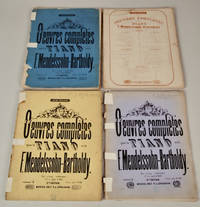
1875réf. 36204Moscou: P.J. Jürgenson 1875. Folio. Original publisher's mid-blue decorative printed wrappers. Vol. I: 125 pp. Contains opp. 5 6 7 nos. 1 and 2 14 15 16 nos. 1-3 19 and 29 Vol. II: 126-262 pp. Contains opp. 25 28 29 30 33 nos. 1-3 and 35 Book 1 Vol. IV: 263-399 pp. Contains opp. 62 Book 5 67 Book 6 72 82 83 85 Book 7 Vol. V: 536-608 pp. Contains opp. 102 Book 8 104 Books 1 and 2 105 and 106 Each volume with a collective title and index. Provenance American composer and pianist Edward Julius Biedermann 1849-1933 with his signature to upper wrappers of three volumes inscribed "To my old friend Chas. B. Hughes." Partially disbound; wrappers torn or lacking. Four of 5 volumes lacking Vol. III. Some minor wear browning and staining. "One of the most gifted and versatile prodigies Mendelssohn stood at the forefront of German music during the 1830s and 40s as conductor pianist organist and above all composer. His musical style fully developed before he was 20 drew upon a variety of influences including the complex chromatic counterpoint of Bach the formal clarity and gracefulness of Mozart and the dramatic power of Beethoven and Weber. Mendelssohn's emergence into the first rank of 19th-century German composers coincided with efforts by music historiographers to develop the concept of a Classic-Romantic dialectic in 18th and 19th-century music. To a large degree his music reflects a fundamental tension between Classicism and Romanticism in the generation of German composers after Beethoven." R. Larry Todd in Grove Music Online. P.J. Jürgenson unknown books
1852réf. 36198Leipzig: Breitkopf & Härtel PN 7867 1852. Folio. Disbound. 1 title 2-7 i publisher's catalogue. Title and music engraved. With secondary pagination. Small oval embossed stamp to upper margin of title with small oval publisher's handstamp to lower margin. Spine and leaves reinforced with clear plastic tape; slightly worn and foxed; trimmed at inner margin. "One of the most gifted and versatile prodigies Mendelssohn stood at the forefront of German music during the 1830s and 40s as conductor pianist organist and above all composer. His musical style fully developed before he was 20 drew upon a variety of influences including the complex chromatic counterpoint of Bach the formal clarity and gracefulness of Mozart and the dramatic power of Beethoven and Weber. Mendelssohn's emergence into the first rank of 19th-century German composers coincided with efforts by music historiographers to develop the concept of a Classic-Romantic dialectic in 18th and 19th-century music. To a large degree his music reflects a fundamental tension between Classicism and Romanticism in the generation of German composers after Beethoven." R. Larry Todd in Grove Music Online. Breitkopf & Härtel [PN 7867] unknown books