2 709 résultats
1982Collana storica Rizzoli a cura di Giorgio Borsa.Edizione illustrata da tavole in b / n nel testo e fuori testo e tavv.a colori fuori testo.In 8o,legatura rigida editoriale,titoli in oro al dorso,sopracoperta illustrata.ottima copia.Pp.579
1973réf. 3304156Göttingen, Vandenhoeck & Ruprecht, 1973. XI, 284 S. OKart.
In-8, broché, couverture imprimée, ix, 202 p. Edition originale. Préface de Henri Lichtenberger. Graphiques et statistiques. Bon exemplaire.
1808réf. 1182042Düsseldorf, J. W. Nöggerath, 1808. 4 Bl., 196 (recte: 166) S. Moderner Ppbd (innen gebräunt, Titel braunfl.).
In-12, demi-percaline de l'époque, dos orné de filets et d'un petit fer spécial, V, 384 p., rousseurs. L'auteur était officier d'ordonnance attaché à Jules Favre. Intéressants détails et anecdotes sur Paris pendant la révolution et le siège.
réf. 18778Paris, Paul Ollendorff, 1885. In-12, demi-percaline de l'époque, dos orné de filets et d'un petit fer spécial, V, 384 p., rousseurs.
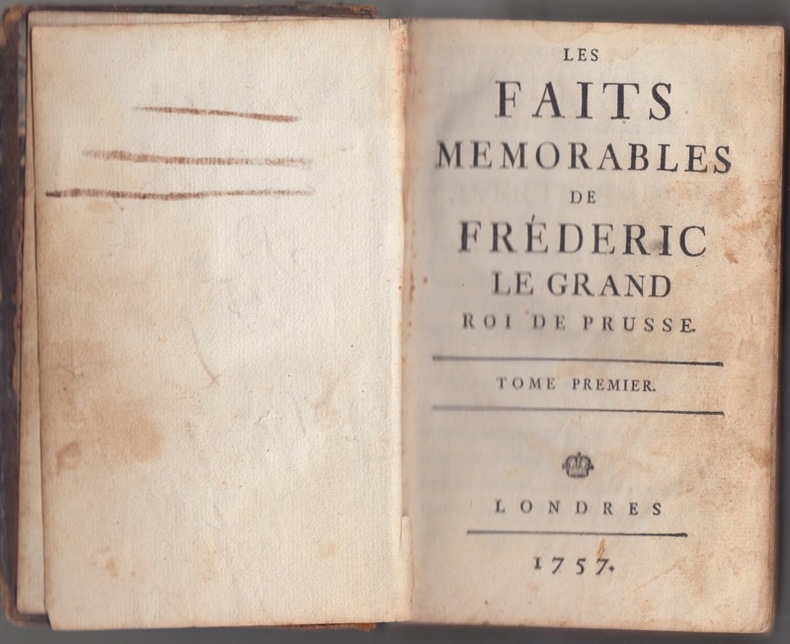
réf. 16363Londres : s. n, 1757,in-12 ,basane epoque,dos abime,reliure usagee,3 ff., 516 - 72 p. : sans le portrait ; 2 tomes en pagination continue suivi du Supplément,complet,
réf. 32698Paris, Armand Colin, 1931. In-8, broché, couverture imprimée, ix, 202 p.
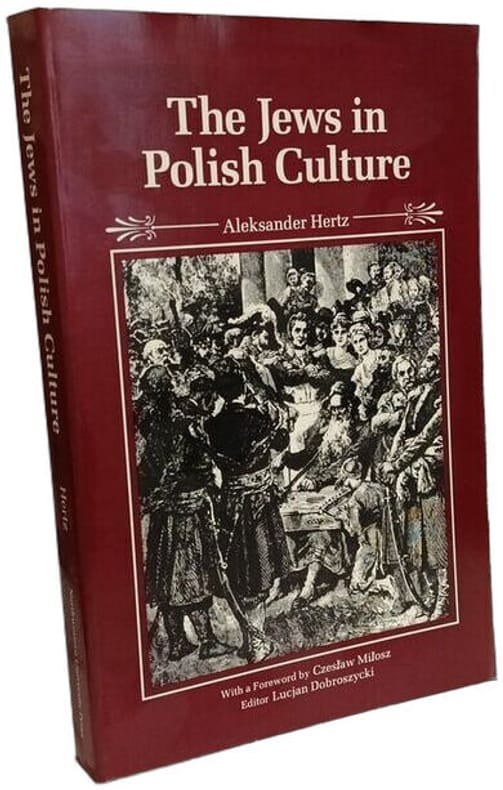
1988réf. 100145334Northwestern University Press 1988 266 pages 14 99x2 29x22 61cm. 1988. Broché. 266 pages.
In-8, broché, xii, (2), 485 p. Edition originale et unique, dans la "Bibliothèque de la Revue Historique". En février 1866, un complot de toutes les forces politiques liguées contre lui contraint Cuza à l'abdication et à l'exil. Quelques mois plus tard, un prince allemand, Charles de Hohenzollern-Sigmaringen, est élu au trône des deux principautés. Le nouvel Etat se fait nation, prend officiellement le nom de Roumanie et se dote d'une constitution. L'auteur était administrateur de l'Institut Français des Hautes Etudes en Roumanie. Bon exemplaire.
1926réf. 3355880Leipzig, Freidenker-Verlag, 1926. 162 S. Mit zeitgenössischen Illustrationen. Original Halbleinen.
réf. 34530Paris, Félix Alcan, 1930. In-8, broché, xii, (2), 485 p.
réf. COM2MBruxelles, 1868. La première série de la Lanterne d'Henri Rochefort. Premier volume, 1 à 13.Du 31 Mai 1868 au 22 Août 1868. In-16°, sous reliure d'époque demi cuir rouge, avec les couvertures brochées conservées et des découpages des journaux d'époque sur l'écrivain et son procès.
1914réf. 22424Paris/Nancy, Éditions Berger-Levrault, 1914. Broché, 16,5 cm x 25 cm, XXIII+ 125 pages, 1 planche hors-texte, 2 fac-similés, 1 carte des exigences de la Prusse. Texte de Henri Welschinger. Un petit manque sur la 4ème de couverture sinon bon état
1879Very Good German Original sepia-toned cabinet photograph taken by German photographer J. C. Schaarwachter (1847-1904). 17x11 cm. Moltke was a Prussian field marshal. The chief of staff of the Prussian Army for thirty years, he is regarded as the creator of a new, more modern method of directing armies in the field. He commanded troops in Europe and the Middle East, commanding during the Second Schleswig War, Austro-Prussian War, and the Franco-Prussian War. He is described as embodying "Prussian military organization and tactical genius.". He was fascinated with railways and pioneered their military usage. He is often referred to as Moltke the Elder to distinguish him from his nephew Helmuth Johann Ludwig von Moltke, who commanded the German Army at the outbreak of World War I. In 1835 on his promotion as captain, Moltke obtained six months leave to travel in south-eastern Europe. After a short stay in Constantinople he was requested by the Sultan Mahmud II to help modernize the Ottoman Empire army, and being duly authorized from Berlin he accepted the offer. He remained two years at Constantinople, learned Turkish, and surveyed the city of Constantinople, the Bosphorus, and the Dardanelles. He traveled through Wallachia, Bulgaria, and Rumelia, and made many other journeys on both sides of the Strait. In 1838 Moltke was sent as an adviser to the Ottoman general commanding the troops in Anatolia, who was to carry on a campaign against Muhammad Ali of Egypt. During the summer Moltke made extensive reconnaissances and surveys, riding several thousand miles in the course of his journey. He navigated the rapids of the Euphrates and visited and mapped many parts of the Ottoman Empire. In 1839 the army moved south to fight the Egyptians, but upon the approach of the enemy, the general refused to listen to Moltke's advice. Moltke resigned from his post of staff officer and took charge of the artillery. In the Battle of Nezib (modern-day Nisibis) on 24 June 1839, the Ottoman army was beaten. With great difficulty, Moltke made his way back to the Black Sea, and thence to Constantinople. His patron, Sultan Mahmud II, was dead, so he returned to Berlin where he arrived, broken in health, in December 1839. Once home Moltke published some of the letters he had written as Letters on Conditions and Events in Turkey in the Years 1835 to 1839. This book was well-received at the time. Early the next year he married a young English woman, Maria Bertha Helena Burt, the daughter of John Heyliger Burt Esq. of St. Croix in the Danish West Indies, who married his sister Augusta. It was a happy union, though there were no children.
In-16, broché, sans couverture, 47 p. Très rare: Manque à WorldCat, un seul exemplaire à KVC : Österreichische Nationalbibliothek.
In-8, pleine percaline de l'éditeur, titre doré, viii, 112 p. Edition originale, rédigé par le directeur de la Deutsche Bank. Bel exemplaire, très frais, bien imprimé sur papier de Hollande, "offert par la Deutsche Bank".
réf. 29602Leipzig, Schnurpfeil, [1891]. In-16, broché, sans couverture, 47 p.
réf. 31097Berlin, Georg Stilke, 1914. In-8, pleine percaline de l'éditeur, titre doré, viii, 112 p.
1838réf. 309741Danzig, Gerhard (ab Band 3 Berlin, Duncker & Humblot), 1838-48. Unterschiedliche Halbleder (2) u. Pappbände (3) d. Zeit (beschabt, Ecken u. Kanten stark bestoßen, Rücken von Band 5 u. 2 Rückenschilder mit Fehlstellen). [2 Warenabbildungen]
1922réf. 3160517Wien, Rikola Verlag, 1922. 229 S. Mit 17 Bildtafeln. OHlwd.
1934réf. 1199084Breslau, Priebatsch, 1934. Gr.-8vo. 2 Bl., 63, (1) S. (Schriften des Osteuropa-Institutes in Breslau 3) OKart. (unaufgeschnitten).
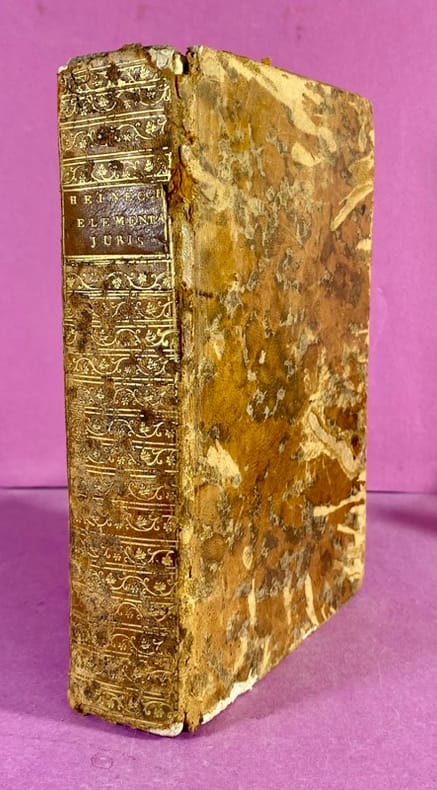
réf. 1589Couverture rigide Leipzig, Caspar Fritsch, 1740. un volume in-8 (19,5 x 12,5 cm), reliure pleine basane fauve marbrée de l'époque, dos lisse orné à la grotesque, coiffes arasées, épidermures, petits manques de cuir en pied et en tête. XII, 349 (23) pages, exemplaire entièrement interfolié, quelques taches d'encre et annotations manuscrites anciennes, papier bruni, rousseurs éparses, pages 39 à 42 désolidarisées. DUPIN 623. Johann Gotlieb Heineccius (1680-1741) fut conseiller du roi de Prusse et professeur de droit et de philosophie dans différentes universités. On considère ses commentaires comme les plus nécessaires après les oeuvres de Cujas. Les Eléments de droit civil romain, selon l’ordre des Institutes de Justinien ont été publiés en français par J. F. Berthelot en 1805.
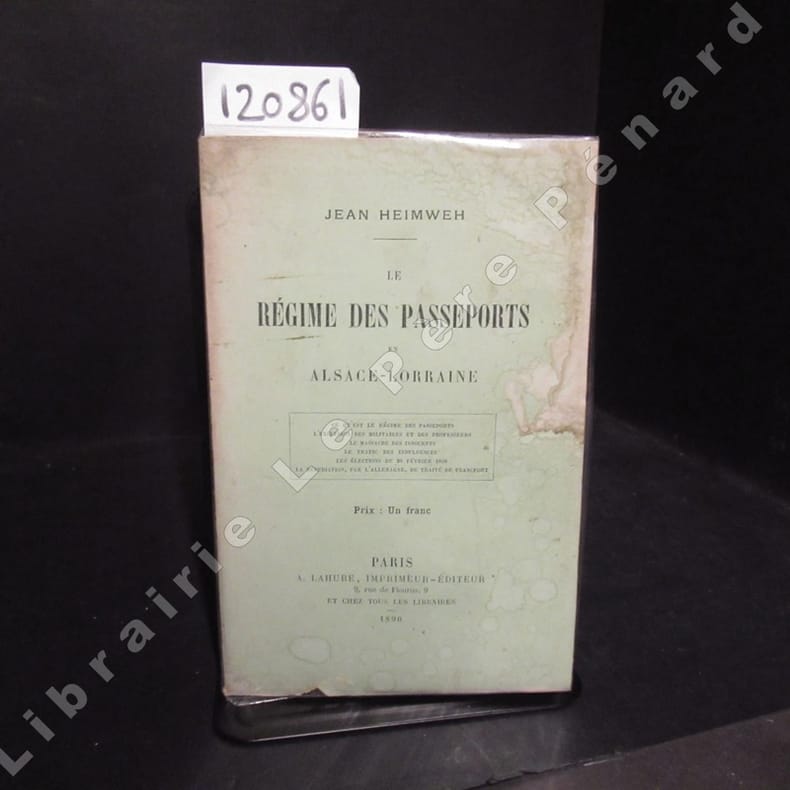
1890réf. 1208611890 A Paris, A. Lahure, imprimeur-éditeur - 1890 - In-12, broché - 76 p. - Ouvrage non coupé (jamais lu)
191716p. 8vo. Original full printed wraps. Revised and reprinted from the New York Times, July 1, 1917. Nice copy. WWI 13x2