1.282 resultados
ref. 62144Paris, R. Simon (Collection "Le Fauteuil Rouge"), 1947, in 8° broché, 137 pages ; couverture rempliée illustrée en couleurs (légèrement fanée).
ref. 334054 pages in8 et 4 pages in4 (manuscrit au crayon) - trés bon état (petite rousseurs et trous d'aiguilles à la lettre)-
1983ref. 46717London, Sotheby Parke Bernet & Co., 1983. 4°. Mit 31 ganzs. farb. Abbildungen. 77 (1) S., Illustr.-OPpbd.
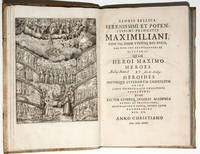
1623ref. 5340Ingolstadii: Ex officina typographica G. Haenlini 1623. Hardcover. Near Fine. 4to 27 x 17.5 cm. 17 ff. 388 pp. recte 386 7 ff. with misnumbered pages at pp. 203-06 243-46 and 260-71 1 full-page engraving 20 x 15.5 the platemark. Bound in contemporary blind-stamped pigskin raised bands boards beveled somewhat scuffed clasps missing. Blue edges small hole repaired on half title and engraving ownership inscription of Andechs Abbey on title page minor browning in some quires. An excellent and unsophisticated copy. First edition of a rare volume of prose and verse glorifying the military exploits of the Prince-Elector Kurfürst of Bavaria Maximilian I 1572-1651 by members of the University of Ingolstadt as compiled by the Jesuit philosopher-theologian Georg Stengel 1584-1651. The Gloria Bellica is an important witness to the intertwining of princely power university politics and religious sectarianism at the onset of the Thirty Years War 1618-48. Published in the year of Maximilian's elevation to Prince-Elector 1623 the book seems to have been an attempt by faculty at Ingolstadt to secure his favor. The increasingly Jesuitical university would be frequently imperiled during the flux of the war and quickly identified Maximilian himself educated by Jesuits as an important military protector. Maximilian's central role in the German Catholic League had been essential in checking the power of the Protestant Union. The volume is especially notable for its full-page prefatory engraving executed by the Augsburg artist Daniel Manasser a highly detailed and elaborate allegory charting Maximilian's martial rise and the praise conferred on him from various secular and sacred sources. Merchants clerics Liberal Arts herself and a throng of lesser citizens crowd together to salute Maximilian as he rides upward on the back of Pegasus toward the Olympian gods reclining in the empyrean; the demigod Hercules mediates between heaven and earth while battling Nessus and the Lernaean Hydra. Flanking Maximilian's ascent are 8 groups from whom he receives "Gloria": his enemies his commanders and soldiers muses and scientists hometown Bavaria the Catholic League the Holy Roman Emperor Ferdinand I the pope and church and indeed Mary Christ and the saints. The text of the Gloria Bellica is arranged as a fuller version of this scheme with 20 chapters each detailing a source Maximilian's glory. OCLC identifies U.S. copies at Harvard Trinity CT Georgetown and Chicago. VD 17 23:231047E; De Backer/S. and VII 1550 32; Lentner 3774; Pfister I 4297; Mario Praz Studies in Seventeenth-Century Imagery Rome: Edizioni di Storia e Letteratura 1975 pp. 503-04. Ex officina typographica G. Haenlini hardcover
1623ref. 5340Ingolstadii: Ex officina typographica G. Haenlini 1623. Hardcover. Near Fine. 4to 27 x 17.5 cm. 17 ff. 388 pp. recte 386 7 ff. with misnumbered pages at pp. 203-06 243-46 and 260-71 1 full-page engraving 20 x 15.5 the platemark. Bound in contemporary blind-stamped pigskin raised bands boards beveled somewhat scuffed clasps missing. Blue edges small hole repaired on half title and engraving ownership inscription of Andechs Abbey on title page minor browning in some quires. An excellent and unsophisticated copy. First edition of a rare volume of prose and verse glorifying the military exploits of the Prince-Elector Kurfürst of Bavaria Maximilian I 1572-1651 by members of the University of Ingolstadt as compiled by the Jesuit philosopher-theologian Georg Stengel 1584-1651. The Gloria Bellica is an important witness to the intertwining of princely power university politics and religious sectarianism at the onset of the Thirty Years War 1618-48. Published in the year of Maximilian's elevation to Prince-Elector 1623 the book seems to have been an attempt by faculty at Ingolstadt to secure his favor. The increasingly Jesuitical university would be frequently imperiled during the flux of the war and quickly identified Maximilian himself educated by Jesuits as an important military protector. Maximilian's central role in the German Catholic League had been essential in checking the power of the Protestant Union. The volume is especially notable for its full-page prefatory engraving executed by the Augsburg artist Daniel Manasser a highly detailed and elaborate allegory charting Maximilian's martial rise and the praise conferred on him from various secular and sacred sources. Merchants clerics Liberal Arts herself and a throng of lesser citizens crowd together to salute Maximilian as he rides upward on the back of Pegasus toward the Olympian gods reclining in the empyrean; the demigod Hercules mediates between heaven and earth while battling Nessus and the Lernaean Hydra. Flanking Maximilian's ascent are 8 groups from whom he receives "Gloria": his enemies his commanders and soldiers muses and scientists hometown Bavaria the Catholic League the Holy Roman Emperor Ferdinand I the pope and church and indeed Mary Christ and the saints. The text of the Gloria Bellica is arranged as a fuller version of this scheme with 20 chapters each detailing a source Maximilian's glory. OCLC identifies U.S. copies at Harvard Trinity CT Georgetown and Chicago. VD 17 23:231047E; De Backer/S. and VII 1550 32; Lentner 3774; Pfister I 4297; Mario Praz Studies in Seventeenth-Century Imagery Rome: Edizioni di Storia e Letteratura 1975 pp. 503-04. Ex officina typographica G. Haenlini hardcover books
2002ref. LFA-126744042N° 26 (Janvier-février 2002) de la revue "Moyen Age" : 68 pages, format 230 x 295 mm, illustrée, brochée, bon état
2005ref. LFA-126740007N° 235 (Septembre 2005): 66 pages, format 220 x 295 mm, illustré, broché couverture couleurs, bon état
ref. 156406S.l. [Kempten], Dannheimer, s.d. (1812) 52 livraisons en un vol. in-4 carré, 228 pp. en numérotation continue, texte sur deux colonnes, exemplaire dans lequel les numéros 33 & 34 ont été intervertis, sans manque, demi-basane modeste à coins, dos à nerfs, étiquette de titre manuscrit contrecollée sur le plat sup., tranches rouges (reliure de l'époque). Dos frotté, un mors sup.fendu, coins abîmés.
ref. 018771[Philippe Briet, Parallela geographiae veteris et novae] Bavière et Tirol - Allemagne et Autriche Gravure originale, 1649, environ 240*170mm. Gravure tirée de l'ouvrage du savant jésuite Philippe Briet (1601-1668) publié en 1648-1649. Texte au dos. [435]
ref. GF13198Photographie 7,5x4 cm - collée sur carton - vers 1900 -
ref. GF13199Photographie 7,5x4 cm - collée sur carton - vers 1900 -
1783ref. 0055861783 S.l.n.e., [c. 1783]. In-12 (166 X 103 mm) maroquin rouge, plats ornés d'un large encadrement de roulette dorée avec armes frappées or au centre, dos lisse muet cloisonné de filets dorés, gardes ornées d'un décor floral peint, tranches dorées (Reliure de l'époque) ; frontispice, (1) f. de titre, 91 planches, (15) ff.
2005ref. LFA-126742131Revue de 28 pages, format 205 x 300 mm, illustrée, brochée, bon état
1966ref. LFA-126722890N° 359-360-361 (Avril-mai-juin 1966), 36 pages, format 210 x 135 mm, broché, Société Dauphinoise d'Ethnologie et d'Archéologie (ancienne Société d'Ethnologie et d'Antropologie fondée en 1894 par le Docteur Bordier et dirigée de 1910 à 1933 par Hippolyte Muller)
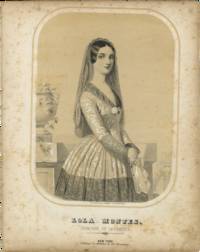
1848ref. Cat360New York: Atwill 201 Broadway 1848. Folio. Complete at 9 pages. Two songs with lithographic portrait of Lola Montez by Sarony & Major. Soft rag paper. Light foxing else very good. A likely very early American printing of two pieces tied directly to the upheavals of 1848 issued just as news and personalities of the European revolutions were electrifying American audiences. The first “Der Lieben Warnun” Love’s Warning is attributed to Ludwig I King of Bavaria whose abdication in March 1848 followed the political scandal surrounding his relationship with Lola Montez. The second “Les Girondins: Mourir pour la Patrie” with text by Alexandre Dumas and music by Alphonse Varney is one of the most popular revolutionary hymns of the period here presented in English and French. At center is the finely printed lithographic portrait of Lola Montez born Eliza Rosanna Gilbert 1821–1861 identified as “Countess of Landsfeld.” Produced by Sarony & Major the image reflects her brief but consequential position in Bavaria where Ludwig elevated her to the nobility and granted her influence at court. Her presence became politically explosive; student unrest and ministerial crisis forced both her exile and the King’s abdication making her a widely discussed celebrity at the time. Montez arrived in the United States in late 1848 quickly converting this notoriety into a touring career. She performed her “Spanish dances” including the sensational “Spider Dance” on stages from New York to New Orleans and later turned to lecturing advertising appearances on “Heroines of History” beauty and personal independence. During the early 1850s she followed the western circuit appearing in San Francisco during the Gold Rush where she commanded high fees and played to packed houses of miners and merchants. She toured through Australia in 1855–56 before returning to the United States where she settled in New York and shifted increasingly toward writing and reform-minded lectures before her death in 1861 possibly of syphilis. The piece was published by Joseph Atwill at his 201 Broadway location which he would abandon soon after to board the steamer Crescent City to Chagres eventually making his way to San Francisco and opening Atwill’s Music Store on Washington St. possibly San Francisco’s first music store before heading off to the mines and then returning to San Francisco a year later to open another music store. OCLC #904564957 locating a single copy at Goucher College. Atwill, 201 Broadway unknown
1848ref. Cat360New York: Atwill 201 Broadway 1848. Folio. Complete at 9 pages. Two songs with lithographic portrait of Lola Montez by Sarony & Major. Soft rag paper. Light foxing else very good. A likely very early American printing of two pieces tied directly to the upheavals of 1848 issued just as news and personalities of the European revolutions were electrifying American audiences. The first “Der Lieben Warnun” Love’s Warning is attributed to Ludwig I King of Bavaria whose abdication in March 1848 followed the political scandal surrounding his relationship with Lola Montez. The second “Les Girondins: Mourir pour la Patrie” with text by Alexandre Dumas and music by Alphonse Varney is one of the most popular revolutionary hymns of the period here presented in English and French. At center is the finely printed lithographic portrait of Lola Montez born Eliza Rosanna Gilbert 1821–1861 identified as “Countess of Landsfeld.” Produced by Sarony & Major the image reflects her brief but consequential position in Bavaria where Ludwig elevated her to the nobility and granted her influence at court. Her presence became politically explosive; student unrest and ministerial crisis forced both her exile and the King’s abdication making her a widely discussed celebrity at the time. Montez arrived in the United States in late 1848 quickly converting this notoriety into a touring career. She performed her “Spanish dances” including the sensational “Spider Dance” on stages from New York to New Orleans and later turned to lecturing advertising appearances on “Heroines of History” beauty and personal independence. During the early 1850s she followed the western circuit appearing in San Francisco during the Gold Rush where she commanded high fees and played to packed houses of miners and merchants. She toured through Australia in 1855–56 before returning to the United States where she settled in New York and shifted increasingly toward writing and reform-minded lectures before her death in 1861 possibly of syphilis. The piece was published by Joseph Atwill at his 201 Broadway location which he would abandon soon after to board the steamer Crescent City to Chagres eventually making his way to San Francisco and opening Atwill’s Music Store on Washington St. possibly San Francisco’s first music store before heading off to the mines and then returning to San Francisco a year later to open another music store. OCLC #904564957 locating a single copy at Goucher College. Atwill, 201 Broadway unknown books
1907Mm 300x405 Fascicolo in folio di pp. 8 con prima carta illustrate in bianco e nero, illustrazioni in nero nel testo. In buono stato. SPEDIZIONE IN 24 ORE DALLA CONFERMA DELL'ORDINE.
1901Mm 290x415 Fascicolo in folio di 8 pp. con prima e ultima carta illustrate a colori, illustrazioni in nero nel testo. In buono stato. SPEDIZIONE IN 24 ORE DALLA CONFERMA DELL'ORDINE.
2012AA.VV. QUITTENBAUM Kunstauktionen München. Auktion 106B. Highlights II Werkbund – Bauhaus - Ulmer Schule. 11. Dezember 2012. München/Monaco di Baviera (Germania), QUITTENBAUM Kunstauktionen GmbH (Theresienstraße 60) 2012 german, in ottavo pp. 78 patinate anche ripiegate I ed.. Catalogo dell'asta QUITTENBAUM GmbH, Monaco di Baviera, Theresienstraße 60, 11 dicembre 2012. Testo in tedesco. VIII grande/ 78 patinate anche ripiegate/ brossura patinata illustrata a colori ai piatti. Illustrazioni a colori e in b/n. Stato buono.
1913Roma, 1913, 1 giugno, copertina illustrata a colori in fascicolo originale completo di pp. 16 de "La Tribuna illustrata - Supplemento illustrato della Tribuna" .
1913Roma, 1913, 16 novembre, copertina illustrata a colori in fascicolo originale completo di pp. 16 de "La Tribuna illustrata - Supplemento illustrato della Tribuna" .
1864ref. boz_006938Adalbert, Prince de Bavière, oncle de Louis II de Bavière - Lettre signée au sujet du désarmement des races bovines - Palais de Nymphenburg - 1864 Lettre signée de Adalbert, Prince de Bavière, quatrième fils du roi Louis Ier de Bavière et oncle du roi Louis II. La lettre est datée du 23 novembre 1864. Rédigée à l'encre brune sur feuillet de papier vélin, sans en-tête imprimé, portant en fin de première page la mention manuscrite du destinataire. Dans cette lettre adressée à Monsieur Protais, Chef de Division au Chemin de fer de l'Ouest, Adalbert de Bavière le félicite chaleureusement de son action en faveur de la propagation des races bovines désarmées et développe une longue argumentation sur les dangers que représentent les cornes pour les éleveurs, leurs familles et le public, qualifiant cette réforme zootechnique de « progrès humanitaire » et même « chrétien ». Dimensions : 20,8 x 26,9 cm État : Bon état général. Plis inhérents à l'envoi, pliures dans les angles inférieurs, présence de petites salissures. Voir photos pour plus de détails . Nombre de pages : 2 pages
ref. Z37068ZBROCHE EDITIONS ALSATIA PHOTOS SUR DEMANDE
ref. 238124 November 1861; Munich Germany. Written while his brother Maximilian II was on the throne. Following Maximilian’s death in 1864 Bavaria would be ruled by the celebrated ‘mad king’ Adalbert’s nephew Ludwig II. The recipient is Lady Ann Cullum 1807-1875 widow of Rev. Sir Thomas Gery Cullum 1777-1855 8th Baronet of Hardwick House Bury St Edmunds who is referred to as ‘botanist and antiquary’ in his eponymous father’s entry in the Oxford DNB. 2pp 4to. Thirty-six lines neatly and closely written. On first leaf of bifolium. In good condition lightly aged and creased. Folded twice. Good firm signature underlined with flourish. Addressed at foot of first page to ‘Lady Cullum à son Château de Bury St Edmond Angleterre’. He begins with the salutation ‘Milady’ and says that he has heard through ‘M. le Conseiller Dutrône les soins que vous donnez à l’amélioration des Races Bovines désarmées’. He congratulates her for this before proceeding to expound at some length his position that the ‘œuvre’ of dehorning is ‘non seulement agricole mais humanitaire - je dirai même chrétienne puisque les vache désarmées sont moins dangereuses que les autres pour notre prochain’. What she has already done towards in regard to this matter is but a ‘gage de ce que vous ferez à l’avenir. - C’est donc avec un double bonheur que je vous adresse Milady comme signe de ralliement entre les amis cosmopolites de cette réforme un modeste specimen des Médailles d’or fondées l’un en Angleterre au Concours International d’Agriculture de Chelsmford sic l’autre en Allemagne au Congrès International de Bienfaisance de Francfort S mein’. From the Cullum family papers. 4 November 1861; Munich [Germany]. unknown
1927ref. 41186Madrid: Tip. de la "Revista de Arch. Bibl. y Museos" 1927-1935.- 5 Vols. 1 h. 369 p.; 1 h. 396 p. 2 h.; 1 h. 396 p. 1 h.; 1 h. 409 p. 1 h.; 645 p.; 4º 241 x 177 cm; Magníficamente encuadernado en Media Piel de color verde intenso lomo dorado.- RARO. Las últimas 4 hojas del tomo 5º un poco rizadas por causa de la humedad pero se encuentran firmes y fuertes. HISTORIA DEL SIGLO DE ORO ESPAÑOL Libro en español Revista de Archivos, Bibliotecas y Museos hardcover