GONCOURT (Edmond et Jules de). GONCOURT (Jules de).Livre Rare Book

2 156 résultats
1894réf. 233031894 Paris, Editions L.Conquet, 1894, in-8, reliure à la bradel, maroquin rouge à coins, dos à 5 nerfs titré au décor floral, 287 pages, joint catalogue 8 pages in fine, (Baraton Relieur).
1533réf. Ant66441533. Giovani Paulo. The books measure 6"x4" and have 16 pages 415 leaves 680 leaves 38 pages and 618 30 pages they are complete. The books are bound in full calf they are rubbed and there is a loss to the top of the spine of the first volume the hinges are strong and everything is well bound in. The first volume has an owner's bookplate some staining to the title page a little light staining in a few places and a few missing corners but no loss to the text the final leaf has a larger loss but again no loss of text. The second volume title page has marginal losses the first leaf of prelims has a loss; the rest of the text has some marginal worming a few marginal losses and slight yellowing to the outer edges. The final volume has slig unknown
1991réf. 222031991 Photographie, tirage pigmentaire, signée, justifiée EA, 1991, 40 x 30 cm, encadrée.
réf. 103766A Paris, chez Firmin Didot, Imprimeur du Roi, 1819, complet en 7 volumes in-8 de 210x130 mm environ, 640, 560, 710, 678, 684, vij-720, 671 pages, demi reliure veau bistre, dos à nerfs portant titres et tomaisons dorés, sur pièces de titre rouge et tomaisons noires, gardes marbrées. Avec 8 planches dépliantes. Quelques erreurs de pagination, coiffes supérieures ébréchées avec début de fentes sur la plupart des volumes, galeries sur certains mors-peaux (tome 3), épidermures, petites rousseurs et pages brunies, déchirure restaurée sur une coiffe (tome 1), sinon bon état. Edition originale.
1764In-4°grande; cc. (40), mancante antiporta calcografice Nel verso del front. ritr. xilogr. di Lodovico Manin, recante: Ludovico Maninus divi Marci procurator anno MDCCLXIIII. Sul front. calcogr. stemma della famiglia Manin.Testo entro cornici calcografiche iniziali e fregi xilografate. Legatura originale con stemma Maninus
1900réf. 235211900 Encre de Chine et lavis sur papier signé en bas à droite, titré en bas à gauche, (1900), 24 x 21 cm.
1985réf. 233021985 Pastel, signé en bas à droite et titré "Venezia Monteverdi", 1985, 49,5 x 44,5 cm.
1800réf. PHO-2106Paris, Tavernier, An VIII (1800), 3 vol. in-8°, XVI, 407 ; 358 ; 383 pp., Demi veau rouge, dos lisse à décor de rocaille avec auteur,titre et tomaison au dos, rousseurs et petits frottements aux plats, cachet répété. De la bibliothèque de sa SAR le Duc de Gènes avec son étiquette en page de garde et son cachet
réf. c6710Paris, L' Edition d'Art H. Piazza , 1930 ; In-8°, plein maroquin grenat, dos à multiples nerfs cernés de filets gras à froid avec au milieu du dos un cercle plein doré et nom d'auteur et titre dorés, tête dorée, couverture conservée ; le centre du 1er plat est orné d'une petite plaque d'ivoire incrustée, peinte d'un dessin original de Venise ( Andréas relieur).147pp. Illustré de dessins dans le texte par Henri Cassiers reproduits en couleurs.
réf. 13103Il Crociato in Egitto. Opéra seria in du Alti Ridotta per il cembalo. Composta da G. MEYERBEER. Nuova edizione. Parigi Maurice SCHLESINGER éditeur. 1825. (Le croisé en Egypte) In 4 demi-cuir noir, initiales dorées sur le premier plat. Titre t filets dorés. Titre gravé, portait lithographié de l’auteur, 275 pages. Ouvrage entièrement gravé. Création à la FENICE de Venise le 7 mai 1824. , présenté au théâtre Italien à Paris le 25 septembre 1825.Livret de Gaétano ROSSI.
1912réf. 24346BERNHEIM JEUNE 1912 1 Préface par Octave Mirbeau. Paris, Bernheim-Jeune et Cie, 1912, in-8, broché, couverture beige, titre marron.
1601réf. 23709Venice: Ducal Palace 1601. Leaf. Fine. Single page of vellum 12 by 16 inches folded and with cuts along two margins to seal the page. Five lines of manuscript the first two in Latin then two in Italian and the last in Latin identifying Marino di Carvallo as the Venetian Ambassador appointed by the Doge of Venice to the King of France Henry IV of Navarre. Signed at the end in Latin "Leonardus Octobonus" for the Council of Ten. He later held the post of Grand Chancellor of Venice. "Marino Gramani Doge of Venice sends greetings and affection to the Most Christian King through our noble and wise faithful and beloved Ambassador Marino di Cavallo." It then references the decision of the Council of Ten the Venetian Governing Body and finishes with "Dated in the Ducal Palace this 4th day of April.1601." The Doge Marino Gremani antagonized Pope Paul IV by trying two priests under Venetian not canon law to which the Pope responded by placing Venice under Interdict. The Ottoboni were an aristocratic Venetian family which provided Venice with more than one Chancellor and ultimately produced Pope Alexander VIII. Marino de Caballo was also from an aristocratic Venetian family and was a noted physician as well as an Ambassador who believed that the most important aspect of his job was to provide an excellent chef and fine food. Finally Henry IV of Navarre a Huguenot ruler of Navarre as Henry III secured the throne of France by converting to Catholicism: "Paris is worth a Mass." Five years later he signed the Edict of Nantes the landmark drecree granting religious tolerance to Protestants and which helped end the Wars of Religion. . Ducal Palace unknown
1601réf. 23709Venice: Ducal Palace 1601. Leaf. Fine. Single page of vellum 12 by 16 inches folded and with cuts along two margins to seal the page. Five lines of manuscript the first two in Latin then two in Italian and the last in Latin identifying Marino di Carvallo as the Venetian Ambassador appointed by the Doge of Venice to the King of France Henry IV of Navarre. Signed at the end in Latin "Leonardus Octobonus" for the Council of Ten. He later held the post of Grand Chancellor of Venice. "Marino Gramani Doge of Venice sends greetings and affection to the Most Christian King through our noble and wise faithful and beloved Ambassador Marino di Cavallo." It then references the decision of the Council of Ten the Venetian Governing Body and finishes with "Dated in the Ducal Palace this 4th day of April.1601." The Doge Marino Gremani antagonized Pope Paul IV by trying two priests under Venetian not canon law to which the Pope responded by placing Venice under Interdict. The Ottoboni were an aristocratic Venetian family which provided Venice with more than one Chancellor and ultimately produced Pope Alexander VIII. Marino de Caballo was also from an aristocratic Venetian family and was a noted physician as well as an Ambassador who believed that the most important aspect of his job was to provide an excellent chef and fine food. Finally Henry IV of Navarre a Huguenot ruler of Navarre as Henry III secured the throne of France by converting to Catholicism: "Paris is worth a Mass." Five years later he signed the Edict of Nantes the landmark drecree granting religious tolerance to Protestants and which helped end the Wars of Religion. . Ducal Palace unknown books
réf. elala5189Venice: 1737. Letter regarding penalties associated with tax arrears accumulated by the community of Asolo. one-page oblong folio. with the doge's lead seal attached with hemp. horizontal & vertical folds. postal marking 'Cito Cito Cito' haste on panel Venice: 1737 unknown
réf. 12095Paris, Chez le Normant, 1831-1833 ; 5 tomes in-8, demi-veau glacé bronze, dos lisse, faux-nerfs noirs et dorés, fleurons décoratifs, titre et tomaison dorés, tranches mouchetées de rouge (reliure de l'époque) ; (4), IV, 487, (1) pp. ; (4), 307, (1) pp. ; (4), 443, (1) pp. ; (4), 359, (1) pp ; (4), 315, (1) pp.
1915Very Good Turkish, Ottoman (1500-1928) Modern cloth bdg. Small 4to. (26 x 19 cm). In Ottoman script (Old Turkish with Arabic letters). 24 p. First edition of this epic and historically important account, describing the siege and fall of the Byzantine Empire and Constantinople by Ottoman Sultan Mehmet II in 1453. This is one of the finest literary examples of sixteenth-century Ottoman prose. "This description of the conquest of Istanbul in 1453 is mentioned only by Ismail Pasha in his "Hediyyetü'l Arifîn". The text, which was published as a supplement to TOEM (parts 20 and 21, Istanbul 1331) is said to be taken from a manuscript owned by Halis Efendi. The introduction to Ca'fer Çelebi's life was also written by Halis Efendi. The work is written in a very elegant style, with ayets, hadith, and beyts in Arabic, Persian, and Turkish scattered throughout the text and may be considered one of the finest examples of sixteenth-century Ottoman prose writing. [.] Ca'fer's work is in some aspects a reliable source for the conquest of Istanbul. The preparation for the siege is given in this work. The council of war which was held before the siege and in particular Mehmed II's speech to the council is very detailed and the chain placed across the entrance to the Golden Horn and its history is very well described in this work as well. During the siege, the Byzantines received help from the outside. Ca'fer is specific about this and states that "four huge vessels full of provisions, soldiers and ammunition came to help of the Byzantines". After the last attack, Constantinople fell into the hands of the Ottoman army. The date given for this is 857 Cem. I. 20 Seshenbe in Ca'fer's work. The plundering and looting which occurred during the first three days of the conquest are vividly described by Ca'fer Çelebi, but the withdrawal of Justinian and his men which preceded the conquest and the death of the Byzantine Emperor during the capture of the city are omitted in this work. Ca'fer's closing lines are devoted to the conversion of St. Sophia (Ayasofya) into a mosque by Mehmed II. Ca'fer Çelebi used eyewitness accounts as well as written works. It is certain that he did not rely exclusively on any source which is not extant, for the departs from Ruhi, Enverî, Tursun Beg, Neshrî, and Asikpasha-zâde either by adding new information or giving a conflicting account." (Erünsal). Özege 11953; TBTK 7066.
1557réf. 7715Aldus in Venetia, 1557 ; in-8 ; plein vélin ivoire, pièce de titre bordeaux (reliure ancienne) ; 255 ff., le dernier marque d'imprimeur des Alde.
réf. 1176Deux volumes in 12 reliés Cuir fauve dos a cinq nerfs 1776 Les érudits et les héritiers des humanistes sont cantonnés à un travail de conservation des archives, tandis que la monarchie charge des historiographes d’écrire l’histoire glorieuse du roi, à travers des modèles narratifs qui n’ont plus rien à voir avec les techniques de l’histoire critique et qui relèvent plutôt de l’éloquence cicéronienne. C’est au plus fort de cette éclipse du tacitisme qu’Amelot de La Houssaie entame sa carrière d’auteur. Après des débuts ratés comme secrétaire d’ambassade à Venise--il est accusé d’avoir volé des documents--il passe deux ans dans les bibliothèques vénitiennes et publie, lors de son retour en France, une histoire du gouvernement de Venise. Il y reprend toutes les techniques historiographiques chères à Paolo Sarpi en les retournant contre la Sérénissime, dont il dénonce la décadence.Le livre, publié en 1676 avec privilège royal, suscite la colère des Vénitiens, et conduit tout droit Amelot à la Bastille, ce qui l’amène à s’interroger sur les conditions d’un discours critique dans la France de Louis XIV. Il va privilégier désormais une nouvelle stratégie d’auteur, en publiant ses idées sous couvert de traductions et d’éditions critiques "(Antoine Lilti.École normale supérieure, Paris in H-France Review)
1960réf. 219041960 Gouache sur papier canson à grains, signée en bas à gauche, (1960), 45.8 x 32.5 cm.
1920réf. 165021920 Pochoir en couleur, signé dans la planche et numéroté, (1920), 34,7 x 44,7 cm.
1854In-folio, 32x44, con titolo, edizione di difficile collazione, stampata dall’autore. La nostra copia presenta10 titoli intermedi, 7 tavole litografiche (manca la tav. G) e 83 tavole incise (di cui 11 colorate a mano). Fogli sciolti con fogli di separazione in carta velina, in cartella originale, lacci. In-folio, 32x44, with title, difficult-to-collate edition, printed by the author. Our copy has 10 intermediate titles, 7 lithographic tables (table G is missing) and 83 engraved tables (11 of which are hand-colored). Loose sheets with tissue paper separator sheets, in original folder, laces.
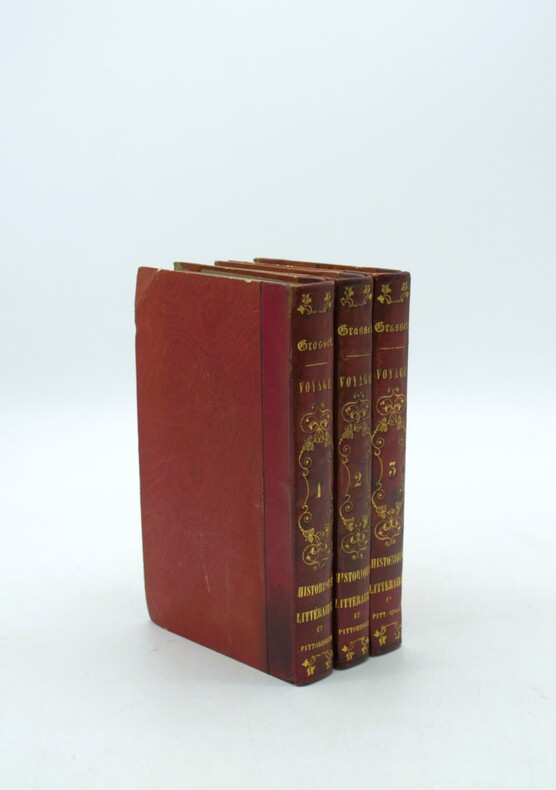
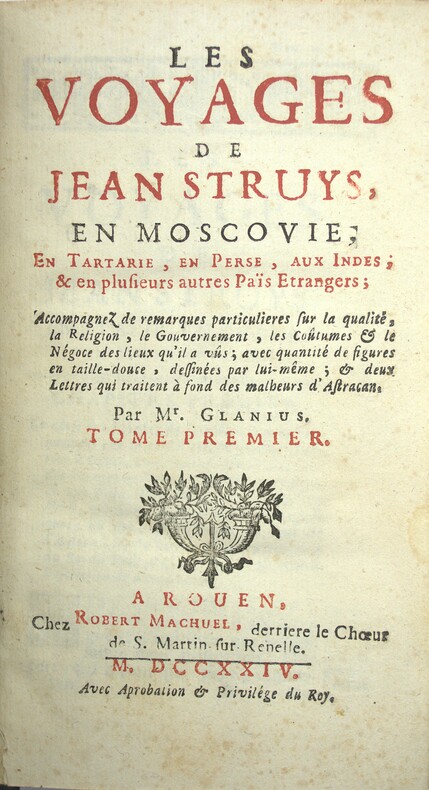
1718réf. PHO-2042Rouen & Amsterdam, chez Machuel & au dépend de la compagnie, 1718-1724, 3 volumes in-12 (165x95mm), 258pp.-3ff., titre-278pp.-5ff., titre-276pp.-2ff., illustré de 29 planches dont plusieurs dépliantes dont une carte, manque le frontispice (tome 1), reliure d’époque, dos à nerfs ornés avec titre et tomaison, frottements, coiffes arasées tome 2 & 3, début de fentes tome 2 & 3, reliure tome 1 avec différences.
1570réf. 19800Venetiis, apud Aldum, 1570, portrait de Aldus Pius Manutius gravé sur bois en médaillon au titre, (au dos de la p. de titre : Armes des Alde marque N°6) ; Editio Aldi Manutii Paulli F. Aldi N. In 8, vélin rigide, dos à faux nerfs dorés décoratifs, pièce rouge (reliure ancienne) ; [24], 45, [1 bl.], [1] f. bl., 352, 94 pp. (signatures : ?-??-??? ; (-((-((( ; A-Y ; a-e 8 ; f. 6).
1893réf. 7832Orpington, Allen, 1893. Fifth Edition. 3 Bde. XV, 403; XIV S., 1 Bl., 397 S.; 3 Bll., 352 S., 2 Bll., 135 S. mit einigen Textabb. 53 teils farb. Tafeln. 4°. Lwd. der Zeit mit Rückentitel (bestoßen und berieben).
1922réf. 143571922 P., Impr. Lapina, 1922, 1 plaquette petit in folio (320 x 210 mm) agrafée et cordon tressé gris, couverture illustrée en couleurs, de (32) pp. Nombreuses illustrations en couleurs.Superbe et en parfait état.