Salvalaggio, Nantas u. Sandro ZanottoAntiquariat.de
2.151 Ergebnisse
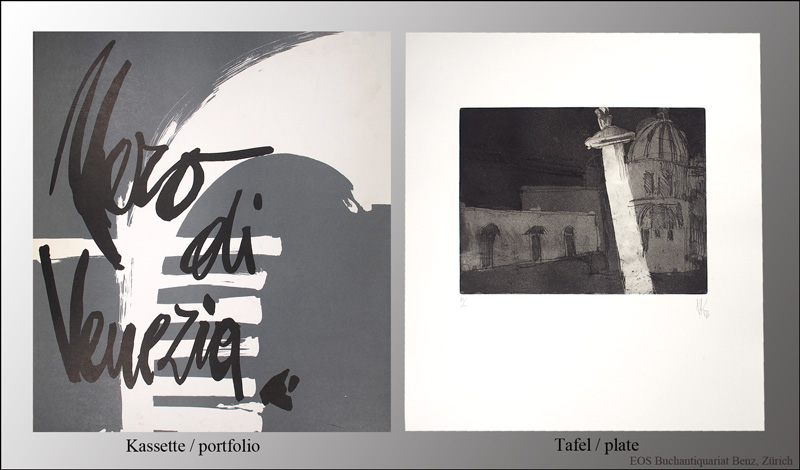
1970Best.-Nr. 5942BBVerona, Edizioni d'arte Ghelfi, (ca. 1970). Folio. (7) S. Mit 20 numerierten, signierten Radierungen u. Aquatinta von Nag Arnoldi sowie 20 Textillustr. (Verzeichnis der Tafeln) u. 1 Portrait. Lose Bogen in illustr. Orig.-Pappkassette + Wichtig: Für unsere Kunden in der EU erfolgt der Versand alle 14 Tage verzollt ab Deutschland / Postbank-Konto in Deutschland vorhanden +, 5942B (bestossen).
Best.-Nr. 2092902141501420300-Mai N.A. Soft Cover. Fine. Size: A4 Number of copies: 300 sheets 300-Mai paperback
1985Best.-Nr. SBBI-SBL-010967Solomon R. Guggenheim Foundation 1985. Good. Our good condition books are generally good for reading but not for gifting or collecting. They could have imperfections such as creasing fanning inscriptions margin notes yellowing staining on edge or cover or pages bumps scuffs etc etc sometimes multiple of these. It's a wide category that encompasses anything that isn't almost-new down to anything that is slightly better than poor. We would NOT recommend gifting Good books - these should be considered reading copies. Our books are dispatched from a Yorkshire former cotton mill. We list via barcode/ISBN so please note that the images are stock images and may not be the exact copy you receive furthermore the details about edition and year might not be accurate as many publishers reuse the same ISBN for multiple editions and as we simply scan a barcode or enter an ISBN we do not check the validity of the edition data when listing. If you're looking for an exact edition please don't order at least not without checking with us first although we don't always have time to check. We aim to dispatch prompty the service used will depend on order value and book size. We can ship to most countries see our shipping policies. Payment is via Abe only. Solomon R. Guggenheim Foundation unknown
1970Best.-Nr. 5942BBVerona, Edizioni d'arte Ghelfi, (ca. 1970). Folio. (7) S. Mit 20 numerierten, signierten Radierungen u. Aquatinta von Nag Arnoldi sowie 20 Textillustr. (Verzeichnis der Tafeln) u. 1 Portrait. Lose Bogen in illustr. Orig.-Pappkassette (bestossen).
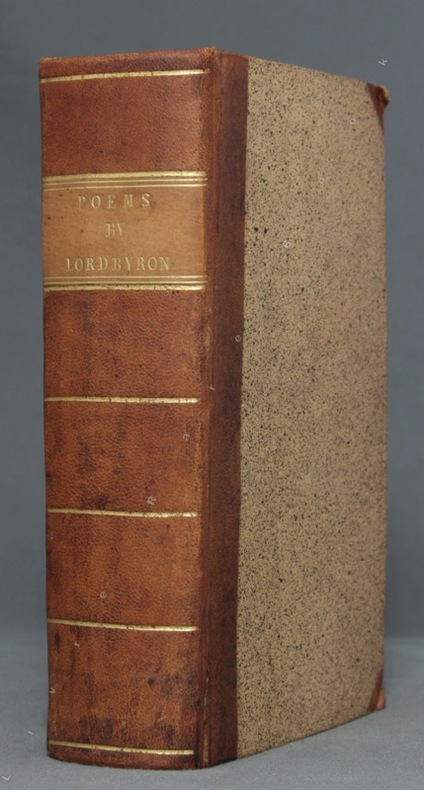
Best.-Nr. 9853Ginerva, e si vende a Parigi / London, G.-J. Paschoud / Printed for J. Murray by T. Davison, 1818 / 1814 / 1821. In-12 de XXIV-93; [8]-128; [4]-VII-47; 81-[2]; [4]-XVIII-[1]-20 à 271 pages, demi-veau blond à petits coins, dos lisse orné de filets et titre dorés, étiquette de titre caramel. Coins et dos frottés, rares rousseurs. Ex-libris Charles de Constant-Rebecque.
Best.-Nr. 14479P. VIRGILII MARONIS Poetae mantuani. Universum Poema : cum absoluta servii honorati mauri grammatici, & badij ascensij interpretatione : Probi & Joannis Uiuis in Eclogas allegorijs. Quibus Accesserunt Ludovici Poelii Rhodigini, Joan Scoppae Parthenopaei jacobi Constantis Fanensis, Francisci Campani Colensis, Jacobi Crucis Bonon, necnon alterius docti hominis lucubrationes & annotaiones in Loca diffiliora. Elegantissimae Praeterea Librorum Omnium Figurae argumenta, lectionum denique varietates, quas & Ioannes Pierius, & alij doctissimi viri hactenus obsruarunt. Que non Ut antea, plurimis foedatamendis, sed acri studio emendat, atq.omni quantum licuit, exparte expolita, emisimus, quod, alios libros cum nostro conserentibus, patebit. In 4 plein cuir fauve raciné, dos à nerfs, titre, caissons, filets dorés. Reliure du XVIème siècle, 210x280mm, page de titre avec marque typographie gravée, représentant la fortune sur un navire avec une voile gonflée par le vent devant elle Mercure et la devise Dies Arte AC Fortuna. VI- 389 pages, tranches mouchetées, texte sur 2 colonnes. Vignettes allégoriques dans le texte, lettrines. VENETIIS Apud Petrum Dusinellum 1586 Coiffes restaurées. Plats légèrement frottés, sans gravité. Bon exemplaire.
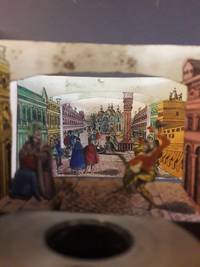
1835Best.-Nr. 3220261Concertina-folding hand-coloured lithographic peepshow with three cut-out sections front-face measuring 98 × 137 mm; the peepshow extends by paper bellows to approximately 275 mm. Hand-coloured lithograph housed in a custom made cloth box. Rare German peepshow of St. Mark's Square in Venice rather naive in appearance resembling the illustrations found in chapbooks of the time. The front-face consists of the title a view of St Mark's Square viewed from an architectural arrangement at the west end of the square symbols of carnival - a tambourine masks and a jester's bauble - and a circular peephole. The staffage on the cut-outs and backboard consist of commedia del arte figures including a dancing man with a mandolin and two dwarfs. The campanile hopelessly represented and wrongly positioned features on the third cut-out and St Mark's on the backboard. [Germany,
1991Best.-Nr. 222231991 Photographie. Tirage pigmentaire signée, justifiée 2/10, 1991, 54,5 x 36.5 cm , encadrée.
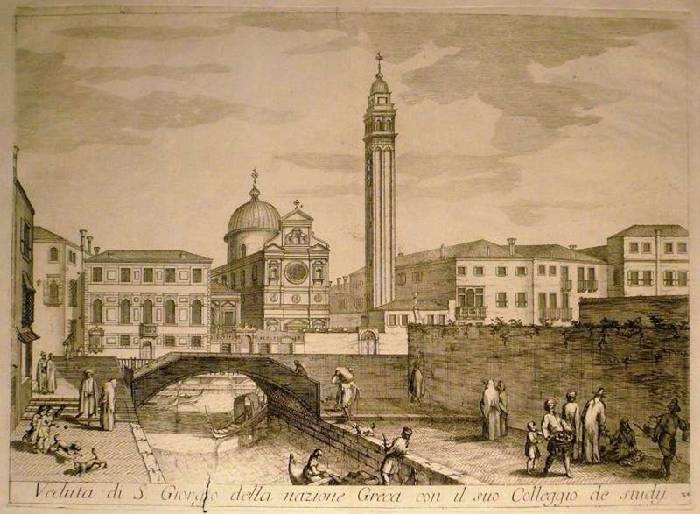
Best.-Nr. VEN001M20 Vues de Venise. Vers 1860. Relié. Dimension extérieure 46 x 36,5 cm / Illustrations 33,8 x 24,6 cm.
1546Best.-Nr. 11249Venise, Hieronymus Scotas, 1546 ; in-folio ; plein vélin ivoire en partie manuscrit (reliure de l'époque) ; (6) ff., 142 ff. recto-verso, (3) ff. le dernier, blanc, a été découpé.
1720Best.-Nr. 81848(1720). 36 x 49 cm.
1614Best.-Nr. 0006781614 Venetia [Venise], Appresso Nicolo Misserini, 1614. Petit in-quarto (174 X 233) vélin rigide à petits rabats, dos quatre nerfs (reliure de l'époque) ; (3) ff. blancs, titre, (11) ff., 496 pp. & relié à la suite 44 pp. ("Sermoni sopra l'Oratione"), (3) ff. blancs. Petite restauration au dos. Manque la pièce de titre.
FIRST EDITION of this extremely important book on Jewish culture, customs, and rituals. [52], 300, [8] pp, complete. Partially a translation of Leon of Modena's Storia degli Riti Hebraici (1637), but largely Simon's own work. Small 8vo. Attractively bound in contemporary calf, spine gilt in six compartments with raised bands. Wear to edges of boards and a ltiny bit of leather lost from tail of spine, but the binding is structurally solid and the joints are strong. Internally very clean, printed on very good paper. Sauvy 337; Barbier I, 553d (later edition); Querard III, 349d. Reprinted many times, but this first edition is very rare.
Best.-Nr. 31071S. e. Cuir S. l.
1797Best.-Nr. 1504061797. ZANETTI Anton Maria and Marco BOSCHINI. Della pittura veneziana trattato in cui osservasi l'ordine del Busching e si conserva la dottrina e le definizioni del Zanetti. Two volumes. viii 145 i.e. 245 3 including final blank pp.; 256 i.e. 272 pp. each volume illustrated with an engraved frontispiece. 8vo 165 x 110 mm. bound alike in contemporary paste paper decorated with red flowers against a striped ground later glassine wrappers. Venice: Presso Francesco Tosi 1797. First edition based on Boschini's Le Minere della pittura 1664 and Zanetti's Della Pittura Veneziana 1771 with additions by the publisher Tosi. Both Boschini and Zanetti were of fundamental importance to the history of art in Venice. Schlosser-Magnino calls Boschini's guide "the first true artistic guide to Venice" and Zanetti's inventory of Venetian painting "one of the best in its genre" p. 548. This handy set combines their work into a comprehensive practical guide to monuments of Venetian art and architecture including a final section Istoria della Pittura Veniziana sic with biographies of artists; and an addition made in 1797 identifying paintings that were transported out of Venice by military force the same year. Marco Boschini 1613-1678 was a Venetian painter engraver and art dealer whose most important client Cardinal Leopoldo de' Medici commissioned him to purchase Venetian paintings for the Medici collection. Zanetti 1706-1778 was the librarian to the famed Marciana Library in Venice for forty years and his familiarity with the art and artists of his city and his access to library records helped to produce his remarkable books. On Zanetti's guide Cicognara adds: "This is the best of the works which deal with Venetian painting and if every principal city possessed a book so arranged and executed we should have gathered together the materials for the best general history of art". Fossati-Bellani 2339. Cicogna 4661. Schlosser-Magnino pp. 548-549. Cicognara 2412 Zanetti & 4350 Boschini. unknown
1588Best.-Nr. 0048811588 In Venetia [Venise], Appresso gli Heredi di Marchiò Sessa, 1588. Petit in-folio (212 X 304 mm) vélin rigide ivoire à coutures apparentes, lettre «V » peinte et dorée, dans un cadre peint et doré, en tête du dos (reliure de l'époque) ; (1) f. blanc, (100) ff. dont titre. Pointes de taches noires au dos, quelques petits trous de vers sur les mors de la reliure, infime travail de ver dans la marge latérale gauche et petit manque en lisière de la marge de tête du feuillet de titre, petit travail de ver aux trois derniers feuillets avec perte de quelques lettres, tampon encré en grande partie illisible sur le premier feuillet blanc, petite mouillure brune en lisière de la marge latérale des feuillets 38 à 54 avec quelques petits manques de papier ; ex-libris et mention manuscrits à l'encre brune en marge du titre.
1790Best.-Nr. 000261Paris Veuve Duchesne et Fils, de l'Imprimerie de Monsieur 1790
1873In -4°, tre voll., pp. XXI, (1), 400 + 21 tavv; VI, 394 + 21 tavv; (4), 362 + 12 tavv.; legatura in mezza pelle con nervi, fregi e titoli al dorso; molte delle tavole litografiche sono colorate a mano. Copia firmata della seconda edizione del noto e fortunato capolavoro di Ruskin (la prima era del 1853, qualificata come “a revolutionary success”, Pmm). A signed copy of the second edition of the notorius work by Ruskin (the first, of 1853, is qualified by Pmm as a “revolutionary success”).
1540Best.-Nr. 6505Venetia (Venezia), Marchia Sessa, 1540 ; in-8 ; plein vélin vieil ivoire (reliure de l'époque) ; (32) ff., 224 ff., le dernier verso blanc ; grand bois gravé (88 x 78 mm) en page de titre représentant Sainte Catherine recevant les stigmates et marque d'imprimeur à la suite du collophon, achevé d'imprimer du 29 avril 1540, date anniversaire de la mort de la Sainte (29 avril 1380).
1861Best.-Nr. 21393Lyon, Imprimerie de Louis Perrin, 1861 ; in-4° oblong (270 x 360 mm), demie-percaline vert-foncé à coins, dos lisse à faux nerfs dorés, fleurons et titre dorés (reliure de l’époque) ; [3] ff. (Faux-titre, Titre illustré gravé par I. Séon, dédicace à Auguste Caristie), 15 planches gravées par Dubouchet (9), I. Séon (5) et Thomassin (1), comportant chacune une serpente légendée d’un feuillet ; [1] f. de Table.
1606In-4°, (2cc), Clemens papae V. Monitorium, & declaratio excommunicationis, interdicti, & aliarum poenarum ecclesiasticarum contra Venetos ... 12cc; Sixti papae IV. Declaratio & promulgatio excommunicationis, interdicti, & aliarum censurarum contra Venetos ...(10cc); Iulii papae II. Monitorium, & declaratio excommunicationis, interdicti, & aliarum censurarum ecclesiasticarum contra Venetos ...(10cc) + Mandata Reipub. Venetae ad concordandum cum Iulio II (8cc)+ Absolutio Venetorum ab excommunicatione & anathemate per Iulium II (2cc) La ripresa dell'economia veneziana fu accompagnata, negli anni a cavallo tra Cinquecento e Seicento, dalla ricerca di un'autonomia dalla Spagna e dal papato. La ricerca dell'autonomia – che spinse Venezia a stabilire accordi diplomatici con i principi protestanti, con l'Inghilterra e la Francia di Enrico IV – condusse la Repubblica a crescenti tensioni e poi allo scontro con la chiesa romana, guidata all'epoca da papa Paolo V. La fase più acuta della contrapposizione si verificò con la vicenda dell'"interdetto" (1606-1607). In questa occasione, Venezia non si piegò alle richieste del papa di abrogare alcune leggi che regolavano la proprietà ecclesiastica nel territorio della Repubblica, rifiutandosi anche di consegnare due sacerdoti veneziani, accusati di delitti comuni, che l'autorità religiosa pretendeva di giudicare secondo i propri codici e di sottrarre così alla giurisdizione civile. Di fronte all'"interdetto", cioè alla scomunica comminatale da Roma, la Serenissima reagì con vigore: furono tra l'altro espulsi da Venezia i gesuiti, il potente ordine religioso identificato come strumento delle interferenze papali nella vita della Repubblica. Dopo una fase di tensioni crescenti, in cui Venezia ottenne l'appoggio degli stati protestanti, la vicenda si avviò alla sua conclusione grazie a un compromesso, favorito dal re di Francia. The recovery of the Venetian economy was accompanied, in the years between the sixteenth and seventeenth centuries, by the search for autonomy from Spain and the papacy. The search for autonomy - which led Venice to establish diplomatic agreements with the Protestant princes, with England and the France of Henry IV - led the Republic to growing tensions and then to the clash with the Roman church, led at the time by Pope Paul V. The most acute phase of the opposition occurred with the "interdetto" (1606-1607). On this occasion, Venice did not bow to the pope's requests to repeal some laws that regulated ecclesiastical property in the territory of the Republic, also refusing to hand over two Venetian priests, accused of common crimes, which the religious authority claimed to judge according to their own codes and thus remove from civil jurisdiction. Faced with the "interdict", that is the excommunication imposed by Rome, the Serenissima reacted vigorously: among other things, the Jesuits, the powerful religious order identified as an instrument of papal interference in the life of the Republic, were expelled from Venice. After a phase of growing tensions, in which Venice obtained the support of the Protestant states, the affair was drawn to its conclusion thanks to a compromise, favored by the King of France.
1606In-4°, 48pp, frontespizio con marca editoriale e motto In te Domino speravi non confundar in aeternum, capolettera xilografico. Lo scritto di Bernardo Giusti si inserisce nella polemica seguita alla cosiddetta ‘guerra dell’interdetto’, in cui Venezia non si piegò alle richieste del papa di abrogare alcune leggi che regolavano la proprietà ecclesiastica nel territorio della Repubblica, rifiutandosi anche di consegnare due sacerdoti veneziani, accusati di delitti comuni, che l'autorità religiosa pretendeva di giudicare secondo i propri codici e di sottrarre così alla giurisdizione civile. Bernardo Giusti condanna i sostenitori dell’indipendenza veneziana equiparandoli a Wycliff e Marsilio da Padova. In-4 °, 48pp, title page with printers mark and motto In te Domino speravi non confundar in aeternum, wood engraved initial. Bernardo Giusti's writing is part of the controversy following the so-called 'guerra dell’interdetto', in which Venice did not bow to the pope's requests to repeal some laws that regulated ecclesiastical property in the territory of the Republic, also refusing to hand over two Venetian priests , accused of common crimes, which the religious authority claimed to judge according to their own codes and thus to remove from civil jurisdiction. Bernardo Giusti condemns the supporters of Venetian independence comparing them with Wycliff and Marsilio of Padua.
1793In-8°; pp. (8), 312, 11 tavole; pp. 408 (piccoli fori di tarlo alle ultime carte), tavole 7. Piccola marginale integrazione alle prime due carte del tomo primo e alla prima del secondo. LEgature in cartonato coevo, dorso restaurato al secondo volume. Completo delle 18 tavole fuori testo incise su rame, alcune più volte ripiegate.
1540Best.-Nr. 003398Gaetano, in Venetia In-12 (15,5 x 11 cm), 1 bl., titre avec encadrement, 2 ff., 4 ff., 1 bl., 87 ff. numérotés, 1 bl., reliure demi-vélin crème, titre manuscrit au dos (reliure ancienne).
1771Best.-Nr. 13273Venezia Giovambattista Albrizzi 1771 fort vol in 12 de 16 ff.n.ch. et 490 pages et 1 ff de privilège demi basane contemporaine avec étiquette et plats papier dominoté .(manque pages de texte 259 à 270)