2.156 Ergebnisse
1606In-4°, 84pp, frontespizio con marca editoriale e motto In te Domino speravi non confundar in aeternum, capolettera xilografico. Il coinvolgimento del card. Bellarmino nella polemica inerente alla guerra dell’interdetto si evidenzia in questo scritto, in cui il Cardinale confuta le tesi sostenute in due libretti contro il Breve di papa Paolo V sopra la censura. Rari commenti manoscritti al margine della prime carte. In-4°, 84pp, title page with printers mark and motto In te Domino speravi non confundar in aeternum, wood engraved initial. The involvement of card. Bellarmino in the controversy inherent to the guerra dell’interdetto is highlighted in this writing, in which the Cardinal refutes the theses supported in two booklets against the Breve of Pope Paul V on censorship. Rare handwritten comments in the margin of the first leaves.
1647Best.-Nr. 0041011647 Venetia [Venise], Presso Antonio Bariletti, 1647. In folio (249 X 355) demi-vélin ivoire, plats de carton souple (reliure de l'époque); (4) ff. (dont titre orné d'une grande vignette gravée), 60 ff.. Ex-libris «DR» [Désiré Ruggieri] dessiné et gravé par Baticle collé sur le premier contreplat.
45x32cm., [26p.] Album de 26 photographies (tirages albuminés) de paysages vénitiens de Carlo Naya, de dimensions 34x26 cm, dont 4 photos en couleurs présentant une forte tonalité bleue, donnant un "effet nuit", et retouchées à l'aquarelle. Tampon de l'atelier sur certaines pages, mais pas sur toutes. Quelque traces d'usure sur la reliure, sinon très bon état.
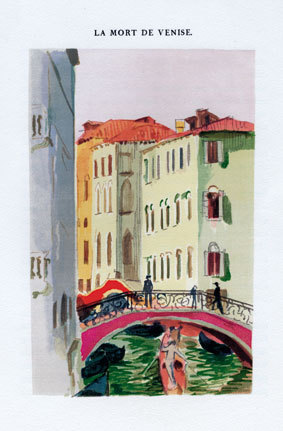
1947Best.-Nr. 6464Paris, Éditions Textes Prétextes, 1947. In-4 de 76-[16]p., en feuilles, couverture illustrée en couleurs, bel étui de papier bleuté, avec le nom de l'éditeur estampé en blanc, formant une composition sur le premier plat du dit étui. Exemplaire très propre.
Best.-Nr. 16808VENISE,NAYA C,IN FOLIO reliure demi toile a coins (posterieure) 44,5x 32 cm,composé de 17 photographies originales colles sur carton fort avec texte au dos en 4 langues; a l’adresse :Piazza ST.MARCO 77/78 bis, sans date vers 1870;avec timbre sec sur 16 planches;bon etat
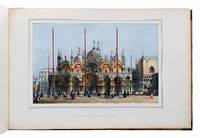
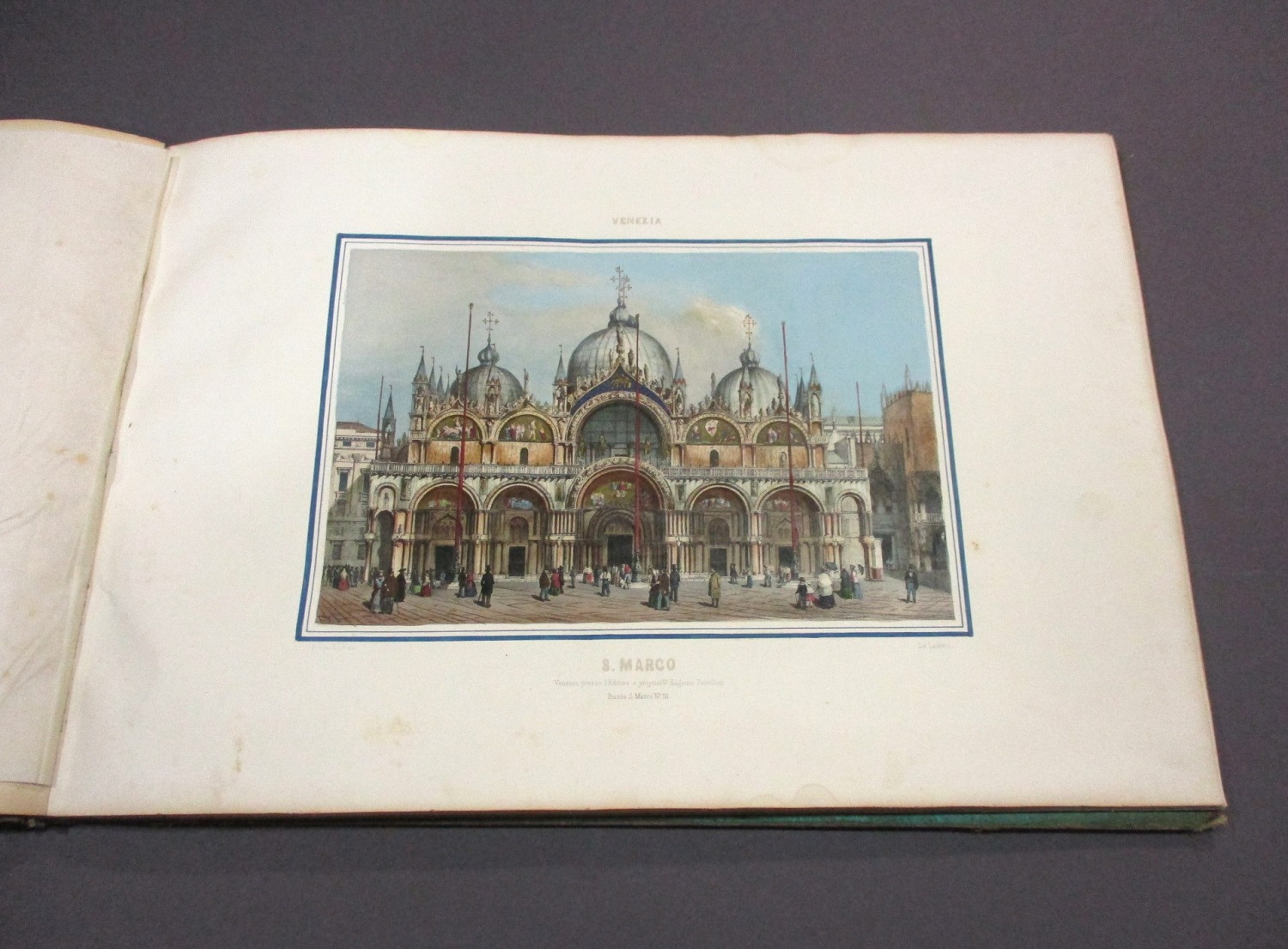
Best.-Nr. 64620Venice: Gio. Brizeghel c.1855. Oblong folio 27 x 40 cm. 19 leaves. Original half cloth over printed boards. Vignette title and 18 lithographed plates with hand-colouring some heightened with gum arabic. Front free endpaper creased and slightly torn some light foxing and browning boards a bit soiled and worn generally a very good example. The plates include: Place St. Marc Petite Place de St. Marc Basilique de St. Marc Intérieur de l'Église de S. Marc Pont des Soupires Porte Principalle du Palais Ducal Cour du Palais Ducal l'Arsenal Quai des Esclavons Pont de Rialto Palais Foscari Eglise de Notre Dame la Laitiere de Venise Porteuse d'Eau à Venise Porteur d'Eau à Venise Gondolier de Venise Môle de la Place St. Marc à Venise Eglise de N.D. de la Salute sur le Grand Canal. Venice: Gio. Brizeghel, [c.1855]. hardcover
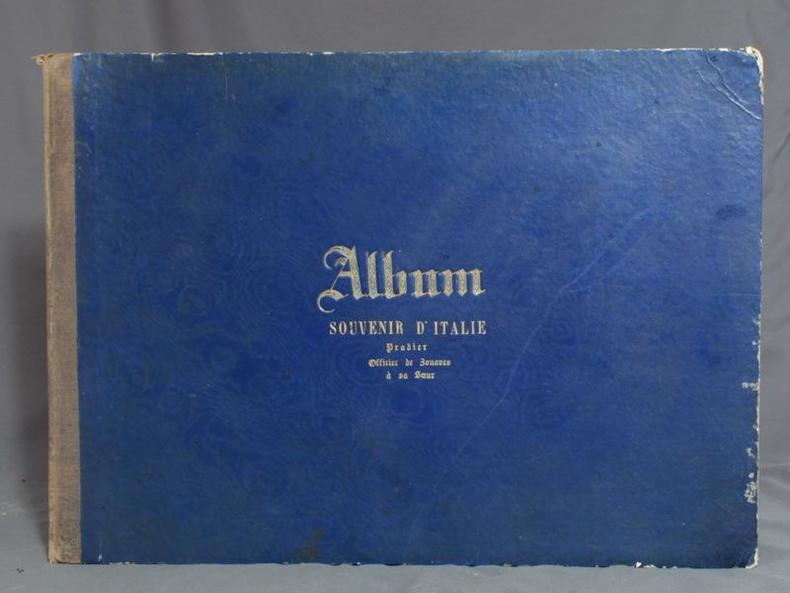
1840Best.-Nr. 4550[vers 1840]. In-folio à l'italienne, dos en toile, plats de papier moiré bleu nuit, titre doré au premier plat (coins légèrement frottés).
1930Best.-Nr. 1180Paris, Editions EOS, 1930 ; in-4 en feuillets, couverture rempliée rouge-brique, sous chemise cartonnée à larges rabats et lacets de soie de même couleur et illustrée d’un grand bois gravé bistre, dos en percaline bistre ; (4) feuillets, 88 pages, (4) feuillets ; 20 bois gravés en couleurs dont dix hors-texte, six vignettes et culs-de-lampe et un grand bois illustrant l’étui et la couverture.
1850Best.-Nr. 22619Venedig, Testolino, ca. 1850). 12 altkolorierte lithographiete Tafeln (ohne das lithograph. Titelblatt). Quer-Fol. Lwd. der Zeit mit Deckeltitel (bestoßen und beschabt). [5 Warenabbildungen]
1847Best.-Nr. 36278Venedig, Giuseppe Kier, 1847. Aus zwei Teilen zusammengesetztes Panorama von Giovanni Pividor (Ansicht 18,8 x 173 cm; Blattgröße 30 x 188,5 cm) in getönter Lithographie, gerollt in bedruckter lithogr. OPp.-Rolle.
1680In-4°, 2 voll. parte prima (20), 780 (i.e. 782), (62p), pag 167 e 168 erroneamente ripetute; parte seconda (5), 732pp, (40), 1 di errata. Legatura in piena pelle coeva con decorazione su entrambi i piatti dei due volumi, nervature e titolo in oro al dorso, tagli in rosso, frontespizi illustrati, ritratto calcografico del doge Alvise Contarini alla carta 3v del primo volume e del doge Marc’Antonio Giustiniani alla carta 3v del secondo volume, numerosi ritratti calcografici nel testo con stemma nobiliare, finalini. Alessandro Maria Vianoli fu uno storico e avvocato veneziano. La sua opera principale è Historia veneta, in cui a partire dalla leggendaria storia antica di Venezia nel primo libro, vengono trattati tutti i dogi fino ad Alvise Contarini. Solo Marin Faliero, giustiziato nel 1355 ha la targa vuota (p.435 primo volume) In-4 °, 2 vols. part one (20), 780 (i.e. 782), (62p), pages 167 and 168 erroneously repeated; second part (5), 732pp, (40), 1 of errata. Contemporary full calf binding with decoration on both plates of the two volumes, ribbed back and gilt title on the spine, red edges, illustrated title pages, chalcographic portrait of doge Alvise Contarini on paper 3v of the first volume and of Doge Marc'Antonio Giustiniani on paper 3v of the second volume, numerous chalcographic portraits in the text with coat of arms, tail ornaments. Alessandro Maria Vianoli was a Venetian historian and lawyer. His main work is Historia veneta, in which starting from the legendary ancient history of Venice in the first book, all the doges are examined up to Alvise Contarini. Only Marin Faliero, beheaded in 1355, has no portrait (p.435 first volume)
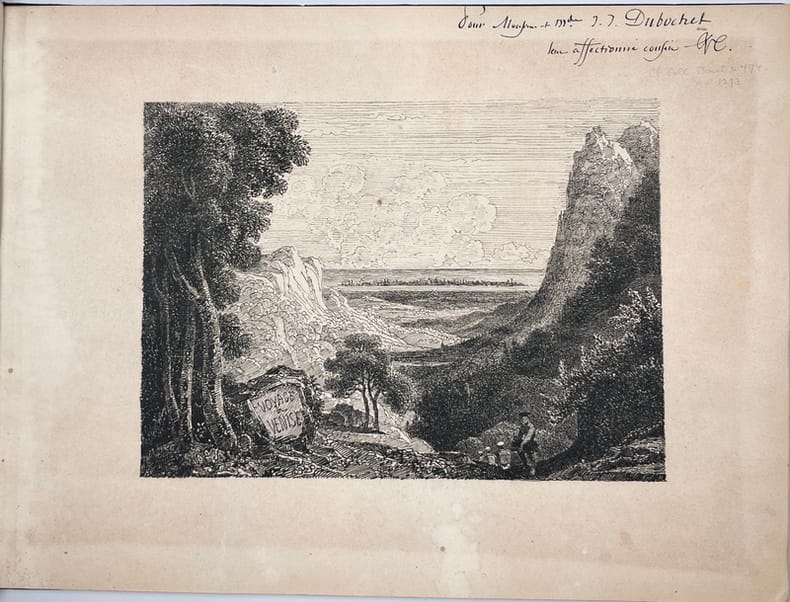
1841Best.-Nr. 21157Genève, Autographié chez Schmid, 1841. In-4 oblong de 109 pages, demi-chagrin vert, dos orné de fers romantiques dorés, plats de percaline, titre doré au premier plat : "Voyage de Venise". Couvertures crème illustrées conservées.
1830Best.-Nr. D7073Venice: Eugenio Testolini n.d. c. 1830. Hardcover. Very Good. Publisher's half brown cloth and printed boards; oblong folio 240 x 343 mm; contains lithographed title-page with inset view of a gondolier and 11 beautifully hand-colored lithographed plates many with the embossed stamp of the publisher in the lower margin. Boards soiled and scuffed; spine tips corners and edge of boards lightly bumped. Nice and bright on the inside! Aside from some faint marginal foxing plates are simply lovely. Eugenio Testolini hardcover
1830Best.-Nr. D7073Venice: Eugenio Testolini n.d. c. 1830. Hardcover. Very Good. Publisher's half brown cloth and printed boards; oblong folio 240 x 343 mm; contains lithographed title-page with inset view of a gondolier and 11 beautifully hand-colored lithographed plates many with the embossed stamp of the publisher in the lower margin. Boards soiled and scuffed; spine tips corners and edge of boards lightly bumped. Nice and bright on the inside! Aside from some faint marginal foxing plates are simply lovely. Eugenio Testolini hardcover books
Best.-Nr. 73961491 Venise chez Christophore de Pensis , 1491, reliure tres rustique en parchemin d'époque manque page de garde , la page de titre est légèrement "entamée" .. environ 30 pages à laver . Incunable , 31 x 22 cm
1929Best.-Nr. 19791Paris, Société Nouvelles des Editions d’Art Devambez, 1929 ; in folio, veau bleu nuit décoré d’une gondole dorée sur les deux plats et le dos, un gondolier en action et une paline décorée, sous un ciel étoilé, titre à la japonaise en lettres fantaisie, contreplats de même, avec quatre coins carrés fauve mosaïqués et reliés par deux filets dorés gras et maigre, entourant une pièce de soie bleu-roi, garde identique, tête dorée sur témoins, couverture et dos conservés, non rogné, étui bordé (Bayard. Lyon).
2013Bibbia di Venezia (Venice bible). Scripta Maneant, 2013. Ultima traduzione completa della Sacra Bibbia a cura della CEI, con coordinamento di Mons. Giuseppe Betori. Fotografo Sandro Vannini. Opera in due volumi (ormato 29x47 cm.) : Antico Testamento (pagine 600), Nuovo Testamento (pagine 416). All’interno il testo si alterna ai capolavori dei mosaici policromi della straordinaria Basilica veneziana. Legatura in piena pelle di vitello conciata al naturale, dorsi con sei nervi e titoli stampati in oro, piatti con al centro, incassato, mosaico in vertoceramica e oro. I volumi sono custoditi in appositi cofanetti. Tiratura di 1999 esemplari. Condizione di nuovo.
1946THE UNIQUE PUBLISHER'S COPY OF BAUDIER'S MASTERPIECE, WITH ALL OF THE ORIGINAL DRAWINGS AND OVER 150 ORIGINAL ETCHINGS, SOME OF WHICH ARE UNIQUE. A SPECTACULAR LIVRE D'ARTISTE FOCUSING LARGELY ON VERSAILLES, with 31 original etchings by Paul Baudier, one of the great book artists of the 20th century. From a total edition of 163 copies, this is THE UNIQUE COPY ON JAPANESE PAPER, PRINTED FOR GUIDO COLUCCI, THE PUBLISHER. *****This copy includes: *****(1) The book itself, printed on Japanese paper (no other copies were printed on Japanese paper). It is justified "Exemplaire unique imprimÈ pour M. Guido Colucci". The 31 etchings are in final state (on Japan, of course, and unique as such), and first and the last are signed in pencil by the artist (the first etching is also warmly inscribed by the artist to Colucci). *****(2) FOUR ADDITIONAL SUITES OF THE 31 ETCHINGS: the first (remarque) state in black on Japan (UNIQUE); the first state in black on Auvergne laid paper; the second state (with many of the remarques still partially visible) in black on Auvergne (UNIQUE); the final state in bistre on Auvergne. *****(3) ALL OF THE ORIGINAL DRAWINGS FOR THE ETCHINGS USED IN THE BOOK. Most of these are executed in pencil, but several employ ink, contÈ crayon, white heightening, etc. ALL OF THESE WONDERFUL DRAWINGS ARE SIGNED BY THE ARTIST. *****(4) The four planches refusÈes in two states: first state on Japan (UNIQUE) and in first state on Auvergne (there was no second state of any of these, of course.) *****(5) The three original SIGNED drawings for the four planches refusÈes (the other planche refusÈe is based on a drawing, in the group described above, from which one of the plates used in the book was adapted.) *****(6) Six original drawings similar to those used in the book, four of which are signed by Baudier and one of which is initialed. *****(7) The original watercolor design by Baudier for the cover of the book (ultimately not used). Folio. Loose as issued in original wraps. Housed in publisher's board chemises and slipcases (this copy, for obvious reasons, is housed in two slipcases rather than one). FINE AND BRIGHT, WITH NO DEFECTS. In all, 161 original etchings, of which 97 are UNIQUE, and 39 ORIGINAL DRAWINGS. AN ASTONISHING AND IMPORTANT COPY OF AN OUTSTANDING LIVRE D'ARTISTE, IN PERFECT CONDITION.
1717Best.-Nr. 56704to manuscript on vellum 23.5 x 17.1 cm 7 ff. 4 ff. vellum blanks including a full-page frontispiece illumination of Venetian Lion of St. Mark each text page with foliate borders in gold ink headings and initials in gold ink. Bound in contemporary Venetian morocco elaborately gold tooled gold block-printed foliate pastedowns. Edge wear and minor rubbing to spine and boards manuscript loose in binding oxidizing to edges of pastedowns. Marginal flaws to frontispiece illumination just touching border in places a few small wormholes elsewhere minor handsoiling. Finely illuminated early 18th-century Venetian manuscript issued by the city's Magistrato alla Sanità Health Department as a license to certify the physician Antonio Damugliano d. 1747 to practice medicine in the Venetian Republic using his propriety formula for topical salves balsami to treat "wounds and ulcers" f. 3v-3r. The manuscript ornately written out and decorated in gold and colored ink opens with a full-page image of the winged Lion of San Marco in the Venetian landscape which serves as an official seal of the document's authenticity and is inscribed by five Provveditori of the Magistrato and one notary who witnessed the certification. This pharmaceutical license represents a rare material survival of how Venice's Magistrato alla Sanità regulated the practice of medicine in its territories even down to the level of controlling how individual practitioners could work with specific drugs. Damugliano presumably was required to keep the document on his person while plying his trade and to present it to the relevant authorities or even to his patients should his practice be called into question. The text of the document is written out twice – first in Italian and then in Latin – to suit the linguistic preferences of both the common Venetian citizen and the professional medical class. Damugliano also known as Antimo Damulianos is noted in the document dated April 1717 as being a native of the Ionian island of Zante or Zakynthos at the time a Venetian colony and having recently returned from Moscow "where with good success and for a long time he practiced medicine with full official permission of many noteworthy people" f. 2v. Damugliano is said to have studied medicine in Europe likely in Italy specializing in contagious diseases and eventually practicing in Asia Minor Persia India China Egypt Constantinople and Trieste and to have been ordered by Emperor Charles VI 1685-1740 to treat the sick of a plague outbreak in Corinth see L. Zoes passim. Damugliano's name is also associated with a 1725 treatise entitled 'Medicina' which circulated in manuscript form in Venice and dealt with the use of salves pills and stones to treat hydrophobia see L. Zoes; we have been unable to locate a copy of this treatise. Damugliano is also recorded as having worked in Vienna where an April 1746 news magazine comments that the "very famous" Damugliano having traveled through numerous kingdoms has arrived to demonstrate the curative powers of "the wondrous Chinese stone called Bezoar" which is effective against fevers snake bites fatigue colic etc. Nachtrag p. 64. The bezoar stone an indigestible mass formed in the digestive tract of ruminants was lauded from the middle ages as a universal antidote to poison. R. Palmer "Pharmacy in the Republic of Venice in the Sixteenth Century" in A. Wear et al. eds. The Medical Renaissance of the Sixteenth Century pp. 100-17; Epeteris: Hetaireia Byzantinon Spoudon vol. 43-44 1977 p. 417; H. Schmuck Grieschischer Biographischer Index vol. 1 p. 247; L. Zoes Lexikon historikon kai laographikon Zakynthou vol. 1; S. Carbone Provveditori e sopraprovveditori alla Santità della Repubblica di Venezia; P. Selmi "Il Magistrato all Sanità" in Difesa della Sanità a Venezia Secoli XIII-XIX pp. 28-50; Nachtrag zu denen wöchentlich-kurtzgefaßter historischer Nachrichten Der neuern Europäischen Begebenheiten auf das Jahr 1746 p. 64.
1717Best.-Nr. 56704to manuscript on vellum 23.5 x 17.1 cm 7 ff. 4 ff. vellum blanks including a full-page frontispiece illumination of Venetian Lion of St. Mark each text page with foliate borders in gold ink headings and initials in gold ink. Bound in contemporary Venetian morocco elaborately gold tooled gold block-printed foliate pastedowns. Edge wear and minor rubbing to spine and boards manuscript loose in binding oxidizing to edges of pastedowns. Marginal flaws to frontispiece illumination just touching border in places a few small wormholes elsewhere minor handsoiling. Finely illuminated early 18th-century Venetian manuscript issued by the city's Magistrato alla Sanità Health Department as a license to certify the physician Antonio Damugliano d. 1747 to practice medicine in the Venetian Republic using his propriety formula for topical salves balsami to treat "wounds and ulcers" f. 3v-3r. The manuscript ornately written out and decorated in gold and colored ink opens with a full-page image of the winged Lion of San Marco in the Venetian landscape which serves as an official seal of the document's authenticity and is inscribed by five Provveditori of the Magistrato and one notary who witnessed the certification. This pharmaceutical license represents a rare material survival of how Venice's Magistrato alla Sanità regulated the practice of medicine in its territories even down to the level of controlling how individual practitioners could work with specific drugs. Damugliano presumably was required to keep the document on his person while plying his trade and to present it to the relevant authorities or even to his patients should his practice be called into question. The text of the document is written out twice – first in Italian and then in Latin – to suit the linguistic preferences of both the common Venetian citizen and the professional medical class. Damugliano also known as Antimo Damulianos is noted in the document dated April 1717 as being a native of the Ionian island of Zante or Zakynthos at the time a Venetian colony and having recently returned from Moscow "where with good success and for a long time he practiced medicine with full official permission of many noteworthy people" f. 2v. Damugliano is said to have studied medicine in Europe likely in Italy specializing in contagious diseases and eventually practicing in Asia Minor Persia India China Egypt Constantinople and Trieste and to have been ordered by Emperor Charles VI 1685-1740 to treat the sick of a plague outbreak in Corinth see L. Zoes passim. Damugliano's name is also associated with a 1725 treatise entitled 'Medicina' which circulated in manuscript form in Venice and dealt with the use of salves pills and stones to treat hydrophobia see L. Zoes; we have been unable to locate a copy of this treatise. Damugliano is also recorded as having worked in Vienna where an April 1746 news magazine comments that the "very famous" Damugliano having traveled through numerous kingdoms has arrived to demonstrate the curative powers of "the wondrous Chinese stone called Bezoar" which is effective against fevers snake bites fatigue colic etc. Nachtrag p. 64. The bezoar stone an indigestible mass formed in the digestive tract of ruminants was lauded from the middle ages as a universal antidote to poison. R. Palmer "Pharmacy in the Republic of Venice in the Sixteenth Century" in A. Wear et al. eds. The Medical Renaissance of the Sixteenth Century pp. 100-17; Epeteris: Hetaireia Byzantinon Spoudon vol. 43-44 1977 p. 417; H. Schmuck Grieschischer Biographischer Index vol. 1 p. 247; L. Zoes Lexikon historikon kai laographikon Zakynthou vol. 1; S. Carbone Provveditori e sopraprovveditori alla Santità della Repubblica di Venezia; P. Selmi "Il Magistrato all Sanità" in Difesa della Sanità a Venezia Secoli XIII-XIX pp. 28-50; Nachtrag zu denen wöchentlich-kurtzgefaßter historischer Nachrichten Der neuern Europäischen Begebenheiten auf das Jahr 1746 p. 64. books
Best.-Nr. 10603Suite de 28 gravures, plus les quatre pages de titre, elles aussi gravées, sur vélin fort, à grandes marges, en un volume In folio à l’italienne plein cuir fauve, 550x435mm, double filet à froid sur les plats. Titre gravé, 355x245mm à la cuvette, deuxième titre 295 x 165mm à la cuvette 3 titre 495x165mm à la cuvette.. Ponte di Rimino Indice dellie Tavole conetenute in quest’Opera (avec des erreurs dans la présentation et la numérotation des planches) planche 5 : Veduta delle’ Arco fabricato in onore d’Augusto Cav. Piranesi inc.en marge inférieure le numéro dans la planche angle supérieur droit.397x257 à l cuvette. Planche 6 : Parto del Foro di Nerva , numéro dans la planche angle supérieur droit. 270x136mm à la cuvette. Planche 7 : Arco di Tito in Roma 265x130mm à la cuvette, numéro dans la planche partie supérieure droite. Planche 9 : Arco Di Constatino in Roma. Piranesi F au bas à gauche dans la gravure. Le numéro 9 est à peine visible, noyé dans les hachures. Planche11: Tempo di Giano et Arco degli Argentieri eretto a settimio Severo in Roma. Piranes Fecit , numéro dans la gravure angla supérieur droit. 266x135mm à la cuvette Planche 12 : Anfiteatro Flavius dessto il colosseo in Roma. Piranese fecit dans la marge inférieure gauche ainsi que le numéro. 273x135mm à la cuvette. Planche 13 : Arco di Settimio. 1) Tempo della concordia 2) Salta di camidoglio. Piranesi s. en marge inférieure droite Israël Silvestre del en marge inférieure gauche.. Planche 14 Ponte Senatorio aggi deto ponte Rotto 1)Tempio di Vesta-2) Tempio della Fortuna virile-3) Porte dell’antico Palation. Piraneses sc. En marge inférieure droite, Israël Silvestre del, .en marge inférieure gauche 259x122mm à la cuvette.Numéro gravé dan la planche angle supérieur droit. Planche 15 : Foro di Augusto Piranese fecit dans la gravure angle inférieur droit. Numéro dans la gravure angle supérieur droit. 265x135mm à la cuvette. Planche16 : Ponte di Rimino fabricato da Augusto e da Tiberio Imperatori. Piransesi fécit en marge inférieure gauche. Numérotation en marge inférieure gauche. 264x136mm. Planche 17 : Antichi A Roma Fuori di Roma Designate ed incise da Gaimbatistta Piranesi Architetto Veneziano Partie seconda. Piranesi fécit en marge inférieure gauche Roma Si vende d’alla auttore dirimpetto l’Academia di Franzia. Arco di Romano erroto ad Augusto. Numérotation dans la gravure angle supérieur droit. 264x130mm. Planche 18 :Sepolcro degliseipioni sull’ant via Appia. Piranese dans la gravure. Numérotation dans la gravure angle supérieur gauche. 272x136m à la cuvette. Planche 20 : Arco di Rimino fabricatada da Augusto. Piranese dans la planche, sous le titre à droite. Numérotation dans la gravure angle supérieur droit 271x137mm à la cuvette. Planche 21 : Tempio di Pola in Istria. Piranes fecit dans la petite marge inférieure gauche. Numérotation dan la marge inférieure droite. 258x126mm, à la cuvette .Planche 22 Rovesio del tempio di Pola in Istria 1) Rovescio di un altro tempio. Piranesi fecit en marge inférieure gauche. Numérotation dans la gravure angle supérieur droit. 255x130mm à la cuvette. Planche 23 : Antféteado di Pola in Istria Vicino al mare. Piranesi fecit en marge inférieure gauche ; Numérotation en marge inférieure gauche. 264x13mm à la cuvette. Planche 24 : Arci di Pola in Istria Vicino alla Porta. Piranesi fecit en marge inférieure gauche. Numérotation (tav) en marge inférieure droit. Planche 25 : Anfiteato di Verona detto l’Arena. Titre gravé dans la planche dans la partie inférieure gauche. Numérotation angle supérieur gauche. 264x130mm à la cuvette. Planche 26 : Tempo di ditunno all Venet ra fuligno e spolette Allevene. Titre et signature Piranese, gravés à la pointe au bas à droite. Numérotation angle supérieur droit. 269x135mm à la cuvette. Planche 27 : Sepolcro delle tres Fratelle curiati in Atrano Titre et signature, Piranese, gravés dans la planche, angle inférieur droit. 262x133mm à la cuvette. Planche 28 : Arco di traiano in Ancona Piranese fécit gravé au dessus du titre. 272x135mm à la cuvette. Planche 29 : Sepolco di Metella deto Capo di Bove. Piranese fecit , double signature La première gravée en majuscules, la seconde au dessous en minuscules. Il s’agit de la planche 20 dont le chiffre 0 a été recouvert du chiffre 9 à la plume. 270x136mm à la cuvette. Planche 30 : Parte dell’antica Via Appia fuoris di Porta Sebastiano circa tre miglia. Piranes fecit au bas à gauche en marge inférieure. Numérotation dans la planche angle supérieur droit. 270x135mm à la cuvette. Planche 31 Arco di Galieno 1) Facciata della chiesa di S. Vito. Piranesi fecit en marge inérieure droite. Numérotation dans la planche angle supérieur droit. 270x136mm à la cuvette. Planche 32 Tempio di Minerva Madica Franc. Piranesi fecit en marge inférieure droite Numérotation en marge supérieure droite. Belles épreuves après 1760. Une déchirure en marge extérieure d’une planche réparée, sans atteinte à la gravure. Traces de tampons effacés, avec habiles recouvrements pour certaines. Fort rare.
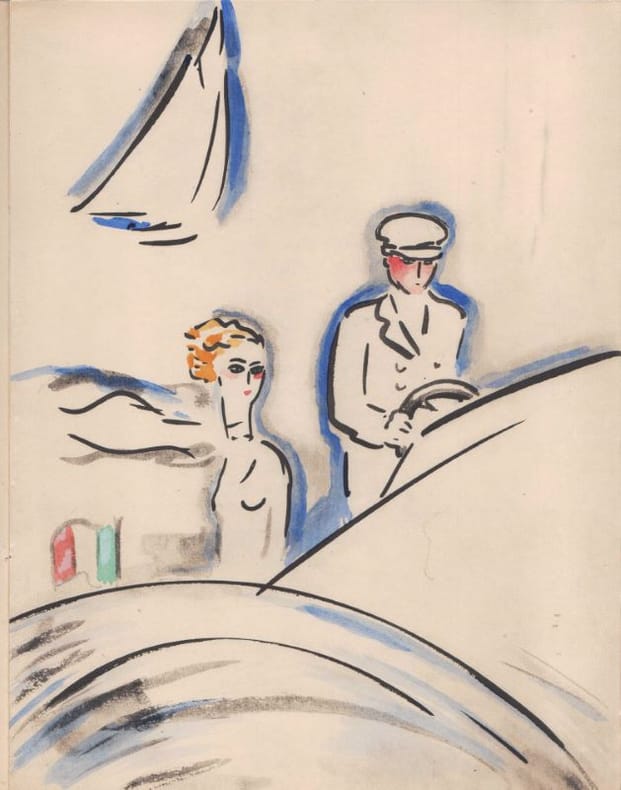
1925Best.-Nr. 21947Cité des Livres 1925 1 Aquarelles de Van Dongen. Paris, A La Cité des Livres, Maître coloriste Jean Saudé, 1925, grand in-4, broché, couverture illustrée d'un voilier, sous étui cartonné gris-bleu, titre en long sur le dos.
Best.-Nr. 19594Venezia, dalla tipografia Andreola [et] dalla tipografia di commercio, 1828 [et] 1831. Deux volumes reliés en un, pleine percaline verte. 12 pages de texte, 48 pl. et [4]-33-[3] pages, 16 pl.
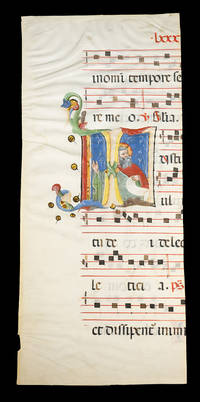
1420Best.-Nr. 0123This exquisite miniature is by Cristoforo Cortese the most accomplished Venetian illuminator of the early fifteenth century. Executed during the formative stage of his career it once formed part of a sumptuous Camaldolese Gradual. The bearded prophet set within an initial I is rendered with Cortese's hallmark precision: expressive features painted with delicate strokes highlighted with red-rimmed haloes and radiant yellow tones. These qualities firmly align the work with Cortese's early output before 1420. The stylistic vocabulary recalls both Florentine models and Venetian innovations. Cortese clearly drew upon the influence of Don Silvestro dei Gherarducci whose Choir Books for San Michele in Murano 1392–1399 provided prototypes for half-length prophet figures. Yet Cortese's interpretation more vibrant and emotive shows the confident individuality that would earn him recognition as the pioneer of Venetian Renaissance illumination. The palette dominated by blues reds and yellows closely parallels related cuttings: a Bust Portrait of a Bearded Man in the Getty's Compendium moralium notabilium MS Ludwig XIV 8 f. 34v; a Saint John the Evangelist in the Victoria and Albert Museum inv. D.637B-1894; and the Entry into Jerusalem at the Fitzwilliam Museum Cambridge Marlay Cutting It. 20. The square notation on the verso written on four-line red staves rastrum 25 mm confirms its liturgical function as part of a choirbook used in monastic chant. Provenance: 1. USA private collection early 20th Century framing tag S.Schwartz picture frames 128 W 42nd Street New York with a note pasted in the back of the frame "This fragment is old German. The miniature is a perfect work of art. Age no less 500 years.". Sister Leaves Known To Exist In: Victoria and Albert Museum Saint Peter initial "C"; Free Library of Philadelphia Saints with initials "G" and "S"; Additional leaves include the Apostle initial "T" and Standing Saint initial "E" formerly F. G. Zeileis collection sold at Sotheby's; Cambridge Fitzwilliam Museum Entry into Jerusalem initial "D"; Museo Civico Medievale Bologna a prophet initial "C"; Softer sales—e.g. Prophet initial "V" Sotheby"s; Robert Lehman Collection; Les Enluminures Paris Bearded Bishop initial "S"; Prophet and St. Paul. Literature: F. Todini in Una collezione di miniature Italiane vol. II 1994 no. VII; M. Bollati Dalla Bibbia di Corradino a Jacopo della Quercia in Duecento 1997 pp. 128-29; G. Freuler Tendencies of Gothic in Florence: Don Silvestro dei Gherarducci Corpus of Florentine Painting IV.7.2 1997; G. Zeileis Più ridon le carte 2009 no. 11; S. Panayotova "Cristoforo Cortese in Cambridge" in Miniatura. Lo sguardo e la parola 2012 pp. 186-89. Illuminated Gradual on parchment
1840Best.-Nr. 030-I1840. Aquarell über Bleistift, auf cremefarbenem Aquarellkatron, links signiert, datiert und bezeichnet ?C. Werner f. 1840. Rom.? 24,3:33,1 cm. Provenienz: Galerie Arnoldi Livie, München. Wunderbar farbfrisches, charakteristisches Aquarell von herausragender künstlerischer Qualität! Vergleichsliteratur: Galerie Joseph Fach, Frankfurt am Main, Kat. 75 mit Farbabb. S. 71; Ausst. Katalog: Venedig Bilder in der deutschen Kunst des 19. Jahrhunderts. Karlsruhe/Paderborn, 2011, Seite 208, Farbtaf. 72.