SAINT SIMON (Maximilien Henri, Marquis de).Livre Rare Book

1770réf. 0045631770 Amsterdam, Marc Michel Rey, 1770. Grand in-folio (340 X 515 mm) demi-veau fauve marbré à petits coins de vélin ivoire, dos cinq nerfs ornés d'une roulette dorée, caissons dorés ornés, palettes en queue et tête, pièce de titre maroquin grenat (reliure de l'époque) ; (4) ff. de faux-titre, titre, explication et tables, XXXIV-76 pages, 36 planches hors-texte, six cartes couleurs dépliantes. Quelques rousseurs claires marginales, déchirure sans manque habilement restaurée en marge de la planche XIX, dos pastiche entièrement refait.
VECCHIA LEGATURA IN MEZZA PELLE VERDE CON TITOLO AL DORSO. BELLISSIME LE 59 TAVOLE PUBBLICATE A LONDON DA I. MERIGOT, N.28 HAYMARKET, E R. EDWARDS, 142 NEW BOND STREET. IL FORMATO DEL SOLO DISEGNO E' CIRCA 22X15. LE STAMPE RAPPRESENTANO ROMA E DINTORNI ( CASCATE DI TIVOLI, CASCATE DI TERNI, VARIE PORTE DI ROMA, PONTE NOMENTANO, COLOSSEO, COLONNA TRAIANA, PONTE SALARIO, S. AGNESE, IL PANTHEON, PONTE MOLLO, VILLA MEDICI, FONTANA EGERIA, LAGO DI NEMI, NARNI, CIVITA CASTELLANA, LAGO DI ALBANO, VICOVARO, VARIE......) TUTTE LE STAMPE SONO A COLORI. IL VOLUME E' COMPOSTO DELLE SOLE TAVOLE, NON C'E' TESTO formato: 44X34.5 stato conservazione: BUONO, QUALCHE TAGLIETTO ALLE VELINE ED UN PAIO AI MARGINI
1776- PRIMO STATO DI QUATTRO -Acquaforte e bulino, 1776 circa, firmato in lastra in basso; esemplare della contemporanea tiratura romana.Magnifica prova, impressa su carta vergata coeva, con pieni margini, in perfetto stato di conservazione. Della serie Vedute di Roma. L’opera consiste in 135 lastre prodotte individualmente dal Piranesi per almeno 30 anni, da circa il 1745, fino alla data della sua morte. All’opera sono aggiunte poi due vedute realizzate dal figlio Francesco. Per la prima volta furono edite dall’editore Giovanni Bouchard nel 1751 (34 lastre), successivamente dallo stesso Piranesi editore a Strada Felice prima e Palazzo Tomati poi (indirizzi che appaiono su molte tavole), fino alla stesura definitiva composta da 137 lastre. Successivamente alla morte dell’autore le matrici furono ereditate dal figlio Francesco, che ne curò la pubblicazione prima nella capitale - le cosiddette tirature “postume romane” - e successivamente a Parigi, dove furono stampate tre edizioni – la cosiddetta “prima di Parigi”, una intermedia (entrambe su carta vergata) e quella curata dall’editore Firmin Didot, la prima su carta senza vergelle, dove le tavole presentano l’aggiunta di un numero arabo ordinale. Tutte le tirature parigine sono piuttosto modeste in qualità, lontane da come il Piranesi le aveva pensate e concepite. Le lastre furono poi acquisite dalla Calcografia Camerale, poi Calcografia Nazionale, oggi Istituto Centrale per la Grafica, dove sono tuttora conservate. - THE FIRST STATE OF FOUR -Etching and engraving, 1776 circa, signed on plate.Example from the contemporary Roman Edition. A very good impression, printed on contemporary strong laid paper, with margins, very good condition. Taken from Vedute di Roma. The whole work consists of 135 plates which have been individually produced by Piranesi along 30 years, from 1745 circa until his death. Two more works have been subsequently added, two plates by his son Francesco. They have been printed for the first time in 1751 (34 plates) by the editor Giovanni Bouchard, afterwards by Piranesi himself, publisher first in Strada Felice an the in Palazzo Tomati, imprint that can be found in mostly of the plates), until the final edition of 137 plates. After Piranesi's death, his son Francesco inherited the plates, editing them first in Rome and then in Paris, where three editions were printed - the so-called "first Paris edition", an intermediate one (both on laid paper) and the one edited by the publisher Firmin Didot, the first on wowe paper, where the plates have an Arabic ordinal number added. All Parisi issues are rather modest in quality, far from how Piranesi had thought and conceived them. The plates were then acquired by the Calcografia Camerale, then Calcografia Nazionale, today Istituto Centrale per la Grafica, where they are still kept. Hind 127, I/IV; Wilton-Ely 260; Focillon 838.
1758- SECONDO STATO DI CINQUE -Acquaforte e bulino, 1758, con indirizzo e prezzo; esemplare della contemporanea tiratura romana. Magnifica prova, impressa su carta vergata coeva con filigrana "doppio cerchio e giglio", con pieni margini, in perfetto stato di conservazione. Della serie Vedute di Roma. L’opera consiste in 135 lastre prodotte individualmente dal Piranesi per almeno 30 anni, da circa il 1745, fino alla data della sua morte. All’opera sono aggiunte poi due vedute realizzate dal figlio Francesco. Per la prima volta furono edite dall’editore Giovanni Bouchard nel 1751 (34 lastre), successivamente dallo stesso Piranesi editore a Strada Felice prima e Palazzo Tomati poi (indirizzi che appaiono su molte tavole), fino alla stesura definitiva composta da 137 lastre. Successivamente alla morte dell’autore le matrici furono ereditate dal figlio Francesco, che ne curò la pubblicazione prima nella capitale - le cosiddette tirature “postume romane” - e successivamente a Parigi, dove furono stampate tre edizioni – la cosiddetta “prima di Parigi”, una intermedia (entrambe su carta vergata) e quella curata dall’editore Firmin Didot, la prima su carta senza vergelle, dove le tavole presentano l’aggiunta di un numero arabo ordinale. Tutte le tirature parigine sono piuttosto modeste in qualità, lontane da come il Piranesi le aveva pensate e concepite. Le lastre furono poi acquisite dalla Calcografia Camerale, poi Calcografia Nazionale, oggi Istituto Centrale per la Grafica, dove sono tuttora conservate. - THE SECOND STATE OF FIVE -Etching and engraving, 1758, signed on plate.Example from the contemporary Roman Edition. A very good impression, printed on contemporary strong laid paper with "double encircled flur-de-lys" watermark, with margins, very good condition. Taken from Vedute di Roma. The whole work consists of 135 plates which have been individually produced by Piranesi along 30 years, from 1745 circa until his death. Two more works have been subsequently added, two plates by his son Francesco. They have been printed for the first time in 1751 (34 plates) by the editor Giovanni Bouchard, afterwards by Piranesi himself, publisher first in Strada Felice an the in Palazzo Tomati, imprint that can be found in mostly of the plates), until the final edition of 137 plates. After Piranesi's death, his son Francesco inherited the plates, editing them first in Rome and then in Paris, where three editions were printed - the so-called "first Paris edition", an intermediate one (both on laid paper) and the one edited by the publisher Firmin Didot, the first on wowe paper, where the plates have an Arabic ordinal number added. All Parisi issues are rather modest in quality, far from how Piranesi had thought and conceived them. The plates were then acquired by the Calcografia Camerale, then Calcografia Nazionale, today Istituto Centrale per la Grafica, where they are still kept. Hindi 47, II/V; Focillon 820.
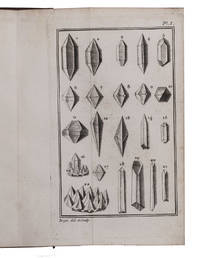
1772réf. L3LEN89INLTKParis 1772. 8vo. Didot Knapen & Delaguette Contemporary mottled calf gold-tooled spine with red title-label red edges marbled endpapers. With 2 folding letterpress tables and 10 folding engraved plates I-X. XXXII 427 2 1 blank pp. First edition of an influential work on geometrical crystallography by the French mineralogist Jean-Baptiste Louis Romé de l'Isle 1736-1790 one of the founders of modern crystallography. "In 1772 he published his first important technical work a one volume essay on crystallography in which he identified 110 crystal forms. This was a major expansion upon the work of Linnaeus . The Essai made Romé de l'Isle a prominent name among Parisian scientists of his day" Wilson. Romé is best known for his "law of constancy of interfacial angles" now the first law of crystal habit. The preliminaries contain an annotated bibliography by the author of the principal works on crystals. The plates depict numerous crystal forms as well as some geometric figures.Occasionally some very faint foxing or a small spot. Binding only slightly rubbed along the extremities. Overall in very good condition.l Hoover 2681; Ward & Carozzi 1906; Wilson The history of mineral collecting p. 52. unknown
1493Veduta panoramica della città tratta dal celebre Liber Cronicarum del 1493."E' la più nota immagine di Roma data alle stampe alla fine del '400. Essendo stata inserita nella fortunatissima opera di Hartman Schedel comunemente nota con il nome di Cronaca di Norimberga può dirsi senz'altro comune. Si tratta di una derivazione dal prototipo comune a tutte le piante medioevali di Roma e noto come panorama di Mantova, a sua volta ripreso da un presunto ma tuttora sconosciuto panorama inciso nella bottega di Francesco Rosselli verso il 1485. La città è vista da nord-est a volo dìuccello per porre in evidenza la zona Vaticana oggetto di vari lavori tra cui le spine di Borgo, il Belvedere (1485/87), il Santo Spirito ed il palazzo del Papa. Sono inoltre riconoscibili le realizzazioni di Santa Maria del Popolo e ponte Sisto. Tra le antichità spiccano il Pantheon, il Colosseo, la colonna Antonina ed in primo piano i Dioscuri nella originaria collocazione presso le terme di Diocleziano. Manca curiosamente l'Isola Tiberina" (cfr. Marigliani p. 117).La monumentale opera di Schedel, il Liber Cronicarum, rappresenta uno “dei più straordinari lavori mai realizzati” dall’editoria del XV secolo. Gli incisori erano Michael Wolgemut, famoso maestro di Albrecht Dürer, e il figliastro Wilhelm Pleydenwurff. Wolgemut fu il tutore di Albrecht Dürer tra il 1486 e il 1490; recenti studi hanno dimostrato come Durer abbia collaborato alla realizzazione di quest’opera, poiché alcuni dei tratti hanno somiglianze stupefacenti con quelli dell’Apocalisse; alcune opere sono infatti attribuite al maestro di Norimberga. La stampa venne supervisionata dal grande stampatore Anton Koberger, le cui opere erano famose in tutta Europa. Xilografia, finemente colorata a mano, consuete tracce di restauro alla piega centrale, nel complesso in ottimo stato di conservazione.BibliografiaA. P. Frutaz, "Le piante di Roma", XCVI; C. Marigliani, "Le Piante di Roma delle collezioni private", n. 8; M. Gori Sassoli (a cura di), "Roma Veduta" p. 139, n. 5; Scaccia Scarafoni, "Le Piante di Roma", n. 125. It is the most famous image of Rome given to the prints at the end of '400. Having been inserted in the very fortunate work of Hartman Schedel commonly known with the name of Chronicle of Nuremberg can be said without doubt common. It is a derivation from the prototype common to all the medieval map of Rome and known as the Mantua panorama, in turn taken from a presumed but still unknown panorama engraved in the workshop of Francesco Rosselli around 1485. The city is seen from the northeast in a bird's eye view to highlight the Vatican area which has been the subject of various works including the Borgo thorns, the Belvedere (1485/87), the Santo Spirito and the Pope's palace. Also recognizable are the realizations of Santa Maria del Popolo and Ponte Sisto. Among the antiquities stand out the Pantheon, the Colosseum, the Antonine column and in the foreground the Dioscuri in the original location near the Baths of Diocletian. The Tiber Island is curiously missing. (see Marigliani p. 117).Schedel's monumental Liber Cronicarum was “one of the most extraordinary works ever produced” The woodblock cutters were Michael Wolgemut, the well-known teacher of Albrecht Dürer, and his stepson Wilhelm Pleydenwurff. Wohlgemut was Albrecht Dürer's tutor between 1486-90 and recent scholarship has shown, Albrecht Dürer may also have collaborated, since some of the cuts bear a remarkably close resemblance to the Apocalypse illustrations. The printing was carried out under the supervision of the great scholar-printer Anton Koberger, whose printing were famous throughout Europe. Woodcut, fine hand colouring, in good condition.BibliografiaA. P. Frutaz, "Le piante di Roma", XCVI; C. Marigliani, "Le Piante di Roma delle collezioni private", n. 8; M. Gori Sassoli (a cura di), "Roma Veduta" p. 139, n. 5; Scaccia Scarafoni, "Le Piante di Roma", n. 125.
réf. B139664-6Roma 1982. 4pp. single sheet of tan wove card stock imprinted in red letterpress. Lrg. 8vo. Self-wraps. The very first catalogue and the first monograph published on the work of Jean-Michel Basquiat with a densely written text by Mario Diacono. The exhibition was devoted to the display of a single major painting Il campo vicino laltra strada The Field Next to the Other Road. Mario Diacono has previously noted that this painting has often been incorrectly dated 1981 and also as being painted and exhibited that year in Modena at the Galleria Emilio Mazzoli in the show titled SAMO. The work was indeed painted in Modena by the 21-year-old Basquiat but in May of 1982. It was one of eight new works that Basquiat produced in a Modena warehouse at the invitation of Emilio Mazzoli for a solo exhibition at the Galleria Mazzoli that never actually took place. By an agreement between Basquiat's primary dealer at the time Annina Nosei and the Galleria Diacono the work was then exhibited by Diacono in Rome in October 1982. Its price was set at 7 million lire or about $5000. In May 2015 the painting was sold at Christies for $37125000. "The Field Next to the Other Road" was reunited with the other seven paintings that were to be in the 1982 Mazzoli exhibition and all were shown together for the first time in an exhibition held at the Fondation Beyeler in Basel June-August 2023. A very fine copy. Extremely rare. Roma, 1982. paperback
réf. B139664-6Roma 1982. 4pp. single sheet of tan wove card stock imprinted in red letterpress. Lrg. 8vo. Self-wraps. The very first catalogue and the first monograph published on the work of Jean-Michel Basquiat with a densely written text by Mario Diacono. The exhibition was devoted to the display of a single major painting Il campo vicino laltra strada The Field Next to the Other Road. Mario Diacono has previously noted that this painting has often been incorrectly dated 1981 and also as being painted and exhibited that year in Modena at the Galleria Emilio Mazzoli in the show titled SAMO. The work was indeed painted in Modena by the 21-year-old Basquiat but in May of 1982. It was one of eight new works that Basquiat produced in a Modena warehouse at the invitation of Emilio Mazzoli for a solo exhibition at the Galleria Mazzoli that never actually took place. By an agreement between Basquiat's primary dealer at the time Annina Nosei and the Galleria Diacono the work was then exhibited by Diacono in Rome in October 1982. Its price was set at 7 million lire or about $5000. In May 2015 the painting was sold at Christies for $37125000. "The Field Next to the Other Road" was reunited with the other seven paintings that were to be in the 1982 Mazzoli exhibition and all were shown together for the first time in an exhibition held at the Fondation Beyeler in Basel June-August 2023. A very fine copy. Extremely rare. Roma, 1982. paperback books
1938réf. 1711871938. ROME. Bozzetti di addobbo dell'urbe per la visita del Führer. Die Ausschmueckungsentwuerfe der Stadt Roms fuer den Besuch des Fuehrers. Folio 316 x 321 mm. publisher's cloth. Rome: n.p. 1938. An extremely pompous tome published to celebrate Hitler's visit to Rome. Perhaps the bad taste is a reflection of the visitor rather than the hosts. Signed by the governor of Rome Piero Colonna with his calling card laid in. OCLC lists only the Wolfsonian and Cleveland Public Library in the U.S. plus 5 in Europe. hardcover
1938réf. 1710831938. 171083 ROME. Il Gruppo Montecatini per l'autarchia mineraria. 72 pp. illustrated throughout with charts and photographs 10 pages on different coloured paper thumb-indexed with a loose map of the exhibition. Small 8vo publisher's silver wrappers in a new silver cloth box with an orange label. Rome: Mostra Autarchica del Minerale Italiano Anno XVII 1938. $2500.00 From the silver wrappers to the vari-coloured thumb index this is a small masterpiece and a splendid example of Italian interwar book design. A touch of foxing but overall a well-preserved copy of a rare work with OCLC listing only one copy in Italy. hardcover
1938réf. 1711871938. ROME. Bozzetti di addobbo dell'urbe per la visita del Führer. Die Ausschmueckungsentwuerfe der Stadt Roms fuer den Besuch des Fuehrers. Folio 316 x 321 mm. publisher's cloth. Rome: n.p. 1938. An extremely pompous tome published to celebrate Hitler's visit to Rome. Perhaps the bad taste is a reflection of the visitor rather than the hosts. Signed by the governor of Rome Piero Colonna with his calling card laid in. OCLC lists only the Wolfsonian and Cleveland Public Library in the U.S. plus 5 in Europe. hardcover books
1938réf. 1710831938. 171083 ROME. Il Gruppo Montecatini per l'autarchia mineraria. 72 pp. illustrated throughout with charts and photographs 10 pages on different coloured paper thumb-indexed with a loose map of the exhibition. Small 8vo publisher's silver wrappers in a new silver cloth box with an orange label. Rome: Mostra Autarchica del Minerale Italiano Anno XVII 1938. $2500.00 From the silver wrappers to the vari-coloured thumb index this is a small masterpiece and a splendid example of Italian interwar book design. A touch of foxing but overall a well-preserved copy of a rare work with OCLC listing only one copy in Italy. hardcover books
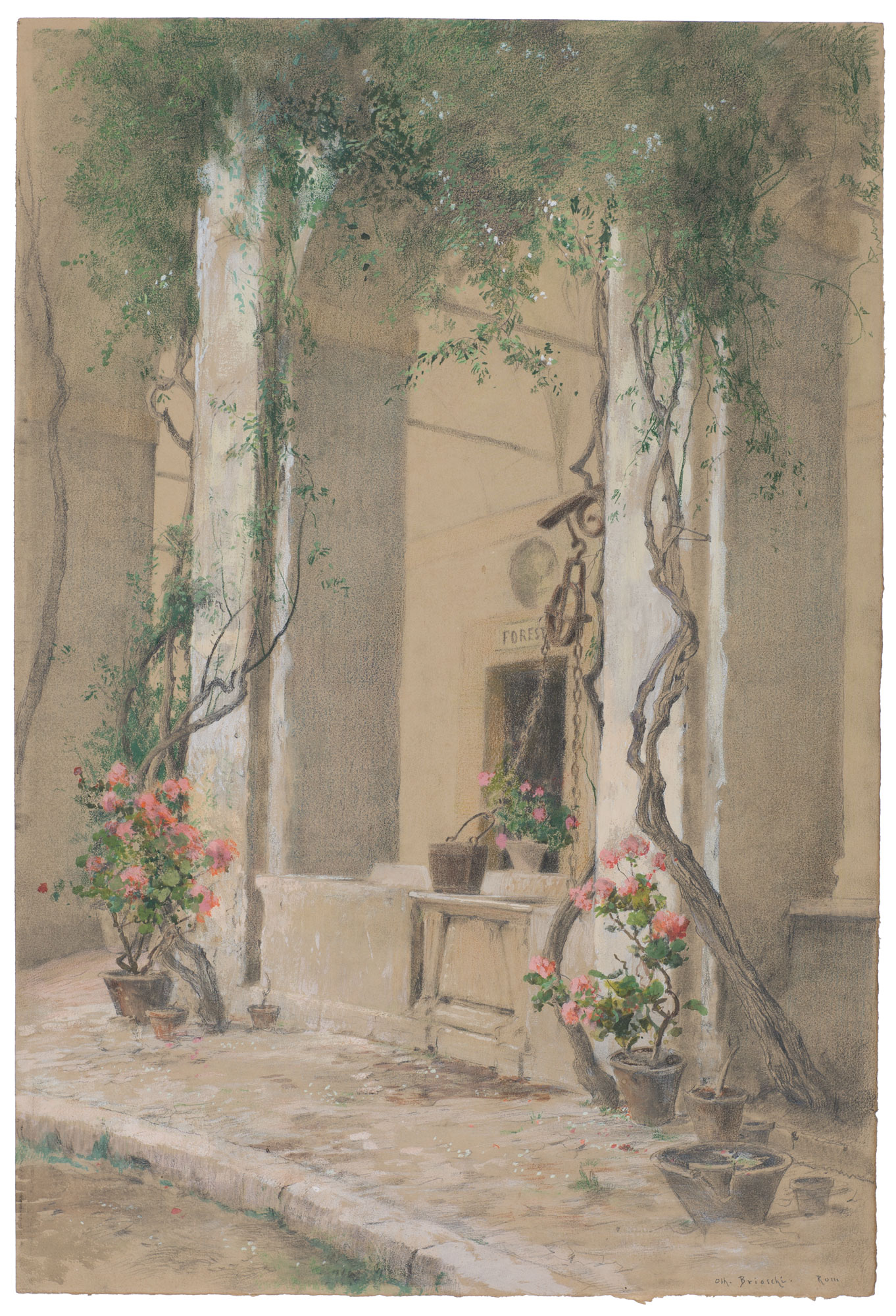
réf. 149-Io.J. Bleistift, Aquarell, Deckfarben und farbige Kreiden auf hellbraunem Velin, rechts unten signiert und bezeichnet ?Oth. Brioschi. Rom.?. 52:35 cm. Auf beiliegendem Etikett mit schwarzer Tusche betitelt ?Halle und Zugang zur Foresteria.?.
17554°, mm 235x135, due volumi, pp. XLVIII, 468, (2), un ritratto e quattro tavole ripiegate fuori testo; pp. XVI, 612, tre tavole ripiegate fuori testo. Legature coeve in piena pergamena rigida titoli entro tasselli dorati al dorso, tagli a spruzzo, due piccoli antichi restauri ai piatti posteriori, peraltro copia molto fresca e genuina. Stemma di Benedetto XIV al frontespizio, capilettera istoriati nelle carte preliminari. Al termine della parte seconda parte si trovano le Memorie istoriche, di pp. 206, (10), con proprio frontespizio, antiporta silografica raffigurante Giordano, San Gregorio e Santa Silvia, ritratto inciso in rame del Cardinale Nero Corsini, dedicatario dell'opera (con piccolo restauro al margine bianco), e cinque tavole di cui tre ripiegate raffiguranti i quattro acquedotti che portavano a Roma le Acque Marcia, Claudia e le due Aniene. Opera completa, in bell'esemplare, di edizione originale e unica. Bibliografia: Riccardi I, 285. Cicognara 3659. Graesse II, 62.
17554°, mm 235x135, due volumi, pp. XLVIII, 468, (2), un ritratto e quattro tavole ripiegate fuori testo; pp. XVI, 612, tre tavole ripiegate fuori testo. Legature coeve in piena pergamena rigida titoli entro tasselli dorati al dorso, tagli a spruzzo, due piccoli antichi restauri ai piatti posteriori, peraltro copia molto fresca e genuina. Stemma di Benedetto XIV al frontespizio, capilettera istoriati nelle carte preliminari. Al termine della parte seconda parte si trovano le Memorie istoriche, di pp. 206, (10), con proprio frontespizio, antiporta silografica raffigurante Giordano, San Gregorio e Santa Silvia, ritratto inciso in rame del Cardinale Nero Corsini, dedicatario dell'opera (con piccolo restauro al margine bianco), e cinque tavole di cui tre ripiegate raffiguranti i quattro acquedotti che portavano a Roma le Acque Marcia, Claudia e le due Aniene. Opera completa, in bell'esemplare, di edizione originale e unica. Bibliografia: Riccardi I, 285. Cicognara 3659. Graesse II, 62.
réf. 5422XVIè siècle. Burin. 19,5 x 23,5. L’ensemble est présenté sous chemise de papier ancien. Suite de 32 pièces d’après Raphaël. Ces estampes sont numérotées de 1 à 32. Le n° de chaque estampe est gravé 2 fois à la gauche et en-bas. Cette suite a été gravée par le Maître au dé qui cependant n’a mis sa marque que sur 2 estampes (les numéros 6 et 9). trois seules sont gravées par Augustin Vénitien et marquées de ses lettres A.V. (4-7-13). Épreuves du 2è état sur 2 avec la marque Ant. Sal. exc. Bartsch T. XV, p. 211 Notre série, très rare, est incomplète de 2 estampes : 9 et 32. L’ensemble est présenté sous chemise de papier ancien. Très bon XVIè siècle 19,5 x 23,5
1780Misura esterna festone mm. 347x428, lieve coloritura. Riferimenti: Andrea Sciolari, Marigliani, "Le piante di Roma delle collezioni private", n° 214, pag. 292
1819Album oblungo (mm. 284 x 410), mz pergamena coeva, titolo oro su tassello al dorso, contenente un foglio di frontespizio e una bellissima raccolta di 50 tavole numerate, create ed incise all’acquaforte dal grande artista Bartolomeo Pinelli (1781-1835), che rappresentano scene della vita del popolo di Roma e dintorni. Vi figurano: arti e mestieri (il venditore d’insalate, l’acquavitaro, lo scoparo, il tripparolo, il carnacciaro, gli spazzacamini, il capraro, i barocciari, il buttaro, ecc.), vari tipi di giochi, differenti categorie sociali, costumi e non solo romani (di Frascati, Ciociaria, Tivoli, Albano, Cerbara e due del Regno di Napoli). Cfr. Colas,2380 - Lipperheide,1265 - Cicognara,1761 che definisce il Pinelli “disegnatore grandissimo e tremendo incisore”. Con lievi fioriture o tracce d’uso per lo più marginali, ma certamente un buon esemplare.
1774Acquaforte e bulino, 1774 circa, firmata in lastra in basso. Contemporanea tiratura “romana” della lastra, esemplare nel primo stato di tre descritto da Hind. Magnifica prova, impressa su carta vergata coeva con filigrana “doppio cerchio e giglio con lettere CB”, con pieni margini, in perfetto stato di conservazione. Della serie Vedute di Roma. L’opera consiste in 135 lastre prodotte individualmente dal Piranesi per almeno 30 anni, da circa il 1745, fino alla data della sua morte. All’opera sono aggiunte poi due vedute realizzate dal figlio Francesco. Per la prima volta furono edite dall’editore Giovanni Bouchard nel 1751 (34 lastre), successivamente dallo stesso Piranesi editore a Strada Felice prima e Palazzo Tomati poi (indirizzi che appaiono su molte tavole), fino alla stesura definitiva composta da 137 lastre. Successivamente alla morte dell’autore le matrici furono ereditate dal figlio Francesco, che ne curò la pubblicazione prima nella capitale - le cosiddette tirature “postume romane” - e successivamente a Parigi, dove furono stampate tre edizioni – la cosiddetta “prima di Parigi”, una intermedia (entrambe su carta vergata) e quella curata dall’editore Firmin Didot, la prima su carta senza vergelle, dove le tavole presentano l’aggiunta di un numero arabo ordinale. Tutte le tirature parigine sono piuttosto modeste in qualità, lontane da come il Piranesi le aveva pensate e concepite. Le lastre furono poi acquisite dalla Calcografia Camerale, poi Calcografia Nazionale, oggi Istituto Centrale per la Grafica, dove sono tuttora conservate. Bibliografia Hind (1922): n. 116, I/III; Focillon (1918): n. 834. Etching and engraving, 1766 circa, signed on plate. Example of the first state of three described by Hind, from the contemporary Roman Edition. A very good impression, printed on contemporary strong laid paper with "double encircled flur-de-lys" watermark, with margins, very good condition. Taken from Vedute di Roma. The whole work consists of 135 plates which have been individually produced by Piranesi along 30 years, from 1745 circa until his death. Two more works have been subsequently added, two plates by his son Francesco. They have been printed for the first time in 1751 (34 plates) by the editor Giovanni Bouchard, afterwards by Piranesi himself, publisher first in Strada Felice an the in Palazzo Tomati, imprint that can be found in mostly of the plates), until the final edition of 137 plates. After Piranesi's death, his son Francesco inherited the plates, editing them first in Rome and then in Paris, where three editions were printed - the so-called "first Paris edition", an intermediate one (both on laid paper) and the one edited by the publisher Firmin Didot, the first on wowe paper, where the plates have an Arabic ordinal number added. All Parisi issues are rather modest in quality, far from how Piranesi had thought and conceived them. The plates were then acquired by the Calcografia Camerale, then Calcografia Nazionale, today Istituto Centrale per la Grafica, where they are still kept. Bibliografia Hind (1922): n. 116, I/III; Focillon (1918): n. 834.
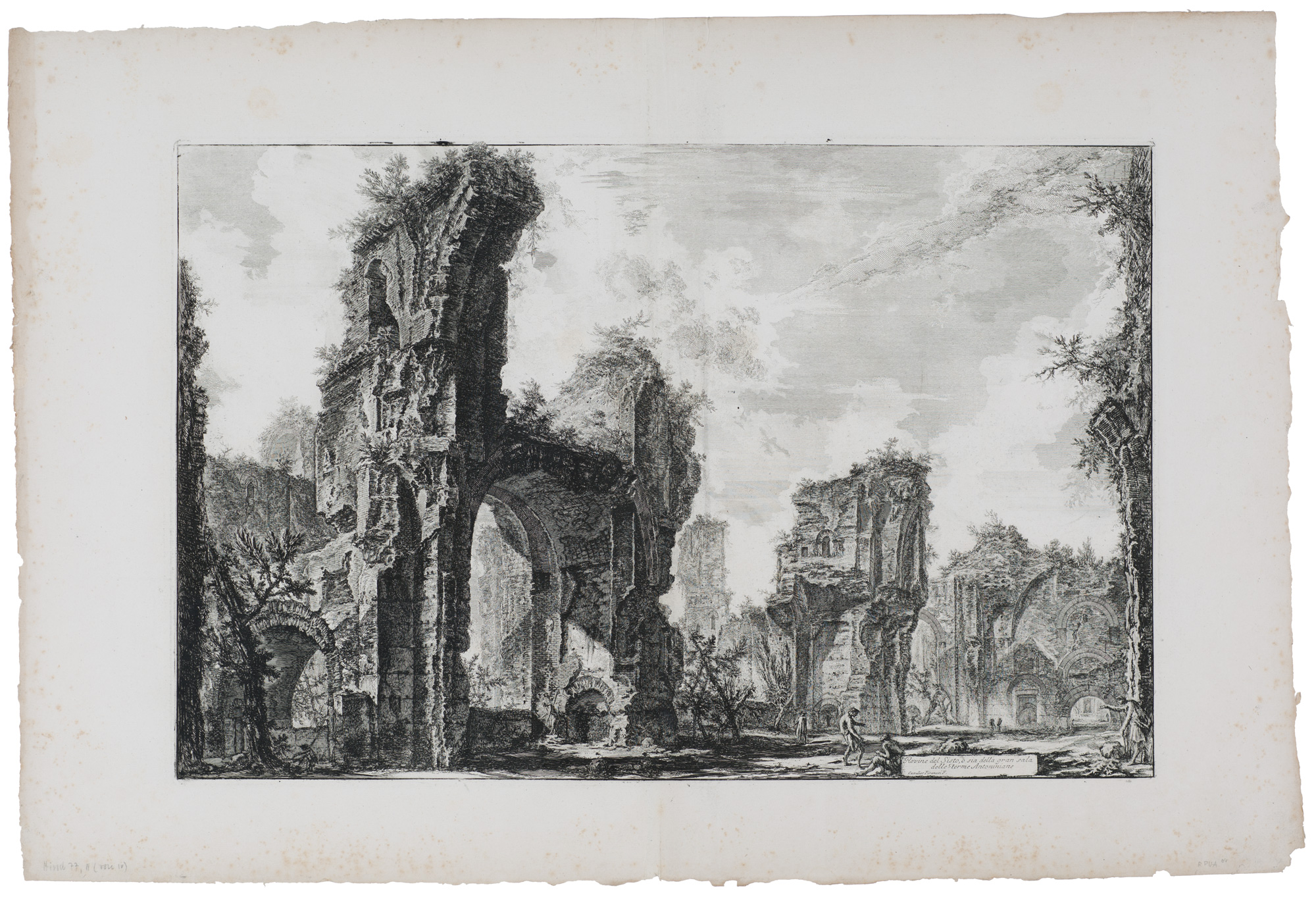
réf. 0827-Bo.J. Radierung, 1765, auf Bütten. 43,2:66,3 cm, Blattgröße 58,3:86 cm.- Unten rechts auf einer Kartusche bezeichnet und signiert ?Cavalier Piranesi F.?. Literatur: Focillon 851; Hind 77, II (v.IV); Ficacci 948; Wilton-Ely 210. ? Sehr kräftiger Abdruck mit dem vollen Rand, die Ränder stockfleckig und mit kleineren Einrissen.
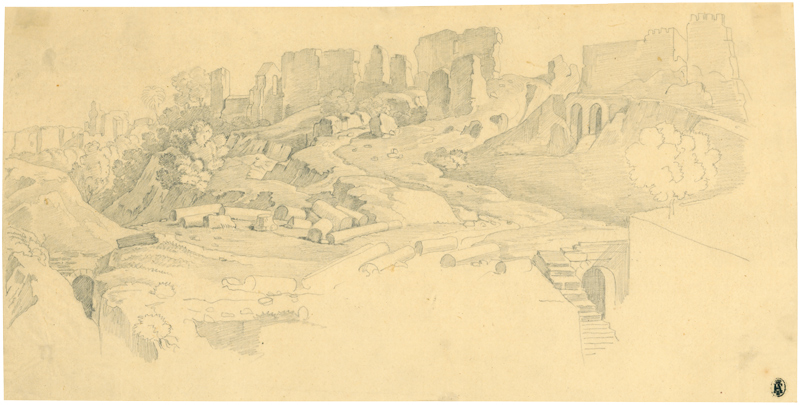
réf. 094-Io.J. Bleistift, auf cremefarbenem Pauspapier. 15,7:31,6 cm. Provenienz: Friedrich August II., König von Sachsen, Lugt 971. Zeichnungen auf Pauspapier fertigte Reinhold in der Regel als notwendiges Arbeitsmaterial für die Ausführung von Gemälden an. Diese vor der Natur entstandenen Studien verkaufte er in einzelnen Fällen schweren Herzens, aber aus Geldnöten gezwungen. Bei dem Motiv handelt es sich möglicherweise um die Ruinen der Villa die Quintili, heute von den Römern auch Roma Vecchia genannt, gelegen an der Via Appia Antica. Literatur: Ausst. Katalog: Heinrich Reinhold (1788-1825). Italienische Landschaften. Gera, 1988, Nr. 44, Abb. S. 130 (obwohl die Größenangabe ein klein wenig abweicht, sind diese und unsere Zeichnung vermutlich identisch); Ausst. Katalog: Von Dillis bis Piloty. München, 1979/80. S. 74.
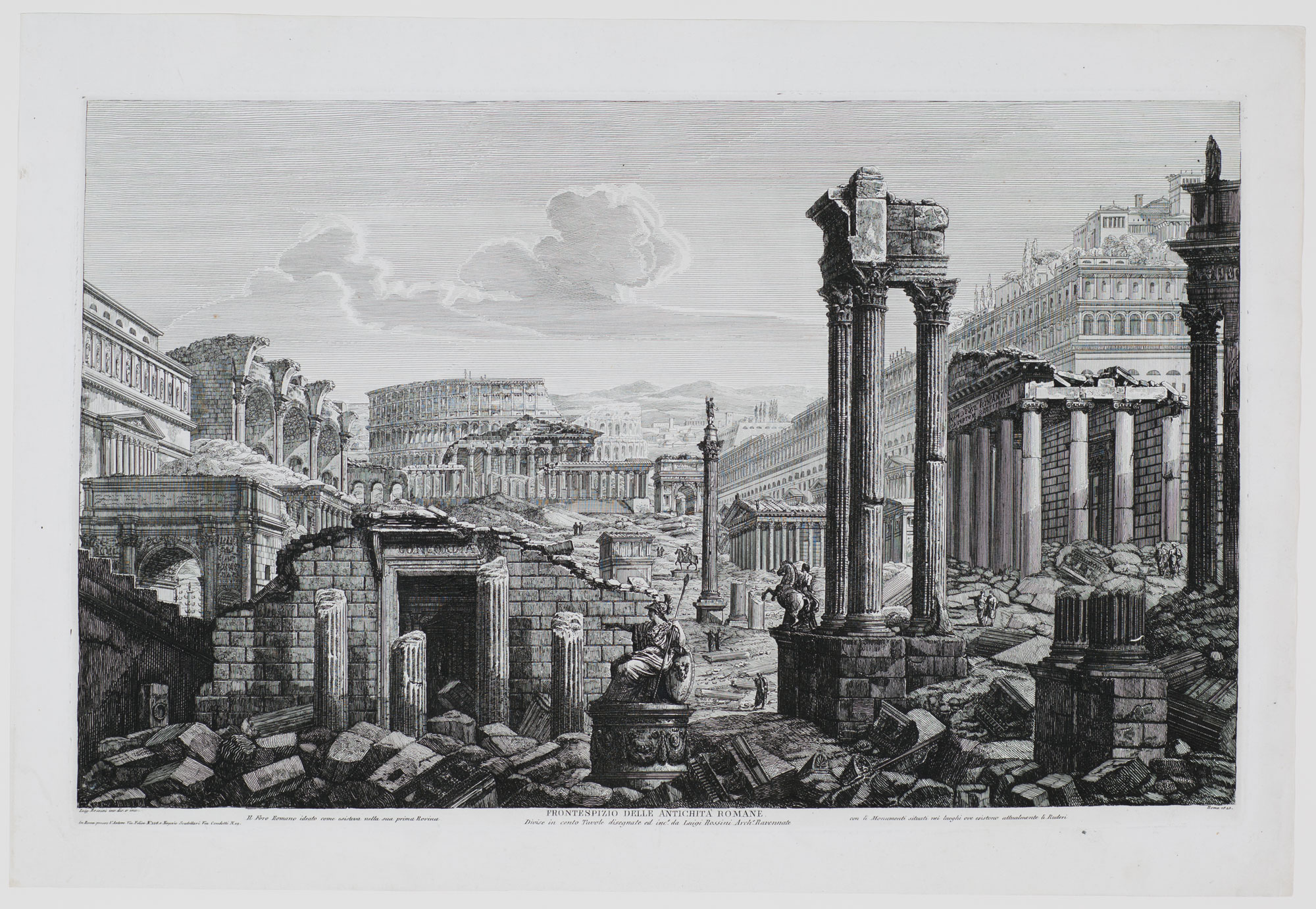
réf. 0812-Bo.J. Kupferstich, 1823, auf Velin. 42,5:67,5 cm. Frontispiz zur 100-Blatt-Folge ?Antichita? Romane?, 1823. ? Tiefschwarzer und klar zeichnender Abdruck, breitrandig.
1919réf. R47918Rome, Institut Historique belge de Rome 1919-2004 complete collection from volume 1 (1919) till volume 74 (2004) except for the following 12 missing volumes; 50 (1980)- 52 - 58 till 61 - 64 - 66 till 69 & 73 (2003), "table générale" of vols.1-35 (by Hendrik Delvaux, 1966, 133pp.) is added, vols.1-32 & 35 are bound in cart.cover with spine in cloth (other volumes in editor's softcover), few library stamps & label on spine
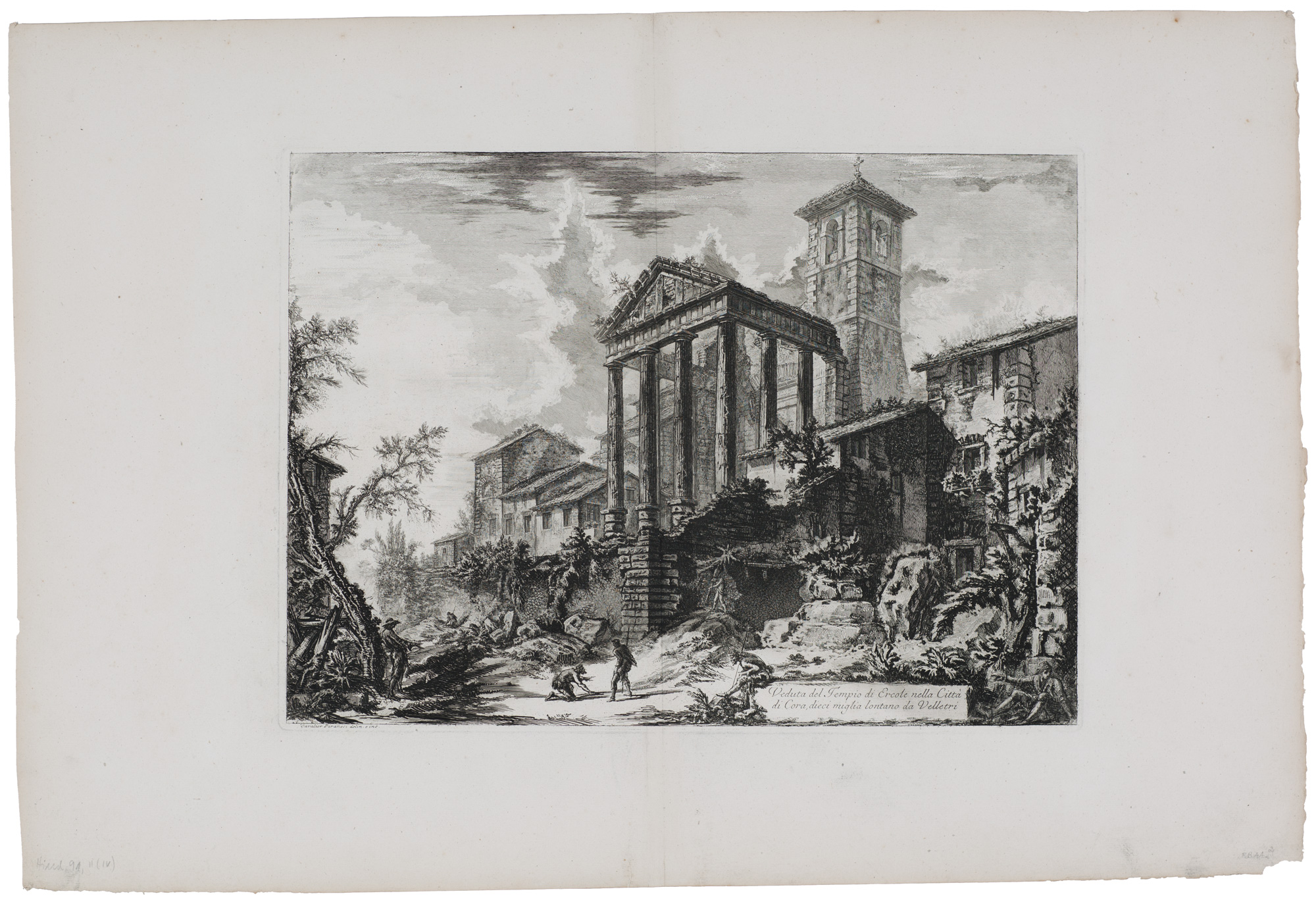
réf. 0830-Bo.J. Radierung, 1769, auf Bütten. 39:53,5 cm, Blattgröße 58,2:86,2 cm.- Unten auf einer Kartusche bezeichnet, links unten signiert ?Cavalier Piranesi delin. e inc.?. Literatur: Focillon 784; Hind 91, II (v.IV); Ficacci 962; Wilton-Ely 224. ? Kräftiger Abdruck mit dem vollen Rand, mit vereinzelten Stockflecken, rechte untere Ecke mit kleinem Papierverlust.
réf. mon0003788486powerHouse Books 2014-04-22. Paperback. Good. 0.5500 7.0100 4.7200. First edition. Pages are tanned. powerHouse Books paperback