1762Acquaforte e bulino, 1762 circa, firmata in lastra in basso. Esemplare della contemporanea tiratura “romana” della lastra, nel primo stato di tre, con indirizzo e prezzo, descritto da Hind: “Si vende presso l’autore a paoli due e mezzo”. Magnifica prova, impressa su carta vergata coeva, coeva con filigrana “doppio cerchio e giglio con lettere CB”, con pieni margini, in perfetto stato di conservazione. Della serie Vedute di Roma. L’opera consiste in 135 lastre prodotte individualmente dal Piranesi per almeno 30 anni, da circa il 1745, fino alla data della sua morte. All’opera sono aggiunte poi due vedute realizzate dal figlio Francesco. Per la prima volta furono edite dall’editore Giovanni Bouchard nel 1751 (34 lastre), successivamente dallo stesso Piranesi editore a Strada Felice prima e Palazzo Tomati poi (indirizzi che appaiono su molte tavole), fino alla stesura definitiva composta da 137 lastre. Successivamente alla morte dell’autore le matrici furono ereditate dal figlio Francesco, che ne curò la pubblicazione prima nella capitale - le cosiddette tirature “postume romane” - e successivamente a Parigi, dove furono stampate tre edizioni – la cosiddetta “prima di Parigi”, una intermedia (entrambe su carta vergata) e quella curata dall’editore Firmin Didot, la prima su carta senza vergelle, dove le tavole presentano l’aggiunta di un numero arabo ordinale. Tutte le tirature parigine sono piuttosto modeste in qualità, lontane da come il Piranesi le aveva pensate e concepite. Le lastre furono poi acquisite dalla Calcografia Camerale, poi Calcografia Nazionale, oggi Istituto Centrale per la Grafica, dove sono tuttora conservate. Bibliografia Hind (1922): n. 66, I/IV; Focillon (1918): n. 849. Etching and engraving, 1766 circa, signed on plate. Example of the first state of four described by Hind, from the contemporary Roman Edition. A very good impression, printed on contemporary strong laid paper with "double encircled flur-de-lys" watermark, with margins, very good condition. Taken from Vedute di Roma. The whole work consists of 135 plates which have been individually produced by Piranesi along 30 years, from 1745 circa until his death. Two more works have been subsequently added, two plates by his son Francesco. They have been printed for the first time in 1751 (34 plates) by the editor Giovanni Bouchard, afterwards by Piranesi himself, publisher first in Strada Felice an the in Palazzo Tomati, imprint that can be found in mostly of the plates), until the final edition of 137 plates. After Piranesi's death, his son Francesco inherited the plates, editing them first in Rome and then in Paris, where three editions were printed - the so-called "first Paris edition", an intermediate one (both on laid paper) and the one edited by the publisher Firmin Didot, the first on wowe paper, where the plates have an Arabic ordinal number added. All Parisi issues are rather modest in quality, far from how Piranesi had thought and conceived them. The plates were then acquired by the Calcografia Camerale, then Calcografia Nazionale, today Istituto Centrale per la Grafica, where they are still kept. Bibliografia Hind (1922): n. 66, I/IV; Focillon (1918): n. 849.
1776- PRIMO STATO DI TRE -Acquaforte e bulino, 1776, firmata in lastra in basso al centro. Magnifica prova, impressa su carta vergata coeva con filigrana “doppio cerchio e giglio con letter CB”, con pieni margini, in perfetto stato di conservazione. Della serie Vedute di Roma. L’opera consiste in 135 lastre prodotte individualmente dal Piranesi per almeno 30 anni, da circa il 1745, fino alla data della sua morte. All’opera sono aggiunte poi due vedute realizzate dal figlio Francesco. Per la prima volta furono edite dall’editore Giovanni Bouchard nel 1751 (34 lastre), successivamente dallo stesso Piranesi editore a Strada Felice prima e Palazzo Tomati poi (indirizzi che appaiono su molte tavole), fino alla stesura definitiva composta da 137 lastre. Successivamente alla morte dell’autore le matrici furono ereditate dal figlio Francesco, che ne curò la pubblicazione prima nella capitale - le cosiddette tirature “postume romane” - e successivamente a Parigi, dove furono stampate tre edizioni – la cosiddetta “prima di Parigi”, una intermedia (entrambe su carta vergata) e quella curata dall’editore Firmin Didot, la prima su carta senza vergelle, dove le tavole presentano l’aggiunta di un numero arabo ordinale. Tutte le tirature parigine sono piuttosto modeste in qualità, lontane da come il Piranesi le aveva pensate e concepite. Le lastre furono poi acquisite dalla Calcografia Camerale, poi Calcografia Nazionale, oggi Istituto Centrale per la Grafica, dove sono tuttora conservate. - THE FIRST STATE OF THREE -Etching with engraving, 1754, signed on plate at lower right. From the contemporary Roman Edition. A very good impression, printed on contemporary laid paper with watermark "double encircled fleur de lys with letters CB", with margins, very good condition. Taken from Vedute di Roma. The whole work consists of 135 plates which have been individually produced by Piranesi along 30 years, from 1745 circa until his death. Two more works have been subsequently added, two plates by his son Francesco. They have been printed for the first time in 1751 (34 plates) by the editor Giovanni Bouchard, afterwards by Piranesi himself, publisher first in Strada Felice an the in Palazzo Tomati, imprint that can be found in mostly of the plates), until the final edition of 137 plates. After Piranesi's death, his son Francesco inherited the plates, editing them first in Rome and then in Paris, where three editions were printed - the so-called "first Paris edition", an intermediate one (both on laid paper) and the one edited by the publisher Firmin Didot, the first on wowe paper, where the plates have an Arabic ordinal number added. All Parisi issues are rather modest in quality, far from how Piranesi had thought and conceived them. The plates were then acquired by the Calcografia Camerale, then Calcografia Nazionale, today Istituto Centrale per la Grafica, where they are still kept. Hind 124 I/III
1729réf. 4449Rome: Nella Stamperia di Gio. Battista de Caporali per andare all'Orso 1729. FIRST EDITION. Hardcover. Fine. Bound in later carta rustica. A fine fresh copy on crisp paper. Very faint soiling to upper margin. A large historiated initial decorative head- and tail-pieces. With the arms of Cardinal Polignac on the title page. A very rare account of the elaborate transformation of Piazza Navona to celebrate the birth of the Dauphin Louis son of King Louis XV of France 1715-1774 and his royal consort María Leszczyńska 1703-1768. The Rococo painter Pier Leone Ghezzi 1674-1750 charged with staging the events had the piazza "restored" to its ancient glory as the stadium of Domitian the foundations of which are buried beneath the piazza and give the modern space its distinctive oblong shape. The spectacle was captured by the Roman painter Giovanni Paolo Pannini 1691-1765 who produced a painting of the Piazza in its glory of which two copies exist. One is in the Louvre the other in the National Gallery of Ireland. The piazza was transformed by the erection of magnificent columns quadriform temples all painted to look like marble monumental statuary and fountains that flowed with wine which was distributed to the spectators. The center-piece of the scene Bernini's Fountain of the Four Rivers; Borromini's church of Sant'Agnese served as the imposing backdrop for this splendid display. All of these elements including the inscriptions the symbolism of the statuary the royal blazons the festoons of laurel flowers and flowers that unified the components the torches and candelabra that illuminated the whole scene the various instruments played etc. etc. are described in detail. The performances are also described. Musicians played from elevated stages delighting the crowd with song. There were fireworks conducted by the papal bombardieri of Castel Sant'Angelo a cavalry parade and a dramatic performance written by the celebrated librettist Pietro Metastasio 1698-1782 with music by Leonardo Vinci 1690-1730. The performance took place in the French ambassador's residence Palazzo Altemps at the northern end of the piazza. The final page of the account names the performers the set designer and the engineers in charge of the fireworks. The second part of the volume comprises sonnets composed in honor of the Dauphin the boy's mother María Leszczyńska and the French ambassador to the Vatican Cardinal Melchior di Polignac. Nella Stamperia di Gio. Battista de Caporali, per andare all'Orso hardcover
1729réf. 4449Rome: Nella Stamperia di Gio. Battista de Caporali per andare all'Orso 1729. FIRST EDITION. Hardcover. Fine. Bound in later carta rustica. A fine fresh copy on crisp paper. Very faint soiling to upper margin. A large historiated initial decorative head- and tail-pieces. With the arms of Cardinal Polignac on the title page. A very rare account of the elaborate transformation of Piazza Navona to celebrate the birth of the Dauphin Louis son of King Louis XV of France 1715-1774 and his royal consort María Leszczyńska 1703-1768. The Rococo painter Pier Leone Ghezzi 1674-1750 charged with staging the events had the piazza "restored" to its ancient glory as the stadium of Domitian the foundations of which are buried beneath the piazza and give the modern space its distinctive oblong shape. The spectacle was captured by the Roman painter Giovanni Paolo Pannini 1691-1765 who produced a painting of the Piazza in its glory of which two copies exist. One is in the Louvre the other in the National Gallery of Ireland. The piazza was transformed by the erection of magnificent columns quadriform temples all painted to look like marble monumental statuary and fountains that flowed with wine which was distributed to the spectators. The center-piece of the scene Bernini's Fountain of the Four Rivers; Borromini's church of Sant'Agnese served as the imposing backdrop for this splendid display. All of these elements including the inscriptions the symbolism of the statuary the royal blazons the festoons of laurel flowers and flowers that unified the components the torches and candelabra that illuminated the whole scene the various instruments played etc. etc. are described in detail. The performances are also described. Musicians played from elevated stages delighting the crowd with song. There were fireworks conducted by the papal bombardieri of Castel Sant'Angelo a cavalry parade and a dramatic performance written by the celebrated librettist Pietro Metastasio 1698-1782 with music by Leonardo Vinci 1690-1730. The performance took place in the French ambassador's residence Palazzo Altemps at the northern end of the piazza. The final page of the account names the performers the set designer and the engineers in charge of the fireworks. The second part of the volume comprises sonnets composed in honor of the Dauphin the boy's mother María Leszczyńska and the French ambassador to the Vatican Cardinal Melchior di Polignac. Nella Stamperia di Gio. Battista de Caporali, per andare all'Orso hardcover books
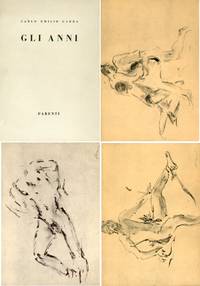
1943réf. 232638Firenze: Parenti 1943. Brossura sovracoperta wrappers dust jacket. Ottimo Fine. Allegati due quartini con tre disegni di Filippo De Pisis per gli Anni. Cm 26x18. pp. 140 4. Ottimo Fine. Edizione originale di 200 esemplari numerati Original edition of 200 numbered copies. Gadda Rif. Sebastiani Gioia Catalogo delle edizioni di Carlo Emilio Gadda. Milano All'insegna del pesce Sebastiani Gioia Catalogo delle edizioni di Carlo Emilio Gadda. Milano All'insegna del pesce d'oro 1993. Parenti, unknown
1550réf. 4841Rome: Antonio Lafreri 1550. Hardcover. Fine. First state. With Lafreri's excudit: "Ant. LafrerI FormIs Romae MDL" at lower right. Watermark "Duck in a Circle"cf. Woodward 79-80. A fine impression rich in tone with light marginal foxing and light soiling particularly in the lower right corner and some trivial surface soiling to the image. An iconic image of the statue known as Pasquino by far the most famous of Rome's 'statue parlanti' talking statues and the eponymous originator of the pasquinade genre. The statue was discovered in 1501 in the Parione district of Rome. Cardinal Oliviero Carafa "the embodiment of humanist ideals centering on the revival of antiquity"Reynolds erected the statue next to his palace near Piazza Navona on the site of today's Palazzo Braschi where it stands to this day. As early as 1501 satirical poems in Latin and Italian variously celebrating or criticizing the pope clergy and nobility or lampooning private individuals were affixed to the statue. By 1508 the statue had become the focus of a yearly celebration held on St. Mark's Day during which the statue was dressed as a Roman deity or other mythological figure and anonymous writers attached to it poems written in the "voice" of the statue. In 1511 Pasquino was dressed as Grief mourning the death of Cardinal Carafa. In 1549 the year before this print was published Pasquino famously opined on the death of Pope Paul III: 'Here was buried a certain Paul/ a fraud a fox thief murderer;/ Here famous in the mouth of Pasquino/ There suffering in the mouth of the devil." The artist responsible for this print has included a number of pasquinades in Latin and Italian shown on bits of paper attached to the walls of Carafa's palace. The ground in front of the statue is strewn with props a reference to the costumes worn by Pasquino during the St. Mark's Day celebration. In the distance are two pairs of men the first standing in the piazza and the second strolling towards the statue. Carafa's arms are visible in the shadow on the statue's base. Lafreri's print is a close copy of one published in 1542 by Antonio Salamanca Lafreri's rival and eventual business partner. The identity of the artist is unknown. Among those to whom the plate has been attributed are Enea Vico and Nicolas Beatrizet. In the same year 1550 that he produced his Pasquino print Lafreri issued a related print the Marforio another of Rome's talking statues with whom Pasquino frequently held "conversations". The origin of the name "Pasquino" has been debated from the very early 16th century with no definitive conclusion having been reached. The sculpture itself comprises two figures believed to be either Menelaus cradling the dead Patroclus or Ajax holding the dead Achilles. The primary inscription is a sonetto caudato. Io non son come paio un Babbuino stroppiato senza piedi et senza mani Nemen con glialtri membri sconci et strani La simmia son di Niccolo Zoppino. Ma son quel famosissimo Pasquino Che tremar faccio i Signor piu soprani et stupir forastieri et Paesani quando compango in volgare o in Latino. La mia persona è fatta in tal maniera Per i colpi e hor questo hor quel in accocca Per ch'io dico i lor falli a buona cera. Ma infin ch'io ha l'usata lingua in bocca Non ne fo stima anchor che 'l resto pera et sempre cantaro Zara a chi tocca Che se la gente sciocca Non si vuol rimaner de i falli suoi Chi terrà me' che no 'l ridica poi. I am not as I seem a Babbuino crippled without hands or feet Nor with obscene and strange exotic parts am I the Ape of Nicolò Zoppino But I am that most famous Pasquino who makes the most prominent men shiver. and astonishes the out-of-towners and my fellow citizens when I compose in vernacular or in Latin. My persona was shaped in this way: by the blows I take from here and from there because I reveal their sins But as long as I have the use of the tongue in my mouth I do not care even if the rest of my body perishes and I will continue to sing whatever happens and the people who are offended must deal with it. Because if stupid people do not want to keep their sins to themselves Who is going to stop me from telling them The one that was sure to attract the most attention reads: Pasquin tu fuste et sarai semper un pazo Ti sai in ogni forma trasformate Se ti voi alle donne grato fare Per che non ti trasformi int' Vn Ca Pasquino you always were and always will be an idiot. You know how to transform yourself into any form If you want to please women Why don't you turn yourself into a dck Pasquino & Marforio: Witnesses to a Rivalry Prelude to a Partnership: The engravings of Rome's talking statues Pasquino and Marforio published in 1550 bear witness to the rivalry between the two leading Roman print publishers of the mid-16th c. Antonio Salamanca 1479-1562 and Antonio Lafreri 1512-1577 and to the vast publishing phenomenon that came to be known as the "Speculum Romanae Magnificentiae" The Mirror of Roman Magnificence". In the years following the sack of 1527 the Spanish emigree Antonio Salamanca began producing engravings of Roman subjects with regularity prior to the sack such prints were few and appeared sporadically. In the 1540s another emigree printer the Frenchman Antonio Lafreri Antoine Lafréry began a rival enterprise copying many of Salamanca's engravings. The Marforio and Pasquino images that Lafreri lifted from Salamanca both date to this period. In 1553 the two competing Roman publishers entered into a contractual alliance for twelve years "with the explicit purpose of printing and selling copperplate prints of ancient and modern subjects. When the contractual agreement between Salamanca and Lafreri was established in 1553 the underlying principle of the "Speculum" was in place: it was to be a corpus of documentary prints of ancient and modern Roman subjects mainly in folio."Parshall Lafreri's and Salamanca's engravings illustrating the ancient and modern marvels of Rome tombs temples palaces baths statuary obelisks columns inscriptions frescoes etc. were purchased by tourists as souvenirs studied by antiquarians used as models by artists and architects and circulated as virtual visits for armchair travelers beyond Rome. By the late 1570s collectors could also purchase an engraved title page while selecting prints for their own Speculum collections. As a result Lafreri's customers or those of his heirs Salamanca had died in 1562 and Parshall suggests that the title was only in use after Lafreri's death in 1577 collected images to suit their own needs or taste. After the death of Lafreri two-thirds of the existing copper plates went to his heirs and another third was sold to other publishers. These new owners continued to print the existing images while still producing new prints. The Marforio print offered here is in the second state with the name of one of these later publishers Pietro de Nobili added. "Print collecting in the Renaissance is not very well understood mainly because prints were numerous comparatively inexpensive and therefore rarely inventoried. They are less likely than other sorts of objects to come down to us with a clear indication of their original setting. Nevertheless the evidence of a few large collections from the sixteenth century does suggest some consistent patterns most notably that prints accumulated in substantial numbers tended to be compiled in albums where they were organized by subject- matter and scale. There is still much to learn about how such collecting practices evolved and the development of a market to serve them."Parshall "Antonio Lafreri's Speculum Romanae Magnificentiae" Print Quarterly March 2006 Vol. 23 No. 1 pp. 3-28. Antonio Lafreri hardcover
1550réf. 4841Rome: Antonio Lafreri 1550. Hardcover. Fine. First state. With Lafreri's excudit: "Ant. LafrerI FormIs Romae MDL" at lower right. Watermark "Duck in a Circle"cf. Woodward 79-80. A fine impression rich in tone with light marginal foxing and light soiling particularly in the lower right corner and some trivial surface soiling to the image. An iconic image of the statue known as Pasquino by far the most famous of Rome's 'statue parlanti' talking statues and the eponymous originator of the pasquinade genre. The statue was discovered in 1501 in the Parione district of Rome. Cardinal Oliviero Carafa "the embodiment of humanist ideals centering on the revival of antiquity"Reynolds erected the statue next to his palace near Piazza Navona on the site of today's Palazzo Braschi where it stands to this day. As early as 1501 satirical poems in Latin and Italian variously celebrating or criticizing the pope clergy and nobility or lampooning private individuals were affixed to the statue. By 1508 the statue had become the focus of a yearly celebration held on St. Mark's Day during which the statue was dressed as a Roman deity or other mythological figure and anonymous writers attached to it poems written in the "voice" of the statue. In 1511 Pasquino was dressed as Grief mourning the death of Cardinal Carafa. In 1549 the year before this print was published Pasquino famously opined on the death of Pope Paul III: 'Here was buried a certain Paul/ a fraud a fox thief murderer;/ Here famous in the mouth of Pasquino/ There suffering in the mouth of the devil." The artist responsible for this print has included a number of pasquinades in Latin and Italian shown on bits of paper attached to the walls of Carafa's palace. The ground in front of the statue is strewn with props a reference to the costumes worn by Pasquino during the St. Mark's Day celebration. In the distance are two pairs of men the first standing in the piazza and the second strolling towards the statue. Carafa's arms are visible in the shadow on the statue's base. Lafreri's print is a close copy of one published in 1542 by Antonio Salamanca Lafreri's rival and eventual business partner. The identity of the artist is unknown. Among those to whom the plate has been attributed are Enea Vico and Nicolas Beatrizet. In the same year 1550 that he produced his Pasquino print Lafreri issued a related print the Marforio another of Rome's talking statues with whom Pasquino frequently held "conversations". The origin of the name "Pasquino" has been debated from the very early 16th century with no definitive conclusion having been reached. The sculpture itself comprises two figures believed to be either Menelaus cradling the dead Patroclus or Ajax holding the dead Achilles. The primary inscription is a sonetto caudato. Io non son come paio un Babbuino stroppiato senza piedi et senza mani Nemen con glialtri membri sconci et strani La simmia son di Niccolo Zoppino. Ma son quel famosissimo Pasquino Che tremar faccio i Signor piu soprani et stupir forastieri et Paesani quando compango in volgare o in Latino. La mia persona è fatta in tal maniera Per i colpi e hor questo hor quel in accocca Per ch'io dico i lor falli a buona cera. Ma infin ch'io ha l'usata lingua in bocca Non ne fo stima anchor che 'l resto pera et sempre cantaro Zara a chi tocca Che se la gente sciocca Non si vuol rimaner de i falli suoi Chi terrà me' che no 'l ridica poi. I am not as I seem a Babbuino crippled without hands or feet Nor with obscene and strange exotic parts am I the Ape of Nicolò Zoppino But I am that most famous Pasquino who makes the most prominent men shiver. and astonishes the out-of-towners and my fellow citizens when I compose in vernacular or in Latin. My persona was shaped in this way: by the blows I take from here and from there because I reveal their sins But as long as I have the use of the tongue in my mouth I do not care even if the rest of my body perishes and I will continue to sing whatever happens and the people who are offended must deal with it. Because if stupid people do not want to keep their sins to themselves Who is going to stop me from telling them The one that was sure to attract the most attention reads: Pasquin tu fuste et sarai semper un pazo Ti sai in ogni forma trasformate Se ti voi alle donne grato fare Per che non ti trasformi int' Vn Ca Pasquino you always were and always will be an idiot. You know how to transform yourself into any form If you want to please women Why don't you turn yourself into a dck Pasquino & Marforio: Witnesses to a Rivalry Prelude to a Partnership: The engravings of Rome's talking statues Pasquino and Marforio published in 1550 bear witness to the rivalry between the two leading Roman print publishers of the mid-16th c. Antonio Salamanca 1479-1562 and Antonio Lafreri 1512-1577 and to the vast publishing phenomenon that came to be known as the "Speculum Romanae Magnificentiae" The Mirror of Roman Magnificence". In the years following the sack of 1527 the Spanish emigree Antonio Salamanca began producing engravings of Roman subjects with regularity prior to the sack such prints were few and appeared sporadically. In the 1540s another emigree printer the Frenchman Antonio Lafreri Antoine Lafréry began a rival enterprise copying many of Salamanca's engravings. The Marforio and Pasquino images that Lafreri lifted from Salamanca both date to this period. In 1553 the two competing Roman publishers entered into a contractual alliance for twelve years "with the explicit purpose of printing and selling copperplate prints of ancient and modern subjects. When the contractual agreement between Salamanca and Lafreri was established in 1553 the underlying principle of the "Speculum" was in place: it was to be a corpus of documentary prints of ancient and modern Roman subjects mainly in folio."Parshall Lafreri's and Salamanca's engravings illustrating the ancient and modern marvels of Rome tombs temples palaces baths statuary obelisks columns inscriptions frescoes etc. were purchased by tourists as souvenirs studied by antiquarians used as models by artists and architects and circulated as virtual visits for armchair travelers beyond Rome. By the late 1570s collectors could also purchase an engraved title page while selecting prints for their own Speculum collections. As a result Lafreri's customers or those of his heirs Salamanca had died in 1562 and Parshall suggests that the title was only in use after Lafreri's death in 1577 collected images to suit their own needs or taste. After the death of Lafreri two-thirds of the existing copper plates went to his heirs and another third was sold to other publishers. These new owners continued to print the existing images while still producing new prints. The Marforio print offered here is in the second state with the name of one of these later publishers Pietro de Nobili added. "Print collecting in the Renaissance is not very well understood mainly because prints were numerous comparatively inexpensive and therefore rarely inventoried. They are less likely than other sorts of objects to come down to us with a clear indication of their original setting. Nevertheless the evidence of a few large collections from the sixteenth century does suggest some consistent patterns most notably that prints accumulated in substantial numbers tended to be compiled in albums where they were organized by subject- matter and scale. There is still much to learn about how such collecting practices evolved and the development of a market to serve them."Parshall "Antonio Lafreri's Speculum Romanae Magnificentiae" Print Quarterly March 2006 Vol. 23 No. 1 pp. 3-28. Antonio Lafreri hardcover books
1576in-4 antico, pp. (16), 309, 1 cb, belliss. leg. p. pelle primo '900 con nervi e tit. oro al d., tit. impresso in oro e belliss. cornici dorate ai piatti riquadrati. Tit. mss al taglio inf. Iniziali e fregi xilogr. Elegante carattere corsivo. Una delle opere più importanti del naturalista marchigiano (S. Elpidio 1524 - Roma 1600). Seconda ediz. sulla prima del 1558 e arricchita del terzo libro originale. Renouard p. 222 (n. 3). Paleari p. 53. Westbury p. 18. Gamba 1220. Vicaire col. 61. Splendido esempl. ad ampi margini. [264]
1682In-folio . Legatura coeva in pelle un po’ usurata. Manca il foglio bianco che precede il frontespizio.
1557réf. ST16379-032Basel: Hieronymus Froben 1552; Venice: Jacopo Strada 1557. FIRST COMPLETE AND FIRST ILLUSTRATED EDITION of the first work; FIRST EDITION Second Issue of the second work. 330 x 215 mm. 13 x 8 1/4". 108 leaves; 8 p.l. 192 181-228 pp. 99 leaves index. Two works in one volume. 18th century marbled calf rebacked original backstrip laid down flat spine in compartments formed by decorative leafy rules and featuring large floral ornaments at center two morocco labels marbled end papers. Printer's device on titles and on final leaf of first work fine large and small mostly historiated woodcut initials and MORE THAN 100 FINE WOODCUTS mostly large or full-page IN FIRST WORK several signed by "C S" perhaps Conrad Schnitt or Christoph Schweizer ILLUSTRATING BUILDINGS OCCUPATIONS MILITARY MACHINES COSTUMES etc. some cuts repeated one cut printed upside down; 369 numismatic woodcuts in text of second work 262 of these including repetitions with medallion portraits and 107 with names only. Front flyleaf with early ink inscription of a library number; third leaf of first work and 10th leaf of second work with the crowned "L" library stamp of the Lamoignon Library. VD16 N 1884; Schweiger II 618; Brunet IV 111; Graesse IV 691 all for first work; Mortimer Italian 322 a later edition with copies of these cuts 355; Adams N-354 P-195. ◆Original spine leather somewhat dried and eroded covers slightly pitted and marked but the binding entirely firm with only superficial wear to joints and certainly agreeable. First title a little smudged and foxed a few other trivial imperfections but A REMARKABLY FRESH CLEAN AND SMOOTH COPY INTERNALLY AND WITH FINE IMPRESSIONS OF THE CUTS. This is a very attractive copy with distinguished provenance of two works with considerable data relating to and shedding substantial light on the politics government provincial administration and military establishment of Rome as well as other aspects of Roman life. The first work here is an anonymous early fifth century Roman state handbook more commonly known as the "Notitia Dignitatum" edited by Siegmund Ghelen Gelenius ca. 1477 - ca. 1554 and Beatus Rhenanus 1485-1547 from a lost Medieval manuscript. It is arranged according to the provinces of the Roman Empire and their cities. The second work is a synopsis of Roman history from Romulus through the reign of Habsburg emperor Charles V in the 15th century. Its first section is based on the "fasti consulares" inscriptions from the Arch of Augustus in the Roman forum listing all Roman consuls from 483 B.C. to 19 A.D. These relics were discovered in the 1540s when the forum was being quarried for building materials. The compiler of this work Panvinio 1529-68 was an Augustinian monk devoted to antiquarian studies who spent considerable time in Italy recording inscriptions on ancient monuments medals and other surfaces. He recognized the "fasti consulares" fragments recovered from the ruins and worked frantically to save them. They were restored by Michelangelo and added to the collection of what became the Capitoline Museum. Panvinio also used the coins and medals collected by Strada the publisher as a source for this compilation. A considerable portion of the interest and value in this volume today resides in the woodcuts. Copied from the original illustrations in an early manuscript of the work now lost; the cuts in the first work include many depictions of books showing several different kinds of decorated bindings. The illustrations also provide many details of Roman dwellings costumes and objects used in private religious and military life. Excepting the fact that they have produced books on basically the same subject our two printers could hardly be more different. Whereas the Swiss Froben was one of the giants of Renaissance printing and a great promoter of learning the Venetian Strada apparently spent much of his time speculating in the antiques market being one of the first merchants to make a business of selling Italian antiques to foreigners. Our copy comes from the collection of the great bibliophile Antoine Moriau 1699-1759 who leased the stately Hôtel d'Angoulême Lamoignon in Paris to house his library of 14000 books and more than 2000 manuscripts. The second work here is rare. Hieronymus Froben, 1552; Venice: Jacopo Strada unknown
1557réf. ST16379-032Basel: Hieronymus Froben 1552; Venice: Jacopo Strada 1557. FIRST COMPLETE AND FIRST ILLUSTRATED EDITION of the first work; FIRST EDITION Second Issue of the second work. 330 x 215 mm. 13 x 8 1/4". 108 leaves; 8 p.l. 192 181-228 pp. 99 leaves index. Two works in one volume. 18th century marbled calf rebacked original backstrip laid down flat spine in compartments formed by decorative leafy rules and featuring large floral ornaments at center two morocco labels marbled end papers. Printer's device on titles and on final leaf of first work fine large and small mostly historiated woodcut initials and MORE THAN 100 FINE WOODCUTS mostly large or full-page IN FIRST WORK several signed by "C S" perhaps Conrad Schnitt or Christoph Schweizer ILLUSTRATING BUILDINGS OCCUPATIONS MILITARY MACHINES COSTUMES etc. some cuts repeated one cut printed upside down; 369 numismatic woodcuts in text of second work 262 of these including repetitions with medallion portraits and 107 with names only. Front flyleaf with early ink inscription of a library number; third leaf of first work and 10th leaf of second work with the crowned "L" library stamp of the Lamoignon Library. VD16 N 1884; Schweiger II 618; Brunet IV 111; Graesse IV 691 all for first work; Mortimer Italian 322 a later edition with copies of these cuts 355; Adams N-354 P-195. ◆Original spine leather somewhat dried and eroded covers slightly pitted and marked but the binding entirely firm with only superficial wear to joints and certainly agreeable. First title a little smudged and foxed a few other trivial imperfections but A REMARKABLY FRESH CLEAN AND SMOOTH COPY INTERNALLY AND WITH FINE IMPRESSIONS OF THE CUTS. This is a very attractive copy with distinguished provenance of two works with considerable data relating to and shedding substantial light on the politics government provincial administration and military establishment of Rome as well as other aspects of Roman life. The first work here is an anonymous early fifth century Roman state handbook more commonly known as the "Notitia Dignitatum" edited by Siegmund Ghelen Gelenius ca. 1477 - ca. 1554 and Beatus Rhenanus 1485-1547 from a lost Medieval manuscript. It is arranged according to the provinces of the Roman Empire and their cities. The second work is a synopsis of Roman history from Romulus through the reign of Habsburg emperor Charles V in the 15th century. Its first section is based on the "fasti consulares" inscriptions from the Arch of Augustus in the Roman forum listing all Roman consuls from 483 B.C. to 19 A.D. These relics were discovered in the 1540s when the forum was being quarried for building materials. The compiler of this work Panvinio 1529-68 was an Augustinian monk devoted to antiquarian studies who spent considerable time in Italy recording inscriptions on ancient monuments medals and other surfaces. He recognized the "fasti consulares" fragments recovered from the ruins and worked frantically to save them. They were restored by Michelangelo and added to the collection of what became the Capitoline Museum. Panvinio also used the coins and medals collected by Strada the publisher as a source for this compilation. A considerable portion of the interest and value in this volume today resides in the woodcuts. Copied from the original illustrations in an early manuscript of the work now lost; the cuts in the first work include many depictions of books showing several different kinds of decorated bindings. The illustrations also provide many details of Roman dwellings costumes and objects used in private religious and military life. Excepting the fact that they have produced books on basically the same subject our two printers could hardly be more different. Whereas the Swiss Froben was one of the giants of Renaissance printing and a great promoter of learning the Venetian Strada apparently spent much of his time speculating in the antiques market being one of the first merchants to make a business of selling Italian antiques to foreigners. Our copy comes from the collection of the great bibliophile Antoine Moriau 1699-1759 who leased the stately Hôtel d'Angoulême Lamoignon in Paris to house his library of 14000 books and more than 2000 manuscripts. The second work here is rare. Hieronymus Froben, 1552; Venice: Jacopo Strada unknown books
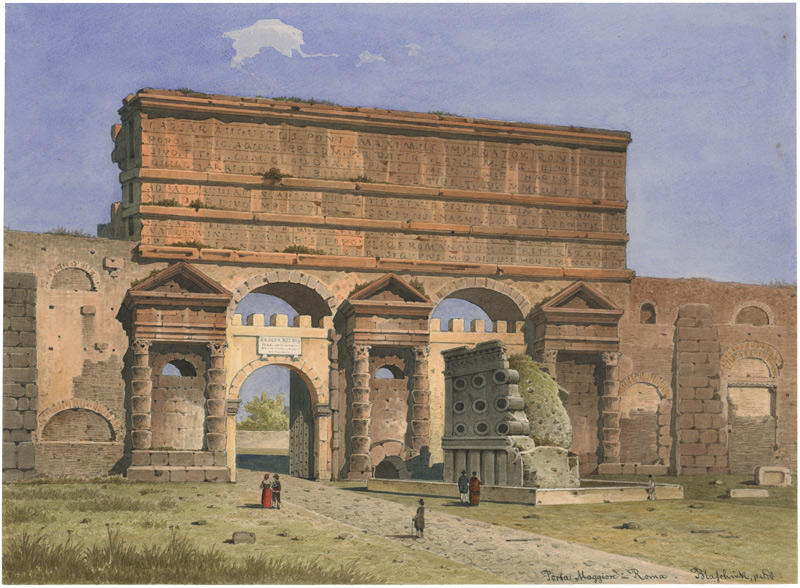
réf. 023-Io.J. Aquarell über Bleistift, auf Velin, rechts unten bezeichnet und signiert ?Porta Maggiore in Roma. Blaschnik pixit?; verso bezeichnet ?Porta maggiore in Rom?. 25,3:34,9 cm. Insgesamt leicht fleckig; verso Reste von alten Klebeetiketten.
In-4, pp. 21 comprensive dell'occhietto (1), legatura coeva in p. pelle ed angoli, titolo, fregi, greche e gigli in oro al dorso, tagli rossi. Edizione originale di questa memoria di grande importanza per la storia tipografica in quanto, stando al Brooks (n.2), rappresenta la seconda opera stampata da Bodoni. Nel volume sono legate altre due opere, tematicamente affini e incentrate sulla controversia del 1768 tra Parma e Roma. (Ovvero legato con:) MANOSCRITTO COEVO. Prammatica Sanzione uscita nell'Espulsione de Gesuiti dagli S.A.R. Ferdinando Duca di Parma e Piacenza. In Venezia a spese di Francesco Pitteri, 1768; pp. (18) in grafia bella e leggibile su pagine con doppia cornice rossa, (6) bianche. (E con:) CAPPELLOTTI. Esame storico-legale teologico sopra le lettere in forma di breve pubblicate in Roma. Contro gli editti de' reali sovrani di Parma emanati intorno l'immunità e disciplina ecclesiastica. Stamperia Reale, 1768; pp. (2) 192 con numerose note ms. al margine inferiore dei primi fogli e mancanza al frontespizio in corrispondenza dell'editore. L'influsso della politica antigesuitica spagnola si fece sentire anche nella borbonica Parma, dove il Tillot aveva iniziato un'energica politica contro i privilegi del clero e nel maggio del 1676 chiese a Carlo III l'autorizzazione per espellere i Gesuiti. Nel frattempo, varava una serie di riforme:stabilì "l'exequator", avocò "l'imprimatur" dei decreti dell'Inquisizione e soprattutto proibì il ricorso a tribunali stranieri, in primo luogo a Roma. Fu quest'ultimo proveddimento, emanato il 16 gennaio 1768, a scatenare la violenta reazione del pontefice: il 30 gennaio emanò il "monitorio di Parma", nel quale tentava la prova di forza e, con una durezza senza precedenti, cassava l'intera legislazione del Tillot e scomunicava i suoi autori e sostenitori in base alla Bolla "In Coena Domini". La risposta immediata di Parma fu l'espulsione dei Geseuiti, nella notte tra il 7 e l'8 febbraio 1768. Buon esemplare.. Brooks, n.2..
1552réf. 4344Rome: Antonio Lafréry 1552. Hardcover. Fine. First state of three. A rich impression with wide margins light marginal foxing and a little light soiling extreme upper margin a little ragged. Inscribed on the pedestal: "LVPAE ROMVLVM ET REMVM VRBIS CONDITORES LACTANTIS ANTIQVVM AC AENEVM IN CAPITOLIO SIGNVM." Ancient bronze image of the she-wolf nursing Romulus and Remus founders of the city on the Campidoglio. Signed "ANT. LAFRERII FORMIS ROMAE MDLII". An icon of central importance to the mythology and history of the city of Rome and an artwork that served as the nucleus of Europe's first public museum. This print attributed to the French emigree engraver Nicolas Béatrizet was issued by Lafréry in 1552 the year before he agreed to a partnership with his rival Antonio Salamanca. After Lafréry's death the plate passed to his nephew Claudio Duchet. It was reprinted by Giovanni Orlandi in 1602 and afterwards before 1622 by Hendrick van Schoel. The first definitive reference to this statue of the she-wolf the twins are Renaissance additions dates to the late 12th- or early 13th century. In his "Mirabilia Romae" the Oxford pilgrim Master Gregorius describes that statue in the portico of the Lateran Palace at which time it was in a damaged state broken off at the feet. According to Gregorius the wolf served as a pendentive to another now lost statue that of a ram which the wolf seemed to stalk. In 1471 Pope Sixtus IV reg. 1471-1484 bequeathed the statue and four other ancient bronzes -the spinario the Camillus and the bronze head and hand holding a globe of Constantine- to the people of Rome to serve as the core of the nascent Capitoline Museum the first public museum in Europe. A long inscription at the entrance of the Palazzo dei Conservatori documents this event and describes Sixtus' donation as an act of restitution of the city's ancient patrimony to its people: "Ob immensam benignitatem Aeneas insignes statuas priscae excellentiae virtutisque monumentum - Romano populo unde exorte fuere restituendas condonandasque censuit." The she-wolf was placed on a platform projecting from the façade of the Palazzo dei Conservatori Sixtus had given 100 gold florins to the Conservatori specifically for the relocation and installation of the statue. A drawing by Heemskerck from the mid-1530s shows the sculpture in that location. In the middle of the 16th century it was moved to a loggia where Aldrovandi saw it prior to 1556. The loggia was later walled in to create an enclosed chamber known as the sala della lupa in which the she-wolf still resides. Antonio Lafréry hardcover
1552réf. 4344Rome: Antonio Lafréry 1552. Hardcover. Fine. First state of three. A rich impression with wide margins light marginal foxing and a little light soiling extreme upper margin a little ragged. Inscribed on the pedestal: "LVPAE ROMVLVM ET REMVM VRBIS CONDITORES LACTANTIS ANTIQVVM AC AENEVM IN CAPITOLIO SIGNVM." Ancient bronze image of the she-wolf nursing Romulus and Remus founders of the city on the Campidoglio. Signed "ANT. LAFRERII FORMIS ROMAE MDLII". An icon of central importance to the mythology and history of the city of Rome and an artwork that served as the nucleus of Europe's first public museum. This print attributed to the French emigree engraver Nicolas Béatrizet was issued by Lafréry in 1552 the year before he agreed to a partnership with his rival Antonio Salamanca. After Lafréry's death the plate passed to his nephew Claudio Duchet. It was reprinted by Giovanni Orlandi in 1602 and afterwards before 1622 by Hendrick van Schoel. The first definitive reference to this statue of the she-wolf the twins are Renaissance additions dates to the late 12th- or early 13th century. In his "Mirabilia Romae" the Oxford pilgrim Master Gregorius describes that statue in the portico of the Lateran Palace at which time it was in a damaged state broken off at the feet. According to Gregorius the wolf served as a pendentive to another now lost statue that of a ram which the wolf seemed to stalk. In 1471 Pope Sixtus IV reg. 1471-1484 bequeathed the statue and four other ancient bronzes -the spinario the Camillus and the bronze head and hand holding a globe of Constantine- to the people of Rome to serve as the core of the nascent Capitoline Museum the first public museum in Europe. A long inscription at the entrance of the Palazzo dei Conservatori documents this event and describes Sixtus' donation as an act of restitution of the city's ancient patrimony to its people: "Ob immensam benignitatem Aeneas insignes statuas priscae excellentiae virtutisque monumentum - Romano populo unde exorte fuere restituendas condonandasque censuit." The she-wolf was placed on a platform projecting from the façade of the Palazzo dei Conservatori Sixtus had given 100 gold florins to the Conservatori specifically for the relocation and installation of the statue. A drawing by Heemskerck from the mid-1530s shows the sculpture in that location. In the middle of the 16th century it was moved to a loggia where Aldrovandi saw it prior to 1556. The loggia was later walled in to create an enclosed chamber known as the sala della lupa in which the she-wolf still resides. Antonio Lafréry hardcover books
1624In-folio, 57 ll., 1bl.; engraved title and 51 full-page engraved plates, giving geodetic and cosmographic instruments and measurements; woodcut ornate initials and tailpieces, large Aldus anchor woodcut device at the end. Bound in contemporary cartonnage (reliure d'attente), with weak hinges; occasional light foxing, light dampstain at the bottom of the last leaves. Despite the title the work includes 50 full-page engravings, of which the last 7 are a supplement by Scala and are especially devoted to architecture and perspective.
1979réf. 432161979. Near fine. Large framed 4-color lithograph 75 x 55 cm / 29.5 x 21.5 in. used as the poster art for the 1979 world premiere of Williams' play Tiger Tail based on his film directed by Elia Kazan Baby Doll. The print is signed and inscribed by Williams: "For Marshall / ever -- / God be with you / Tennessee '79." The print is also signed by Rome with the designation "Tiger Proof." The play was produced and performed at the Hippodrome Theatre in Gainesville Florida where Williams was serving as artist-in-residence. The event was co-produced by the Joan Ling Gallery that held an exhibit of Rome's prints in the lobby during the run of the show. This artwork is offered along with a 25.5 x 19.5-in. poster at no extra cost mounted on foam core of the production at the Hippodrome running from Nov. 2 through Dec. 1. There is some scuffing to the frame and some very minor scratching to the glass but the lithograph is in near-fine to fine condition. The poster shows moderate scuffing and bumping. unknown
1979réf. 432161979. Near fine. Large framed 4-color lithograph 75 x 55 cm / 29.5 x 21.5 in. used as the poster art for the 1979 world premiere of Williams' play Tiger Tail based on his film directed by Elia Kazan Baby Doll. The print is signed and inscribed by Williams: "For Marshall / ever -- / God be with you / Tennessee '79." The print is also signed by Rome with the designation "Tiger Proof." The play was produced and performed at the Hippodrome Theatre in Gainesville Florida where Williams was serving as artist-in-residence. The event was co-produced by the Joan Ling Gallery that held an exhibit of Rome's prints in the lobby during the run of the show. This artwork is offered along with a 25.5 x 19.5-in. poster at no extra cost mounted on foam core of the production at the Hippodrome running from Nov. 2 through Dec. 1. There is some scuffing to the frame and some very minor scratching to the glass but the lithograph is in near-fine to fine condition. The poster shows moderate scuffing and bumping. unknown books
1699In folio oblungo (mm. 273x405), p. pergam. settecentesca, dorso a cordoni con tit. oro su tassello. Bellissimo album contenente 138 tavv. finemente inc. in rame (incluso il frontespizio) che raffigurano non solo i grandi monumenti quali il Pantheon o il Colosseo, ma rappresentano tutti gli aspetti della grandezza di Roma nel campo militare, archeologico, marittimo e soprattutto architettonico. In questa raccolta figurano 17 tavv. incise dal perugino Pietro Santi Bartoli (1635-1700). L’opera è dedicata al Cardinale Hieronymo Casanate. Cfr. Cicognara,3857: "Sotto ciascuna stampa leggonsi le dichiarazioni intagliate in rame; sono tav. 138 raccolte in questa Calcografia e riprodotte con questo frontespizio, le quali erano state impiegate precedentemente in simili opere, come vedesi dalle tavole ritoccate, e nuovamente numerate per ridurle in questo ordine". Bell'esemplare, ben conservato.
1631réf. 126711631 un volume, reliure d'époque plein-vélin vieil ivoire parcheminé in-folio (28X41 cm) (jansenist's binding full vellum old ivory in-folio), dos long (spine without raised band) muet (without title), plat à fermoirs à lacets de cuir avec un lacet restant sur quatre, tranches lisses (smooth edges) lisières des pages abimées avec une usure en arrondi (écorné) en haut à droite sur toute les pages, déchirures légères en marge mais nombreuses,ex-libris manuscrit à l'encre brune : " ....Nail Tailleur de pierre et architecte à Angers..." , orné de 40 planches gravées sur Bois (engraving-wood) en noir par Francini dont le portrait de Francini signé " Bosse fecit" parAbraham Bosse, présence de léger trous en marge de la dernière gravure , cicatrices de mouillures (scars of waterstains), manque marginal de papier sur la page n'atteignant à aucun moment la gravure (lack of paper, but the engraving is intact), sans pagination (unpaginated) (1 p.), 4 pages de texte, 40 planches gravées, 1631 A Paris, Chez Melchior Tavernier, Graueur & Imprimeur du Roy pour les Tailles douces Editeur,
1668Rarissima pianta planimetrica prospettica della città di Roma in cui si evidenziano le chiese, gli edifici e monumenti più importanti. Edizione dedicata a Papa Clemente IX (pontificato di appena due anni e mezzo: 26 giugno 1667 al 9 dicembre 1669). Hubert Jaillot in questa edizione, pubblicata a Parigi, riprende la pianta del Cruyl di 3 anni prima ed aggiunge in basso al centro dei 317 + 21 rimandi le sette vedutine di chiese romane prese dalla pianta del Falda dell'anno precedente.Alexis Hubert JAILLOT (1632 - 1712)
1650Rarissima ristampa della lastra anonima - attribuita ad Antonio Lafreri e databile al 1555/60. Esemplare nel terzo stato di quattro descritto e illustrato in Bifolco-Ronca, pagina 2377.In alto a sinistra l’iscrizione Urbis Rome totius olim orbis domitricis, situs: cum adhuc extantibus, sacrosancte vetustatis monumentis PIRRHO LIGORIO NEAP. INVENTOR. Orientazione nei quattro lati al centro con il nome dei punti cardinali SEPTENTRIO, MERIDIES, ORIENS, OCCIDENS, il nord a sinistra.Anonima pianta prospettica della città, basata sulla pianta di Pirro Ligorio, edita da Michele Tramezzini nel 1552. La pianta è inserita in alcuni esemplari dello Speculum Romanae Magnificentiae di Antonio Lafreri, al quale pertanto viene attribuita. Il grande interesse storico di questa pianta non è dato dall’opera stessa, una semplice copia del lavoro del Ligorio, ma è rappresentato dalle tirature successive di questa lastra. Il secondo stato, databile alla seconda metà del XVII secolo, è completamente emendato ed arricchito da toponomastica in lingua francese. Viene inserita anche una lunga descrizione della città, sempre in lingua francese. E’ noto che, alla morte di Antonio Lafreri (1577), i due terzi delle lastre furono divisi tra i nipoti Stefano e Claudio Duchetti. Il restante terzo venne suddiviso tra più editori. Questa lastra quindi potrebbe avere preso la via di Parigi, dove venne ristampata circa un secolo dopo. In alternativa la carta potrebbe essere stampata Roma ed emendata in lingua francese. Tale edizione viene descritta da Hülsen (1915), che la annovera tra le “Copie e ristampe”, come "Incisa nel sec. XVII ex.ovvero XVIII. Ne vidi una copia presso il sig. Lang nel 1914" (la libreria antiquaria Lang di Roma). Un altro esemplare, che tuttavia potrebbe essere lo stesso citato da Hülsen, è descritto nella biblioteca della British School of Rome, appartenuto alla celebre collezione di Thomas Ashby (1874-1931), direttore dell’accademia dal 1906 al 1925. Sempre Hülsen cataloga lo stato finale dell’opera, con l’indirizzo dell’editore francese Francois Jollain. Acquaforte e bulino, stampata su carta vergata coeva, in ottimo stato di conservazione. Bibliografia Bifolco-Ronca, Cartografia e topografia italiana del XVI secolo (2018): pp. 2376-77, tav. 1123, III/IV; Frutaz (1962): n. XVI e tav. 25; Hülsen (1915): II, p. 42, n. 11 e p. 43, nn. 13-14; Karrow (1993): n. 51/1.1; Marigliani (2007): n. 36; Marigliani (2016): n. XI.5. A very rare map of the city, published in Paris in the mid-seventeenth century using the plate made in Rome by Antonio Lafreri.Example of the third state of four.The map is based on that of Pirro Ligorio, 1552, edited by Michele Tramezini in Rome, and its subsequent and numerous variants.The only example known today of this map is in the library of the British School of Rome, belonged to the famous collection of Thomas Ashby (1874-1931), director of the British School at Rome from 1906 to 1925.For the stile of type this work can be attributed to the French publisher Francois Jollain. The plate appears to be yet more ancient, even '500, to which were added numerous inscriptions in French, starting from the extensive description in the bottom right corner.Copper engraving, perfect condition. An extremely rare work.LiteratureBifolco-Ronca, Cartografia e topografia italiana del XVI secolo (2018): pp. 2376-77, tav. 1123, III/IV;Frutaz (1962): n. XVI e tav. 25; Hülsen (1915): II, p. 42, n. 11 e p. 43, nn. 13-14; Karrow (1993): n. 51/1.1; Marigliani (2007): n. 36; Marigliani (2016): n. XI.5. Frutaz (1962): n. XVI e tav. 25; Hülsen (1915): II, p. 42, n. 11 e p. 43, nn. 13-14; Karrow (1993): n. 51/1.1; Marigliani (2007): n. 36; Marigliani (2016): n. XI.5. DI ROMA DAL 1551 AL 1748, (1915) 43e.
1774- PRIMO STATO DI TRE -Acquaforte e bulino, 1774, firmata in lastra . Esemplare della contemporanea tiratura romana. Magnifica prova, impressa su carta vergata coeva con filigrana “doppio cerchio e giglio con lettere CB”, con pieni margini, in perfetto stato di conservazione. Della serie Vedute di Roma. L’opera consiste in 135 lastre prodotte individualmente dal Piranesi per almeno 30 anni, da circa il 1745, fino alla data della sua morte. All’opera sono aggiunte poi due vedute realizzate dal figlio Francesco. Per la prima volta furono edite dall’editore Giovanni Bouchard nel 1751 (34 lastre), successivamente dallo stesso Piranesi editore a Strada Felice prima e Palazzo Tomati poi (indirizzi che appaiono su molte tavole), fino alla stesura definitiva composta da 137 lastre. Successivamente alla morte dell’autore le matrici furono ereditate dal figlio Francesco, che ne curò la pubblicazione prima nella capitale - le cosiddette tirature “postume romane” - e successivamente a Parigi, dove furono stampate tre edizioni – la cosiddetta “prima di Parigi”, una intermedia (entrambe su carta vergata) e quella curata dall’editore Firmin Didot, la prima su carta senza vergelle, dove le tavole presentano l’aggiunta di un numero arabo ordinale. Tutte le tirature parigine sono piuttosto modeste in qualità, lontane da come il Piranesi le aveva pensate e concepite. Le lastre furono poi acquisite dalla Calcografia Camerale, poi Calcografia Nazionale, oggi Istituto Centrale per la Grafica, dove sono tuttora conservate. - THE FIRST STATE OF THREE -Etching with engraving, 1774, signed on plate. From the contemporary Roman Edition. A very good impression, printed on contemporary laid paper with watermark "double encircled fleur de lys with letters CB", with margins, very good condition. Taken from Vedute di Roma. The whole work consists of 135 plates which have been individually produced by Piranesi along 30 years, from 1745 circa until his death. Two more works have been subsequently added, two plates by his son Francesco. They have been printed for the first time in 1751 (34 plates) by the editor Giovanni Bouchard, afterwards by Piranesi himself, publisher first in Strada Felice an the in Palazzo Tomati, imprint that can be found in mostly of the plates), until the final edition of 137 plates. After Piranesi's death, his son Francesco inherited the plates, editing them first in Rome and then in Paris, where three editions were printed - the so-called "first Paris edition", an intermediate one (both on laid paper) and the one edited by the publisher Firmin Didot, the first on wowe paper, where the plates have an Arabic ordinal number added. All Parisi issues are rather modest in quality, far from how Piranesi had thought and conceived them. The plates were then acquired by the Calcografia Camerale, then Calcografia Nazionale, today Istituto Centrale per la Grafica, where they are still kept. Hind 110, I/III; Focillon 830; Wilton Ely 243.
1755- PRIMO STATO DI SEI -Acquaforte e bulino, 1755 circa, firmata in lastra in basso a destra. Esemplare della contemporanea tiratura romana. Magnifica prova, ricca di toni impressa su carta vergata coeva priva di filigrana, con pieni margini, lieve traccia della consueta piega centrale, per il resto in perfetto stato di conservazione. Esemplare in barbe nel rarissimo primo stato di sei, avanti i ritocchi nel cielo e l'indrizzo degli editori Bouchard e Gravier. Della serie Vedute di Roma. L’opera consiste in 135 lastre prodotte individualmente dal Piranesi per almeno 30 anni, da circa il 1745, fino alla data della sua morte. All’opera sono aggiunte poi due vedute realizzate dal figlio Francesco. Per la prima volta furono edite dall’editore Giovanni Bouchard nel 1751 (34 lastre), successivamente dallo stesso Piranesi editore a Strada Felice prima e Palazzo Tomati poi (indirizzi che appaiono su molte tavole), fino alla stesura definitiva composta da 137 lastre. Successivamente alla morte dell’autore le matrici furono ereditate dal figlio Francesco, che ne curò la pubblicazione prima nella capitale - le cosiddette tirature “postume romane” - e successivamente a Parigi, dove furono stampate tre edizioni – la cosiddetta “prima di Parigi”, una intermedia (entrambe su carta vergata) e quella curata dall’editore Firmin Didot, la prima su carta senza vergelle, dove le tavole presentano l’aggiunta di un numero arabo ordinale. Tutte le tirature parigine sono piuttosto modeste in qualità, lontane da come il Piranesi le aveva pensate e concepite. Le lastre furono poi acquisite dalla Calcografia Camerale, poi Calcografia Nazionale, oggi Istituto Centrale per la Grafica, dove sono tuttora conservate. - THE FIRST STATE OF SIX -Etching and engraving, 175, signed on plate at the lower right.Example from the contemporary Roman Edition. A very good impression, printed on contemporary strong laid paper without watermark, with margins, very good condition. The first state of six, before the retouches of the plate and the address of Bouchard and Gravier. Very rare. Taken from Vedute di Roma. The whole work consists of 135 plates which have been individually produced by Piranesi along 30 years, from 1745 circa until his death. Two more works have been subsequently added, two plates by his son Francesco. They have been printed for the first time in 1751 (34 plates) by the editor Giovanni Bouchard, afterwards by Piranesi himself, publisher first in Strada Felice an the in Palazzo Tomati, imprint that can be found in mostly of the plates), until the final edition of 137 plates. After Piranesi's death, his son Francesco inherited the plates, editing them first in Rome and then in Paris, where three editions were printed - the so-called "first Paris edition", an intermediate one (both on laid paper) and the one edited by the publisher Firmin Didot, the first on wowe paper, where the plates have an Arabic ordinal number added. All Parisi issues are rather modest in quality, far from how Piranesi had thought and conceived them. The plates were then acquired by the Calcografia Camerale, then Calcografia Nazionale, today Istituto Centrale per la Grafica, where they are still kept. Hind 35 I/VI; Focillon 810.
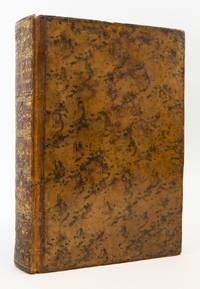
1773réf. 15686Paris, Chez Didot jeune ; Chez Knapen, 1773. In-8 de XXXII—299-(5) pp., basane havane marbré, dos orné à nerfs, pièce de titre en maroquin rouge, tranches rouges (reliure de l'époque).