15 570 résultats
2020réf. SBBI-mon0000049906HATIER 2020. paperback. Acceptable. Please see the condition note after this for details if this is missing please consider Acceptable to mean poor quality that could include major staining water damage writing missing dustjacket etc etc. Our books are dispatched from a Yorkshire former cotton mill. We list via barcode/ISBN so please note that the images are stock images and may not be the exact copy you receive furthermore the details about edition and year might not be accurate as many publishers reuse the same ISBN for multiple editions and as we simply scan a barcode or enter an ISBN we do not check the validity of the edition data when listing. If you're looking for an exact edition please don't order at least not without checking with us first although we don't always have time to check. We aim to dispatch prompty the service used will depend on order value and book size. We can ship to most countries see our shipping policies. Payment is via Abe only. HATIER paperback
2005réf. SBBI-mon0000052050Hachette Illustrated UK 2005. paperback. Good. Our good condition books are generally good for reading but not for gifting or collecting. They could have imperfections such as creasing fanning inscriptions margin notes yellowing staining on edge or cover or pages bumps scuffs etc etc sometimes multiple of these. It's a wide category that encompasses anything that isn't almost-new down to anything that is slightly better than poor. We would NOT recommend gifting Good books - these should be considered reading copies. Our books are dispatched from a Yorkshire former cotton mill. We list via barcode/ISBN so please note that the images are stock images and may not be the exact copy you receive furthermore the details about edition and year might not be accurate as many publishers reuse the same ISBN for multiple editions and as we simply scan a barcode or enter an ISBN we do not check the validity of the edition data when listing. If you're looking for an exact edition please don't order at least not without checking with us first although we don't always have time to check. We aim to dispatch prompty the service used will depend on order value and book size. We can ship to most countries see our shipping policies. Payment is via Abe only. Hachette Illustrated UK paperback

2007réf. SBBIH-RSSLMQIQQPWXDodo Press 2007. paperback. Good. Our good condition books are generally good for reading but not for gifting or collecting. They could have imperfections such as creasing fanning inscriptions margin notes yellowing staining on edge or cover or pages bumps scuffs etc etc sometimes multiple of these. It's a wide category that encompasses anything that isn't almost-new down to anything that is slightly better than poor. We would NOT recommend gifting Good books - these should be considered reading copies. Our books are dispatched from a Yorkshire former cotton mill. We list via barcode/ISBN so please note that the images are stock images and may not be the exact copy you receive furthermore the details about edition and year might not be accurate as many publishers reuse the same ISBN for multiple editions and as we simply scan a barcode or enter an ISBN we do not check the validity of the edition data when listing. If you're looking for an exact edition please don't order at least not without checking with us first although we don't always have time to check. We aim to dispatch prompty the service used will depend on order value and book size. We can ship to most countries see our shipping policies. Payment is via Abe only. Dodo Press paperback
1897réf. 29161London: George Routledge & Sons Limited 1897. Very good plus. First edition of this beautifully illustrated collection of simply rhyming verses about the everyday life of little children at the turn of the century - quite scarce in this condition. 9.25'' x 8''. Original cloth spine paper pictorial boards. Illustrated throughout cw: depiction of golliwog doll. 62 2 pages. A bit of rubbing and light soil to boards hinges starting to crack but still firm. George Routledge & Sons, Limited unknown
1897réf. 29161London: George Routledge & Sons Limited 1897. Very good plus. First edition of this beautifully illustrated collection of simply rhyming verses about the everyday life of little children at the turn of the century - quite scarce in this condition. 9.25'' x 8''. Original cloth spine paper pictorial boards. Illustrated throughout cw: depiction of golliwog doll. 62 2 pages. A bit of rubbing and light soil to boards hinges starting to crack but still firm. George Routledge & Sons, Limited unknown books
1915réf. 188802London: William Rider & Son. Ltd. 1915. First edition. An appealing collection exploring beliefs regarding human transformation into animals from "the point of view of folklore and occultism" - tales of "wer-wolves" and "wer-foxes" witches and their familiars animal dances human serpents phantom cats and cocks. The author was herself a suitably studious if somewhat quirky character. A wartime production uncommon in such sharp condition. For its date a typically well-produced Rider publication a serious and well-researched enquiry into the uncanny. Florence Hamel 1870-1957 began her career as an author of popular biographies in the main of prominent French women Émilie du Châtelet Agnès Sorel Dauphines of France Fair Women at Fontainebleau but also of La Fontaine and Lady Hester Stanhope. She later diversified writing a number of novels including the supernaturally themed Tiger-Wolves The Luminous Pearl and Trust to Boyd. In 1912 she founded Grafton & Co. which became the leading publishers of bibliographical and librarianship textbooks and of the trade journal Library World which she edited until her death; in 1919 an antiquarian department was added under the notable if slightly disreputable bibliographer R. A. Peddie. Bookseller Robin Waterfield offers colourful reminiscence of the place "I applied and got the job and absolutely loved the work. The proprietor was a South African called Fanny Hamel who wore a red wig. Somehow Fanny had entered into a liaison with Mr R. A. Peddie who was my boss at Grafton's. Peddie was a most distinguished bibliographer but had been dismissed from his post as librarian of St Bride's Printing Library for irregularity of attendance and drunkenness. There was always a large bottle of whisky under the counter to 'encourage' librarians" Markham. Octavo. Original greyish yellow pictorial cloth lettered in black to spine and to the front cover with image of a werewolf in black against a brilliant blue mountain range. Spine a touch tanned light rubbing of the cover design; free endpapers slightly browned light foxing front back and fore-edge pale toning to the text; overall solid square and clean a very good copy. Andrew Block A Short History of the Principal London Antiquarian Booksellers and Book-Auctioneers 1933; Frank Hamel obituary The Library World 58 4 April 1957; Sarah Markham In Conversation on-line. hardcover
1829réf. 3446Parigi, Presso Aimé-André (Dai Torchi di G. Didot Maggiore), 1829
1790In-folio; pp. (2) 76, 60 “dimostrazioni”, 4 tav. ripiegate; mezza pergamena con titolo dorato al dorso. Edizione originale. L’opera fu voluta da Leopoldo I di Toscana prima di lasciare la Toscana e prendere il titolo di Leopoldo II imperatore, contiene un interessante resoconto sul periodo di riforme economiche, politiche e giuridiche frutto di un pensiero liberista e illuminato. Francesco Maria Gianni fu collaboratore di Leopoldo già dal 1781.
1963réf. 000005NY: Clayton Press 1963 Book. Good. Cloth. Signed by Authors. First Edition. 16mo - over 5¾" - 6¾" tall. THE EYE OF ISHTAR By F.E.SCHISLER Rare/SIGND/1ST Author: Florence E. Schisler Publisher/Copyright: Clayton Press NY 1963 Edition: First Edition Condition: all defects if any are formulated into pricing The jacket has a chip to the top of the spine see photo. Small sweat like stain in the top gutter that does not effect the pages. There are some penciled writings on the front endpaper stating that the book is a first edition and signed by the author in a nice pen signature. Book is without any other marks or writings pages are clean book is tight and sturdy. A good copy. Size: 5 ½ x 8 approximately Pages: 237 pages Binding/Cove: Hardback with dust jacket Refunds: All items are 100% refundable up to 10 days after item received Background/Description: Signed First Edition. Clayton Press NY 1963. Good/Good- condition. Overall a good signed edition. The blazing jewel - torn from the image of the goddess Ishtar - casts its ancient spell over the destinies of three beautiful women separated by the centuries yet linked by the heritage of the goddess. In a hauntingly moving tale the reader is carried in turn to the brutality of the Middle Ages the electric tension of the times of revolutionary America and to the present. This is a super rare book with no other copies by this author found for sale on the Internet. There are only 2 other copies found with this title on the Internet and they are reprints with prices of $173 & $250. Good price! No Reserve! Inv: s67 . Clayton Press hardcover
1907réf. 002788London: Blackie & Sons Ltd. 1907 Green cloth pictorially stamped in green black red and gilt slight cover soil book plate and gift inscription dated 1907. An extremely scarce and marvelous book by Florence Harrison about whom very little is known. A collection of charming rhymes by Harrison illustrated with 22 beautiful tipped in color plates a few ripples and small edge tears as is common with this book as well as full page line drawings printed on green paper. This by far one of the nicest copies of the book we've had. First Edition. Pictorial Cover. Near Fine/No Jacket. Illus. by Florence Harrison. Oblong 4to. Blackie & Sons Ltd. hardcover
1907réf. 002788London: Blackie & Sons Ltd. 1907 Green cloth pictorially stamped in green black red and gilt slight cover soil book plate and gift inscription dated 1907. An extremely scarce and marvelous book by Florence Harrison about whom very little is known. A collection of charming rhymes by Harrison illustrated with 22 beautiful tipped in color plates a few ripples and small edge tears as is common with this book as well as full page line drawings printed on green paper. This by far one of the nicest copies of the book we've had. First Edition. Pictorial Cover. Near Fine/No Jacket. Illus. by Florence Harrison. Oblong 4to. Blackie & Sons Ltd. hardcover books
1787réf. 45818ABParis, David 1787-91. 4 Bände. 4°. [2] Bll., IV, 258 [recte 254]; 176 S.; [1] Bl., 148; 171 S. Leder der Zeit auf 5 Bünden mit 2 Rückenschildern (numeriert I-IV) und Rückenvergoldung. Kanten und Gelenke berieben, Kapitale etwas bestoßen. Kl. Papier-Rückenschild. Etwas gebräunt (einige Tafeln etwas stärker), stellenweise etwas (stock)-fleckig. 2 Namen am Vorsatz. Band I die ersten 7 Tafeln und Text bis S. 11 mit Wasserrand, Band III eine Tafel etwas wasserrandig. Wenige Tafeln im Plattenrand durch zu starken Andruck eingerissen. Wenige Bll. und Tafeln mit schwacher Knickspur. [4 Warenabbildungen]
réf. 18374Recueil de photographies de tableaux, oeuvres d'art, monuments et vues de villes d'Italie en un volume in-quarto (340x265 mm), plein velin ivoire rigide, dos arrondi décoré et doré d'entrelacs de feuilles et fleurs, plats bisautés décorés d'un large encadrement d'entrelacs dorés sur fond rouge vif de style renaissance, lui-même entouré en extérieur et intérieur d'une large roulette décorative dorée et filets rouges et or, titre "Italia" en lettres peintes et décorées en rouge et or, tranches rouges (étiquette du relieur Giulio Giannini. Firenze). 40 feuilles de carton montées sur onglets avec de nombreuses photographies (fin XIXe - début XXe siècle) de tableaux (41), sculptures (12), vues de Venise (16), de Florence (2), Milan et Bellagio. Les 8 derniers feuillets sont occupés par des cartes postales anciennes.
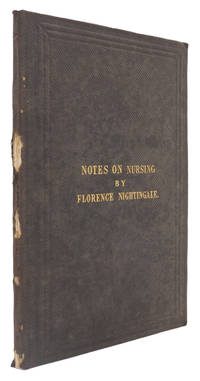
1860réf. 5434London: Harrison Bookseller to The Queen 1860. FIRST EDITION early issue 8vo pp. 79 1. Original dark brown limp pebbled cloth boards boards bordered with triple blind rules front board lettered direct in gilt. Spine rather nibbled front joint correspondingly weakened boards somewhat mottled. An early printing of Nightingale’s enormously influential nursing book first published in 1860 and reprinted frequently over the following decades. This copy has ‘the right of translation is reserved’ on the title-page ads to the endpapers dated 1860 and 5 of the 6 issue points identified by Bishop & Goldie as denoting an earlier printing. The sixth issue point the corrected heading on p.73 is noted as potentially later being found in both states in copies with all other corrections made. But in this copy that ‘later’ correction is accompanied by the other five in the earlier uncorrected state - perhaps disproving the assumed priority. Bishop & Goldie 4. Harrison, Bookseller to The Queen hardcover
réf. 124843London Blackie and Son Limited 1910. . First edition thus; 4to 27 x 22 cm; 36 tipped-in colour plates and 34 black & white ones a few marginal spots primarily to first and final pages otherwise near-fine; publisher's cream cloth with gilt decoration and lettering illustrated endpapers top edge gilt a little faded to extremities and spine some general signs of age some light spotting to page edges and endpapers else very good plus; xxiv 372pp. Florence Susan Harrison 18771955 English Art Nouveau and Pre-Raphaelite illustrator of poetry and children's books. She illustrated many books by Christina Rossetti from 1910-1920. London, Blackie and Son Limited, 1910. hardcover
réf. 23591London: G. Bell and Sons. 1928. First edition first printing. First edition first printing. Publisher's original brown cloth with gilt titles the the spine in dustwrapper. Containing "Cassandra" a previously unpublished essay on the position of women in society by Florence Nightingale Appendix. Illustrated throughout with black and white plates of paintings drawings and photographs.�An excellent near fine copy the binding square and firm the cloth and gilt bright and fresh. The contents with very light spotting to the prelims are otherwise clean throughout and without inscriptions or stamps. Complete with the lightly rubbed and nicked dustwrapper that is toned to the spine and panel edges and with a clean closed score without loss to the bottom edge of the lower panel. An attractive example in original dustwrapper of Ray Strachey's "best-known and most successful book" ODNB uncommon thus. An in-depth history of the women's movement collected and written by a woman who was instrumental in much of the movement itself. Strachey came from a liberal artistic family which had close ties with the Bloomsbury group. She campaigned and wrote extensively on women's suffrage and later stood as an independent for Brentford and Chiswick for three general elections before becoming the parliamentary secretary for the UK's first female MP Nancy Astor and then the head of the Women's Employment Federation. Her papers are held at The Women's Library at the London School of Economics. "While acknowledging in a limited way the importance of the militants the book established a version of the suffrage movement that endorsed the views and celebrated the role of Millicent Fawcett and the NUWSS" ODNB. Further details and images for any of the items listed are available on request. All items are catalogued by humans. Lucius Books welcomes direct contact with our customers. London: G. Bell and Sons. 1928 hardcover
1908réf. 38770London: Longmans Green & Co 1908. First printing. Very good plus. First edition of this beautifully illustrated Edwardian fantasy of an "unsophisticated little boy" who sets out to rescue a Princess on orders from a fairy. 9.75'' x 10''. Original red cloth spine with pictorial boards. Decorative endpapers. Illustrated throughout with full-page chromolithographs and additional line drawings in-text. Unpaginated. Some rubbing and wear to boards. Light soil to interior. Longmans, Green & Co unknown
1908réf. 38770London: Longmans Green & Co 1908. First printing. Very good plus. First edition of this beautifully illustrated Edwardian fantasy of an "unsophisticated little boy" who sets out to rescue a Princess on orders from a fairy. 9.75'' x 10''. Original red cloth spine with pictorial boards. Decorative endpapers. Illustrated throughout with full-page chromolithographs and additional line drawings in-text. Unpaginated. Some rubbing and wear to boards. Light soil to interior. Longmans, Green & Co unknown books
1905réf. 58WXEB0002YVFunk & Wagnalls 1905. hardcover. Collectible-Good. 0x0x0. 1905 Autograph Edition. Funk & Wagnalls hardcover
1962réf. 1801150016Paris: Pathe; Pilote Publicite; Affiches Gaillard 1962. First Edition. Framed Poster. Very Good. Lithograph poster framed under plexiglass. Halftone color. Extremely large; 167 x 126 cm 63 x 47 inches. Minor discoloration along bottom margin. Please contact us about shipping rates prior to ordering. This is a very large poster that will require additional shipping charges. Bresson's film received the Special Jury prize at Cannes Festival 1962. "A minimal and austere telling of the story of Joan of Arc's trial and execution. Bresson's shortest feature film is a wonderful example of his evolution towards a stripped-down essentialist aesthetic style. As in all of his films here Bresson attempts to go beyond the surface to the soul of his subject and in The Trial of Joan of Arc he achieves this goal with a film that reveals a great deal about human nature and particularly the resilience of the human spirit. Pathe; Pilote Publicite; Affiches Gaillard unknown
1960réf. 133256N.p.: N.p. 1960. Vintage borderless photograph from the 1962 film by photographer Andre Marinie. A candid on-the-set photograph of the film's reclusive director Robert Bresson behind the camera typically pensive and with cigarette in hand. Marinie's stamp and stamp from the film's production companies Agnes Delahaie Productions and Consortium Pathe on the verso. Linda Rasmussen at AllMovie notes: "Characteristically breaking with tradition director Robert Bresson presents a realistic unique view of the life and death of Joan of Arc. Using a script based on the actual transcript notes taken during her trial Bresson focuses on the psychological and physical torture that Joan had to endure showing how these techniques were used to break her resolve and cause her to eventually recant her faith. "With impeccable historical accuracy Bresson re-creates the story of the peasant girl who after leading an unsuccessful revolt against the government was brought to trial convicted of heresy and burned as a witch. However Bresson shows Joan Florence Carrez as a woman more sophisticated and calculating and less naive than she has normally been represented. His Joan while more real is no less heroic than the traditional Joan." In a custom museum-quality frame archivally mounted with UV glass. 9.5 x 7.25 inches. Near Fine. N.p. unknown
1960réf. 133256N.p.: N.p. 1960. Vintage borderless photograph from the 1962 film by photographer Andre Marinie. A candid on-the-set photograph of the film's reclusive director Robert Bresson behind the camera typically pensive and with cigarette in hand. Marinie's stamp and stamp from the film's production companies Agnes Delahaie Productions and Consortium Pathe on the verso. Linda Rasmussen at AllMovie notes: "Characteristically breaking with tradition director Robert Bresson presents a realistic unique view of the life and death of Joan of Arc. Using a script based on the actual transcript notes taken during her trial Bresson focuses on the psychological and physical torture that Joan had to endure showing how these techniques were used to break her resolve and cause her to eventually recant her faith. "With impeccable historical accuracy Bresson re-creates the story of the peasant girl who after leading an unsuccessful revolt against the government was brought to trial convicted of heresy and burned as a witch. However Bresson shows Joan Florence Carrez as a woman more sophisticated and calculating and less naive than she has normally been represented. His Joan while more real is no less heroic than the traditional Joan." In a custom museum-quality frame archivally mounted with UV glass. 9.5 x 7.25 inches. Near Fine. N.p. unknown books
réf. Z1-V-009-02423Thorndike Press. Used - Good. Ships from UK in 48 hours or less usually same day. Your purchase helps support Sri Lankan Children's Charity 'The Rainbow Centre'. Ex-library so some stamps and wear but in good overall condition. 100% money back guarantee. We are a world class secondhand bookstore based in Hertfordshire United Kingdom and specialize in high quality textbooks across an enormous variety of subjects. We aim to provide a vast range of textbooks rare and collectible books at a great price. Our donations to The Rainbow Centre have helped provide an education and a safe haven to hundreds of children who live in appalling conditions. We provide a 100% money back guarantee and are dedicated to providing our customers with the highest standards of service in the bookselling industry. Thorndike Press unknown
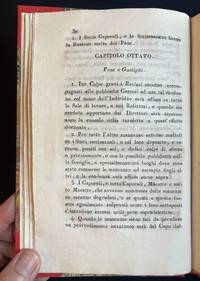
1818réf. 4414Florence: presso Niccolò Carli 1818. 8vo 193 x 125 mm. 45 3 bl.; 37 1 bl. pp. Letterpress tables. The second part is an Appendix separately paginated with half-title and approbation at end dated 1818. A few small spots to title and last few pages. Modern half linen and marbled boards original rear wrapper bound in. Only Edition of the rules for the main Florentine workhouse for the destitute mainly children established by Napoleon in 1812 to honor the birth of his son the King of Rome on the site of two former monasteries in the Florentine suburb of Montedomini. The architect Giuseppe del Rosso combined the two monastic edifices creating one main building in a neoclassical style and a complex of six smaller buildings for workshops etc. The Pia Casa di Montedomini as it came to be known was not only a poorhouse but was a center for poor relief generally. The various categories of candidates for aid are set forth in the introduction: children or adults who were taken in by Montedomini or by other “pious establishments” in the city as permanent residents known as Reclusi; those who were given work during the day and who returned to their families at the end of the day; those who were given work to carry out at home; and those few who were granted financial help. The Reclusi were divided by age: children under 3 went to the Spedale degli Innocenti those aged 3 to 10 and 10 to 15 to two different orphanages and those who were disabled or too old to work to another hospice Spedale di Bonifazio. Thus families were broken up: this is acknowledged in the text. Blank sample forms are provided for the admission of each category. Most of the rules are devoted to the main Reclusi aged 15 and up. The first chapter outlines admissions procedures; chapters 2 and 3 describe their general living conditions and daily routines and the following chapters address details of work food clothing and bedding all paid for through the inhabitants’ labor. Not surprisingly given the Napoleonic inspiration the Reclusi were organized in quasi-military “brigades” divided by sex and type of work. The brigades were led by the most compliant and hard-working individuals male “Caporali” and female “Maestre” who wore differently colored uniforms from the others. Every moment of the day was strictly regimented and other than eating and sleeping there was no time for anything other than work except for two hours of recreation on the occasional special feast day when only selected individuals were allowed to leave the Casa in strictly controlled groups. The daily life of these children and young adults who were imprisoned “for their own good” is hard to fathom for a modern reader: they rose at 6 or 6:30 prayed worked until noon finally were allowed to eat and then went back to work until 11 or 11:30 pm. Most of the work seems to have involved sewing or needlework; some worked for tailors or other textile workers. Dinner was followed by prayers and bedtime silence was imposed at 1 am. Meals were spartan: the rations of each ingredient are prescribed down to the ounce. Lunch was 2 ounces of soup 10 ounces of bread and 6 ounces of meat or a comparable quantity of vegetables. Dinner was bread and vegetables. One suspects that many barely survived in these conditions. Other chapters and the Appendix are devoted to the administration of the Casa accounting and record-keeping work assignments and payment and relations with extra-institutional employers. I locate no copies in American libraries. R. Uccelli Contributo alla Bibliografia della ToscanaC 1922 2575. presso Niccolò Carli unknown
1818réf. 4414Florence: presso Niccolò Carli 1818. 8vo 193 x 125 mm. 45 3 bl.; 37 1 bl. pp. Letterpress tables. The second part is an Appendix separately paginated with half-title and approbation at end dated 1818. A few small spots to title and last few pages. Modern half linen and marbled boards original rear wrapper bound in. Only Edition of the rules for the main Florentine workhouse for the destitute mainly children established by Napoleon in 1812 to honor the birth of his son the King of Rome on the site of two former monasteries in the Florentine suburb of Montedomini. The architect Giuseppe del Rosso combined the two monastic edifices creating one main building in a neoclassical style and a complex of six smaller buildings for workshops etc. The Pia Casa di Montedomini as it came to be known was not only a poorhouse but was a center for poor relief generally. The various categories of candidates for aid are set forth in the introduction: children or adults who were taken in by Montedomini or by other “pious establishments” in the city as permanent residents known as Reclusi; those who were given work during the day and who returned to their families at the end of the day; those who were given work to carry out at home; and those few who were granted financial help. The Reclusi were divided by age: children under 3 went to the Spedale degli Innocenti those aged 3 to 10 and 10 to 15 to two different orphanages and those who were disabled or too old to work to another hospice Spedale di Bonifazio. Thus families were broken up: this is acknowledged in the text. Blank sample forms are provided for the admission of each category. Most of the rules are devoted to the main Reclusi aged 15 and up. The first chapter outlines admissions procedures; chapters 2 and 3 describe their general living conditions and daily routines and the following chapters address details of work food clothing and bedding all paid for through the inhabitants’ labor. Not surprisingly given the Napoleonic inspiration the Reclusi were organized in quasi-military “brigades” divided by sex and type of work. The brigades were led by the most compliant and hard-working individuals male “Caporali” and female “Maestre” who wore differently colored uniforms from the others. Every moment of the day was strictly regimented and other than eating and sleeping there was no time for anything other than work except for two hours of recreation on the occasional special feast day when only selected individuals were allowed to leave the Casa in strictly controlled groups. The daily life of these children and young adults who were imprisoned “for their own good” is hard to fathom for a modern reader: they rose at 6 or 6:30 prayed worked until noon finally were allowed to eat and then went back to work until 11 or 11:30 pm. Most of the work seems to have involved sewing or needlework; some worked for tailors or other textile workers. Dinner was followed by prayers and bedtime silence was imposed at 1 am. Meals were spartan: the rations of each ingredient are prescribed down to the ounce. Lunch was 2 ounces of soup 10 ounces of bread and 6 ounces of meat or a comparable quantity of vegetables. Dinner was bread and vegetables. One suspects that many barely survived in these conditions. Other chapters and the Appendix are devoted to the administration of the Casa accounting and record-keeping work assignments and payment and relations with extra-institutional employers. I locate no copies in American libraries. R. Uccelli Contributo alla Bibliografia della ToscanaC 1922 2575. presso Niccolò Carli unknown books