Florence P HoldenBiblio.com

16 269 résultats
réf. 0267547617.Ghardcover. Good. Access codes and supplements are not guaranteed with used items. May be an ex-library book. hardcover
1998réf. 55210Bayonne: Musee Bonnat. New. Paperback. FREE UPGRADE to Courier/Priority Shipping Upon Request – – IN STOCK AND IMMEDIATELY AVAILABLE FOR SHIPMENT - Flawless copy brand new pristine never opened -- Text in French. 38 pages. 15 works catalogued; lovely color illustrations -- with a bonus offer-- . 1998. Musee Bonnat paperback
réf. 51277aafVevea (Suisse), Säuberlin & Pfeiffer, (Printers), 1923, in-4to, 79 p., 38 tipped-in full-page colourplates by G.H., (Georg Heil), first free (special designed) flyleaf missing, ill. boards, small cloth-sprip on spine, binding loose.
réf. 15980Vevey, Säuberlin & Pfeiffer 1923, 320x240mm, 79pages, editor's binding. Book in very good condition.
1923réf. 15980Vevey : Säuberlin & Pfeiffer 1923. reliure d'éditeur. JACKSON Florence.Auntie Jack’s Nonsense Rhymes. Dedicated to her nieces nephews God-children and all other children God bless them. Illustrated by Georg Heil. Vevey Säuberlin & Pfeiffer1923 320x240mm 79 pages 38 planches couleurs editor's binding. Book in very good condition. No hidden customs fees for orders shipped to the U.S.A with a value of up to 800 USD PDDP shipping we pay the VAT in advance Säuberlin & Pfeiffer unknown
réf. feb92092Used. For more details please contact me unknown
réf. Juanpebooks130741WE ship worldwide. Brand new 100%guarentee unknown
réf. 7598P. Horay 1978
réf. 7009Editions Gérard Monfort, Paris, 1999. In-8, broché sous couverture illustrée en couleurs, 93 pp. - pl. I. Giotto et les origines de la peinture gothique en Italie - II. Le registre chronologique de l'art dans la Toscane du début du Trecento - III. Les orientations contrastées des "suiveurs" florentins de Giotto - IV. La "mort noire" ...
réf. 16149Paris : Kirby-Beard & cie 1948. Small quarto original embossed wrappers with pictorial onlay in glassine jacket bound with staples and silk ties; pp 21 illustrated with colour plates depicting female models wearing fine dresses the illustrations also incorporating a selection of magnificent watches; a very good copy. A superbly produced promotional brochure for the Parisian firm Kirby-Beard horologists jewellers and goldsmiths showcasing designs of Omega watches and dress designs by Pierre Balmain Jacques Fath Lucien Lelong and Robert Piguet. unknown
1989réf. BN151625Luzern : Strom-Verl. 1989. 1989. Authentische Zeugnisse von den Kindern des grossen Geistes : aus d. Werk d. legendären Indianer-Photogr. Edward Sheriff Curtis. Text von Florence Curtis Graybill u. Victor Boesen. Aus d. Amerikan. übertr. von Herbert Thiele-Fredersdorf Authentische Zeugnisse von den Kindern des grossen Geistes : aus d. Werk d. legendären Indianer-Photogr. Edward Sheriff Curtis. Text von Florence Curtis Graybill u. Victor Boesen. Aus d. Amerikan. übertr. von Herbert Thiele-Fredersdorf Curtis Edward S. und Florence Curtis Graybill Luzern : Strom-Verl. unknown
réf. SONG1493926551Springer 2015-09-13. 1st ed. 2015. hardcover. Used: Good. 6.14x1.13x9.21. Buy with confidence. Excellent Customer Service & Return policy. Springer hardcover
2015réf. x-1493926551Springer 2015. Hardcover. New. 600 pages. 9.50x6.50x1.50 inches. Springer hardcover
réf. DADAX1493926551Springer 2015-09-13. 1st ed. 2015. hardcover. New. 6.14x1.13x9.21. Buy with confidence. Excellent Customer Service & Return policy. Springer hardcover
2016réf. x-1493947346Springer Verlag 2016. Paperback. New. reprint edition. 511 pages. 9.00x6.00x1.00 inches. Springer Verlag paperback
2011réf. I-130-817EUD 2011. Paperback. Very Good. Former library book. Edition 2011. Ammareal gives back up to 15% of this item's net price to charity organizations. EUD paperback
réf. BN103653EUD. Softcover. Autofiguration dans le théatre contemporain Autofiguration dans le théatre contemporain EUD paperback
réf. 608449on First-Day Cover for the 15 cent American Dance stamps Scott # 1749 #1750 #1751 #1752 with pictorial cachet by Artmaster postmarked New York NY April 26 1978. Boldly signed by Peter Duchin. 6 1/2" x 3 3/4". Very good. Provenance from the estate of Adrian Fagan. Signed by Authors. No Binding. Very Good. unknown books
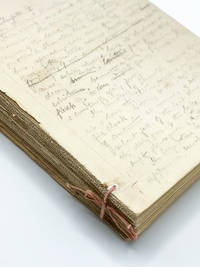
1910réf. 44643n.p.: n.p. 1910. Very good. Original draft entirely written out by hand of the sequel to the international sensation THE ROSARY. While Florence Barclay was working on this manuscript she was in the midst of a life-changing experience: her romance novel THE ROSARY had just become one of the biggest blockbuster novels of the Edwardian era. It was not only a runaway bestseller for years on end but also parodied by PUNCH made into at least five films and described by the Queen of England herself as her favorite book of the year. According to Rachel Anderson it was "said to have been read and wept over by every housemaid in the British Isles." THE MISTRESS OF SHENSTONE was something of its sequel featuring characters first introduced in THE ROSARY. THE MISTRESS OF SHENSTONE is an exquisite romance between a widow and the man who accidentally killed her husband: like THE ROSARY it combines a moving arc of emotional development with an alluring charisma between the main characters. When Barclay arrived in the United States for a book tour of SHENSTONE she was greeted as a celebrity much in the way that Charles Dickens had been on his first trip to the country. In addition to photographers and journalists she was met right off the boat by a crush of fans holding welcome banners. This experience was so unlike what was expected for English authors in the period that her daughter makes special remark upon it in her biography of the author: "To English readers it may seem a surprising outburst and very different to anything that can be imagined as taking place in England by way of reception accorded to a private individual" 220. In 1921 SHENSTONE also became the first of Barclay's books before THE ROSARY to be turned into a film. This manuscript offers a window into the writing process of a famous romance author at the height of her power. In addition to the entire base text in Barclay's hand essentially every page is revised in the same hand in some cases extensively. Common editorial markings include crossed out words and sentences some replaced with new text additions to punctuation and rearranged phrases. It is illuminating to compare the manuscript itself with the details of Barclay's writing as described in her daughter's book LIFE OF FLORENCE L. BARCLAY 1921. In seeking to champion her mother as an author for "ordinary readers" her daughter asserts that Barclay "had no eye to the literary connoisseur the seeker after mere artistic effect" 242. Yet many of the revisions made by Barclay in this draft suggest that she cared much more about the art of her work than the biography claims. Altered words often reflect the author's stylistic refinements seeking a more accurate or elevated word in place of the original e.g. "empty" changed to "desolate". Other changes show a focused eye for paring down. For instance "she poured out the doctor's tea" and "passed it across the folding tea table between them" has been changed simply to "handed it to him." These decisions reflect more than a desire to "supply them her readers with that they wanted" 242: they show an author spending hours refining her craft. A manuscript offering the opportunity to research further into the working process of a major popular romance writer - a topic that has thus far been rarely recorded or studied. 9'' x 6.75''. 386 individual lines sheets thread-bound by hand with pink ribbon filled out in pencil on rectos only. Text begins with Chapter I "On the terrace of Shenstone" and ends with the phrase sentence of the final chapter "Mrs. Jim Airth" in larger script an effect reproduced in the printed final. Editorial markings throughout. Housed in later waxed canvas wrapper with two printed labels "The Mistress of Shenstone" and one handwritten annotation "1st M S of Mistress of Shenstone." Provenance: by descent from author's family. n.p. unknown
réf. 26751This popular and prolific American novelist often penned such inspirational fiction for young adults as "The Singular Miss Smith" "Transfiguration of Miss Philura" and "The Resurrection of Miss Cynthia." Two items: First an ALS 1p 6" X 7" Staten Island New York Kingsley Avenue no less! 1923 February 27. Addressed to Albert Johannsen 1871-1962 a University of Chicago geology professor who authored "The House of Beadle and Adams and Its Dime and Nickel Novels" University of Oklahoma Press 1950 the definitive reference work and bibliography on the subject. Fine. Charming note trying to oblige an admirer: "Somewhere in the attic are more respectable 'scraps' of manuscript than the enclosed; but at present I am not able to endure the winter rigors of that repository of 'literary remains.' This is a rejected beginning of the thirteenth chapter of the book I am now writing: 'The Life of Henry Fowle Durant' Founder of Wellesley College. I am sorry I saw fit to crumple it before dropping it into the waste basket." Second the aforementioned Autograph Manuscript Signed 1p 8½" X 11" n.p. n.y. Very good. Despite Kingsley's claim of having crumpled it this thin onionskin-type paper bears almost no evidence of having been so abused. Handsomely and closed penned in black fountain pen and bearing a number of crossouts additions and deletions this is a very full page 89 clearly marked chapter "XIII" and opens: "In her singularly lucid and beautiful 'Interpretation of the Genius of Henry Fowle Durant' Anne Eugenia Morgan writes of him thus: 'Henry Fowle Durant came to provide a transition in our human course -- a beautiful curve for a staircase that leads up up into the clearing mysteries of the bow of light the bow of higher truth luminous in our time." Most unusual to find earlier versions of published works such as this. Kingsley's "Life of Henry Fowle Durant" was published the following year in New York by Century Company. This fascinating pair is accompanied by Johannsen's original 8½" X 11" file folder bearing a printed "Collection of Albert Johannsen" label partly filled in by Johannsen. unknown
réf. 26890This popular and prolific English novelist is best known for children's books ranging from "A Very Simple Story" 1866 to "Behind the Scenes in a Schoolroom" 1914. ANS 1p 4½" X 7" n.p. 1902 December 20. Addressed to "Sir." Very good. Mild bit of age toning. On pale green letterhead Montgomery graciously informs an admirer "I have much pleasure in sending you the autograph you ask me for." Accomplished boldly in black ink in a fair hand as flowery as her fiction. From the collection of University of Chicago geology professor Albert Johannsen 1871-1962 author of "The House of Beadle and Adams and Its Dime and Nickel Novels" 1950 the definitive reference work and bibliography on the subject. Johannsen's original 8½" X 11" file folder bearing his printed "Collection of Albert Johannsen" label partly filled in by Johannsen accompanies this item. unknown
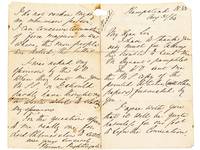
1864réf. 3103Hampstead: np 1864. First edition. nb. Good. FLORENCE NIGHTINGALE REJECTS THE FIRST GENEVA CONVENTION NINE DAYS AFTER ITS SIGNING: "IT IS LIKE AN OPERA CHORUS". A foundation-era manuscript of international humanitarian law: Florence Nightingale's private rejection of the First Geneva Convention written to Britain's Geneva delegate nine days after its signing-the primary source the ICRC's own historians have long identified as the more accurate record of her views and which the Collected Works anticipated without having. -------- This letter sits at the precise intersection of everything Florence Nightingale most fundamentally believed and everything for which she is remembered. Her life's work rested on a single conviction: that the mass death of soldiers from disease neglect and institutional failure was preventable and that the remedy was systemic reform not charitable supplementation.The Geneva Convention of 1864 proposed a different answer to the same problem. She thought it was wrong and this letter says so privately and without diplomatic qualification to Thomas Longmore the man who had just helped negotiate it. On August 22 1864 twelve European states signed the Geneva Convention for the Amelioration of the Condition of the Wounded in Armies in the Field. The Convention established the neutrality and protection of wounded soldiers medical personnel and hospitals and adopted the red cross on a white ground as their identifying emblem. It represented a revolutionary proposition: that even in war international law could impose limits upon belligerent states. Nine days later Nightingale rejected the premise that such an agreement could meaningfully alter the conduct of war. The War Office had sent her the manuscript copy of the Convention's articles - materials furnished to them by the letter's recipient Longmore from the Geneva Conference - and asked for her opinion before Britain's accession was finalized. She was the obvious person to ask: no one alive had more direct experience of the conditions the Convention was designed to address. Her response in this letter is devastating: "It amounts to nothing more than a declaration that humanity to the wounded is a good thing. It is like an Opera chorus. And if the principal European characters sing 'We never will be cruel more' I am sure if England likes to sing too 'We never will be cruel more' I see no objection." For Nightingale the fundamental problem was enforcement. A promise of humane conduct had little value because governments willing to observe it required no treaty while governments unwilling to observe it would simply disregard one: "But it is like vows. People who keep a vow would do the thing without the vow. And if people will not do it without the vow they will not do it with." She applies that reasoning directly to the signatories: "England & France will not be more humane to the enemy wounded for having signed the Convention. And the Convention will not keep semi-barbarous nations like Russia from being inhuman." And Nightingale refuses to disguise the realities of warfare beneath humanitarian rhetoric: "I do not reckon myself an inhuman person I can conceive circumstances of 'force majeure' in war where the more people are killed the better." Her conclusion is political and administrative. The question ultimately belongs not to humanitarian volunteers but to government: "For the question appears to me really one for Lord Palmerston to settle." NIGHTINGALE AGAINST HENRY DUNANT: The letter captures one of the fundamental disagreements at the birth of modern humanitarianism. Nightingale and Henry Dunant Swiss humanitarian co-founder of the Red Cross had confronted essentially the same problem-the catastrophic failure of military systems to care for wounded and sick soldiers-but arrived at profoundly different solutions. Nightingale believed the answer was to reform the state and its military medical administration; Dunant believed the inadequacy of those systems required an independent humanitarian structure capable of supplementing them. Nightingale had already objected to Dunant's proposal for voluntary relief societies arguing that such organizations would assume responsibilities properly belonging to governments. Contemporary accounts record her warning that this would relieve governments of duties "which they alone are in a position to assume." The present letter goes further. Written after the Geneva Convention had actually been signed it addresses not merely Dunant's voluntary relief societies but the international legal mechanism intended to protect the wounded. Her objection was fundamental: no treaty could conjure humane conduct in governments that lacked the will or the administrative capacity to provide it. Critically this was not a position confined to her private correspondence. Lynn McDonald's scholarly edition of the Collected Works records that Nightingale communicated the force majeure argument directly to Dunant himself warning him simultaneously of "the very great danger of taking the responsibility off governments of providing for wounded and sick." The present letter to Longmore is the only known primary document in which she makes this argument in full in her own hand to the man who had negotiated the instrument she was critiquing. It has not previously appeared in the scholarly record. THE SYSTEMS REFORMER BEHIND THE "LADY WITH THE LAMP": The letter also exposes the inadequacy of the sentimental popular image of Nightingale as merely the compassionate "Lady with the Lamp." Nightingale was a formidable researcher statistician administrator and systems reformer. She pioneered the use of statistical information and data visualization to demonstrate preventable military mortality and became the first woman elected a Fellow of the Royal Statistical Society in 1858. Her experience during and after the Crimean War convinced her that preventable military suffering resulted principally from failures of administration sanitation organization and accountability. Her solution was therefore not to create a parallel charitable apparatus but to force governments and military institutions to perform their existing responsibilities. That distinction remains central to scholarship on Nightingale and the Red Cross. The International Committee of the Red Cross ICRC itself acknowledges that although she and Dunant shared the objective of alleviating wartime suffering their "values and approaches differed significantly" and specifically recognizes her skepticism that an international convention protecting the wounded would actually be respected on the battlefield. The ICRC further cautions scholars against confusing "the public declarations of a woman well versed in the art of public relations with her private opinions." The present letter is precisely the private opinion the ICRC's own historians have flagged as the more accurate record of her views. NIGHTINGALE AND THE RED CROSS - PUBLIC MYTH AND PRIVATE OPINION: The historical irony is considerable. In 1872 Henri Dunant publicly credited Nightingale as an inspiration for his humanitarian work declaring that although he was known as founder of the Red Cross and originator of the Geneva Convention "it is to an Englishwoman that all the honour is due." Nightingale consequently became associated in popular memory with the humanitarian movement whose foundational assumptions she had challenged. The International Red Cross Conference of 1907 sent her a formal message saluting her as "the pioneer of the first Red Cross movement." She spent forty years privately maintaining that the movement was built on a false premise. That distinction gives the present manuscript particular force. Written "Private" to Britain's representative at Geneva while the Convention was scarcely a week old it records Nightingale without commemorative hindsight or diplomatic polish. She calls the new international agreement an "Opera chorus" compares its promises to ineffectual vows predicts that civilized powers will behave according to circumstances regardless of their signatures and argues that states inclined toward brutality will simply ignore it. The document thus places one of the nineteenth century's greatest humanitarian reformers at the precise historical moment when two competing models for alleviating suffering in war confronted one another: Dunant's international humanitarian law and voluntary relief movement versus Nightingale's insistence upon state responsibility and systemic military reform. History ultimately incorporated both. Modern military medical systems bear Nightingale's legacy while the Geneva Conventions and the Red Cross embody Dunant's. Their apparently contrary paths ultimately became complementary. This letter captures the disagreement at its source. PROVENANCE: From the personal papers of Sir Thomas Longmore 1816-1895 Professor of Military Surgery at Netley and British delegate to the Geneva Conference of August 1864; thence by family descent. Marked "Private" by Nightingale herself the letter remained among Longmore's papers. Autograph Letter Signed "Florence Nightingale" to Sir Thomas Longmore rejecting the First Geneva Convention nine days after its signing. Hampstead N.W.: August 31 1864. One sheet 7x9 in folded into four pages. Hole at top center. Originally folded to create six panels. Top two panels completely separated at both folds bottom panels separated along vertical fold; other panels just barely attached. There is no loss at the folds and when the panels are placed together everything appears complete and attached. Text throughout legible and unfaded. Signature crisp and fully legible. References: Boissier Pierre. "Florence Nightingale and Henry Dunant: Similarities and Differences." International Review of the Red Cross 1964. McDonald Lynn ed. Florence Nightingale and the European Wars: From the Crimean to the Franco-Prussian War. The Collected Works of Florence Nightingale University of Guelph. Mohr Charlotte. "Florence Nightingale: Portrait of a Pioneer of Modern Nursing in Writings." ICRC Library / Cross-Files August 2018. Angela Countess of Limerick. "Florence Nightingale." International Review of the Red Cross 1964. np unknown
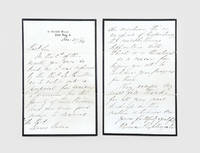
1864réf. 177463London: 21 December 1864. Your great kindness on behalf of this good man's family Nightingale writes to Davis 1820-1883 a clergyman and headmaster to rally support for the family of the recently deceased Lutheran minister Theodor Fliedner 1800-1864 Nightingale's old friend and tutor whom she viewed as a father figure. Fliedner founded and ran 30 deaconess houses where women could train in theology and nursing and his family required financial aid to continue his work. Nightingale met Theodor Fliedner in 1841 and in 1850 became a temporary resident at his flagship deaconess community the Kaiserswerther Diakonie. The women who resided there had committed to a holy life and taken vows. However they were not enclosed as they were trained to go out into the community to care for the sick. Further they could leave at any point if they wished. It was an ideal place for Nightingale for whom nursing was a religious vocation and the time she spent there was "key in the development of her mission" Macdonald p. 7. In 1851 she wrote her first publication issued anonymously titled The Institute of Kaiserswerth on the Rhine in which she recommended Fliedner's deaconess houses to English women. She commented on "the delicacy the cheerfulness the grace of Christian kindness the moral atmosphere" in the hospitals and "the kindness of the sisters in imparting their own knowledge" Nightingale p. 19. The Fliedners and Nightingale remained close long after her stay. In 1853 she became godmother to their child and upon Fliedner's death Nightingale felt that she had lost a father. Determined to support his family in their "continuance of the work" Nightingale wrote and printed an appeal and engaged a network of clergymen to promote the cause. To this end she writes to Reverend Davis that "you were so kind. as to enter into a proposal for sending a provision for the family" and asks that he circulate her pamphlets "amongst the likeliest members" of his community. Bifolium and single sheet 177 x 113 mm. Autograph letter written across 3 pages letterhead of 27 Norfolk Street Park Lane mourning borders. Previously folded occasional small splits at ends of folds: in very good condition. McDonald Lynn ed. Florence Nightingale's Spirital Journey: Biblical Annotations Sermons and Journal Notes 2001; Nightingale Florence The institution of Kaiserswerth on the Rhine for the practical training of deaconesses under the direction of the Rev. Pastor Fliedner 1851. unknown
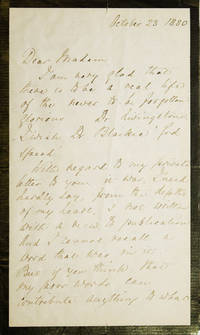
1880réf. 320579Derby 1880. 3pp. folded sheet mourning stationery. With the original mailing envelope. Usual fold. Old tape repair on conjugate leaf with resulting stain affecting a few words of text but not affecting signature. 3pp. folded sheet mourning stationery. With the original mailing envelope. "I am very glad that there is to be a real life of the never to be forgotten glorious Dr. Livingstone. I wish Dr. Blaikie God speed. With regard to my private letter to you it was I need hardly say from the depths of my heart & not written with a view to publication and I cannot recall a word that was in it. But if you think that my poor words can contribute anything to what must be the object of every English speaking nation & not only this but of every man woman & child all over the world viz. to make known one who has opened the way of peace & not terror to those who were 'lying in darkness & the shadow of death' on so large a portion of the globe. I feel that I cannot decline what otherwise is so repugnant to me . And pray believe me ever the faithful servant of yourself & the great memory of as true a hero saint as ever lived ." Written on the occasion of the preparation for imminent publication of William Garden Blaikie's biography of Livingstone published 1880 the letter gives permission for a letter of hers to be published in which she said of Livingstone: "We cannot console ourselves for our loss. He is irreplaceable" p. 458 and called him "the greatest man of his generation unknown
1930réf. 17891E1930s. Original autograph signature of British author Florence Riddell written in vintage fountain pen ink on a 4” x 3” piece of paper. Fine. Florence Riddell is the author of ‘Wives Win’ ‘Out of the Mist’ ‘Perilous Love’ etc. unknown