13.756 resultados
1776ref. 33412London: J. F. W. Des Barres for The Atlantic Neptune 1776. Large engraved chart from Des Barres' Atlantic Neptune on two sheets of laid paper joined each bearing "J Bates" watermark. 43x31 inches sheet size nice margins; contemporary hand-color in outline; slightest offsetting a superior copy. State 4 of 7. Fine chart depicting the waters between New Bedford and Martha's Vineyard. Buzzards Bay and the Vineyard Sound including the Elizabeth Islands and the western half of Martha's Vineyard. Showing much more on-shore information than is typical for a Des Barres chart there are details of property boundaries structures even a road from Menemshaw Pond to Tisbury. Native names throughout remain largely unchanged today. Joseph Des Barres was born in Switzerland in 1721 and educated in Basel before emigrating to England and entering the Royal Military College where he learned engineering and the art of surveying. In 1756 Des Barres was commissioned a Lieutenant in the Royal American Regiment and dispatched to North America. He served in America during the Seven Years War under Colonel Bouquet Lord Howe and General Amherst and participated in the Quebec campaign as General Wolfe's engineer. Though Des Barres was responsible for the surveys done of Nova Scotia and the Isle of Sable the surveying of the coastline of what became the United States was undertaken by Major Samuel Holland a Dutchman who joined the British army during the French and Indian War as an engineer and became ultimately Surveyor General for North America. Holland was in charge of a rather large staff that included Charles Blaskowitz and George Gauld. They ultimately provided greatly improved charts for the entire coastline and the Gulf of Mexico. All this work was done prior to the Revolution which necessarily brought the surveys to an end. The publishing supervised by Des Barres continued throughout the war years. Des Barres compiled and edited the atlas maintaining a high standard throughout. His primary motive seems to have been the navigational usefulness of the charts. He clearly envisioned a navigator's needs in approaching a shoreline. The Atlantic Neptune was the first new survey of American coastlines in a century and the need was very great. The charts were plagiarized for the next thirty or forty years. Des Barres also had a flare for making charts aesthetically appealing so that they are invariably handsome as well as unfailingly interesting. Stevens 88D; John Carter Brown Library Charting the East Coast of North America The Atlantic Neptune Providence: 1972; Robert Lingel 'The Atlantic Neptune' in the Bulletin of the New York Public Library July 1936 pp.571-603; Augustus P. Loring 'The Atlantic Neptune' in American Maritime Prints New Bedford: 1985. J. F. W. Des Barres for The Atlantic Neptune unknown
1776ref. 33412London: J. F. W. Des Barres for The Atlantic Neptune 1776. Large engraved chart from Des Barres' Atlantic Neptune on two sheets of laid paper joined each bearing "J Bates" watermark. 43x31 inches sheet size nice margins; contemporary hand-color in outline; slightest offsetting a superior copy. State 4 of 7. Fine chart depicting the waters between New Bedford and Martha's Vineyard. Buzzards Bay and the Vineyard Sound including the Elizabeth Islands and the western half of Martha's Vineyard. Showing much more on-shore information than is typical for a Des Barres chart there are details of property boundaries structures even a road from Menemshaw Pond to Tisbury. Native names throughout remain largely unchanged today. Joseph Des Barres was born in Switzerland in 1721 and educated in Basel before emigrating to England and entering the Royal Military College where he learned engineering and the art of surveying. In 1756 Des Barres was commissioned a Lieutenant in the Royal American Regiment and dispatched to North America. He served in America during the Seven Years War under Colonel Bouquet Lord Howe and General Amherst and participated in the Quebec campaign as General Wolfe's engineer. Though Des Barres was responsible for the surveys done of Nova Scotia and the Isle of Sable the surveying of the coastline of what became the United States was undertaken by Major Samuel Holland a Dutchman who joined the British army during the French and Indian War as an engineer and became ultimately Surveyor General for North America. Holland was in charge of a rather large staff that included Charles Blaskowitz and George Gauld. They ultimately provided greatly improved charts for the entire coastline and the Gulf of Mexico. All this work was done prior to the Revolution which necessarily brought the surveys to an end. The publishing supervised by Des Barres continued throughout the war years. Des Barres compiled and edited the atlas maintaining a high standard throughout. His primary motive seems to have been the navigational usefulness of the charts. He clearly envisioned a navigator's needs in approaching a shoreline. The Atlantic Neptune was the first new survey of American coastlines in a century and the need was very great. The charts were plagiarized for the next thirty or forty years. Des Barres also had a flare for making charts aesthetically appealing so that they are invariably handsome as well as unfailingly interesting. Stevens 88D; John Carter Brown Library Charting the East Coast of North America The Atlantic Neptune Providence: 1972; Robert Lingel 'The Atlantic Neptune' in the Bulletin of the New York Public Library July 1936 pp.571-603; Augustus P. Loring 'The Atlantic Neptune' in American Maritime Prints New Bedford: 1985. J. F. W. Des Barres for The Atlantic Neptune unknown books
1606ref. 1305011606. First Edition. SUETONIUS HOLLAND Philemon translator. The Historie of Twelve Caesars Emperors of Rome. WITH: JUSTINUS M. Junianus. The Historie of Justine. London: Matthew Lownes / William Jaggard 1606. Two volumes bound in one. Small folio in sixes 7-1/2 by 11 inches contemporary full brown calf raised bands tan morocco spine label. $24000.First edition in English of SuetoniusÕ dramatic biographies of the Caesars the important Holland translation bound together with a 1606 edition of Justinus' widely read abridgment of Pompeius TrogusÕ Historiae Philippica.""De Vita Caesarum from Julius Caesar to Domitian is largely responsible for that vivid picture of Roman society and its leaders morally and politically decadent that dominated historical thought until modified in modern times by the discovery of nonliterary evidence. The biographies are organized by topics: the emperor's family background career before accession public actions private life appearance personality and deathÉ The earlier lives down to Nero especially those of Julius Caesar and Octavius Caesar are much the fullest perhaps because as an antiquarian Suetonius was drawn to the documentary byways of an earlier ageÉ it is exciting reading"" Britannica. ""Classical 'lives' became prototypes for later writings about individuals. A rival for Plutarch was Suetonius flourished A.D. 112-121 whose Lives of the Caesars overflowed with anecdotes of lust violence and idiosyncrasy"" Boorstin The Creators 586. Holland was considered the ""translator general in his ageÉ while the plague raged at Coventry where Holland lived in 1605-06 Holland translated Suetonius' Historie of Twelve Caesars"" DNB. The work was Robert Graves' primary inspiration for his novel I Claudius 1934. With woodcut initials and elaborate woodcut chapter headpieces incorporating medallion portraits.Justinus' work is an abridgment of the monumental Historiae Philippicae by Roman historian Pompeius Trogus ""a history of the world down to the Roman conquest of the East"" Peck. Justinus' Epitome became a critical source for the history of Macedonia and the Hellenistic kingdoms. First translated into English by Arthur Golding in 1564 it stood as the primary source from which Elizabethans drew their knowledge of classical history. There is little doubt that William Shakespeare was well-acquainted with the book. ""Altogether there are ten or more clear-cut allusions to memorable characterizations and passagesÉ In addition Shakespeare seems to have drawn heavily upon the book in naming many of his dramatic personages"" Charles Barrell. Direct parallels can be found in Henry V Henry VI Titus Andronicus Taming of the Shrew and The Winter's Tale. Golding's much earlier translation is typically cited as Shakespeare's source but it is curious that the translator of this 1606 edition George Wilkins was an associate of Shakespeare a fellow member of the King's Company of Actors and the co-author of Shakespeare's late drama Pericles Prince of Tyre. The unscrupulous Wilkins actually ""extensively plagiarized"" Golding's translation for his own version so the two texts are perforce very similar. With woodcut initials and elaborate woodcut chapter headpieces incorporating medallion portraits. STC 23424. Brueggemann 703. Moss II:636. Harris 145. Palmer 100. STC 24293. Ownership signature dated 1657. Occasional early ink marginal marks.Interior generally crisp and clean; paper flaw to leaf P5 of Suetonius affecting letters but not the sense of the text occasional light dampstaining to top edge of Justinus. Expert restoration to joints which are cracked but holding firm. An exceptional copy. hardcover
1606ref. 1305011606. First Edition. SUETONIUS HOLLAND Philemon translator. The Historie of Twelve Caesars Emperors of Rome. WITH: JUSTINUS M. Junianus. The Historie of Justine. London: Matthew Lownes / William Jaggard 1606. Two volumes bound in one. Small folio in sixes 7-1/2 by 11 inches contemporary full brown calf raised bands tan morocco spine label. $24000.First edition in English of SuetoniusÕ dramatic biographies of the Caesars the important Holland translation bound together with a 1606 edition of Justinus' widely read abridgment of Pompeius TrogusÕ Historiae Philippica.""De Vita Caesarum from Julius Caesar to Domitian is largely responsible for that vivid picture of Roman society and its leaders morally and politically decadent that dominated historical thought until modified in modern times by the discovery of nonliterary evidence. The biographies are organized by topics: the emperor's family background career before accession public actions private life appearance personality and deathÉ The earlier lives down to Nero especially those of Julius Caesar and Octavius Caesar are much the fullest perhaps because as an antiquarian Suetonius was drawn to the documentary byways of an earlier ageÉ it is exciting reading"" Britannica. ""Classical 'lives' became prototypes for later writings about individuals. A rival for Plutarch was Suetonius flourished A.D. 112-121 whose Lives of the Caesars overflowed with anecdotes of lust violence and idiosyncrasy"" Boorstin The Creators 586. Holland was considered the ""translator general in his ageÉ while the plague raged at Coventry where Holland lived in 1605-06 Holland translated Suetonius' Historie of Twelve Caesars"" DNB. The work was Robert Graves' primary inspiration for his novel I Claudius 1934. With woodcut initials and elaborate woodcut chapter headpieces incorporating medallion portraits.Justinus' work is an abridgment of the monumental Historiae Philippicae by Roman historian Pompeius Trogus ""a history of the world down to the Roman conquest of the East"" Peck. Justinus' Epitome became a critical source for the history of Macedonia and the Hellenistic kingdoms. First translated into English by Arthur Golding in 1564 it stood as the primary source from which Elizabethans drew their knowledge of classical history. There is little doubt that William Shakespeare was well-acquainted with the book. ""Altogether there are ten or more clear-cut allusions to memorable characterizations and passagesÉ In addition Shakespeare seems to have drawn heavily upon the book in naming many of his dramatic personages"" Charles Barrell. Direct parallels can be found in Henry V Henry VI Titus Andronicus Taming of the Shrew and The Winter's Tale. Golding's much earlier translation is typically cited as Shakespeare's source but it is curious that the translator of this 1606 edition George Wilkins was an associate of Shakespeare a fellow member of the King's Company of Actors and the co-author of Shakespeare's late drama Pericles Prince of Tyre. The unscrupulous Wilkins actually ""extensively plagiarized"" Golding's translation for his own version so the two texts are perforce very similar. With woodcut initials and elaborate woodcut chapter headpieces incorporating medallion portraits. STC 23424. Brueggemann 703. Moss II:636. Harris 145. Palmer 100. STC 24293. Ownership signature dated 1657. Occasional early ink marginal marks.Interior generally crisp and clean; paper flaw to leaf P5 of Suetonius affecting letters but not the sense of the text occasional light dampstaining to top edge of Justinus. Expert restoration to joints which are cracked but holding firm. An exceptional copy. hardcover books
1779ref. 33200London 1779. Engraved and aquatint map period hand colouring. 14 lettered references large inset with title as above. Rare revolutionary chart of the Hudson River showing the American defenses on the eve of the Battle of Fort Montgomery. On October 6 1777 a British force led by Lieutenant General Sir Henry Clinton attacked Forts Montgomery and Clinton from the landward side where the American defenses were only partially completed. Support from cannon fire from British ships on the Hudson River that had passed through the chevaux de frise on the lower river. By the end of the day both forts had fallen to the British who burned the forts and tore down the stonework buildings. However the battle was a pyrrhic victory for the British. The campaign against the forts caused delays in reinforcing General John Burgoyne at Saratoga where Americans forced the British surrender ten days later at the Battle of Saratoga before Clinton's forces could arrive. The present map which depicts the Forts and the River defenses prior to the battle is from The Atlantic Neptune the finest large scale sea atlas of the United States and Canadian Atlantic coastline ever produced. The maps in the atlas were produced over a seven-year period 1775-82 and are well known for their accurate portrayal of various sounds bays bars harbors as well as navigational hazards. This atlas was used extensively by the Royal Navy during the American Revolution. Des Barres studied under the great mathematician Daniel Bernoulli at the University of Basel before continuing on to the Royal Military College at Woolwich. On the outbreak of the Seven Years war in 1756 he joined the British Royal American Regiment as a military engineer. He came to the attention of General James Wolfe who appointed him to be his aide-de-camp. From 1762 Des Barres was enlisted to survey the coastlines of Nova Scotia Newfoundland and the Gulf of St.Lawrence while his colleague Samuel Holland charted the New England coast and further south. In 1774 Des Barres returned to England where he began work on the Neptune. His dedication to the project was so strong that often at his own expense he continually updated and added new charts and views up until 1784. That year he returned to Canada where he remained for a further forty years becoming a senior political figure and a wealthy land owner and living to the advanced age of 103. The Atlantic Neptune was the first British sea atlas of her North American colonies and one of the most important achievements of eighteenth century cartography. With an official commission from the Royal Navy Des Barres published the first volume in London in 1775 which was soon followed by further volumes. Des Barres' monumental endeavor eventually featured over two-hundred charts and aquatint views many being found in several states. All of the charts were immensely detailed featuring both hydrographical and topographical information. The Neptune met with the highest acclaim from the beginning and is today widely regarded as superior to all other atlases produced during its time. Henry Stevens identified only a single state of this chart issued coloured or uncoloured which appeared in some examples volume four part two of the Atlantic Nepture; the map however is not listed in the engraved list of maps for that section and given the rarity was likely not issued in all copies. National Maritime Museum: Henry Stevens Collection: HNS156; Cf. Phillips Atlases 1198; Hornsby Surveyors of Empire: Samuel Holland J.F.W. Des Barres and the Making of the Atlantic Neptune 2011. unknown
1779ref. 33200London 1779. Engraved and aquatint map period hand colouring. 14 lettered references large inset with title as above. Rare revolutionary chart of the Hudson River showing the American defenses on the eve of the Battle of Fort Montgomery. On October 6 1777 a British force led by Lieutenant General Sir Henry Clinton attacked Forts Montgomery and Clinton from the landward side where the American defenses were only partially completed. Support from cannon fire from British ships on the Hudson River that had passed through the chevaux de frise on the lower river. By the end of the day both forts had fallen to the British who burned the forts and tore down the stonework buildings. However the battle was a pyrrhic victory for the British. The campaign against the forts caused delays in reinforcing General John Burgoyne at Saratoga where Americans forced the British surrender ten days later at the Battle of Saratoga before Clinton's forces could arrive. The present map which depicts the Forts and the River defenses prior to the battle is from The Atlantic Neptune the finest large scale sea atlas of the United States and Canadian Atlantic coastline ever produced. The maps in the atlas were produced over a seven-year period 1775-82 and are well known for their accurate portrayal of various sounds bays bars harbors as well as navigational hazards. This atlas was used extensively by the Royal Navy during the American Revolution. Des Barres studied under the great mathematician Daniel Bernoulli at the University of Basel before continuing on to the Royal Military College at Woolwich. On the outbreak of the Seven Years war in 1756 he joined the British Royal American Regiment as a military engineer. He came to the attention of General James Wolfe who appointed him to be his aide-de-camp. From 1762 Des Barres was enlisted to survey the coastlines of Nova Scotia Newfoundland and the Gulf of St.Lawrence while his colleague Samuel Holland charted the New England coast and further south. In 1774 Des Barres returned to England where he began work on the Neptune. His dedication to the project was so strong that often at his own expense he continually updated and added new charts and views up until 1784. That year he returned to Canada where he remained for a further forty years becoming a senior political figure and a wealthy land owner and living to the advanced age of 103. The Atlantic Neptune was the first British sea atlas of her North American colonies and one of the most important achievements of eighteenth century cartography. With an official commission from the Royal Navy Des Barres published the first volume in London in 1775 which was soon followed by further volumes. Des Barres' monumental endeavor eventually featured over two-hundred charts and aquatint views many being found in several states. All of the charts were immensely detailed featuring both hydrographical and topographical information. The Neptune met with the highest acclaim from the beginning and is today widely regarded as superior to all other atlases produced during its time. Henry Stevens identified only a single state of this chart issued coloured or uncoloured which appeared in some examples volume four part two of the Atlantic Nepture; the map however is not listed in the engraved list of maps for that section and given the rarity was likely not issued in all copies. National Maritime Museum: Henry Stevens Collection: HNS156; Cf. Phillips Atlases 1198; Hornsby Surveyors of Empire: Samuel Holland J.F.W. Des Barres and the Making of the Atlantic Neptune 2011. unknown books
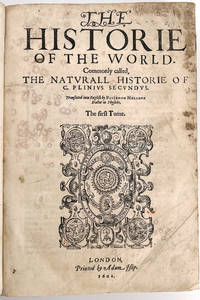
ref. 121437London Printed by Adam Islip 1601. . First edition in English first issue with the Islip imprint; 2 vols folio 30.5 x 20.7 cm; 2 title pages each with woodcut allegorical device woodcut head- and tailpieces decorative initials last leaf with errata on recto and colophon on verso one or two instances of early marginalia; lacking first blank leaf in each volume scattered light foxing and staining a few marginal open and closed tears scattered small rust holes costing a few letters faint dampstaining to a few gatherings; late 18th-century half calf over marbled paper-covered boards edges speckled red sometime rebacked with original spines laid down gilt tooling to spines red morocco title labels to spines lettered in gilt; a handsome copy. Handsome first edition of Philemon Holland's renowned English translation 'Over and over again it will be found that the source of some ancient piece of wisdom is Pliny.' PMM 5 A handsome first edition first issue of Philemon Holland's renowned English translation of Pliny's Natural History. The most popular of Holland's translations it had never before been printed in English and would not be attempted again for another 250 years. One of the greatest translators of the Elizabethan age Holland's Pliny was an important source for Shakespeare. 'In Othello's allusion to the Pontic Sea Shakespeare was clearly drawing upon Pliny's Historie as translated by Holland Similarly Pliny has also been cited as a source for Othello's reference to the "medicinal gum" of "the Arabian trees"' Payne Search for Meaning 63 and many trace Caliban in The Tempest to Holland's Pliny. 'The importance of Pliny lay not so much that he was an inexhaustible source for monsters eclipses and the stranger habits of all created things but that in the pages of Philemon Holland's translation Shakespeare found that emphasis on Nature which he employed and re-interpreted in the tragedy' Evans The Language of Shakespeare's Plays. STC 20029.5; Pforzheimer 496; ESTC S115918; Brueggemann 670; Lowndes 1885; cf. PMM 5. London, Printed by Adam Islip, 1601. hardcover
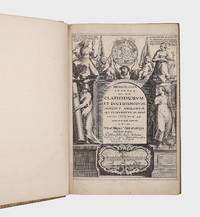
1601ref. 3078London: Impensis G. Bishop 1601. FIRST EDITION second issue with cancel title page. Hardcover. Fine. Bound in contemporary English calfskin ruled in blind re-backed and re-cornered in morocco. An excellent copy internally with very minor faults. A few signatures have very marginal damp-stains there are occasional rust spots minor marginal tears and a few natural paper flaws no loss to text. The first title page features an elaborate architectural border with Solomonic columns. "The 'Natural History' of Pliny the Elder is more than a natural history: it is an encyclopaedia of all the knowledge of the ancient world. It comprises 37 books with mathematics and physics geography and astronomy medicine and zoology anthropology and physiology philosophy and history agriculture and mineralogy the arts and letters. The 'Historia' soon became a standard book of reference; abstracts and abridgements appeared by the third century. Bede owned a copy Alcuin sent the early books to Charlemagne and Dicuil the Irish geographer quotes him in the ninth century. It was the basis of Isidore's Etymologiae and such medieval encyclopedias as the Speculum Majus of Vincent of Beauvais and the Catholicon of Balbus. One of the earliest books to be printed at Venice the centre from which so much of classical literature was first dispensed it was later translated into English by Philemon Holland in 1601 and twice reprinted a notable achievement for so vast a text. Over and over again it will be found that the source of some ancient piece of knowledge is Pliny." PMM 5 "Holland's first book the first complete rendering of Livy into English was published in 1600 when he was nearly fifty. It was a work of great importance presented in a grand folio volume of 1458 pages and dedicated to the queen. . "The Livy was followed in the next year by an equally huge translation of the elder Pliny: The Historie of the World Commonly called the Naturall Historie. This encyclopaedia of ancient knowledge about the natural world had already had a great indirect influence in England as elsewhere in Europe but had not been translated into English before and would not be again for 250 years."ODNB. Impensis G. Bishop hardcover
1601ref. 3078London: Impensis G. Bishop 1601. FIRST EDITION second issue with cancel title page. Hardcover. Fine. Bound in contemporary English calfskin ruled in blind re-backed and re-cornered in morocco. An excellent copy internally with very minor faults. A few signatures have very marginal damp-stains there are occasional rust spots minor marginal tears and a few natural paper flaws no loss to text. The first title page features an elaborate architectural border with Solomonic columns. "The 'Natural History' of Pliny the Elder is more than a natural history: it is an encyclopaedia of all the knowledge of the ancient world. It comprises 37 books with mathematics and physics geography and astronomy medicine and zoology anthropology and physiology philosophy and history agriculture and mineralogy the arts and letters. The 'Historia' soon became a standard book of reference; abstracts and abridgements appeared by the third century. Bede owned a copy Alcuin sent the early books to Charlemagne and Dicuil the Irish geographer quotes him in the ninth century. It was the basis of Isidore's Etymologiae and such medieval encyclopedias as the Speculum Majus of Vincent of Beauvais and the Catholicon of Balbus. One of the earliest books to be printed at Venice the centre from which so much of classical literature was first dispensed it was later translated into English by Philemon Holland in 1601 and twice reprinted a notable achievement for so vast a text. Over and over again it will be found that the source of some ancient piece of knowledge is Pliny." PMM 5 "Holland's first book the first complete rendering of Livy into English was published in 1600 when he was nearly fifty. It was a work of great importance presented in a grand folio volume of 1458 pages and dedicated to the queen. . "The Livy was followed in the next year by an equally huge translation of the elder Pliny: The Historie of the World Commonly called the Naturall Historie. This encyclopaedia of ancient knowledge about the natural world had already had a great indirect influence in England as elsewhere in Europe but had not been translated into English before and would not be again for 250 years."ODNB. Impensis G. Bishop hardcover books
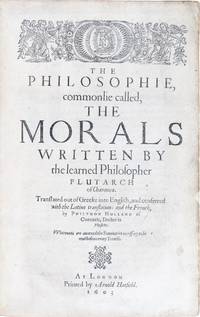
1603ref. 1168London: Printed by Arnold Hatfield 1603. First Edition. Very good. First complete edition in English containing everything you’d ever want to know of what Romans thought about private daily life. An essential balancing compendium for all the Roman history books the historiographer’s question is always what else was going on. It’s a spectacular read but you better wipe off your magnifying glasses because this book is 1400 pages of well-spaced but small type. Full mottled calf by Riviere & Son signed on the verso of the front free endpaper morocco labels marbled endpapers all edges gilt woodcut initials and headpieces rebacked a few faint scratches tiny chip paper flaw from the title page’s edge but fine and complete with the errata. The condition is exceptional for this book. Ugly copies abound but no copy like ours has sold at auction or in the trade since this one sold at Sotheby’s in 1989 for $4675 expensive then and expensive now but the finest of copies usually are. Ex–James Hale Bates 1845–1901 the American travel writer with his armorial bookplate upside down on the rear endpaper. Ex–The Garden Limited see below their bookplate also upside down next to Bates’ the error in placement certainly made by Bates The Garden owners intentionally followed suit. 4 p.l. 1363 1 pp. 32 leaves. Ref: STC 20063. ESTC S115981. Harris p. 116. Lowndes III 1891. The exalted Elizabethan translator Philemon Holland 1552–1637 was a physician and Latinist whose love of the classics prompted his devotion to rendering ancient authors into the language of Shakespeare and his output was prodigious. His first project was a translation of the Roman historian Livy published in 1600. The next year Holland tackled Pliny’s massive Natural History he also translated significant historical works of Suetonius 1606 and Ammianus Marcellinus 1609. The contents of the Morals are amazing. They confront a wild range of topics embracing fortune exile animal intelligence health advice for newlyweds the education of children benefitting from one’s enemies the value of having few or many friends how to recognize a flatterer and 10 times as many more. And though Catullus’ neoteric poems and some documents survive the primary only other source of the private details of Roman daily life beyond this book is just graffiti on the walls of Roman ruins like at Pompeii. Individual Plutarch treatises had been previously translated into English some more liberally than others but this is the first translation of the entire sequence of essays that make up the “Moralia.” Further the value of the collection is enhanced because Plutarch borrows from lost Greek works some of which would otherwise be unknown to us. The modern provenance here is at the zenith. It’s no hyperbole to say that the collection of The Garden Ltd. was the most outstanding American library of notable books put together in the second half of the 20th century. It was comprised of high spots from all periods breathtaking in their impeccable condition. It included the last 1st edition seen of Cervantes’ 1605 Don Quixote and a set of Shakespeare’s 4 folios bought by Dick Manney and then bought by us from Sotheby’s by private treaty in 1991. Does this collection have a backstory It does. Haven O’More was a genial narcissist with an autobiography fattened on bombastic exaggeration. His oft asked question was “Do you know who I am” It should have been “Do you know who I think I am” He found a rich investor Michael Davis and with Davis’ loot he built a staggering library in awe-inspiring condition that he planned to place at the center of his zanily conceived “new sacred city.” But O’More was holding aces and eights and after a public confrontation at Christies over a Gutenberg Bible Davis got bored with O’More’s antics and forced a 1989 sale at Sotheby’s titled The Garden Ltd. Printed by Arnold Hatfield unknown
1603ref. 1168London: Printed by Arnold Hatfield 1603. First Edition. Very good. First complete edition in English containing everything you’d ever want to know of what Romans thought about private daily life. An essential balancing compendium for all the Roman history books the historiographer’s question is always what else was going on. It’s a spectacular read but you better wipe off your magnifying glasses because this book is 1400 pages of well-spaced but small type. Full mottled calf by Riviere & Son signed on the verso of the front free endpaper morocco labels marbled endpapers all edges gilt woodcut initials and headpieces rebacked a few faint scratches tiny chip paper flaw from the title page’s edge but fine and complete with the errata. The condition is exceptional for this book. Ugly copies abound but no copy like ours has sold at auction or in the trade since this one sold at Sotheby’s in 1989 for $4675 expensive then and expensive now but the finest of copies usually are. Ex–James Hale Bates 1845–1901 the American travel writer with his armorial bookplate upside down on the rear endpaper. Ex–The Garden Limited see below their bookplate also upside down next to Bates’ the error in placement certainly made by Bates The Garden owners intentionally followed suit. 4 p.l. 1363 1 pp. 32 leaves. Ref: STC 20063. ESTC S115981. Harris p. 116. Lowndes III 1891. The exalted Elizabethan translator Philemon Holland 1552–1637 was a physician and Latinist whose love of the classics prompted his devotion to rendering ancient authors into the language of Shakespeare and his output was prodigious. His first project was a translation of the Roman historian Livy published in 1600. The next year Holland tackled Pliny’s massive Natural History he also translated significant historical works of Suetonius 1606 and Ammianus Marcellinus 1609. The contents of the Morals are amazing. They confront a wild range of topics embracing fortune exile animal intelligence health advice for newlyweds the education of children benefitting from one’s enemies the value of having few or many friends how to recognize a flatterer and 10 times as many more. And though Catullus’ neoteric poems and some documents survive the primary only other source of the private details of Roman daily life beyond this book is just graffiti on the walls of Roman ruins like at Pompeii. Individual Plutarch treatises had been previously translated into English some more liberally than others but this is the first translation of the entire sequence of essays that make up the “Moralia.” Further the value of the collection is enhanced because Plutarch borrows from lost Greek works some of which would otherwise be unknown to us. The modern provenance here is at the zenith. It’s no hyperbole to say that the collection of The Garden Ltd. was the most outstanding American library of notable books put together in the second half of the 20th century. It was comprised of high spots from all periods breathtaking in their impeccable condition. It included the last 1st edition seen of Cervantes’ 1605 Don Quixote and a set of Shakespeare’s 4 folios bought by Dick Manney and then bought by us from Sotheby’s by private treaty in 1991. Does this collection have a backstory It does. Haven O’More was a genial narcissist with an autobiography fattened on bombastic exaggeration. His oft asked question was “Do you know who I am” It should have been “Do you know who I think I am” He found a rich investor Michael Davis and with Davis’ loot he built a staggering library in awe-inspiring condition that he planned to place at the center of his zanily conceived “new sacred city.” But O’More was holding aces and eights and after a public confrontation at Christies over a Gutenberg Bible Davis got bored with O’More’s antics and forced a 1989 sale at Sotheby’s titled The Garden Ltd. Printed by Arnold Hatfield unknown books
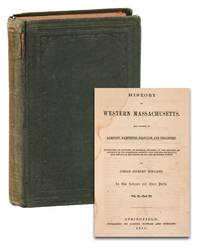
1855ref. 140949744Springfield MA: Samuel Bowles and Company 1855. First Edition. Good. First edition of the first book-appearance of the poem "Bars Fight" by Lucy Terry which is believed to be the oldest known work of literature by an African American. 619pp. Bound in publisher's green cloth stamped in gilt and decorated in blind. Good binding a little tender worn and softened corners sunned spine with loss bookplate to front pastedown tidemarks to prelim and terminal sheets occasional spotting to pages and evidence of biopredation. Terry's poem was preserved orally and not published until the November 20 1854 issue of The Springfield Daily Republican. It was published here in book-form the following year by Republican editor Josiah Gilbert Holland and included in this history of Western Massachusetts on account of its content. A ballad poem written as a first-person account of frontier violence it portrays an attack on two white families by Native Americans. The incident occurred in an area of Deerfield MA called "The Bars" which was a colonial term for a meadow. After this 1855 posthumous publication "Bars Fight" remained undiscovered until 1942 when it was published in Lorenzo Greene's The Negro in Colonial New England 1620-1776. Lucy Terry Prince often credited as simply Lucy Terry c. 1733-1821 was an American settler and poet. Kidnapped in Africa and enslaved she was taken to the British colony of Rhode Island. Her future husband purchased her freedom before their marriage in 1756. "Bars Fight" is the only surviving work by Terry though she was said to have been a prolific poet. Samuel Bowles and Company unknown
1855ref. 140949744Springfield MA: Samuel Bowles and Company 1855. First Edition. Good. First edition of the first book-appearance of the poem "Bars Fight" by Lucy Terry which is believed to be the oldest known work of literature by an African American. 619pp. Bound in publisher's green cloth stamped in gilt and decorated in blind. Good binding a little tender worn and softened corners sunned spine with loss bookplate to front pastedown tidemarks to prelim and terminal sheets occasional spotting to pages and evidence of biopredation. Terry's poem was preserved orally and not published until the November 20 1854 issue of The Springfield Daily Republican. It was published here in book-form the following year by Republican editor Josiah Gilbert Holland and included in this history of Western Massachusetts on account of its content. A ballad poem written as a first-person account of frontier violence it portrays an attack on two white families by Native Americans. The incident occurred in an area of Deerfield MA called "The Bars" which was a colonial term for a meadow. After this 1855 posthumous publication "Bars Fight" remained undiscovered until 1942 when it was published in Lorenzo Greene's The Negro in Colonial New England 1620-1776. Lucy Terry Prince often credited as simply Lucy Terry c. 1733-1821 was an American settler and poet. Kidnapped in Africa and enslaved she was taken to the British colony of Rhode Island. Her future husband purchased her freedom before their marriage in 1756. "Bars Fight" is the only surviving work by Terry though she was said to have been a prolific poet. Samuel Bowles and Company unknown books
ref. 240634Amsterdam, E. Maaskamp, s.d. (1811) in-folio, titre bilingue, 12 planches accompagnées chacune de deux feuillets de légende, une en français, l'autre en néerlandais, cartonnage d'attente vert d'eau (reliure de l'époque). Coupes un peu usées.
1634ref. 34275London: Printed by Adam Islip and to be sold by John Grismond in Ivy-lane and to be sold at the Signe of the Gun 1635 1634 1634. The first Tome. The second Tome. The second printing with numerous corrections of the first English translation. Printed by Adam Islip in 1634 the first volume contains the title-page dated 1635 which was offered for sale by John Grismond the second volume retains the 1634 title-page. Elaborate woodcut printer's device to title engraved floriated initials and fine head and tail pieces throughout. Folio in 6s 2 vols. bound in one an excellent copy bound in full contemporary polished calf in original state the back with raised bands over cords covers with double fillet rules in blind. 56 614 42; 12 632 86. Advertisement leaf at end of vol. II pp. Collated complete. An especially desirable copy of this highly important book. In its rare original state this book is seldom encountered. The textblock is crisp and unpressed and remains in a very pleasing state of preservation some minor evidence of damp in a few places as to be expected the spine with expert restoration at the head and tail of the panel a beautiful copy. IMPORTANT EARLY ISSUE OF THE GREAT TRANSLATION OF PLINY INTO ENGLISH BY PHILEMON HOLLAND. The second printing of the first full English translation of this important book. First published in Venice in 1469 “The ‘Natural History” of Pliny the Elder is more than a natural history: it is an encyclopaedia of all the knowledge of the ancient world. .He was a compiler rather than an original thinker and the importance of this book depends more on his exhaustive reading he quotes over four hundred authorities Greek and Latin than on his original work. All the spare time allowed him by a busy administrative career was devoted to reading; he began long before daybreak his nephew the younger Pliny recorded and grudged every minute not spent in study; no book was so bad he used to say as not to contain something of value. When he died the 'Natural History' the sole extant work out of one hundred and two volumes from his pen was still incomplete. It comprises thirty-seven books dealing with mathematics and physics geography and astronomy medicine and zoology anthropology and physiology philosophy and history agriculture and mineralogy the arts and letters. He is scrupulous in his acknowledgment of his sources you must he wrote with honest humility declare those from whom you have profited and the whole of the first book is devoted to the tables of contents and authorities which bear witness to his method. The HISTORIE soon became a standard book of reference: abstracts and abridgments appeared by the third century. Bede owned a copy Alcuin sent the early books to Charlemagne and Dicuil the Irish geographer quotes him in the ninth century. It was the basis of Isidorets Etymologiae and such medieval encyclopedias as the Speculum Majus of Vincent of Beauvais and the Catholicon of Balbus. One of the earliest books to be printed at Venice the center from which so much of classical literature was first dispensed it was later translated into English by Philemon Holland in 1601 and twice reprinted a notable achievement for so vast a text. . More recently scholars as various as Humboldt and Grimm have praised and acknowledged their debt to it. Over and over again it will be found that the source of some ancient piece of knowledge is Pliny. PMM The standard of reference for scholars since the 15th century Holland’s translation made it available to the English speaking world for the first time. Although not strictly scientific itself mingling a good deal of the author's fancy with fact Pliny's NATURALL HISTORIE was important in stimulating scientific thought in succeeding generations. "It is an encyclopedia of all the knowledge of the ancient world set out in an orderly fashion. It was the source of much medieval knowldege--and legend--and the model for such works as the SPECULUM MAJUS of Vincent of Beauvais. The high regard in which it was held in the world of the Renaissance can be seen by its early appearance in print 1472" PMM. The HISTORIE divided into 37 libri or "books" was completed except for finishing touches in 77 CE. In the preface dedicated to Titus who became emperor shortly before Pliny's death Pliny justified the title and explained his purpose on utilitarian grounds as the study of "the nature of things that is life" "Preface" 13. Heretofore he continued no one had attempted to bring together the older scattered material that belonged to "encyclic culture" egkyklios paideia the origin of the word encyclopaedia. Disdaining high literary style and political mythology Pliny adopted a plain style--but one with an unusually rich vocabulary--as best suited to his purpose. A novel feature of the NATURALL HISTORIE is the care taken by Pliny in naming his sources more than 100 of which ae authors and sometimes the titles of the books many of which are now lost from which Pliny derived his material. The HISTORIE properly begins with Book II which is devoted to cosmology and astronomy. Here as elsewhere Pliny demonstrated the extent of his reading especially of Greek texts. Books VII through XI treat zoology beginning with humans VII then mammals and reptiles VIII fishes and other marine aninmals IX birds X and insects XI. In Books XII throuogh XIX on botany Pliny came closest to making great contributions to science. He drew heavily upon Theophrastus and still made important independent observations particularly those made during his travels in Germany. Pliny is one of the chief sources of modern lknowledge of Roman gardens early botanical writings and the introduction into Italy of new horticultural and agricultural discoveries. Born at Como in 23 Pliny died while observing the eruption of Vesuvius in 79 A.D. His NATURALIS HISTORIA is a scientific encyclopedia often uncritical but very elaborate and of great value. Pliny attached to each book the list of his authorities 146 Roman and 327 Greek being quoted. He explained that people may be living at the antipodes and stated that the speed of light is greater than that of sound. His work includes the oldest account of ancient art. In addition it contains a remarkable amount of early information on Asia and Africa. Its influence throughout the Middle Ages was very great. This is an especially nice copy of the second offering of the work in English. This issue corrected the many errors of the first English edition. As with the copy listed in the British Museum the first tome has a new title page dated 1635. Further this is a variant issue with “and are to be sold by John Grismond” after Adam Islip on the imprint. Dedicated to Sir Robert Cecil. Printed by Adam Islip and to be sold by John Grismond, in Ivy-lane and to be sold at the Signe of the Gun hardcover
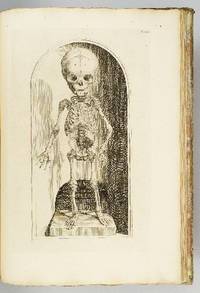
1739ref. ST12883Leyden: Johann Arnold Langerak 1739. First Edition in Latin. 540 x 380 mm. 21 1/4 x 15". 70 leaves of text.Translated by William Dundass. Original red quarter vellum over marbled boards raised bands UNTRIMMED EDGES. Engraved printer's device on title large decorative initials and tailpieces EXTRA ENGRAVED TITLE AND 114 STRIKING PLATES OF ANATOMICAL FIGURES three folding. Wellcome II 401; Heirs of Hippocrates 468; Choulant-Frank pp. 252-3; Russell 213. ◆Vellum on spine rather worn with three one-and-one-half-inch pieces broken away revealing structure underneath paper boards quite chafed other minor problems externally but an entirely solid unrestored binding. A couple of plates with short closed marginal tears one folding plate with one-inch closed tear into image no loss untrimmed edges a little browned and brittle with isolated small chips occasional minor foxing or insignificant stains three plates lightly browned but still AN UNUSUALLY ATTRACTIVE COPY INTERNALLY with the broadest of margins with especially clean and fresh leaves and with rich impressions of the plates. With plates of notable visual impressiveness this was the finest anatomy book in England during the first half of the 18th century; it also was largely a plagiarism borrowing most of its engraved content from a work by the Dutch physician Govert Bidloo published in 1685. Bidloo's work was the first large-scale anatomical atlas to appear after Vesalius' epoch-making "De Humani Corporis Fabrica" and the plates which are highly praised by Norman and Garrison-Morton are characterized by startlingly detailed life-size depictions of the human body both adult and infant with figures flayed to reveal muscles opened to show organs and unfleshed to exhibit bones. According to Choulant-Frank Bidloo's publishers sold 300 impressions of these plates to Cowper probably to recoup some of their money after disappointing sales. Cowper took Bidloo's original 105 plates added nine of his own and produced an English translation of the original Latin text to accompany them. Discussing the original plates produced by Gerard de Lairesse 1641-1711 Norman says that the figures are displayed "in an emotional almost tender manner contrasting the raw dissected parts with the full soft surfaces of uncut flesh placing flayed bound figures in ordinary nightclothes or bedding setting ordinary household objects such as books jars or cabinets in the same scene as cut-up torsos or limbs. His illustrations brought the qualities of Dutch still-life painting into anatomical illustration and gave a new darker spiritual expression to the significance of the act of dissection." When Cowper's version of the atlas first appeared as "The Anatomy of Humane Bodies" in London in 1698 there was also a 1737 Leyden printing in English before our more scholarly Latin edition Bidloo complained to the Royal Society and accused Cowper of plagiarism and fraud resulting in much acrimony and heated pamphleteering between the two physicians. Notwithstanding this scandal Cowper's achievements and discoveries--including the pair of glands that bear his name--were considerable and his text improved significantly upon the original work. Unfortunately as the DNB notes "the notoriety of this case has served to obscure a true appreciation of Cowper and of his many original contributions to anatomical illustration." The atlases of Bidloo and Cowper appear on the market regularly but at 540 x 380 mm. the present copy is distinguished by its size which is significantly larger than what is typically seen with this edition--we have not been able to trace a copy larger than ours from marketplace or institutional records. Johann Arnold Langerak unknown
1739ref. ST12883Leyden: Johann Arnold Langerak 1739. First Edition in Latin. 540 x 380 mm. 21 1/4 x 15". 70 leaves of text.Translated by William Dundass. Original red quarter vellum over marbled boards raised bands UNTRIMMED EDGES. Engraved printer's device on title large decorative initials and tailpieces EXTRA ENGRAVED TITLE AND 114 STRIKING PLATES OF ANATOMICAL FIGURES three folding. Wellcome II 401; Heirs of Hippocrates 468; Choulant-Frank pp. 252-3; Russell 213. ◆Vellum on spine rather worn with three one-and-one-half-inch pieces broken away revealing structure underneath paper boards quite chafed other minor problems externally but an entirely solid unrestored binding. A couple of plates with short closed marginal tears one folding plate with one-inch closed tear into image no loss untrimmed edges a little browned and brittle with isolated small chips occasional minor foxing or insignificant stains three plates lightly browned but still AN UNUSUALLY ATTRACTIVE COPY INTERNALLY with the broadest of margins with especially clean and fresh leaves and with rich impressions of the plates. With plates of notable visual impressiveness this was the finest anatomy book in England during the first half of the 18th century; it also was largely a plagiarism borrowing most of its engraved content from a work by the Dutch physician Govert Bidloo published in 1685. Bidloo's work was the first large-scale anatomical atlas to appear after Vesalius' epoch-making "De Humani Corporis Fabrica" and the plates which are highly praised by Norman and Garrison-Morton are characterized by startlingly detailed life-size depictions of the human body both adult and infant with figures flayed to reveal muscles opened to show organs and unfleshed to exhibit bones. According to Choulant-Frank Bidloo's publishers sold 300 impressions of these plates to Cowper probably to recoup some of their money after disappointing sales. Cowper took Bidloo's original 105 plates added nine of his own and produced an English translation of the original Latin text to accompany them. Discussing the original plates produced by Gerard de Lairesse 1641-1711 Norman says that the figures are displayed "in an emotional almost tender manner contrasting the raw dissected parts with the full soft surfaces of uncut flesh placing flayed bound figures in ordinary nightclothes or bedding setting ordinary household objects such as books jars or cabinets in the same scene as cut-up torsos or limbs. His illustrations brought the qualities of Dutch still-life painting into anatomical illustration and gave a new darker spiritual expression to the significance of the act of dissection." When Cowper's version of the atlas first appeared as "The Anatomy of Humane Bodies" in London in 1698 there was also a 1737 Leyden printing in English before our more scholarly Latin edition Bidloo complained to the Royal Society and accused Cowper of plagiarism and fraud resulting in much acrimony and heated pamphleteering between the two physicians. Notwithstanding this scandal Cowper's achievements and discoveries--including the pair of glands that bear his name--were considerable and his text improved significantly upon the original work. Unfortunately as the DNB notes "the notoriety of this case has served to obscure a true appreciation of Cowper and of his many original contributions to anatomical illustration." The atlases of Bidloo and Cowper appear on the market regularly but at 540 x 380 mm. the present copy is distinguished by its size which is significantly larger than what is typically seen with this edition--we have not been able to trace a copy larger than ours from marketplace or institutional records. Johann Arnold Langerak unknown books
1600ref. 11257London: Adam Islip. Good with no dust jacket. 1600. First English Edition. Leather. 10 lacking first blank 804 809-13511354-1403 41 lacking last blank pp. Collates complete save for first and last blanks pagination skips correspond to ESTC 006185333. Impressive thick folio 13" x 8.5" Magnificent modern rebinding in full blindstamped panelled dark leather 5 raised bands to the spine with florettes in the compartments title author and date in gilt. Fore-edge has title written on to be shelved edge out. Renewed end pages with college library bookplate and bookplate of Eric Gerald Stanley 1923-2018 a British Anglo-Saxonist and the Rawlinson and Bosworth Professor at Univ. Of Oxford. Title page with large engraved printer's mark remounted with some repairs an old signature in brown ink with date April 26 1600. Xylographic "The" in the title. Verso of title page has woodcut portrait of Queen Elizabeth and the verso of A4 has a portrait of Livy framed in bay leaves and fruits. Dedication page has upper corner torn and has been restored with loss of text and head woodcut old cellotape repair as well. To the Reader page has corner repaired with no loss some staining p251-255 small ink smear on one page Iiii quire corners restored a few other pages with minor stains or repairs in the corners Cccccc3 has a thin spot/small hole in the margin with no loss of text. Very occasional marginalia. Numerous engraved head and tail pieces type is clear paper is strong and nice. The first English edition of Livy's Roman History translated by Holland considered one of the greatest translators of the Elizabethan era. "His first published translation The Romane Historie 1600 was the first complete rendering of Livy's Latin history of Rome Ab Urbe Condita into English. According to John Considine: 'It was a work of great importance presented in a grand folio volume of 1458 pages and dedicated to the Queen. The translation set out to be lucid and unpretentious and achieved its aim with marked success. It is accurate and often lively and although it does not attempt to imitate the terseness of Latin it avoids prolixity.' " Livy or Titus Livius gives us the Ab Urbe Condita literally "From the Founding" a history of Rome from its very beginnings. The first 10 books are the most famous celebrated for their grandeur -- "it as a panegyrist of Rome and Italy that Livy finds his most memorable expression." Here we learn of the quasi-mythological history of Rome of Aeneas Romulus and Remus and the battles of the early kings of Rome; the Law of the Twelve Tables the wars against the Gauls the Latins and the Samnites and finally the battle -- complete with elephants --between Hannibal's son Hasdrubal and Nero. Livy was known as a supreme master of the Latin language. "His prose was worthy of Cicero's but more subtle more malleable and more lyrical." Livy probably wrote his history of Rome during the reign of Augustus Caesar; it is a fascinating work that in many cases is our only source of numerous aspects of Roman history; with vivid accounts of Tarquin the Proud the Carthagenian Wars and other events from Rome's tumultuous past. A beautiful and important book in a magnificent binding complete save for the front and rear blanks in quite good condition with a nice provenance. ; Folio 13" - 23" tall . Adam Islip hardcover
1776ref. 34405London: J. F. W. Des Barres 1776. Engraved with color wash and outline color. Sheet: 31 x 42 1/4 inches. Expert restoration primarily at the upper margin. Two sheets joined both watermarked "J.Bates" and countermarked "JB". Fourth state of five. Among the earliest charts published by Des Barres were those relevant to the crisis in New England as the War of Independence broke out. This chart depicts the coast of Massachusetts from Salem to Scituate Harbor and includes the complicated hydrography of Boston Harbor and the confluent rivers. A considerable amount of coastal topography is included obviously relevant to warships. Fundamentally a chart for navigators it includes soundings and shoals with particularly strong detail along the Charles and Mystic Rivers as well as in Salem and Marblehead. Samuel Holland was the lead surveyor. In 1764 he was named Surveyor General of both the Province of Quebec and the Northern District of North America. He had a considerable staff and the British Navy assisted in providing soundings. From 1770 to 1774 his squad worked exclusively on northeastern colonies that soon became part of the United States. The surveys that derived from the industry of their work were the most accurate ever made to that time. They were sent to London where Des Barres supervised the engraving and publication. The charts were very soon put to use. Des Barres of Swiss-Huguenot extraction studied under the great mathematician Daniel Bernoulli at the University of Basel before continuing on to the Royal Military College at Woolwich. Upon the outbreak of hostilities with France in 1756 he joined the British Royal American Regiment as a military engineer. He came to the attention of General James Wolfe who appointed him to join his personal detail. During this period he also worked with the future legendary explorer James Cook on a monumental chart of the St. Lawrence River. From 1762 Des Barres was enlisted to survey the coastlines of Nova Scotia Newfoundland and the Gulf of St. Lawrence while his colleague Samuel Holland charted the New England coast. He also managed to gain access to some surveys of the American South Cuba and Jamaica. In 1774 Des Barres returned to England where he began work on The Neptune. His dedication to the project was so strong that often at his own expense he continually updated and added new charts and views up until 1784. That year he returned to Canada where he remained for a further forty years becoming a senior political figure and a wealthy land owner and living to the advanced age of 103. Stevens Collection 94d ; cf. Hornsby Surveyors of Empire: Samuel Holland J.F.W. Des Barres and the Making of the Atlantic Neptune. 2011. J. F. W. Des Barres unknown
1776ref. 34405London: J. F. W. Des Barres 1776. Engraved with color wash and outline color. Sheet: 31 x 42 1/4 inches. Expert restoration primarily at the upper margin. Two sheets joined both watermarked "J.Bates" and countermarked "JB". Fourth state of five. Among the earliest charts published by Des Barres were those relevant to the crisis in New England as the War of Independence broke out. This chart depicts the coast of Massachusetts from Salem to Scituate Harbor and includes the complicated hydrography of Boston Harbor and the confluent rivers. A considerable amount of coastal topography is included obviously relevant to warships. Fundamentally a chart for navigators it includes soundings and shoals with particularly strong detail along the Charles and Mystic Rivers as well as in Salem and Marblehead. Samuel Holland was the lead surveyor. In 1764 he was named Surveyor General of both the Province of Quebec and the Northern District of North America. He had a considerable staff and the British Navy assisted in providing soundings. From 1770 to 1774 his squad worked exclusively on northeastern colonies that soon became part of the United States. The surveys that derived from the industry of their work were the most accurate ever made to that time. They were sent to London where Des Barres supervised the engraving and publication. The charts were very soon put to use. Des Barres of Swiss-Huguenot extraction studied under the great mathematician Daniel Bernoulli at the University of Basel before continuing on to the Royal Military College at Woolwich. Upon the outbreak of hostilities with France in 1756 he joined the British Royal American Regiment as a military engineer. He came to the attention of General James Wolfe who appointed him to join his personal detail. During this period he also worked with the future legendary explorer James Cook on a monumental chart of the St. Lawrence River. From 1762 Des Barres was enlisted to survey the coastlines of Nova Scotia Newfoundland and the Gulf of St. Lawrence while his colleague Samuel Holland charted the New England coast. He also managed to gain access to some surveys of the American South Cuba and Jamaica. In 1774 Des Barres returned to England where he began work on The Neptune. His dedication to the project was so strong that often at his own expense he continually updated and added new charts and views up until 1784. That year he returned to Canada where he remained for a further forty years becoming a senior political figure and a wealthy land owner and living to the advanced age of 103. Stevens Collection 94d ; cf. Hornsby Surveyors of Empire: Samuel Holland J.F.W. Des Barres and the Making of the Atlantic Neptune. 2011. J. F. W. Des Barres unknown books
1620ref. 377978Arnhem: J. Jansson & Crispin de Passe 1620. First edition. Engraved title page possibly by Crispin van de Passe with small view of London and small map of England; 65 engraved portraits 2 engraved illustrations by Magdalena and Willem van de Passe; woodcut initials and tailpieces. 135 ff. xx 1-42 2 43-96 2 97-134 2 135-164 2 165-240 2 pp. 1 vols. Folio 304 x 200 mm. Nineteenth-century green morocco spine gilt boards ruled with dobule fillet turn-ins gilt a.e.g. Small paper flaws to 2-6 N1. Binding slightly rubbed near fine. First edition. Engraved title page possibly by Crispin van de Passe with small view of London and small map of England; 65 engraved portraits 2 engraved illustrations by Magdalena and Willem van de Passe; woodcut initials and tailpieces. 135 ff. xx 1-42 2 43-96 2 97-134 2 135-164 2 165-240 2 pp. 1 vols. Folio 304 x 200 mm. First edition of this notable volume of English iconography including portraits of Henry VIII Elizabeth I Jane Gray William Tyndale Thomas Cromwell Thomas More Francis Drake John Hawkins Philip Sydney and Martin Frobisher and many others. The engravings are of a uniformly bigh quality as one would expect from members of the van de Passe family; they are present here in strong rich impressions. Hind describes three additional single leaves that are present in some copies. The index leaf the most common of the three is present in this copy immediately following leaf V6. The leaf with verses by Jan Gruter which "only appears in occasional copies" is not present here; nor is the leaf bearing the emblematic plate in honor of Sir Thomas Holland which was absent in all but two of the copies known to Hind. This copy comes from the library of Alexander Hamilton Douglas tenth Duke of Hamilton also Marquis of Hamilton county Lanark Marquis of Douglas and Clydesdale Earl of Angus Arran Lanark and Selkirk Baron Hamilton Avon Polmont Mackanshire Innerdale Abernetby and Jedburgh Forest and premier peer in the peerage of Scotland; Duke of Brandon in Suffolk and Baron Dutton co. Chester in that of Great Britain; Duke of Châtelherault in France and hereditary keeper of Holyrood House. He was a great collector forming a significant collection of printed books and amassing a group of manuscripts that De Ricci describes as "remarkable"; he also acquired paintings and objects of vertu. In 1810 he married Susan daughter of William Beckford and thus on Beckford's death in 1844 he inherited that great library and art collection. He housed the whole at Hamilton Palace keeping the two libraries separate; his son the eleventh Duke continued to add items to the Hamilton library. The twelfth Duke put the collections up for sale at auction in 1882-1884; they fetched the unprecedented sum of £397562. ESTC: S119103; Hind II pp. 145-62; Sabin 32505. Provenance: Alexander Hamilton Douglas 10th Duke of Hamilton bookplate; David R. Godine bookplate J. Jansson & Crispin de Passe unknown
1620ref. 377978Arnhem: J. Jansson & Crispin de Passe 1620. First edition. Engraved title page possibly by Crispin van de Passe with small view of London and small map of England; 65 engraved portraits 2 engraved illustrations by Magdalena and Willem van de Passe; woodcut initials and tailpieces. 135 ff. xx 1-42 2 43-96 2 97-134 2 135-164 2 165-240 2 pp. 1 vols. Folio 304 x 200 mm. Nineteenth-century green morocco spine gilt boards ruled with dobule fillet turn-ins gilt a.e.g. Small paper flaws to 2-6 N1. Binding slightly rubbed near fine. First edition. Engraved title page possibly by Crispin van de Passe with small view of London and small map of England; 65 engraved portraits 2 engraved illustrations by Magdalena and Willem van de Passe; woodcut initials and tailpieces. 135 ff. xx 1-42 2 43-96 2 97-134 2 135-164 2 165-240 2 pp. 1 vols. Folio 304 x 200 mm. First edition of this notable volume of English iconography including portraits of Henry VIII Elizabeth I Jane Gray William Tyndale Thomas Cromwell Thomas More Francis Drake John Hawkins Philip Sydney and Martin Frobisher and many others. The engravings are of a uniformly bigh quality as one would expect from members of the van de Passe family; they are present here in strong rich impressions. Hind describes three additional single leaves that are present in some copies. The index leaf the most common of the three is present in this copy immediately following leaf V6. The leaf with verses by Jan Gruter which "only appears in occasional copies" is not present here; nor is the leaf bearing the emblematic plate in honor of Sir Thomas Holland which was absent in all but two of the copies known to Hind. This copy comes from the library of Alexander Hamilton Douglas tenth Duke of Hamilton also Marquis of Hamilton county Lanark Marquis of Douglas and Clydesdale Earl of Angus Arran Lanark and Selkirk Baron Hamilton Avon Polmont Mackanshire Innerdale Abernetby and Jedburgh Forest and premier peer in the peerage of Scotland; Duke of Brandon in Suffolk and Baron Dutton co. Chester in that of Great Britain; Duke of Châtelherault in France and hereditary keeper of Holyrood House. He was a great collector forming a significant collection of printed books and amassing a group of manuscripts that De Ricci describes as "remarkable"; he also acquired paintings and objects of vertu. In 1810 he married Susan daughter of William Beckford and thus on Beckford's death in 1844 he inherited that great library and art collection. He housed the whole at Hamilton Palace keeping the two libraries separate; his son the eleventh Duke continued to add items to the Hamilton library. The twelfth Duke put the collections up for sale at auction in 1882-1884; they fetched the unprecedented sum of £397562. ESTC: S119103; Hind II pp. 145-62; Sabin 32505. Provenance: Alexander Hamilton Douglas 10th Duke of Hamilton bookplate; David R. Godine bookplate J. Jansson & Crispin de Passe unknown books
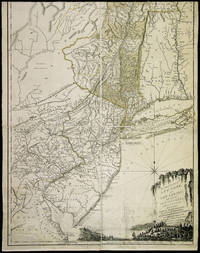
1776ref. 36226London: Printed for Robt. Sayer and John Bennett August 17 1776. Large and Detailed Map of Colonial North America Including Quebec and Montreal This famous map is one of the best for the provinces of New York and New Jersey during the colonial period. It is the fourth state described by McCorkle following versions published circa 1768 in 1775 and earlier in 1776. "The map includes western Connecticut and Massachusetts and most of Vermont. In 1775 the title became 'The Provinces of New York and New Jersey; with part of Pensilvania and the Province of Quebec'.Three insets were added in this state: A chart of the mouth of the Hudson River; A plan of the City of New York; Plan of Amboy.The following year the date changed to 1776. Later in the same year the title was extended to include 'Corrected and improved from the original materials by Govern.r Pownall' and Holland's rank was given as Major" - McCorkle. The present copy is the final version described by McCorkle. THE PROVINCES OF NEW YORK AND NEW JERSEY is in effect a large-scale map of the Hudson River and its tributaries including the Mohawk and settlement in New York is almost entirely confined to the banks of the Hudson and Mohawk rivers. The unexplored Adirondack County is left almost entirely blank with a lengthy notation that begins "Beaver Hunting Country of the Confederated Indians." Pennsylvania extends north into western New York state almost as far as the Mohawk Vermont is shown attached to New York with each existing township identified and the map extends north into Quebec beyond Montreal. Interesting notations on the country are scattered across the face of the map. For instance in Pennsylvania an area with little detail is simply noted as "endless mountains." The map is beautifully decorated with a pastoral title cartouche suggestive of the Hudson Palisades in the lower right corner. The map was created by Samuel Holland Surveyor General for the Northern District of North America. As a result of the French and Indian War 1755-63 Great Britain had acquired a new American Empire for which there were few adequate maps. Two new offices of surveyor general for the American colonies were established in 1763-64. The colonies were divided at the Potomac River into a northern and southern district and the respective surveyors appointed were Samuel Holland and Gerard De Brahm. Holland conceived of a general survey of North America east of the Mississippi to be based upon geodetic principles on a scale of one inch to one mile but work was interrupted in 1775 by the outbreak of the American Revolution. A very good copy of Holland's large and important map which includes western New England and portions of Quebec. Engraved map consisting of eight folio sheets backed on linen 54½ x 21¾ inches with contemporary color outlining and shading of some boundaries and geographic features. Slightly soiled occasional minor stains a few old repairs no loss of text. In a brown cloth slipcase. A very good copy. DEGREES OF LATITUDE fig. 21. PHILLIPS ATLASES 1166 number 17. McCORKLE 768.3 775.6 776.13. hardcover
1776ref. 36226London: Printed for Robt. Sayer and John Bennett August 17 1776. Large and Detailed Map of Colonial North America Including Quebec and Montreal This famous map is one of the best for the provinces of New York and New Jersey during the colonial period. It is the fourth state described by McCorkle following versions published circa 1768 in 1775 and earlier in 1776. "The map includes western Connecticut and Massachusetts and most of Vermont. In 1775 the title became 'The Provinces of New York and New Jersey; with part of Pensilvania and the Province of Quebec'.Three insets were added in this state: A chart of the mouth of the Hudson River; A plan of the City of New York; Plan of Amboy.The following year the date changed to 1776. Later in the same year the title was extended to include 'Corrected and improved from the original materials by Govern.r Pownall' and Holland's rank was given as Major" - McCorkle. The present copy is the final version described by McCorkle. THE PROVINCES OF NEW YORK AND NEW JERSEY is in effect a large-scale map of the Hudson River and its tributaries including the Mohawk and settlement in New York is almost entirely confined to the banks of the Hudson and Mohawk rivers. The unexplored Adirondack County is left almost entirely blank with a lengthy notation that begins "Beaver Hunting Country of the Confederated Indians." Pennsylvania extends north into western New York state almost as far as the Mohawk Vermont is shown attached to New York with each existing township identified and the map extends north into Quebec beyond Montreal. Interesting notations on the country are scattered across the face of the map. For instance in Pennsylvania an area with little detail is simply noted as "endless mountains." The map is beautifully decorated with a pastoral title cartouche suggestive of the Hudson Palisades in the lower right corner. The map was created by Samuel Holland Surveyor General for the Northern District of North America. As a result of the French and Indian War 1755-63 Great Britain had acquired a new American Empire for which there were few adequate maps. Two new offices of surveyor general for the American colonies were established in 1763-64. The colonies were divided at the Potomac River into a northern and southern district and the respective surveyors appointed were Samuel Holland and Gerard De Brahm. Holland conceived of a general survey of North America east of the Mississippi to be based upon geodetic principles on a scale of one inch to one mile but work was interrupted in 1775 by the outbreak of the American Revolution. A very good copy of Holland's large and important map which includes western New England and portions of Quebec. Engraved map consisting of eight folio sheets backed on linen 54½ x 21¾ inches with contemporary color outlining and shading of some boundaries and geographic features. Slightly soiled occasional minor stains a few old repairs no loss of text. In a brown cloth slipcase. A very good copy. DEGREES OF LATITUDE fig. 21. PHILLIPS ATLASES 1166 number 17. McCORKLE 768.3 775.6 776.13. hardcover books
1601ref. 84London: Adam Islip 1601. First Edition in English. Very Good . Folio 11 3/4 x 8 inches 298 x 203 mm 2 VOLUMES bound into one. Pp. 58 614 42; 12 632 84 2. Title pages with woodcut devices present in both parts lacking blanks pi1 and Ppp8 woodcut initials head and tailpieces copious indexes of both volumes final errata sheet. Full later calf re-jointed extra-gilt spine with 5 raised bands some rust spots marginal tears and paper flaws eight leaves with expertly repaired corners with resulting small loss of text; occasional marginalia; paper supple and evenly toned; binding somewhat scuffed but firm and square. Armorial bookplate of James Backnell Praed pasted inside front cover. Carter 5; Pforzheimer 496; ESTC 006187259. A handsome and rare copy of the first full English translation of Pliny's Naturalis Historia by Philemon Holland the greatest translator of the Elizabethan age. «The 'Natural History' of Pliny the Elder is more than a natural history: it is an encyclopaedia of all the knowledge of the ancient world. The famous story of Pliny's death while trying to observe the eruption of Vesuvius at closer quarters than was prudent is often and justly cited as an example of the devoted curiosity on which the furthering of knowledge depends and to the Romans his writing on the natural sciences was pioneer work held in small esteem as he modestly says by his countrymen. He was a compiler rather than an original thinker and the importance of this book depends more on his exhaustive reading he quotes over four hundred authorities Greek and Latin than on his original work. All the spare time allowed him by a busy administrative career was devoted to reading ; he began long before daybreak his nephew the younger Pliny recorded and grudged every minute not spent in study; no book was so bad he used to say as not to contain something of value. When he died the 'Natural History' the sole extant work out of one hundred and two volumes from his pen was still incomplete. It comprises thirty-seven books dealing with mathematics and physics geography and astronomy medicine and zoology anthropology and physiology philosophy and history agriculture and mineralogy arts and letters. He is scrupulous in his acknowledgement of his sources you must he wrote with honest humility declare those from whom you have profited and the whole of the first book is devoted to the tables of con tents and authorities which bear witness to his method. The Historia soon became a standard book of reference. One of the earliest books to be printed at Venice the centre from which so much of classical literature was first dispensed it was later translated into English by Philemon Holland in 1601 and twice reprinted a notable achievement for so vast a text.» Carter John. Printing and the Mind of Man. New York: Holt Rinehart & Winston 1967. Adam Islip unknown