2.172 Ergebnisse
1926Best.-Nr. 29577Amsterdam, Frederik Muller & Cie., 1926. 4° (35 mal 27 cm), 10 S. + Planches 22 Abb.; Sous la direction de Ant. W. M. Mensing (Frederik Muller & Cie.); in französicher Sprache, Ex Libris-Klebereste a. Vorsatz, Bezahlung per PayPal möglich , we accept PayPal, Regalspuren am Fußschnitt, Einband beschabt und stark bestoßen und eingegraut mit min. Einrissen, altersbedingte Bräunungen, Gebr.sp., kartoniert
1711Best.-Nr. 0030381711 Amstelaedami [Amsterdam], Excudit Franciscus Halma, 1711. In-quarto (208 X 258) maroquin vert, triple encadrement de filet doré sur les plats, filets dorés en place des nerfs, urnes dorées dans les compartiments, coupes filetées, tranches jaunes (reliure de lépoque) ; (1) f. blanc, frontispice gravé, titre avec vignette gravée, 10 ff. (dédicace, préface et élégie), 502 pages, (14) pp. (index), (2) ff. blancs.
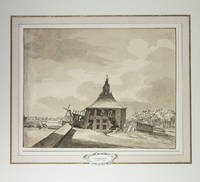
1772Best.-Nr. BCGB6MMFQHCTNetherlands 1772. Ca. 23 x 29 cm. Original pen drawing. A very nice and historically interesting drawing by Caspar Jacobsz. Philips 1732-1789 the well known Amsterdam draughtsman engraver and etcher art historian author and publisher together with two engravings. Although the two prints do not mention the name of Caspar Philips as inventor they probably were made after the drawing described above or an earlier version of it and its pendant in the Amsterdam city archives. Very fine copies all under passe-partouts.l Cf. Muller historieplaten 4224a and 4227b. ART ARCHITECTURE & PHOTOGRAPHY CARTOGRAPHY GEOGRAPHY & TOPOGRAPHY DRAWINGS PRINTS & WATERCOLOURS LOW COUNTRIES Amsterdam City Plans Topography & Views Prints & Print Series unknown
1719Best.-Nr. F5OGBDYNZ8OAAmsterdam: Gerard Valk 1719. Very large engraved folding plan comprising 1 1/2 sheets measuring 46 x 83 cm as assembled engraved by Danckert Danckertsz. and his father after drawings by Jacob Vennekool including the two hemispheres of the world map and a celestial map of the constellations of the northern hemisphere each 10 cm in diameter. Very large engraved plan showing the extraordinary cartographic mosaic floor of the Burgerzaal of the Amsterdam City Hall designed by Jacob van Campen with a celestial map in the centre and the magnificent map of the world in 2 hemispheres on either side. The engraving was first published in 1661 and the map shows Tasman's recent discoveries in Australia and Tasmania and depicts California as an island. Many discoveries from his second voyage remained otherwise unpublished until the end of the 17th-century. This engraved representation is all that is left of this cartographical work of art. Wear caused by people walking on the mosaic meant it had to be restored about a hundred years later. When in turn this restoration was damaged the two hemispheres were filled in with plain marble slabs without pictorial representation.The drawing of the floor was made by Jacob Vennekool who worked closely with Van Campen and since his drawings were first published even before the building was completed they may reflect Van Campen's plan more closely than the finished building itself. They also of course show it before the alterations made at various times in later years.Slightly wrinkled in the right margin one fold reinforced and a few tiny spots otherwise in very good condition.l Cf. BAL 533 1st Dutch ed.; Fowler 77 & 274 1st Dutch ed.; Berlin Kat. 2235 1st French ed. Gerard Valk, unknown
Best.-Nr. AMA-992Paris, Fasquelle, 1911. In 12, bradel demi-box noir, papier peint à la main, couvertures et dos conservés (Reliure de Delapierre). [2 ff.], 300 pp.
Best.-Nr. 4221MIS EN BEAU LANGAGE ACCOMMODE AU GOUT DE CE TEMPS, ET ENRICHIS DE FIGURES EN TAILLE-DOUCE . A AMSTERDAM chez George Gallet 1698, 2 volumes en maroquin rouge (reliure signée de Quinet ) plats avec de nombreux filets dores avec blasons aux angles dentelles interieure, tranches dorées superbe dos à nerfs richement decorés dans les caissons , ex libris de Mr Gransire
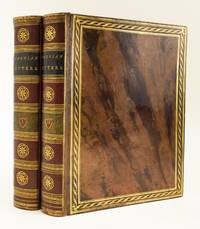
1798Best.-Nr. ST15948London: T. Cadell jun. & W. Davies 1798. First Illustrated Edition to which is prefixed a geographical index. 290 x 225 mm. 11 1/2 x 8 3/4". Two volumes. Edited by Thomas Birch. HANDSOME EARLY 19TH CENTURY MARBLED CALF BY J. FRÖDING OF AMSTERDAM his ticket on front free endpaper covers framed by thick and thin rules and bead-and-feather chain roll smooth spine of dark red straight-grain morocco gilt in a Neoclassical style with panels formed by chain and Greek key rolls containing sunburst centerpiece encircled by garlands one green and one black morocco label gilt-hatched turn-ins marbled endpapers all edges gilt. With frontispiece portraits of Philip and Charles Yorke 11 engraved busts of famous Athenians and a folding map of Greece. For the binder: Van Leeuwen "Dutch Decorated Bookbinding in the 18th Century" I 714. ◆Boards tending to splay slightly joints faintly rubbed the leaves immediately adjacent to the map a bit browned occasional mild foxing or tiny rust stains but AN EXTREMELY ATTRACTIVE COPY--clean and fresh internally with generous margins and in a stately lustrous binding. This is an especially pleasing copy of the definitive edition of an epistolary novel comprising a group of fictional letters purportedly written during the Peloponnesian War and featuring a notably handsome binding by Amsterdam artisan Jonas Fröding. Begun as an academic exercise among friends headed by Philip Yorke second Earl of Hardwicke 1720-90 and his brother Charles 1722-70 "Letters" was edited by the historian Thomas Birch 1705-66 with contributions from Henry Coventry John Green Samuel Salter the bluestocking scholar Catherine Talbot 1721-70 Daniel Wray George Henry Rooke John Heaston and John Lawry. After a private printing in 1741 of just 10 copies a second edition of 100 copies appeared in 1781 after several of the original participants had died and sparked what Britannica calls "a considerable vogue" for this and other works of historical fiction. A pirated Dublin edition was issued in 1792 to capitalize on this popularity but it was suppressed by Hardwicke's heir and superseded by our very attractive large-format 1798 printing done under the third Earl of Hardwicke's direction with an added geographical index engraved plates and a map. Stockholm-born binder Jonas Fröding ca. 1763-1808 was registered as a burgher in Amsterdam in 1794 at which time Jan Storm van Leeuwen believes he was working as an apprentice for the Crevenna Bindery a prestigious workshop that produced high-quality bindings for bibliophiles on their old and valuable books. One such client was the Italian-Dutch merchant by whose name the bindery was known Pieter Crevenna. In 1803 Fröding was received into the bookbinders' guild and set up his own workshop where he continued to use several roll tools from the Crevenna stock. While none of our rolls matches Crevenna rolls exactly two of them bead-and-feather Greek key are very similar to Crevenna rolls IX and XXV van Leeuwen I 715-16 and the overall design is quite like van Leeuwen fig. 239 a 1795 binding of tree calf by the Crevenna bindery with a gilt design in a Neoclassical style; that work would have been done during the time van Leeuwen believes Fröding was an apprentice there. Sadly Fröding's career lasted just five years; he died in Amsterdam in 1808. Not surprisingly given the brevity of his working life bindings by Fröding are uncommon in the marketplace. This work is seen for sale from time to time but our copy stands out because of its particularly attractive binding. T. Cadell jun. & W. Davies unknown
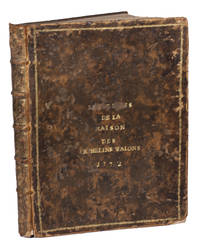
1772Best.-Nr. A81EC98HI9JLAmsterdam: David Pierre Humbert 1772. Near contemporary gold-tooled marbled calf with the title lettered in gold on the front board gold-tooled board edges marbled endpapers gilt edges. Large 4to 21.5 x 27 cm. With an engraved vignette on the title page and a divisional title page for the Prieres a l'usage de la maison des orphelins walons on leaf I3r. Further with 2 woodcut headpieces. Very rare work with the rules and regulations of the orphanage and elderly home institutions of the Walloon Protestant Church at Amsterdam in 1772. It is divided in 15 chapters each giving the regulations for the staff the physician the regents the guards etc. and the orphans and elderly. The preface contains the history of the "Hospice Wallon" from 1630-1772. On page 69 and onwards the prayers in use at the house are given. At the end a list of the regents male and female from 1631 until 1771 is present. This copy is interleaved with blank leaves a few with manuscript annotations in ink. In 1631 the Walloon community bought 3 houses at the Laurierstraat where they founded their orphanage. Eventually these buildings became to crowded and in 1669 the first stones were laid for another building at the corner of the Vijzelgracht in Amsterdam. In April 1671 the orphans moved to the new building now Maison Descartes.With manuscript annotations in black ink on the verso of the blank leaf between leaves A1 and A2 in the text on A2r and on the verso of the blank leaf between leaves C1 and C2; the other interleaved leaves remain blank. The binding is somewhat rubbed the fore edge and part of the fore edge margin of the last third of the leaves are stained and some offsetting on the letterpress leaves of the text on the surrounding letterpress pages this happened before the blank leaves were bound in. Otherwise in very good condition.l STCN 310471796 3 copies; WorldCat 461252717 1154627392 3 copies. David Pierre Humbert, unknown
1860Best.-Nr. ABC_50131Amsterdam: printed by R. de Vries for François Buffa & Sons 1860. Original brown blind-stamped wave-grained cloth with the title and imprint information lettered in gold on the front board in a rococo frame yellow endpapers. Oblong ca.16.4 x 24.6 cm. per leaf. The panorama is made up of 8 numbered lithographed views printed in monochrome with beige tone block. The viewer looks southward from the IJ over the city from the Oosterdok eastern dock and the Oosterkerk eastern church along the docks and wharfs via the recognisable towers of several churches and the view of the Royal Palace to the Westerdok western dock a large factory and the Blauwhoofd the northwestern-most bulwark of the city. Extremely rare leporello-style bound copy of a lithographic panorama of Amsterdam printed in monochrome with a beige tone block after drawings by Johan Conrad Greive 1837-1891 and lithographed by Ruurt de Vries Jr. 1813-1874.A remarkably precise and atmospheric profile of Amsterdams IJ waterfront extending from the Lijnbanen to beyond the Blaauwhoofd. The principal buildings are identified beneath each plate. The panorama captures in extraordinary detail the eastern docks the Oosterdok and Westerdok areas and numerous landmarks including the Zeemagazijn Admiraliteitsmagazijn Oosterkerk Zuiderkerk Oude Kerk the Dam with the Royal Palace and Nieuwe Kerk Westerkerk Noorderkerk and the bustling shipping of the IJ. A distant suggestion of Haarlems St Bavos Church may be discerned on the horizon.Greives meticulous urban draughtsmanship is akin to painting with the precision of photography. He later became chairman of Arti et Amicitiae and was celebrated for his highly detailed views of cities and rivers.The present example is preserved in a true leporello concertina binding: the front and back boards are not joined at the spine but are attached only to the first and last leaves of the accordion-folded sheets.This work is extremely rare: we have located only two other bound copies both held at the University of Groningen. Curiously of the related publication Panorama de Rotterdam likewise illustrated by J.C. Greive and published by François Buffa & Sons only a single surviving copy is recorded also at the University of Groningen. We have traced another copy of the Rotterdam panorama at the House of European History.The work has been cut slightly short touching the plate numbering and is slightly foxed throughout. Otherwise in very good condition.l d'Ailly Repertorium 278; Rijksmuseum object no. RP-P-1905-1045 RP-P-1905-1043 RP-P-1905-1039; WorldCat 64777818 2 copies; cf. for the Panorama De Rotterdam WorldCat 64777862 1 copy; more about the Buffa company: Landwehr Studies in Dutch books with Coloured Plates published 1662-1875 1976 pp. 62-66. [printed by R. de Vries for] François Buffa & Sons, hardcover
1609Best.-Nr. PHO-11431 volume in-folio (33 x 23 cm), vélin rigide parchemin (reliure de l'époque), dos lisse titré à l'encre, nombreuses écritures manuscrites sur les plats, 5 à 53-[1] feuillets. Page de titre, 3 premiers feuillets et feuillets 51 et 52 manquants, charnière fendue ,mouillure sur 5 ff et manque de papier en marge , galerie de vers avec manque. Seconde édition française, illustrée de 55 gravures sur bois in-texte.
1648Best.-Nr. 73101648 Amsterdam by Pieter I. P. 1648800 pages ,686 cheur figures de Van Sichem (plusieurs signées du monogramme dans la page) Etat exceptionnel dans une reliure plein velin , bel objet !
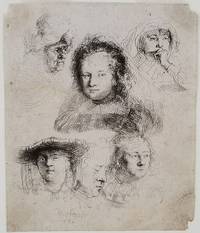
1815Best.-Nr. 23646Amsterdam 1815. In this etching Rembrandt has depicted his wife Saskia surrounded by six other subjects of different ages including his mother. The etching is reminiscent of a sketchbook page in which the artist practices different facial expressions and the fall of drapery on his subjects. Saskia receives the most detailed study with very fine lines used to draw her curls and a thin headdress. Each figure looks out in a different direction. There are approximately 125-225 known impressions of this work many posthumous. Nowell-Usticke B365. This impression is pre-1815 signed by the french printseller Naudet in 1801. This impression predates the 1815 restrike. Signed on the verso by the early Parisian print seller Naudet - "Chez Naudet Md au Louvre 1801". The "Md" is an abbreviation for 'Marchand" merchant. See Maberley Joseph "The Print Collector: An Introduction to the Knowledge Necessary for Forming." 1880 p.84 and Fagan Louis "Collectors' Marks" 1883 p. 73. There are several prints held in the Fitzwilliam Museum Cambridge with Naudet inscriptions one being "Two boys blowing bubbles. Bartsch 365; Hollstein White and Boon 365. 5 x 6 1/16". Usticke's second state of 2 with the horizontal scratches between the head of Saskia and the turbaned head in profile upper left. With slight loss on three corners and a small closed tear. Signed in the plate "Rembrandt f 1636" in the bottom left the "f" somewhat faint. unknown
1710Best.-Nr. DIV012in 8 ( 18x 12 cm) 201 Fol / pages 5470 (H) 1710 (c) frontispice gravé ,papier en bel état ,tranches dorés reliure sur haies de bois ,fermoirs métalliques présent . Un plat parfaitement séparé du volume En portugais Very rare 2nd second edition of the only treatise on Hebrew laws and customs written in Portuguese language and printed for the Portuguese Sephardic communities in Northern Europe. Treasure of Jewish Laws that the people of Israel must know and observe composed by Rabbi Hacham Menasseh ben Israel in Amsterdam, 1st edition 1647; and this 2nd edition in 1710. In 8. º (18x12 cm) (v) -201 - (iv) folium. Binding (worn out at edges) contemporary full calf gilt at spine. Engraved frontispiece. Contains title page to Third Part (Of feasts and fasts throughout the year, the people of Israel must know and observe) and the Last part (in which contains all the precepts, rites and ceremonies concerning to a perfect economy dedicated to the very noble and magnificent lords Abraham and Ishak Israel Pereyra). MENASSEH BEN ISRAEL was born in Lisbon in 1604. Very young of age he went to Amsterdam with his father, Joseph ben Israel, and became a disciple of Haham Yshac Uziel. In 1622 he was appointed professor of the Portuguese Jewish community in Amsterdam and, four years later, he founded the first Hebraic typography in Amsterdam; printing small books in Portuguese, Spanish and Hebrew languages. Menasseh had a decisive contribution in reopening England to the Jewish people, closed since the time of King Edward Ist. He went personally to London and had talks with Cromwell who gave him an honorific pension he never profit of. Menasseh died in 1658 after returning from London. He was portrait by Rembrant. Inocêncio VI, 211. 'In a book dealer which trade was new and old books, I found a complete copy of the Treasure. I've never seen another. '
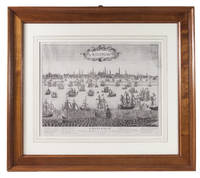
1660Best.-Nr. ABC_49405Amsterdam 1660. In a passe partout framed in a modern wooden frame. Engraving: ca. 38.5 x 50 cm; frame: 66.5 x 76 cm. Rare large engraved view of Amsterdam as seen from the inlet known as the IJ. The work is captioned in French and includes a numbered legend for the buildings in the background. According to d'Ailly it must have been engraved between 1660 and 1668 as it shows the Oost-Indisch Zeemagazijn a large warehouse built by the Dutch East India Company between 1660-1663 but not the Lutheran Church which was built in 1668. The present engraving is not signed but is very similar to a slightly later view of Amsterdam by French engraver Pierre-Alexandre Aveline 1656-1722. It bears the same caption and legend and has a nearly identical background but differs in the typography cartouche and the amount of ships in the foreground. The present state is exceptionally rare as we have not been able to trace any other copies of it in sales records and only three in literature.The engraving is slightly creased the upper right corner has been professionally repaired. Otherwise in very good condition.l D'Ailly E. A. Repertorium van de profielen der stad Amsterdam en van de plattegronden der schutterswijken 98 3 copies; cf. d'Ailly 101 and 102 Aveline view. unknown
1665Best.-Nr. 73181665 A Amsrerdami 1665 . In-4° de [34]-316-50 pages, plein veau (reliure de l’époque). Fortunio Liceti, né à Rapallo en 1577, était un homme d’une érudition prodigieuse. Il publia de nombreux ouvrages sur la médecine, l’histoire naturelle, la philosophie et la physique. Son livre sur la nature des monstres, ici dans l’édition la plus complète, est le premier traité sur les anomalies génétiques et les malformations embryonnaires ; il est orné d’un fontispice, de 64 figures et de 4 planches à pleine page gravées par Giambattista Bissoni, montrant des monstres humains. Magnifique exemplaire, doté d'une reliure aux armes et chiffres sur les deux plats de Charles de Saint Maure Duc de Montausier ( 1610 - 1690) Pair de France
Best.-Nr. 4361" Docteur en Medecine. Dont le contenu se voit à la page suivante. Augmentées de la vie de l'Autheur & de quelques Remarques sur sa vie & sur l'histoire. Avec l'explication de tous les mots difficiles".Amsterdam, [Louis et Daniel Elzevier], 1663, 2 volumes in-12, plein superbe reliure plein maroquin bleu nuit travail non signé , triple filets sur les plats dos superbement decorés , interieur des plats os ornés decors de dentelles 24], 488, [10]; [2]; pp. 489-946, [8] pp. Manquent les pp. 465-468.Marque à la sphère.RARE PREMIERE EDITION ELZEVIRIENNE, d'une grande élégance typographique.Les éditeurs ont joint au texte de Rabelais un Eclaircissement de quelques endroits difficiles de Rabelais, et une Vie de Rabelais attribués à Pierre Du Puy. La fameuse bouteille en caractères typographiques se trouve à la p. 833.Exemplaire sur papier fin (l'autre tirage, sur papier fort, a tendance à jaunir).
1591Best.-Nr. 2981Amsterdam: Herman Jansz. Muller 1591. 8vo 143 x 95 mm. Collation: A-T8 T8 blank. 302 pp. Text in gothic types stage directions and lists of actors in italic. Title woodcut of a family meal six text woodcuts of which 5 half-page and one smaller. Wormtrack in gutter of first few leaves dampstaining to foremargins and lower corners a fewer quires with larger dampstain. 17th-century stiff parchment manuscript spine title. Provenance: "Herman Lamberts Bellaer Anno 1685" signature on front flyleaf Bellaer was a notary in Weesp North Holland from 1656 to 1658; "no. 38" written on title; sheet of 20th-century paper with note tipped in at front.Only Edition of an anonymous vernacular play collection a late survival of a popular medieval performance tradition. These seven plays in Dutch verse dramatize the seven Works of Mercy from Matthew 25:35-46. They were written and performed in the open air on seven consecutive Sundays by the amateur Amsterdam literary and theatrical confraternity or "chamber of rhetoric" known as de Egelantier or Eglantier eglantine or wild rose allegedly in order to encourage the citizens of Amsterdam to participate in a lottery for the benefit of the Amsterdam insane asylum Poll p. 113. The edition was printed by one of the Eglantier members.In each play of the present collection an allegorical figure with a name like "Good Education" or "Brother Love" knocks on the door of the house of a different stock character - a burgher an artisan a farmer etc. - asking to be fed or clothed or given shelter. While these tradesmen comply a selfish character named "Most of the World" invariably rejects the stranger. Each play has a prologue and an epilogue that provides the moral of the story explaining that the stranger the naked the hungry the thirsty etc. are all Christ on the Cross.By the early sixteenth century every town and many villages of the Low Countries possessed their own "college" or chamber of rhetoric; these were literary confraternities whose origin lay in medieval French-speaking theater groups of Flanders and Brabant which performed mystery and miracle plays. Endowed with corporate structures emblematic names often flowers and their own blazons and regalia the chambers of rhetoric became a central cultural institution of Netherlandish life. After the Reformed church came to power in the northern provinces in 1581 it attempted to halt public performances of religious plays and even to suppress the chambers altogether but largely failed the chambers especially of larger towns usually retaining the support of local authorities. Hence one finds such "throwbacks" as the present series of religious plays. A peculiar to the modern reader mixture of traditional farce and didactic allegory it is typical of rhetoricians' plays which were usually "absolutely middle-class in tone and opposed to aristocratic ideas and tendencies in thought" EB 1911 8:721 with simple dramatic plots that were secondary to their educational value.Although founded later than many others at the end of the 15th century Amsterdam's de Eglantier was the most prominent Chamber of Rhetoric in the northern Netherlands. Its prestige was enhanced by the infusion of humanist writers and writers from the southern Netherlands who emigrated to the north during the religious wars. The Zeven Spelen is unique in containing the productions of a single city's Rhetorical Chamber: all other known Renaissance Dutch rhetoricians' collections contain the productions of several different towns performed in elaborate literary competitions known as landjuweelen.Six of the seven simple but charming woodcuts illustrating this edition in a consistent style and apparently by the same wood-engraver possibly the printer represent the first six acts of mercy the seventh play is illustrated with a smaller Last Judgment cut evidently from the printer's stock. Their charm lies in their portrayal of scenes from daily life: a family dining as a servant brings a platter and a mother feeds her baby; a vintner sitting cross-legged on a wine barrel in a medieval square pouring a welcome drink to a pair of wanderers while a neighbor quaffs behind him; naked men being clothed a prisoner in a stockade; a sickbed with a woman stirring gruel. The printer-publisher Harmen or Herman Jansz Muller ca. 1540-1617 was a member of a family of engravers printers and print- and booksellers who operated under the sign of "Den Vergulden Passer." Under his direction from ca. 1566 until his death the bookselling activities of the firm reached their apogee. As in many of his imprints Muller identifies himself here as a figuersnyder and it is possible that the title woodcut and the five larger cuts were his own work cf. Thieme-Becker 25:230 who suggested as much. Muller was also a member of De Egelantier and pubished a number of works for them.OCLC locates 5 copies in American libraries Folger Newberry National Gallery of Art Harvard and U. Michigan. STCN 844000841; The New Hollstein / The Muller Dynasty Part III 1999 75 and pp. 21-22; E. W. Moes De Amsterdamsche boekdrukkers en uitgevers in de zestiende eeuw 1900-1915 I p. 315 no. 223; Univ. of Amsterdam Library Catalogus van oudere werken op het gebied der Nederlandsche letteren 1921 no. 6; Scheepers collection Catalogus van een zeer belangrijke verzameling fraaie en zeldzame boeken der 16e-19e eeuw 1947 I:66. Cf. G. Kalff Geschiedenis der Nederlandsche letterkunde in de 16de eeuw part 2 1889 pp. 25 & 48-55; Klaas Poll Over de tooneelspelen van den Leidschen rederijker Jacob Duym 1898 p. 113-14; A. van Dixhoorn "Chambers of Rhetoric: performative culture and literary sociability in the Early Modern Northern Netherlands" in The Reach of the Republic of Letters: Literary and Learned Societies in Late Medieval and Early Modern Europe 2008 119-148; A-L. Van Braene "Faith on Stage: the Chambers of Rhetoric and Civic Religion in the Low Countries 1400-1700" K. Eisenbichler A Companion to Medieval and Early Modern Confraternities Brill 2019 pp. 365-84. Herman Jansz. Muller hardcover books
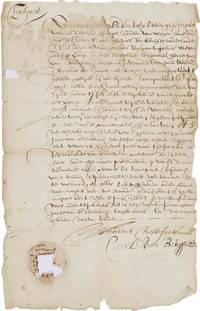
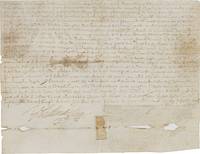
1653Best.-Nr. 68225Fort New Amsterdam in New Netherland New York City: June 18 1653. Buying a Bowery in New York City in 1653 Carel van Brugge d. 1682 who has signed this document in his official capacity as the secretary of the High Council was in fact an Englishman named Charles Bridges who had arrived in New Amsterdam via Curaçao. He came to New Netherland with Stuyvesant in May 1647 and was made commissary at Fort Orange in November 1647 commissary of the provincial accounts in 1651 and provincial secretary and ex officio vendue master in 1652. After the English took over and New Amsterdam became New York he resumed use of his English name. Thomas Hall 1614–1670 who is purchasing the Manhattan property referred to in this document arrived in New Amsterdam in the 1630s after being captured following a failed attack on Fort Nassau an English attempt to establish settlement on the Delaware River. By the end of the 1630s he was operating a tobacco plantation becoming a successful farmer and merchant. He was elected a member of the Eight Men in 1643 and the Nine Men in 1647. Quoted and translated in Gehring's New York Historical Manuscripts: "Appeared.before us.Gerritt Jansen van Oldenborgh citizen and inhabitant of New Netherland; and declared to have conveyed to Thomas Hall a certain piece of land according to the patent thereof dated 17 February 1646; containing in all 25½ morgens and 125 rods; together with a marsh which has always been used by the farm called the Pannebackers or farm No. 5 etc." Bifolium. Dampstaining some worming to margins edges worn separations at folds. Remnants of a paper-covered red wax seal. Still good overall. For the conveyance from Gerritt Jansen Van Oldenborgh to Thomas Hall see Charles T. Gehring ed. New York Historical Manuscripts: Dutch Vols. GG HH & II Land Papers Baltimore 1980 II-35a p.119. unknown
1653Best.-Nr. 68206Fort New Amsterdam in New Netherland New York City. March 22 1653. Selling a Bowery in New York City in 1653 Carel van Brugge d. 1682 who has signed this document in his official capacity as the Secretary of the High Council despite going by his Dutch name was an Englishman named Charles Bridges who had arrived in New Amsterdam via Curaçao. He came to New Netherland with Stuyvesant in May 1647 and was made Commissary at Fort Orange in November 1647 Commissary of the Provincial Accounts in 1651 and Provincial Secretary and ex officio Vendue Master in 1652. After the English took New Amsterdam he resumed use of his English name. Wilhelmus Hendricksen Beeckman 1623-1707 also came to New Amsterdam with Peter Stuyvesant in 1647 and became the Treasurer of the Dutch West India Company. He served in various official capacities in New Amsterdam including being appointed one of the five original schepens of the city. Cornelisz Claeszen Swits 1610-1655 was the son of Claes Cornelisz Swits 1576-1641 an early Swiss immigrant to New Amsterdam who was killed by a Weckquaesgeek touching off what would become known as Kieft's War and the extermination of the tribe between 1643 and 1645. For the conveyance from Swits to Beeckman on the same date and presumably relating to the same property see Charles T. Gehring ed. New York Historical Manuscripts: Dutch Vols. GG HH & II Land Papers Baltimore 1980 II-23 p.115. Old folds. With paper-covered red wax seal. Some losses to wax from the seal though the paper covering in excellent condition. About very good. unknown
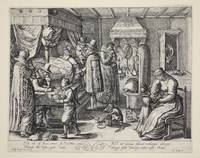
1618Best.-Nr. 5161Utrecht: Cripsijn de Passe the Elder c. 1614- 1618. FIRST STATE. Hardcover. Fine. Signed in the lower margin with the names of the artist and publisher: “Crisp de pas inu inv et fe” / “C. de pas ex.” Numbered in the image lower center: 3. Four lines in Latin divided into two columns: “Haec alia est facies rerum sic vertitur ordo/ Post tot delicias subeunt morbusque dolorque./ Mutantur laetis tristia grata malis/ Nempe solet Nemesis redere iusta vices.”. Brilliant richly-inked early impression printing sharp and crisp with excellent contrasts and remarkable clarity with the support lines along the text distinct. Like most of the surviving copies with the number in the lower margin as described by Franken. Slim margins around the border in very fine condition. A print of great rarity especially in such fine condition. This plate by Crispijn de Passe II is one of a set of four illustrating the biblical parable of Lazarus and the rich man. The story from the Gospel of Luke 16:19-31 tells of an extremely wealthy man who shows no compassion when the poor leprous beggar Lazarus begs him for bread and water. After his death the rich man is sent to hell where he is punished for his greed and heartlessness whereas the pious and humble Lazarus is taken to heaven. It reminds us that earthly wealth is of no consequence after death and that those who suffer in this life will receive comfort in the next. The episode depicted here is The Dying Hour of the Rich Man. Even as the doctor attends the man on his deathbed the notary in the foreground is already dividing the old man’s estate while to the far left a demon cheerfully welcomes him to the hereafter with music. The inscription reads: “This is the other face of things. Thus is the order reversed. Sad things are turned to happy ones; good things to evil. After so many joys come pain and illness. / Indeed retribution Nemesis is wont to return just punishments.” The verses are possibly by the Dutch antiquarian and humanist Aernout van Buchel 1565-1641 whose monogram appears next to the verses on the second plate in the series. The other prints in the series Hollstein 3 4 and 6 depict: 1. Lazarus in the house of the rich man; 2. Feast in the house of the Rich Man; and 4. The Rich Man in Hell. The design for the fourth plate is the work of De Passe the Elder. “Parabole du mauvais riche. Quatre planches numérotées avec 4 l. de souscr. en 2 div. Suite intéressante pour les mœurs costumes et intérieurs qui sont des premières années du 17e siècle et parce que les estampes appartiennent aux meilleures productions des deux maîtres dont on peut en même temps comparer le burin. Il résulte de cette comparaison que Crispyn junior le gagne sur son père pour la taille fine et propre et qu'il a une science du clair obscur qui manque à Crispyn le vieux. Mais dans chacune des quatre estampes il y a des parties dignes des meilleurs maîtres du temps tant pour le dessin que pour la gravure.” Franken 1062-1065 The Artist: Crispijn de Passe the Younger came from a large distinguished Dutch family of professional engravers and was trained in the workshop of his father Cripsijn de Passe the Elder who published this print. He was known for his remarkable handling of the burin of which this engraving is an excellent example. The artist modeled both the interior and the figures in costume on contemporary tastes offering insights into the elegant lifestyle of the seventeenth-century upper classes. De Passe worked in his father’s Utrecht workshop beginning in 1612 until his departure for Paris around 1618. He worked in Paris with some interruptions until 1629 at which time he resumed work in Utrecht. In 1639 he removed to Amsterdam where he died circa 1670. The Dives and Lazarus series must have been made before 1618 when Crispijn the Younger left for Paris See Veldman Crispijn de Passe and his Progeny p. 221. The Publisher: “The elder De Passe 1565–1637 began his career as an engraver and publisher in Antwerp; forced to leave because of his Anabaptist faith he settled -after an interlude in Aachen- in 1589 in Cologne. He set up a print publishing house producing portraits of the European nobility as well as religious mythological and allegorical prints and books. In 1611 he and his family were exiled from Cologne and took refuge in Utrecht. With the assistance of his children he soon started another prosperous business. It is in Utrecht that this print was produced.”National Portrait Gallery He died in Utrecht in 1637. While publishing in Cologne the elder De Passe had engraved another series also of 4 prints on the Rich Man and Lazarus theme after drawings by Maarten de Vos Hollstein XV nos. 118-121. The second plate in that series shows the Rich Man being bathed by naked women. The other three plates are versions of the same scenes as those found in the series described here. Cripsijn de Passe the Elder, c. 1614- hardcover
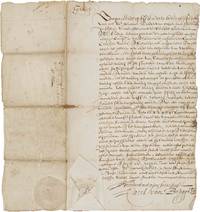
1646Best.-Nr. 68207Fort New Amsterdam in New Netherland New York City: February 17 1646. Granting Land in Lower Manhattan in 1646 Translated by Gehring as a deed for ".a certain piece of land formerly known by the name of Pannebacker's or Bouwery No. 5 or 4; extending next to the land of Cornelis Claesz Swits along the wagon road until Hans Kiersteeden's plantation; and further on straight through the woods to the boundary line of Leendert Aerden at the point where the three roads of the inner wagon road meet." Kieft served as the sixth Director of New Netherland from 1638 to 1647 and his term was marked by extreme violence against Native Americans. He was succeeded by Peter Stuyvesant in 1647. A very rare signature. Old folds. Small losses to vellum along lower fold not affecting text. Without the seal. Very good. Charles T. Gehring ed. New York Historical Manuscripts: Dutch Vols. GG HH & II Land Papers Baltimore 1980 GG-134 p.39. hardcover
1730Best.-Nr. E1Q9EQ01U79OAmsterdam: Reinier and Josua Ottens 1730. Mounted and framed. With title in banner at top centre arms of the city at top right city seal at top left and the primary locations with captions. Large engraved panorama on 4 sheets ca. 42 x 218 cm as assembled. Rare large engraved view of Amsterdam as seen from the inlet known as the IJ published by Reinier and Josua Ottens ca. 1730 with numerous ships on the IJ. It's the last state of the view by Jacob Savry published in 1647 and partly updated including the changes made by Visscher in his issue from 1653. Most obvious are the changes on the east part of the city with several new buildings including ''s Lands Zeemagazijn' now known as the Netherlands Maritime Museum.Washed and with one minor professional restoration near the title. Very good copy of a beautifully executed an detailed view of Amsterdam.l D'Ailly Profielen 186; De Vries Atlas van Amsterdam 14; cf. D'Ailly Profielen 55 & 74. Reinier and Josua Ottens, unknown