RABELAIS FrançoisLivre Rare Book

2362 risultati
rif. 4361" Docteur en Medecine. Dont le contenu se voit à la page suivante. Augmentées de la vie de l'Autheur & de quelques Remarques sur sa vie & sur l'histoire. Avec l'explication de tous les mots difficiles".Amsterdam, [Louis et Daniel Elzevier], 1663, 2 volumes in-12, plein superbe reliure plein maroquin bleu nuit travail non signé , triple filets sur les plats dos superbement decorés , interieur des plats os ornés decors de dentelles 24], 488, [10]; [2]; pp. 489-946, [8] pp. Manquent les pp. 465-468.Marque à la sphère.RARE PREMIERE EDITION ELZEVIRIENNE, d'une grande élégance typographique.Les éditeurs ont joint au texte de Rabelais un Eclaircissement de quelques endroits difficiles de Rabelais, et une Vie de Rabelais attribués à Pierre Du Puy. La fameuse bouteille en caractères typographiques se trouve à la p. 833.Exemplaire sur papier fin (l'autre tirage, sur papier fort, a tendance à jaunir).
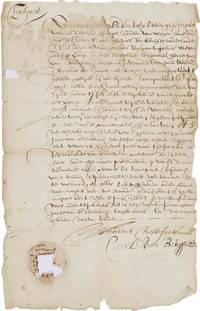
1653rif. 68225Fort New Amsterdam in New Netherland New York City: June 18 1653. Buying a Bowery in New York City in 1653 Carel van Brugge d. 1682 who has signed this document in his official capacity as the secretary of the High Council was in fact an Englishman named Charles Bridges who had arrived in New Amsterdam via Curaçao. He came to New Netherland with Stuyvesant in May 1647 and was made commissary at Fort Orange in November 1647 commissary of the provincial accounts in 1651 and provincial secretary and ex officio vendue master in 1652. After the English took over and New Amsterdam became New York he resumed use of his English name. Thomas Hall 1614–1670 who is purchasing the Manhattan property referred to in this document arrived in New Amsterdam in the 1630s after being captured following a failed attack on Fort Nassau an English attempt to establish settlement on the Delaware River. By the end of the 1630s he was operating a tobacco plantation becoming a successful farmer and merchant. He was elected a member of the Eight Men in 1643 and the Nine Men in 1647. Quoted and translated in Gehring's New York Historical Manuscripts: "Appeared.before us.Gerritt Jansen van Oldenborgh citizen and inhabitant of New Netherland; and declared to have conveyed to Thomas Hall a certain piece of land according to the patent thereof dated 17 February 1646; containing in all 25½ morgens and 125 rods; together with a marsh which has always been used by the farm called the Pannebackers or farm No. 5 etc." Bifolium. Dampstaining some worming to margins edges worn separations at folds. Remnants of a paper-covered red wax seal. Still good overall. For the conveyance from Gerritt Jansen Van Oldenborgh to Thomas Hall see Charles T. Gehring ed. New York Historical Manuscripts: Dutch Vols. GG HH & II Land Papers Baltimore 1980 II-35a p.119. unknown
1653rif. 68225Fort New Amsterdam in New Netherland New York City: June 18 1653. Buying a Bowery in New York City in 1653 Carel van Brugge d. 1682 who has signed this document in his official capacity as the secretary of the High Council was in fact an Englishman named Charles Bridges who had arrived in New Amsterdam via Curaçao. He came to New Netherland with Stuyvesant in May 1647 and was made commissary at Fort Orange in November 1647 commissary of the provincial accounts in 1651 and provincial secretary and ex officio vendue master in 1652. After the English took over and New Amsterdam became New York he resumed use of his English name. Thomas Hall 1614–1670 who is purchasing the Manhattan property referred to in this document arrived in New Amsterdam in the 1630s after being captured following a failed attack on Fort Nassau an English attempt to establish settlement on the Delaware River. By the end of the 1630s he was operating a tobacco plantation becoming a successful farmer and merchant. He was elected a member of the Eight Men in 1643 and the Nine Men in 1647. Quoted and translated in Gehring's New York Historical Manuscripts: "Appeared.before us.Gerritt Jansen van Oldenborgh citizen and inhabitant of New Netherland; and declared to have conveyed to Thomas Hall a certain piece of land according to the patent thereof dated 17 February 1646; containing in all 25½ morgens and 125 rods; together with a marsh which has always been used by the farm called the Pannebackers or farm No. 5 etc." Bifolium. Dampstaining some worming to margins edges worn separations at folds. Remnants of a paper-covered red wax seal. Still good overall. For the conveyance from Gerritt Jansen Van Oldenborgh to Thomas Hall see Charles T. Gehring ed. New York Historical Manuscripts: Dutch Vols. GG HH & II Land Papers Baltimore 1980 II-35a p.119. unknown books
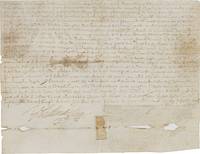
1653rif. 68206Fort New Amsterdam in New Netherland New York City. March 22 1653. Selling a Bowery in New York City in 1653 Carel van Brugge d. 1682 who has signed this document in his official capacity as the Secretary of the High Council despite going by his Dutch name was an Englishman named Charles Bridges who had arrived in New Amsterdam via Curaçao. He came to New Netherland with Stuyvesant in May 1647 and was made Commissary at Fort Orange in November 1647 Commissary of the Provincial Accounts in 1651 and Provincial Secretary and ex officio Vendue Master in 1652. After the English took New Amsterdam he resumed use of his English name. Wilhelmus Hendricksen Beeckman 1623-1707 also came to New Amsterdam with Peter Stuyvesant in 1647 and became the Treasurer of the Dutch West India Company. He served in various official capacities in New Amsterdam including being appointed one of the five original schepens of the city. Cornelisz Claeszen Swits 1610-1655 was the son of Claes Cornelisz Swits 1576-1641 an early Swiss immigrant to New Amsterdam who was killed by a Weckquaesgeek touching off what would become known as Kieft's War and the extermination of the tribe between 1643 and 1645. For the conveyance from Swits to Beeckman on the same date and presumably relating to the same property see Charles T. Gehring ed. New York Historical Manuscripts: Dutch Vols. GG HH & II Land Papers Baltimore 1980 II-23 p.115. Old folds. With paper-covered red wax seal. Some losses to wax from the seal though the paper covering in excellent condition. About very good. unknown
1653rif. 68206Fort New Amsterdam in New Netherland New York City. March 22 1653. Selling a Bowery in New York City in 1653 Carel van Brugge d. 1682 who has signed this document in his official capacity as the Secretary of the High Council despite going by his Dutch name was an Englishman named Charles Bridges who had arrived in New Amsterdam via Curaçao. He came to New Netherland with Stuyvesant in May 1647 and was made Commissary at Fort Orange in November 1647 Commissary of the Provincial Accounts in 1651 and Provincial Secretary and ex officio Vendue Master in 1652. After the English took New Amsterdam he resumed use of his English name. Wilhelmus Hendricksen Beeckman 1623-1707 also came to New Amsterdam with Peter Stuyvesant in 1647 and became the Treasurer of the Dutch West India Company. He served in various official capacities in New Amsterdam including being appointed one of the five original schepens of the city. Cornelisz Claeszen Swits 1610-1655 was the son of Claes Cornelisz Swits 1576-1641 an early Swiss immigrant to New Amsterdam who was killed by a Weckquaesgeek touching off what would become known as Kieft's War and the extermination of the tribe between 1643 and 1645. For the conveyance from Swits to Beeckman on the same date and presumably relating to the same property see Charles T. Gehring ed. New York Historical Manuscripts: Dutch Vols. GG HH & II Land Papers Baltimore 1980 II-23 p.115. Old folds. With paper-covered red wax seal. Some losses to wax from the seal though the paper covering in excellent condition. About very good. unknown books
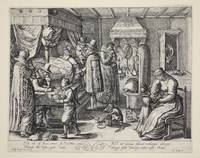
1618rif. 5161Utrecht: Cripsijn de Passe the Elder c. 1614- 1618. FIRST STATE. Hardcover. Fine. Signed in the lower margin with the names of the artist and publisher: “Crisp de pas inu inv et fe” / “C. de pas ex.” Numbered in the image lower center: 3. Four lines in Latin divided into two columns: “Haec alia est facies rerum sic vertitur ordo/ Post tot delicias subeunt morbusque dolorque./ Mutantur laetis tristia grata malis/ Nempe solet Nemesis redere iusta vices.”. Brilliant richly-inked early impression printing sharp and crisp with excellent contrasts and remarkable clarity with the support lines along the text distinct. Like most of the surviving copies with the number in the lower margin as described by Franken. Slim margins around the border in very fine condition. A print of great rarity especially in such fine condition. This plate by Crispijn de Passe II is one of a set of four illustrating the biblical parable of Lazarus and the rich man. The story from the Gospel of Luke 16:19-31 tells of an extremely wealthy man who shows no compassion when the poor leprous beggar Lazarus begs him for bread and water. After his death the rich man is sent to hell where he is punished for his greed and heartlessness whereas the pious and humble Lazarus is taken to heaven. It reminds us that earthly wealth is of no consequence after death and that those who suffer in this life will receive comfort in the next. The episode depicted here is The Dying Hour of the Rich Man. Even as the doctor attends the man on his deathbed the notary in the foreground is already dividing the old man’s estate while to the far left a demon cheerfully welcomes him to the hereafter with music. The inscription reads: “This is the other face of things. Thus is the order reversed. Sad things are turned to happy ones; good things to evil. After so many joys come pain and illness. / Indeed retribution Nemesis is wont to return just punishments.” The verses are possibly by the Dutch antiquarian and humanist Aernout van Buchel 1565-1641 whose monogram appears next to the verses on the second plate in the series. The other prints in the series Hollstein 3 4 and 6 depict: 1. Lazarus in the house of the rich man; 2. Feast in the house of the Rich Man; and 4. The Rich Man in Hell. The design for the fourth plate is the work of De Passe the Elder. “Parabole du mauvais riche. Quatre planches numérotées avec 4 l. de souscr. en 2 div. Suite intéressante pour les mœurs costumes et intérieurs qui sont des premières années du 17e siècle et parce que les estampes appartiennent aux meilleures productions des deux maîtres dont on peut en même temps comparer le burin. Il résulte de cette comparaison que Crispyn junior le gagne sur son père pour la taille fine et propre et qu'il a une science du clair obscur qui manque à Crispyn le vieux. Mais dans chacune des quatre estampes il y a des parties dignes des meilleurs maîtres du temps tant pour le dessin que pour la gravure.” Franken 1062-1065 The Artist: Crispijn de Passe the Younger came from a large distinguished Dutch family of professional engravers and was trained in the workshop of his father Cripsijn de Passe the Elder who published this print. He was known for his remarkable handling of the burin of which this engraving is an excellent example. The artist modeled both the interior and the figures in costume on contemporary tastes offering insights into the elegant lifestyle of the seventeenth-century upper classes. De Passe worked in his father’s Utrecht workshop beginning in 1612 until his departure for Paris around 1618. He worked in Paris with some interruptions until 1629 at which time he resumed work in Utrecht. In 1639 he removed to Amsterdam where he died circa 1670. The Dives and Lazarus series must have been made before 1618 when Crispijn the Younger left for Paris See Veldman Crispijn de Passe and his Progeny p. 221. The Publisher: “The elder De Passe 1565–1637 began his career as an engraver and publisher in Antwerp; forced to leave because of his Anabaptist faith he settled -after an interlude in Aachen- in 1589 in Cologne. He set up a print publishing house producing portraits of the European nobility as well as religious mythological and allegorical prints and books. In 1611 he and his family were exiled from Cologne and took refuge in Utrecht. With the assistance of his children he soon started another prosperous business. It is in Utrecht that this print was produced.”National Portrait Gallery He died in Utrecht in 1637. While publishing in Cologne the elder De Passe had engraved another series also of 4 prints on the Rich Man and Lazarus theme after drawings by Maarten de Vos Hollstein XV nos. 118-121. The second plate in that series shows the Rich Man being bathed by naked women. The other three plates are versions of the same scenes as those found in the series described here. Cripsijn de Passe the Elder, c. 1614- hardcover
1618rif. 5161Utrecht: Cripsijn de Passe the Elder c. 1614- 1618. FIRST STATE. Hardcover. Fine. Signed in the lower margin with the names of the artist and publisher: “Crisp de pas inu inv et fe” / “C. de pas ex.” Numbered in the image lower center: 3. Four lines in Latin divided into two columns: “Haec alia est facies rerum sic vertitur ordo/ Post tot delicias subeunt morbusque dolorque./ Mutantur laetis tristia grata malis/ Nempe solet Nemesis redere iusta vices.”. Brilliant richly-inked early impression printing sharp and crisp with excellent contrasts and remarkable clarity with the support lines along the text distinct. Like most of the surviving copies with the number in the lower margin as described by Franken. Slim margins around the border in very fine condition. A print of great rarity especially in such fine condition. This plate by Crispijn de Passe II is one of a set of four illustrating the biblical parable of Lazarus and the rich man. The story from the Gospel of Luke 16:19-31 tells of an extremely wealthy man who shows no compassion when the poor leprous beggar Lazarus begs him for bread and water. After his death the rich man is sent to hell where he is punished for his greed and heartlessness whereas the pious and humble Lazarus is taken to heaven. It reminds us that earthly wealth is of no consequence after death and that those who suffer in this life will receive comfort in the next. The episode depicted here is The Dying Hour of the Rich Man. Even as the doctor attends the man on his deathbed the notary in the foreground is already dividing the old man’s estate while to the far left a demon cheerfully welcomes him to the hereafter with music. The inscription reads: “This is the other face of things. Thus is the order reversed. Sad things are turned to happy ones; good things to evil. After so many joys come pain and illness. / Indeed retribution Nemesis is wont to return just punishments.” The verses are possibly by the Dutch antiquarian and humanist Aernout van Buchel 1565-1641 whose monogram appears next to the verses on the second plate in the series. The other prints in the series Hollstein 3 4 and 6 depict: 1. Lazarus in the house of the rich man; 2. Feast in the house of the Rich Man; and 4. The Rich Man in Hell. The design for the fourth plate is the work of De Passe the Elder. “Parabole du mauvais riche. Quatre planches numérotées avec 4 l. de souscr. en 2 div. Suite intéressante pour les mœurs costumes et intérieurs qui sont des premières années du 17e siècle et parce que les estampes appartiennent aux meilleures productions des deux maîtres dont on peut en même temps comparer le burin. Il résulte de cette comparaison que Crispyn junior le gagne sur son père pour la taille fine et propre et qu'il a une science du clair obscur qui manque à Crispyn le vieux. Mais dans chacune des quatre estampes il y a des parties dignes des meilleurs maîtres du temps tant pour le dessin que pour la gravure.” Franken 1062-1065 The Artist: Crispijn de Passe the Younger came from a large distinguished Dutch family of professional engravers and was trained in the workshop of his father Cripsijn de Passe the Elder who published this print. He was known for his remarkable handling of the burin of which this engraving is an excellent example. The artist modeled both the interior and the figures in costume on contemporary tastes offering insights into the elegant lifestyle of the seventeenth-century upper classes. De Passe worked in his father’s Utrecht workshop beginning in 1612 until his departure for Paris around 1618. He worked in Paris with some interruptions until 1629 at which time he resumed work in Utrecht. In 1639 he removed to Amsterdam where he died circa 1670. The Dives and Lazarus series must have been made before 1618 when Crispijn the Younger left for Paris See Veldman Crispijn de Passe and his Progeny p. 221. The Publisher: “The elder De Passe 1565–1637 began his career as an engraver and publisher in Antwerp; forced to leave because of his Anabaptist faith he settled -after an interlude in Aachen- in 1589 in Cologne. He set up a print publishing house producing portraits of the European nobility as well as religious mythological and allegorical prints and books. In 1611 he and his family were exiled from Cologne and took refuge in Utrecht. With the assistance of his children he soon started another prosperous business. It is in Utrecht that this print was produced.”National Portrait Gallery He died in Utrecht in 1637. While publishing in Cologne the elder De Passe had engraved another series also of 4 prints on the Rich Man and Lazarus theme after drawings by Maarten de Vos Hollstein XV nos. 118-121. The second plate in that series shows the Rich Man being bathed by naked women. The other three plates are versions of the same scenes as those found in the series described here. Cripsijn de Passe the Elder, c. 1614- hardcover books
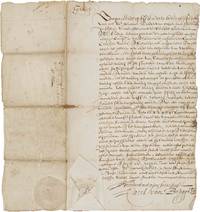
1646rif. 68207Fort New Amsterdam in New Netherland New York City: February 17 1646. Granting Land in Lower Manhattan in 1646 Translated by Gehring as a deed for ".a certain piece of land formerly known by the name of Pannebacker's or Bouwery No. 5 or 4; extending next to the land of Cornelis Claesz Swits along the wagon road until Hans Kiersteeden's plantation; and further on straight through the woods to the boundary line of Leendert Aerden at the point where the three roads of the inner wagon road meet." Kieft served as the sixth Director of New Netherland from 1638 to 1647 and his term was marked by extreme violence against Native Americans. He was succeeded by Peter Stuyvesant in 1647. A very rare signature. Old folds. Small losses to vellum along lower fold not affecting text. Without the seal. Very good. Charles T. Gehring ed. New York Historical Manuscripts: Dutch Vols. GG HH & II Land Papers Baltimore 1980 GG-134 p.39. hardcover
1646rif. 68207Fort New Amsterdam in New Netherland New York City: February 17 1646. Granting Land in Lower Manhattan in 1646 Translated by Gehring as a deed for ".a certain piece of land formerly known by the name of Pannebacker's or Bouwery No. 5 or 4; extending next to the land of Cornelis Claesz Swits along the wagon road until Hans Kiersteeden's plantation; and further on straight through the woods to the boundary line of Leendert Aerden at the point where the three roads of the inner wagon road meet." Kieft served as the sixth Director of New Netherland from 1638 to 1647 and his term was marked by extreme violence against Native Americans. He was succeeded by Peter Stuyvesant in 1647. A very rare signature. Old folds. Small losses to vellum along lower fold not affecting text. Without the seal. Very good. Charles T. Gehring ed. New York Historical Manuscripts: Dutch Vols. GG HH & II Land Papers Baltimore 1980 GG-134 p.39. hardcover books
1963rif. 39265New York: NAACP Legal Defense and Educational Fund but never published 1963-1964. LIKELY THE ONLY COMPLETE COPY OF THIS EXTRAORDINARY and extraordinarily rare! PUBLICATION THE MASTER COPY OF THE FIRST MANUAL FOR PURSUING CIVIL RIGHTS CASES PRESERVED BY JACK GREENBERG WHO CONCEIVED OF THE PROJECT. Volume I: viii 1-198 198/1-14 199-375 pp; Volume II: vi misnumbered viii but complete 377-487 487/1-78 488-606 606/1-24 607-723; 725-817 602/1-58. Jack Greenberg initiated this project shortly after taking the reins of the NAACP Legal Defense Fund which being non-profit had already detached itself from the for-profit N.A.A.C.P. As Greenberg notes in the preface civil rights law was becoming a specialty like other branches of the law and thus needed specialized guidebooks. The Fund's lawyers guided by the principles set forth in these manuals went on to win virtually all of the important cases of the civil rights era. Only a few dozen copies were issued and most of them lack some or all of the important interpolations see collation. Furthermore since this manual was printed for use in a seminar and issued in three-ring binders sections were often removed. And finally the third volume was issued last in a tiny edition and is exceptionally rare. Fortunately Jack Greenberg preserved a complete copy with all of the interpolations for personal reference. Upon his retirement as a Columbia Law School professor in 2015 at age 90 he gave this set to his son. 4to. In the original leatherette three-ring binders all of which are perfectly functional. Some wear to binders but still solid. Internally FINE AND BRIGHT with a few manuscript corrections in Greenberg's hand. AN ABSOLUTELY CENTRAL DOCUMENT FOR THE HISTORY OF THE CIVIL RIGHTS MOVEMENT AND OF ALL LATER CIVIL RIGHTS LITIGATION. NAACP Legal Defense and Educational Fund (but never published) hardcover
1730rif. E1Q9EQ01U79OAmsterdam: Reinier and Josua Ottens 1730. Mounted and framed. With title in banner at top centre arms of the city at top right city seal at top left and the primary locations with captions. Large engraved panorama on 4 sheets ca. 42 x 218 cm as assembled. Rare large engraved view of Amsterdam as seen from the inlet known as the IJ published by Reinier and Josua Ottens ca. 1730 with numerous ships on the IJ. It's the last state of the view by Jacob Savry published in 1647 and partly updated including the changes made by Visscher in his issue from 1653. Most obvious are the changes on the east part of the city with several new buildings including ''s Lands Zeemagazijn' now known as the Netherlands Maritime Museum.Washed and with one minor professional restoration near the title. Very good copy of a beautifully executed an detailed view of Amsterdam.l D'Ailly Profielen 186; De Vries Atlas van Amsterdam 14; cf. D'Ailly Profielen 55 & 74. Reinier and Josua Ottens, unknown
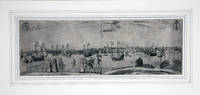
1599rif. DB9FTP3RHVIKAntwerp 1599. Pieter Bast Framed. Large engraved panorama on 2 sheets ca. 27 x 76 cm as assembled. Rare first state of a 16th-century view of Amsterdam as seen from the inlet known as the IJ made by Pieter Bast a Dutch engraver from Antwerp best known for his city map of Amsterdam and this view. "In its amplitude and the sheer audacity of the presentation this engraving is indisputably one of Bast's most significant creations. It is as much a portrait of the harbour of Amsterdam as of the city itself and underscores the unique importance of maritime trade as the principle source of the city's wealth and power". With its distinctive orientation he not only initiated the series of representations of Amsterdam as seen from the IJ but also "established the standard for an entire genre of Dutch maritime painting" Keyes. In 1611 a second state edition was published by Claesz Jansz. Visscher who drastically altered the composition. In very good condition.l Hollstein Dutch & Flemish I p. 168 8; Keyes Pieter Bast 8 and p. 19. BOOK HISTORY & PRINTING CARTOGRAPHY GEOGRAPHY & TOPOGRAPHY DRAWINGS PRINTS & WATERCOLOURS LOW COUNTRIES Amsterdam Charts & Maps City Plans Topography & Views Early Printing - 16th century Netherlands Prints & Print Series unknown