3 990 résultats
1983réf. 85527Middletown: Wesleyan University Press 1983. First edition. 187 pp. Very near fine in like dust jacket with one short tear to the top edge. Work by Jorge Mautner Ferreira Gullar Haroldo De Campos Mário Faustino Augusto De Campos Décio Pigntari and Lindolf Bell largely concrete in form. Middletown: Wesleyan University Press unknown books
1972N°6, de Juin 1972 de la revue fondée par Emmanuel Mounier et dirigée par Jean-Marie Domenach. Au sommaire: "Asie, idéologie et société": articles sur les documents du Pentagone et le Nord-Vienam par Gérard CHALIAND, la pensée de Mao et la Révolution culturelle chinoise par François FEJTÖ, l'Inde sous Indira Gandhi, puis sur le Brésil, la toxicomanie et la psychanalyse par Claude OLIEVENSTEIN, Mounier et le surréalisme, etc. Avec la bande annonce de l'éditeur. Français
1974N°5 de la nouvelle série, de mai 1974, de la revue fondée par Emmanuel Mounier et dirigée par Jean-Marie Domenach; au sommaire: "Après Pompidou", de Jacques JULLIARD, "Un Etat sans frein et une societe rétive", de Stanley HOFFMANN, "Trente-huit ans... chômeur", de Pierre LEULLIETTE, "Le "modèle bresilien" ou l'ultra-capitalisme pour pays pauvres" de Jacques de COURSON, "Brésil: l'enjeu d'une Eglise" par Charles ANTOINE, etc. Français
2000N°3-4, de juillet-décembre 2000, de la 4è série, tome 121 de la série générale, de la revue trimestrielle fondée par Henri Berr; au sommaire, dossier "Anthropologies, Etats et populations": "il s'agit de l'anthropologie, de ses rapports avec la colonisation, bien sûr, mais aussi avec l'action des Etats ou celle des organisations non-gouvernementales, et ce souvent, aujourd'hui même, en France, au Brésil, en Afrique du Sud" (in avant-propos d'Eric BRIAN). "A la croisée de la sociologie des savoirs scientifiques, de l'ethnographie de l'Etat et de l'histoire sociale de l'anthropologie, ce volume étudie les relations entre la construction de l'anthropologie comme forme de connaissance de certaines populations et l'élaboration et la mise en œuvre par les Etats de politiques visant à administrer ces populations. Les articles traitent de lieux et de moments très variés: la place des populations indigènes dans la construction nationale au Mexique depuis le siècle passé, les débats classificatoires sur fond d'apartheid en Afrique du Sud, les projets de réforme de l'administration coloniale française, les politiques de l'Etat brésilien face aux populations indiennes et noires, le folklore dans la France de Vichy, la confrontation de l'architecture contemporaine à la réaffirmation culturelle kanak dans le Pacifique des années 1990, la délimitation des terres indigènes dans le Brésil d'aujourd'hui, ou les programmes contemporains de développement. L'histoire des sciences sociales, ainsi entendue, constitue une contribution autant à l'anthropologie des pratiques classificatoires et des processus d'identification qu'à la sociologie historique de l'Etat." (4è de couverture). Français
1990Au sommaire, dossier: "Le Brésil au pluriel": "Pluralité des développements brésiliens" par Ignacy SACHS, "La conquête de l'espace brésilien" par Hervé THERY, "Autoportraits du Brésil" par Mario CARELLI; suivi de: "La rupture franco-britannique de 1940. Le conseil suprême interallié, de l'invasion à la défaite de la France" par François BEDARIDA, "Nationalisme et réactions fondamentalistes en France. Mythologies identitaires et ressentiment antimoderne" par Pierre-André TAGUIEFF, "L'affaire Rajk, quarante ans plus tard" par François FEJTÖ, "Le système Ceausescu. Utopie totalitaire et nationalisme insulaire" par Catherine DURANDIN; Enjeux: "Martin Malia dans l'historiographie soviétique" par Michel WINOCK. Français
1993Au sommaire: "Structures du pouvoir et politiques de modernisation dans la Chine du 20e siècle" par Marie-Claire BERGERE, "Le 700e anniversaire de la Confédération helvétique. Heurs et malheurs d'une commémoration" par Rémy PITHON, "Les missions universitaires françaises au Brésil dans les années 1930" par Jean-Paul LEFEVRE, "Les socialistes français et la question des retraites (1880-1914)" par Bruno DUMONS et Gilles POLLET, "Les Croix-de-feu et l'antisémitisme" par Richard MILLMAN, "L'inauguration du Musée d'art moderne et d'art contemporain de Nice en 1990" par Philippe POIRRIER; Enjeux: "Pour une écriture européenne de l'histoire de l'Europe" par Nicolas ROUSSELIER. Français
1974réf. 13205Paris, Esprit, 1974 1 volume In-8° Broché. Paginé de [769] à 928, 12 pages bleutées. Bon état; non coupé.
1972réf. 13478Paris, Esprit, 1972 1 volume 14 x 22,6cm Broché. Paginé de 929 à 1119, 20 pages bleutées. Bon état.
2000réf. 18620Paris, Centre international de synthèse / Albin Michel, 2000 1 volume 15,4 x 23,5cm Broché. Paginé de [225] à 548, 6 feuillets; quelques illustrations in texte. Bon état (pâle petite tache en tranche supérieure).
1990réf. 13973Paris, Presses de la Fondation nationale des sciences politiques, 1990 1 volume 17 x 24cm Broché sous couverture au 1er plat orné d'une photo. 151p. Bon état.
1993réf. 13987Paris, Presses de la Fondation nationale des sciences politiques, 1993 1 volume 17 x 24cm Broché sous couverture au 1er plat orné d'une photo. 141p., 1 feuillet. Bon état.
2009réf. LFA-126733204N° 138 (Juin 2009) : 72 pages, format 210 x 295 mm, illustré, broché, CEGRA, bon état
2008réf. LFA-126733205N° 136 (Décembre 2008) : 72 pages, format 210 x 295 mm, illustré, broché, CEGRA, bon état
réf. 244677Glashütten im Taunus, Reiss & Auvermann, 1989 in-8, 379 pp., 2077 numéros décrits, avec un frontispice en couleurs et 48 planches hors texte, toile Bradel cerise illustrée (reliure de l'éditeur).
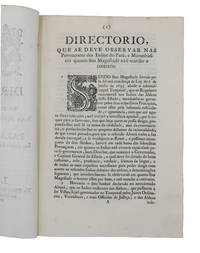
1758réf. 69200Lisboa: Miguel Rodrigues 1758. Integrating the Indigenous People of Brazil into Portuguese Society A scarce and monumentally important law in the history of the Indigenous peoples of Brazil. Far more than a simple reorganization of government and a step towards Jesuit expulsion this remarkable document prescribes the entire worldview of the Portuguese crown regarding the newly free Indigenous population in its colonies enumerating ninety-five articles which direct how they should live and work down to the most minute details of daily life. This decree following the June 6 decree which abolished the slavery of Native Brazilians was approved by King José I on August 7 1755. One piece in Marquis de Pombal's sweeping reforms Pombal's policy towards the American Indian was one of full integration with White society. The goal of this policy in Brazil was threefold—to curb the influence of the Jesuit order to encourage the "civilization" of Indigenous settlements and therefore their commercial and agricultural productivity and finally to draw a clear line between Natives now free and theoretically equal to Portuguese citizens and imported African slaves who would be the key to exploiting the New World's immense natural resources. This decree initially confined to Pará e Maranhão but soon extended to all of Brazil presents a complex and contradictory view of its newly free people subjects. The first article insists that a Portuguese Director is needed for each settlement as Indigenous leaders "due to the lamentable rusticity and ignorance with which they have been educated until now do not have the necessary aptitude required for government." The document is insistent beginning with the second article that the Directors are only there to advise and "may not in any case exercise coercive jurisdiction over the Indians" who are alternately referred to as equal to Whites and as idle immoral and childlike. Many of the articles herein are intended to transmute Indigenous Brazilians into good Portuguese citizens—Directors are to insist on the exclusive use of the Portuguese language in schools and business Articles 6-7 and each person is to be given a surname "with great care being taken by the Directors to introduce the same surnames as those of the families of Portugal" 11 our translation. Other articles enforce the restyling of homes to look more Portuguese the reorganization of households into the nuclear family unit and the adoption of Portuguese dress. Many others encourage agriculture and trading though the Director who receives one sixth of the produce of his settlement is required to supervise all transactions nominally to ensure that unscrupulous Portuguese merchants are not fleecing their poor naïve charges. Shockingly for the time Article 80 abolishes the enforced separation of the White and Indigenous populations and encourages the former to settle among the later. To prevent land runs care is taken that Native inhabitants should receive preference for land grants and "honorable positions" in local government. Perhaps most remarkable are Articles 88 and 89 which actively encourage miscegenation: "I recommend to the Directors that they apply unceasing care in facilitating and promoting on their part marriages between Whites and Indians….To facilitate said marriages the Directors will employ all the effectiveness of their zeal in persuading all White Persons who reside in their Settlements that the Indians are not of inferior quality to them that His Majesty deigning to qualify them for all those honors appropriate to the ranks of their posts consequently the same privileges will be enjoyed by persons who marry said Indians; thus banishing the most prejudicial imaginings of the Inhabitants of this State who have always considered such marriages to be infamous." The above is in stark contrast to Article 10 which reveals much about the true impetus of these reforms. That article reads in large part: "Among the lamentable principles and pernicious abuses that have resulted in the Indians' considerable decline one of them is undoubtedly the unjust and scandalous introduction of calling them Blacks; perhaps wanting with the infamy and vileness of this name to persuade them that nature had destined them to be the slaves of the Whites as is regularly imagined with respect to the Blacks of the African coast. And because besides being extremely detrimental to the civility of the Indians themselves this abominable abuse would be indecent to the Royal Laws of His Majesty to call Blacks men whom the said King was pleased to raise up and declare exempt from all infamy." This was all part of Pombal's plan and set the stage for vastly increased slave labor in Brazil. Indeed in 1761 Pombal banned the importation of slaves to Portugal and her eastern possessions instead routing the entirety of her share in the international slave trade to Brazil. By painting Whites and Native Brazilians as equals in direct opposition to Blacks the Portuguese administration created a clear and legally grounded distinction about which races were to be free and which to be enslaved. The strategy proved effective long outliving Portuguese dominion of Brazil—slavery was not abolished there until 1888 the last holdout in the Western Hemisphere. Despite the many articles encouraging Directors to be fair and theoretically putting limits on their ability to interfere with Indigenous autonomy the Directory system was unsurprisingly rife with abuse. Eventually corruption on behalf of the Directors was so frequent and so flagrant that the Directory was abolished in 1798. A crucial document of Portuguese colonial policy outlining a dramatically new and sometimes shockingly progressive attitude towards the Indigenous people of Brazil and with far-reaching consequences for Brazilian society and the role of slavery in its future. Folio. Disbound. Minimal staining along upper edge. Near fine. BORBA DE MORAES p.265. RODRIGUES 883 "Interesting and rare". unknown books
1758réf. 69200Lisboa: Miguel Rodrigues 1758. Integrating the Indigenous People of Brazil into Portuguese Society A scarce and monumentally important law in the history of the Indigenous peoples of Brazil. Far more than a simple reorganization of government and a step towards Jesuit expulsion this remarkable document prescribes the entire worldview of the Portuguese crown regarding the newly free Indigenous population in its colonies enumerating ninety-five articles which direct how they should live and work down to the most minute details of daily life. This decree following the June 6 decree which abolished the slavery of Native Brazilians was approved by King José I on August 7 1755. One piece in Marquis de Pombal's sweeping reforms Pombal's policy towards the American Indian was one of full integration with White society. The goal of this policy in Brazil was threefold—to curb the influence of the Jesuit order to encourage the "civilization" of Indigenous settlements and therefore their commercial and agricultural productivity and finally to draw a clear line between Natives now free and theoretically equal to Portuguese citizens and imported African slaves who would be the key to exploiting the New World's immense natural resources. This decree initially confined to Pará e Maranhão but soon extended to all of Brazil presents a complex and contradictory view of its newly free people subjects. The first article insists that a Portuguese Director is needed for each settlement as Indigenous leaders "due to the lamentable rusticity and ignorance with which they have been educated until now do not have the necessary aptitude required for government." The document is insistent beginning with the second article that the Directors are only there to advise and "may not in any case exercise coercive jurisdiction over the Indians" who are alternately referred to as equal to Whites and as idle immoral and childlike. Many of the articles herein are intended to transmute Indigenous Brazilians into good Portuguese citizens—Directors are to insist on the exclusive use of the Portuguese language in schools and business Articles 6-7 and each person is to be given a surname "with great care being taken by the Directors to introduce the same surnames as those of the families of Portugal" 11 our translation. Other articles enforce the restyling of homes to look more Portuguese the reorganization of households into the nuclear family unit and the adoption of Portuguese dress. Many others encourage agriculture and trading though the Director who receives one sixth of the produce of his settlement is required to supervise all transactions nominally to ensure that unscrupulous Portuguese merchants are not fleecing their poor naïve charges. Shockingly for the time Article 80 abolishes the enforced separation of the White and Indigenous populations and encourages the former to settle among the later. To prevent land runs care is taken that Native inhabitants should receive preference for land grants and "honorable positions" in local government. Perhaps most remarkable are Articles 88 and 89 which actively encourage miscegenation: "I recommend to the Directors that they apply unceasing care in facilitating and promoting on their part marriages between Whites and Indians….To facilitate said marriages the Directors will employ all the effectiveness of their zeal in persuading all White Persons who reside in their Settlements that the Indians are not of inferior quality to them that His Majesty deigning to qualify them for all those honors appropriate to the ranks of their posts consequently the same privileges will be enjoyed by persons who marry said Indians; thus banishing the most prejudicial imaginings of the Inhabitants of this State who have always considered such marriages to be infamous." The above is in stark contrast to Article 10 which reveals much about the true impetus of these reforms. That article reads in large part: "Among the lamentable principles and pernicious abuses that have resulted in the Indians' considerable decline one of them is undoubtedly the unjust and scandalous introduction of calling them Blacks; perhaps wanting with the infamy and vileness of this name to persuade them that nature had destined them to be the slaves of the Whites as is regularly imagined with respect to the Blacks of the African coast. And because besides being extremely detrimental to the civility of the Indians themselves this abominable abuse would be indecent to the Royal Laws of His Majesty to call Blacks men whom the said King was pleased to raise up and declare exempt from all infamy." This was all part of Pombal's plan and set the stage for vastly increased slave labor in Brazil. Indeed in 1761 Pombal banned the importation of slaves to Portugal and her eastern possessions instead routing the entirety of her share in the international slave trade to Brazil. By painting Whites and Native Brazilians as equals in direct opposition to Blacks the Portuguese administration created a clear and legally grounded distinction about which races were to be free and which to be enslaved. The strategy proved effective long outliving Portuguese dominion of Brazil—slavery was not abolished there until 1888 the last holdout in the Western Hemisphere. Despite the many articles encouraging Directors to be fair and theoretically putting limits on their ability to interfere with Indigenous autonomy the Directory system was unsurprisingly rife with abuse. Eventually corruption on behalf of the Directors was so frequent and so flagrant that the Directory was abolished in 1798. A crucial document of Portuguese colonial policy outlining a dramatically new and sometimes shockingly progressive attitude towards the Indigenous people of Brazil and with far-reaching consequences for Brazilian society and the role of slavery in its future. Folio. Disbound. Minimal staining along upper edge. Near fine. BORBA DE MORAES p.265. RODRIGUES 883 "Interesting and rare". unknown
1775réf. 15987Lisbon. 1775. A royal proclamation indended to prevent fraud in the export of tobacco and to encourage agriculture and commerce in general. 18pp. Large quarto. Stitched very good. unknown
1775réf. 15987Lisbon. 1775. A royal proclamation indended to prevent fraud in the export of tobacco and to encourage agriculture and commerce in general. 18pp. Large quarto. Stitched very good. unknown books
1941réf. 41843Washington D.C.: U.S. Government Printing Office 1941. First edition. Paper wrappers. Very good copies. .10 pp. 11 pp. 5 pp. 16 pp. 16 pp. 10 pp. 8vo. & 4to. Comprising Foreign Trade Series #107 1932; #114 1933; 1933 typed copy prepared by Statistical Division of PAU; #177 1940; #188 1941 and Garman A.D. "Mining Laws of Brazil" Information Circular Department of Commerce I.C. 6298 July 1930. U.S. Government Printing Office unknown books
1941réf. 41843Washington D.C.: U.S. Government Printing Office 1941. First edition. Paper wrappers. Very good copies. .10 pp. 11 pp. 5 pp. 16 pp. 16 pp. 10 pp. 8vo. & 4to. Comprising Foreign Trade Series #107 1932; #114 1933; 1933 typed copy prepared by Statistical Division of PAU; #177 1940; #188 1941 and Garman A.D. "Mining Laws of Brazil" Information Circular Department of Commerce I.C. 6298 July 1930. U.S. Government Printing Office unknown
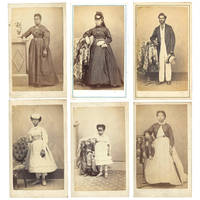
1890réf. 363568Rio de Janeiro Brazil: Photographia do Commercio 1890. A group of six carte-de-visite format albumen prints likely dating from the 1890s. The subjects are all Afro-Brazilians posed standing with their right arm resting on a piece of furniture a table a chair a pedestal. Five of the six images have printed backs identifying them as originating from Photographia do Commercio Rua da Carioca no. 40 Rio de Janeiro. These printed backs are in two styles both similar but one is smaller than the other. The sixth image has no identifying information but the distinctive pattern of the cloth on the table visible in the image places it in the same photo studio. Wilhelm Gaensby 1843–1928 emigrated to Brazil from Switzerland with his parents when he was five in 1848. He learned photography from Alberto Henschel and opened his own studio in Salvador in 1875. About 1893 he moved to Rio de Janeiro keeping his original studio in operation. A number of albums of Gaensby's landscape and scenic photographs survive but little has been written about his studio work. Perhaps the best survey of his career can be found in the chapter devoted to him in Os Fotógrafos do Império Editora Capivara 2005; translated from Brésil: Les premiers photographes d'un empire sous les Tropiques; Gallimard 2005. Generally very good or better. Medium contrast images tending towards sepia tones. Photographia do Commercio unknown
1775réf. 21552Paris 1775. Very good condition. Detailed copper engraved map of the coast of Brazil from Para showing Cap de Rio Grande and Cap de Sergipe down to the Baye de Tous les Saints. Showing many towns and coastal ports. With decorative cartouche. From Prevost's "L'Histoire Generale des Voyages". Bellin 1703 - 1772 one of the most noted French mapmakers of the 18th century was named the hydrographer chief cartographer to the French Navy and later the Official Hydrographer to the French King. Folding 13 1/4 x 10 1/4" with ample margins. Strong impression very clean short diagonal crease at lower right corner in margin only. unknown
1775réf. 21550Paris 1775. Very good condition. Detailed copper engraved map of the coast of Brazil from Barre d'Iguape down to Riv. de la Plata. Showing many towns coastal ports native settlements and missions. With decorative cartouche. From Prevost's "L'Histoire Generale des Voyages". Bellin 1703 - 1772 one of the most noted French mapmakers of the 18th century was named the hydrographer chief cartographer to the French Navy and later the Official Hydrographer to the French King. 7 1/4 x 10". Strong impression very clean. unknown
1775réf. 21551Paris 1775. Very good condition. Detailed copper engraved map of the coast of Brazil from S. Salvador in Cap de Bahia down to Cap St. Thomas and S. Vincent. Showing many towns coastal ports and the Riv. Saint Francois. With decorative cartouche. From Prevost's "L'Histoire Generale des Voyages". Bellin 1703 - 1772 one of the most noted French mapmakers of the 18th century was named the hydrographer chief cartographer to the French Navy and later the Official Hydrographer to the French King. 7 x 9 3/4". Strong impression very clean. unknown
1942réf. 361083Tokyo: Burajiru ni Okeru Nihonjin Hattenshi Kanko Iinkai Publication Committee for the History of Japanese Development in Brazil 1942. First Edition. Hardcover. Very good. A two-volume history of the Japanese in Brazil by a one-time California resident who helped open Brazil for the Japanese. The first Japanese immigrants settled in Brazil in 1908 not coincidentally the year after the Gentleman's Agreement restricted immigration to the United States. The new arrivals mostly pursued coffee cultivation around Sao Paulo. The first volume covers the diplomatic agreements and legal framework for Japanese immigrants in Brazil. The second volume describes the various colonies established successful businesses and offers biographies of some pioneers. These volumes were published to coincide with the 2600th anniversary of Japan a milestone used to stoke the flames of nationalism in the early 1940s. These books were reprinted in the 1950s when Japanese immigration to Brazil boomed again and then again in the 1990s. Aoyagi was a major proponent of Japanese emigration and for the establishment of colonies in the Americas. He arrived in California in the 1890s was the first Japanese to visit Peru and then led the push for agricultural colonies in Brazil negotiating the agreements to allow settlements and agricultural exports. Aoyagi was also instrumental in negotiating for Japanese government funds to buy land in Brazil for immigrant farmers. See Azuma In Search of Our Frontier pp. 110ff for more on Aoyagi's efforts in Brazil. "A general history of Japanese emigration to Brazil and the economic achievements of Japanese immigrants from 1908 to 1939. Includes the role of Japanese steamship companies as principal promoters of emigration and statistical data on Japanese agriculture."—A Buried Past 1438 vol. 1 only. Vol. I: 16 424; vol. II: 9 636 pages. Plus a few leaves of plates and charts and a handful of in-text halftone photographs. OCLC: Many single and two-volume listings. First editions of both volumes. Both very good or better in the publisher's gray-blue cloth. In cracked and browned but intact publisher's slipcases. Burajiru ni Okeru Nihonjin Hattenshi Kanko Iinkai [Publication Committee for the History of Japanese Development in Brazil] hardcover