VENEZUEALAN GUIANA – GOLD MININGBiblio.com
93 résultats
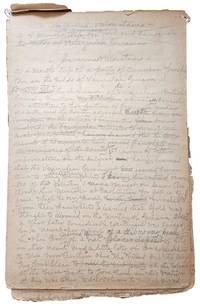
réf. FRE55Oblong small folio ca. 177x277 cm 7 x 11 in. Ca. 180 pp. including ca. 99 pages of text. Pencil on yellowish paper. Period original illustrated wrappers fastened with a string. Amateur restoration with brown paper tape over the original spine and ca. two pages reinforced on the verso with paper. Occasional pencil corrections by the author. Wrappers fragile and rubbed with small losses to the front wrapper about ten pages with tears several leaves loose but otherwise a good copy. Historically significant manuscript diary of a forty-one-year-old railroad employee from Canton Ohio offering a first-hand account of an American gold-prospecting expedition into Venezuelan Guiana present-day Guayana in the fall of 1897. Gold discoveries in southeastern Venezuela during the mid-nineteenth century followed by the rapid development of the El Callao mining district in the 1860s attracted foreign prospectors to the remote interior of Venezuelan Guiana. The discoveries also intensified Venezuela’s long-running boundary dispute with Britain whose claims on behalf of British Guiana extended into gold-bearing territory and at their broadest approached the mouth of the Orinoco River. By the time our party arrived in 1897 the dispute was under international arbitration while Venezuela remained politically unstable with recurrent revolutions and fears of renewed armed conflict. Against this background the travellers pursued reports of a rich placer deposit supposedly discovered by an Ohio prospector named Bundy although no contemporary American newspaper account of this particular discovery has yet been located. According to the diary the author had “much experience handling earthwork and some knowledge of general prospecting.” The core party consisted of the author and fellow Canton residents J. H. Alexander and H. C. Knoblock. They left Canton on September 1 1897 travelling to New York by Fort Wayne and Erie Railroads then sailed aboard the S.S. Caracas transferring at Curaçao to the S.S. Philadelphia before reaching La Guaira Venezuela. After visiting Caracas they continued along the Venezuelan coast aboard the Dutch steamer Prins Maurits to Trinidad then re-entered Venezuela through the Orinoco Delta aboard the City of Bolívar and reached Ciudad Bolívar. From there they made a fifteen-day roughly 250-mile trek south to Paragua and later established a prospecting camp near Caño Wanaca and Mount El Rotundo. The diary ends in November and appears incomplete covering three of the four months indicated by its title. The diary features ninety-nine pages of manuscript text with the first thirteen pages describing the expedition's journey from their departure in Canton through their voyage to New York and Curaçao. About fourteen pages of the Venezuelan section trace the more urban stage of the journey through La Guaira Caracas and the coastal ports of Guanta Cumaná and Carúpano prior to the main prospecting expedition from Ciudad Bolívar. The author records stays at early hotels in La Guaira Hotel Sfatoro Grand Hotel and Hotel Italia as well as visits to cafés parks and public events La Guaira — Café Italia; Caracas — El Calvario and a military-band concert in Plaza Bolívar. Interestingly he describes La Guaira as a “filthy town” and criticizes Caracas’s open-gutter sewage poor gas and electric lighting. In the capital the compiler also records meeting General Jacinto Fabricio Lara the Venezuelan Minister of Development who oversaw mining interests and supplied the party with regional mining maps. He further notes Carúpano’s reconstruction after a destructive tidal wave active rum smuggling and the excessive customs formalities at Venezuelan ports. The central sixty pages cover the interior expedition south of Ciudad Bolívar with six burros and a hired “West Indian Negro” later dismissed for drunkenness. In these passages the author records numerous encounters with local residents including a woman preparing chicken soup with yuca & cassava cassava-bread production at La Tigre his treatment of a bleeding young man and the manufacture of papelón at a sugar plantation. He also recounts crossing the rock-strewn Río Grande Claro severe mosquito bites getting lost on the trail to Paragua and trading medicine for food. Interestingly at Paragua the author harshly criticizes the minimal use of dairy sparse furnishings repetitive music played on cuatros and widespread child cigar smoking and describes a local funeral that descended into a drunken brawl. In the same part of the diary the author details the party’s principal prospecting activities. He writes about their first field tests along the road to Paragua where he and a local guide examined a mountain stream using a pick shovel and gold pan; although they found no gold he records promising formations and notes a nearby mountain composed largely of iron ore. Near Paragua the author describes accompanying Señor Morales on a twenty-five-mile journey across the savanna to inspect a quartz vein at the foot of a large mountain though he notes that careful examination revealed no trace of gold. Finally he talks about their most systematic work at a base camp near Caño Wanaca and Mount El Rotundo where he recounts how they cleared brush blazed trails dug test pits in alluvial ravines washed stream gravels for “colors” of gold and examined the mountain’s iron-rich rock and unusual cave formations. Especially interesting are the author’s observations on Venezuela’s unstable political situation including the seizure at Carúpano of a vessel carrying arms for an impending revolution and the hurried transfer of cattle across the Paragua River following a disputed election. He also records a Venezuelan passenger’s fervent gratitude to the United States for resisting British territorial claims while another episode describes customs officials in Ciudad Bolívar mistaking the party’s food supplies for gunpowder and threatening them with imprisonment. Among the prominent officials who assisted the party at different stages of the journey were U.S. Minister Francis B. Loomis ca. 1861-1948 Legation Secretary William W. Russell ca. 1858-1944 and Consular Agent Robert Henderson in Ciudad Bolívar. The diary also contains a detailed account of the travellers’ stopover in Port of Spain Trinidad an important transit point on their journey. The author praises the colony’s infrastructure electric streetcars well-maintained botanical gardens and bustling commercial district stocked largely with imported English goods. Overall historically significant manuscript diary of a forty-one-year-old railroad employee from Canton Ohio offering a first-hand account of an American gold-prospecting expedition into Venezuelan Guiana in the fall of 1897. unknown
1974réf. 84941Georgetown Guyana: Sheik Sadeek 1974. First Edition. Slim octavo 20.25cm; mimeographed sheets stapled into pictorial card wrappers; ii381pp. Inscribed by the author on the title page to Puerto Rican editor translator and literary critic Roberto Marquez: "For my friend R. Marquez / With the compliments of Sheik S. / Hope you find something suitable / 21.8.79" Light wear gentle sunning to spine; Near Fine. Self-published volume by the noted Guyanese poet and author gathering six short works published between 1949-1972 most centered around Guyanese daily life and written in the local patois. A nice association copy inscribed to Marquez who at the time was founder and editor of the journal Caliban: A Journal of New World Thought and Writing. Uncommon; OCLC notes 11 holdings. 84941. Sheik Sadeek unknown
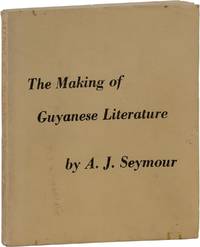
1978réf. 84949Georgetown Guyana: S.i. 1978. First Edition. Octavo 21cm; printed manila card wrappers; text is mimeographed with author's name and title hand-written in ink on the spine; ii78-10414pp. This copy is from the library of to Puerto Rican editor translator and literary critic Roberto Marquez with his ink name and date 8/79 on upper front endpaper. Seymour has inscribed this copy to him and mis-dated it on the half-title page: "For Roberto from AJ / with admiration affection / Aug 5. 1969." This was Marquez's working copy showing numerous passages marked over several readings showing extensive interaction with the text. Wrappers are edgeworn dust-soiled with a few small adhesive marks to same; Very Good. "This is a pioneering literary work. It is a distillation of my personal development as critic and editor in Guyana over several decades and it gathers within two covers what I may describe as a guide to as well as a survey of major forms of creative writing in the Guyana experience" from the preface. 84949. S.i. unknown
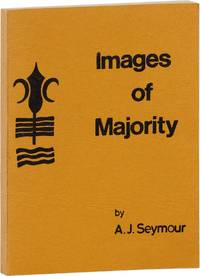
1978réf. 84948Georgetown Guyana: Labour Advocate Printery 1978. First Edition. First Printing. Octavo 20.5cm; bright orange card wrappers with titles printed in black on front cover; xii1053pp. Inscribed by Seymour on the title page to Puerto Rican editor translator and literary critic Roberto Marquez: "For Roberto Marquez / from Arthur Seymour / Jan 30. 1978 / With best wishes." Marquez has marked several passages in ink throughout the text. Hint of sunning to spine some trivial wear to extremities; Very Good. Collection of verse by the Guyanese poet capturing memories of his visits to various places Bonafoux Hato Rey Brasilia Rome Gibbs St. Peter and touching on themes of love the national ethos Black consciousness and the "philosophical quest for the underlying and varied meanings of the various moods that come upon us all" from the introduction. 84948. Labour Advocate Printery unknown
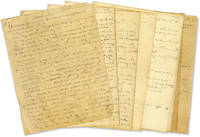
1925réf. 810841925. Manuscript report on on the recto sides only of 15pp of lined notepaper to the secretaries of a combined mining venture based out of Number 8 Old Jewry London. A few small dogears and creases some age toning of the paper and the fact that it's written in pencil make it a little tricky to decipher at times although a partial transcript is included from a previous collector. A very good A hand-written preliminary report which nevertheless contains a wealth of logistical and local detail regarding the business of pitching camp supply lines sickness boring results and assay findings depths propected gravel assessments depth of survey records etc. Comments regarding the local labor supply place the whole exploit firmly into the realm of exploitation with phrasing like ".the riff-raff of coastal negroes who are unstable - lazy and contemptuous of authority." A fascinating and ephemeral piece of industrial colonial history. Wray himself seems to have been a widely traveled mining surveyor with some of his recorded work being not only across Africa but also the Koorboora mining region of Queensland Australia among others. unknown
réf. DADAX0367171481New unknown
réf. DADAX1598741950New unknown
réf. DADAX1598741942New unknown
réf. DADAX0415150043New unknown
réf. DADAX0878554181New unknown
réf. DADAX1859416861New unknown
réf. SONG0521363780Used: Good unknown
réf. SONG0904180867Used: Good unknown
réf. DADAX0807856398New unknown
réf. DADAX0230339875New unknown
réf. DADAX0415863295New unknown
réf. DADAX0244043744New unknown
réf. DADAX1436875463New unknown
1932réf. HALL510223Paperback. 1932. 44 to 224pp plates & maps card covers London 1932-1961. Very good ex-library copies. . paperback
1799réf. 30444Londres no printer 1799. Near cont. hcloth. A little rubbed. 6IV183 pp. Engraved portrait of Barthelemy. Halftitle and portrait loose. Halftitle soiled and browned. Large copy but slightly browned. At end a part of another work withbound. There exists different print bearing the same year 1799 A second edition was issued also in 1799. - Sabin: 67627. hardcover
1824réf. 54352Amsterdam Gerard Hulst van Keulen 1824. Contemp. hcloth. Stamp on title-page. IV251 pp. A few scattered brownspots. hardcover
1820réf. 43738London John Murray 1820. Wirhout wrappers as ectracted from "The Quarterly Journal of Science and the Arts. The Royal Institution of Great Britain" vol. VIII a. IX. Pp. 260-287 a. pp. 1-32 a. 1 folded engraved map 20x25 cm. "Map of the Missions of the Caroni". unknown
réf. DADAX1436947693New unknown
réf. DADAX0195391640New unknown
réf. DADAX0230115896New unknown