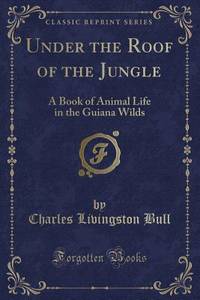
Under the Roof of the Jungle
réf. 1333583362.Gpaperback. Good. Access codes and supplements are not guaranteed with used items. May be an ex-library book. paperback
Bonita · États-Unis50,43 $US≈ 45,05 €
92 résultats
réf. 20663No place. Three of the signatures are dated from January 1932 the other two are undated. The five signatories are: Sir Alfred Claud Hollis 1874-1962 Governor of Trinidad and Tobago 1930-1936 and author of a historical account of Spanish Trinidad; his wife Enid Mabel Hollis née Longman Lady Hollis 1888-1939; Sir Edward Brandis Denham 1876-1938 Governor of British Guiana 1930–1935 and Jamaica 1935–1938; Sir Thomas Reginald St Johnston 1881-1950 Governor of the Leeward Islands 1929-1936; Sir William Charles Fleming Robertson 1867-1937 Governor of Barbados 1925-1932. On one side of a 13.5 x 16.5 cm leaf of cream paper torn from an autograph album. In good condition lightly aged. Three of the governors have signed in a column towards the centre of the page: 'Claud Hollis Governor Trinidad 17.1.32 Edward . Denham . Govr. British Guiana. 26.1.32. Reginald St. Johnston. Govr. Leeward Islands.' Hollis's wife has signed to the right of her husband's signature in the top right-hand corner: 'Enid Hollis' and beneath her signature in an extremely close hand is the signature of 'W. C. F Robertson. Govenor Barbados 31.1.32'. No place. Three of the signatures are dated from January 1932, the other two are undated. unknown
réf. 1333583362.Gpaperback. Good. Access codes and supplements are not guaranteed with used items. May be an ex-library book. paperback
réf. 0267504861.Ghardcover. Good. Access codes and supplements are not guaranteed with used items. May be an ex-library book. hardcover
réf. 0656856173.Ghardcover. Good. Access codes and supplements are not guaranteed with used items. May be an ex-library book. hardcover
réf. 1333711565.Gpaperback. Good. Access codes and supplements are not guaranteed with used items. May be an ex-library book. paperback
1978réf. 84949Georgetown Guyana: S.i. 1978. First Edition. Octavo 21cm; printed manila card wrappers; text is mimeographed with author's name and title hand-written in ink on the spine; ii78-10414pp. This copy is from the library of to Puerto Rican editor translator and literary critic Roberto Marquez with his ink name and date 8/79 on upper front endpaper. Seymour has inscribed this copy to him and mis-dated it on the half-title page: "For Roberto from AJ / with admiration affection / Aug 5. 1969." This was Marquez's working copy showing numerous passages marked over several readings showing extensive interaction with the text. Wrappers are edgeworn dust-soiled with a few small adhesive marks to same; Very Good. "This is a pioneering literary work. It is a distillation of my personal development as critic and editor in Guyana over several decades and it gathers within two covers what I may describe as a guide to as well as a survey of major forms of creative writing in the Guyana experience" from the preface. 84949. S.i. unknown
réf. 1177925397.Gpaperback. Good. Access codes and supplements are not guaranteed with used items. May be an ex-library book. paperback
réf. 0484311379.Ghardcover. Good. Access codes and supplements are not guaranteed with used items. May be an ex-library book. hardcover
réf. 133323242X.Gpaperback. Good. Access codes and supplements are not guaranteed with used items. May be an ex-library book. paperback
réf. 1347264124.Ghardcover. Good. Access codes and supplements are not guaranteed with used items. May be an ex-library book. hardcover
réf. 127629459X.Gpaperback. Good. Access codes and supplements are not guaranteed with used items. May be an ex-library book. paperback
réf. 1279465409.Gpaperback. Good. Access codes and supplements are not guaranteed with used items. May be an ex-library book. paperback
réf. 1020064986.Ghardcover. Good. Access codes and supplements are not guaranteed with used items. May be an ex-library book. hardcover
réf. 1017887411.Ghardcover. Good. Access codes and supplements are not guaranteed with used items. May be an ex-library book. hardcover
réf. 10910London: George Bell and Sons 1901. First edition. Octavo half binding by Morrell of of brown morocco and marbled boards spine with one raised band and an intricate decorative panel containing spheres and petals reminds me a little of an astronomical chart; titling and binding have an 1890s feel top edge gilt pp. xxxvii 514. Armorial bookplate of Herbert Claiborne Pell light foxing throughout leather is starting to split at hinges coners are bumped and worn bare to boards. An interesting and unusual binding with attractive period design. NCBEL III column 617. London: George Bell and Sons, 1901. First edition. hardcover
réf. 1391243862.Ghardcover. Good. Access codes and supplements are not guaranteed with used items. May be an ex-library book. hardcover
réf. 139096650X.Gpaperback. Good. Access codes and supplements are not guaranteed with used items. May be an ex-library book. paperback
réf. 1020952229.Ghardcover. Good. Access codes and supplements are not guaranteed with used items. May be an ex-library book. hardcover
réf. 1020404655.Ghardcover. Good. Access codes and supplements are not guaranteed with used items. May be an ex-library book. hardcover
réf. 1331517710.Gpaperback. Good. Access codes and supplements are not guaranteed with used items. May be an ex-library book. paperback
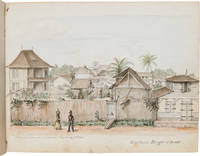
1840réf. 66308Various places in French Guiana and the West Indies as described below. 1840-1876. 19th-Century Watercolors of French Guiana and the West Indies A volume of exceptionally detailed and accomplished ink and watercolor illustrations of landscapes and animal life in French Guiana and its environs in the 1850s as well as landscapes of the West Indies from the same period. These illustrations provide excellent representations of the people and places of Cayenne and the surrounding region showing streetscapes canal scenes military establishments residential neighborhoods homes the flora fauna insects and inhabitants of the region. Several show men women and children of African descent at work and at rest. At least two of these images are dated 1840 eight years before the end of slavery in French Guiana and likely depict enslaved men and women. This volume appears to have been created by Jean Louis Marie Hippolyte de Saint-Quentin 1814-1902 who was the primary assessor of real estate for French Guiana and a valued advisor to successive governors of the colony. In gratitude for his services in 1869 he was named a Knight of the Legion of Honor – the highest decoration that France can bestow on one of its citizens. In addition to his abilities as a government administrator Saint-Quentin was also an artist noted for his jailhouse portrait of D'Chimbo a famous Guianese bandit – created just prior to D'Chimbo's execution by guillotine in 1862. Saint-Quentin later gifted the portrait to the Musée Alexandre-Franconie in Cayenne. This volume of ink and watercolor illustrations and pencil sketches begins with a contemporary photograph of the artist with the following penciled manuscript notation in French: "Ne a Cayenne Ghyana Francaise en 1800 fils de Narcisse Edouard Isdore de Saint Quentin et de Louise Elisabeth-Victoire d'Audiffredy" "Born in Cayenne French Guiana in 1800 son of Narcisse Edouard Isdore de Saint Quentin and Louise Elisabeth-Victoire d'Audiffredy". Narcisse and Louise came from established Creole families based in Cayenne from the 18th century and had five sons of whom only Jean Louis Marie Hippolyte has been identified as an accomplished artist. It should be noted that the historical record differs from the penciled manuscript notation for Jean de Saint-Quentin's date and place of birth: Jean was born in 1814 in Paris rather than 1800 in Cayenne. At the time Jean's parents had moved back to France for a short period when Portugal had captured Guiana but returned to Cayenne within the decade. The photographic portrait dated 1860 at the beginning of the sketchbook shows a man of middle age and Jean de Saint-Quentin would have been forty-six years old at the time. The illustrations in this volume are dated between 1840 and 1876 mostly the 1850s and show the people places and wildlife of French Guiana a century after its initial colonization by the French as well as views of the islands of the West Indies that Saint-Quentin likely created while travelling in the Caribbean. Many of the landscapes include well-known landmarks making them visually comparable to many of the same places today. His remarkably detailed natural history drawings of the animals he encountered in the jungles of French Guiana give the modern viewer a glimpse of some of the species present prior to the time of modern development and habitat destruction. De Saint-Quentin had an eye for architecture and produced precise drawings characterized by rich detail depth realistic color and meticulous presentation. Of the forty-four works in this sketchbook eighteen are pen and watercolor landscapes or views of towns and estates nine are complete or incomplete pencil sketches eight are images of animal life in the Cayenne region three are watercolor sketches three are pencil sketches with a sepia wash and three are contemporary photographs. Following Saint-Quentin's portrait are views of Cayenne French Guiana and their surrounds which start with the landscapes he found right outside his bedroom windows along the Canal Laussat in the center of Cayenne. These are detailed suburban views peopled with locals walking on the canal towpaths – some just enjoying the day while others are hard at work carrying goods atop their heads with one painting showing a soldier in full uniform walking along a street next to a civilian woman. Men are netting fish in the canal while others are punting a flatboat filled with goods along the canal. The backgrounds are full of varied architectural interest with detailed views of the wooden homes and outbuildings of de Saint-Quentin's neighbors as well as a barracks for workers. Other Cayenne views include a street scene with workers paddling a boat while two officers converse with a civilian a view of a military parade ground with a group of men likely recruits being spoken to by an officer a soldier nodding off by the guard house and a worker leading horses nearby. These initial paintings are quite finished with wonderful detail rich color and beautiful depth. The sketchbook continues with a series of views of beaches towns and the jungle including the Kourou coastline with an early settlement the village of Roura surrounded by the jungle on a promontory in the Comte estuary and a wonderful view of men paddling a flatboat along a river through the forests of the Amazon. Following these expansive views of locations near Cayenne de Saint-Quentin focuses his lens to create a series of natural history portraits of the fauna native to the French Guianese portion of the Amazon rainforest including a half-size view of a miniature deer native to the region a full-scale detailed view of a forest tarantula a beautifully colored jungle moth detailed sketches of unusual reptiles and a magnificent and very detailed full-size view of a jungle phasmid one of the largest known species of Amazonian insect. These drawings of native fauna are followed by a sepia view of a home in a jungle clearing with a woman her children and a servant in the yard in front of the house. A series of watercolor and pencil sketches of islands in the West Indies follows starting with a distant view of St. Martin St. Eustatius Saba St. Barthélemy and St. Kitts followed by a two-page illustration of a military installation at the Demerara River in Guyana. Following this are several other views around the Caribbean and Lesser Antilles including a lovely detailed view of the settlement at Barbados a series of unfinished pencil sketches of St. Lucia Dominique and Antigua and a mostly-finished watercolor sketch of St. Thomas. Several more illustrations of French Guiana follow including a view of a plantation in Macouria a delightful close-up of the home of the butcher in Conamama showing two men taking their ease on its front porch as well as an expansive view of a hilltop chalet in Kourou. A mounted contemporary photographic reproduction of an original panoramic photograph of the Penal Colony of St-Laurent-du-Maroni precedes a meticulous watercolor view of the Oyapok River estuary and jungle along its shore. One final natural history painting of a tame parakeet is followed by a pencil and sepia watercolor sketch of Antibes France dated August 1868 from the Mediterranean washed with sepia watercolor. The penultimate leaf of the sketchbook has a mounted contemporary photograph of part human part fish "monstrosity" found in the South Pacific Island of New Caledonia with the final leaf containing a painting of a person walking along a jungle shore between two palms making a very suitable end to the collection. A full list of illustrations follows: 1 Photographic portrait of the artist dated 1860. Portrays a man of middle age in a makeshift photography studio composed of a sheet hung on a line in front of a picket fence; he is holding a cane and cap in his left hand standing beside a chair with his right hand in his coat pocket and his left on the top of the chair. 2 "Le Pont Laussal Panorama autour de ma chambre Cayenne le 30 8bre 1853." A watercolor and ink cityscape of Cayenne along the Canal Laussat with what likely is a small portion of the artist's fenced yard in the immediate foreground the canal in the middle ground with its punts foot bridge and towpaths on either side populated with a horse-drawn wagon foot traffic and a pair of men netting for fish; more homes and the hills surrounding Cayenne are in the background. 3 "L'Etablissement Jambe Panorama autour de ma chambre Cayenne le 3 9bre 1853." Another cityscape along the Canal Laussat at the intersection of a street with one of the towpaths. Across the canal is a fenced yard with a barracks with men loitering in front of it and an open barn. The towpath closest to the viewer has a woman with a parasol and two Africans walking along it; there are three men in a punt plying the canal waters with more homes and the hills around Cayenne in the background. 4 "Les Cases Houget et Bouté Panorama autour de ma chambre Cayenne le 9 9bre 1853." A cityscape with a street in the foreground; a soldier and a woman of at least partial African descent with a colorful dress and kerchief with a large pot balanced on her head walking along a tall wooden fence that fronts the road; an elaborate two-story house and its barn inside the fence and more houses and palm trees in the background. 5 "Vue sur le Parc du Génie Panorama autour de ma chambre 18.9.bre 1853." A streetscape at the crossing of two large roads in a military yard; two officers in uniform speak with a civilian in the street between a house with a small palm in front of it and its barn while on the cross street a group of thirteen civilians drag a large flatboat that has been placed on wheels; there is a well and barracks on the far side of the street and the rooftops of buildings in the background. 6 Unfinished portrait of an elegant African or Creole gentleman in a waistcoat and jacket. 7 "2e Vue sur le Parc du Génie Panorama autour de ma chambre 18 9bre 1853." This second view of the military yard has a crowd of civilians and military personnel standing and listening to a gesticulating officer while a soldier sits at the gate watching the proceedings. A man leading two horses and a gentleman pushing a wheelbarrow are to the right foreground while houses rooftops and ship's masts form the background. 8 "Larivot La Pointe Tangui 9bre 1853 D'áprēs Dupuy." A small view of an area in near Larivot Harbor in Cayenne French Guiana called Tangui Point showing two houses and palm trees on a clearing near the shore with a sloop and a flatboat plying the waters of the North Atlantic in the foreground. 9 "Souvenir de Kourou 2.9.bre 1840." A colorful view of the Kourou coastline with what appears to be the Atlantic in the foreground and a sloop flying French colors. On land are an elaborate two-story house with palm trees to its rear and an outbuilding and two thatched cottages nearby; the background is composed of mountains forest and sky. 10 Unfinished painting of the marble bust of a man. 11 "Roura 31 Xbre1853." A landscape of the village of Roura along the Atlantic coast. The village consists of a church with a steeple and two nearby houses as well as a house along the shore some distance away. A skiff plies the water of the Comte River estuary; the background is of forested hills and a grey cloudy sky. 12 "Caria cou Petite Gazelle de la Guyane dessineé d'aprés nature ½ Grandeur Tibourou 2 Janvier 1854." A half-size profile view of the head of what is likely a Red Brocket Deer Mazama americana a petite deer that is only two-and-a half feet high at the shoulder that is native to the forests surrounding Cayenne. This specimen was likely observed near Crique Tibourou just southwest of Cayenne. 13 "illegible 2 Janvier 1854." A scene of four men and a dog in a flatboat on a river that fronts the rain forest. Some trees in detail are to the right with three dead trees that fell from the forest into the water near shore. 14 "Araignée-crabe male Grandeur naturelle 5 Janvier 1854." A full scale detailed drawing of what is likely a Pinktoe Tarantula Avicularia avicularia a tree-dwelling spider found throughout the rainforests of French Guiana. 15 "Tibourou 5 Janvier 1854 Grandeur naturelle." A full-scale representation of two snakes observed near Crique Tibourou just southwest of Cayenne. The gray and black snake could not be identified while the red and black snake is likely the Tropical Flat Snake Siphlophis compressus. 16 "Cayenne 20 aoūt 1854." A colorful and detailed drawing of a moth with a blue-green abdomen and thorax blue-green forewings and blue hindwings lined in yellow with a red spot. We are unable to identify the genus and species of this insect. 17 A group of two unidentified reptiles one drawn in great detail while the other is an unfinished sketch; an unidentified black insect and an unidentified brown pupa. 18 "Débris d'un Phasme Géant Grandeur naturelle." A full-scale drawing of the remains of an insect likely in the Order Phasmida walkingsticks. As this specimen is even larger than French Guiana's titan beetle Titanus giganteus which is considered one of the largest insects in the world if this insect has yet to be classified it would be an important addition to entomologic studies of French Guiana. 19 "habitation Par Force aux Cascades 25 7bre 1854." A detailed drawing colored in sepia of a two-story wood-framed house within a forest clearing showing women and children of African descent. In the foreground there is a woman walking through the clearing holding the hand of a child while looking at another child that has strayed to her left and another woman in an apron toward the center of the clearing holding a pot on her head. 20 "libourou de Versailles libourou de Cayenne." A mostly-finished drawing of two dogs with a domesticated dog on the right labeled "libourou de Versailles" while the seemingly feral growling dog on the left with a curled tail is labeled "libourou de Cayenne." 21 "Partie Nord de St. Christophe 29 mai 1857." A two-sheet drawing of the northern shore of the West Indies island of Saint Christopher St. Kitts with a view of what is likely Brimstone Hill Fortress in the right foreground and small distant inset views with the captions "St. Martin" "St. Eustache" "Saba" and "St. Barthélémy" on the upper left of the lefthand sheet. 22 Unfinished pencil drawing of a landscape featuring a four-story home. 23 "Acouchis." A drawing of what are likely two red Acouchi Myoprocta acouchy which are herbivore rodents found in the rain forests of French Guiana. The drawing of the acouchis are on three pieces of blue paper that have been adhered along the bottom edge of a page in the sketchbook containing a collection of pencil sketches that include a woman in a gown multiple drawings of faces and a soldier with a sword. 24 "Démérari les Casernes et le Phare 24 mai 1857." A lovely two-sheet landscape of the Georgetown light house and the surrounding military barracks where Guyana's Demerara River meets the Atlantic. The landscape includes the lighthouse and residential buildings on the right page while military barracks occupy the coast drawn on the left page. 25 "Vue prise á la Barbade 27 mai 1857." A landscape of coastal Barbados including what is likely the British diplomatic mission there as well as surrounding homes with a background of empty dunes. 26 An unfinished pencil sketch for a maritime landscape with an island and skiff. 27 An unfinished pencil sketch of homes in the forest. 28 "St. Lucia Le Carénage." An initial unfinished pencil sketch of the capital city of St. Lucia initially called Le Carénage "safe anchorage" and now known as Castries. 29 "indecipherable á St. Lucia." An unfinished pencil sketch of a city or military emplacement on the top of a hill in St. Lucia – possibly Fort Charlotte on Morne Fortune. 30 "Dominique rue indecipherable an Roseau 28 mai likely 1857." An unfinished pencil sketch of view of the capital city of Roseau on the island of Dominique Dominica from the water clearly showing Église de Notre-Dame du Bon Port du Mouillage de Roseau now known as The Cathedral of Our Lady of Fair Haven of Roseau or simply Roseau Cathedral surrounded by city buildings. 31 An unfinished pencil sketch for a maritime landscape with an island and ketch with inset sketches of the islands of Saba and St. Martin. 32 "Antigua 29 mai 57." An unfinished pencil sketch of the west coast of Antigua clearly showing Fort Barrington and Antigua's capitol city of St. Johns St. John's Harbor. 33 "St. Thomas." A mostly-finished watercolor and ink painting of the city of Charlotte Amalie on the south shore of the island of St. Thomas clearly showing Skytsborg Tower now known as "Blackbeard's Castle". 34 "Guyane Quarters sous le Vent Habitation Vigué á Macouria 8bre 1840." A detailed watercolor and ink drawing of an elaborate wooden house and its outbuildings in Macouria French Guiana located between Cayenne and Kourou. The image shows a man standing on the porch of the house and a man and woman conversing in the clearing in front of the house all three of them apparently of African descent. 35 "Habitation Leboucher á Conamama Guyane – quartiers sous le vent 29 8bre 1840." An attractive and colorful ink and watercolor of the home of the butcher of Conamama French Guiana showing a view of the home's porch yard and a small outbuilding. A man of African descent leans against the wall of the house to one side of the front door wearing a tall hat and smoking a pipe while another lies comfortably on the porch with his knees up. There are pieces of pottery on the porch railing a basket on the floor of the porch and a rifle leaning against the railing. The yard is fenced with a gate; there is a view of a coconut palm behind the outbuilding and trees beyond. 36 "Guyane – Quartiers Sous-le-Vent Habitation Pariacabo á Kourou." A detailed painting of wooden houses perched on the hills overlooking Pariacabo Harbor in Kourou French Guiana. The view shows a wooden house with a surrounding porch perched on top of a forested hill with a path curving up the hill to the house's front yard. Another two dwellings are located on lower ground and there is a background of more forested hills. 37 "Guyane Francaise Etablissement pénitentiaire de Saint Louis indecipherable sur le Maroni en 186 parle capitaine F. Ronmy." A contemporary print of an original three-image panoramic photograph of the Penal Colony of St-Laurent-du-Maroni likely taken by Thomas Ferdinand Ronmy n.d. a Captain of Military Engineering in French Guiana during the 19th century. The three photographic prints together measure 2 x 6¼ inches. 38 "Guyane - quartiers au vent Entrée de l'Oyapock." A view of the Oyapok River Estuary south of Cayenne looking toward Oyapok Bay just off the North Atlantic. To the left of the view is a jungled shore and to the middle and right is the river with a steam-powered sloop approaching the viewer with its sails furled. 39 "9 fevrier 1876." A colorful mostly-finished painting of what is possibly a Golden-Capped Conure Aratinga auricapillus sitting on the back of a tall chair. This parakeet is native to the tropical forests of Brazil Colombia Ecuador French Guiana Guyana Peru Suriname and Venezuela. 40 A small sketch of a village in a jungle clearing along the banks of either a river or the ocean on a 2½ x 5-inch slip of paper laid into the sketchbook. 41 "Souvenir du Capo d'antibes 10 aoūt 1863." A pencil and sepia view of the peninsula at Antibes France from the Mediterranean with the Garoupe lighthouse clearly visible at the top of the peninsula; there are dwellings around the lighthouse and scattered down the peninsula. 42 A small unfinished pencil sketch of what looks to be military emplacement. 43 ".du Chateau d"Antibes avec…." An unfinished pencil and sepia view from the Mediterranean of a chateau tucked away into the hills of the Antibes France. 44 "Monstre de la nouvelle caledunie. Photographe en 1866." A carte-de-visite-sized photograph of a fish body with humanoid thorax arms and head with a pencil caption identifying it as from the islands of New Caledonia in the South Pacific. These creatures are commonly referred to as a "Fiji Mermaid" a sort of invented curiosity that was sold to European sailors in Southeast Asian ports through the 18th and 19th centuries. They are usually a desiccated or taxidermized chimera of a fish and a small primate but were believed to be real infant mermaids. Several examples survive in well-known Wunderkammers including the Enlightenment Room at the British Museum. George Cruikshank made an engraving of one that was exhibited in a London coffee house in 1822. They were also a feature of P.T. Barnum's shows etc. 45 Watercolor sketch of a person holding a stick walking up from a beach toward higher land with palm trees and vegetation. A splendid collection of mid-19th-century illustrations of the people places and wildlife of French Guiana and the Caribbean by Jean Louis Marie Hippolyte de Saint-Quentin conveying the artist's admiration of the people and landscapes of French Guiana and its neighboring regions as well as his fascination and wonder at the beauty and diversity of nature found just outside his door. Oblong quarto. Contemporary half sheep and textured paper manuscript title on front board. Boards soiled rubbed and edge worn; front joint split but still attached by cords. Light intermittent soiling and staining to pages occasional adhesive residue faint scattered foxing. Moderate closed tears to margins of a few pages open tear to margin of one page with no loss to illustrations. Illustrations quite clean colors bright and vivid. Very good. In a half morocco clamshell case spine gilt. hardcover
réf. 709804to. 2-pages approximately 250 words in part: "the idea of moving there from Phila. Has taken such a hold on my mind that I merely wanted your advice . the stagnation of Business here induced me to apply to you . I once more trouble you requesting your opinion." McCalmont 1765-1838 was co-owner of plantations in Demarara and one of the largest enslavers there; Demarara was a colony of the Dutch West India Company or the Netherlands 1745-1815 when it became a British colony Old fold lines but very good. unknown
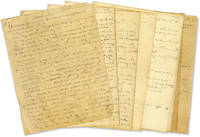
1925réf. 810841925. Manuscript report on on the recto sides only of 15pp of lined notepaper to the secretaries of a combined mining venture based out of Number 8 Old Jewry London. A few small dogears and creases some age toning of the paper and the fact that it's written in pencil make it a little tricky to decipher at times although a partial transcript is included from a previous collector. A very good A hand-written preliminary report which nevertheless contains a wealth of logistical and local detail regarding the business of pitching camp supply lines sickness boring results and assay findings depths propected gravel assessments depth of survey records etc. Comments regarding the local labor supply place the whole exploit firmly into the realm of exploitation with phrasing like ".the riff-raff of coastal negroes who are unstable - lazy and contemptuous of authority." A fascinating and ephemeral piece of industrial colonial history. Wray himself seems to have been a widely traveled mining surveyor with some of his recorded work being not only across Africa but also the Koorboora mining region of Queensland Australia among others. unknown
1963réf. 204873San Francisco 1963. Tiny shallow chip to one edge; fine. Broadside printed on one side of a single leaf approx. 8-1/2 X 11 in. Full page letter to American union members reporting on the manipulation of AFL and other American unions supporting the general strike in British Guiana sic. Not well remembered today the 80-day walkout was the longest general strike on the world. This letter calls out George Meany and other union leaders for falling in line with this action which was being pushed by right-wing anti-communist organizations aiming for political change and not representing the interests of workers. The operation was part of a covert US effort secretly funded by the CIA who used the American unions as tools to oust the popular Guianese leader Cheddi Jagan who was friendly with Cuba's Fidel Castro. unknown
1837réf. 2252821837. Watercolor on paper. 19 x 26 cm. 7-1/2 x 10-1/4 inches. Matted. Watercolor on paper. 19 x 26 cm. 7-1/2 x 10-1/4 inches. Adriaan David van der Gon Netscher was a member of the Netscher family a Dutch military family that traces its heritage back to the 1600s. Adriaan David was a naval officer honorably discharged in 1848 and a member of the Court of Police in British Guyana where he painted this striking little watercolor of the Public Building. unknown