George Fulmer; Florida Sunbelt MigrationBiblio.com
2 668 résultats
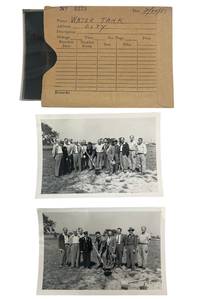
1950réf. 238291950. The evolution of public and civic ceremonies in Clearwater Florida 1951 to 1954 documenting the ceremonies political activity public institutions youth programs infrastructure projects and residential life through which served critical and symbolic functions in the rapid expansion of Sunbelt cities. George Fulmer photographed Clearwater near the beginning of an extraordinary demographic transformation when the city grew from 15581 residents in 1950 to 34653 in 1960 an increase of 122.4 percent. His assignments record that expansion at street level where campaigns elections welfare organizations public works graduations parades and civic gatherings supplied the institutional framework of a developing Sunbelt community. Photo archive of approximately 94 items comprising 46 silver gelatin photograph prints with 46 corresponding large negatives housed in 12 numbe"red commercial photo studio envelopes bearing manuscript assignment captions Clearwater Florida principally 1951 to 1954. Silver gelatin photograph prints ranging from 4.5 x 2.5" to 5" x 4" and each negative about 4 x 5 inches. Fulmer's photographs show crowds of both men and women registering or voting among curtained booths; men breaking ground for a city water tank; officials planting a camellia at the county courthouse; a large men's banquet and presentation ceremony; a high school graduation with students filling a decorated auditorium stage; young women in performance costumes; and children and teenagers posed outside a local theater. Political assignments include a 1952 Alto Adams gubernatorial campaign rally outside the Bank of Clearwater with women wearing "Alto Adams" hats campaign posters surrounding the speaker's platform and spectators lining the sidewalk; Republican gatherings beneath American flags and a portrait of Abraham Lincoln; and Eisenhower campaign volunteers holding "Eisenhower" and "I like Ike" placards outside a Clearwater business. Another series follows a street parade with marching participants balloons decorated vehicles storefronts and spectators while the envelope is captioned "Youth parade." Fulmer also photographed the Clearwater Welfare Center at 612 where a sign identifies the facility as "Sponsored by the Seventh day Adventist Church" recording a public ceremony at its entrance before an audience of adults and children. The studio envelopes retain captions including "Election day voting" "County court house camellia planting" "Alto Adams for Gov" "Eisenhower for Pres" and "Republican speaker" connecting individual negatives and prints to the assignments under which Fulmer produced them. Clearwater's postwar expansion belongs to the larger redistribution of American population and political influence toward Florida and the Sunbelt but Fulmer's assignments establish that transformation through municipal and community activity. Elections are particularly prominent. In 1952 Dwight D. Eisenhower carried Florida with 544036 votes 55 percent of the statewide total becoming part of a changing political landscape in a state long dominated by Democrats. The gubernatorial photographs belong to the same election year: Alto Adams campaigned for the Democratic nomination in a contest ultimately won by Dan McCarty who became governor in January 1953 while contemporary Florida photographic collections similarly record rallies and campaign activity surrounding that election. Fulmer's numbered envelopes demonstrate the process by which such events entered the local photographic record placing presidential and gubernatorial politics beside voting rooms welfare work school ceremonies youth recreation courthouse landscaping water infrastructure parades and residential scenes. Light handling wear and occasional curling; studio envelopes with expected toning handling wear creasing and manuscript notations. Overall in good condition. unknown
1950réf. 238291950. The evolution of public and civic ceremonies in Clearwater Florida 1951 to 1954 documenting the ceremonies political activity public institutions youth programs infrastructure projects and residential life through which served critical and symbolic functions in the rapid expansion of Sunbelt cities. George Fulmer photographed Clearwater near the beginning of an extraordinary demographic transformation when the city grew from 15581 residents in 1950 to 34653 in 1960 an increase of 122.4 percent. His assignments record that expansion at street level where campaigns elections welfare organizations public works graduations parades and civic gatherings supplied the institutional framework of a developing Sunbelt community. Photo archive of approximately 94 items comprising 46 silver gelatin photograph prints with 46 corresponding large negatives housed in 12 numbe"red commercial photo studio envelopes bearing manuscript assignment captions Clearwater Florida principally 1951 to 1954. Silver gelatin photograph prints ranging from 4.5 x 2.5" to 5" x 4" and each negative about 4 x 5 inches. Fulmer's photographs show crowds of both men and women registering or voting among curtained booths; men breaking ground for a city water tank; officials planting a camellia at the county courthouse; a large men's banquet and presentation ceremony; a high school graduation with students filling a decorated auditorium stage; young women in performance costumes; and children and teenagers posed outside a local theater. Political assignments include a 1952 Alto Adams gubernatorial campaign rally outside the Bank of Clearwater with women wearing "Alto Adams" hats campaign posters surrounding the speaker's platform and spectators lining the sidewalk; Republican gatherings beneath American flags and a portrait of Abraham Lincoln; and Eisenhower campaign volunteers holding "Eisenhower" and "I like Ike" placards outside a Clearwater business. Another series follows a street parade with marching participants balloons decorated vehicles storefronts and spectators while the envelope is captioned "Youth parade." Fulmer also photographed the Clearwater Welfare Center at 612 where a sign identifies the facility as "Sponsored by the Seventh day Adventist Church" recording a public ceremony at its entrance before an audience of adults and children. The studio envelopes retain captions including "Election day voting" "County court house camellia planting" "Alto Adams for Gov" "Eisenhower for Pres" and "Republican speaker" connecting individual negatives and prints to the assignments under which Fulmer produced them. Clearwater's postwar expansion belongs to the larger redistribution of American population and political influence toward Florida and the Sunbelt but Fulmer's assignments establish that transformation through municipal and community activity. Elections are particularly prominent. In 1952 Dwight D. Eisenhower carried Florida with 544036 votes 55 percent of the statewide total becoming part of a changing political landscape in a state long dominated by Democrats. The gubernatorial photographs belong to the same election year: Alto Adams campaigned for the Democratic nomination in a contest ultimately won by Dan McCarty who became governor in January 1953 while contemporary Florida photographic collections similarly record rallies and campaign activity surrounding that election. Fulmer's numbered envelopes demonstrate the process by which such events entered the local photographic record placing presidential and gubernatorial politics beside voting rooms welfare work school ceremonies youth recreation courthouse landscaping water infrastructure parades and residential scenes. Light handling wear and occasional curling; studio envelopes with expected toning handling wear creasing and manuscript notations. Overall in good condition. unknown books
réf. SONG1893695018Used: Good unknown
1841réf. 28264Paris Arthus Bertrand 1841 in-8 de 4 ff.n.ch. et 368 pp. broché, non coupé, couvertures imprimées, qqs lég. rousseurs, fente au dos
Paris, Didot, 1768, 21 x 31,5 cm, contornos coloreados de época, reverso en blanco. (Este raro mapa fue grabado para la "Descripción de Débouquements Qui Sont au Nord de l'île de Saint Domingue", 1768, una pequeña guía de navegación con 152 páginas y 34 cartas náuticas del Norte del Mar Caribe. Como se indica en la cartela, está claramente influenciado por los recientes esfuerzos cartográficos británicos de su nueva posesión [en el primer tratado de París de 1763, al concluir la guerra de los franceses e indios, Inglaterra recibió Florida de España a cambio de la retrocesión de La Habana y El norte de Cuba para los españoles]. En particular, el mapa de John Gibson para la revista Caballeros de 1763, famoso por su descripción de la península de Florida como un archipiélago, parece haber sido una fuente importante para este trabajo. Excepcionalmente, el norte está en el lado derecho del mapa]).
1811réf. 6624AWien, Bauer, 1810/1811. 8°. Bde. 1 und 2 von 3 Bdn. 336, 360 Seiten. Mit 2 gestochenen Frontispizen. Pappbände der Zeit mit Rückenschildern. Rücken etwas angestaubt, sonst tadellos.
2006réf. STM-9780735403475Europe: American Institute Of Physics 2006. Paperback. Brand New. Book Condition:- Brand New. Secured Packaging. Fast DeliveryBookseller Inventory # 9780735403475 American Institute Of Physics paperback
réf. DADAX0942394593New unknown
1897Piacevolissima opera. Volume in-folio; legatura moderna in mezza pelle (mantenuti i piatti originali applicati sul nuovo cartonato); pp. 16 + 16 tavole incise all'acquaforte su carta pesante. Ogni foglio cm. 46 x 33 (alla battuta cm. 28 x 22). Consueto ingiallimento della carta; mende alle cuffie (in particolare la parte superiore del dorso staccata dal piatto anteriore per cm. 4); il margine delle prime due pagine è stato sottoposto a restauro professionale; un piccolo alone segna, senza disturbare, l'angolo interno inferiore delle 16 pagine iniziali e della prima tavola; ottime le condizioni delle altre tavole. La prima edizione di questa bella opera è del 1888. Questo il testo completo del frontispizio: "Frescos de Goya en la Iglesia de San Antonio de la Florida. Grabados al agua fuerte por D. José M. Galvan y Candela grabador del Deposito Hidrografico. Obra premiada con medalla de segunda clase en la Exposicion National de Bellas Artes de 1878. Texto por D. Juan De Dios De La Rada y Delgado precedido del informe dado acerca de esta obra por la Real Academia de San Fernando. Escrito por el Excmo. Sr. D. Pedro de Madrazo directo de la misma. Segunda Edicion.
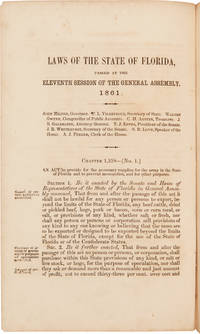
1862réf. 24895Tallahassee: Office of the Floridian & Journal Printed by Dyke & Carlisle 1862. Scarce Confederate Florida laws. Dbd. Tanned. Some light foxing on preliminary leaves. Good. PARRISH & WILLINGHAM 2733. SERVIES 4679. AII FLORIDA 253. unknown
1862réf. 24895Tallahassee: Office of the Floridian & Journal Printed by Dyke & Carlisle 1862. Scarce Confederate Florida laws. Dbd. Tanned. Some light foxing on preliminary leaves. Good. PARRISH & WILLINGHAM 2733. SERVIES 4679. AII FLORIDA 253. unknown books
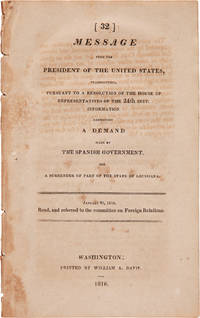
1816réf. 5200Washington. 1816. Prints two letters from Onìs and Monroe's reply in which he complains of expeditions being arranged by Robinson and Toledo against Spanish claims. Onìs also continues his objections to the American seizure of West Florida. Monroe replies that these activities are beyond the jurisdiction of the U.S. and asserts that the cession of Louisiana includes the territory as far west as the Rio Grande. 23pp. Dbd. Tanned and foxed otherwise a good clean copy. HOWES L502. STREETER TEXAS 1060. SERVIES 887. unknown
1816réf. 5200Washington. 1816. Prints two letters from Onìs and Monroe's reply in which he complains of expeditions being arranged by Robinson and Toledo against Spanish claims. Onìs also continues his objections to the American seizure of West Florida. Monroe replies that these activities are beyond the jurisdiction of the U.S. and asserts that the cession of Louisiana includes the territory as far west as the Rio Grande. 23pp. Dbd. Tanned and foxed otherwise a good clean copy. HOWES L502. STREETER TEXAS 1060. SERVIES 887. unknown books
1810réf. 3213311810. unbound. very good. Three newspapers with pieces on the declaration of independence of West Florida. I: The Boston Patriot. Volume IV No. 19. 4 pages measuring 19 x 13-1/2 inches; minor horizontal fold bisecting all pages. Boston: Isaac Munroe November 3 1810. Lightly rubbed with some fading to the masthead but otherwise a clean clear and easily readable -- a very good copy. II: New-England Palladium. Volume 36 No. 48. Friday December 14 1810. 4 pages measuring 21 x 13 inches; minor horizontal fold bisecting all pages lightly toned and foxed but in very good condition. III: Portsmouth Oracle. Volume XXII No. 5. Saturday November 3 1810. Four pages measuring 19 x 13.5 inches. Usual folds with light toning and foxing contemporary ink notation upper margin. A very good copy. The Boston Patriot contains the declaration of independence of West Florida issued issued by John Rea president of the West Florida convention on September 26 1810. The New-England Palladium has public statements from President James Madison Secretary of State Robert Smith John Rhea etc. on the independence of West Florida. The Portsmouth Oracle has two pieces: an account of the seizure of the fort at Baton Rouge signed by Philemon Thomas and John Rhea and the official statement of independence issued and signed by John Rhea and the members of the Convention. West Florida made up of the Florida Parishes of Louisiana declared independence from Spain in September 1810 and was absorbed into the United States by mid December becoming part of the state of Louisiana. unknown
1810réf. 3213311810. unbound. very good. Three newspapers with pieces on the declaration of independence of West Florida. I: The Boston Patriot. Volume IV No. 19. 4 pages measuring 19 x 13-1/2 inches; minor horizontal fold bisecting all pages. Boston: Isaac Munroe November 3 1810. Lightly rubbed with some fading to the masthead but otherwise a clean clear and easily readable -- a very good copy. II: New-England Palladium. Volume 36 No. 48. Friday December 14 1810. 4 pages measuring 21 x 13 inches; minor horizontal fold bisecting all pages lightly toned and foxed but in very good condition. III: Portsmouth Oracle. Volume XXII No. 5. Saturday November 3 1810. Four pages measuring 19 x 13.5 inches. Usual folds with light toning and foxing contemporary ink notation upper margin. A very good copy. The Boston Patriot contains the declaration of independence of West Florida issued issued by John Rea president of the West Florida convention on September 26 1810. The New-England Palladium has public statements from President James Madison Secretary of State Robert Smith John Rhea etc. on the independence of West Florida. The Portsmouth Oracle has two pieces: an account of the seizure of the fort at Baton Rouge signed by Philemon Thomas and John Rhea and the official statement of independence issued and signed by John Rhea and the members of the Convention. West Florida made up of the Florida Parishes of Louisiana declared independence from Spain in September 1810 and was absorbed into the United States by mid December becoming part of the state of Louisiana. unknown books
1879réf. 37868Savannah: Morning News Steam Printing House 1879. 1879. FLORIDA GEORGIA. Sixth edition. 7 1/2" x 5" pictorial wrappers 80 pp. illustrated maps advertisements. A small green slip has been affixed to the title page advising the the Savannah Florida & Western Railway has purchased the Atlantic and Gulf Railroad Company and is now the successor. Folding map is of the Atlantic & Gulf Railroad and shows the lines from Savannah to Bainbridge spur to Albany and connections in Florida from Tallahassee to Baldwin and Jacksonville and to Cedar Key. The booklet describes stations and points of interest in southern Georgia and Florida as well as other railroads towns and points of interest in Florida and southern Georgia. Moderate wear to the spine rear cover becoming loose but still intact covers lightly soiled interior clean else a very good copy. Morning News Steam Printing House, 1879. unknown
réf. DADAX1597896306New unknown
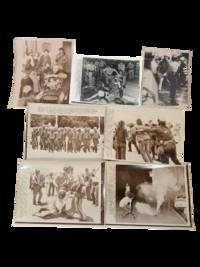
1972réf. 234431972. Florida antiwar protest press archive documenting demonstrations in Miami Beach during the 1972 Republican National Convention when activists targeted President Richard Nixon's renomination after years of bombing troop deployments and stalled peace negotiations in Vietnam. Protesters gathered outside convention sites government buildings and public streets to oppose the war challenge Nixon's reelection campaign and confront the heavy police and military security presence surrounding the convention. Photo archive of 7 Large silver gelatin press photographs each approx 8 x 10" Miami Beach Florida 1972. Military police march toward convention stations carrying riot clubs and wearing helmets and flak suits; demonstrators are pushed back by uniformed personnel; a seated protester is restrained on the grass by police; and tear gas fills a street as a demonstrator crouches near a smoking canister. Additional scenes show antiwar organizers seated indoors with signs reading "Stop the War Now" helmeted police standing over demonstrators in the street and a protester being taken away during a confrontation. Captions identify Miami Beach the Republican National Convention police preparations arrests and disruption threats tied to convention proceedings. The archive records the 1972 convention as a flashpoint in the late Vietnam War when Nixon campaigned on strength abroad while antiwar activists challenged the bombing of North Vietnam the mining of Haiphong Harbor and the continuation of U.S. military policy despite troop withdrawals. Miami Beach became a controlled political theater where nomination ceremonies unfolded behind lines of police National Guard and military personnel while demonstrators used sit-ins marches and street actions to force the war into public view. Press stamps caption slips editorial envelopes and agency markings preserve the photographs as working news files from the confrontation. Light handling wear caption attachments editorial markings toning and minor edge wear. Overall in good condition. unknown
1972réf. 234431972. Florida antiwar protest press archive documenting demonstrations in Miami Beach during the 1972 Republican National Convention when activists targeted President Richard Nixon's renomination after years of bombing troop deployments and stalled peace negotiations in Vietnam. Protesters gathered outside convention sites government buildings and public streets to oppose the war challenge Nixon's reelection campaign and confront the heavy police and military security presence surrounding the convention. Photo archive of 7 Large silver gelatin press photographs each approx 8 x 10" Miami Beach Florida 1972. Military police march toward convention stations carrying riot clubs and wearing helmets and flak suits; demonstrators are pushed back by uniformed personnel; a seated protester is restrained on the grass by police; and tear gas fills a street as a demonstrator crouches near a smoking canister. Additional scenes show antiwar organizers seated indoors with signs reading "Stop the War Now" helmeted police standing over demonstrators in the street and a protester being taken away during a confrontation. Captions identify Miami Beach the Republican National Convention police preparations arrests and disruption threats tied to convention proceedings. The archive records the 1972 convention as a flashpoint in the late Vietnam War when Nixon campaigned on strength abroad while antiwar activists challenged the bombing of North Vietnam the mining of Haiphong Harbor and the continuation of U.S. military policy despite troop withdrawals. Miami Beach became a controlled political theater where nomination ceremonies unfolded behind lines of police National Guard and military personnel while demonstrators used sit-ins marches and street actions to force the war into public view. Press stamps caption slips editorial envelopes and agency markings preserve the photographs as working news files from the confrontation. Light handling wear caption attachments editorial markings toning and minor edge wear. Overall in good condition. unknown books
1910réf. 15233St. Augustness: The Record Company 1910. First Edition. Pamphlet. Near fine. Promotional booklet for Orlando located in Orange County Florida published by The Record Company circa 1910. Oblong octavo 32pp. Publisher's maroon wrappers title printed in gold on cover bound at spine with staples. Sunning to covers staples beginning to rust. A scarce pamphlet showing the local infrastructure farming operations municipal buildings and churches all in half tone illustrations. Illustrations likely by Clarence E. Howard who worked as a photographer and newspaper editor. A reference to the first Automobile Carnival dates this pamphlet prior to 1912. OCLC 882242309 A scarce work. Orlando Florida traces its roots back to the 1830s during a period marked by the Seminole Wars where the U.S. Army built Fort Gatlin south of the present-day Orlando city limits to protect settlers from attacks by Native Americans. By 1840 the area around Fort Gatlin was settled leading to the growth of a small community that by 1856 was known as Jernigan named after the Jernigan family who established the first permanent settlement. The name Orlando was adopted in 1857 though the origin of the name is subject to various legends one of the most popular claims it was named after Orlando Reeves a soldier who allegedly died in the area during the Second Seminole War. The city was officially incorporated in 1875 and by the late 19th century Orlando became a significant hub for Florida's citrus industry. The Record Company unknown
1910réf. 15233St. Augustness: The Record Company 1910. First Edition. Pamphlet. Near fine. Promotional booklet for Orlando located in Orange County Florida published by The Record Company circa 1910. Oblong octavo 32pp. Publisher's maroon wrappers title printed in gold on cover bound at spine with staples. Sunning to covers staples beginning to rust. A scarce pamphlet showing the local infrastructure farming operations municipal buildings and churches all in half tone illustrations. Illustrations likely by Clarence E. Howard who worked as a photographer and newspaper editor. A reference to the first Automobile Carnival dates this pamphlet prior to 1912. OCLC 882242309 A scarce work. Orlando Florida traces its roots back to the 1830s during a period marked by the Seminole Wars where the U.S. Army built Fort Gatlin south of the present-day Orlando city limits to protect settlers from attacks by Native Americans. By 1840 the area around Fort Gatlin was settled leading to the growth of a small community that by 1856 was known as Jernigan named after the Jernigan family who established the first permanent settlement. The name Orlando was adopted in 1857 though the origin of the name is subject to various legends one of the most popular claims it was named after Orlando Reeves a soldier who allegedly died in the area during the Second Seminole War. The city was officially incorporated in 1875 and by the late 19th century Orlando became a significant hub for Florida's citrus industry. The Record Company unknown books
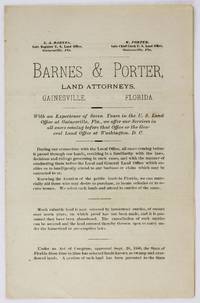
1890réf. 3620Gainesville Fl: Daily Advocate Job Print 1890. Very good. 4pp. on a single folded sheet. Mild soiling minor toning old folds. A seemingly unrecorded real estate promotional leaflet issued by Louis A. Barnes and Watson Porter local land attorneys working in and around Gainesville Florida. The pair is seeking prospective purchasers for "much valuable" homestead lands now available for settlement again after being abandoned "under the homestead or pre-emption laws." They also offer services for claims on "Spanish Grants" land warrants soldiers' homestead rights and more. Interestingly one of the two lawyers here Watson Porter previously served as a surgeon in the Third U.S. Colored Troops. In Florida Porter and his wife Olivia established O.A. Porter's Addition to Gainesville selling lots exclusively to African-American people who did not have ready access to land or financing; the neighborhood survives today in Gainesville as Porters Quarters. Porter also served as the Principal of the Union Academy a freedman's school and was a strong supporter of Josiah T. Walls the only African-American man from Gainesville to be elected and seated twice to the U.S. House of Representatives. Some of the land and services in question in the present pamphlet were almost certainly provided to African-American settlers. The pamphlet was printed by the Gainesville-area Daily Advocate which operated in the area between 1884 and 1890. No copies located in OCLC. Daily Advocate Job Print unknown
1890réf. 3620Gainesville Fl: Daily Advocate Job Print 1890. Very good. 4pp. on a single folded sheet. Mild soiling minor toning old folds. A seemingly unrecorded real estate promotional leaflet issued by Louis A. Barnes and Watson Porter local land attorneys working in and around Gainesville Florida. The pair is seeking prospective purchasers for "much valuable" homestead lands now available for settlement again after being abandoned "under the homestead or pre-emption laws." They also offer services for claims on "Spanish Grants" land warrants soldiers' homestead rights and more. Interestingly one of the two lawyers here Watson Porter previously served as a surgeon in the Third U.S. Colored Troops. In Florida Porter and his wife Olivia established O.A. Porter's Addition to Gainesville selling lots exclusively to African-American people who did not have ready access to land or financing; the neighborhood survives today in Gainesville as Porters Quarters. Porter also served as the Principal of the Union Academy a freedman's school and was a strong supporter of Josiah T. Walls the only African-American man from Gainesville to be elected and seated twice to the U.S. House of Representatives. Some of the land and services in question in the present pamphlet were almost certainly provided to African-American settlers. The pamphlet was printed by the Gainesville-area Daily Advocate which operated in the area between 1884 and 1890. No copies located in OCLC. Daily Advocate Job Print unknown books
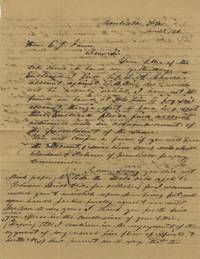
1863réf. BK0082Monticello Florida 1863. Autograph letter signed 2 pp. 7 x 9 inches addressed to the Honorable E. J. Vann Madison Florida. Stampless folded letter with fair circular "MONTICELLO FLA." January 23 datestamp and bold "PAID / 10" handstamp. Back flap removed with a small paper repair at the upper left; otherwise very good. A wartime business letter from James B. Jones of Monticello to E. J. Vann in Madison concerning accounts connected with the estate of D. B. Bird and the collection of local debts. The first portion belongs to the ordinary legal and commercial life of Middle Florida with references to unpaid accounts estate administration and the firms of Denham & Palmer and Johnson Bird & Co. Jones then turns abruptly from bookkeeping to Confederate destiny offering an elaborate blessing. After thanking Vann for his wishes for Jones's health and spirits he writes: "May your shadow become more enlarged and may you live to see the Southern Confederacy one of the most powerful & prosperous nations of the earth . In short may you live to see her Eagle if she even has one with his wings extended with one wing in the Pacific Ocean the other at same time in the Atlantic and his tail in the Gulf of Mexico south of Cuba & at the same time drink from the waters of the Ohio." The letter captures both the routine world of wartime Florida-estate claims merchants lawyers and unpaid accounts-and one Floridian's Confederate imaginary. . unknown
1863réf. BK0082Monticello Florida 1863. Autograph letter signed 2 pp. 7 x 9 inches addressed to the Honorable E. J. Vann Madison Florida. Stampless folded letter with fair circular "MONTICELLO FLA." January 23 datestamp and bold "PAID / 10" handstamp. Back flap removed with a small paper repair at the upper left; otherwise very good. A wartime business letter from James B. Jones of Monticello to E. J. Vann in Madison concerning accounts connected with the estate of D. B. Bird and the collection of local debts. The first portion belongs to the ordinary legal and commercial life of Middle Florida with references to unpaid accounts estate administration and the firms of Denham & Palmer and Johnson Bird & Co. Jones then turns abruptly from bookkeeping to Confederate destiny offering an elaborate blessing. After thanking Vann for his wishes for Jones's health and spirits he writes: "May your shadow become more enlarged and may you live to see the Southern Confederacy one of the most powerful & prosperous nations of the earth . In short may you live to see her Eagle if she even has one with his wings extended with one wing in the Pacific Ocean the other at same time in the Atlantic and his tail in the Gulf of Mexico south of Cuba & at the same time drink from the waters of the Ohio." The letter captures both the routine world of wartime Florida-estate claims merchants lawyers and unpaid accounts-and one Floridian's Confederate imaginary. . unknown books