1994A clean, unmarked book with a tight binding. 248 pages. 8 1/2"w x 11"h. Edge wear to cover with slightly curling corners. Many black and white and color illustrations.
ref. 12711Paris : Editions Contrejour / Kodak, 1989 - grand format toilé sous jaquette illustrée en couleurs, 6 pages de présentation par Yves Berger et tables des photographies - 48 pages de photographies en hors texte en couleurs par Marc Garanger - très bon état -
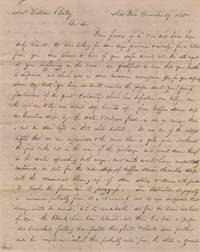
1835ref. BK0025New York City 1835. Autograph letter signed by the merchant firm Baker & Moore 4 pp. addressed to General William Battey care of Dr. Charles Luzenberg at the Franklin Infirmary on the Pontchartrain Railroad New Orleans. Stampless folded letter with red circular "NEW-YORK" December 31 datestamp and manuscript "25" rate. Appx. 1000 words. File folds; otherwise very good. A lengthy commercial letter written thirteen days after the Great Fire of New York describing the destruction of the city's mercantile district and tracing its immediate effects through insurance capital banking commodity prices and trade with New Orleans. Written by the New York firm of Baker & Moore to their associate William Battey the letter provides a near-contemporary account of the fire an assessment of the city's financial resilience and instructions for exploiting the resulting fluctuations in the markets for brandy wine raisins tobacco iron and copper. The fire began on the evening of December 16 during an extraordinary cold spell and northwest gale. Frozen hydrants wells cisterns and hoses left the city's volunteer fire companies largely unable to contain it. By the following day the fire had destroyed much of the commercial district between Wall Street and the East River including the Merchants' Exchange and hundreds of stores and warehouses. Buildings were eventually demolished with gunpowder to create firebreaks at Exchange Place and Coenties Slip. Contemporary estimates varied but approximately 674 buildings were destroyed with losses eventually placed at twenty million dollars or more.1 Baker & Moore begin by describing the extent of the burned district the severe weather and the use of explosives to arrest the flames: "Since my last you have no doubt received the paper sent you giving particulars of the great calamity which has befallen our City. On the 16th our City was about half burned up. From Coffee House Slip to Coenties Slip by the water & William Street is all in ruins. There is but one store left in that whole district. It was one of the coldest nights that we ever experienced & the wind blew a gale from Northwest. The fire broke out in the rear of the Exchange and went down through to the water spreading both ways and would have undoubtedly continued on but for the wide slips of Coffee House & Coenties Slip with the occasional blowing up of some stores & houses with powder to check the flame in its progress" The account quickly turns from the physical destruction to the distribution of its financial losses: "The destruction of property is immense probably from 10 to 15000000$ and it was supposed that many would be ruined but tis remarkable so far we have not heard of one. The Banks have been liberal and there has been a proper and benevolent feeling manifested throughout & should some further aid be brought in which probably will from the State or general government we think there may be no failures. The Insurance companies most of them are ruined and the principal loss is in Insurance capital. The loss will in some instances fall upon those who cannot well afford it. Many widows & orphans have had their all taken from them. The loss is large and New York has met with a great calamity but she is made of such materials & her facilities are so large & varied that the mercantile community will bear up under more than any other place in the Union & we think in one year's time it will be almost forgotten." The confidence expressed here correctly anticipated the city's rapid commercial recovery. Banks and government agencies extended credit and payment terms rebuilding began almost immediately and the burned district was reconstructed with new countinghouses and warehouses. The disaster also exposed the inadequacy of New York's water supply and firefighting arrangements contributing to later infrastructure and institutional reforms. Baker & Moore then apply the disaster to their own trade with New Orleans. Hundreds of warehouses and their contents had been destroyed increasing prices of imported foods wines and spirits. The firm instructs Battey to use the New York price current to obtain higher prices for their consignments: "This fire has advanced most all kinds of goods. Raisins are worth here $3-$3½. Wines such as Mess. Eastman's have advanced with us 4-6 cents. So many hundred casks destroyed must advance it and make it higher through the season. More than one half the Brandy was consumed tis now selling at $1.75 and some are asking $2. We wish what we sent you sold & this will be a favorable time to sell-show N.Y. price current-and get as good a price as you can. There will we think be no want of Brandy. Those raisins we think you had better dispose of at once. We think from N.O. current must pay something handsome for us. In regard to old Iron we find good old iron will always sell for the money for 112½ gross hundred equal to 1c per lb. Cast & wrought are same price. If you can come across a lot to do you may make it answer & pay us well. Copper if you can buy low enough may pay something. We thought hay might pay out but tis so high we cannot buy to send. We are of opinion that goods generally will be higher in consequence of this fire yet when we consign goods we wish them sold when they can to pay and we wish Eastman & Co. to sell and close up our affairs in their hands." The concluding paragraph briefly introduces events in Florida. The Second Seminole War had begun that month following mounting resistance to the forced removal of the Seminole people from Florida. Baker & Moore believed that the conflict might affect the movements of a brig expected in New Orleans: "We observe that trouble is anticipated with the Indians in Florida & if so our Brig may not get a load of them & be in N. Orleans earlier than we anticipated tis uncertain what will be the result they may detain her longer until they can get them on board." The wording appears to indicate that the vessel was expected to transport a group of Native people although the letter does not identify the brig its owners or the precise circumstances of the contemplated voyage. The recipient General William Battey was then in New Orleans apparently acting as Baker & Moore's commercial representative while also attending to his health at the Franklin Infirmary. The firm gave him considerable discretion to supervise consignments collect funds purchase goods when opportunities arose and forward current market information to New York. The address places him in the care of Dr. Charles Aloysius Luzenberg who founded the Franklin Infirmary with municipal support in 1835 and subsequently helped establish the Medical College of Louisiana the forerunner of Tulane's medical school.2 Baker & Moore appear to have been commission or importing merchants whose own affairs escaped direct damage but whose trade was immediately altered by the destruction of competing inventories. The letter thus follows the fire from the burned commercial district into the decisions of a New York firm and its representative in New Orleans. A substantial contemporary account of the Great Fire of 1835 documenting the destruction of New York's commercial center and the disaster's immediate movement through insurance banking commodity markets interregional credit and trade with New Orleans. We find no similar examples on the secondary market or in auction records. 1 Herbert Asbury "The Great Fire of 1835" The New Yorker July 26 1930. 2 Louisiana Historical Association "Luzenberg Charles Aloysius" in Dictionary of Louisiana Biography accessed August 2 2026 https://www.lahistory.org/resources/dictionary-louisiana-biography/dictionary-of-louisiana-biography-l/. . unknown books
1835ref. BK0025New York City 1835. Autograph letter signed by the merchant firm Baker & Moore 4 pp. addressed to General William Battey care of Dr. Charles Luzenberg at the Franklin Infirmary on the Pontchartrain Railroad New Orleans. Stampless folded letter with red circular "NEW-YORK" December 31 datestamp and manuscript "25" rate. Appx. 1000 words. File folds; otherwise very good. A lengthy commercial letter written thirteen days after the Great Fire of New York describing the destruction of the city's mercantile district and tracing its immediate effects through insurance capital banking commodity prices and trade with New Orleans. Written by the New York firm of Baker & Moore to their associate William Battey the letter provides a near-contemporary account of the fire an assessment of the city's financial resilience and instructions for exploiting the resulting fluctuations in the markets for brandy wine raisins tobacco iron and copper. The fire began on the evening of December 16 during an extraordinary cold spell and northwest gale. Frozen hydrants wells cisterns and hoses left the city's volunteer fire companies largely unable to contain it. By the following day the fire had destroyed much of the commercial district between Wall Street and the East River including the Merchants' Exchange and hundreds of stores and warehouses. Buildings were eventually demolished with gunpowder to create firebreaks at Exchange Place and Coenties Slip. Contemporary estimates varied but approximately 674 buildings were destroyed with losses eventually placed at twenty million dollars or more.1 Baker & Moore begin by describing the extent of the burned district the severe weather and the use of explosives to arrest the flames: "Since my last you have no doubt received the paper sent you giving particulars of the great calamity which has befallen our City. On the 16th our City was about half burned up. From Coffee House Slip to Coenties Slip by the water & William Street is all in ruins. There is but one store left in that whole district. It was one of the coldest nights that we ever experienced & the wind blew a gale from Northwest. The fire broke out in the rear of the Exchange and went down through to the water spreading both ways and would have undoubtedly continued on but for the wide slips of Coffee House & Coenties Slip with the occasional blowing up of some stores & houses with powder to check the flame in its progress" The account quickly turns from the physical destruction to the distribution of its financial losses: "The destruction of property is immense probably from 10 to 15000000$ and it was supposed that many would be ruined but tis remarkable so far we have not heard of one. The Banks have been liberal and there has been a proper and benevolent feeling manifested throughout & should some further aid be brought in which probably will from the State or general government we think there may be no failures. The Insurance companies most of them are ruined and the principal loss is in Insurance capital. The loss will in some instances fall upon those who cannot well afford it. Many widows & orphans have had their all taken from them. The loss is large and New York has met with a great calamity but she is made of such materials & her facilities are so large & varied that the mercantile community will bear up under more than any other place in the Union & we think in one year's time it will be almost forgotten." The confidence expressed here correctly anticipated the city's rapid commercial recovery. Banks and government agencies extended credit and payment terms rebuilding began almost immediately and the burned district was reconstructed with new countinghouses and warehouses. The disaster also exposed the inadequacy of New York's water supply and firefighting arrangements contributing to later infrastructure and institutional reforms. Baker & Moore then apply the disaster to their own trade with New Orleans. Hundreds of warehouses and their contents had been destroyed increasing prices of imported foods wines and spirits. The firm instructs Battey to use the New York price current to obtain higher prices for their consignments: "This fire has advanced most all kinds of goods. Raisins are worth here $3-$3½. Wines such as Mess. Eastman's have advanced with us 4-6 cents. So many hundred casks destroyed must advance it and make it higher through the season. More than one half the Brandy was consumed tis now selling at $1.75 and some are asking $2. We wish what we sent you sold & this will be a favorable time to sell-show N.Y. price current-and get as good a price as you can. There will we think be no want of Brandy. Those raisins we think you had better dispose of at once. We think from N.O. current must pay something handsome for us. In regard to old Iron we find good old iron will always sell for the money for 112½ gross hundred equal to 1c per lb. Cast & wrought are same price. If you can come across a lot to do you may make it answer & pay us well. Copper if you can buy low enough may pay something. We thought hay might pay out but tis so high we cannot buy to send. We are of opinion that goods generally will be higher in consequence of this fire yet when we consign goods we wish them sold when they can to pay and we wish Eastman & Co. to sell and close up our affairs in their hands." The concluding paragraph briefly introduces events in Florida. The Second Seminole War had begun that month following mounting resistance to the forced removal of the Seminole people from Florida. Baker & Moore believed that the conflict might affect the movements of a brig expected in New Orleans: "We observe that trouble is anticipated with the Indians in Florida & if so our Brig may not get a load of them & be in N. Orleans earlier than we anticipated tis uncertain what will be the result they may detain her longer until they can get them on board." The wording appears to indicate that the vessel was expected to transport a group of Native people although the letter does not identify the brig its owners or the precise circumstances of the contemplated voyage. The recipient General William Battey was then in New Orleans apparently acting as Baker & Moore's commercial representative while also attending to his health at the Franklin Infirmary. The firm gave him considerable discretion to supervise consignments collect funds purchase goods when opportunities arose and forward current market information to New York. The address places him in the care of Dr. Charles Aloysius Luzenberg who founded the Franklin Infirmary with municipal support in 1835 and subsequently helped establish the Medical College of Louisiana the forerunner of Tulane's medical school.2 Baker & Moore appear to have been commission or importing merchants whose own affairs escaped direct damage but whose trade was immediately altered by the destruction of competing inventories. The letter thus follows the fire from the burned commercial district into the decisions of a New York firm and its representative in New Orleans. A substantial contemporary account of the Great Fire of 1835 documenting the destruction of New York's commercial center and the disaster's immediate movement through insurance banking commodity markets interregional credit and trade with New Orleans. We find no similar examples on the secondary market or in auction records. 1 Herbert Asbury "The Great Fire of 1835" The New Yorker July 26 1930. 2 Louisiana Historical Association "Luzenberg Charles Aloysius" in Dictionary of Louisiana Biography accessed August 2 2026 https://www.lahistory.org/resources/dictionary-louisiana-biography/dictionary-of-louisiana-biography-l/. . unknown
2011Signed on title page by author. Otherwise the book is in mint unread condition. 372pp. Ron Cassidy, a retired vicar in Manchester tells the story of New Orleans in North America with particular emphasis on its music and the jazz of New Orleans.
ref. 016460Albert Delpit (1849-1893), écrivain, né à la Nouvelle-Orléans (USA). L.A.S., Paris, mercredi 28 septembre 1871, 2p in-8. A Théophile Guérin (1823-1875), chimiste, exilé à Guernesey avec Victor Hugo, journaliste au journal La Cloche au moment de ce courrier. « Monsieur et cher confrère, Au sujet des deux feuilletons que j'ai publiés dans La Cloche, M. Ludovic Thierry, ex commandant du 70ème bat. (1.arr.) me fait l'honneur de m'écrire pour me dire que son arrondissement doit être joint à ceux qui ont résisté à la Commune dès le commencement. Je ne mets nullement en doute la conduite de M. Thierry mais je tiens à dire une bonne fois que je n'ai pas eu la prétention de faire une histoire générale, mais simplement raconter les évènements auxquels j'ai été mêlé, par la bonne raison que ce sont les seuls que j'ai vus. C'est encore le meilleur moyen d'être exact. Je dis cela une bonne fois pour prévenir toute autre réclamation de ce genre. Croyez, monsieur et cher confrère à mes sentiments bien dévoués. Albert Delpit ». Intéressant document autour de sa participation à la Commune. [378]
ref. 016461Albert Delpit (1849-1893), écrivain, né à la Nouvelle-Orléans (USA). L.A.S., samedi [ca.1890], 1p in-12. Au compositeur Jules Massenet (1842-1912). « Cher ami, je voudrais vous voir et vous amener mon éminent ami M. de Laveleye qui a besoin de vous parler. A quelle heure nous trouverons vous lundi ? Ou avant onze ou dans l'après-midi quand vous voudrez. Bien vôtre Albert Delpit ». Il s'agit très certainement d'Emile de Laveleye, un économiste et historien belge. [378]
ref. 016462Albert Delpit (1849-1893), écrivain, né à la Nouvelle-Orléans (USA). L.A.S., sd [1887], 1p in-8. A l'écrivain Jules Claretie (1840-1913). Remerciements pour l'envoi de son livre Le Candidat. [378]
ref. 016463Albert Delpit (1849-1893), écrivain, né à la Nouvelle-Orléans (USA). L.A.S., sd [ca.1875], 1p 1/2 in-12. A l'écrivain Jules Claretie (1840-1913). « Mon cher Claretie, Vous trouverez dans les journaux de demain matin le motif de la disparition de Jean-nu-Pieds. Deslandes va me reprendre cet hiver. Voulez-vous expliquer ce qui s'est passé, et me faire une belle sortie, comme vous savez fait une belle entrée ? Je vous l'ai déjà dit, mon cher ami, j'ai bien des défauts, mais j'ai, au moins une qualité : j'ai absolument mes amis : je vous le prouverai, et quand je vous l'aurez prouvé, je serai encore, et toujours, votre obligé et ami A Delpit ». Cette lettre concerne donc sa pièce de théâtre jouée en 1875 que Raymond Deslandes, directeur du théâtre du Vaudeville, aura donc déprogrammée avant, probablement, de la remettre à l'affiche. Cette pièce, tirée de son roman, est basée sur l'histoire de la « Révolte des Nu-pieds » dont le chef Jean Quétil fut surnommé Jean Nu-Pieds. Belle lettre. [378]
ref. 016465Albert Delpit (1849-1893), écrivain, né à la Nouvelle-Orléans (USA). L.A.S., Benfeld, jeudi 1er décembre, 7p 1/2 in-8. Au dramaturge Pierre Berton (1842-1912). Longue et très intéressante lettre dans laquelle on apprend donc qu'il améliorait une pièce de théâtre en tenant compte de l'avis de Berton et de l'acteur Adolphe Dupuis (1824-1891). La lettre de Delpit arrivant tardivement, les modifications proposées sont les mêmes que celles de Dupuis et Delpit en a déjà tenu compte. Il détaille longuement les différentes modifications. Très intéressante lettre sur son travail. [378]
ref. 016860Albert Delpit (1849-1893), écrivain, né à la Nouvelle-Orléans (USA). L.A.S., 1er juin 1892, 1p in-12. Au docteur et écrivain Maurice de Fleury (1860-1931). A propos d'un rendez-vous manqué. [391]
ref. 016861Albert Delpit (1849-1893), écrivain, né à la Nouvelle-Orléans (USA). L.A.S., 29 novembre 1890, 3p in-12. Au docteur et écrivain Maurice de Fleury (1860-1931). Belle lettre autour de son beau-frère, le docteur Félix Guyon (1831-1920). Il critique l'article de Fleury à ce sujet : « ce n'est pas aimable ; c'est même désagréable ». Il ne fera pas d'article sur Guyon et ne lui demandera pas de photo. [391]
ref. 020223Albert Delpit (1849-1893), écrivain, né à la Nouvelle-Orléans (USA). L.A.S., sd, 1p in-12. A Léonce Détroyat (1829-1898), homme politique, journaliste. « Monsieur Détroyat, Vous me feriez infiniment plaisir en reproduisant dans l'Estafette la pièce de vers ci-jointe que je publie aujourd'hui dans la [nom illisible]. Est-ce possible ? Mille remerciements à l'avance. ADelpit ». Document ayant subi l'humidité. [384]
ref. 020224Albert Delpit (1849-1893), écrivain, né à la Nouvelle-Orléans (USA). L.A.S., 6 mai 1890, 1p in-12. A l'écrivain Henry Bocage (1833-1917). « mon cher ami, vous êtes absurde. Personne ne vous lâche dans la commission et tout le monde vous désire ». Il semble être question de l'élection de Bocage à la commission de la Société des Gens de Lettres. Delpit lui donne les noms de personnes prêtes à voter pour lui. « Je m'engage à vous payer 50 cigares si vous échouez ». [384]
ref. 020225Albert Delpit (1849-1893), écrivain, né à la Nouvelle-Orléans (USA). L.A.S., 11 mai 1892, 1p in-12. Au journaliste Adolphe Tabarant (1863-1950), à La Vie Populaire. Il l'autorise à reproduire Le Mariage d'Odette. [384]
ref. 020226Albert Delpit (1849-1893), écrivain, né à la Nouvelle-Orléans (USA). L.A.S., sd, 1p in-8. « Cher ami, est-on content de l'article ? Je vous ai renvoyé des livres pour Geffroy et votre femme. J'ai envoyé idem à M. Lion. Je vous embrase car je vous aime. Albert Delpit ». [384]
ref. 020227Albert Delpit (1849-1893), écrivain, né à la Nouvelle-Orléans (USA). L.A.S., 4 août 1880, 3p in-8. A monsieur Dupuis. Longue lettre amicale, il se propose de passer chez eux, signale que son fils a été malade. « les théâtres chôment : m'est avis que la politique devrait bien en faire autant ». [384]
ref. 020228Albert Delpit (1849-1893), écrivain, né à la Nouvelle-Orléans (USA). L.A.S., ca.1890 [cachet illisible], 1p in-12. A Henri Ferrari, directeur de la Revue bleue. Il signale un changement d'adresse. [384]
ref. 020229Albert Delpit (1849-1893), écrivain, né à la Nouvelle-Orléans (USA). L.A.S., sd [lundi], 2p in-8. Il souhaite causer avec son correspondant « au sujet du budget des beaux-arts » avant de partir dans le midi. [385]
ref. 020230Albert Delpit (1849-1893), écrivain, né à la Nouvelle-Orléans (USA). L.A.S., sd, 1p in-12. « mon cher ami, je te recommande mon ami [Gustave] Toudouze. Il t'apporte un petit volume. Pourrais-tu prier Fournier de lui faire un joli article de bibliographie ? Merci d'avance et crois-moi ton ami ADelpit ». [385]
ref. 020231Albert Delpit (1849-1893), écrivain, né à la Nouvelle-Orléans (USA). L.A.S., sd [jeudi], 1p in-8. Il ne peut déjeuner avec son correspondant le samedi étant déjà invité. [385]
ref. 020232Albert Delpit (1849-1893), écrivain, né à la Nouvelle-Orléans (USA). L.A.S., 18 février 1888, 2p in-8. Lettre amicale signalant qu'il en voulait à son correspondant en septembre mais qu'il a eu tort. [385]
ref. 020234Albert Delpit (1849-1893), écrivain, né à la Nouvelle-Orléans (USA). L.A.S., sd, 1p in-8. Il est malade et ne pourra être là le lendemain. Il demande à son correspondant de prévenir [Léon] Chapron. [385]
ref. 020235Albert Delpit (1849-1893), écrivain, né à la Nouvelle-Orléans (USA). L.A.S., 20 février 1880, 1p in-8. A l'écrivain Edouard Fournier (1819-1880). remerciements pour un article. [386]
ref. 020236Albert Delpit (1849-1893), écrivain, né à la Nouvelle-Orléans (USA). L.A.S., 17 juillet 1881, 4p in-8. A la veuve d'Edouard Fournier (1819-1880). Belle lettre amicale, rappelant amitié pour son défunt mari, la félicitant pour le prix de Rome obtenu par son fils, Louis-Edouard Fournier. [386]