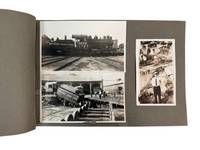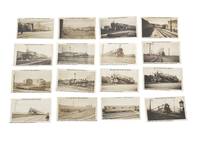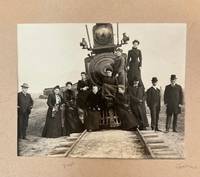
1902Best.-Nr. 236271902. Early twentieth century American travel photograph album with accompanying handwritten identification notes circa 1900 to 1905 documenting the travels of the family of Texas & Pacific Railway official C. G. Warner through the railroad steamship and hotel networks that connected the American Southwest with Europe during the mature era of international leisure travel. The accompanying manuscript key identifies family members railroad scenes buildings and destinations throughout the album transforming anonymous travel photographs into a documented record of an identifiable railroad family. The notes further preserve family tradition explaining that Warner traveled to Europe in 1902 for medical treatment providing a narrative framework that links the railroad photographs Atlantic crossing and European views as a documented journey. Photo album of silver gelatin photographs various sizes most approximately 3.5 x 3.5 inches the largest approximately 6.25 x 8.25 inches United States Europe and Mexico circa 1900 to 1905 accompanied by four pages of handwritten identifications. The opening sequence depicts repeated group portraits posed around Texas & Pacific locomotive no. 21 including women standing on the pilot smokebox running boards and cab additional views of the locomotive in profile railroad employees passenger cars station scenes and the Railroad Young Men's Christian Association building. The handwritten notes identify C. G. Warner in multiple railroad photographs and suggest he served as a director of the Texas & Pacific identify Elizabeth W. Douglass in an early family portrait distinguish mail or express cars identify Warner's private railroad car and name additional family members including Aunt Libbet Anna Warner Clara K. Green Clara Kooser and H. B. Kooser. The journey continues aboard the American Line steamship SS St. Paul including deck scenes crew members harbor views and a large commercial photograph of the liner under way. European photographs include the Arc de Triomphe the Paris Opéra lakeside towns and grand hotels in Switzerland the Palace of Westminster and Big Ben in London streetscapes waterfronts public gardens and prominent civic buildings. Family members appear throughout in formal portraiture seaside recreation hotel grounds and informal gatherings while additional photographs record Juárez Mexico and substantial American residences photographed before departure. The handwritten notes record that C. G. Warner Aunt Juliett and Aunt Libbet sailed on April 2 1902 returning on June 3 after spending most of their journey in France with a shorter stay in England and state that Warner traveled abroad because of poor health to "take the baths." The notes further preserve family recollection that contemporary newspapers reported Warner "derived much benefit from two months' rest" before spending time in the Gould offices upon his return to New York placing the photographs within a documented episode in the life of a named railroad executive rather than an anonymous vacation. Viewed alongside the photographs the manuscript identifications establish people places transportation infrastructure and chronology substantially strengthening the documentary character of the album. Red stained leather album with black pasted decoration; pages 7 and 9 loose binding heavily worn album leaves toned photographs clear and firmly adhered. Overall in good condition. A documented visual record of one American railroad family's movement through the interconnected rail steamship and hotel systems that carried affluent travelers between Texas New York Mexico and Europe at the beginning of the twentieth century. unknown books
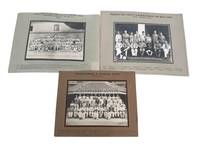
1930Best.-Nr. 236621930. British Indian railway and military administrative staff photo archive circa 1930s to 1943 documenting the trained Indian clerical instructional stores and supervisory personnel who operated institutions central to colonial transportation and wartime logistics. The principal photograph depicts the instructional and clerical staff of the Railway Training School at Bina the first Area School established by the Great Indian Peninsula Railway which operated there from 1926 until its transfer to Bhusawal in 1962. The two dated portraits extend this administrative record to the Rawalpindi Arsenal in 1942-43 and the Cantonment Board at Ambala in 1941 placing railway education beside military supply and cantonment government during the Second World War. Photo archive of 3 Large silver gelatin photographs mounted on cardstock Each Photographer boards measure 12 x 16 inches and Photograph 8½ x 11 inches Bina Rawalpindi and Ambala India circa early 1940s. The Bina portrait identifies approximately sixty members of the "Instructional & clerical staff R.T.S. Bina" posed in six rows before a tiled railway building bearing the sign "The Railway Training School." A second photograph captioned "Clerical staff including Stores Branch of Rawalpindi Arsenal" records employees photographed at the departure of S. Avtar Singh in 1942-43; a printed roster identifies staff by row and includes many locals. The third photograph records a farewell to Lieutenant Colonel G. Leslie-Mold president of the Cantonment Board at Ambala on April 25 1941 with British military officers and Indian civilian officials identified beneath the image. Leslie-Mold later served as Assistant Adjutant General and Director of Personnel Services at Army Headquarters in India. Railway schools developed as the expanding colonial network required standardized instruction in traffic control station procedure accounting freight handling signaling and the clerical routines through which trains goods and personnel were coordinated across long distances. Railways allowed the British administration to move troops rapidly supply cantonments and arsenals connect agricultural and mineral districts with ports and impose common schedules and bureaucratic procedures across the colony; they also created a large Indian technical and clerical workforce whose knowledge kept the system operating. The portraits record this institutional hierarchy with European officers occupying senior positions while Indian instructors accountants clerks store employees and subordinate officials form the numerical body of each organization. Surface wear toning rubbed edges corner losses and occasional marks to the mounts; photographs remain generally clear and well defined. Overall in good condition. A concentrated visual record of the Indian personnel who sustained railway instruction military provisioning and cantonment administration within the transport and defense infrastructure of late British rule. unknown books
1924Best.-Nr. 236771924. California railroad and industrial development photo album documenting Southern Pacific workers locomotives rail yards derailments logging settlements and expanding cities in 1924 when rail transport remained the principal link between the state's resource districts agricultural regions ports and urban markets. The album follows railway personnel through working landscapes and recreational stops connecting industrial infrastructure with the lives of the people who operated and traveled through it. A view of the recently completed Angelus Temple in Los Angeles extends this record into the rapidly developing metropolitan landscape served by the railroad. Photo album containing more than 150 silver gelatin photographs most 2.5" x 3.25" mounted in a cord bound album measuring approximately 7" x 11" California 1924. The photographs show Southern Pacific Lines steam locomotives numbered 1209 and 2193 engine crews posed on running boards and beside tenders workers seated on railway equipment tracks crossing forested districts and trains moving through mountain and coastal terrain. One identifiable building records the Angelus Temple soon after its 1923 completion in Echo Park. Several images document wrecked or derailed freight cars lying beside damaged track including cars numbered 666 and 699 with cranes workers and nearby industrial buildings recording the labor of clearance and recovery. Other views show rail yards clustered industrial towns timber country rough wooden buildings urban skylines waterfronts farms automobiles and residents posed outside houses or along the right of way. Personal photographs follow men and women swimming fishing hiking and standing beside rivers lakes mountain formations and snow covered peaks presenting leisure as an extension of railway mobility. A signed portrait inscribed "Sincerely yours Thos. Barkley" appears near the front of the album. Southern Pacific inherited and expanded routes developed by the Central Pacific and California and Oregon railroads building a network that joined Los Angeles and the Bay Area with agricultural valleys timber districts mountain passes and northern markets. The Shasta Route completed during the nineteenth century and extensively improved in the early twentieth formed one part of this system and shaped the economic development of California and Oregon by moving freight and passengers through the interior West. The album's logging settlements and industrial sidings show how rail access converted timber farm products and mineral resources into commodities that could reach urban processing centers and distant markets while its wreck photographs expose the mechanical risks underlying that circulation. Some images loose scattered wear fading creasing and occasional staining; most images retain clear detail. Overall in very good condition. A photo album showcasing how Southern Pacific transportation connected California's extraction sites industrial towns natural landscapes and growing metropolitan centers. unknown books
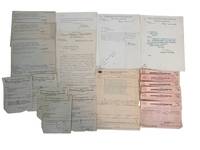
1902Best.-Nr. 238621902. Choctaw and Chickasaw railroad land and mineral acquisition archive documenting the movement of tribal property into corporate railroad control through right of way compensation land company administration and federally supervised purchases. The papers connect the Choctaw Oklahoma & Gulf Railroad Company and the Chicago Rock Island & Pacific Railway Company with the Choctaw Land Company the Rock Island Coal Mining Company and the United States Indian Service. Recorded transactions include $558.50 in compensation to the Choctaw Nation for 11.17 miles of right of way and a $526073.50 purchase of coal deposits from the Choctaw and Chickasaw Nations. Choctaw Oklahoma & Gulf Railroad Company; Chicago Rock Island & Pacific Railway Company; United States Indian Service. Railroad land and mineral acquisition records. Chicago Little Rock Muskogee and El Reno 1902 to 1920. Twenty one documents comprising one construction voucher three corporate letters seven temporary receipts and tract cards six official Indian Service receipts and three corporat e payment orders. 1 Undated Choctaw Oklahoma & Gulf Railroad construction voucher on a form printed July 24 1898 made to Ethan Allen Hitchcock Secretary of the Interior recording $558.50 as compensation to the Choctaw Nation for 11.17 miles of right of way from Howe Indian Territory to the Arkansas boundary under the Act of February 18 1888. 2 C. H. Warren to R. A. Jackson September 3 1902 asking Jackson to revise the officers of a land company organized in Arkansas and naming Holden as secretary and treasurer Jilson as vice president and Crosby as president. 3 C. H. Warren to R. A. Jackson September 23 1902 approving the corporation provided its powers are broad enough to permit "leasing and mortgaging as well as to buy and sell." 4 J. W. McLoud to R. A. Jackson October 9 1902 two sheets discussing proposed minutes for the Choctaw Land Company deeds from the Choctaw & Memphis Railroad Company to J. Parke Hood property already sold and the filing of articles of incorporation and a certificate of organization with the Arkansas secretary of state. 5 Seven temporary receipts and tract cards 1918 and 1919 issued by the Office of the Superintendent for the Five Civilized Tribes: nos. 180 183 185 191 192 and 197 itemize McAlester and Howe Poteau District tracts by number acreage price per acre total purchase price improvements and amount paid; a cashier's temporary receipt dated November 25 1919 acknowledges $14817.46 from the Chicago Rock Island & Pacific Railway as the second installment on surface lands purchased in the Choctaw Nation. 6 Six United States Indian Service official receipts 1918 to 1920: no. 14803 records $12500.03 from the Choctaw Oklahoma & Gulf Railroad Company as a twenty percent deposit on surface and improvements in the McAlester and Howe Poteau districts; no. 15938 records $105214.70 for identified coal tracts; no. 16400 acknowledges $2985.80 from the Rock Island Coal Mining Company for reserved lands; nos. 40325 and 40326 acknowledge payments of $2650.60 for town lots and $109057.60 for coal deposits; and no. 63004 records $82854.51 as a partial payment for coal and asphalt deposits. 7 Three Chicago Rock Island & Pacific Railway corporate payment orders November and December 1919 calculating second installments on $62085.20 in surface lands $12810 in town lots and $526073.50 in coal deposits purchased from the Choctaw and Chickasaw Nations with five percent interest overpayment adjustments and advanced royalty credits. The construction voucher records the railroad's initial statutory passage through Choctaw territory while the 1902 letters show corporate attorneys defining the Choctaw Land Company's authority over deeds sales leases and mortgages. The later papers document the federal machinery used to transfer surface property and mineral deposits: tract numbers acreage prices initial deposits annual installments five percent interest overpayments and royalty credits pass between railroad accounting offices and the Superintendent for the Five Civilized Tribes. The coal payment orders closely follow the visible terms of the 1918 sale including a twenty percent purchase installment and interest on deferred payments. Expected folds and handling wear; several receipts and tract cards have edge tears or small losses; the construction voucher is separated along horizontal folds with additional marginal loss. Overall fair to good condition. A transaction level record of railroad access to Choctaw land and the subsequent corporate purchase of surface property town lots coal and asphalt associated with the Choctaw and Chickasaw Nations. unknown books
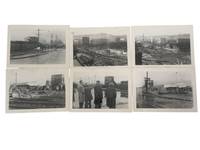
1948Best.-Nr. 232471948. Seattle freight yard fire photo archive documenting the destruction and emergency aftermath of a rail served maritime industrial site in 1948. The photographs center a burned yard associated with the American Hawaiian Steamship Company a major intercoastal carrier that linked Pacific ports with Atlantic and Gulf Coast trade and maintained a substantial presence on Seattle's waterfront during the first half of the twentieth century. Rather than isolating a single ruined structure the group shows the working system around it: street access fire response rail lines lumber storage cargo handling space and the industrial buildings that tied Seattle's urban growth to port commerce. Photo archive of 6 black and white photographs each 3" x 4.5" Seattle Washington studio stamp en verso dated December 4 1948. The images show a broad debris field of charred timbers collapsed framing burned posts pooled water and smoke rising across a freight yard crossed by railroad tracks. Two views prominently include the sign for American Hawaiian S.S. Co. while another visible sign reads Keystone Steel & Wire Company placing the site within Seattle's maritime industrial district. One street view shows fire hoses snaking across wet pavement toward the still smoking yard and another frames a group of men in long overcoats and hats standing at the edge of the destruction surveying the scene. Utility poles warehouse buildings sidings stacked material and the hillside cityscape beyond the yard anchor the fire within a dense industrial section of Seattle shaped by port traffic and rail distribution. Seattle's maritime industry shaped the city from its earliest waterfront settlement into a major Pacific port where rail lines piers warehouses and steamship companies made Elliott Bay the engine of urban growth and commercial expansion. Minor edgewear and curling. Overall very good condition. These photographs preserve a short concentrated record of emergency aftermath on a working Pacific Coast waterfront at the start of the postwar shipping era when Seattle remained a major junction of rail and ocean transport and steamship firms still occupied prominent waterfront facilities. unknown books
1932Best.-Nr. 233221932. Trains and RailroadsUrbanization Nickel Plate Road photo archive documenting steam rail systems across New York and the Midwest with additional views of New York City subway yard and NYC Board of Transportation activity 1932-36. The photographs center the cross-country operation of the New York Chicago and St. Louis Railroad commonly known as the Nickel Plate Road with images showing freight trains leaving yards switchers handling cars passenger service enginehouse scenes and terminals. All stamped with dates between 1932 and 1936 and the imprint of photographer Cameron Blaikie of Englewood NJ with come bearing handwritten ink caption indicating copy recipients. The group records Midwestern mainline railroading and New York's subway system at a time when steam power electrified transit and large repair yards were essential American industrial and urban circulation. Photo archive of 16 silver gelatin photographs 2.5 x 4 inches Ohio Indiana and New York City1932-36 Twelve photographs are captioned for the New York Chicago & St. Louis Railroad or New York Chicago & Saint Louis Railroad and include a "Nickel Plate Limited westbound leaving Hammond Ind." a "Northbound freight train leaving yard at South Lima Ohio" an eastbound freight near Hammond a "Six-coupled 0-6-0 type locomotive switching cars at Lima Ohio" a "Six-coupled 0-6-0 type switcher Toledo Ohio" a "Six-coupled 0-6-0 type locomotive converted from 2-8-0 in yard at Toledo Ohio" "Mikado 2-8-2 type locomotive at South Lima Ohio enginehouse" and a "4-6-4 type locomotive." The captions identify both location and function distinguishing switching yard departure enginehouse activity locomotive class and passenger movement. Four photographs are captioned "City of New York N.Y. Board of Transportation" and show the Eighth Avenue subway system at 207th Street including "Shops and storage yard of the Eighth Ave. subway system Independent system at 207th Street" "Train entering 207th St. yard from tunnel" a broad terminal view described as "56 tracks wide not all in picture" and a work car "equipped with spools of electric cable which is attached to 3rd rail shoes of cars entering shop" an unusually specific record of shop procedure and third rail handling. Across the group recurring visual elements include multiple parallel tracks telegraph poles signals towers service buildings freight consists subway cars and engines shown in motion or in work settings rather than static display. The New York Chicago and St. Louis Railroad served as a major Midwestern carrier linking Buffalo Chicago St. Louis and intermediate industrial centers and these photographs fix that system at the level of daily operation through named trains locomotive classes yards and service points in Lima South Lima Toledo and Hammond. The Board of Transportation views extend that operational focus into New York's municipally run transit network where the Independent Subway's 207th Street facility handled car storage repair and electrical shop work on a large scale. Light surface wear mild curling and minor corner and edge wear; captions clear and photographs clean. The archive gives railroad labor and urban infrastructure collections a compact but sharply captioned record of how steam railroading and electrified rapid transit functioned in practice. unknown books
1896Best.-Nr. 234211896. TransportationIndustrial Disasters Atlantic City railroad disaster photo archive likely documenting the July 30 1896 collision west of Atlantic City New Jersey one of the deadliest American railroad accidents of the 1890s. The wreck occurred when a West Jersey Railroad excursion train carrying members of the Improved Order of Red Men fraternal organization from Bridgeton and Salem crossed the Reading Railroad line and was struck by a Philadelphia express crushing loaded passenger coaches and leaving dozens dead and injured. The local Atlantic City photographer's stamp the beach and pier crowd the open rail junction the smashed wooden coachwork and the dense public gathering around the debris all support identification with the Atlantic City disaster rather than a more inland wreck. Photo archive of 4 albumen photographs each approx 7.5 x 8 inches mounted on boards measuring approximately 10 x 12 inches Atlantic City New Jersey likely 1896. At the wreck site men in suits caps work clothes and shirt sleeves stand among splintered timbers exposed wheel assemblies broken coach framing twisted metal and scattered railroad debris. A damaged passenger car remains partly upright with its roof torn open and side panels crushed while another wreck scene includes telegraph poles parallel tracks a railroad signal and a wide crowd gathered across the right of way. Workers and onlookers climb over the wreckage stand on overturned components and cluster around the remains of the coaches giving the scenes the character of both recovery work and public witnessing. The fourth view shows the community Atlantic City's shore economy with men women and children gathered along the beach and crowded across a pier many in formal summer dress hats and parasols. Verso stamp reads: "W. Crompton & Co. 132 N. South Carolina Ave. Atlantic City N.J. Duplicates can be furnished at Short Notice." By the 1890s Atlantic City had become a major East Coast resort town and railroad access was central to its growth; the same excursion system that filled its beaches also concentrated large numbers of passengers in wooden cars vulnerable to catastrophic collision. The presence of a local commercial photographer's stamp is significant indicating that these disaster scenes circulated as purchasable local views for an audience already accustomed to buying Atlantic City souvenirs. Mounts toned and soiled prints faded with some loss of contrast scattered surface wear and staining to mounts one with slight loss at upper right corner; overall in good condition. The archive preserves the immediate aftermath wreckage and response to a major Atlantic City disaster in the late 19th century. unknown books
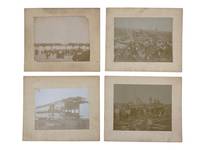
1893Best.-Nr. 234551893. Boston and Albany Railroad disaster photo archive documenting the catastrophic 1893 bridge collapse at Chester Massachusetts when the westbound Chicago Limited Express crashed through an iron bridge spanning the Westfield River. The wreck occurred on August 31 1893 after the bridge failed beneath the weight of the train sending locomotives and passenger cars into the river gorge below. Fourteen people were killed and dozens injured in a disaster that drew national newspaper attention during a period when American railroads were rapidly expanding passenger service while struggling with aging infrastructure and increasing locomotive weight. Photo archive of 4 albumen photographs mounted on original boards each 8" x 10" Chester Massachusetts August 31 1893. The images show passenger coaches twisted into the collapsed bridge structure tracks hanging above shattered timbers and the locomotive overturned amid splintered debris along the riverbank. One view centers on a heavily damaged passenger car resting beside broken rails while groups of men stand surveying the destruction. Another records the locomotive and tender surrounded by wreckage and recovery workers gathered along the track bed. Smoke rises above the debris field in one scene while telegraph poles hillsides and the river valley remain visible in the background situating the wreck within the narrow western Massachusetts rail corridor. Pencil inscriptions along the mounts identify "Chester" with date "Aug. 31st 1893." The Chester wreck became one of several highly publicized railroad disasters of the late nineteenth century that intensified scrutiny of bridge engineering inspection standards and railroad safety during the peak era of American passenger rail expansion. By the 1890s express trains such as the Chicago Limited linked eastern industrial centers to the Midwest with unprecedented speed but the increased weight of modern locomotives placed enormous strain on bridges originally designed for lighter rolling stock. These photographs preserve not only the violence of the collapse itself but also the physical reality of nineteenth-century rail disaster recovery when wreckage removal body recovery and public investigation unfolded directly at the crash site. Light toning scattered surface wear and minor mount wear consistent with age; images remain clear and detailed. Overall in very good condition. unknown books
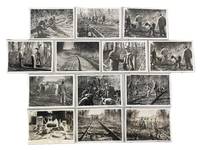
1960Best.-Nr. 233391960. Railroad labor photo archive documenting manual track rehabilitation work on a rural rail line likely Minnesota circa 1960s during the period when thousands of miles of lightly used American branch line track were being abandoned salvaged or transferred into preservation and excursion use. The scenes illustrate the broader contraction of regional rail service that accelerated after World War II as trucking highway construction and changing freight patterns undermined small-line profitability. Crews work directly on deteriorated rails and ties using pry bars hammers jacks buckets and lining tools recording the physical labor required to maintain secondary rail infrastructure before mechanized maintenance became dominant on many smaller lines. Several scenes suggest volunteer or preservation-oriented work rather than standard commercial railroad maintenance including the mixed-age crew casual work clothing and informal group arrangements. Notations identify John L. Blamey on two images possibly referring to a Minnesota photographer of the same name. Photo archive of 12 black and white Kodak prints each 5 x 7 inches likely silver gelatin photographs Minnesota circa 1960s. Workers stand along heavily worn track in wooded rural terrain while replacing ties aligning rails clearing ballast and fastening hardware by hand. A rail maintenance vehicle and small rail equipment appear in the distance in several scenes while other views isolate long stretches of neglected track curving through leaf-covered corridors. Younger participants in denim overalls work alongside older men in railroad caps and heavy work jackets suggesting a collaborative rehabilitation effort rather than a fully standardized railroad gang. Buckets oil cans pry bars spikes and timber ties are positioned directly along the right-of-way emphasizing the improvised and labor-intensive character of the work. One scene captures two men driving spikes while kneeling beside exposed ties; another shows a larger crew spread across the rails with tools arranged in parallel lines along the track bed. Several prints bear manuscript identification to "John L. Blamey." One still life of dining utensils and tableware appears within the group perhaps a meal shared by the group or an image retained from the same processing batch. By the 1960s many Midwestern branch lines faced abandonment as railroads consolidated operations and shifted investment toward higher-volume freight corridors. Across states such as Minnesota Wisconsin and Iowa local historical societies preservation groups and volunteer railroad organizations increasingly intervened to salvage depots rolling stock and short rail segments before removal. These scenes preserve the transition period when maintaining even a short stretch of track still depended upon coordinated hand labor and inherited railroad knowledge. No loss or wear noted; prints clean and sharply detailed. Overall in very good to near fine condition. unknown books
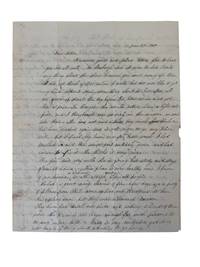
1850Best.-Nr. 235001850. Slavery & Abolition Underground Railroad Fugitive Slave Signed letter mentioning threats of arson against an abolitionist community in Pennsylvania 1850. Lancaster stood on a volatile antislavery route in 1850 with fugitives moving west toward Columbia and the Susquehanna River while pro slavery men targeted communities accused of sheltering escapees. Mary Louisa Harbaugh the young wife of Rev. Henry Harbaugh of the German Reformed Church wrote to her mother that "a party of fellows from Phil. came up here and threatened to burn this place down" and that residents had kept watch after "a great many alarms of fire." Lancaster was the home of Thaddeus Stevens the lawyer and future Radical Republican congressman who defended fugitives and attacked slavery in public life. Columbia eleven miles west had a large free Black population and served as a crossing point for people escaping slavery before and after the Fugitive Slave Act of 1850. Harbaugh M. L. Autograph Letter Signed. Lancaster Pennsylvania June 15 1850. Three manuscript pages plus stampless address leaf addressed to her mother Mrs. Margaret A. Linn Lewisburg Pennsylvania. Harbaugh reports household matters children's clothing local health and the arson threat in one domestic letter writing that the city was "very healthy" except for "a few old people" before describing the men from Philadelphia who threatened to burn Lancaster. The address leaf preserves the Lewisburg destination manuscript postal markings and remains of the original red wax seal. The part concerning the arsonists reads as follows: "Dear Mother .This place is very healthy now. I know of no disease or sickness at all except among a few old people. We had a great many alarms of fire a few days ago a party of fellows from Phil. came up here and threatened to burn this place down but they were discovered too soon. They have had a watch out since and nothing is heard of them now. The place is not large enough for such persons to do any injury to it." Mary Louisa Harbaugh's husband Rev. Henry Harbaugh was a prominent German Reformed minister and writer who avoided public antislavery controversy while her family in Lewisburg was connected to abolitionist politics through her father's break with the Democratic Party for James G. Birney's Free Soil candidacy. Local newspapers such as the June 19 1850 issue of The Lancaster Examiner and Herald reportedly attributed the fire as "no doubt the work of incendiaries as two men were seen running from the Cooper Shop just as the alarm was given" in which they made their escape. It was reported that a young black man by the name of "Gilmore" was arrested and imprisoned on suspicion but was released the next day for insufficient evidence. Other newspapers reportedly minimized the incident without attribution to racial tension all while Columbia suffered a fire that destroyed nine houses and the offices of the Columbia Spy. Folded as mailed with light toning minor edge wear one small seal tear and clean legible manuscript throughout. Overall very good condition. unknown books
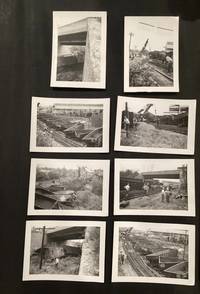
1959Best.-Nr. 235191959. Erie Railroad accident recovery photo archive depicting a freight train derailment at Newburg Yard on August 10 1959 most likely in the Cleveland Ohio Newburg or Newburgh industrial district. Newburg was an old industrial section of southeast Cleveland tied to railroads steel works and freight switching with the former Atlantic & Great Western later Erie running through the area. The location identification is strengthened by the yard name Erie equipment industrial overpass setting and the known Cleveland use of Newburg or Newburgh in railroad and steel district geography. The wreck occurred one year before the Erie Railroad merged with the Delaware Lackawanna & Western Railroad in 1960 placing the scene near the end of the independent Erie era. Photo archive of 8 silver gelatin photographs approximately snapshot to small-format prints Newburg Yard August 10 1959. Freight cars sit overturned and jackknifed across multiple yard tracks with Pennsylvania and Erie-marked cars visible among the wreckage. A crane works beside the damaged cars while railroad men stand along the ballast on the embankment and under a bridge or overpass watching the clearance operation from trackside. Several views show the same derailment from elevated and ground-level positions including a crushed cab or caboose area tipped hopper cars tangled rails scattered debris and crews working near the crane boom. Verso captions repeat "Aug. 10-1959" "Newburg Yard" "Walczak Cond." "Lyons Bachman" and "Kompura" with faint "Kodak Velox Paper" stamps on the backs. Railroad yard accidents in the 1950s were handled before modern centralized emergency-management practice relying on railroad wreck crews cranes section men conductors brakemen and yard personnel to reopen tracks quickly so freight could move. The repeated captions naming the conductor brakemen and additional crew members give the group stronger labor value than an anonymous wreck scene tying the damaged rolling stock to the men responsible for the train and its aftermath. Light curling handling wear minor creasing and light verso soiling; overall in good condition. The archive preserves a dated Erie Railroad freight accident with named crew visible wreck-clearance work and a probable Cleveland Ohio Newburg Yard setting. unknown books
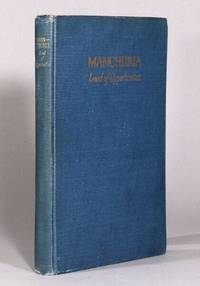
1924Best.-Nr. 71397New York: South Manchuria Railway Company 1924. Revised edition 8vo pp. ix 1 98 2; color folding map 60 pages of plates; publisher's blue cloth gilt title on upper cover and spine; hinges cracked a touch of foxing very good. The South Manchuria Railway Company was founded and managed by the Japanese government and served as sort of imperial representative of the colonial project in China. They published many books aimed at a western audience touting the success of this project. From the preface: "The record of this achievement in colonial enterprise is here set forth in facts and figures with a careful avoidance of debatable questions of international politics. South Manchuria Railway Company unknown books
1925Best.-Nr. 95101Ryuzan Chosen: Chosen Railways 1925. Very Good. single sheet folded several times to produce a 12 panel brochure on one side and a map of Heijo with a smaller map of Shingishu-Antung and various small 18 black and white photos around the edge on the other side. 19 x 9 cm. when folded and 38 x 44 cm. when fully unfolded. Text in English. Back cover of folded brochure heavily scuffed and lacking some of the text which briefly described hotels under the management of S.M.R. -- this damage probably occurred when this scarce item was "rescued" from an album or scrapbook. One of the photos surrounding the map shows the Railway bridge built by the Japanese 1909-1911 over the Yalu River between what is now Dandong on the Chinese side and Sinuiju in North Korea. Heij then a modest-sized city is known today as Pyongyang and is the capital of North Korea with a population of more than three million. Chosen Railways was under control of South Manchuria Railway between 1917 and 1925. Chosen Railways unknown books
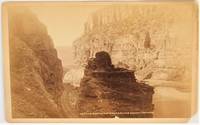
1886Best.-Nr. 189521886. Colorado Photography Western Americana Original albumen photograph of a Glenwood Canyon rock formation identified as the Portals in Garfield County Colorado. The scenery is presented as "840. The Portals of Grand River Canon. D&R.G.RR" on the lower margin. 1886. 7" x 4.5". Presents a captivating view of a Glenwood Canyon's vast sedimentary rocks housing the path of the Denver and Rio Grande Western Railroad. Notable American Photographer William Henry Jackson captures a serene moment as the Colorado sunlight beams onto one section of the canyon. In the foreground he captures a glimpse of the Denver and Rio Grande Western Railroad adjacent to the Colorado River. An official photography stamp reads "W.H. Jackson & Co. Photographers of Rocky Mountain Scenery Denver Colorado." on the verso. William Henry Jackson established established a studio in Denver Colorado and produced a huge inventory of national and international views. He incorporated himself as W.H. Jackson Photograph and Publishing Company in 1883. Missing part of bottom right corner not affecting text or photo. In very good condition. unknown books
Best.-Nr. 19198African American Two Trains Running play by August Wilson the sixth in his ten-part series The Pittsburgh Cycle. The play takes place in Civil Rights era 1968 in the Hill District an African-American neighborhood in Pittsburgh Pen. August Wilson depict a black urban class struggle in America and the play's dialog spotlights 1960 Black American Culture. Vintage original poster Los Angeles. Poster size 22 x 14″ The poster artwork was by Jeffrey Smith. The poster features artwork depicting Browne Fishburne and Chisholme.The main charachters are shown on the poster : Wolf Anthony Chisholm the numbers runner; Sterling Larry Fishburne a Young Turk fresh out of prison; Hambone Sullivan Walker the mentally troubled and Holloway Roscoe Lee Browne the cafe's philosopher.There were a few regional performances of the play including one at the Ahmanson at the Doolittle in Los Angeles. It ran only January 16 through March 291992 and was directed by Lloyd Richards who also directed the plays Broadway debut. Laurence Fishburne won a Tony Award for "Outstanding Actor in a Play" for his portrayal of Sterling and can be seen in the for front row of the poster. Very good condition and matted and Framed. unknown books
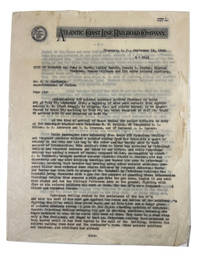
1944Best.-Nr. 929931944. Good. Letter dated September 13 1946. 28 cm. Carbon copy on thin Atlantic Coast Line Railroad Company letterhead stationery. Substantial chipping around edges no loss of text on first leaf. Our unnamed Captain of Police reports on an incident which began when around 200 African American soldiers were changing trains. Local police arrested two of the soldiers for intoxication and took them to the local Police Station. When police returned to the railroad station they found six of the soldiers assaulting two military policemen and intervened to help the MPs using the butt end of a riot gun to break up the fight. When a large number of other soldiers came to join the fight they were stopped at gunpoint by the local policemen with assistance from the MPs and military officers. The African American soldiers marched in formation to local Police Headquarters where 133 soldiers were charged with disorderly conduct and five others differently charged. Almost all pleaded not guilty but all were found guilty the next day and remained in jail another night until their fines were paid -- $17 each for the 133 soldiers and up to $100 for the five who were differently charged. All 138 soldiers were then marched back the the train station and departed. One wonders how accurately the incident was described to our unnamed Captain by those he interviewed. There is nothing in his letter to suggest that he interviewed any of the African American soldiers. unknown books
1986Best.-Nr. 59711Pistoia Italy: Breda Railway Group n.d. 1986. Small folio. Promotional packet for Breda containing 9 mostly tri-fold leaflets in both Italian and English most with 8 panels of text color illustration and diagrams on high-quality coated paper and all contained in a black portfolio and original mailing envelope. Fine. Among the titles included are: Il Pendolare: Train for Rapid Commuter Transportation; Milan Subway: Light Alloy Electric Rapid Transit Cars for Public Subway Transport; Rapid Transit Car; Light Rail Vehicles for Cleveland U.S.A.; Metro Roma / Rome Subway; Ferrovie Nord Milano: Electric Railcar for Commuter Service together with several others. Breda Railway Group, n.d. unknown books
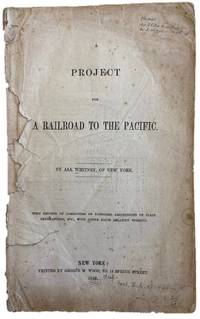
1849Best.-Nr. 176531849. Whitney Asa. A Project for a Railroad to the Pacific 1849 a programmatic proposal that advances one of the earliest sustained arguments for a transcontinental railroad linking the Atlantic and Pacific coasts of the United States. Written at a moment when westward expansion intensified following the Mexican American War and the acquisition of western territories Whitney's text outlines a national infrastructure project intended to facilitate settlement commerce and political integration across the continent. The pamphlet engages federal authority directly assembling legislative materials and appeals designed to secure congressional support for a railroad that would redefine transportation migration and territorial control. Whitney Asa. A Project for a Railroad to the Pacific. New York: George W. Wood 1849. Pamphlet. The work includes appended reports of committees of Congress and resolutions from state legislatures presenting Whitney's plan alongside official responses and debates concerning feasibility land grants and national interest. The proposal details a continuous rail route to the Pacific and reflects early efforts to translate expansionist vision into coordinated federal policy. Contemporary associations with later governmental surveys and planning efforts including those supported by Secretary of War Jefferson Davis in the 1850s situate Whitney's publication within the evolving political contest over routes funding and the sectional implications of western development. Issued prior to the construction of the transcontinental railroad in 1869 Whitney's proposal belongs to a formative phase in which infrastructure planning intersected with broader questions of national expansion economic development and the extension of political power into new territories. Debates over the railroad's route and sponsorship were closely tied to sectional conflict including disputes over whether new regions would permit or restrict slavery giving such proposals significance beyond transportation alone. Title page chipped with library stamp at lower margin; two maps not present; otherwise complete text with expected wear. Overall good condition. unknown books
1870Best.-Nr. 58937Dublin: Midland Great Western Railway of Ireland n.d. 1870. Unaccomplished pro-forma folio broadside approx. 13¾" x 8¾" on gray paper; fine. Pro-forma contract for the purchase of rails and fish plates with blanks left for tons of rails date terms signature and date. "To be delivered free on any part of the wharves of the Royal Canal Docks at Dublin that may be pointed out by the engineer or into lighters in the docks at his option . With the rails sufficient fish plates ared provided . the rails and fish plates are to correspond accurately with the annexed drawings" not present. Unlocated. Midland Great Western Railway of Ireland, n.d. unknown books
1914Best.-Nr. 171371914. Photo album California Vernacular Photo album of travels and vacations filled with 256 images from around California. 1914-1920. Original cloth boards. 11.5 x 15.5 in. "Photographs" in gilt on front cover. 256 original silver gelatin print photographs of various size from 2 ½ x 2 ½ inches to 5 ½ x 3 ½ inches. Family photo album with images from up and down the California coastline. Captions and handwritten annotations throughout album. Numerous photographs from well-known locations in San Francisco including Golden Gate Park Land's End and images from the Marina District in 1915 when the Panama-Pacific International Exposition was being held in the city. View of the 19th century battleship USS Oregon seen from San Francisco. Images labeled from Sacramento include the Capital dome Capital Park and the California State Railroad Museum and locomotive C.P. Huntington. Other locations noted from around California include Redwood City Bakersfield and Placerville. There are also photographs of the group camping in the Santa Cruz Mountains picnicking at the beach and playing in the Pacific Ocean. There are numerous rural scenes showing farm work and livestock such as horses cattle and donkeys. A photo of a rural baseball game in which the players stand in a wide field with a drawbridge in the background. Numerous photographs of outdoor activities such as camping fishing and hiking. Many photos removed from later pages. Some captions faded. In very good condition. unknown books
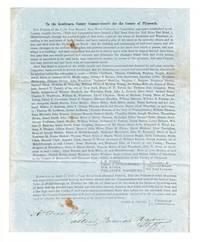
1847Best.-Nr. 57241Plymouth: April 17 1847. Broadside letter approx. 10¾" x 8" on blue paper signed in type by the Committee of the CCBRR J. B. Tobey Thos. J. Coggeshall Wm. Bates and Philander Washburn and also by Josiah Smith as Chairman of C. Commissioners. Signed in ink at the bottom: "A true copy / attest Branch Harlow / Shff." Petition requesting the commissioners to adjudicate damages caused to landowners from a proposed road from Middleborough through parts of Rochester and Wareham listing the names of about 100 interested parties. The petition was apparently successful: a 15 mile line was opened by the company between Middleborough and Wareham in 1848 and extended another 13 miles to Sandwich the same year. The Cape Cod Branch subsequently merged with the Old Colony and Newport Railway to form the Old Colony Railroad in 1872. Not in OCLC. April 17 unknown books
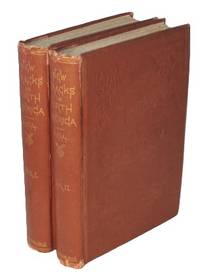
1869Best.-Nr. 162891869. Bell William. New Tracks in North America. 1869 stands as a primary narrative of post-Civil War railroad expansion and scientific exploration in the American West written by a British physician who joined General William J. Palmer's Kansas Pacific Railway survey expedition of 1868-1869. Traveling from St. Louis across Colorado New Mexico Arizona and toward southern California Bell served informally as expedition physician and photographer while documenting landscapes Indigenous communities geological formations and the logistical challenges of surveying a southern transcontinental route. Published the year the first transcontinental railroad was completed Bell's account situates railroad construction within imperial science commercial speculation and settler expansion. Part II contains an extended section titled "The Native Races of New Mexico" in which Bell interprets archaeological ruins and architectural remains in an effort to trace the migration of Indigenous peoples in the Southwest reflecting nineteenth-century ethnographic and antiquarian methodologies. His narrative links infrastructure development to territorial incorporation and resource assessment at a decisive moment in western consolidation. Bell William. New Tracks in North America. London: Chapman and Hall 1869. First edition. Two volumes: Vol. I pp. lxv 236; Vol. II pp. vii 322. Complete with 20 colored lithograph plates 3 botanical plates woodcuts in the text a colored folding map and a colored plate with three small maps. The folding map depicts the trans-Mississippi West beyond the 100th meridian and south of the 42nd parallel extending into northern Mexico above the 26th parallel employing differentiated coloration to indicate elevation. Original cloth retained recased with new endpapers. Vol. I with a few pencil markings one plate repaired on the verso and one page with corner loss affecting several characters; Vol. II clean and sound. Bell's expeditionary account appeared at the height of railroad-financed town founding and mineral speculation. Following the survey Bell and Palmer became associated in railroad enterprise and regional development including ventures that contributed to the founding of Colorado Springs and expansion of rail infrastructure in central Colorado. The work combines travel narrative scientific observation cartography and ethnographic description offering insight into how rail corridors structured federal land policy Indigenous displacement and commercial migration. Light wear consistent with recasing; plates and folding map present; minor defects as noted; overall good to very good condition. A substantial illustrated first edition documenting the surveying phase of southern transcontinental railroad expansion and its intertwined scientific and colonial ambitions. unknown books
1832Best.-Nr. 55449Boston: J. E. Hinckley and Co 1832. First edition 8vo pp. 87 1; uncut and stitched as issued; tables in the text; without the folding map and lithograph plan as called for in some OCLC listings; contemporary annotations at the back in Acts of Incorporation; very good. Includes a geological memoir of the area between Massachusetts and Narragansett Bays. American Imprints 11443. J. E. Hinckley and Co unknown books
1909Best.-Nr. 85268New York: n.p. 1909. Paperback. Very Good. 4 photos in the 1907 report 27 27 27p. Softcovers in original wrapper. 26 cm. Later string ties. Business card for Jose Merla Manager of Royal "M. C." Lines laid in one of the reports. n.p. paperback books
1900Best.-Nr. 51798Chicago: Curt Teich & Co. for the Van Noy Inter-State Co 1900. Oblong 4to unpaginated; 25 full-pg illustrations in color and mounted two pages of text containing illustration descriptions; tan pictorial wrappers lettered in black & gilt color illustration mounted on upper cover ribbon-bound; covers a bit toned at edges corners creased illustrations clean & bright overall very good. A picturesque view-book of "the most interesting views seen along the route" of Utah Nevada and California. Curt Teich & Co. for the Van Noy Inter-State Co unknown books