56 788 résultats
1992réf. 88491London: Bristol Classic Press 1992. First UK edition. 214 pp w/index of writers. Fine in near fine dust jacket with some sunning to spine. Translated from the original Russian by Angela Livingstone with her introduction and notes. From the collection of Nathaniel Tarn with his bookplate inside the front cover and his occasional pencil marginalia. London: Bristol Classic Press unknown books
réf. vot830Community Communications Inc. Ronald P. Beers 2001. Quarto gray cloth hardcover silver letters 160 pp. Fine in a Fine dust jacket. From dust jacket: Not your ordinary Florida Gainesville is an extraordinary fusion of cutting-edge technology and Deep South traditions a city where pristine woodlands give way to enchanting bayous and cool clean springs a city where the antique homes and shops of old Florida coexist with new suburban communities. It is a place that people of all ages and walks of life are proud to call “home.” Gainesville is also home to the University of Florida some of the finest museums and theaters in the state and an exceptional number of innovative businesses and organizations. The city’s high-tech and biotech firms stand on the forefront of research and discovery. The result is an extraordinary quality of life for the people who live here a constantly renewed and energized dynamic between the economy and the people. Gainesville: Alive with Opportunity features the breathtaking color photography of Ray Carson and contributing photographer Randy Batista. It is a visual journey through the city’s seasons its festivals and events its neighborhoods and nearby communities and its landmarks and attractions. Seasoned journalist and Gainesville Sun columnist Marina Blomberg illuminates the images with concise captions many of which are filled with fascinating often surprising facts. Completing the picture of Gainesville is a section of profiles showcasing the city’s businesses hospitals universities and other institutions and organizations. These engaging profiles written by Terry Van Nortwick capture the pulse of this sophisticated city and provide a valuable research tool for anyone interested in exploring the city’s businesses. hardcover books
réf. 1vot486Pensacola Bay Flying Machines Ltd. Co. 2014. Signed and inscribed by the Author. Octavo softbound stiff photo. illus. blue wrappers x 244 pp. Fine. From lower cover: Celebrate the centennial of powered flight with the achievements of Pensacola’s own early aviators! On December 17 1903 Orville and Wilbur Wright launched into history with the first powered controlled and sustained flight of an aeroplane. On November 30 1911 Pensacola witnessed her own first successful aeroplane flight beginning over 90 yeas of near-continuous aviation achievements and adventures over the Gulf Coast that continue to this day. Learn about the 1909 “Rhodes Aeroplane” flight attempt for Fort Barrancas; the 1911 “Nassr Aeroplane” flight attempt from Kupfrian’s Park; the 1911 “Curtiss-Mills Pusher” flight from Palmetto Beach; Pensacola’s first civilian landing field; the birth of the “Cradle of Naval Aviation” and “Annapolis of the Air”; Pensacola’s and Florida’s first aviation-related death; early aviation records set in Pensacola; Medals of Honor awarded for aviation actions in Pensacola; Charles Lindbergh’s connection with Pensacola; Pensacola’s lighter-than-air achievements; visiting barnstomers flying circuses and airtours; Pensacola’s aviation mysteries tragedies and oddities. paperback books
1987réf. 85025NY: Dutton 1987. First US edition. 108 pp w/notes & index. Fine in glossy illustrated wrappers. Translations from the original Russian by Elaine Feinstein with her introduction. Literal versions provided by Angela Livingstone Simon Franklin Valentina Coe Vera Traill Jana Howlett and Bernard Comrie. NY: Dutton unknown books
1944réf. 51104Washington DC: Bureau of Ships Navy Dept 1944. United States. Navy Department. Bureau of Ships. Radar system fundamentals NAVSHIPS 900 017. Washington DC: Bureau of Ships Navy Dept. 1944. VI 394pp. 235 x 150 mm. Library stamp to front wrapper. Confidential classification status. Stamp of the "Inspector of Naval Material" to the last page. Very good. First Edition. "There are some activities of the United States Navy . employing relatively few navy personnel which are almost unknown to civilians and only vaguely understood by most officers and men of the Navy. This is the Naval Inspection Service" Manning G.C. "The Navy Material Inspection Service" Proceedings 62402: 1143-1155 August 1936. Accessed online 27 June 2023. 51104. Bureau of Ships, Navy Dept unknown books
1977réf. 79682London: Weidenfeld & Nicolson 1977. First edition. 250 pp. Some light soiling to page edges else near fine in very near fine dust jacket. Previous owner has inked “CORRECTION: p4” on the front free endpaper and crossed out “London Review of Books” and added “The Albion Review” to the margin. London: Weidenfeld & Nicolson unknown books
1988réf. 79681London: Chatto & Windus 1988. First edition. 277 pp. Pages toned cheap paper else near fine in near fine dust jacket. London: Chatto & Windus unknown books
1998réf. 78589London: Chatto & Windus 1998. First edition. xii 435 pp w/index. Fine in fine dust jacket. London: Chatto & Windus unknown books
1987réf. 75828Newcastle Upon Tyne: Bloodaxe 1987. First edition US issue. 160 pp. Very near fine in glossy illustrated wrappers. Translations from the original Russian by David McDuff. US distributor sticker affixed to the title page. Dufour Editions review slip and promotional flyer laid in. Newcastle Upon Tyne: Bloodaxe unknown books
1983réf. 75830London: Virago 1983. First UK edition. 524 pp w/index. Light crease to one lower corner of the front cover else near fine in illustrated wrappers with a paperclip mark to the first two leaves from holding a review slip in place. Edited and translated from the original Russian by J. Marin King. Seven page introduction by Susan Sontag. Review slip from the US distributor of this title laid in. London: Virago unknown books
1977réf. 61678Tucson: Grilled Flowers 1977. First edition numbered & signed issue. 28 pp. Very near fine in sewn wrappers. One of 25 numbered copies SIGNED by Rivera. Her first book a collection of twelve poems. Grilled Flowers Special Issue Series Number Two. [Tucson]: Grilled Flowers unknown books
1970réf. 9538gcsArlington Virginia: Office of Naval Research - Department of the NAvy 1970. ACR-184. Large octavo blue cloth hardcover gilt letters ix 612 pp. Several check-marks next to offered courses; otherwise Fine. Office of Naval Research - Department of the NAvy, 1970. ACR-184. hardcover books
1823réf. 9537gcsDahlgren Virginia: Naval Surface Weapons Center 1981. NSWC MP 82-334. Large octavo burgundy cloth hardcover gilt letters xiii 1101 pp. Corner cut neatly from ffep.; otherwise Fine. Naval Surface Weapons Center, 1981. NSWC MP 82-334. hardcover books
1971réf. 5793fdWashington DC: Department of the Navy United States of America 1971. Six parts in one volume. Octavo navy blue faux leather gilt letters and decoration to spine pictorial endpapers xxvii 42 118 170 152 134 477 pp. Very Good with light rubing to endpapers slight toning age darkening to interior. Department of the Navy, United States of America, 1971. hardcover books
1968réf. 3067qsKingston Rhode Island: University of Rhode Island July 1968. Octavo paperbound stiff illus. green wrappers 118 pp. Good with title inked to spine and sticker to upper cover. University of Rhode Island, July, 1968. unknown books
1979réf. 14089kmsNew York: St. Martin’s Press 1979. First Edition Review Copy. Quarto blue leatherette hardcover gilt letters vii 152 pp. Good with soiling to page edges neat former-owner stamps former-owners published review pasted to rear endpaper in a Near-Fine dust jacket. From jacket: Over a quarter of the world’s surface is arid or semi-arid and there are fears that this total may increase sharply as the result of climatic change and growing pressures from an expanding and hungry world population. Urgent needs have led man himself to contribute alarmingly to the continuous depletion of the stock of usable lands through unconsidered exploitation: fertile areas are degrading rapidly and marginal ones are turning into deserts. This timely book shows how the threats to such fragile territories can be arrested controlled and reversed through the careful management of dry-land ecosystems. It examines the characteristics of arid and semi-arid environments throughout the world and describes the kinds of vegetation they are able to support. Drawing thier lessons from nature the authors show how indiginous vegetation can be used to create developments which are self-sustaining in the long run based on an apporach that works with nature rather than against it. They set out in great detail the techniques that are involved from the preliminary survey of climate topography soils and water through the analysis of the existing ecosystem to the planning of developments with plants and regimes of irrigation plant propagation and management of soil water vegeation and human settlements. St. Martin’s Press, (1979). First Edition, Review Copy. hardcover books
1980réf. 12920Santa Monica CA:Momentum Press 1980. First edition. Near fine in wrappers. Publisher’s name and address written on half-title. Santa Monica, CA:Momentum Press, unknown books
1981réf. 29715Berkeley: Kelsey St. Press 1981. First edition. 55 pp. Some sunning to spine else very near fine in wrappers. Language poet Ron Silliman's ownership signature on the front free end page. A very early Kelsey St. book. Both sections of the book--'Grammars' and 'Cropped Sets'--are composed of sequences of prose poems hovering somewhere between the genres of the journal fiction and essay an aesthetic strongly suggestive of San Francisco's New Narrative writers. Berkeley: Kelsey St. Press unknown books
1851réf. 69961Charleston SC: A. J. Burke Printer 1851. First edition. 8vo. 31 pp. Turnbull III p. 136. OCLC locates seven copies Duke Spartanburg County Public South Carolina Historical Society South Carolina New York Historical Society Clements Princeton Theological. Original printed self-wrappers stitched. Very good. A. J. Burke, Printer unknown books
réf. 70024The letters and documents include orders to move ships and provide aid to a blockade runner personnel matters transfers promotions repairing and outfitting ships reporting on the dead and wounded from the "Atlanta" and other matters. All of the material is more fully described below generally in chronological order starting with the earliest piece for each individual. Some storage wear and soiling but a very good lot. TATTNALL Captain and Flag Officer Josiah 1795-1871; commanded Southern naval units in defense of Port Royal S.C. in 1861 the defense of Virginia's waters in 1862 and naval forces of Georgia 1862-1863. Appointing Lt. Arthur Sinclair Fleet Captain of the Savannah Squadron giving instructions for communicating with the Commandant's Office and calling for economy in a manuscript copy of a letter signed clerically for "Flag Officer Comdg Tattnall" by Tattnall's clerk C. Lucian Jones on "Confederate States Navy Station / Commandant's Office / Savannah" letterhead February 26 1863. This copy noted as "sent to the Commander of vessels . the Comdg Officer Str Isondiga" at the time Lt. Joel S. Kennard. 4to. Two-pages approximately 150 words in part: "In addition to your duty as Commander of the Atlanta you will also perform that of Fleet Captain and will as such take charge of the general duties of the Squadron being guided by my general and such other orders as I may issue from tie to time." Sinclair 1810-1865 commanded the "Atlanta" February - May 1863 by which time both he and Tattnall were relieved of command for various failures Lt. William Webb being appointed to fill there posts see his entry below. 1 WEBB Lieutenant and Flag Officer William A. 1824-1881; commended for his actions commanding the "Teaser" in the Battle of Hampton Roads March 1862; commanded a secret squadron of small boats outfitted with spar torpedoes in Charleston Harbor in 1862-1863; commanded the "Atlanta" and the Savannah Squadron. Giving instructions for conduct in various areas to his junior officers in an autograph letter and three letters each signed by Webb as commander of the "Atlanta" and Savannah Squadron Commander May 13 - June 9 1863 to Lt. Commander Joel S. Kennard see below commanding the "Isondiga" in Webb's squadron shortly after taking command. 4to. 4-pages. The first letter asks from a "complete muster roll" of the "Isondiga's" officers and crew the other three being "General orders No. 3" prohibiting boats from going "below Thunderbolt" five miles south of Savannah "without the officers being well armed" the final two offering directions for having repairs to the Isondiga taken care of and giving instructions on the construction of pennants to fly. Accompanied by a manuscript "General Order No. 4" clerically signed by now "Secretary" Jones June 3 1863 from Webb to Kennard both "Off Thunderbolt." Folio. Two-pages approximately 200 words in part: "All vessels under my command will keep a strict look out night and day and will bring to all boats and vessels not belonging to or employed by the Army of Navy . no boat or vessel will be allowed to pass unless their passport is signed by the Comdg Genl . the guard vessel for the day will have the grand flag flying and will have a boat ready for boarding . a correct register of all vessels brought to will be kept . all commanders will inspect quarterly for condition of each vessel . with respect to the completeness of her equipment and the proper stationing of her crew." Webb's Savannah command was short lived he attempted to break the Union blockade by engaging with two Monitors patrolling Wassaw Sound on June 17 but the "Atlanta" ran aground forcing Webb to surrender under withering fire that severely damaged the ship killing one and wounding 16 crew members Webb not being able to repeat his Hampton Roads performance being captured and sent to prison in Boston for a year. 5 KENNARD Lt. Commander Joel S. 1819-1901; commanded the "Isondiga" in the Savannah Flotilla 1862-1864. Complaining of being passed over for Savannah Squadron command for a more junior officer William A. Webb and asking for a transfer in an autograph letter signed by Kennard from the C.S Str "Isondiga" on the Savannah River May 9 1863 to Stephen R. Mallory Confederate Secretary of the Navy in Richmond. 4to. Two-pages approximately 175 words in part: "I cannot help feeling that I am fully as much entitled to advancement as Mr. Webb . nor is it my intention to boast any great display of gallantry during this war but Sir there is such a thing as a proper self esteem . as far as I know or can learn of Mr. Webb's career mine will not suffer by comparison . if it be possible to obtain command of any one of the vessels said to be in course of construction in Europe I would gladly accept it." Accompanied by five autograph letters signed by Kennard June 23 - March 6 1864 the first to three "Isondiga" junior officers concerning a supply problem with their signed manuscript reply and accounting sheet three to Flag Officer William W. Hunter see below concerning "Isondiga" personnel repairs and charges of drunkenness against an engineer signed manuscript charges included here and the last to Savannah Paymaster D.C. Seymour concerning pay for his crew members. Also accompanied by a letter from the Savannah paymaster to Kennard forwarding instruction not present for "Isondiga's" assistant paymaster written June 17 1863 the day of "Atlanta's" defeat and Webb's capture. 10 KENNARD. Forwarding information from the "Atlanta" debacle in a manuscript letter left unsigned perhaps a retained copy from Kennard on the "Isondiga" Savannah River June 26 1863 nine days after the engagement to Stephen R. Mallory Confederate Secretary of War. 4to. Two-pages approximately 200 words in part: "Letters have been received by parties in the City from two of the officers and one of the crew of the 'Atlanta' prisoners of war at the time of writing in Port Royal S.C. . the third letter is from one of the crew by the name of Moore. After mentioning the casualties this man Moore states particulars of the engagement. A summary of which is that two of the enemy's fifteen inch shot passed through the port side of the Atlanta hull disabling two gun crews that a third shattered the Pilot house; that she got aground and that being thus unable to bring any of her guns to bear upon the Enemy the ship was surrendered." Two of "Atlanta's" officers reported slightly different numbers of casualties but one mentioned one dead and 16 wounded among them several named officers. 6 HUNTER Commander William W. 1803-1892; commanded Confederate vessels protecting Gulf of Mexico ports 1861-1863; commanded the Savannah Squadron 1863-1864. Ordering the discharge of a sailor the movements of the "Isondiga" and inspecting munitions in a series of four autograph letters and orders signed by Hunter as "Flag Officer Commanding Afloat" February 5 - March 19 1864 from Savannah to Lt. Commander Kennard aboard the "Isondiga." 4to half-sheet 4to and a slip 2 x 7 ¾ inches approximately 250 words total. Accompanied by an autograph order marked at its head "Confidential" signed by Hunter to Kennard March 4 1864 forwarding a letter present here but actually a clerical copy docketed verso and signed by Hunter also marked by him "Confidential" from Brig. Gen. H.W. Mercer commanding army troops in Savannah at the time to Hunter the same day explaining that a Confederate steamer with "a most important cargo of Army stores is expected nightly and requesting that Hunter and his vessels keep an eye out to assist any attack by Union ships; Hunter's order to Kennard advises "you will further object therein stated by every means in your power." Following the destruction of the "Atlanta" and capture of the Savannah Squadron's commander William Webb on June 17 1863 Kennard was named squadron commander pro tem until Hunter arrived from the Gulf to take command later than year a post he held until Sherman drove Confederate Forces from the Savannah area in December 1864. So for a bit more than a year Hunter and his flotilla helped hold Savannah but without the "Atlanta" he had no hope of breaking the blockade or otherwise diminishing the Union's naval superiority. Webb made his name at the Battle of Hampton Roads March 8-9 1862 commanding the gunboat CSS "Teaser." As part of the Confederate flotilla attempting to break the Union blockade it offered cover fire for the newly construction ironclad "Virginia" formerly the Merrimac as it engaged the USS "Cumberland" on the first day; after sinking that ship and forcing the "Congress" to surrender though it was also sunk when shore batteries fired on the Confederate vessels sailing to accept the surrender the "Merrimac" appeared to be heading for a victory. The appearance of the Monitor the following day changed the scene however and the two sides fought to a standstill. Webb and the "Teaser" again performed superbly and wounded Webb won the "thanks" of the Confederate Congress. Michael Reese in his Autographs of the Confederacy writes of Webb "commander of the C.S. 'Teaser' a gunboat in the James River Squadron that fought with distinction at Hampton Roads . a rare signature." We found one sale of a Webb letter similar to the four offered here Alexandria Historical Auctions February 9 2021 $1100. Files of Confederate naval manuscripts as offered here are very scarce in trade this is the first we have offered in our 45 years of selling Civil War material and the first we've seen. unknown books
1864réf. 63452Richmond VA 1864. 4to one-page on blue paper the text in full: "In compliance with your request I have the honor to transmit herewith copy of my letter to the Hon. W. Porcher Miles on the subject of the torpedo boats"; with a "Rebel Archives" stamp on verso. Chambliss 1809-1875; Sussex County Virginia plantation owner and member of the Confederate House of Representatives 1862-1865 was a member of the house Naval Affairs committee and William Porcher Miles 1822-1899; Mayor of Charleston South Carolina 1855-1857 U.S. House of Representatives 1857-1860 Confederate House of Representatives 1862-1865 was chairman of the house Military Affairs committee. This letter was written several months after the Confederacy's first torpedo boat the David made its initial attack against the Union ship New Ironsides in Charleston Harbor 5 October 1863 and two months before its second against the USS Memphis 6 March 1864. After two failed attempts at a sortie in 1863 losing 13 crew members in the process the Hunley became the first torpedo boat to actually sink a war vessel successfully completing its mission against the USS Housatonic in Charleston Harbor on February 17 1864. Very good Mallory's signature strong and black. Folded. 10187. unknown books
1910réf. 52132Washington DC: Press of Shaw Bros 1910. First edition. 8vo. 46 pp. Illustrated portrait. Inscribed to John H. Hunter by "the author". Scarce; the NUC locates only three copiesDLC ViU NcD only microfilm editions found on OCLC. Not in Nevins or Broadfoot. Original printed wrappers spine eroded. Press of Shaw Bros unknown books
1901réf. 50496Washington DC: Byron S. Adams printer 1901. First edition. 8vo. 38 pp. At head of front wrapper: Completed Brief prepared by "Herbert & Micou attorneys". Continuing the argument for Port Royal as the better site. Not recorded on OCLC. Original printed green wrappers sunned some wear at extremities; Franklin Institute stamp else very good. Byron S. Adams, printer unknown books
2011réf. UFIOGLA00ajsSt. Martin's Griffin 2011. Fine. Fiorato Marina. The Glassblower of Murano. NY: St. Martin's Griffin 2011. 348pp. 8vo. Paperback. Book condition: Near fine. St. Martin's Griffin paperback books
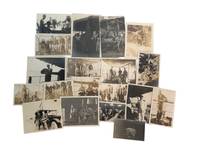
1917réf. 238881917. U.S. Navy Mexican Patrol photo archive documenting natural history provisioning and wartime shipboard life aboard USS Rainier during World War I. Associated with Lieutenant junior grade Dr. Louis Henry Clerf the vessel's medical officer the photographs record fish a large shark a deer and a dog alongside the daily routines of sailors living and working aboard a small Pacific Fleet auxiliary. Fishing appears as food procurement recreation collective labor and an occasion for observing and photographing marine life. A Black U.S. Navy sailor appears prominently among the men handling and displaying the catches while the vessel's mounted cannon rigging machinery and naval uniforms establish the military setting behind these scenes of everyday life. Photo archive of 19 silver gelatin photographs most measuring 3.5 x 4.5 inches aboard USS Rainier and associated Pacific coastal locations circa 1917 to 1919. Sailors pose with large fish suspended from lines display individual catches clean fish across the deck and gather around food beneath canvas awnings. One photograph records a large shark surrounded by sailors while others show a sailor displaying a substantial fish and groups gathered around the preparation of the catch. A dog appears at a shipboard table and a deer stands tethered beside machinery and piping bringing animals directly into the vessel's working and social spaces. One photograph prominently shows a Black sailor with the fishing catch while other images record officers and enlisted men in white and dark naval dress gathered on deck or beside an automobile ashore. Rigging winches railings mechanical equipment canvas awnings and a mounted cannon recur throughout locating the fishing meals and informal gatherings within the confined operational environment of an armed naval vessel. Built at Portland in 1917 as the civilian schooner Patrol and subsequently known as Angel Rainier was acquired by the Navy and commissioned at Mare Island on July 30 1917 then assigned to Division 2 Pacific Fleet and Mexican Patrol duty. Navy records document the acquisition of small vessels for Mexican patrol service during 1917 and the continuing patrol of Mexican waters during the war. A separate larger group of photographs from the same Louis Henry Clerf Rainier corpus provides corroborating evidence for his photographic association with the vessel and for the broader range of animal and environmental subjects he recorded during its service; that separate group is not included in the present 19 photographs. The photographs offered here remain focused on the immediate life of the Navy crew where catches move from sea to deck to preparation and communal use while the shark deer and dog record the animals brought into the sailors' working environment. The Black sailor's presence provides direct visual evidence of Black naval service within this wartime crew while the cannon and working machinery keep these scenes firmly connected to the vessel's military function. Light surface wear scattered fading and toning and occasional edge and corner wear; images remain generally clear and legible. Overall in very good condition. A concentrated visual record of natural history Black naval service provisioning recreation and wartime life aboard USS Rainier during the Mexican Patrol. unknown books