56,825 results
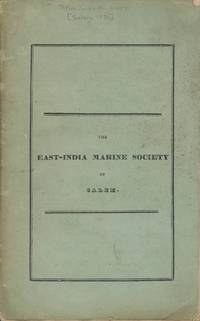
1831ref. BK0165Salem Massachusetts: Salem Press Palfray Ives Foote & Brown 1831. 78 pp. 8vo. Original printed wrappers. Wrappers frayed at spine; light dampstaining at margins of a portion of the leaves at rear. Good. An early catalogue of the collections of the East-India Marine Society of Salem recording the maritime journals and objects gathered by Salem captains and merchants during the city's great period of overseas trade. Founded in 1799 by captains and supercargoes who had sailed beyond the Cape of Good Hope or Cape Horn the Society required its members to contribute to a cabinet of "natural and artificial curiosities" the collection from which the present Peabody Essex Museum developed. The Society moved the collection into the newly built East India Marine Hall in 1825 and this expanded catalogue appeared only six years later. The volume includes the Society's act of incorporation bylaws lists of members and officers a catalogue of its manuscript journals of voyages and an extensive catalogue of the museum. The voyage journals occupy pages 33-42 and document Salem voyages to ports throughout Asia and the Indian Ocean; the balance of the catalogue records the ethnographic natural-history and other objects brought home by the Society's members. This was a substantially enlarged successor to the Society's 1821 catalogue which ran to 100 pages; the 1831 edition extends to 178 pages and was followed by a further supplement in 1837. A national bibliography of American library catalogues records copies of the 1831 edition at only a small group of institutional collections.1 1 Robert Singerman American Library Book Catalogues 1801-1874: A National Bibliography Graduate School of Library and Information Science University of Illinois at Urbana-Champaign 1996 94. . Salem Press, Palfray, Ives, Foote & Brown unknown books
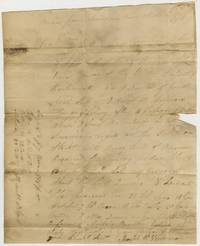
1799ref. BK0195Surinam River 1799. Autograph letter signed one page on a folded sheet with integral address panel to Moses Brown of Newburyport Massachusetts. 7 ½ x 9 inches. Old folds scattered soiling and minor losses and splitting along folds. Good. A firsthand account of the embargo on American shipping at Surinam during the Quasi-War with France written by Captain Joseph H. Woodman to the Newburyport merchant and shipowner Moses Brown. Woodman had arrived at Surinam on February 27 finding "an Embargo on all American Vessels and the Market Stock'd with every kind of American Produce." Writing a month later he reports plans to depart with "a fleet of 75 Sail of American Vessels Under Convoy of the United States Ship Portsmouth and a Number of private Arm'd Ships." Despite the crowded market Woodman reports selling his outward cargo and purchasing a return shipment of sugar molasses cocoa coffee and cotton. He also discusses remittances to Brown whose extensive commercial interests in the West Indies and South America are documented in surviving correspondence at Harvard's Baker Library.1 A contemporary account reproduced in Naval Documents Related to the Quasi-War Between the United States and France confirms that American vessels were embargoed at Surinam from February 3 to March 25 1799 and independently records their departure under convoy of the USS Portsmouth commanded by Daniel McNeill.2 Woodman's letter was written the following day providing a contemporary merchant captain's account of the disruption and the American naval protection organized in response. 1 Moses Brown papers Baker Library Harvard Business School accessed October 12 2026 https://hollisarchives.lib.harvard.edu/catalog/bak00105. 2 Naval Documents related to the Quasi-War between the United States and France Vol. II part 3 United States Government Printing Office 1935 588. . unknown books
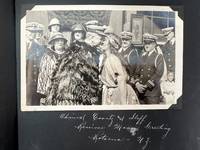
1925ref. 239961925. U.S. Navy Pacific fleet cruise photo album documenting naval service and Indigenous encounters during Admiral Robert E. Coontz's 1925 deployment to Australia and New Zealand. The inscription "Property of J. J. Prieskop. U.S.S. Seattle band" identifies its owner as a musician associated with the fleet flagship. Following major exercises in Hawaiian waters the fleet crossed the Pacific for a voyage combining naval training with public receptions and a demonstration of American maritime reach. www.history.navy.mil At Rotorua Te Arawa hosts welcomed the visiting officers at Ohinemutu where speeches and exchanges of gifts connected MÄori hospitality with hopes for closer British-American friendship. Photo album containing approximately 260 silver gelatin photographs ranging from 2.5 x 3 to 8.5 x 5.5 inches United States and Pacific locations chiefly circa 1925 mostly mounted with corner holders on black paper leaves with numerous contemporary handwritten captions. Coontz wears a feather cloak while exchanging a hongi the MÄori greeting involving the pressing together of noses beneath "Admiral Coontz and staff receives Maori greeting Rotorua - N.Z." Samoan performers carry weapons beneath "Samoan warriors in war dance" while other scenes record sailors visiting vendors and a canoe approaching the ship. Hawaiian women perform with musicians before a commercial backdrop beneath "Hula dancers in Lahaina - 6/25." A portrait printed "'Maori' South Sea Island Belle" presents a woman holding a patu its promotional wording distinguishing commercial souvenir portraiture from the formal Rotorua reception. Sailors handle coal beneath "Coaling ship" and "In coal barge"; additional naval scenes include USS Tennessee's 14-inch gun turrets and costumed equator-crossing festivities. A band portrait dated June 1925 at Lahaina Roads Maui bears handwritten identifications of individual musicians including Prieskop while supporting scenes include horses and a rodeo captioned Oak Grove Portland Oregon. Additional photographs document encounters with Samoan communities including ceremonial performers groups of local residents and American sailors interacting with vendors. One image bears the contemporary caption "Samoan Warriors in War dance" reflecting both the cultural performance depicted and the terminology employed by American observers. Another photograph captioned "Hula dancers in Lahaina - 6/25" records Hawaiian women performing with musicians before a commercial backdrop documenting the presentation of Indigenous culture to visiting naval personnel. The album is particularly valuable for its combination of naval history and Indigenous Pacific encounters. It records the broader cultural and diplomatic dimensions of American naval expansion including the ways MÄori Samoan and Hawaiian communities received interacted with and were represented by visiting American servicemen. Visible wear includes chipped album leaves vacant mounts scattered fading and staining and tears or edge losses to some photographs. Overall good condition. A substantial and historically engaging photographic record of the U.S. Navy's 1925 Pacific deployment distinguished by its identified images of Admiral Coontz and the USS Tennessee a MÄori diplomatic greeting at Rotorua Samoan ceremonial performances Hawaiian hula dancers and named naval musicians-documenting both American maritime power and its encounters with Indigenous Pacific cultures during the interwar era. unknown books
2008ref. 85444Paris: Onestar Press 2008. First Limited Edition. Quarto. 30cm. Publisher's original pink paper wraps titled in black to spine and front cover. 197pp. Some sunning and fading to the pale pink paper of the covers with some very minor shelfwear and soiling clean and bright; internally clean and fresh signed by Abramović to the title page. A very good attractive copy. Abramović's record in both Serbian and English of the correspondence she received across a 14 year period recorded here in the form of the first line of every single letter. Published in a limitation of 1000 copies only signed or inscribed examples are very scarce. "Since I was very young until my early thirties I had serious problems in opening and reading any letters I received. Letters would stay on my table for weeks before I found the courage to open them and during this time my sense of guilt would grow and grow. Most of the time when I finally opened the letters it was too late to answer them and my sense of guilt was worse than ever. I kept every single letter from the first notes received from my mother in 1965 up to the time I left Belgrade for ever in 1979. I decided to chronologically write down the first sentence from all of these letters without noting the name of the senders. When finished I was astonished to see how it was possible to trace all my life just by reading the text created by all these first lines. Later I heard that Marcel Duchamp on receiving a letter opened answered and immediately burnt the letter he'd received. Jean Tinguely never opened or answered any letter and every Christmas he made a ritual of burning unopened envelopes which sometimes included important information and even checks. M.A." Around a dozen examples recorded in US institutions. Onestar Press unknown books
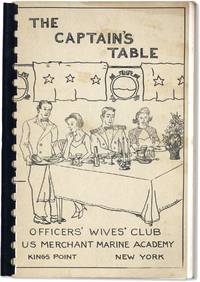
1966ref. 83678New York: Published for author 1966. First Edition. Octavo 21.5cm; black comb binding with textured card covers; 215pp; b&w illustrations by Lieutenant Commander Walter J. O'Hara throughout. Inscribed on front endpaper: "Love to Ruth from Wynne". Cover design by Captain Lauren S. McCready. Light shelfwear with soil and light splashing on covers; Very Good. Cookbook of the Officers' Wives' Club complied by United Stated Merchant Marine Academy USMMA organized into "Home Port" and "Foreign Ports" with a focus on appetizers & hors d'oeuvers casseroles desserts meats and vegetables. October 1966 Committee members include Charlotte R. Schuler Marilyn O'Leary Patricia Nau Estelle Koppelson and advisor Wynne R. McLintock. Officers' Wives' Club cook books were often published as projects to raise fundraising and as such they were often sponsored by local businesses and community members. 83678. Published for author unknown books
1851ref. 69961Charleston SC: A. J. Burke Printer 1851. First edition. 8vo. 31 pp. Turnbull III p. 136. OCLC locates seven copies Duke Spartanburg County Public South Carolina Historical Society South Carolina New York Historical Society Clements Princeton Theological. Original printed self-wrappers stitched. Very good. A. J. Burke, Printer unknown books
ref. 70024The letters and documents include orders to move ships and provide aid to a blockade runner personnel matters transfers promotions repairing and outfitting ships reporting on the dead and wounded from the "Atlanta" and other matters. All of the material is more fully described below generally in chronological order starting with the earliest piece for each individual. Some storage wear and soiling but a very good lot. TATTNALL Captain and Flag Officer Josiah 1795-1871; commanded Southern naval units in defense of Port Royal S.C. in 1861 the defense of Virginia's waters in 1862 and naval forces of Georgia 1862-1863. Appointing Lt. Arthur Sinclair Fleet Captain of the Savannah Squadron giving instructions for communicating with the Commandant's Office and calling for economy in a manuscript copy of a letter signed clerically for "Flag Officer Comdg Tattnall" by Tattnall's clerk C. Lucian Jones on "Confederate States Navy Station / Commandant's Office / Savannah" letterhead February 26 1863. This copy noted as "sent to the Commander of vessels . the Comdg Officer Str Isondiga" at the time Lt. Joel S. Kennard. 4to. Two-pages approximately 150 words in part: "In addition to your duty as Commander of the Atlanta you will also perform that of Fleet Captain and will as such take charge of the general duties of the Squadron being guided by my general and such other orders as I may issue from tie to time." Sinclair 1810-1865 commanded the "Atlanta" February - May 1863 by which time both he and Tattnall were relieved of command for various failures Lt. William Webb being appointed to fill there posts see his entry below. 1 WEBB Lieutenant and Flag Officer William A. 1824-1881; commended for his actions commanding the "Teaser" in the Battle of Hampton Roads March 1862; commanded a secret squadron of small boats outfitted with spar torpedoes in Charleston Harbor in 1862-1863; commanded the "Atlanta" and the Savannah Squadron. Giving instructions for conduct in various areas to his junior officers in an autograph letter and three letters each signed by Webb as commander of the "Atlanta" and Savannah Squadron Commander May 13 - June 9 1863 to Lt. Commander Joel S. Kennard see below commanding the "Isondiga" in Webb's squadron shortly after taking command. 4to. 4-pages. The first letter asks from a "complete muster roll" of the "Isondiga's" officers and crew the other three being "General orders No. 3" prohibiting boats from going "below Thunderbolt" five miles south of Savannah "without the officers being well armed" the final two offering directions for having repairs to the Isondiga taken care of and giving instructions on the construction of pennants to fly. Accompanied by a manuscript "General Order No. 4" clerically signed by now "Secretary" Jones June 3 1863 from Webb to Kennard both "Off Thunderbolt." Folio. Two-pages approximately 200 words in part: "All vessels under my command will keep a strict look out night and day and will bring to all boats and vessels not belonging to or employed by the Army of Navy . no boat or vessel will be allowed to pass unless their passport is signed by the Comdg Genl . the guard vessel for the day will have the grand flag flying and will have a boat ready for boarding . a correct register of all vessels brought to will be kept . all commanders will inspect quarterly for condition of each vessel . with respect to the completeness of her equipment and the proper stationing of her crew." Webb's Savannah command was short lived he attempted to break the Union blockade by engaging with two Monitors patrolling Wassaw Sound on June 17 but the "Atlanta" ran aground forcing Webb to surrender under withering fire that severely damaged the ship killing one and wounding 16 crew members Webb not being able to repeat his Hampton Roads performance being captured and sent to prison in Boston for a year. 5 KENNARD Lt. Commander Joel S. 1819-1901; commanded the "Isondiga" in the Savannah Flotilla 1862-1864. Complaining of being passed over for Savannah Squadron command for a more junior officer William A. Webb and asking for a transfer in an autograph letter signed by Kennard from the C.S Str "Isondiga" on the Savannah River May 9 1863 to Stephen R. Mallory Confederate Secretary of the Navy in Richmond. 4to. Two-pages approximately 175 words in part: "I cannot help feeling that I am fully as much entitled to advancement as Mr. Webb . nor is it my intention to boast any great display of gallantry during this war but Sir there is such a thing as a proper self esteem . as far as I know or can learn of Mr. Webb's career mine will not suffer by comparison . if it be possible to obtain command of any one of the vessels said to be in course of construction in Europe I would gladly accept it." Accompanied by five autograph letters signed by Kennard June 23 - March 6 1864 the first to three "Isondiga" junior officers concerning a supply problem with their signed manuscript reply and accounting sheet three to Flag Officer William W. Hunter see below concerning "Isondiga" personnel repairs and charges of drunkenness against an engineer signed manuscript charges included here and the last to Savannah Paymaster D.C. Seymour concerning pay for his crew members. Also accompanied by a letter from the Savannah paymaster to Kennard forwarding instruction not present for "Isondiga's" assistant paymaster written June 17 1863 the day of "Atlanta's" defeat and Webb's capture. 10 KENNARD. Forwarding information from the "Atlanta" debacle in a manuscript letter left unsigned perhaps a retained copy from Kennard on the "Isondiga" Savannah River June 26 1863 nine days after the engagement to Stephen R. Mallory Confederate Secretary of War. 4to. Two-pages approximately 200 words in part: "Letters have been received by parties in the City from two of the officers and one of the crew of the 'Atlanta' prisoners of war at the time of writing in Port Royal S.C. . the third letter is from one of the crew by the name of Moore. After mentioning the casualties this man Moore states particulars of the engagement. A summary of which is that two of the enemy's fifteen inch shot passed through the port side of the Atlanta hull disabling two gun crews that a third shattered the Pilot house; that she got aground and that being thus unable to bring any of her guns to bear upon the Enemy the ship was surrendered." Two of "Atlanta's" officers reported slightly different numbers of casualties but one mentioned one dead and 16 wounded among them several named officers. 6 HUNTER Commander William W. 1803-1892; commanded Confederate vessels protecting Gulf of Mexico ports 1861-1863; commanded the Savannah Squadron 1863-1864. Ordering the discharge of a sailor the movements of the "Isondiga" and inspecting munitions in a series of four autograph letters and orders signed by Hunter as "Flag Officer Commanding Afloat" February 5 - March 19 1864 from Savannah to Lt. Commander Kennard aboard the "Isondiga." 4to half-sheet 4to and a slip 2 x 7 ¾ inches approximately 250 words total. Accompanied by an autograph order marked at its head "Confidential" signed by Hunter to Kennard March 4 1864 forwarding a letter present here but actually a clerical copy docketed verso and signed by Hunter also marked by him "Confidential" from Brig. Gen. H.W. Mercer commanding army troops in Savannah at the time to Hunter the same day explaining that a Confederate steamer with "a most important cargo of Army stores is expected nightly and requesting that Hunter and his vessels keep an eye out to assist any attack by Union ships; Hunter's order to Kennard advises "you will further object therein stated by every means in your power." Following the destruction of the "Atlanta" and capture of the Savannah Squadron's commander William Webb on June 17 1863 Kennard was named squadron commander pro tem until Hunter arrived from the Gulf to take command later than year a post he held until Sherman drove Confederate Forces from the Savannah area in December 1864. So for a bit more than a year Hunter and his flotilla helped hold Savannah but without the "Atlanta" he had no hope of breaking the blockade or otherwise diminishing the Union's naval superiority. Webb made his name at the Battle of Hampton Roads March 8-9 1862 commanding the gunboat CSS "Teaser." As part of the Confederate flotilla attempting to break the Union blockade it offered cover fire for the newly construction ironclad "Virginia" formerly the Merrimac as it engaged the USS "Cumberland" on the first day; after sinking that ship and forcing the "Congress" to surrender though it was also sunk when shore batteries fired on the Confederate vessels sailing to accept the surrender the "Merrimac" appeared to be heading for a victory. The appearance of the Monitor the following day changed the scene however and the two sides fought to a standstill. Webb and the "Teaser" again performed superbly and wounded Webb won the "thanks" of the Confederate Congress. Michael Reese in his Autographs of the Confederacy writes of Webb "commander of the C.S. 'Teaser' a gunboat in the James River Squadron that fought with distinction at Hampton Roads . a rare signature." We found one sale of a Webb letter similar to the four offered here Alexandria Historical Auctions February 9 2021 $1100. Files of Confederate naval manuscripts as offered here are very scarce in trade this is the first we have offered in our 45 years of selling Civil War material and the first we've seen. unknown books
1919ref. 81517N.p.: P.G. Yedinak Printer 1919. No statement of printing or edition. 12mo 19cm. Staplebound printed yellow wrappers; 426pp; illus. Mild edgewear and soil; internally fresh and unmarked. A Very Good copy. Frontispiece portrait of Commanding Officer Capt. Edward S. Kellogg; other text illustrations reproducing photographs and line drawings. Scarce little keepsake possibly printed shipboard for circulation among officers and crew of the U.S.S. Huntington a first class armored cruiser that saw duty primarily as a convoy escort in WW1. She was named for the city of Huntington West Virginia. From OCLC cataloguing data it appears that an expanded version was printed later in 1919; of this preliminary version OCLC notes two physical locations only. P.G. Yedinak, Printer unknown books
1924ref. 60288New York: Macmillan 1924. First Edition. Limited edition. Number 75 of 350 signed and numbered copies. Octavo 24cm. Brown paper over boards backed in black cloth in black card slipcase titled on paper labels; plain endpapers; xiv112pp. Signed by author on limitation page. Lightly rubbed at spine but generally clean: Very Good. Slipcase rubbed and chipped at edges but sound Good or better. Marina Wister was the daughter of acclaimed novelist Owen Wister. Macmillan unknown books
1822ref. 55730London: Printed for the author and sold by F. C. and J. Rivington 1822. First Edition. Octavo in fours 20cm. Rebound in black cloth titled on spine in gilt; plain endpapers; ii 97 1pp; with folding advertisement for a Quarterly Muster Pay and Victualing Book sold by Burgess Hunt and Carter Ramsgate. Errata slip laid down on final page. Annotated throughout in pencil. A sturdy copy rebound with minor soiling to intial and final leaves tear in folding table neatly mended: Good or better. Naval impressment was standard pratice in Britain from the mid-seventeenth century until the end of the Napoleonic Wars after which the Navy developed other recruitment methods until the return of conscription in 1916. Printed for the author, and sold by F. C. and J. Rivington unknown books
1989ref. 46263Leningrad: Aurora Art Publishers 1989. First English Language Edition. Quarto 29.5cm.; dark red publisher's cloth boards with embossed title on front and gilt lettering on spine in white and color pictorial dust jacket; 159pp 135 plates. Text block is yellowing slightly at extremities otherwise sound and Fine. Additional toning on pastedowns and end papers. Dust jacket is slightly creased along upper edges towards spine; inner flaps rolling slightly at edges with a spot of splitting on rear flap. Else very light shelf wear Fine. This account of pioneering 19th century Russian artist Vasily Perov 1834-1882 features biographical information and commentary on his artwork presented here in text illustrations and 135 full color plates. Perov is especially noteworthy for employing critical realism in his depictions of everyday citizens streetlife and peasantry. Aurora Art Publishers unknown books
1864ref. 63452Richmond VA 1864. 4to one-page on blue paper the text in full: "In compliance with your request I have the honor to transmit herewith copy of my letter to the Hon. W. Porcher Miles on the subject of the torpedo boats"; with a "Rebel Archives" stamp on verso. Chambliss 1809-1875; Sussex County Virginia plantation owner and member of the Confederate House of Representatives 1862-1865 was a member of the house Naval Affairs committee and William Porcher Miles 1822-1899; Mayor of Charleston South Carolina 1855-1857 U.S. House of Representatives 1857-1860 Confederate House of Representatives 1862-1865 was chairman of the house Military Affairs committee. This letter was written several months after the Confederacy's first torpedo boat the David made its initial attack against the Union ship New Ironsides in Charleston Harbor 5 October 1863 and two months before its second against the USS Memphis 6 March 1864. After two failed attempts at a sortie in 1863 losing 13 crew members in the process the Hunley became the first torpedo boat to actually sink a war vessel successfully completing its mission against the USS Housatonic in Charleston Harbor on February 17 1864. Very good Mallory's signature strong and black. Folded. 10187. unknown books
1919ref. 34793Washington DC: Navy Department Commission on Training Camp Activities 1919. First Edition. Oblong 12mo 10x13.5cm.; publisher's dark blue staple-bound card wrappers; 298pp.; chiefly musical scores two full-page photographic illus. linocuts by John Held throughout. A hint of toning to wrapper extremities else Very Good to Near Fine. Collection of patriotic songs with illustrations by a young John Held signed in image either "JH" or "J. Held" but otherwise unattributed to him. The noted Jazz Age cartoonist had already had work published in Vanity Fair though after the United States entered World War I he worked for Naval Intelligence in Central America as an illustrator and cartographer. Navy Department Commission on Training Camp Activities unknown books
1907ref. 31197N.p. Japan ca 1907. Pair of large trapunto banners both removed from original frames. First 82cm x 60cm ca 32" x 24"; embroidered in silk with trapunto elements on a black silk ground; photographic portrait on cabinet card inserted in embroidered pocket at center inscribed "Mellie McKeever" on verso. Silk ground fragile with a few thin tears but no significant losses; light soil; embroidered portions generally well-preserved and colors bright. Very Good. Second banner 65cm x 50cm ca 25" x 20"; photo-transfer on silk with embroidered ornaments. Slight fading to embroidered portions but generally well-preserved and sound; Very Good. Both banners with firm provenance purchased from the descendants of Mellie McKeever of Richwood West Virginia. Two exceptional and well-preserved examples of the ornamental trapunto banners that were popular souvenirs among U.S. sailors and marines during the late 19th and early 20th century. Yokohama was the principal point of production for these naval souvenirs but we have also seen examples from the Philippines and mainland China; Japanese examples such as these are generally distinguished by a higher quality of embroidery and more sophisticated composition. The banners became popular among British and American sailors beginning as early as the Boxer Rebellion and the Spanish-American War but seem to have reached their peak of popularity with the arrival in the Far East of Teddy Roosevelt's Great White Fleet in 1908. Some 14000 sailors and marines made land at various Japanese ports-of-call in that year and given the regularity with which these textiles still appear one imagines that every sailor must have brought at least one of these souvenirs home with him. The first example though of an unusually impressive size is of a type frequently seen displaying typical naval iconography right down to the hand-painted battleship portrait of a two-stack battleship of the Kearsarge class its hull painted white reflecting its peace-time mission at bottom center. The embroidered frame to hold a cabinet portrait of the sailor or perhaps a loved one is a typical feature found on more elaborate examples. The American Eagle in full battle stance is a nearly universal element of these banners. The second banner is of a style we have not previously seen and for which we can find no analogues in the extensive literature of naval souvenirs. It is clearly a family portrait probably a composite made from cartes-des-visites carried by McKeever; the portraits are printed by silkscreen using a photo-transfer process with applied trapunto decorations. The likenesses are clearly enlarged -- it is highly unlikely that a common sailor would have had room aboard a battleship to carry full-size portraits -- and it strikes us that this must have seemed an almost magical process at the time of creation especially to a young man from a tiny lumber-and-coal town in central West Virginia. Aside from their obvious virtues as objects of art and handicraft we regard these banners as compelling pieces of material culture from a period of tremendous social transformation in the United States. According to the Naval Historical Center U.S. naval rolls expanded by nearly 400% between the beginning of the Spanish-American War and the launching of the Great White Fleet. To meet this demand for the first time in its history the Navy began recruiting from the American heartland rather than solely from the Eastern Seaboard states. The generation of inland farmers and mechanics to follow was thus the first in American history to experience first-hand cultures as diverse and divergent from their own as those of Europe Asia and the Pacific Islands; they represented not only the beginning of the American imperialist enterprise but also the first stirrings of America's global consciousness. That so many of these banners have survived in good condition is evidence of the degree to which they were treasured by their owners for whom they represented an experience that must have been transformative and definitive. unknown books
1972ref. 26443New York: Holt Rinehart and Winston 1972. First Edition. Octavo. Cloth boards; dustjacket; 312pp. Fine unread copy. A "dispassionate" examination of the women's movement from a male perspective by the San Francisco journalist and prolific author on social-movement themes. Holt, Rinehart and Winston unknown books
1829ref. 9021127Edinburgh / London: Printed for Cadell & Co. / Simpkin and Marshall 1829. 1st. Hardcover. Very good. Bound in full dark blue calf with spines and board edges stamped and decorated in gilt. Gilt stamped spine labels are rubbed and chipped more than half gilt lost but impressions still legible. Boards are rubbed at the heads heels extremities and bottom edges. Volume one has a separated front inner hinge. Volume two front inner hinge has started but is holding. Marbled endpapers. Fold-out map in color bound in to volume one. Three tables on one fold-out sheet bound in to volume three. Printed for Cadell & Co. / Simpkin and Marshall hardcover books
1993ref. 9008555New York: Abrams 1993. 1st. Hardcover. Book fine Dust jacket fine. 168 illustrations including 70 in color. Bound in publisher's original grey cloth with the front cover and spine stamped in white. Abrams hardcover books
1990ref. 9006824Princeton: Princeton University Press 1990. 1st. Hardcover. Book fine Dust jacket fine. Bound in red cloth with the spine stamped in gilt. Princeton University Press hardcover books
1910ref. 52132Washington DC: Press of Shaw Bros 1910. First edition. 8vo. 46 pp. Illustrated portrait. Inscribed to John H. Hunter by "the author". Scarce; the NUC locates only three copiesDLC ViU NcD only microfilm editions found on OCLC. Not in Nevins or Broadfoot. Original printed wrappers spine eroded. Press of Shaw Bros unknown books
1901ref. 50496Washington DC: Byron S. Adams printer 1901. First edition. 8vo. 38 pp. At head of front wrapper: Completed Brief prepared by "Herbert & Micou attorneys". Continuing the argument for Port Royal as the better site. Not recorded on OCLC. Original printed green wrappers sunned some wear at extremities; Franklin Institute stamp else very good. Byron S. Adams, printer unknown books
2011ref. UFIOGLA00ajsSt. Martin's Griffin 2011. Fine. Fiorato Marina. The Glassblower of Murano. NY: St. Martin's Griffin 2011. 348pp. 8vo. Paperback. Book condition: Near fine. St. Martin's Griffin paperback books
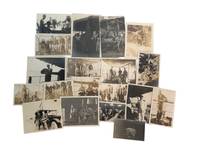
1917ref. 238881917. U.S. Navy Mexican Patrol photo archive documenting natural history provisioning and wartime shipboard life aboard USS Rainier during World War I. Associated with Lieutenant junior grade Dr. Louis Henry Clerf the vessel's medical officer the photographs record fish a large shark a deer and a dog alongside the daily routines of sailors living and working aboard a small Pacific Fleet auxiliary. Fishing appears as food procurement recreation collective labor and an occasion for observing and photographing marine life. A Black U.S. Navy sailor appears prominently among the men handling and displaying the catches while the vessel's mounted cannon rigging machinery and naval uniforms establish the military setting behind these scenes of everyday life. Photo archive of 19 silver gelatin photographs most measuring 3.5 x 4.5 inches aboard USS Rainier and associated Pacific coastal locations circa 1917 to 1919. Sailors pose with large fish suspended from lines display individual catches clean fish across the deck and gather around food beneath canvas awnings. One photograph records a large shark surrounded by sailors while others show a sailor displaying a substantial fish and groups gathered around the preparation of the catch. A dog appears at a shipboard table and a deer stands tethered beside machinery and piping bringing animals directly into the vessel's working and social spaces. One photograph prominently shows a Black sailor with the fishing catch while other images record officers and enlisted men in white and dark naval dress gathered on deck or beside an automobile ashore. Rigging winches railings mechanical equipment canvas awnings and a mounted cannon recur throughout locating the fishing meals and informal gatherings within the confined operational environment of an armed naval vessel. Built at Portland in 1917 as the civilian schooner Patrol and subsequently known as Angel Rainier was acquired by the Navy and commissioned at Mare Island on July 30 1917 then assigned to Division 2 Pacific Fleet and Mexican Patrol duty. Navy records document the acquisition of small vessels for Mexican patrol service during 1917 and the continuing patrol of Mexican waters during the war. A separate larger group of photographs from the same Louis Henry Clerf Rainier corpus provides corroborating evidence for his photographic association with the vessel and for the broader range of animal and environmental subjects he recorded during its service; that separate group is not included in the present 19 photographs. The photographs offered here remain focused on the immediate life of the Navy crew where catches move from sea to deck to preparation and communal use while the shark deer and dog record the animals brought into the sailors' working environment. The Black sailor's presence provides direct visual evidence of Black naval service within this wartime crew while the cannon and working machinery keep these scenes firmly connected to the vessel's military function. Light surface wear scattered fading and toning and occasional edge and corner wear; images remain generally clear and legible. Overall in very good condition. A concentrated visual record of natural history Black naval service provisioning recreation and wartime life aboard USS Rainier during the Mexican Patrol. unknown books
ref. WELLER9798875002298New. New book. unknown books
1983ref. UWARALO00fpVintage Books 1983. Very Good. Warner Marina. Alone of All Her Sex. New York: Vintage Books 1983. 398 xixpp. Illustrated. 8vo. Paperback. Book condition: . Vintage Books paperback books
1997ref. 212194Caldas da Rainha Portugal: Camara Municipal 1997. First edition. Softcover. 69 pages. Text in English and Portuguese. Features a contribution by Delfim Sardo. Includes numerous color and black and white illustrations and biographical information. A clean near fine copy in French style wrappers. Camara Municipal unknown books