1961réf. 010558Hamden CT: Shoe String Press 1961. 1961 reprint of 1960 edition. Unmarked interior tight binding. 407 pages. Illustrated with maps and black & white photos. Growth of overseas British civil aviation from the beginnings through the formation of Imperial Airways in 1934 eventually ending in the BOAC. Clean. Cloth. Near Fine/No Jacket. 8vo - over 7¾" - 9¾" tall. Shoe String Press Hardcover
1919réf. 17374Aeroplane & General Publishing London 1919. First Edition. Hardcover Original Cloth. Very Good Condition/No Dust Jacket. Size: Quarto. Text body is clean and free from previous owner annotation underlining and highlighting. Binding is tight covers and spine fully intact. Scattered foxing but text mostly clean. Previous owner's inscription in ink neat. Edges foxed and browned. Quantity Available: 1. Shipped Weight: Under 1 kilogram. Category: Aviation; Antiquarian & Rare. All our pictures shown here are of the actual item not stock photos. Inventory No: 17374. . Aeroplane & General Publishing hardcover
1980réf. 032008New York: Atheneum 1980. Near Fine condition. Square and tight. Sharp corners. NO owner's name or bookplate. NOT a library discard. NOT a remainder. Pages are crisp clean and unmarked. NO underlining. NO highlighting. NO margin notes. The Incredible Story of Brent Dyer and Donna Johnson who endured a plane crash in the mountains of Idaho and were forced to resort to cannibalism to survive. Bound in the original blue boards with a gilt-stamped blue cloth spine. From GoodReads: "Documents the efforts to survive undertaken by Donna Johnson and Brent Dyer after their plane crashed in the mountains of Idaho and the two had no choice but to consume the flesh of one of the dead passengers." From a 2024 review by Amanda: "My partner is related to one of the survivors of this tragic incident and one of his family members lent me this book as a must read but warned me that it would be emotionally heavy which it is. While its a quick read you cant help but feel the sense of despair and helplessness that the victims felt as they came to terms with their injuries their isolation and their hunger. They survived a horrific crash and had to cope with the death of Don and the insanity of Norm following his brain injury all while coming to terms with the fact that nobody was coming for them as Search and Rescue were likely looking in the wrong area and likely couldnt see their white plane amongst the white snow that continued to fall. I appreciated the authors historical review of cannibalism throughout the many different cultures that have practiced it out of necessity or to gain something spiritually or otherwise from the act. Without being in an extreme survival situation it is impossible to know what I or anyone else for that matter would do in those circumstances and I hold no judgment towards survivors who fall back on extreme measures such as these to stave off death. One thing that surprised me was the amount of supplies they took with them on their walk that served no practical purpose for survival such as a curling iron aftershave perfume etc; they were seriously injured and struggling to walk so I thought they would try to lighten their loads as much as possible but I can also understand how hard it must be to leave behind items that brought them comfort regardless of their impracticality. Im not surprised that they eventually ditched some of these items. I had to fight to hold back tears reading the section of the book when they were found and finally got a chance to call home and when Jimmy Robertston offered to bring the dog to them." GoodReads rating 3.89 stars. First Edition so stated. Hardcover. Near Fine condition/No dust jacket. Illus. by NOT a library discard. 8vo. 203pp. Great Packaging Fast Shipping. Atheneum Hardcover
1999réf. 8622463Butterworth-Heinemann 1999. This is an ex-library book and may have the usual library/used-book markings inside.This book has soft covers. In fair condition suitable as a study copy. Please note the Image in this listing is a stock photo and may not match the covers of the actual item850grams ISBN:9780340741528 Butterworth-Heinemann paperback
1958réf. 53090Burbank CA: Lockheed Aircraft Corporation 1958. Nine parts in one vol. 4to. 4; 11 1; 13 3; 15 1; 14 2; 19 1; 19 1; 15 1; 15 1 pp. all issues separately paginated black white & coloured ink throughout. With over 250 photo illustrations text illustrations diagrams maps. All issues with self-printed softcovers bound together in original Lockheed Corporation adjustable blue & silver foil softcovers copper lettering stamped on front cover yapp edges very slight uniform toning NF set from the library of David H. Kenyon 1918-2011 former Lockheed engineer & military sales manager as well as aviation consultant for Pan American TWA and the Venezuelan Airlines and later President of the Southern California Wing of the OX5 Aviation Pioneers. First editions of these unusually rare original printings of the in-house history magazine published by the Lockheed Public Relations office at the end of 1957 into 1958. This work was published in chapters each with separate heading and intended to stand alone so subscribers and Lockheed employees could choose to collect them all or just some. Back issues were available for only a limited time in 1958 as was the company printed softcover post-binder and additional 4 page introduction present here. These magazines drew from a number of Lockheed archive scrapbooks company factory photographs with contributions from Robert & Courtlandt Gross Cyril Chapellet Carl Squier Allan Lockheed Walter Varney John K. Northrop all providing an excellent and informative history of Lockheed aviation through the first six decades of the 20th century. Worldcat locates 1 complete collection Hagley -- several institutions hold assorted chapters the 1980 Arno reprint or the later continuation of the history under the same title. Lockheed Aircraft Corporation, paperback
1519réf. 58083Lock Haven PA: Piper Aircraft Corporation Oct. 15 1946. Oblong 4to. 11 x 8.5 in. 12 pp unpaginated. With three-colour plates colour-printed throughout self-printed colour softcovers minor shelfwear slight creasing still NF copy w/ printed price-list mounted verso front cover. First edition of this extraordinarily scarce Piper Aircraft Corp. sales brochure issued just after World War II before private Civil Aircraft restrictions had been lifted in the United States. The models featured here include the Piper Cub Super Cruiser a 3-passenger aircraft fitted with 100 horsepower engine and capable of 600 miles flying range; the Piper Cub Special which was the thrifty low-cost model fitted with a 65-horsepower engine and cruising range of 200 miles; and finally the Piper Cub Sea Scout which was a Super Cruiser fitted with pontoons. The PA-12 Super Cruiser was basically a J-5C aircraft produced from 1946-1948 and two of them flew around the World in 1947 with both still surviving in museums. Worldcat locates 1 copy Canada Sci & Tech Museum. Piper Aircraft Corporation, paperback
1942réf. 63319Dayton OH: The Material Center Experimental Engineering Section Wright Field Aug. 1942. 4to. 40 pp. mimeograph typescript. With photo illustrations with text illustrations diagrams. Blue-tinted printed softcovers Rising Sun motif on front cover blue lettering minor age toning to fore-edges minor bumping to couple corners edgewear still VG copy from the library of Otto C. Winzen 1917-1979 pioneering German-American aeronautical engineer was interned during World War II and later significantly advanced material and construction of high-altitude balloons after World War II. First edition of this very rare original Restricted Wartime report on the flight and combat capabilities of the famed and innovative Japanese aircraft less just 9 months after the attack on Pearl Harbor and one month after the US was able to secure a Mitsubishi A6M2 Type Zero which had crashed during the Aleutians campaign in Alaska in July 1942. This report focuses on the Mitsubishi Aichi Kawanishi and Nakajima bombers fighters reconnaissance aircraft torpedo bombers dive bombers flying boats and float planes. Worldcat locates 1 copy Defense Bibliothek NL. The Material Center, Experimental Engineering Section, Wright Field, paperback
2012réf. 032631Osprey Publishing 2012. THE AUTHOR'S own copy WITH 32 signatures!! SIGNED by the AUTHOR Col. Ret. Gaillard R. Peck Jr. i.e. Evil. directly on the half title page his signature only NOT personalized to anyone. PHOTOS upon request. Laid-in are two internet downloads of the author's signature for comparisn / authentication. This copy is also signed with notes of gratitute to Col. Peck by approx. 31 Red Eagles -- aviators and crew who served under him. Many of those signatures also list the years they served under Col. Peck with their "Bandit" and unit numbers. PHOTOS upon request. At the end is an appendix of Red Eagle Alumni that lists many of the 31 who have signed here in tribute to Col. Peck most addressing him with his call sign "Evil." Very Good condition in a bright and shiny Near Very Good dust jacket. The cover has edge bumps but NO pages are affected i.e. no page creases. NOT a library discard. NOT a remainder. But for the ink tributes and signartures pages are clean and unmarked. Bound in the original silver-stamped blue boards. Complete with lightly frayed dust jacket. From the publisher: "This book is the story of a group of military pioneers who were intent on using their experience and knowledge to develop a new training paradigm for fighter pilots. As a Vietnam veteran and Phantom F-4 pilot Col. Gail Peck call-sign "EVIL" had been disappointed with the level of training offered to US fighter pilots. He was determined to ensure that US fighter pilots were unbeatable in the air particularly against their Cold War adversaries flying the already legendary MiG fighter jets. Working with the support of General Hoyt S. Vandenberg Jr. and under conditions of the upmost secrecy the CONSTANT PEG program was launched with Peck as the original "Red Eagle." This fascinating unknown history was first revealed in Steve Davies' acclaimed Red Eagles: America's Secret MiGs but this book is the insider's perspective complete with never-before published anecdotes and photographs revealing how Peck battled bureaucracy and skepticism to ultimately establish the premier fighter pilot training center. Along the way Peck explores many of the central questions surrounding the project: why did the combat Air Forces of the USA find themselves in need of a major revision in their approach to air-to-air combat training How did they secretly build an airfield to clandestinely conduct air-to-air combat training using actual MiGs as the adversary training platforms What was it like to be a Red Eagle pilot or maintainer and what were the major challenges they faced on a daily basis What did the USA get out of the program in terms of a return on investment Was it worth it and where do we go now Despite operating for a decade no single pilot ever revealed the secret nature of the training until the program was eventually declassified in 2006. Now for the first time we can read about what it felt like to build the airfields source the MiG aircraft and finally take them to the skies above America itself all in the quest to establish the USAF as the premier fighter jet force the world over." GoodReads rarting: 3.85 stars. Hardcover. Very Good condition/Near Very Good dust jacket. Illus. by THE AUTHOR'S COPY. 8vo. 320pp. 32 pages of photos. Great Packaging Fast Shipping. Osprey Publishing Hardcover
1891réf. 49066Paris Gauthier-Villars 1891. 4to. No wrappers. In: "Comptes Rendus Hebdomadaires des Séances de L'Academie des Sciences" Tome 113 No 2. Pp. 49- 104 entire issue offered. Langley's paper: pp. 59-63. Disbound but clean. Tear to one margin not affecting the text. First appearnce of this pioneering paper in which Langley announced that it is possible with the motors that we now have to keep a plane in the air with large speed.In 1891 Langley experimented with steam-engine powered Aerodromes beginning the series which would lead to the human-carrying machine of 1903. The first of these was designated Aerodrome No. 0 and proved a failure. The second machine Aerodrome No. 1 was powered by a carbonic acid gas and later by compressed air. Aerodrome No. 2 also built in 1891 was also a disappointment. Aerodrome No. 3 1892 was of stronger construction and was modified a number of times. A better means of heating the steam was tested on Aerodrome No. 3 and was a decided improvement and was incorporated into Aerodrome No. 4. By the end of 1893 Aerodrome No. 4 was ready for testing and a launching device atop a house boat was built. unknown
1949réf. 13826Salem Oregon: The Oregon State Board of Aeronautics. Very Good. 1949-1955. First Edition. Magazine. Includes 10 issues from the first two volumes then a straight run from volume 3 no. 1 to vol. 7 no. 12. The first two volumes are 8 1/2x11 4 pages the rest are half that size 6 to 10 pages. A very scarce bit of Northwest aviation history. First two volumes are punched for a three ring binder the rest have gummed tabs applied for the same purpose. Should be removeable if you wish as they are water based and a damp sponge will remove them. I've never seen another copy of this publication. The only xlib marks are a stamp or pencil notation in the upper right corner. ; Ex-Library; 8vo 8" - 9" tall . The Oregon State Board of Aeronautics unknown
1923réf. 20361Washington D. C.: United States Touring Information Bureau Inc. Very Good. 1923. First Edition. Hardcover. Very light rubbing with one spot of soil on the front cover. Includes the scarce folding map in the rear pocket. Only flaw is the missing blank fep. ; 8vo 8" - 9" tall . United States Touring Information Bureau, Inc. hardcover
1931réf. 17448Strasburg Virginia: Shenandoah Publishing House 1931 First edition of this history of early aviation. Publisher's pictorial blue cloth stamped in silver. . Octavo. With frontispiece and dozens of illustrations throughout including many full- and half-page photo reproductions Binding is clean and attractive. A remarkably bright and fine copy signed by the author "Jack Stearns Gray" in the very good original dustjacket. In the foreword Jack Stearns Gray 1890 – 1961 writes "My first flight was over a part of the Adirondack Range in 1912; my last flight over Washington D.C. in 1927. The first was made sitting on the wing—the last in a cockpit." Gray was the first Virginia woman aviator to fly from Virginia soil and along with her husband George A. Gray traveled all over the eastern United States as barnstormers in their Wright Model B. Gray knew many of the major aviation pioneers including Amelia Earhart Charles Lindbergh Glenn Curtis and the Wright brothers and she records their stories in the present work. She also discusses her contemporary woman aviators including Elinor Smith Ruth Nichols Ruth Elder Camp Opal Kunz and many others. Gray writes in the foreword: "'Jack' is my nickname. I have borne with it flown with it and now I feel like it. Edith is my real name but on only three rare occasions have I used it" including "when I visited Ethel Roosevelt at the White House in 1908." The present work was also praised by Lieutenant Commander Earle Ovington the first U.S. Air Mail pilot and Congressman R. Walton Moore. Shenandoah Publishing House, hardcover
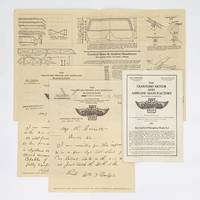
réf. 80804Two brochures and two letters from The Crawford Motor and Airplane Manufactory an early Seal Beach California designer and builder of high-powered motors hydro-airplanes airplanes hydroplanes and propellers for pleasure and commercial purposes. The letters handwritten and signed by founder William Crawford in 1928 concern the potential order of a small airplane by Raymond Garrett of Key Drug Co. in Ponca City Oklahoma. One of the brochures is a four-page pamphlet 6" x 9" about the Crawford Monoplane Model A-1. The second piece measures 11" x 17" and is printed on both sides. It includes an article by Crawford titled "Simple Aerodynamics and the Aeroplane" a price list of propellers and a schematic for wing designs. Crawford traces its roots back to 1912 when Harvey Crawford William's brother placed an entry in the Third International Air Meeting at Dominguez Hills. A year later the brothers established the Crawford Flying School at Sunset Field near Los Angeles. Four years after that the company expanded its interest to designing aircraft and became known as the Crawford Airplane and Motor Manufactory which designed several powered aircraft including the Crawford Monoplane Model A-1 released in 1928. They manufactured the parts and consumers assembled the airplane. According to Aeorpedia.com 600 kit planes were sold to interested builders. In later years the brothers designed a series of powered gliders. Crawford continued to offer a flight school and the local airfield called Crawford Field and later Seal Beach Airport operated until the 1940s. It is now part of the Naval Weapons Station Seal Beach and residential housing. The brochures and letters are a little toned with folds for mailing; otherwise very good. Scarce. unknown
1910réf. A38279Pucheim Germany. Very Good. 1910. Other. This is a group of four small photographs 3.5" length x 2.5x height possibly on salted paper of airplanes flown at the Munich Air Race of 1910. The reverse of the photographs give basic descriptions including the place -- Puchheim and the Aviators. The grpou of for prints come with an autograph handwritten statement from the owner giving them to a friend for his aviation collection. The aviators include: Emil Jeannin Dr. Otto Lindpaintner and Gustav Otto. While Emil Jeannin is listed as one of the five pilots engaged for this race the other three aviators were apparently running in the same circles / groups and likely brought their planes with them. "The Munich "Akademie für Aviatik" was founded in 1909 mainly by members of the Royal Bavarian Automobile Club. Its main aim was promoting aviation particularly by flying dirigibles and other flying machines. This included building an airfield with all necessary installations but also creating a library and a museum and the awarding of prizes for competitions. Suitable grounds for an airfield were found in the village of Puchheim 15 kilometres west of central Munich where 76 hectares of moorland was bought and leased. A modern and completely equipped airfield with a two-kilometre race course was built. It was decided to celebrate the opening of the airfield by organizing an "aviation week" of five days in the end of May starting less than a week after the Berlin-Johannisthal spring meeting. Five pilots were engaged. Emil Jeannin Baron Pierre de Caters and Ellery von Gorrissen came directly from the Berlin meeting where the two former had been very successful. They were accompanied by Belgian Jules Tyck on a Blériot and local Munich man Simon Brunnhuber on one of the Antoinettes bought by Walther Huth who would later start the Albatros company." from Wikipedia; B&W Illustrations . unknown
1965réf. 3029Apollo Logistics Training; North American Aviation Inc. Space and Information Systems Division; Downey California; 1 January 1965. 1965 Paper wraps 2-hole metal binding various pagination Preface; Table of Contents; List of Illustrations; List of Tables; Introduction: 11 pp.; Cryogenic Storage System: 9 pp.; Fuel Cell System: 18 pp.; Batteries and Battery Charger: 9 pp.; DC Power System: 7 pp.; AC Power Generation & Distribution: 16 pp.; Controls and Displays: 13 pp.; Bibliography: 2 pp. Numerous figures and one table. About good minus moderate rust two-hole metal binder; the first page title page has STL Copy No. 5 written in red pencil STL undoubtedly refers to Space Technology Laboratories Inc.; modest edgewear; moderate browning of paper due to inherent quality of paper used but paper not brittle. Defects described in detail. Rare in any condition. No OCLC library holdings. It looks like the Smithsonian National Air and Space Museum Archives Division has a copy of this Study Guide. 3214046. 1st Edition. Soft cover. Good. Apollo Logistics Training; (North American Aviation, Inc., Space and Information Systems Division; Downey, California); 1 Januar paperback
1986réf. 012174Canada's Wings 1986. 211 pp. The author " . Latvia's most prolific aircraft designer describes it all from the earliest pioneers to the final Soviet occupation--military and civil aviation flying clubs and airlines competitions and long-distance flights aircraft design and production." Numerous b&w photos and figures. Red cloth. A bright clean copy. . Very Good/Very Good. 4to. Canada's Wings hardcover
1990réf. JA109-001The Society of the First World War Aviation Historians 1990. Book. Very Good. Stapled Wraps. 4to - over 9¾ - 12" tall. 32 issues complete 1990-1997. 4 per year. Pictures etc on request. The Society of the First World War Aviation Historians Paperback
1971réf. 14183France: Jeanne-D'arc. Fine in Near Fine dust jacket. 1971. First Edition. Hardcover. A history in French of the first free flight in a balloon. Not speaking French I am at somewhat of a disadvantage in translating the content. ; Small 4to 9" - 11" tall; 205 pages . Jeanne-D'arc hardcover
1940réf. 163578Tokyo: Tokyo takarazuka gekijo & Asahi shinbun Tokyo honsha 1940. An intriguing and lively piece of Second World War domestic propaganda sponsored by the Tokyo Takarazuka Theatre an all-female dance company founded in 1934. The rear cover and inside wrappers advertise a November 1940 production on pilots and aeroplanes which was staged to celebrate the 2600th anniversary of the accession of the first emperor. This booklet was issued to introduce audiences to Japan's airforce. It also seemingly served as a promotional "taster" for the magazine Aviation Asahi. The magazine was launched in late 1940 to promote interest in aviation among boys; here the front cover is identical to that of Aviation Asahi's debut issue and the periodical's publisher is listed on the imprint page. Small duodecimo 88 x 64 mm ff. 12. Map of East Asian air routes hand coloured perhaps as issued across central fold illustrations throughout text. Original illustrated wrappers wire-stitched as issued front cover lettered in blue and red. Lower corner of front wrapper creased a fine copy. unknown
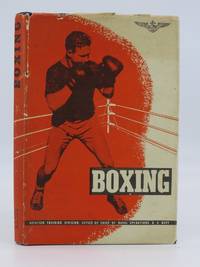
1943réf. 19367Annapolis Maryland: United States Naval Institute. Very Good in Good dust jacket. First Edition. Hardcover. Navy cover is rubbed at corners and caps but clean bright and in very good condition. Boards and spine are straight. Binding is tight. Toning to illustrated end sheets and paste downs. Pages are very lightly toned but clean and very good. Scarce dust jacket is toned and soiled with light tattering along top edge but in in good condition. DJ protected by a brand new clear acid-free mylar cover. We add mylar covers to all books with DJs to preserve the DJs and add luster to magnify their beauty. If pictured shown without the mylar cover for an accurate representation of dust jacket. ; The Naval Aviation Physical Training Manuals; 286 pages . 1943. United States Naval Institute hardcover
2000réf. 017676Stamford: Key Books Ltd. 2000 5th revised edition. Book and dust jacket in good condition. Blue covers and pictorial endpapers circa 80 Spitfires. XXII 650 pages. Photographs illustrations serial numbers camouflage and markings. English language.Extra shipping may required. 5de / 5th. cardboard / karton - hardcover. good / goed/good / goed. A4 formaat. Key Books Ltd. hardcover
réf. 118812Very Good. A gelatin silver print 216 × 166 mm lightly creased at the corner-tips; in excellent condition. The aircraft appear to be a Sopwith Camel and two Avro 504s specific models not determined. Offered with two other photographs of a biplane possibly a Sopwith Camel in the air: one is silhouetted above billowing sunlit clouds 147 × 199 mm printed without margins; the other is shown flying between clouds above hedgerows and fields 216 × 166 mm. We purchased these photographs with a small group of aerial photographs of Leighterton Aerodrome. 'By 1917 the Australian Flying Corps AFC consisted of four operational squadrons which outstripped the ability of the Army's Central Flying School at Point Cook to supply sufficient trained airmen. It was decided therefore to establish training squadrons within the AFC. Four such squadrons were subsequently established in the United Kingdom during 1917. 8 Squadron AFC was formed at Wendover on 24 October 1917. It was originally identified as 33 Australian Training Squadron Royal Flying Corps but was renamed along with all of the Australian squadrons in January 1918. The squadron relocated to Cirencester on 9 January 1918 and thence to Leighterton where it remained until disbanded in April 1919. The squadron's principal role was to prepare personnel for service with what was at first 71 Australian Squadron RFC and subsequently 4 Squadron AFC which was operating with British forces over the Western Front' Australian War Memorial website. 3 items. unknown
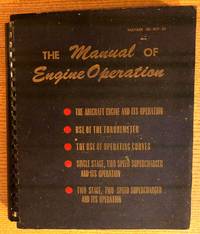
1955réf. 160830Pratt & Whitney 1955. Spiral Bound. Very Good. Book shows very light wear only. Binding is solid and square text/interior is clean and free of marking of any kind. Five section large format spiral bound aircraft manual with the above listed sections. About 200 pages on heavy clean paper color charts and tables many mechanical illustrations with a great many very specific instructions and operation of Pratt & Whitney aircraft: eg.: Shutting off the engine is accomplished as follows: 1. shut off booster pump if applicable. 2. Move mixture control to idle cutt-off or full lean with the throttle open to any idling speed. 3. When the engine stops rotating turn off the ignition. 4. LEAVE THE COWL FLAPS FULL OPEN for at least 15 minutes. Use of Operating Curves section includes Sea Level Calibration Curve Altitude Calibration Curve Brake mean Effective Pressure and Typical Power Curves with three fold-out pages: Auto Lean Operation x2 & Auto Rich Operation. Keywords: Powerplant Lubrication Priming Starting Aircraft Diagrams Charts Tables Manifold Pressure Pratt & Whitney unknown
1955réf. 22328Produced for Private Circulation Flight Refuelling Limited Tarrant Rushton 1955. 8vo. First Edition with full-page photograph and numerous diagrams in the text and large folding map; original blue cloth upper board lettered in gilt a near fine copy. WITH A LONG T.L.s FROM SIR ALAN COBHAM ON FLIGHT REFUELLING LTD STATIONERY TO V H RABY DEPUTY UNDER-SECRETARY OF STATE IN THE AIR MINISTRY. Cobham's detailed letter concludes 'The Report may be regarded as a supplement to Mr. Latimer-Needham's book 'Refuelling in Flight' which appeared in 1950. Together these two publications cover the whole history of research and development leading up to the adoption of flight refuelling on the V-class bombers'. With the separately printed Explanatory Note mounted on front free endpaper verso. Produced for Private Circulation, Flight Refuelling Limited, Tarrant Rushton, hardcover
1930réf. 62531New York NY: Elton-McCardle 500 7th Ave. 1930. 4to. 16 pp unpaginated. printed in red & black and metallic silver ink throughout. With numerous photo illustrations text illustrations diagrams double-page centerfold colour illustration of the “EMCO” design Pilot-Plane in metallic silver black & red center crease fold dustsoiling edgewear minor thumbing small closed tear at lower fore-edge front cover still a VG- copy. First edition stated of this unusually scarce catalogue marketing the “only model plane” fitted with a rudimentary automatic pilot installed into the sailplane which featured an 84 in. wingspan. The prototype model had been tested at Van Cortlandt Park in The Bronx New York prior it’s division into six different park spaces by Robert Moses’s construction of the Henry Hudson Parkway and Mosholu Parkway. The fuselage was designed to be 45 in. long standing 16 in. climbing 500 feet per minute and designed to be dismantled into 6 different pieces and stowed in special case. Although the catalogue is vague on the “Automatic Pilot” it appears to have been some sort of early mechanical gyroscope possibly similar to the autopilot introduced by Sperry and Shiras in 1930 for the US Army Air Corps. Elton 1893-1966 was an aviation enthusiast and cartoonist who began as a sports cartoonist with the Philadelphia Record and Motion Picture Magazine and moved in 1916 to movie animation with Paramount-Bray Studio Cameragraph Film Co. and directed The Whozit Weekly cartoon series for Universal from 1918-1920 where both his sisters worked as silent film actresses. He continued as an animator and cartoonist publishing his “Jack Daw’s Adventures” cartoon strip and then was recruited about 1932-1933 by Walt Disney where he subsequently moved to California and spent the rest of his career until 1950 when he began manufacturing model airplanes again for Hobby Craft Supply Maufacturing in Burbank CA. No copies in Worldcat. Elton-McCardle, 500 7th Ave., unknown