19 282 résultats
réf. 90223aaf1908, in-4to, brochure originale.
1942réf. 5-905North American Aviation. C. 1942. 1942. 1st ed. 325p. Photos. Illustrations. In original printed brown cloth binder loose leaf. "Do not remove from airplane". Copy of H. M. Swanson Class 44-2-C Sqn 7. Copy no. 000054. Heavy. Fine copy. 1st. Hardcover. Fine. North American Aviation. C. 1942. Hardcover
1961réf. 265DGZürich, 1961. Poster - Offset printing. Illustration by Nikolaus Schwabe. 102 x 64 cm. + Wichtig: Für unsere Kunden in der EU erfolgt der Versand alle 14 Tage verzollt ab Deutschland / Postbank-Konto in Deutschland vorhanden +
réf. 185676[Paris], C. Ballard, s.d. (1824) placard in-4 (30 x 24 cm), en feuille. Anecdotiques rousseurs.
1855réf. EEzz81941KParis, 1840-1855. gr.-4°, mit zahlr. gestochenen, teils lith. Abb. im Text, schwarze HLdrbde. d. Zt., 4 Blindbünde, Rückenkanten leicht beschabt, Deckel etw. berieb., insges. sehr gutes Expl. In Französisch. - In dieser überaus wichtigen Architekturzeitschrift werden die verschiedendsten Themen bearbeitet, u.a. über Eisenbahnbau (Bahnhöfe, Bahngebäude etc. ), Aeronautik, Archäologie, Kunsthandwerk, Technik, Elektrizität, Gartenbau etc.
réf. R320135412non précisé. non daté. In-8. Broché. Etat d'usage, Couv. convenable, Dos satisfaisant, Intérieur acceptable. 51 pages - nombreuses illustrations en monochrome hors texte - illustration en couleurs contre collée sur le 1er plat - 3 photos en noir et blanc.. . . A l'italienne. Classification Dewey : 629.1-Aviation
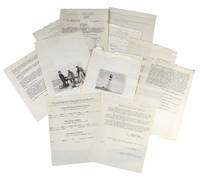
1923réf. 175141923. Wright Orville. Archive of aeronautical speed record trials 1923 a documentary record of early aviation competition and the formalization of international standards for measuring and certifying flight performance. Centered on trials conducted at McCook Field and Wilbur Wright Field in Dayton Ohio the material documents world record attempts over one kilometer 500 kilometers and 1000 kilometers under the supervision of Orville Wright who served as directing official. The archive captures a transitional moment in aviation history when experimental flight gave way to regulated competition with standardized timing calibrated instruments and formal reporting procedures required for international recognition by the Fédération Aéronautique Internationale. Archive comprising 14 manuscript and typed documents in English and French accompanied by two original black and white photographs. Materials include official reports submitted to the National Aeronautic Association and to the Fédération Aéronautique Internationale correspondence addressed to Secretary General Paul Tissandier technical certification documents from the Bureau of Standards and timing sheets recording individual pilot performance. A report dated March 29 1923 details speed trials conducted over 500 and 1000 kilometer courses while related documentation records the surveying and marking of one and three kilometer straightaway courses at Wilbur Wright Field. The bilingual nature of the archive reflects the FAI's use of French as its official language with parallel documentation measuring distinct record categories. Recorded achievements include Lt. R. L. Maughan's one kilometer speed of 380.751 kilometers per hour in a Curtiss R 6 Racer Lt. Alex Pearson's 500 kilometer record at 270.06 kilometers per hour and the 1000 kilometer endurance speed of 205 kilometers per hour achieved by Lts. H. R. Harris and R. Lockwood. Photographs depict course pylons at Wilbur Wright Field and official timer Odis A. Porter observing aircraft performance during timed runs. The archive documents the institutionalization of aviation record keeping in the early twentieth century when governing bodies such as the Fédération Aéronautique Internationale established uniform procedures for homologating records across national contexts. The involvement of Orville Wright alongside officials including Lorin Wright and Odis A. Porter situates the trials within the Dayton aviation community that had been central to powered flight since 1903. These materials illustrate the convergence of engineering innovation military aviation through the U.S. Army Air Service and international oversight demonstrating how record setting functioned both as technological advancement and as a structured competitive discipline. Minor handling wear to documents; photographs well preserved with strong contrast. Overall very good condition. unknown
1923réf. 175141923. Wright Orville. Archive of aeronautical speed record trials 1923 a documentary record of early aviation competition and the formalization of international standards for measuring and certifying flight performance. Centered on trials conducted at McCook Field and Wilbur Wright Field in Dayton Ohio the material documents world record attempts over one kilometer 500 kilometers and 1000 kilometers under the supervision of Orville Wright who served as directing official. The archive captures a transitional moment in aviation history when experimental flight gave way to regulated competition with standardized timing calibrated instruments and formal reporting procedures required for international recognition by the Fédération Aéronautique Internationale. Archive comprising 14 manuscript and typed documents in English and French accompanied by two original black and white photographs. Materials include official reports submitted to the National Aeronautic Association and to the Fédération Aéronautique Internationale correspondence addressed to Secretary General Paul Tissandier technical certification documents from the Bureau of Standards and timing sheets recording individual pilot performance. A report dated March 29 1923 details speed trials conducted over 500 and 1000 kilometer courses while related documentation records the surveying and marking of one and three kilometer straightaway courses at Wilbur Wright Field. The bilingual nature of the archive reflects the FAI's use of French as its official language with parallel documentation measuring distinct record categories. Recorded achievements include Lt. R. L. Maughan's one kilometer speed of 380.751 kilometers per hour in a Curtiss R 6 Racer Lt. Alex Pearson's 500 kilometer record at 270.06 kilometers per hour and the 1000 kilometer endurance speed of 205 kilometers per hour achieved by Lts. H. R. Harris and R. Lockwood. Photographs depict course pylons at Wilbur Wright Field and official timer Odis A. Porter observing aircraft performance during timed runs. The archive documents the institutionalization of aviation record keeping in the early twentieth century when governing bodies such as the Fédération Aéronautique Internationale established uniform procedures for homologating records across national contexts. The involvement of Orville Wright alongside officials including Lorin Wright and Odis A. Porter situates the trials within the Dayton aviation community that had been central to powered flight since 1903. These materials illustrate the convergence of engineering innovation military aviation through the U.S. Army Air Service and international oversight demonstrating how record setting functioned both as technological advancement and as a structured competitive discipline. Minor handling wear to documents; photographs well preserved with strong contrast. Overall very good condition. unknown books
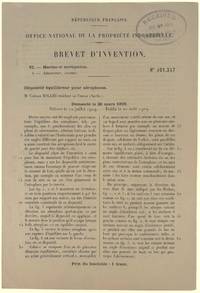
1909réf. 221611909. Bollée Camille. Dispositif équilibreur pour aéroplanes 1909 documents early efforts to solve the problem of aircraft stability in the immediate years following the Wright brothers first powered flight when engineers in Europe and the United States sought mechanical solutions to controlled flight. Issued by the French government this patent establishes a technical approach to maintaining equilibrium through adjustable aerodynamic surfaces mounted on a rotating vertical shaft shifting emphasis from pilot skill to engineered stabilization. The document supports research into early aviation engineering international patent exchange and the rapid development of aeronautical control systems in the pre-World War I period. Bollée Camille. Dispositif équilibreur pour aéroplanes. Paris: Office National de la Propriété Industrielle 1909. Three pages with one illustrated plate containing six technical diagrams; original printed paper wrapper measuring approximately 11 x 7.5 inches. Patent submitted March 26 1909 granted July 12 and published August 21. The text describes a stabilization system "composed of a generally vertical shaft. capable of a rotating motion around its axis upon which one or several surfaces are mounted" designed to counterbalance lateral instability through adjustable aerodynamic elements. Diagrams illustrate variable positioning of these surfaces to alter lift and drag with the stated objective "to maintain the balance of airplanes. for example during lateral gusts or slips." Front page bears a Chicago patent office stamp dated July 27 1910 indicating circulation and review within American patent or engineering contexts. This patent was produced during a period of intense international experimentation in powered flight when inventors across France Germany and the United States pursued competing methods to improve control safety and maneuverability. Bollée's design reflects early recognition of the need for mechanical stabilization systems that could respond dynamically to environmental forces anticipating later developments in controlled flight technologies. The presence of an American stamp demonstrates transatlantic interest in aeronautical innovation at a moment when aviation knowledge circulated rapidly through patent systems and technical publications. Light age toning with faint crease to upper corner; document remains clean and legible; overall near fine condition. This item provides direct evidence of early twentieth century engineering approaches to flight stability and the global exchange of aviation technology. unknown
1909réf. 221611909. Bollée Camille. Dispositif équilibreur pour aéroplanes 1909 documents early efforts to solve the problem of aircraft stability in the immediate years following the Wright brothers first powered flight when engineers in Europe and the United States sought mechanical solutions to controlled flight. Issued by the French government this patent establishes a technical approach to maintaining equilibrium through adjustable aerodynamic surfaces mounted on a rotating vertical shaft shifting emphasis from pilot skill to engineered stabilization. The document supports research into early aviation engineering international patent exchange and the rapid development of aeronautical control systems in the pre-World War I period. Bollée Camille. Dispositif équilibreur pour aéroplanes. Paris: Office National de la Propriété Industrielle 1909. Three pages with one illustrated plate containing six technical diagrams; original printed paper wrapper measuring approximately 11 x 7.5 inches. Patent submitted March 26 1909 granted July 12 and published August 21. The text describes a stabilization system "composed of a generally vertical shaft. capable of a rotating motion around its axis upon which one or several surfaces are mounted" designed to counterbalance lateral instability through adjustable aerodynamic elements. Diagrams illustrate variable positioning of these surfaces to alter lift and drag with the stated objective "to maintain the balance of airplanes. for example during lateral gusts or slips." Front page bears a Chicago patent office stamp dated July 27 1910 indicating circulation and review within American patent or engineering contexts. This patent was produced during a period of intense international experimentation in powered flight when inventors across France Germany and the United States pursued competing methods to improve control safety and maneuverability. Bollée's design reflects early recognition of the need for mechanical stabilization systems that could respond dynamically to environmental forces anticipating later developments in controlled flight technologies. The presence of an American stamp demonstrates transatlantic interest in aeronautical innovation at a moment when aviation knowledge circulated rapidly through patent systems and technical publications. Light age toning with faint crease to upper corner; document remains clean and legible; overall near fine condition. This item provides direct evidence of early twentieth century engineering approaches to flight stability and the global exchange of aviation technology. unknown books
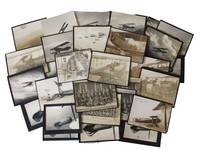
1918réf. 177171918. World War I military aviation. Primary-source photographs documenting early United States military aviation training at Henry Post Airfield Fort Sill Oklahoma during the formative period of the U.S. Army Air Service following its establishment in May 1918. The images record the first generation of American military pilots operating within a rapidly developing aviation program built in response to World War I supporting research into the expansion of U.S. airpower pilot training infrastructure and the integration of aircraft into military operations. The presence of DH-4 two-seat biplane bombers the principal American-built combat aircraft of the war situates the archive within the transition from experimental aviation units to operational military squadrons. A dated caption identifying "October 29 1918 Sergeant Schauble" flying at 3700 feet further anchors the material within the final phase of the war. Archive of 26 silver gelatin photographs Fort Sill Oklahoma circa 1917-1918 each measuring approximately 7.25 x 5.25 inches. The archive includes many photos of the biplanes in the air one photo shows several DH-4 bombers soaring in the clouds in a Flying-V formation. A handwritten caption on one image "October 29 1918 Sergeant Schauble " is depicted flying in a DH-4 at 3700 feet as well as going on a "parachute trip". One photo shows a serious plane crash with two DH-4s biplanes nose down in the ground. The pilots are also depicted in hot air balloons. Fort Sill was home to several US Army Balloon Companies during this period which were still primarily used for reconnaissance and directing aerial bombardment during World War I. The photo archive includes many shots of biplanes in the clouds or on runways with pilots in goggles including 4 images of pilots or troops in group shots. Most photos show the planes or balloons in mid air. . Army balloon companies stationed at Fort Sill for reconnaissance and artillery observation. Several images capture aircraft at altitude among cloud formations while others document runway activity and pre-flight staging. Versos of many prints retain remnants of black album paper indicating removal from a compiled photographic album. The archive documents the early operational environment of American military aviation at a moment when the United States was rapidly expanding its aerial capabilities following limited prewar development including the Army's first acquisition of aircraft from the Wright brothers in 1909. Henry Post Airfield functioned as a central training site for pilots entering service during World War I and the inclusion of both airplane and balloon units reflects the continued reliance on multiple aerial technologies for reconnaissance and combat support. The photographs provide visual evidence of training practices aircraft deployment and the material conditions of early air service operations during a period of institutional formation. Minor edge wear and surface wear are present with album residue on versos; overall very good condition. A cohesive photographic record of early U.S. military aviation training and aircraft use during World War I. unknown
1918réf. 177171918. World War I military aviation. Primary-source photographs documenting early United States military aviation training at Henry Post Airfield Fort Sill Oklahoma during the formative period of the U.S. Army Air Service following its establishment in May 1918. The images record the first generation of American military pilots operating within a rapidly developing aviation program built in response to World War I supporting research into the expansion of U.S. airpower pilot training infrastructure and the integration of aircraft into military operations. The presence of DH-4 two-seat biplane bombers the principal American-built combat aircraft of the war situates the archive within the transition from experimental aviation units to operational military squadrons. A dated caption identifying "October 29 1918 Sergeant Schauble" flying at 3700 feet further anchors the material within the final phase of the war. Archive of 26 silver gelatin photographs Fort Sill Oklahoma circa 1917-1918 each measuring approximately 7.25 x 5.25 inches. The archive includes many photos of the biplanes in the air one photo shows several DH-4 bombers soaring in the clouds in a Flying-V formation. A handwritten caption on one image "October 29 1918 Sergeant Schauble " is depicted flying in a DH-4 at 3700 feet as well as going on a "parachute trip". One photo shows a serious plane crash with two DH-4s biplanes nose down in the ground. The pilots are also depicted in hot air balloons. Fort Sill was home to several US Army Balloon Companies during this period which were still primarily used for reconnaissance and directing aerial bombardment during World War I. The photo archive includes many shots of biplanes in the clouds or on runways with pilots in goggles including 4 images of pilots or troops in group shots. Most photos show the planes or balloons in mid air. . Army balloon companies stationed at Fort Sill for reconnaissance and artillery observation. Several images capture aircraft at altitude among cloud formations while others document runway activity and pre-flight staging. Versos of many prints retain remnants of black album paper indicating removal from a compiled photographic album. The archive documents the early operational environment of American military aviation at a moment when the United States was rapidly expanding its aerial capabilities following limited prewar development including the Army's first acquisition of aircraft from the Wright brothers in 1909. Henry Post Airfield functioned as a central training site for pilots entering service during World War I and the inclusion of both airplane and balloon units reflects the continued reliance on multiple aerial technologies for reconnaissance and combat support. The photographs provide visual evidence of training practices aircraft deployment and the material conditions of early air service operations during a period of institutional formation. Minor edge wear and surface wear are present with album residue on versos; overall very good condition. A cohesive photographic record of early U.S. military aviation training and aircraft use during World War I. unknown books
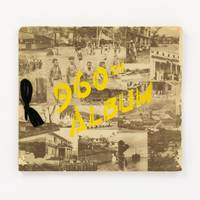
1945réf. 138169The Philippines: 960th Engineer Aviation Topographic Company 1945. First Edition. Paperback. Very Good. The Philippines 960th Engineer Aviation Topographic Company 1945. Oblong quarto 255 × 288 mm 45 leaves printed rectos only comprising the title-cover on a background of a collage of some two dozen illustrations and 44 leaves containing 133 illustrations with all illustrations reproduced from photographs. Shoelace-bound three-colour pictorial card cover a little worn at the extremities with trifling surface loss to silverfish; two leaves a little soiled; expert conservation to small chips and tears to the edges of four leaves; minor signs of age and use including some annotations - see below; overall a very good copy. The first leaf contains a large illustration of a Lockheed P-38 Lightning designed as a fighter but used in a variety of roles including aerial reconnaissance. An inscription in ink on the illustration identifies the pilot as '1st. Lt. Alexander Roberts Dec. 1943 New Guinea'. Written in the margin below the illustration is '960th Photo Recon. Dobodura New Guinea Non. sic 1943 - Feb. 1944 Ie Shima April 1945 P.I. Feb. 44 - Ap. 1945 Honolulu Sept 1945 deact.'. The servicemen in the four illustrations on the fourth leaf are identified: from left to right top to bottom they are 'MSgt. Burts' 'Ingelmann' 'Johnson' and '"Jesse" James and Samualson'. The dog on the next page is 'Killer'. At the rear Ernie Pyle's grave is identified. 'The second phase of the Okinawa Campaign consisted of the objectives of Ie Shima which housed the big airfield of the islands and Motobu Peninsula. With Rear Admiral Lawrence F. Reifsnider USN commanding the attack group the U.S. Army's 77th division landed on April 16 1945. The invading force thought that the Japanese had abandoned the airfield due to aerial photo reconnaissance but they met about 3000 men as they moved towards the center of the island. Not unlike the Battle for Iwo Jima the island had networks of underground tunnels enhanced by Mt. Gosuki but the island was secured on April 21. Famed War Correspondent Ernie Pyle was killed on Ie Shima while covering the occupation. To repair the destruction caused by prior bombing and naval gunfire support U.S. Navy Seabees repaired the airstrips. Of note the island was utilized by the Japanese Surrender delegation in mid-August 1945 as a stop point between Japan and Manila Bay Philippines for negotiations with General Douglas A. McArthur USA' National Museum of the United States Navy online. The illustrations in this rare souvenir cover a wide range of the activities of the 960th in the Pacific theatre during the Second World War. 960th Engineer Aviation Topographic Company paperback
1929réf. 142560Adelaide: Harry Carew Nott 1929. Fine. Adelaide Harry Carew Nott 1929. A commercial photograph album oblong quarto 230 × 318 mm comprising 4 card leaves cord-bound in overlapping card covers with 21 gelatin silver photographs 84 × 136 mm or the reverse loosely attached with photocorners on both sides of the leaves and the inside surface of the covers; all photographs are captioned in white ink on the mount. Cord-bound commercial album stamped in blind 'Portraiture'; covers slightly marked and a little worn at the corners; the contents are in fine condition the last photograph is creased and cracked at one corner. A lengthy article related to this event appeared in 'The Advertiser' Thursday 23 May 1929: 'The Victorian section of the Australian Aero Club will conduct an aerial pageant at the Essendon Aerodrome near Melbourne on Saturday afternoon. The programme of events includes the Aerial Derby for which over 20 machines have been entered. Of these about eight will represent New South Wales and eight Victoria. South Australia will also have a strong representation. Seven planes will leave the Parafield Aerodrome for Melbourne this morning at 9.30 if the weather permits. The following planes will comprise the formation: D.H. 60 Gipsy Moth G-AUIB D.H. Moth V-HUAM D.H. Moth V-EUAR D.H. Gipsy Moth G-AUIV D.H. Gipsy Moth G-AUKO Avro Avian G-AUSY and probably the De Havilland "Old Gold" passenger machine. The first three are Aero Club planes and the others are privately owned. Flying-Officer J.A. Mollison Aero Club instructor will be leader of the formation and Mr. C.A. Hewitt will be deputy-leader. Others making the flight to Melbourne are Messrs. N. Birks J.A. Jukes A.H. Wilkins E.B. Lawson P. Knapman F. Wellington S. Hamilton L. Wood J. Churchill Smith secretary of Aero Club and Dr. H.C. Nott. The flight to Essendon will be made via Nhill Victoria. Friday will be spent by the airmen in tuning up engines for the races on the following day'. The first eight photographs were taken at Parafield Aerodrome in outer-suburban Adelaide with portraits of Nott and Wood identified. These are followed by two at Nhill Aerodrome 'Mollison refuelling' and 'Lawson'; two at Ararat Aerodrome 'on Racecourse'; and eight taken at Rockbank 28 kms west of Melbourne. These are captioned 'Mollison taking off in "1B"'; 'Hewitt'; 'Nott in "A5"'; Lawson Mollison Hewitt & Wellington éxamining "A17"'; 'Hewitt Mollison Lawson & Wellington'; 'Nott Mollison Lawson & Wellington'; and 'Mollison Lawson & Hewitt'. The last one taken from the air is captioned 'Crashed Aero at Nhill'. The Nhill Aviation Heritage Centre website records that on 23 May 1929 'J.A. Mollison arrived from Adelaide with 6 aircraft. One crash-landed at old Dimboola road aerodrome instead of landing at New site at Halpin Park'. The pilot was possibly Lin Wood. Harry Carew Nott unknown
réf. 010438Inglewood CA: North American Aviation Inc 251pp ix index 12pp emergency; num bw ills. Or green leather look 'vinyl' covers. Ring binding with 2 sets of 3 rings. Some darkening and rubbing to covers some binding holes pulled moderate notations throughout. From writing on title page appears to be an engineers copy. Front cover states 'Not to be removed from airplane' accounting for the extreme scarcity of this wartime bomber flight manual. From title page:This document contains information affecting the security of the United States within the meaning of the espionage Act USC 50-31 and 32. Its transmission or the revelation of its contents in any manner to any unauthorized person is prohibited by law'. This statement now obsolete under 50 year public access ruling. Comprehensive WWII flight manual for B-25C and D bombers of the utmost scarcity. First Edition. Hard Cover. Very Good. Large 8vo. North American Aviation Inc Hardcover
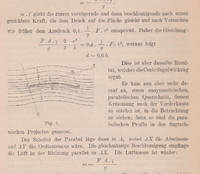
1895réf. 13050Berlin : Zeit. f. Luftschiffahrt u. Physik der Atmosphare 1895. Offprint. as issued. A good copy; corner waterstain at the top; rumpling to edges. 8vo. There are several text illustrations. A 16 page offprint of Lilienthal's experiments to determine the best profile i.e. curve of a wing to maximize lift. A critical element in flight either gliding or powered. This copy of the offprint has an ink inscription in the hand of the recipient : ' Presented to GSC Greely S Curtis with the author's compliments '. There are some light annotations and designs in pencil on a blank portion of the offprint. Curtis was an American aviation pioneer. See Gibbs-Smith . Aeroplane and Davy . Flight - for an account of Lilienthal. Zeit. f. Luftschiffahrt u. Physik der Atmosphare unknown books
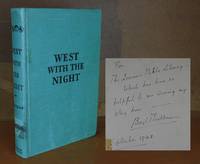
1942réf. 19265Boston: Houghton Mifflin Company 1942. Hardcover. Good-/No Jacket. Boston: Houghton Mifflin Company 1942. Early printing probably 1st year. 294 pages. Good-. Tight binding; exlibrary with usual marks; pages mostly clean; spine a little sticky in one spot due to old label residue; covers have some wear scuffing and soil; no jacket. Very scarce signed. West with the Night is a 1942 memoir by Beryl Markham chronicling her experiences growing up in Kenya then British East Africa in the early 1900s leading to celebrated careers as a racehorse trainer and bush pilot there. It is considered a classic of outdoor literature. In 2004 National Geographic Adventure ranked it number 8 in a list of 100 best adventure books. Markham was the first person to fly the Atlantic east to west in a solo non-stop flight a westbound flight requires more endurance fuel and time than the eastward journey because the craft must travel against the prevailing Atlantic winds. When Markham decided to take on the Atlantic crossing no pilot had yet flown non-stop from Europe to New York and no woman had made the westward flight solo though several had died trying. Markham hoped to claim both records. On 4 September 1936 she took off from Abingdon England. After a 20-hour flight her Vega Gull The Messenger suffered fuel starvation due to icing of the fuel tank vents and she crash-landed at Baleine Cove on Cape Breton Island Nova Scotia Canada. Markham had become the first woman to cross the Atlantic east-to-west solo and the first person to make it from England to North America non-stop from east to west. She was celebrated as an aviation pioneer. SEE OUR OTHER LISTINGS FOR MORE INTERESTING AND COLLECTIBLE TITLES. . Boston: Houghton Mifflin Company hardcover
1969pp. xv, 691. Black and white photos. List of abbreviations and symbols. Alphabetical list of aircraft with cross references. Bilingual English/French text. Printed upon glossy stock. Represents "the first attempt to consolidate basic information such as type, serial, source, and disposition of all the more than 22,000 military aircraft that have been used in Canada by Canadian military forces." - Forward. "Contains an individual entry for every aircraft on charge or on formal loan to the Military Air Forces of Canada from inception through to 31 January 1968, the eve of the creation of the unified Canadian Armed Forces. All aircraft are cross referenced by type listing and registration. In addition the civil registration provided in Chapter 10 give an insight into the disposition or the acquisition of civil types used by the military, or military types used for civil applications." - xi. Moderate wear to unmarked book. Moderate lean to spine. Above-average wear to dust jacket now preserved in archival-grade Brodart. A sound copy of this extraordinary reference which represents eight years of devoted research by the author, who flew Liberators in the Second World War. Cooke [3e] p.334 Book
1969réf. 2110502150903106Jijitsushinsha 1969. Soft Cover. Fine. Number of books: 4 Jijitsushinsha paperback
197044 parts in 1 vol., 8vo., First Edition, with very numerous photographs and fine coloured illustrations throughout; strongly bound in maroon buckram, gilt back, ALL ORIGINAL WRAPPERS PRESERVED, all fine copies. The Profiles are bound in alphabetical order of manufacturer/aircraft. The collection comprises (series number in brackets) : Albatross DI-DIII (127); Albatross D V (9); O. Aviatik (Berg) D1 (151); B.E.2, 2a & 2b (133); Breguet 14 (157); Bristol Scouts C&D (139); Bristol Fighter (21); Bristol M.1 (193); Curtiss JN-4 (37); de Havilland D.H.2 (91); American D.H.4 (97); de Havilland D.H.4 (26); de Havilland D.H.5 (181); de Havilland D.H.9 (62); de Havilland D.H.10 (145); Fokker Dr.I (55); Fokker D.VII (25); Fokker D.VIII (67); Fokker Monoplanes (38); Gotha GI-GV (115); Hanriot HD1 (109); Junkers Monoplanes (187); Martinsyde Elephant (200); Nieuport I7 (49); Nieuport N.28C-I (79); Pfalz D III (43); Pfalz D XII (199); Phonix Scouts (175); R.E.8 (85); Roland C II (163); S.E.5 (103); S.E.5A (1); Short 184 (74); Siemens Schuckert D III & IV (86); Sopwith Camel F.I (31); Sopwith Dolphin (169); Sopwith Pup (13); Sopwith 7F.I Snipe (50); Sopwith 1&1/2 Strutter (121); Sopwith Triplane (73); Spad XIII C.1 (17); S.V.A. (Ansaldo) Scouts (61); Thomas-Morse Scout (68); Vickers F.B.27 Vimy (5). A SPLENDID COLLECTION SAFELY PRESERVED FOR THE FUTURE.
19528vo., Fifth Impression, with portrait frontispiece and 17 plates on 12; navy cloth, gilt back, a very good, bright, clean copy in unclipped dustwrapper, the latter lightly chafed at extremities. SIGNED IN PENCIL ON TITLE BY DAM BUSTERS VETERANS JOHNNY JOHNSON (T-Tommy) AND LES MUNRO (W-Willie), AND ADDITIONALLY BY MARY STOPES-ROE (daughter of Barnes-Wallis). A photograph with printed signature of Richard Todd (Wing Commander Guy Gibson in Michael Anderson's well-known film) is mounted on front free endpaper. Published a year after the first edition. The moving story of RAF Bomber Command's most famous squadron and arguably the most famous air exploit of WWII. The stirring 'Dam Busters March', written by Eric Coates as the theme to the movie, was almost immediately adopted as an official march of the Royal Air Force. Enser, p.64; Mulholland & Jordan B121 (recording the first edition).
réf. 202203787Paris, Librairie hachette, 1919 ; in-4, 40 pp., cartonnage de l'éditeur. Eo dédicacé par l'auteur en 1919: Préface du capitaine Madon - scènes de l'aviation militaire - rare -.
1919réf. 40826Paris Hachette 1919 In-4, cartonnage illustr de l'diteur.Edition originale de cet album richement illustr par Marcel Jeanjean de planches et vignettes humoristiques en couleurs, reprsentant des scnes de l'aviation militaire durant la guerre de 14-18. Marcel Jeanjean (1893-1973) fut un illustrateur fcond dans le domaine de l'aviation. Pilote durant la premire guerre mondiale, et promu pilote de reconnaissance en 1917, il croqua la vie quotidienne de son escadrille sur des carnets dont il tirera plus tard cet album de croquis. Exemplaire en parfait tat.
1969réf. 115919Genève (CH), Interavia S.A. 1969 In-4 33 x 24,5 cm. Présentation composite. Brochés, couvertures illustrées, environ 90 pp. par numéro, abondamment illustré. Ensemble en bon état.
1990255 pages. Signed and dated by both authors. Hand-numbered copy #1216 of 2000. Index. 65 colour photos. 297 black and white photos. 46 formation diagrams. "Colonel O.B. Philp, know as 'the father of the Snowbirds', has recalled from birth the early years of the internationally renowned aerobatic squadron... Published to mark the Snowbirds 20th anniversary in 1990." - B.C. Bookworld. Clean, bright and unmarked with negligible wear. Dust jacket now preserved in archival-grade Brodart cover. Superb copy. Book