19 028 résultats
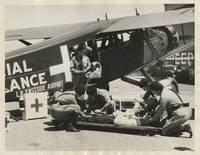
1934réf. BK0141Los Angeles: Associated Press 1934. Original press photograph measuring approximately 9 x 7 inches. Typed press caption affixed to verso International News Photos stamp manuscript editorial markings. Excellent. A press photograph documenting an early women's airborne emergency medical organization in Los Angeles. The image shows members of a women's flying medical unit gathered beside an airplane during first aid maneuvers on July 9 1934. The unit brought together women interested in aviation and emergency medicine and trained its members to provide rapid medical assistance in the event of disasters and other national emergencies. The detailed original caption explains that the newly organized medical unit was a detachment of the Women's Air Reserves conducting its first maneuvers in Los Angeles intended "to prepare its members to render speedy and effective service in first aid work in times of disaster or national emergency." It identifies Lieut. Emma Kittredge standing as directing a first aid exercise beside the detachment's ambulance ship. The photograph provides a visual record of women's involvement in aviation organized emergency preparedness and medical training during the interwar period. . Associated Press unknown books
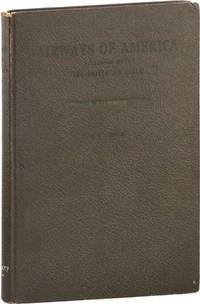
1933réf. 88120New York: The Geograhpical Press / Columbia University 1933. First Edition. Octavo. Brown simulated leather over boards hardcover; 207pp; illus; map endpapers; large folding map in rear pocket as issued. Private or non-circulating library copy with neat white ink shelf-number at base of spine and ink annotation to rear endpaper no institutional markings. Light external wear but still a sound Very Good copy. A fascinating work dating from the earliest years of American commercial aviation utilizing aerial photography to identify prominent geological and geographical features visible to the trans-continental air traveller. The book's sub-title suggests that this was the first of a planned series of related studies but we find no evidence that further works were published. The Geograhpical Press / Columbia University unknown books
1982réf. 86327London: Putnam 1982. Fifth Revised Edition. Octavo. 22cm. Publisher's dark blue cloth titled in gilt to spine. Dustjacket. 489pp. Very light wear and bumping to spine ends and extremities clean and tight; internally clean and fresh. A near fine copy. A frequently revised and updated reference work of naval aviation and equipment originally published in 1958. From the library of Nathaniel Tarn noted poet translator and bibliophile with his bookplate to the front pastedown. Putnam unknown books
1962réf. 86624London: Putnam 1962. First U.K. Edition. Octavo. 22cm. Publisher's black and white speckled cloth titled in gilt to spine. Dustjacket. 278pp. Some minor bumping to spine ends and corners clean and tight; internally clean and fresh red endpapers red topstain some spotting and soiling to page edges; in a strong lightly sunned dustjacket with some light scuffing and soiling to the white rear panel some fading to the spine panel and a couple of cosmetic nicks to the extremities. A very good copy. A biography written by Air Vice Marshall Wykeham of the RAF no stranger to risky aeronautical adventure himself of the eccentric intrepid and influential Alberto Santos-Dumont. A Brazilian aeronut first inspired by the ill-fated Andree balloon adventure to the pole but then branching out into the design and flight of a number of prototype fixed wing aircraft. Santos-Dumont is considered by many to be arguably the first man to fly a powered aeroplane but his work was beaten to the punch by the Wright Brothers who were considerably less erratic a circumstance which bedevilled Santos-Dumont for the remainder of his life. A much neglected personality in the field of aeronautical design exploration and development. Putnam unknown books
1913réf. 49234Boston: James Means 1913. 12mo 18cm. Staple-bound printed wrappers; 10pp. Trivial external soil else Near Fine. James Means 1855-1920 is best remember as the publisher and editor of the influential Aeronautics Annuals that appeared in 1895-7 providing a clearing-house for the latest trends in aviation engineering and providing a basis for the innovations of Orville and Wilbur Wright. The current publication advertises refinements to Means' simplified control column for which he originally won a patent in 1911. James Means unknown books
1965réf. 108656Washington DC: U.S. Government Printing Office 1965. Softcover. Very Good. First edition. Very good with a large coffee stain around the wrappers and spine. U.S. Government Printing Office unknown books
1950réf. 158188Paris: Union Aéromaritime de Transport 1950. Two vintage Union Aéromaritime de Transport UAT airline ticket envelopes circa 1950s. UAT was founded in 1949 in Paris by a group of technicians and the shipping line Chargeurs Réunis and was headquartered out of the 8th arrondissement of Paris. In 1963 the company merged with Transports Aériens Intercontinentaux to form Union de Transports Aériens. 8 x 4.75 inches. Near Fine. Union Aéromaritime de Transport unknown books
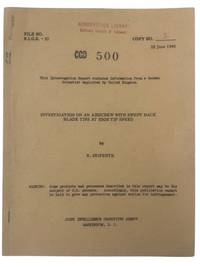
1946réf. 236021946. German aeronautical research on swept-back airscrew blade design 1946 documenting the Allied technical intelligence program that captured translated and rapidly disseminated advanced German aviation research immediately following the Second World War. Prepared from work conducted at the British Ministry of Aircraft Production M.A.P. Völkenrode and originating in research begun under the renowned aerodynamicist Albert Betz at Göttingen the report examines swept-back propeller blade tips operating at extremely high rotational speeds as German engineers sought solutions to compressibility effects encountered as aircraft approached the speed of sound. R. Seiferth's Investigation on an Airscrew with Swept Back Blade Tips at High Tip Speed a draft translation dated April 1 1946 issued by the Joint Intelligence Objectives Agency as CGD 500 on 22 June 1946. Reports and Translations. 10 × 8 inches. Six leaves stapled. The title page identifies the work as a translation prepared at M.A.P. Völkenrode while the printed JIOA wrapper states "This Interrogation Report contains Information from a German Scientist exploited by United States." The report summarizes experimental investigations into swept-back airscrew geometry at high tip speeds discussing aerodynamic efficiency compressibility effects and comparative testing. The front wrapper bears the manuscript notation "500 Seiferth" and the ownership stamp of the California Institute of Technology Aeronautics Library preserving the provenance of this copy within one of America's leading postwar centers of aeronautical research. Light handling wear; original staples intact; library stamp and manuscript notation to front wrapper. Overall good condition. Although focused on propeller aerodynamics rather than the turbojet itself the report examines many of the same high-speed airflow problems that confronted the emerging jet age including shock-wave formation compressibility aerodynamic efficiency and transonic flight. It presents experimental investigations into swept-back airscrew geometry at high tip speeds and comparative testing within the broader body of German aerodynamic research that proved invaluable to Allied aircraft designers developing the first generation of practical jet aircraft turboprop engines and high-speed military aviation after 1945. By the end of the war Germany possessed the world's most advanced operational jet aircraft including the Messerschmitt Me 262 fighter and Arado Ar 234 jet bomber while German scientists were conducting extensive research into swept wings high-speed aerodynamics and propulsion concepts that were years ahead of most Allied programs. Recognizing the extraordinary military and scientific value of this work Allied technical intelligence teams immediately secured German laboratories interrogated leading engineers and translated thousands of reports before the information could be lost. Issued by the Joint Intelligence Objectives Agency as CGD 500 on 22 June 1946 Seiferth's report formed part of that remarkable series of intelligence publications that transferred German wartime aeronautical knowledge into American and British research establishments accelerating the development of the first generation of postwar jet-powered aircraft. unknown books
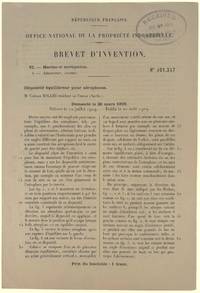
1909réf. 221611909. Bollée Camille. Dispositif équilibreur pour aéroplanes 1909 documents early efforts to solve the problem of aircraft stability in the immediate years following the Wright brothers first powered flight when engineers in Europe and the United States sought mechanical solutions to controlled flight. Issued by the French government this patent establishes a technical approach to maintaining equilibrium through adjustable aerodynamic surfaces mounted on a rotating vertical shaft shifting emphasis from pilot skill to engineered stabilization. The document supports research into early aviation engineering international patent exchange and the rapid development of aeronautical control systems in the pre-World War I period. Bollée Camille. Dispositif équilibreur pour aéroplanes. Paris: Office National de la Propriété Industrielle 1909. Three pages with one illustrated plate containing six technical diagrams; original printed paper wrapper measuring approximately 11 x 7.5 inches. Patent submitted March 26 1909 granted July 12 and published August 21. The text describes a stabilization system "composed of a generally vertical shaft. capable of a rotating motion around its axis upon which one or several surfaces are mounted" designed to counterbalance lateral instability through adjustable aerodynamic elements. Diagrams illustrate variable positioning of these surfaces to alter lift and drag with the stated objective "to maintain the balance of airplanes. for example during lateral gusts or slips." Front page bears a Chicago patent office stamp dated July 27 1910 indicating circulation and review within American patent or engineering contexts. This patent was produced during a period of intense international experimentation in powered flight when inventors across France Germany and the United States pursued competing methods to improve control safety and maneuverability. Bollée's design reflects early recognition of the need for mechanical stabilization systems that could respond dynamically to environmental forces anticipating later developments in controlled flight technologies. The presence of an American stamp demonstrates transatlantic interest in aeronautical innovation at a moment when aviation knowledge circulated rapidly through patent systems and technical publications. Light age toning with faint crease to upper corner; document remains clean and legible; overall near fine condition. This item provides direct evidence of early twentieth century engineering approaches to flight stability and the global exchange of aviation technology. unknown books
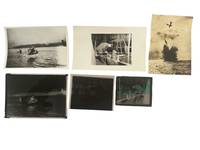
1912réf. 225241912. Unknown photographer Wright hydroaeroplane and early biplane models photo archive circa 1912 to 1913 documents early American seaplane experimentation during the period when the Wright Company adapted its pusher aircraft technology for water takeoff alighting and military use. The photographs capture a hydroaeroplane on or near water a dramatic water-impact or alighting scene and a hangar interior where men work over the open framework of a Wright-type machine providing visual evidence of experimental aircraft handling float design rigging and workshop adjustment. Wright State University's Wright Brothers Collection identifies a 1913 photograph of Orville Wright standing in the Miami River between the pontoons of a Wright Model CH Flyer confirming the Great Miami River as a documented site for Wright Model CH hydroaeroplane testing in this period. Six pieces total comprising three silver gelatin prints each approximately 7 x 5 inches and three contemporaneous negatives including two large-format film negatives and one smaller glass or film negative likely made in the Dayton Ohio area and a Wright Company hangar. The largest print shows a pusher-type biplane with forward elevator and floats partly submerged near a piling giving the aircraft an unmistakable hydroaeroplane profile. A second sepia-toned print captures a tall column of spray in open water as a small aircraft passes overhead or just beyond the splash likely recording a hard alighting water-impact or test-run sequence. A third print shows an interior hangar scene with two mechanics or engineers in caps and a man in a straw boater leaning over the exposed structure of a Wright machine; visible details include struts bracing wires control runs open framework and fittings along the central bay. The three negatives correspond to the water-impact and hangar views preserving additional technical detail of the rigging geometry float or skid attachments and pusher layout. The visual evidence aligns closely with Orville Wright's 1913 Model C-H hydroaeroplane work on the Miami River south of Dayton though attribution to a specific flight or photographer should remain cautious without inscriptions or provenance beyond the images themselves. Contemporary and local Wright histories describe the Model C-H as a hydroaeroplane tested by Orville on the Miami River in 1913 and one Dayton aviation history account states that in May 1913 he resumed testing the Model C-H at a secluded Miami River site and made 100 flights carrying up to 800 pounds of payload. The photographs matter because they show the Wright enterprise after Wilbur Wright's death in 1912 when Orville continued technical experimentation even as competitors especially Glenn Curtiss pressed forward in flying-boat development. Light edge creases and small corner bumps to the prints one print with faint silvering and toning negatives with light emulsion scuffing and edge tape remnants but strong density and detail very good overall. Focused early aviation archive preserving both river testing and workshop evidence from the moment Wright biplane design was being adapted to hydroaeroplane use on the eve of World War I. unknown books
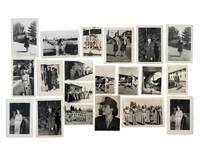
1943réf. 213501943. Women's Army Corps service and female aviation training during World War II documented in photographs dating from approximately 1943 to 1945. The images record the wartime expansion of women's participation in the United States military following the establishment of the Women's Army Corps in 1943 and the parallel development of programs that placed women in aviation related roles supporting the war effort. The photographs depict women in uniform participating in military drill training activities and aviation work around small aircraft illustrating the increasing presence of women in technical and logistical positions that supported military operations during the war. One image taken at Treasure Island in San Francisco situates part of the archive within one of the major naval training and transit centers used by the United States during the conflict. Archive of 20 original black and white silver gelatin photographs dating from the World War II years. Several images show members of the Women's Army Corps posing in formation saluting and participating in organized training exercises. Other photographs depict women standing beside small aircraft preparing for flight or seated in cockpits suggesting involvement in aviation training or aircraft support work connected to wartime flight programs. Informal photographs show servicewomen gathered outside wooden barracks relaxing in flight gear and posing beside aircraft. One photograph identifies the location as Treasure Island San Francisco. Several prints contain handwritten inscriptions on the reverse identifying individuals and dates including notes such as "Sincerely Leona" along with named individuals including Sensabough Bash Braughton Rogers Mazie Paula and June and Kay Gallagher with Bud Sterthors and Donley. During World War II the Women's Army Corps allowed women to serve in uniform in administrative mechanical and communications positions that had previously been reserved for men while aviation related programs trained women to ferry aircraft and assist in technical flight operations. These initiatives formed part of the broader mobilization of American women into wartime labor and military service during the 1940s. Photographic documentation of female service members provides important visual evidence of the changing roles of women within the armed forces during the war. Photographs measure approximately 3.5 x 5 inches and are preserved as loose prints. Minor edge wear and light creasing visible on several photographs; overall very good condition. The archive offers concise visual documentation of women's military and aviation participation during the Second World War. unknown books
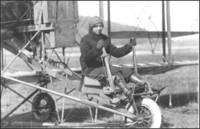
réf. 18789Women in Aviation. Silver gelatin print photo of female pilot sitting in early aircraft with her hands on the gears the body of the plane partially visible behind her. Circa 1920s. 4.75" x 6.5" inches. Legislative barriers as well as social and economic factors made it nearly impossible for women to participate in early aviation. Getting through flight school and gaining access to a plane to fly was a testament to the incredible tenacity and resources required for a woman to access both. Photo shows a woman sitting belted to pilot's seat one hand on each large gear shift feet prepped on the thin ledge above the plane's front tire. She wears a gingham hat cut close to her head a wool coat wool pants and knee-high leather boots with protective-wear covering the shins. The plane's front tire is muddy suggesting she's just landed in a field. A few ink spots do not obstruct the plane or female pilot. This original photo is evidence that women participated in early aviation. Overall good condition. unknown books
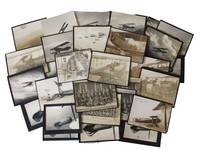
1918réf. 177171918. World War I military aviation. Primary-source photographs documenting early United States military aviation training at Henry Post Airfield Fort Sill Oklahoma during the formative period of the U.S. Army Air Service following its establishment in May 1918. The images record the first generation of American military pilots operating within a rapidly developing aviation program built in response to World War I supporting research into the expansion of U.S. airpower pilot training infrastructure and the integration of aircraft into military operations. The presence of DH-4 two-seat biplane bombers the principal American-built combat aircraft of the war situates the archive within the transition from experimental aviation units to operational military squadrons. A dated caption identifying "October 29 1918 Sergeant Schauble" flying at 3700 feet further anchors the material within the final phase of the war. Archive of 26 silver gelatin photographs Fort Sill Oklahoma circa 1917-1918 each measuring approximately 7.25 x 5.25 inches. The archive includes many photos of the biplanes in the air one photo shows several DH-4 bombers soaring in the clouds in a Flying-V formation. A handwritten caption on one image "October 29 1918 Sergeant Schauble " is depicted flying in a DH-4 at 3700 feet as well as going on a "parachute trip". One photo shows a serious plane crash with two DH-4s biplanes nose down in the ground. The pilots are also depicted in hot air balloons. Fort Sill was home to several US Army Balloon Companies during this period which were still primarily used for reconnaissance and directing aerial bombardment during World War I. The photo archive includes many shots of biplanes in the clouds or on runways with pilots in goggles including 4 images of pilots or troops in group shots. Most photos show the planes or balloons in mid air. . Army balloon companies stationed at Fort Sill for reconnaissance and artillery observation. Several images capture aircraft at altitude among cloud formations while others document runway activity and pre-flight staging. Versos of many prints retain remnants of black album paper indicating removal from a compiled photographic album. The archive documents the early operational environment of American military aviation at a moment when the United States was rapidly expanding its aerial capabilities following limited prewar development including the Army's first acquisition of aircraft from the Wright brothers in 1909. Henry Post Airfield functioned as a central training site for pilots entering service during World War I and the inclusion of both airplane and balloon units reflects the continued reliance on multiple aerial technologies for reconnaissance and combat support. The photographs provide visual evidence of training practices aircraft deployment and the material conditions of early air service operations during a period of institutional formation. Minor edge wear and surface wear are present with album residue on versos; overall very good condition. A cohesive photographic record of early U.S. military aviation training and aircraft use during World War I. unknown books
1910réf. 173311910. Flight. No. 63 No.11 Vol. II. March 12 1910 London UK. 197 pages. 8.5" x 12" inches. Early aviation weekly magazine that acted as the official organ of the Royal Aero Club of the United Kingdom. Contains multiple articles introducing and analyzing airplane models such as the Wright biplane Macfie British Aeroplane Avis Monoplane and more. This was clearly a highly inventive time in the aeronautical field with a multitude of companies producing these rudimentary single passenger planes for hobbyists such as the likely readership of this magazine. Advertisements for fledgling companies looking to break into the field are littered throughout the magazine. There is also a segment titled: Aviation News of the Week where stories of individual pilots are published regarding their mishaps or successes in the field of flight. The overall tone of this magazine has a quaintness to it with the Flight community being close-knit highly enthusiastic and a bit eccentric. This phenomenon has nonetheless been lost as aeronautics was regulated centralized and militarized as a result of the First World War. This piece is in good condition as wrappers are partially separated minorly chipped and have some stains on front though as a whole the piece is totally suitable for reading. unknown books
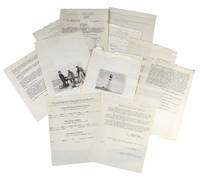
1923réf. 175141923. Wright Orville. Archive of aeronautical speed record trials 1923 a documentary record of early aviation competition and the formalization of international standards for measuring and certifying flight performance. Centered on trials conducted at McCook Field and Wilbur Wright Field in Dayton Ohio the material documents world record attempts over one kilometer 500 kilometers and 1000 kilometers under the supervision of Orville Wright who served as directing official. The archive captures a transitional moment in aviation history when experimental flight gave way to regulated competition with standardized timing calibrated instruments and formal reporting procedures required for international recognition by the Fédération Aéronautique Internationale. Archive comprising 14 manuscript and typed documents in English and French accompanied by two original black and white photographs. Materials include official reports submitted to the National Aeronautic Association and to the Fédération Aéronautique Internationale correspondence addressed to Secretary General Paul Tissandier technical certification documents from the Bureau of Standards and timing sheets recording individual pilot performance. A report dated March 29 1923 details speed trials conducted over 500 and 1000 kilometer courses while related documentation records the surveying and marking of one and three kilometer straightaway courses at Wilbur Wright Field. The bilingual nature of the archive reflects the FAI's use of French as its official language with parallel documentation measuring distinct record categories. Recorded achievements include Lt. R. L. Maughan's one kilometer speed of 380.751 kilometers per hour in a Curtiss R 6 Racer Lt. Alex Pearson's 500 kilometer record at 270.06 kilometers per hour and the 1000 kilometer endurance speed of 205 kilometers per hour achieved by Lts. H. R. Harris and R. Lockwood. Photographs depict course pylons at Wilbur Wright Field and official timer Odis A. Porter observing aircraft performance during timed runs. The archive documents the institutionalization of aviation record keeping in the early twentieth century when governing bodies such as the Fédération Aéronautique Internationale established uniform procedures for homologating records across national contexts. The involvement of Orville Wright alongside officials including Lorin Wright and Odis A. Porter situates the trials within the Dayton aviation community that had been central to powered flight since 1903. These materials illustrate the convergence of engineering innovation military aviation through the U.S. Army Air Service and international oversight demonstrating how record setting functioned both as technological advancement and as a structured competitive discipline. Minor handling wear to documents; photographs well preserved with strong contrast. Overall very good condition. unknown books
1940réf. 1668821940. AVIATION. Steel Horizons. Aviation Issue. Volume 2 Number 4. 46 pp. illustrated throughout. Folio bound in publisher's wrappers. Pittsburgh: Allegheny Ludlum Steel Corporation 1940. Given the subject matter an unusual example of imaginative design more of the kind one might have expected from Holland at the time. unknown books
réf. 4651bd2Department of Trade and Industry 1967. Reprinted in 1970 incorporating amendments one to three. Octavo gray wrappers stapled ii 22 pp. Fine. Notes written on stationary from The Excelsior Hong Kong laid-in. unknown books
1949réf. 164751949. Vintage original Gelatin silver print press photo. Richarda Morrow-Tait first woman pilot to circumnavigate the globe. August 19 1949. 7 x 8½ in. Black/white photo of Morrow-Tait in the cockpit of her plane Next Thursday's Child. Original press caption printed next to image: "British round-the-world flyer returned home 8/19 to Britain which she left just a year and a day ago. Her flight to London's Croydon Airport ended the 1st single-engine round-the-world flight by a woman at point where she started it." These original press photo taken by photojournalist within tight timeframe for the benefit of particular editorial board and with the aim of usage by the press to illustrate an article often affected public opinion in the nation. Pencil inscriptions and stamp on back. Very good. unknown books
1920réf. 127751920. Early aviation technical manuscript explaining aircraft engine operation ignition systems and electrical wiring during the formative decades of powered flight. Produced in the early 1920s when aviation technology was transitioning from experimental wartime aircraft to increasingly standardized civil and military aeronautical engineering the manuscript documents the mechanical knowledge required to operate and maintain contemporary aircraft engines and electrical systems. The notebook focuses particularly on ignition circuitry engine starting procedures and performance specifications subjects central to the reliability and safety of early aviation machinery. References to the Jaguar engine a widely used aircraft powerplant of the interwar period situate the manuscript within the technical environment of early twentieth century aviation engineering and aircraft maintenance training. Manuscript aviation engineering notebook. Fourteen handwritten pages with numerous technical drawings and labeled diagrams explaining aircraft systems. The manuscript includes sections describing "general data" relating to aircraft performance characteristics such as speed and weight along with detailed mechanical illustrations including a "main wiring diagram." Several pages explain engine starting procedures and ignition circuitry. One labeled sequence reads: "Jaguar starting. See that both the engine magnets are switched off and that the throttle is in the slow running position. 2. With gas starter. Connect the gas coupling of the starter to the lead to the distributor of one of the two engine magnets. See that H1 lead switch from gas starter mag to engine mag is switched off. 3. Start the gas starter." Another passage describing a technical diagram states: "The ignition system is a highly developed form of battery coil ignition designed as an integral part of the engine. The general layout comprises a direct current generated gear driven from the engine." The manuscript combines written explanation with hand drawn schematics intended to clarify the layout and function of aircraft electrical and ignition components. During the early 1920s aviation expanded rapidly following the technological acceleration of World War I when aircraft design engine power and onboard systems developed at unprecedented speed. Technical manuals and engineering notebooks such as this formed an essential part of the training culture surrounding aircraft mechanics pilots and aeronautical engineers who needed to understand increasingly complex electrical systems ignition mechanisms and engine starting procedures. The attention given to wiring diagrams and ignition circuitry reflects the growing sophistication of aircraft power plants and onboard electrical networks during the interwar period. Surviving manuscript documentation of this kind provides insight into how aviation technology was taught recorded and transmitted during a period when aeronautical engineering was still developing standardized instructional literature. Light handling wear with minor age toning; overall excellent condition. A detailed early technical manuscript documenting the mechanical knowledge underlying inter war aviation technology. unknown books
1983réf. vas5252Montreal Que.: International Civil Aviation Organization 1983. Fourth Edition. Quarto stiff blue wrappers 72 pp. Fine. International Civil Aviation Organization, 1983. Fourth Edition. unknown books
1979réf. vas5251Montreal Que.: International Civil Aviation Organization 1979. Fourth Edition. Quarto stiff blue wrappers 31 pp. Near-Fine. International Civil Aviation Organization, 1979. Fourth Edition. unknown books
1976réf. vas5250Montreal Que.: International Civil Aviation Organization 1976. 8th Edition. Quarto stiff blue wrappers 65 pp. Near-Fine. International Civil Aviation Organization, 1976. 8th Edition. unknown books
1982réf. vas5248Montreal Que.: International Civil Aviation Organization 1982. Seventh Edition. Quarto stiff blue wrappers 60 pp. Good. International Civil Aviation Organization, 1982. Seventh Edition. unknown books
1569réf. vas5247Montreal Que.: International Civil Aviation Organization 1976. Doc 9156-AN/900. Quarto stiff printed wrappers viii 30 179 25 3 36 12 1 pp. Very Good. International Civil Aviation Organization, 1976. Doc 9156-AN/900. unknown books
1965réf. vas5253Monbteal Que.: International Civil Aviation Organization 1965. Doc 748/2. Second Edition. Quatro softbound lxxiv 182 pp. Tables. Fine. International Civil Aviation Organization, (1965). Doc 748/2. Second Edition. paperback books