19 448 résultats
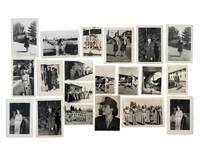
1943réf. 213501943. Women's Army Corps service and female aviation training during World War II documented in photographs dating from approximately 1943 to 1945. The images record the wartime expansion of women's participation in the United States military following the establishment of the Women's Army Corps in 1943 and the parallel development of programs that placed women in aviation related roles supporting the war effort. The photographs depict women in uniform participating in military drill training activities and aviation work around small aircraft illustrating the increasing presence of women in technical and logistical positions that supported military operations during the war. One image taken at Treasure Island in San Francisco situates part of the archive within one of the major naval training and transit centers used by the United States during the conflict. Archive of 20 original black and white silver gelatin photographs dating from the World War II years. Several images show members of the Women's Army Corps posing in formation saluting and participating in organized training exercises. Other photographs depict women standing beside small aircraft preparing for flight or seated in cockpits suggesting involvement in aviation training or aircraft support work connected to wartime flight programs. Informal photographs show servicewomen gathered outside wooden barracks relaxing in flight gear and posing beside aircraft. One photograph identifies the location as Treasure Island San Francisco. Several prints contain handwritten inscriptions on the reverse identifying individuals and dates including notes such as "Sincerely Leona" along with named individuals including Sensabough Bash Braughton Rogers Mazie Paula and June and Kay Gallagher with Bud Sterthors and Donley. During World War II the Women's Army Corps allowed women to serve in uniform in administrative mechanical and communications positions that had previously been reserved for men while aviation related programs trained women to ferry aircraft and assist in technical flight operations. These initiatives formed part of the broader mobilization of American women into wartime labor and military service during the 1940s. Photographic documentation of female service members provides important visual evidence of the changing roles of women within the armed forces during the war. Photographs measure approximately 3.5 x 5 inches and are preserved as loose prints. Minor edge wear and light creasing visible on several photographs; overall very good condition. The archive offers concise visual documentation of women's military and aviation participation during the Second World War. unknown books
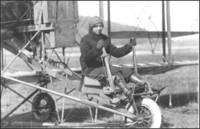
réf. 18789Women in Aviation. Silver gelatin print photo of female pilot sitting in early aircraft with her hands on the gears the body of the plane partially visible behind her. Circa 1920s. 4.75" x 6.5" inches. Legislative barriers as well as social and economic factors made it nearly impossible for women to participate in early aviation. Getting through flight school and gaining access to a plane to fly was a testament to the incredible tenacity and resources required for a woman to access both. Photo shows a woman sitting belted to pilot's seat one hand on each large gear shift feet prepped on the thin ledge above the plane's front tire. She wears a gingham hat cut close to her head a wool coat wool pants and knee-high leather boots with protective-wear covering the shins. The plane's front tire is muddy suggesting she's just landed in a field. A few ink spots do not obstruct the plane or female pilot. This original photo is evidence that women participated in early aviation. Overall good condition. unknown books
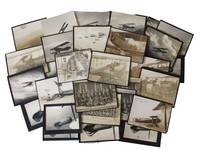
1918réf. 177171918. World War I military aviation. Primary-source photographs documenting early United States military aviation training at Henry Post Airfield Fort Sill Oklahoma during the formative period of the U.S. Army Air Service following its establishment in May 1918. The images record the first generation of American military pilots operating within a rapidly developing aviation program built in response to World War I supporting research into the expansion of U.S. airpower pilot training infrastructure and the integration of aircraft into military operations. The presence of DH-4 two-seat biplane bombers the principal American-built combat aircraft of the war situates the archive within the transition from experimental aviation units to operational military squadrons. A dated caption identifying "October 29 1918 Sergeant Schauble" flying at 3700 feet further anchors the material within the final phase of the war. Archive of 26 silver gelatin photographs Fort Sill Oklahoma circa 1917-1918 each measuring approximately 7.25 x 5.25 inches. The archive includes many photos of the biplanes in the air one photo shows several DH-4 bombers soaring in the clouds in a Flying-V formation. A handwritten caption on one image "October 29 1918 Sergeant Schauble " is depicted flying in a DH-4 at 3700 feet as well as going on a "parachute trip". One photo shows a serious plane crash with two DH-4s biplanes nose down in the ground. The pilots are also depicted in hot air balloons. Fort Sill was home to several US Army Balloon Companies during this period which were still primarily used for reconnaissance and directing aerial bombardment during World War I. The photo archive includes many shots of biplanes in the clouds or on runways with pilots in goggles including 4 images of pilots or troops in group shots. Most photos show the planes or balloons in mid air. . Army balloon companies stationed at Fort Sill for reconnaissance and artillery observation. Several images capture aircraft at altitude among cloud formations while others document runway activity and pre-flight staging. Versos of many prints retain remnants of black album paper indicating removal from a compiled photographic album. The archive documents the early operational environment of American military aviation at a moment when the United States was rapidly expanding its aerial capabilities following limited prewar development including the Army's first acquisition of aircraft from the Wright brothers in 1909. Henry Post Airfield functioned as a central training site for pilots entering service during World War I and the inclusion of both airplane and balloon units reflects the continued reliance on multiple aerial technologies for reconnaissance and combat support. The photographs provide visual evidence of training practices aircraft deployment and the material conditions of early air service operations during a period of institutional formation. Minor edge wear and surface wear are present with album residue on versos; overall very good condition. A cohesive photographic record of early U.S. military aviation training and aircraft use during World War I. unknown books
1910réf. 173311910. Flight. No. 63 No.11 Vol. II. March 12 1910 London UK. 197 pages. 8.5" x 12" inches. Early aviation weekly magazine that acted as the official organ of the Royal Aero Club of the United Kingdom. Contains multiple articles introducing and analyzing airplane models such as the Wright biplane Macfie British Aeroplane Avis Monoplane and more. This was clearly a highly inventive time in the aeronautical field with a multitude of companies producing these rudimentary single passenger planes for hobbyists such as the likely readership of this magazine. Advertisements for fledgling companies looking to break into the field are littered throughout the magazine. There is also a segment titled: Aviation News of the Week where stories of individual pilots are published regarding their mishaps or successes in the field of flight. The overall tone of this magazine has a quaintness to it with the Flight community being close-knit highly enthusiastic and a bit eccentric. This phenomenon has nonetheless been lost as aeronautics was regulated centralized and militarized as a result of the First World War. This piece is in good condition as wrappers are partially separated minorly chipped and have some stains on front though as a whole the piece is totally suitable for reading. unknown books
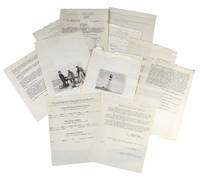
1923réf. 175141923. Wright Orville. Archive of aeronautical speed record trials 1923 a documentary record of early aviation competition and the formalization of international standards for measuring and certifying flight performance. Centered on trials conducted at McCook Field and Wilbur Wright Field in Dayton Ohio the material documents world record attempts over one kilometer 500 kilometers and 1000 kilometers under the supervision of Orville Wright who served as directing official. The archive captures a transitional moment in aviation history when experimental flight gave way to regulated competition with standardized timing calibrated instruments and formal reporting procedures required for international recognition by the Fédération Aéronautique Internationale. Archive comprising 14 manuscript and typed documents in English and French accompanied by two original black and white photographs. Materials include official reports submitted to the National Aeronautic Association and to the Fédération Aéronautique Internationale correspondence addressed to Secretary General Paul Tissandier technical certification documents from the Bureau of Standards and timing sheets recording individual pilot performance. A report dated March 29 1923 details speed trials conducted over 500 and 1000 kilometer courses while related documentation records the surveying and marking of one and three kilometer straightaway courses at Wilbur Wright Field. The bilingual nature of the archive reflects the FAI's use of French as its official language with parallel documentation measuring distinct record categories. Recorded achievements include Lt. R. L. Maughan's one kilometer speed of 380.751 kilometers per hour in a Curtiss R 6 Racer Lt. Alex Pearson's 500 kilometer record at 270.06 kilometers per hour and the 1000 kilometer endurance speed of 205 kilometers per hour achieved by Lts. H. R. Harris and R. Lockwood. Photographs depict course pylons at Wilbur Wright Field and official timer Odis A. Porter observing aircraft performance during timed runs. The archive documents the institutionalization of aviation record keeping in the early twentieth century when governing bodies such as the Fédération Aéronautique Internationale established uniform procedures for homologating records across national contexts. The involvement of Orville Wright alongside officials including Lorin Wright and Odis A. Porter situates the trials within the Dayton aviation community that had been central to powered flight since 1903. These materials illustrate the convergence of engineering innovation military aviation through the U.S. Army Air Service and international oversight demonstrating how record setting functioned both as technological advancement and as a structured competitive discipline. Minor handling wear to documents; photographs well preserved with strong contrast. Overall very good condition. unknown books
1940réf. 1668821940. AVIATION. Steel Horizons. Aviation Issue. Volume 2 Number 4. 46 pp. illustrated throughout. Folio bound in publisher's wrappers. Pittsburgh: Allegheny Ludlum Steel Corporation 1940. Given the subject matter an unusual example of imaginative design more of the kind one might have expected from Holland at the time. unknown books
1920réf. 127751920. Early aviation technical manuscript explaining aircraft engine operation ignition systems and electrical wiring during the formative decades of powered flight. Produced in the early 1920s when aviation technology was transitioning from experimental wartime aircraft to increasingly standardized civil and military aeronautical engineering the manuscript documents the mechanical knowledge required to operate and maintain contemporary aircraft engines and electrical systems. The notebook focuses particularly on ignition circuitry engine starting procedures and performance specifications subjects central to the reliability and safety of early aviation machinery. References to the Jaguar engine a widely used aircraft powerplant of the interwar period situate the manuscript within the technical environment of early twentieth century aviation engineering and aircraft maintenance training. Manuscript aviation engineering notebook. Fourteen handwritten pages with numerous technical drawings and labeled diagrams explaining aircraft systems. The manuscript includes sections describing "general data" relating to aircraft performance characteristics such as speed and weight along with detailed mechanical illustrations including a "main wiring diagram." Several pages explain engine starting procedures and ignition circuitry. One labeled sequence reads: "Jaguar starting. See that both the engine magnets are switched off and that the throttle is in the slow running position. 2. With gas starter. Connect the gas coupling of the starter to the lead to the distributor of one of the two engine magnets. See that H1 lead switch from gas starter mag to engine mag is switched off. 3. Start the gas starter." Another passage describing a technical diagram states: "The ignition system is a highly developed form of battery coil ignition designed as an integral part of the engine. The general layout comprises a direct current generated gear driven from the engine." The manuscript combines written explanation with hand drawn schematics intended to clarify the layout and function of aircraft electrical and ignition components. During the early 1920s aviation expanded rapidly following the technological acceleration of World War I when aircraft design engine power and onboard systems developed at unprecedented speed. Technical manuals and engineering notebooks such as this formed an essential part of the training culture surrounding aircraft mechanics pilots and aeronautical engineers who needed to understand increasingly complex electrical systems ignition mechanisms and engine starting procedures. The attention given to wiring diagrams and ignition circuitry reflects the growing sophistication of aircraft power plants and onboard electrical networks during the interwar period. Surviving manuscript documentation of this kind provides insight into how aviation technology was taught recorded and transmitted during a period when aeronautical engineering was still developing standardized instructional literature. Light handling wear with minor age toning; overall excellent condition. A detailed early technical manuscript documenting the mechanical knowledge underlying inter war aviation technology. unknown books
1971réf. 104558Washington DC: Department of Transportation/ Federal Aviation Administration 1971. Softcover. Good. Revised edition. Illustrated. Missing a page as well as the back wrapper soiling and other wear thus only good in a partial wrapper. Department of Transportation/ Federal Aviation Administration unknown books
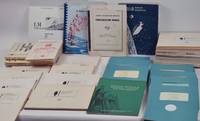
1969réf. 29710various: various 1969. various. Very Good. Our consignor's father was an aeronautical engineer working for Boeing and assigned to work with NASA on the Apollo program. He did a significant favor for a member of the astronauts office while living in Houston. They asked him what they might do in return. He requested "a full set of Apollo astronaut training manuals" the result of which you see here - 34 items in total. They have remained in the family since. A list of the manuals follows. Many are by the sub-contractors responsible for building the particular systems involved. A remarkable archive. In addition to a letter of provenance from the consignor the archive includes a 1968 Nassau Telephone book showing the previous owner as well as a goodly number of astronauts. GRUMMAN MANUALS: The following manuals all state "For training purposes only: In support of LM-5 & Subsequent Subsystem Briefings." and are part of "Contract NAS 9-1100 Exhibit E: Paragraph 3.7.4 Type III Document." They are all three hole punched and held together with dual post "prestong" brand adjustable metal straps with robin blue colored Grumman binder paper with cut-outs for the titles. The metal straps are rusted to varying degrees the paper still bright and clean. 1 LSG 770-154-6 - LM-5 & Sub. June 1969. "Abort Guidance Section Study Guide Lunar Module LM-5 & Subsequent." Light green paper. No copies OCLC. 2 LSG 770-430-40 LM-5 & Sub. April 1969. "Instrumentation Subsystem Study Guide Lunar Module LM-5 & Subsequent." Yellow paper. No copies OCLC. 3 LSG 770-154-7 - LM-5 & Sub. April 1969. "Control Electronics Section Study Guide Lunar Module LM-5 & Subsequent" Light green paper. No copies OCLC. 4 LSG 770-154-5 - LM-5. April 1969. "Radar Section Study Guide Lunar Module LM-5" Blue paper. No copies OCLC. 5 LSG-770-154-9-LM-5 & Sub. May 1969. "Propulsion & RCS Subsystem Study Guide Lunar Module LM-5 & Subsequent" Dark green paper. No copies OCLC. 6 LSG 770-154-4-LM-5 & Sub. May 1969. "Electrical Power Subsystem Study Guide Lunar Module LM-5 & Subsequent" Yellow paper. No copies OCLC. 7 LSG-770-154-3-LM-5 & Sub. May 1969. "Environmental Control Subsystem Study Guide Lunar Module LM-5 & Subsequent" Tan/orange paper. No copies OCLC. 8 LSG 770-154-10-LM-5. May 1969. "Lunar Module Structures Handout LM-5" Light grey ash paper. No copies OCLC. Wikipedia note on the LM-5: "Lunar Module Eagle LM-5 is the spacecraft that served as the crewed lunar lander of Apollo 11 which was the first mission to land humans on the Moon. It was named after the bald eagle which was featured prominently on the mission insignia. It flew from Earth to lunar orbit on the command module Columbia and then was flown to the Moon on July 20 1969 by astronaut Neil Armstrong with navigational assistance from Buzz Aldrin. Eagle's landing created Tranquility Base named by Armstrong and Aldrin and first announced upon the module's touchdown. The name of the craft gave rise to the phrase "The Eagle has landed" the words Armstrong said upon Eagle's touchdown." The Grumman manuals below have different wrapper colors but the same metal strap binding. 9 LSG 770-430. Nov 1967. "Orientation Study Guide Lunar Module" White printed wrappers have ink stamp of "Mutter H.P." White paper internally. No copies OCLC. 10 LSG 770-430-48 -LM-3. "August 1967. Propulsion and RCS Study Guide Lunar Module LM-3" White printed wrappers. Green paper internally. Inked "Oscar Bernard" on top wrapper. No copies OCLC. 11 LMA790-1. LMA790-01001C. October 15 1965. Superceeds LMA790-1 dated March 15 1965. "Lunar Excursion Module Familiarization Manual" Exhibit E Paragraph 10.2 NAS 9-1100. Type II Document. Inked in red "Crew Systems" at head of top wrapper with small piece of top wrapper excised. two copies this title OCLC 12 "Lunar Module Subsystem Assembly and Installations". 52 pages. Printed green wrappers. What appears to be a commercial advertising item rather than a training manual. No copies OCLC. GENERAL MOTORS CORPORATION manuals 1 "Apollo CM Primary Guidance Navigation and Control System Student Study Guide". CSM Digital Autopilots. DAP 2100. June 2 1969. Perfect bound with light blue paper. 3 copies this title OCLC 2 "Apollo Lunar Module Primary Guidance Navigation and Control System Student Study Guide." LM PGNCS Level III System Mechanization Course SM31000. Dates January 27 1967 Oct 1 1967 and finally Jan 30 1969. Bound with blue plastic comb binding. Blue paper. No copies OCLC. NASA MANUALS: 1 FLIGHT CONTROL DIVISION manual NASA. FC027. 3/15/68. "Lunar Module Systems Handbook Vehicle LM-3" MSC8305-68. 5 hole punched. Not bound. No copies OCLC. 2 MSC Internal Note MSC-CF-E-68-12. "Photo Equipment for Manned Space Flight Handbook" June 20. 1968. 5 hole punched. Stapled. "Oscar Bernard x-5821" inked on top wrapper and a few inked notes on the bottom wrapper. No copies OCLC. NORTH AMERICAN ROCKWELL CORPORATION SPACE DIVISION MANUALS. All note "For Training purposes only". All 11 x 8 1/2 inches. 1 CSM Logistics Training : Guidance and Control System - Block II May 15 1969. Prefect bound white and blue paper No copies OCLC. 2 CSM Logistics Training: Sequential Systems EDS SECS LES ELS Course No A-318 Handout No. 1. June 15 1969. Perfect bound light yellow paper. No copies OCLC. 3 Apollo CSM Logistics Training. Apollo Operations Handbook Subsections 2.2 and 2.3. Guidance and Control. May 1 1969. Perfect Bound blue paper. No copies OCLC. 4 Apollo CSM Logistics Training. Apollo Operations Handbook Subsection 2.8 Telecommunications. May 1 1969. Perfect bound dark brown paper. No copies OCLC. 5 Apollo CSM Logistics Training. Apollo Operations Handbook Subsection 2.6 Electrical Power System May 1 1969. Perfect bound yellow paper. No copies OCLC. 6 Apollo CSM Logistics Training. Apollo Operations Handbook Subsection 2.9 Sequential Systems May 1 1969. Perfect bound tan paper. No copies OCLC. 7 Apollo Training. Apollo Operations Handbook CSM Preliminary Subsection 2.9 Sequential Systems June 26 1968 Perfect bound light yellow paper some folding on "fax" paper. Ink stamp "Mutter H.P." on top wrapper and spine. 8 Apollo Training. Structures and Mechanical Subsystems Course Number A-5125. June 13 1969. Perfect bound grey paper. No copies OCLC. 9 Apollo Training. Block II CSM Propulsion Subsystem. Dec 12 1968. Perfect bound pale green paper. No copies OCLC. 10 Apollo Training. Electrical Power Subsystem Block II CSM. Nov 1 1968. Perfect bound oblong yellow paper. No copies OCLC. 11 Apollo Training. CSM/LM Docking and Crew Transfer Block II handout. Apr 15 1968. Perfect bound oblong pale brown paper. Stamp "Mutter H. P." on top wrapper and spine. No copies OCLC. 12 Apollo Training. Environmental Control System Block II. Apr 1 1969. Perfect bound oblong orange sherbert paper. No copies OCLC. 13 Apollo Training. Crew Equipment Course A512 C. Jan 1 1969. Perfect bound pink paper. No copies OCLC. 14 Apollo Training. Crew Equipment Course A512C. June 26 1968. Perfect bound pink paper. No copies OCLC. #7-14 above show "Apollo Logistics Training" logo on the top wrapper with little or no mention of Rockwell in the document although we believe it is clearly their output given the names physical addresses to use for questions about the documents and production details of the various manuals. Wikipedia note on the CSM: "The Apollo command and service module CSM was one of two principal components of the United States Apollo spacecraft used for the Apollo program which landed astronauts on the Moon between 1969 and 1972. The CSM functioned as a mother ship which carried a crew of three astronauts and the second Apollo spacecraft the Apollo Lunar Module to lunar orbit and brought the astronauts back to Earth." NORTH AMERICAN AVIATION Inc. SPACE AND INFORMATION SYSTEMS DIVISION manuals 1 SID 64-1613A GFE Command and Service Module - Manned Space Flight Network Signal Performance and Interface Specificaiton Block II. NAS 9-150 Revised Nov 22 1966. Copy made on "fax" style paper three hole punched with two aluminum screw posts holding the pages together. Another stamp unclear if on the original or here stamped notes Recorded Jul 18 1967 by the Saturn V Data management at the Boeing C. Technical Data Central. Note on orginal document notes 60 8 1/2 x 11 and 20 11 x 17 foldouts presumably. No copies OCLC. 2 SID 64-1389 GFE NASA Furnished Crew Equipment Performance and Interface Specification Block II. NAS 9-150. Revised Feb 22 1965 Copy made on "fax" style paper three hole punched with two aluminum screw posts holding the pages together. Another stamp unclear if on the original or here stamped notes Recorded Aug 2 1967 by the Saturn V Data management at the Boeing C. Technical Data Central. Note on orginal document notes 164 pages. No copies OCLC. 3 SID 64-1388. GFE Scientific Equipment Performance and Interface Specification Block II - CM. NAS9-150. Revised Feb 22 1965. Note on original document indiates 51 pages. Stamped upper left rusted one page loose in rear. No copies OCLC. 4 SID 64-1866. GFE Command and Service Module - Manned Space Flight Network Signal Performance and Interface Specification - Block 1. NAS9-150. January 5 1965. Exhibit I Paragraph 4.1. "Fax" style paper three hole punched with two aluminum screw posts for binding. No copies OCLC. NOTE: GFE stands for Government Furnished Equipment - where the government would provide equipment to the contractor to assist in their work NOTE: The # in the lists above are included solely for convenience of reference. Identifying numbers on the documents if any follow that number. Provided with a letter of provenance and the Sept 1968 Nassau Bay TX Telephone Co directory with the consignor's father listed in it as well as a fair number of well known astronauts. various. A remarkable archive of training manuals only a few of which appear in OCLC and only one of which we've seen in the last 20 years. various unknown books
1930réf. 500910In broken English Ocean Grove NJ February 10 1930; to Marvin Popkin: " - I haffe to go to - camp in Newark Aire Squadron I having 380 men - to lern the Bay to aperste the Plain - ". 7" x 10 1/2" 1 page. with a signed/inscribed photograph of Wiegand and 2 companions and related newspaper. Very good. Wiegand member of the Richthofen air circus; credited with shooting down 22 enemy planes. unknown books
1970réf. S8288London:: Her Majesty's Stationery Office 1970. 1970. 8vo. xvi 315 pp. Photos illus. foldout chart index. Cloth dust-jacket; jacket extremities slightly rubbed. A FINE COPY. Her Majesty's Stationery Office, 1970. hardcover books
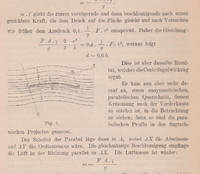
1895réf. 13050Berlin : Zeit. f. Luftschiffahrt u. Physik der Atmosphare 1895. Offprint. as issued. A good copy; corner waterstain at the top; rumpling to edges. 8vo. There are several text illustrations. A 16 page offprint of Lilienthal's experiments to determine the best profile i.e. curve of a wing to maximize lift. A critical element in flight either gliding or powered. This copy of the offprint has an ink inscription in the hand of the recipient : ' Presented to GSC Greely S Curtis with the author's compliments '. There are some light annotations and designs in pencil on a blank portion of the offprint. Curtis was an American aviation pioneer. See Gibbs-Smith . Aeroplane and Davy . Flight - for an account of Lilienthal. Zeit. f. Luftschiffahrt u. Physik der Atmosphare unknown books
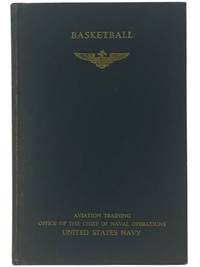
1950réf. 2352748Annapolis Maryland: United States Naval Institute 1950. Revised Edition. Hard Cover. Good/No Jacket. 0x0x0. Boards a bit soiled a bit musty pencil notes on rear flyleaf with minimal pencil marks in text a couple drill numbers circled. 1950 Hard Cover. xiv 259 pp. Part of a series of physical training manuals originally produced by the United States Naval Aviation Training Division and revised by the V-Five Association of America to better align with civilian educational interests. This volume focuses on basketball with sections on the sport's origin safety techniques training drills and team dynamics. United States Naval Institute hardcover books
réf. 3234Archive. 7 pieces. 1938 to 1939. A grouping of seven pieces concerning Frederic E. Humphreys the first Army officer to fly solo. These pieces arranged in chronological order mention the thirtieth anniversary of Humphreys first flight.1 TLS. 1pp. 8 x 10. July 18 1938. War Department. A typed letter signed J Totten on War Department letterhead concerning Special Recognition for Colonel F.E. Humphreys: Reference is made to your letter of November 12 1937 recommending that some form of special recognition be awarded Colonel Frederic E. Humphreys New York National Guard for being the first officer of the United States Regular Army to fly a plane aloneit is proposed to make a suitable award to Colonel Humphreys. By order of the Secretary of War.2 TL. 1pp. 8 x 10. July 18 1938. War Department. A typed letter that is an unsigned copy of #1.3 TDS. 1pp. 8 x 10. August 3 1938. No place. A typed letter signed Ames T. Brown indicating that he mailed a letter to Louis L. Pendleton concerning the 30th anniversary of the flight.4 TD. 1pp. 8 x 10. August 4 1938. Camp Smith Peekskill. A typed document mentioning that it is to be addressed to Colonel Louis L. Pendleton.5 ALS. 1pp. 8 x 10. August 23 38. New York City. An autograph letter signed L.L. Pendleton Colonel addressed to Lieutenant Humphreys: Please not attached papers which please return to me at your convenience. The Mills of the Gods grind slow it would seem but better late than never also applies. I hope I will be around next summer to see what they really do then!6 TLS. 1pp. 7 x 9. April 5 1939. Aberdeen Proving Ground. A typed letter signed C.M. on Office of the Commanding Officer Aberdeen Proving Ground stationery. He wrote to Humphreys: It certainly was nice to get your pleasant letter of April 3rdmy memory is quite clear as to the time you and Lahm were trying out the first Wright airplane. I am glad you enjoyed the bulletin or class letter but I prepared it quite a while before it was issued and made some serious omissionsThere is a good article in the Sperryscope Vol 8 no 10 just out by Lahm which mentions the trying experience of your pamphlet. Call up the Sperryscope Co. and get a copy from Gillmor who is an old friend of mine. Lahm received the first flying lesson but Humphreys made the first solo flight just before Lahm made his flight.7 Card. 1pp. No date. Governors Island NY. A card imprinted Colonel Earl McFarland and written on in pencil My best wishes and I hope to see you soon. Governors Island NY. unknown books
1919réf. M8116Washington D.C.:: Government Printing Office 1919. 1919. 267 x 190 mm. Tall 8vo. 446 pp. Color frontis. extensively illustrated with photographs of aviation equipment in use physical examinations of flight candidates and test equipment constructed to test the physiological effects of flight conditions tables 1 folding index. Gilt-stamped navy cloth; rubbed inner hinge cracked. Very good. Government Printing Office, 1919. hardcover books
1919réf. M8115Washington D.C.:: Government Printing Office 1919. 1919. 267 x 190 mm. Tall 8vo. 446 pp. Color frontis. extensively illustrated tables 1 folding index. Gilt-stamped navy cloth; rubbed. Very good. This extensively illustrated manual for the medical personnel of the United States Air Service contains numerous figures and plates including photographs of aviation equipment in use physical examinations of flight candidates and test equipment constructed to test the physiological effects of flight conditions. Government Printing Office, 1919. hardcover books
1945réf. CAT01371945. Various sizes and dates. Clara Adams was a wealthy widow who took up air travel in its early days setting records for transatlantic flights and circumnavigation as a commercial airline passenger. In doing so she helped popularize flying as a safe and comfortable way to travel. She was friends with many famous women of aviation including pilots Amelia Earhart Alys McKey Bryant and Thea Rasche. This collection includes three photographs with Earhart and one with Rasche some with holograph inscriptions. Also present are items related to the captain of the Graf Zeppelin Hugo Eckener; a rare Ohio hobbyist magazine; and a curious leaflet advertising light art Clavilux recitals. An unusual collection collected by Adams and showing her range of interests. Contents arranged chronologically: Sproul William Cameron. ALS. Postmark: Dec 8 1927. Single leaf 2 pp.; together with envelope. Sproul was a governor of Pennsylvania he writes to Adams that he is staying at a hunting lodge in Virginia and quite unwell. He died in 1928. Earhart Amelia Photograph of Clara Adams and Amelia Earhart 1929. 8 x 10 inches somewhat faded signed by Chautauqua portrait photographer Harold Wagner. Photograph taken at the home of Dr. and Mrs. Arthur Bestor after Earhart landed her plane at the Chautauqua Golf Course on July 20 1929. Earhart Amelia Two photographs of Clara Adams and Amelia Earhart with Earhart's plane 1929. Each: 3 â… x 5 ¾ inches and 2 ¾ x 5 ½ in. in corner mounts on vintage album paper very good. Another photograph verso of Adams and unidentified group of people. Eckener Hugo Two Photographs of Adams with Dr. Hugo Eckener 1929. Each approximately 3 ¼ x 5 inches captions in Adams' handwriting with date and place Lakehurst N.J. Together with an envelope from Eckener to Adams postmarked 1947. Eckener was the captain of the Graf Zeppelin which departed from Lakehurst Naval Air Station during its record-setting circumnavigation in 1929. Rasche Thea Photograph with Thea Rasche n.d. 7 ⅛ x 5 inches very good. Rasche was a German aerobatics pilot at Tempelhof airport ca. 1930s. Very good. Photograph of Clara Adams with Nazi officers. 5 ⅞ x 4 inches very good. Adams and the officers are in a hot air balloon presumably in Germany. Very good. Hamburg America Line Canceled Check to Hamburg Am Line 1935. Written by Clara Adams to the transatlantic shipping company Hamburg America Line in the amount of $123.50. Very good. National Coin Journal and Hobby News: The Hobbiests sic Mail-Order Journal. No. 1 Feb.-Apr. 1936. Lorain Ohio: The Hobby Shop 1936. Featuring Clara Adams on cover 8vo 28 pp.; toned and frayed covers separated. Rare single-issue hobbyist magazine. OCLC locates one institutional holding the National Postal Museum. Mortiz Carol Joan. "To Clara Adams." In The Brooklyn Eagle Nov. 23 1940. Newspaper clipping mounted to Pan American Airways stationary with ink notation presumed to be in Adams's hand. Boeing. "Tomorrow's air-liner--today's record breaker." Advertisement clipped from Life magazine 1945. With photo of the Stratoliner and inscription in Adams' hand noting that she was a passenger on the first flight "N.Y. to Cal. / Cal. back to N.Y." Folded else good. Undated: Eleven photographs of Clara Adams various dates most approx. 4 x 2 ½ in. a few smaller good. Including image of her in front of the stairs to the "Mainliner" and in Hawaii. Lorraine Studio Brooklyn photo sleeve. 5 â… x 3 ½ in; empty. Adams press photo. 7 ⅛ x 5 inches; holograph signature recto; verso pencil inscription also lists photographer Glen Lowry. Unsigned press photo corner bent. Wilfred Thomas Clavilux Recitals played by Thomas Wilfred. New York: n.d. Single leaf folded 4 pp.; illus. with Adams holograph signature to front. Wilfred invented the Clavilux "light organ" to play lumia an artform combining light and music. This item advertising performances at the Grand Central Palace in New York where Wilfred ran the Art Institute of Light until the beginning of WWII. unknown books
1918réf. 000220U.S. Army 1918. Owner's name in ink top of front cover. Contains entries from 8/6/18 to 9/18/18 at Post Field Ft. Sill Oklahoma. While at Ft. Sill this 2nd Lieutenant from Kansas worked on reconnaissance infantry contact puff target sketching railroad yards machine gun proficiency. He then transferred to the School of Aerial Gunnery at Selfride Field Michigan from 9/30/18 to 10/19/18. All courses are listed with hours spent grading signed by instructors. Laid-in are orders to report to Selfride Field and a letter dated October 19 1918 naming the log's owner as being now rated as an Aerial Observer. A fine piece of aviation ephemera from the Great War. We find only one other similar pilot's log for sale at this time. Tan Cloth. Minor Edge Wear and Soiling. Square Octavo. U.S. Army Hardcover books
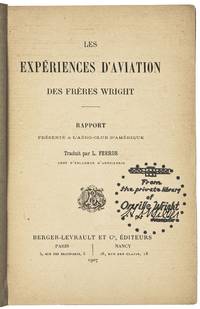
1907réf. 4284OFFPRINT IN FRENCH OF WRIGHT BROTHERS REPORT RECORDING THE LONGEST FLIGHT AT THE TIME 8vo pp. 1-3 4-7 8 blank. In original printed publisher's wrappers. Printed advertisements on back cover. Ink stamp "From the private library of Orville Wright" on title page signature of H. A. Miller. Uncut. A fine copy of the first French edition of Wright brothers' report from March 12 1906 to the secretary of the recently created Aero Club of America recording the longest flight in history at the time. This French edition was published the same year that the Wright brothers traveled to Europe in an effort to secure monopoly on air travel and negotiate for the sale of the Wright airplane. In 1908 the Wright brothers would return to Europe to perform 200 demonstrative flights. The report summarizes the last stage of the brothers' flying experiments which began in 1899 and allowed them to develop a plane capable of making routine flights. Upon completing their experiments in Dayton Ohio in the fall of 1905 the brothers did not fly again for 2.5 years focusing their attention on securing a patent which they were granted in May 1906. In the report the brothers write that the flights of 1905 made "in a swampy meadow about 8 miles east of Dayton Ohio and continued from June until the early days of October" were meant to correct some problems "necessary to overcome before it would be safe to employ flyers for practical purposes." The experiments proved successful: "Owing to frequent experimental changes in the machine and the resulting differences in its management the earlier flights were short; but towards the middle of September means of correcting the obscure troubles were found and the flyer was at last brought under satisfactory control." The report includes a chart documenting the brothers' progress: on October 5 Wilbur made his longest flight in which he circled the field 30 times in 39 minutes. The report also summarizes the brothers' experiments prior to 1905: "Previous to the year 1905 we had experimented at Kitty Hawk North Caroline with man-carrying gliding machines in the years 1900 1901 1902 and 1903. Flights to the number of more than 100 had also been made at Dayton Ohio in 1904." This copy sold at Sotheby's for $4375 in 2008. We were able to locate only two copies worldwide: in the U.S. at MIT and at the Bibliothèque nationale de France. Published Writings of Wilbur and Orville Wright p. 6. Berger-Levrault et Cie, Éditeurs paperback books
1981réf. 291686Gillingham: Meresborough Books 1981. hardcover. very good. Illus. 8vo blue boards spine sunned. Gillingham: Meresborough Books 1981. Very good Meresborough Books unknown books
1920réf. 1567951920. paperback. Many illustrations and advertisements. 31 pages. 4to original printed wrappers. New York: Aerial Age Company 1920. Near fine. unknown books
réf. 156911paperback. near fine. Illustrated with b/w photographs. 24 pages. 4to original color pictorial wrappers with wonderful illustration by Stewart Rouse. Chicago: Aviation Service and Transport Inc. 1928. Near fine. unknown books
1919réf. 1567941919. paperback. Many illustrations and advertisements. 40 pages. 4to original printed wrappers. New York: Aerial Age Company 1919. A very good copy. unknown books
1944réf. 238793New York: The MacMillan Company 1944. Hardcover. Very Good. Revised edition. 774pp. Black and white illustrations. Maps present. Bumped corners rubbed edges and faint soiling else very good. Part of the Air-Age Education Series. The MacMillan Company hardcover books
1785réf. ST15350Paris: Cuchet 1783-1784; 1784; Amsterdam and Paris: Gueffier 1785. FIRST EDITIONS. Second Issue of the first work with the four-page "Supplément" at the end. 223 x 127 mm. 8 x 5". Three separately published works bound as a three-volume set the first work occupying the first two volumes. Uniform contemporary orange paste-paper boards backed with marbled sheepskin corners tipped with vellum raised bands flanked by decorative gilt rolls one red and one green morocco label. First work with a folding table and 14 ENGRAVED PLATES nine numbered plates in first volume five in second two of the latter folding; second with three engraved plates; third work with one folding plate. First work: Darmon 51; PMM 229; Norman I 769; Maggs Bros. "The History of Flight" 65. A hint of rubbing to extremities intermittent minor browning small rust spots or offsetting in the text bed largely due to inferior paper stock four leaves with one-inch brown stain to text nothing obscured a couple of short marginal tears from rough opening but QUITE A FINE SET--the text clean fresh and well-margined the plates with excellent impressions and the binding remarkably well preserved with few signs of wear. This is the second issue with the rare "Supplément" in the second volume of the earliest account of the first public experiments with hot air balloons and it is considered to be the first authoritative technical and historical work on aerostation as well as the first serious discussion of balloon travel as a practical possibility. The experiments were conducted by the Montgolfier brothers Joseph 1740-1810 and Etienne 1745-99 who had been intrigued by the experiments of Cavendish and Priestly with "inflammable air." The eminent scientist Faujas 1741-1823 who was the promoter financier and chronicler of the Montgolfiers quickly published this account after the brothers had launched a balloon at Annonay in June of 1783 then a balloon carrying some farm animals in September and finally a balloon carrying Pilatre de Rozier and the Marquis d'Arlandes in November. This last flight--the first manned aerial voyage in history--covered five-and-one-half miles across Paris and lasted 25 minutes. Plate 8 here shows the two original aeronauts viewed from the terrace of Franklin's home in Passy. The third volume begins with a discussion of the inflammable gas used to lift the balloons and gives a summary of Montgolfier's history of balloon flights. The final work sets forth another scientific innovation an electrostatic machine that employed sheets of taffeta to create friction that produced static electricity. The Royal Academy of Sciences tested the machine and found it a great improvement--less expensive and less liable to accidents--than earlier machines that had used plates of glass. The work seems to be very rare: we could find no copy sold at auction in either RBH or ABPC. This is a most appealing set its combination of works on inventions offering a glimpse of the popular fascination with emerging technologies especially those related to flight in the late 18th century. Cuchet, 1783-1784; 1784; Amsterdam and Paris: Gueffier unknown books