HOYT Edwin P.MareMagnum

230 results
19868vo., First Edition, with plates; red cloth, gilt back, a near fine copy in unclipped dustswrapper.
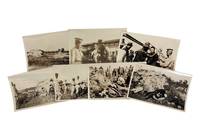
1940ref. 234221940. Chinese prisoner execution photo archive from Japanese-occupied Manchuria circa 1940s recording the custody restraint killing and aftermath of Chinese prisoners under Japanese military control. Japan's occupation of Manchuria followed the Mukden Incident of September 18 1931 when Japanese forces used an explosion along the South Manchurian Railway as the pretext for military conquest; in 1932 Japan established Manchukuo a puppet state that drew international condemnation through the League of Nations' Lytton Commission. By the 1940s Manchuria remained a central zone of Japanese military power in northeast China where occupation authority puppet-state policing and anti-guerrilla campaigns produced summary punishments prisoner shootings and public terror against local Chinese populations. Photo archive of 7 silver gelatin photographs each 4" x 6.5" Manchuria circa 1940s. Japanese soldiers in field uniforms and peaked caps surround blindfolded Chinese captives seated in open ground near an earthen bank; in one scene soldiers level rifles toward bound or blindfolded prisoners at close range. Several men lie face down or on their sides at the base of the embankment with soldiers and civilian onlookers standing above them; plain wooden boxes or planks sit nearby suggesting prepared burial or removal. Another scene records a prisoner being physically restrained in a courtyard or village setting with tiled rooflines uniformed soldiers and civilian men crowded around him. The sequence moves between armed custody execution ground bodies on the earth and prisoner handling under guard giving the group a direct evidentiary relationship to Japanese military violence in occupied Manchuria. Manchuria was not a peripheral theater in Japan's war in China; it was the region where the Kwantung Army transformed a railway-security pretext into territorial occupation state building under Manchukuo and a long-running military presence that helped bring international crisis in the 1930s and full-scale war in Asia. The scenes preserved here are not battlefront combat views but close-range records of prisoners controlled by armed soldiers making the archive especially significant for the study of occupation violence Japanese military practice wartime China and the fate of Chinese civilians or irregular fighters labeled enemies under Japanese authority. Light edge wear and minor fading to some areas; images remain primarily clean; overall very good condition. The archive preserves a compact but stark record of military force in Japanese-occupied Manchuria grounded in the physical proximity between guards prisoners rifles and bodies. unknown
1940ref. 234221940. Chinese prisoner execution photo archive from Japanese-occupied Manchuria circa 1940s recording the custody restraint killing and aftermath of Chinese prisoners under Japanese military control. Japan's occupation of Manchuria followed the Mukden Incident of September 18 1931 when Japanese forces used an explosion along the South Manchurian Railway as the pretext for military conquest; in 1932 Japan established Manchukuo a puppet state that drew international condemnation through the League of Nations' Lytton Commission. By the 1940s Manchuria remained a central zone of Japanese military power in northeast China where occupation authority puppet-state policing and anti-guerrilla campaigns produced summary punishments prisoner shootings and public terror against local Chinese populations. Photo archive of 7 silver gelatin photographs each 4" x 6.5" Manchuria circa 1940s. Japanese soldiers in field uniforms and peaked caps surround blindfolded Chinese captives seated in open ground near an earthen bank; in one scene soldiers level rifles toward bound or blindfolded prisoners at close range. Several men lie face down or on their sides at the base of the embankment with soldiers and civilian onlookers standing above them; plain wooden boxes or planks sit nearby suggesting prepared burial or removal. Another scene records a prisoner being physically restrained in a courtyard or village setting with tiled rooflines uniformed soldiers and civilian men crowded around him. The sequence moves between armed custody execution ground bodies on the earth and prisoner handling under guard giving the group a direct evidentiary relationship to Japanese military violence in occupied Manchuria. Manchuria was not a peripheral theater in Japan's war in China; it was the region where the Kwantung Army transformed a railway-security pretext into territorial occupation state building under Manchukuo and a long-running military presence that helped bring international crisis in the 1930s and full-scale war in Asia. The scenes preserved here are not battlefront combat views but close-range records of prisoners controlled by armed soldiers making the archive especially significant for the study of occupation violence Japanese military practice wartime China and the fate of Chinese civilians or irregular fighters labeled enemies under Japanese authority. Light edge wear and minor fading to some areas; images remain primarily clean; overall very good condition. The archive preserves a compact but stark record of military force in Japanese-occupied Manchuria grounded in the physical proximity between guards prisoners rifles and bodies. unknown books
ref. 17597Neuchâtel, La Baconnière 1930, 235x155mm, 191pages, reliure d'éditeur sous jaquette. Bel exemplaire.
ref. 6279La Seyne-sur-Mer, Editeur Jean Le Marigny, sans date (1934?). 1 volume in-8 carré, 228 pp., reliure moderne plein cuir, couverture illustrée conservée, orné de nombreuses photographies in texte et hors texte, très bon état général.
ref. 8724La Seyne-sur-Mer, Editeur Jean Le Marigny, sans date (1934?). 1 volume in-8 carré, 228 pp., broché, couverture illustrée, orné de nombreuses photographies in texte et hors texte, très bon état général.
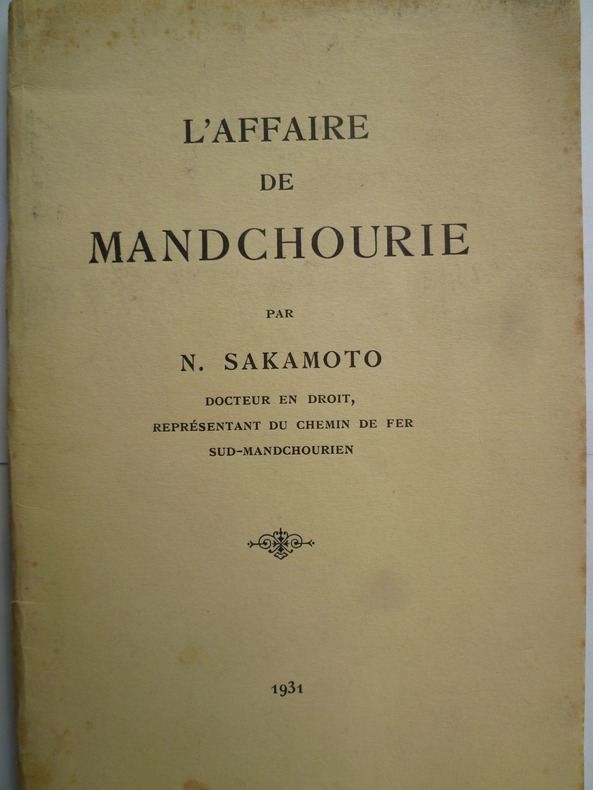
ref. 3477Paris, Librairie du recueil Sirey, 1931. 1 plaquette in-8, brochée, couverture souple, 33 pp., ornée d'une carte montrant les emplacements des forces chinoises et les groupements des bandits chinois, bon état.
ref. 10602Paris, Librairie du recueil Sirey, 1931. 1 plaquette in-8, brochée, couverture souple, 33 pp., ornée d'une carte montrant les emplacements des forces chinoises et les groupements des bandits chinois, bon état.
1931Chez l'auteur, 1931. In-8 broché. 33 pages + carte "carte de Mandchourie. Emplacements des forces chinoises et groupements des bandits chinois". Joint une lettre de l'auteur. Couverture un peu brunie sinon bon exemplaire.
1931ref. 173894Chez l'auteur Chez l'auteur, 1931. In-8 broché. 33 pages + carte "carte de Mandchourie. Emplacements des forces chinoises et groupements des bandits chinois". Joint une lettre de l'auteur. Couverture un peu brunie sinon bon exemplaire.
1904ref. ABE-141342267820 PAGES-DESSINS DE CAMARA
1905ref. ABE-152448275404216 PAGES-24,5 CM X 32 CM-COUVERTURE COULEURS-DESSINS COULEURS ET NOIR ET BLANC
1945ref. ABE-162141222702 PAGES FORMAT 43 CM X 60 CM-P1: LES DEPOSITIONS DES TEMOINS A DECHARGE SE POURSUIVENT BRINON ET DARNAND SONT ENTENDUS, 2 PHOTOS, ARTICLE DE MAURICE CLAVEL-NAGASAKI A SON TOUR A RECU UNE BOMBE ATOMIQUE, PHOTO-LES RUSSES ONT ATTAQUE ILS ONT PENETRE EN MANDCHOURIE OU DE FURIEUX COMBATS SE DEROULENT-P2: SEIZIEME AUDIENCE MOUVEMENTEE AU PROCES PETAIN UN ANCIEN PREFET PROVOQUE DES INCIDENTS-UN COMPLOT CONTRE PIERRE LAVAL CONDUIT SON AUTEUR A FRESNES
ref. 26671P., Plon, 1927, petit in 8° broché, VII-306pp. ; couverture défraichie et effrangée.
ref. 61818P., Plon, 1925, in 12 relié demi-percaline brique à la bradel, dos orné, étiquette basane noire, couverture conservée, VII-306 pages ; mention de 2e mille sur la couverture.
2007ref. LFA-126746375Un ouvrage de 492 pages, format 155 x 245 mm, illustré, broché couverture couleurs, publié en 2007, bon état
1913Ecole Supérieur de Guerre, 1907. Cours ronéotypé de In-4 relié demi-toile chocolat à coins, titre doré en dos. 6 pages (erratum) + 1 ere partie : Couverture et exploration, 2ème partie : la cavalerie dans la bataille, 3ème partie Les opérations contre les lignes de communication de 327 pages et appendice : Destruction d'un pont de chemin de fer japonais au sud d'Haitcheng le 21 février 1905, 13 pages. Bien complet des 35 planches libres, certaines déplaintes. Bon état
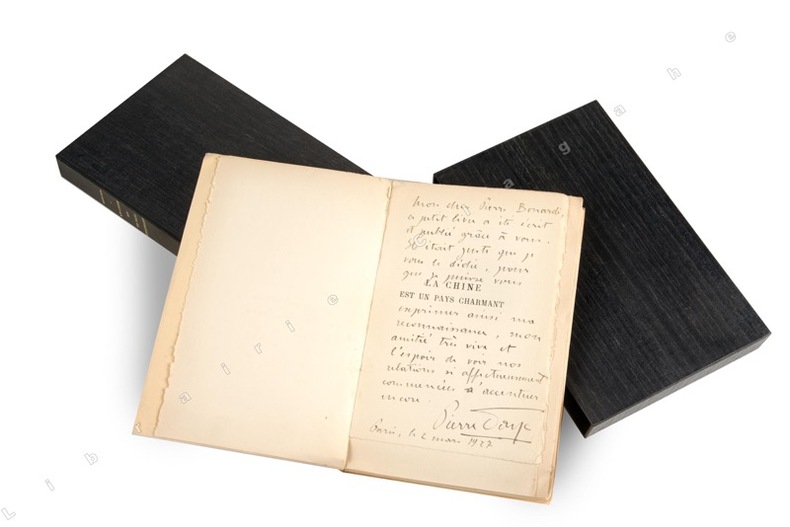
1927ref. 20808Paris, les Editions de France, collection “Notre Temps” publiée sous la direction de Pierre Bonardi, 1927 ; in-16 (210 mm), broché ; [8], 211, [5] pp., couverture jaune imprimée en rouge et noir, chemise-étui simili ébène, dos chagrin noir, titre doré (P.Goy & C.Vilaine).
ref. 1478A Pedone, édiiteur, Paris 1931
ref. 2651Paris, Editions Jos. Vermaut, 1957. 1 volume in-8, 187 pp., broché, couverture illustrée, orné de nombreuses photographies hors texte, bon état général.
ref. 9467Paris, Editions Pierre Bossuet, 1939. 1 volume in-8, 316 pp., broché, couverture imprimée souple, très bon état.
ref. 12566Paris, Editions Pierre Bossuet, 1939. 1 volume in-8, 316 pp., broché, couverture imprimée souple, très bon état.
ref. 2340Librairie Ch. Delagrave, Paris, 1906
in-16, 68 pages, broche, couverture illustree. Bel exemplaire. [BU-10]
ref. 2946Paris, Imprimerie Money, sans date (1931). 1 plaquette, 48 pp., brochée, couvertures souples illustrées légèrement salies, bon état intérieur.