Manchuria - CLYDE, Paul HibbertAntiquariat.de

184 résultats
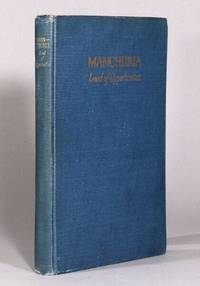
1966réf. 142370New York. Octagon Books Inc. 1966. XV, (2), 323 pages and one folded map. Green, illustrated original cloth binding in good condition. 21x14 cm
1932réf. JA9-319Dairen [Dalian], The South Manchuria Railway, 1932 / 1934. 2 B?nde original flexible Leinenb?nde, 4?, mit zahlreichen Abb. und Karten; Zustand: gut Vorsatz gestempelt
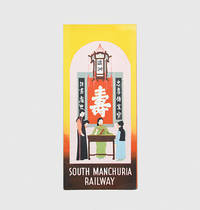
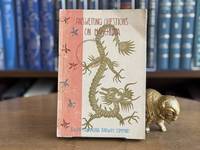
1933réf. 73809New York: The South Manchuria Railway Company 1933. A promotional piece extolling "The Progress of Manchuria" following the establishment of Manchukuo a puppet state of the Empire of Japan in northeast China and Inner Mongolia produced in conjunction with the 1933 Century of Progress International Exposition at Chicago. Established in 1906 the Japanese-owned and operated South Manchuria Railway Company or Mantetsu for short was charged with a government-like role in managing the rail transportation and urban planning after the Japanese invasion in 1931. "It is conceded by all that the rapid industrial agricultural and educational development of Manchuria during the past 28 years is chiefly due to Japanese investments and the enterprise of her industrialists and skilled technicians. In all this important work the South Manchuria Railway Company has taken the lead and it is largely through the foresight confidence and intelligence of the administration of this great artery of commerce that has made Manchuria a prosperous and peaceful land for the past twenty years. This explains why the great migration of nearly 8000000 to Manchuria took place in the last few years. Here they found a land of peace and plenty until the war lords taxed and exploited them to the limit so they declared their independence as did the Americans in 1776." This folding brochure opens to a railway map of the region which shows four sections under construction. There are also 12 photographic images highlighting Manchuria's historic sights modern infrastructure and abundant resources. Printed in color on a 12" x 18" sheet of white paper that folds to 4" x 9" 12 panels. A fine fresh example with just a hint of edgewear. Scarce OCLC locates only three holdings Michigan National Library of Australia Canadian Centre for Architecture. The South Manchuria Railway Company unknown books
1934réf. 1452111934. MANCHURIA. Saishin Manshu shashincho The latest Manchuria photograph album. By Kin'ichiro Yamazaki. Illustrated with two fold-out colour maps and 86 photographic plates some hand-coloured printed on various coloured papers interleaved with descriptive text in Japanese and English. Oblong 8vo. 135 x 195 mm bound in publisher's pictorial cloth two-hole binding with string ties. Wakayama: Kobun-Do-Shoten 1934. A fine copy of this very scarce guide book to Manchuria under the Japanese occupation. Among other things the guide covers the main sites in the major cities of Mukden Dairen Harbin and Port Arthur. By printing the guide in a slightly larger format than is usual for such works the publishers were able to illustrate it with larger and better photographs than are usually found in works of a similar nature. hardcover books
1933réf. 56051Osaka and Tokyo Japan.: The Asahi. No. 9. 10- 1933. Color and black and white illustrations throughout 166 pages 15 x 10 1/2 inches color pictorial wrappers. Covers: 4 1/2 inch split to tail of spine 2 1/4 inch split to head of spine with 3/4 inch paper loss stains to left edge of back cover multiple soft creases to front cover front cover beginning to come loose general wear including a few short tears to cover edges. Interior: age toning to sheets very good condition overall. This annual English-language magazine published by the Asahi newspaper contains six color plates highlighting traditional Japanese art. The front cover by Manjiro Terauchi depicts "A country maiden picking tea at Uji the well-known tea growing district near Kyoto." The table of contents lists articles in the following sections: "Introduction" "Economic and Financial" including industries such as textile chemical and heavy "Current Topics in Japan" and "General" "Progress of the Press in Japan" "The Sino-Japanese Dispute and the League of Nations" "Manchukuo in Construction" and a four page article with pictures "Jiudo - the Art of Spiritual and Physical Culture." Striking back cover color advertisement for the South Manchuria Railway Co. with map of the area. . The Asahi. unknown books
1939réf. 56037Osaka Japan.: Osaka Mainichi. 12-25- 1939. One original Japanese color woodblock print with tissue guard black and white illustrations throughout plus an additional seven color plates viii168 pp 15 x 10 inches color pictorial wrappers. Light creasing and wear to covers with one inch tear to upper left edge of front cover and to upper right edge short tears and little loss to spine and back cover. Interior in good condition. The woodblock print is in fine condition. The magazine features a colorful and intricately designed woodblock print by the artist Takahashi Hiroaki 1871-1945 depicting the Kanda Matsuri in Tokyo "one of Japan's three great festivals.Clad in 'tekomai' costume the two geisha in the forefront carry red lanterns bearing their names and jangle iron rods called 'kanabo'.clearing the way for the procession." Many interesting articles reflect the contemporary feeling in Japan already at war with China in the years leading up to World War II including "Mode of Living in Present Day Nippon" by Kichijiro Inoue: "The attitude of China was an insolent one for a neighbor to assume. It also lacked understanding and sympathy as regards Japan's racial requirements." The table of contents lists the following sections: Editorial Of General Interest Cultural Field China Emergency International Relations Finance and Industry Events of International Interest Sports. . Osaka Mainichi. unknown books
1933réf. 1964131933. An attractive piece of ephemera with photographs of cities in Manchuria a regional map incorporating the railway network and infographics recording the growth of imports exports and the population. The South Manchuria Railway occupied a prominent place in the exposition's Japanese pavilion. The leaflet's text portrays Manchuria as an independent state whose residents had seceded from China in a manner akin to the American Revolution of 1776 and positions Japan as a neutral conduit between the West and the region's rich resources. Colour lithographed sheet 460 x 300 mm folding to 230 x 103 mm printed both sides. Colours vivid and bright small closed tear at foot of one fold: a fine example. unknown
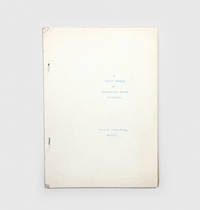
1934réf. 193780Likely Mukden: South Manchuria Railway 1934. First edition significantly scarcer than the second edition of 1936 of this memorandum on the railway's revenue and growth threats from bandits and infrastructure and bus and shipping lines run by its ancillary organizations. Sections are also devoted to agricultural development town planning and medical work. WorldCat records a single holding Claremont Colleges. This work is not to be confused with a more common book of the same title published in the same year. Quarto 252 x 174 mm. With 3 folding tables tables in text. Contents in dittoed typescript occasional corrections in black ink likely as issued. Original white card covers wire-stitched as issued front cover lettered in blue dittoed typescript. Creasing and a little marking to covers rear cover and final leaf detached from wire stitching: very good. unknown
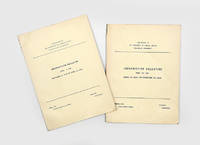
1933réf. 193848Hsinking Changchun: Department of Foreign Affairs Manchoukuo Government 1933 & 1934. First collection editions gathering informational notices previously circulated only to a limited audience in mimeographed form. Issued between September 1932 and February the documents concern the puppet state's legal economic and political affairs including flood relief taxation imports and exports and opium regulation. 2 works quarto. Section titles printed in colour paper. Original light yellow textured card wrappers front covers printed in black. Spines repaired with adhesive creasing and light cockling: very good. unknown
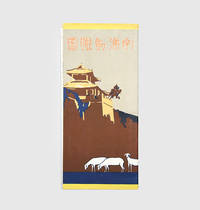
1923réf. 188890Perhaps Tokyo: Mantetsu tetsudobu c. 1923. The backbone of Japan's overseas empire A large and colourful tourist map of the mainline running from Jilin and Changchun to Lushun Port Arthur recording stations branchlines rivers and the belt of mountains skirting the mainline's south side. The text on the verso provides essential information on major destinations along the route. This map was issued during a period when Japan both consolidated its economic and political hold over South Manchuria but also faced heightened Chinese opposition in the form of strikes and protests. Tourist traffic however flowed unabated. Colour map formed from 2 joined sheets each 750 x 250 mm text and tipped-on errata slip on verso. Folding away into original illustrated wrappers. General creasing 55 mm split at head of first fold archival tape repair to wrappers: very good. unknown
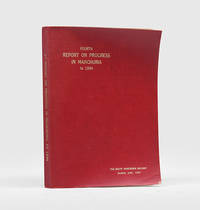
1934réf. 180943Dairen: South Manchuria Railway 1934. First edition of this comprehensive statistical and narrative report including a large folding map of Manchuria a map of road construction and plans of the ports of Rashin and Dairen. Sections convey the expansion of the railway's administrative structure and business interests into all aspects of governance. Quarto. With 24 plates 2 colour diagrams 4 maps and plans 2 colour. Original red cloth over limp card spine and front cover lettered in gilt. Covers and some text bowing rear endpaper lifting from cover spotting to edges plans at rear creased where incorrectly refolded: very good. hardcover
1924réf. 71397New York: South Manchuria Railway Company 1924. Revised edition 8vo pp. ix 1 98 2; color folding map 60 pages of plates; publisher's blue cloth gilt title on upper cover and spine; hinges cracked a touch of foxing very good. The South Manchuria Railway Company was founded and managed by the Japanese government and served as sort of imperial representative of the colonial project in China. They published many books aimed at a western audience touting the success of this project. From the preface: "The record of this achievement in colonial enterprise is here set forth in facts and figures with a careful avoidance of debatable questions of international politics. South Manchuria Railway Company unknown
1936réf. 0107528Tokyo: The Herald Press 1936. Paperback. pp. x 84. 8vo. Black and white photos and map. Fold-out map at rear. Light shelfwear crease and ring mark to front cover South Manchuria Railway Company ink stamp to title page; very good-. The Herald Press paperback
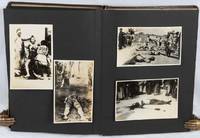
1940réf. 220264Circa1940s. Photographic album with eighty mounted black and white photographic illustrations of varying sizes a further four photographs loosely inserted. Unpaginated. Some with captions some with handwritten descriptions on the verso. 25 x 17cm. Faux leather blind stamped decorative binding a little worn on the edges the rear gutter has been neatly strengthened. Good condition. A strange and very disturbing but historically significant album of photos taken by a Japanese man before and during the Asia-Pacific War. Some photos have been removed from the album but those remaining include family images and school photos taken at the 80th anniversary of Takefumi Higashi Junior School in Echizen City Fukui Prefecture Japan in 1951. A set of five photos stamped with the mark of "E. Tsukio" and the place name Takefumi Higashi show the aftermath of an exceptionally heavy snowfall. The photographs in this album seems to be associated with a family surnamed Hiroba as a number have handwritten notations on the back bearing the names of various individuals with that surname. The album includes a set of commercially produced photographs of the aftermath of the 1923 Great Kanto Earthquake including grim images of piles of bodies of earthquake victims. These are annotated as having been a present from a man named Hiroba Shigenobu. A photo at the rear of the album shows a photo of a Japanese army officer with sword and medals and is annotated "Hiroba Shigeharu 6 October 1940 on the eve of the third expedition to Manchuria given by Takeda Fumio". Next to this is a set of commercially produced photographs of Port Arthur focusing on the monuments to the 1905 Japanese victory there in the Russo-Japanese War. These monuments were a popular tourist attraction for Japanese people visiting Manchuria before or during the Asia-Pacific War. There are also numerous original photos taken in Harbin and the surrounding area mostly in March and April 1941. These include pictures of the streetscape of Harbin and local people participating in an ice festival on the river but also of Japanese military actions in the area - setting up an observation post transporting goods by horse-cart etc. One photo shows the range of cigarette brands available for sale in wartime Harbin. Four photos show a ceremony celebrating the establishment of the "Shimizu Unit no. 24" in Northeast China. The celebrations included a sumo wrestling competition and a party where Japanese troops were entertained by Chinese "beautiful geisha" raising the disturbing spectre of the recruitment of "comfort women" by the wartime Japanese military. More shocking still are nine photos of beheadings and other acts of extreme violence being perpetrated on people during the war in China. The precise locations of these scenes are unclear. Some of the photos appear to have been commercially produced as they contain title inscriptions in within the print but others may be original. One titled photo shows "the heads of bandits being transported by train". A haunting reminder both the horrors of war and of the way in which these can be interwoven into apparently normal family lives. . hardcover
réf. 45325446-nnew. unknown
1872réf. 224630London.: Royal Geographical Society. 1872. 143-274pp notes. 21 x 13cm. Bound by a prior owner in green cloth-covered boards and quarter calf. One gathering bound in upside-down spine and boards shelf worn hinges tender but holding overall still in good condition. Alongside Palladius' Journey through Manchuria this issue also includes such articles as: the Livingstone Search and Relief Expedition; Journey Round the Island of Yezo Japan; and a Letter to Dr Kirk on an Ascent of Mount Kilima Njaro by Rev. Charles New. . Royal Geographical Society. hardcover
1933réf. 171122Circa1933. Map in text with outline colour graphs black and white mainly photographic illustrations 16pp original pictorial wrappers. Very good copy. 18.9 x 12.8cm. This booklet argues the importance of Manchuria and Inner Mongolia for Japan and its people as a new frontier for migration and development. It points out that the development of railway networks and in agricultural production should be of benefit for not only for Japan and its migrants but also for Manchuria through its growth prosperity and stable governance. It seems likely this booket was published a few years after the Manchurian Incident when Japan was keen to expand its influence and rights throughout the area. . unknown
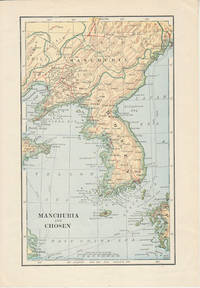
1900réf. 174813London. Circa1900. Map printed in colour showing submarine and overland telegraphs Manchuria Chosen Liao-Ting Kirin and Chili 21.5 x 13.3 cm 25.7 x 17.1 cm sheet size margins a little scuffed in very good condition. . unknown
réf. 22071901Harbin 1928 M.R.S. Stiff green wrs. very good 19 x 26.5 cm. 36p. English 36p. Chinese text 3 color maps charts statistics 16 b.w. photos March 1928 issue. OBSCURE WORK The journal is a record of the activities for the Society members in North Manchuria. With reports on the structure of the M.R.S. reports of committee work organization & manag- ement statistics charts museum work publishing library scientific activity: natural history Sungaree river biolog- ical station botanical plot geology & physical geography medical veterinary and sanitary work historical science cultural development photographic work publishing &c. unknown
réf. 91065401New York 1922 S.M.R. Half cloth over boards very good 91 113p. 102 b.w. photos fold out color map 41 tables 10 charts statistics. An excellent source which addresses the geogrpahy history & government natural resources argiculture development in manufacturing commerce & finance. The South Manchuria Rail way and its work: the railway harbors ships coal mines & steel works gas electricity hotels scientific instituti- ons civic administration. The open road to Manchuria. Very good primary source loaded with statistics and facts. Scans can be sent by email. unknown
réf. 91115401Seoul 1920. Blue cloth very good 266p.index 2 appendices 46 b.w. photos statistics fold out chart valuable refer- ence source loaded with charts & statistics fold out map top gilt crisp clean copy. Covering the ten years since the establishment of the Bank of Chosen. Addressing the economic reconstruction of Chosen currency reform central bank system monetary organs. Econ- omic development of Chosen fishery forestry mining manu- facturing industry. Development of commerce & trade finan- cial banking growth of the Bank of Chosen & the part played by it in Manchuria & Chosen's economic development. SCARCE. unknown
réf. 240476011933 South Manchuria Railways. Folded pamphlet 10 x 23 cm very good 3 folds opens to a large 30 x 46 cm. sheetlarge map 12 b. w. photos 3 statistical charts English text. A lovely period ephemera and guide. Designed for the "The exhibit of the South Manchuria Railway Company.was at the Centur of Progress International Exposition at Chicago. It is an industrial and commerical exhibit of Manchuria. This folding 12p pamphlet shows good b. w. photos of Hsinking and other places: Dairen Port Arthur Harbin development of Manchoukuo Anshan ironworks statistical charts of popu- lation staple products exports &c. unknown
1925réf. 95101Ryuzan Chosen: Chosen Railways 1925. Very Good. single sheet folded several times to produce a 12 panel brochure on one side and a map of Heijo with a smaller map of Shingishu-Antung and various small 18 black and white photos around the edge on the other side. 19 x 9 cm. when folded and 38 x 44 cm. when fully unfolded. Text in English. Back cover of folded brochure heavily scuffed and lacking some of the text which briefly described hotels under the management of S.M.R. -- this damage probably occurred when this scarce item was "rescued" from an album or scrapbook. One of the photos surrounding the map shows the Railway bridge built by the Japanese 1909-1911 over the Yalu River between what is now Dandong on the Chinese side and Sinuiju in North Korea. Heij then a modest-sized city is known today as Pyongyang and is the capital of North Korea with a population of more than three million. Chosen Railways was under control of South Manchuria Railway between 1917 and 1925. Chosen Railways unknown
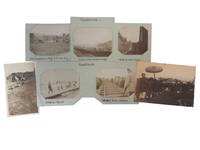
1903réf. 236401903. Chinese Eastern Railway and rural Manchuria photo archive depicting railway travel across Manchuria in 1903 documenting the rapid transformation of northeastern China into one of the most contested transportation corridors of the early twentieth century. Created only months before the outbreak of the Russo-Japanese War the photographs record a landscape where imperial railway construction traditional village life and foreign travel briefly occupied the same space. The French captions identify the photographer as part of the growing community of European travelers who crossed northern China by rail during the final years of the Qing dynasty when newly completed railway lines made regions previously reached only by caravan or river increasingly accessible. Photo archive of 7 silver gelatin photographs ranging from approximately 3 x 4 to 4 x 6.25 inches Manchuria and northern China 1903. Most prints bear contemporary handwritten French captions identifying locations and events including "Montée des monts Kingan" "Passage du Liao-Ho" "Attendant le train de secours" and "Scène champêtre au village de Che-San-Ling." The photographs show passenger trains winding through the forested slopes of the Khingan Mountains travelers gathered beside railway tracks awaiting a rescue train pedestrians crossing the Liao River by ferry expansive mountain vistas viewed from the railway a rural farming scene with villagers pack animal and harvested fields near Che-San-Ling and a ceremonial procession led by musicians carrying traditional instruments and parasols while foreign uniformed soldiers in white tropical helmets march behind. The photographs were made as Manchuria became the focal point of international competition following construction of the Chinese Eastern Railway between 1897 and 1903 a Russian-financed line that connected the Trans-Siberian Railway with Port Arthur and opened the interior of Manchuria to unprecedented commercial and military movement. By 1903 Russia's expanding railway presence and continued military occupation had become an international diplomatic crisis with negotiations over withdrawal collapsing only months before war erupted with Japan in February 1904. These photographs preserve the region immediately before that transformation showing railway travel functioning alongside agricultural villages river crossings and ceremonial life that had defined Manchuria long before foreign concessions arrived. The French captions also reflect the wave of French-speaking diplomats missionaries engineers businessmen and independent travelers who moved through China after the Boxer Rebellion using the expanding railway network to record landscapes and communities that had only recently become accessible to European visitors. Light surface wear minor edge wear and expected age toning; several photographs mounted with original manuscript captions. Overall in very good condition. A visual record of railway expansion cross-cultural travel and everyday life in Manchuria at the moment the region stood on the threshold of the Russo-Japanese War. unknown
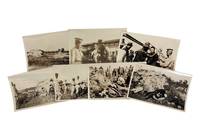
1940réf. 234221940. Chinese prisoner execution photo archive from Japanese-occupied Manchuria circa 1940s recording the custody restraint killing and aftermath of Chinese prisoners under Japanese military control. Japan's occupation of Manchuria followed the Mukden Incident of September 18 1931 when Japanese forces used an explosion along the South Manchurian Railway as the pretext for military conquest; in 1932 Japan established Manchukuo a puppet state that drew international condemnation through the League of Nations' Lytton Commission. By the 1940s Manchuria remained a central zone of Japanese military power in northeast China where occupation authority puppet-state policing and anti-guerrilla campaigns produced summary punishments prisoner shootings and public terror against local Chinese populations. Photo archive of 7 silver gelatin photographs each 4" x 6.5" Manchuria circa 1940s. Japanese soldiers in field uniforms and peaked caps surround blindfolded Chinese captives seated in open ground near an earthen bank; in one scene soldiers level rifles toward bound or blindfolded prisoners at close range. Several men lie face down or on their sides at the base of the embankment with soldiers and civilian onlookers standing above them; plain wooden boxes or planks sit nearby suggesting prepared burial or removal. Another scene records a prisoner being physically restrained in a courtyard or village setting with tiled rooflines uniformed soldiers and civilian men crowded around him. The sequence moves between armed custody execution ground bodies on the earth and prisoner handling under guard giving the group a direct evidentiary relationship to Japanese military violence in occupied Manchuria. Manchuria was not a peripheral theater in Japan's war in China; it was the region where the Kwantung Army transformed a railway-security pretext into territorial occupation state building under Manchukuo and a long-running military presence that helped bring international crisis in the 1930s and full-scale war in Asia. The scenes preserved here are not battlefront combat views but close-range records of prisoners controlled by armed soldiers making the archive especially significant for the study of occupation violence Japanese military practice wartime China and the fate of Chinese civilians or irregular fighters labeled enemies under Japanese authority. Light edge wear and minor fading to some areas; images remain primarily clean; overall very good condition. The archive preserves a compact but stark record of military force in Japanese-occupied Manchuria grounded in the physical proximity between guards prisoners rifles and bodies. unknown