225 résultats
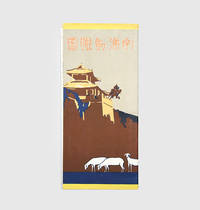
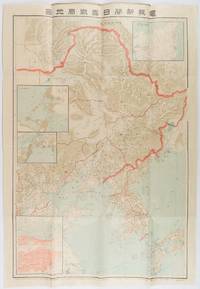
1904réf. 216818東京. Tokyo.: 電報新聞社. Denpō Tsūshinsha. Fifth Edition. Meiji 37 1904. Colour folding map with four inset maps 78.2 x 54.5cm folds into light card covers measuring 21 x 14cm. Very good copy. This the fifth edition of this map was published on 7th June 1904 reflecting the high level of public interest in receiving up-to-date information on the war particularly while the siege of Port Arthur continued without a decisive Japanese victory. The map includes four inset maps among them detailed views of Port Arthur and Vladivostok. It also records distances between key ports in Japan Korea and China. . 電報新聞社. [Denpō Tsūshinsha]. unknown
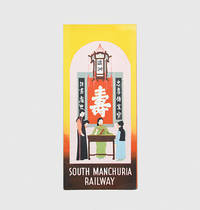
1933réf. 1964131933. An attractive piece of ephemera with photographs of cities in Manchuria a regional map incorporating the railway network and infographics recording the growth of imports exports and the population. The South Manchuria Railway occupied a prominent place in the exposition's Japanese pavilion. The leaflet's text portrays Manchuria as an independent state whose residents had seceded from China in a manner akin to the American Revolution of 1776 and positions Japan as a neutral conduit between the West and the region's rich resources. Colour lithographed sheet 460 x 300 mm folding to 230 x 103 mm printed both sides. Colours vivid and bright small closed tear at foot of one fold: a fine example. unknown
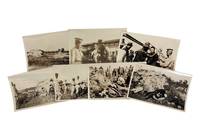
1940réf. 234221940. Chinese prisoner execution photo archive from Japanese-occupied Manchuria circa 1940s recording the custody restraint killing and aftermath of Chinese prisoners under Japanese military control. Japan's occupation of Manchuria followed the Mukden Incident of September 18 1931 when Japanese forces used an explosion along the South Manchurian Railway as the pretext for military conquest; in 1932 Japan established Manchukuo a puppet state that drew international condemnation through the League of Nations' Lytton Commission. By the 1940s Manchuria remained a central zone of Japanese military power in northeast China where occupation authority puppet-state policing and anti-guerrilla campaigns produced summary punishments prisoner shootings and public terror against local Chinese populations. Photo archive of 7 silver gelatin photographs each 4" x 6.5" Manchuria circa 1940s. Japanese soldiers in field uniforms and peaked caps surround blindfolded Chinese captives seated in open ground near an earthen bank; in one scene soldiers level rifles toward bound or blindfolded prisoners at close range. Several men lie face down or on their sides at the base of the embankment with soldiers and civilian onlookers standing above them; plain wooden boxes or planks sit nearby suggesting prepared burial or removal. Another scene records a prisoner being physically restrained in a courtyard or village setting with tiled rooflines uniformed soldiers and civilian men crowded around him. The sequence moves between armed custody execution ground bodies on the earth and prisoner handling under guard giving the group a direct evidentiary relationship to Japanese military violence in occupied Manchuria. Manchuria was not a peripheral theater in Japan's war in China; it was the region where the Kwantung Army transformed a railway-security pretext into territorial occupation state building under Manchukuo and a long-running military presence that helped bring international crisis in the 1930s and full-scale war in Asia. The scenes preserved here are not battlefront combat views but close-range records of prisoners controlled by armed soldiers making the archive especially significant for the study of occupation violence Japanese military practice wartime China and the fate of Chinese civilians or irregular fighters labeled enemies under Japanese authority. Light edge wear and minor fading to some areas; images remain primarily clean; overall very good condition. The archive preserves a compact but stark record of military force in Japanese-occupied Manchuria grounded in the physical proximity between guards prisoners rifles and bodies. unknown
1930réf. 2091502135501278Osaka Mainichi Shimbun 1930. Soft Cover. Fine. Number of pages: 446p Map size: 16x23cm Osaka Mainichi Shimbun paperback
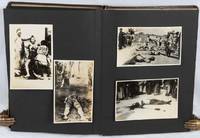
1940réf. 220264Circa1940s. Photographic album with eighty mounted black and white photographic illustrations of varying sizes a further four photographs loosely inserted. Unpaginated. Some with captions some with handwritten descriptions on the verso. 25 x 17cm. Faux leather blind stamped decorative binding a little worn on the edges the rear gutter has been neatly strengthened. Good condition. A strange and very disturbing but historically significant album of photos taken by a Japanese man before and during the Asia-Pacific War. Some photos have been removed from the album but those remaining include family images and school photos taken at the 80th anniversary of Takefumi Higashi Junior School in Echizen City Fukui Prefecture Japan in 1951. A set of five photos stamped with the mark of "E. Tsukio" and the place name Takefumi Higashi show the aftermath of an exceptionally heavy snowfall. The photographs in this album seems to be associated with a family surnamed Hiroba as a number have handwritten notations on the back bearing the names of various individuals with that surname. The album includes a set of commercially produced photographs of the aftermath of the 1923 Great Kanto Earthquake including grim images of piles of bodies of earthquake victims. These are annotated as having been a present from a man named Hiroba Shigenobu. A photo at the rear of the album shows a photo of a Japanese army officer with sword and medals and is annotated "Hiroba Shigeharu 6 October 1940 on the eve of the third expedition to Manchuria given by Takeda Fumio". Next to this is a set of commercially produced photographs of Port Arthur focusing on the monuments to the 1905 Japanese victory there in the Russo-Japanese War. These monuments were a popular tourist attraction for Japanese people visiting Manchuria before or during the Asia-Pacific War. There are also numerous original photos taken in Harbin and the surrounding area mostly in March and April 1941. These include pictures of the streetscape of Harbin and local people participating in an ice festival on the river but also of Japanese military actions in the area - setting up an observation post transporting goods by horse-cart etc. One photo shows the range of cigarette brands available for sale in wartime Harbin. Four photos show a ceremony celebrating the establishment of the "Shimizu Unit no. 24" in Northeast China. The celebrations included a sumo wrestling competition and a party where Japanese troops were entertained by Chinese "beautiful geisha" raising the disturbing spectre of the recruitment of "comfort women" by the wartime Japanese military. More shocking still are nine photos of beheadings and other acts of extreme violence being perpetrated on people during the war in China. The precise locations of these scenes are unclear. Some of the photos appear to have been commercially produced as they contain title inscriptions in within the print but others may be original. One titled photo shows "the heads of bandits being transported by train". A haunting reminder both the horrors of war and of the way in which these can be interwoven into apparently normal family lives. . hardcover
réf. 8663HongKong, Imprimerie de la Société des Missions Etrangères, 1934. 1 fort volume in-8, XX - 1040 pp., enrichi de nombreuses gravures et de plusieurs cartes (dont la grande carte dépliante en couleurs du Man-Tcheou-Kouo). Reliure demi-velin à coins, plats cartonnés marbrés, couvertures illustrées conservées, très bon état.
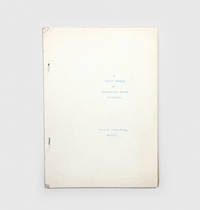
1934réf. 193780Likely Mukden: South Manchuria Railway 1934. First edition significantly scarcer than the second edition of 1936 of this memorandum on the railway's revenue and growth threats from bandits and infrastructure and bus and shipping lines run by its ancillary organizations. Sections are also devoted to agricultural development town planning and medical work. WorldCat records a single holding Claremont Colleges. This work is not to be confused with a more common book of the same title published in the same year. Quarto 252 x 174 mm. With 3 folding tables tables in text. Contents in dittoed typescript occasional corrections in black ink likely as issued. Original white card covers wire-stitched as issued front cover lettered in blue dittoed typescript. Creasing and a little marking to covers rear cover and final leaf detached from wire stitching: very good. unknown
1938Fair French Modern full brown leather, gilt lettering of title on front board. Heavily water stained, and some chippings on extremities of some pages. A fair copy. 4to. (27 x 20 cm). In French. 63 p. The very rare autographed copy of this lecture given in Lebanon on January 20, 1937, at the Youth Center, by Ostrorog after his serving in China as Assistant High Commissioner, a French diplomat from a noble Polish family, who had served as Assistant High Commissioner in China and Syria in the 1930s. Signed and inscribed by Ostrorog as "Par Mahid, Avec autre au mille amitié, Damas, 1938". On the eve of the Second Sino-Japanese War (1937-1945) between the Chinese and the Empire of Japan which is often regarded as the beginning of World War II in Asia, French ex-Assistant High Commissioner in China Ostrorog gave a lecture about Chinese power and policy. Some titles from book: "La Chine.; Le monde au temps de Confucius.; Humanisme Confuceen.; Opposition de l'humanisme Chinois a la morale idealiste de l'occident.; Facteur grammatical.; Universalite des caracteres.; Facteur geographique.; Facteur moral.; La republique des philosophes.; Reaction de Huang Ti au 3me siecle avant notre ere.; Evolution historique dans le cadre de l'unite.; Isolement.; Arrivee des Europeens au XVIme siecle les marchands et les missionnaires.; La querelle des rites condamnation des Jesuites.; Eclat du couchant Kien Lung.; Lettre de Kien Lung a Georges III.; Guerre de l'Opium.; Qeuvre des missions en Chine.; Tseu-hi et Abdul-Hamid.; Le Japon.; Propagande de Moscou.; Succes du mouvement nationaliste.; Intervention Japonaise en Mandchourie.; L'Unite Chinoise menacee.; La Grande pitie.; L'avenir de la Chine.". From the last chapter: "In our contract, the Chinese until now have taken only the faults and vices of Western civilizations. There is, however, something else to choose from and perhaps the time is near when the Chinese will understand it. Whether they are few in number, fifty, forty, ten, or five only, that will suffice. And on that day, with the power of assimilation which has always characterized it, China will integrate, in a way, all the foreign contributions of a moral or cultural order, to rebuild its unity, to resume the continuity of his story, and rediscover his genius." Only two copies in OCLC: 42804470. Signed and inscribed by Stanislas Ostrorog.
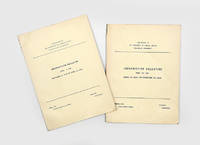
1933réf. 193848Hsinking Changchun: Department of Foreign Affairs Manchoukuo Government 1933 & 1934. First collection editions gathering informational notices previously circulated only to a limited audience in mimeographed form. Issued between September 1932 and February the documents concern the puppet state's legal economic and political affairs including flood relief taxation imports and exports and opium regulation. 2 works quarto. Section titles printed in colour paper. Original light yellow textured card wrappers front covers printed in black. Spines repaired with adhesive creasing and light cockling: very good. unknown
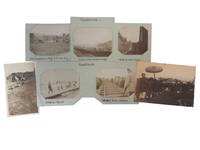
1903réf. 236401903. Chinese Eastern Railway and rural Manchuria photo archive depicting railway travel across Manchuria in 1903 documenting the rapid transformation of northeastern China into one of the most contested transportation corridors of the early twentieth century. Created only months before the outbreak of the Russo-Japanese War the photographs record a landscape where imperial railway construction traditional village life and foreign travel briefly occupied the same space. The French captions identify the photographer as part of the growing community of European travelers who crossed northern China by rail during the final years of the Qing dynasty when newly completed railway lines made regions previously reached only by caravan or river increasingly accessible. Photo archive of 7 silver gelatin photographs ranging from approximately 3 x 4 to 4 x 6.25 inches Manchuria and northern China 1903. Most prints bear contemporary handwritten French captions identifying locations and events including "Montée des monts Kingan" "Passage du Liao-Ho" "Attendant le train de secours" and "Scène champêtre au village de Che-San-Ling." The photographs show passenger trains winding through the forested slopes of the Khingan Mountains travelers gathered beside railway tracks awaiting a rescue train pedestrians crossing the Liao River by ferry expansive mountain vistas viewed from the railway a rural farming scene with villagers pack animal and harvested fields near Che-San-Ling and a ceremonial procession led by musicians carrying traditional instruments and parasols while foreign uniformed soldiers in white tropical helmets march behind. The photographs were made as Manchuria became the focal point of international competition following construction of the Chinese Eastern Railway between 1897 and 1903 a Russian-financed line that connected the Trans-Siberian Railway with Port Arthur and opened the interior of Manchuria to unprecedented commercial and military movement. By 1903 Russia's expanding railway presence and continued military occupation had become an international diplomatic crisis with negotiations over withdrawal collapsing only months before war erupted with Japan in February 1904. These photographs preserve the region immediately before that transformation showing railway travel functioning alongside agricultural villages river crossings and ceremonial life that had defined Manchuria long before foreign concessions arrived. The French captions also reflect the wave of French-speaking diplomats missionaries engineers businessmen and independent travelers who moved through China after the Boxer Rebellion using the expanding railway network to record landscapes and communities that had only recently become accessible to European visitors. Light surface wear minor edge wear and expected age toning; several photographs mounted with original manuscript captions. Overall in very good condition. A visual record of railway expansion cross-cultural travel and everyday life in Manchuria at the moment the region stood on the threshold of the Russo-Japanese War. unknown
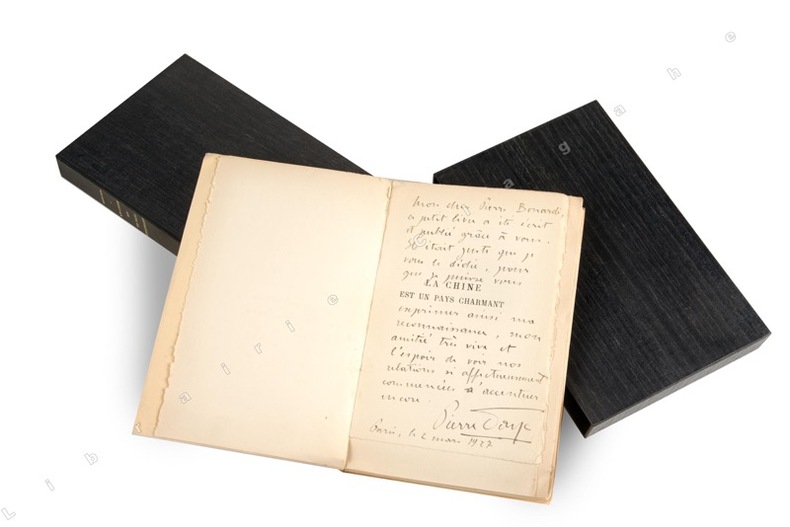
1927réf. 20808Paris, les Editions de France, collection “Notre Temps” publiée sous la direction de Pierre Bonardi, 1927 ; in-16 (210 mm), broché ; [8], 211, [5] pp., couverture jaune imprimée en rouge et noir, chemise-étui simili ébène, dos chagrin noir, titre doré (P.Goy & C.Vilaine).
1939réf. 2110502150410819South Manzhou Railway 1939. Soft Cover. Fine. Volume: 1 South Manzhou Railway paperback
1938réf. 2080502106906007Not Available 1938. Soft Cover. Fine. The book is in fine condition. Not Available paperback
1940réf. 2091502135500733Shinkyo Daido Plaza Manshu Central Bank 1940. Soft Cover. Fine. Number of pages: book size: 25cm Shinkyo Daido Plaza Manshu Central Bank paperback
1924réf. 2091502135501228South Manchuria Railway Co. Ltd. Harbin Office Investigation Section 1924. Soft Cover. Fine. Number of pages: 23 Standard size: 22x32cm South Manchuria Railway Co., Ltd. Harbin Office Investigation Section paperback
1770réf. X83682Paris, chez N.M. Tilliard 1770 [Suite du titre: " On y joint une pièce de vers sur le Thé, composé par le même empereur. Traduit en françois par le p. Amiot, missionnaire à Peking et publié par m. Deguignes], xxiv + xxxviii + 381 + [iii] pp., avec table de matières détaillée aux pages 339 à 381, première et seule édition, 20cm., reliure plein-cuir d'époque (titre et décorations dorées au dos, vague trace de trois étiquettes enlévées, coins peu fatigués), feuilles de garde marbrées, tranches rouges, cachet d'une bibliothèque de Scheut (congrégation missionnaire très active en Chine) sur la page de titre et au verso de la première feuille de garde, texte frais avec très peu de rousseurs, bon exemplaire de cet ouvrage bien rare et curieux, [AMIOT Joseph Marie, Toulon 1718 - Péking 1793, "partit pour la Chine en 1740, il eut bientôt gagné l'estime et la confiance de l'empereur Kien-Long et il apprit en perfection la langue chinoise et celles des Tatars que parlait l'empereur " (voir De Backer-Sommervogel I-295-6) / KIEN-LONG ou bien CHING KAO-TSUNG, 1710-1786, empereur de Chine en succession de son père en 1736 jusqu'à sa mort], X83682
1770[Suite du titre: "… On y joint une pièce de vers sur le Thé, composé par le même empereur. Traduit en françois par le p. Amiot, missionnaire à Peking et publié par m. Deguignes], xxiv + xxxviii + 381 + [iii] pp., avec table de matières détaillée aux pages 339 à 381, première et seule édition, 20cm., reliure plein-cuir d'époque (titre et décorations dorées au dos, vague trace de trois étiquettes enlévées, coins peu fatigués), feuilles de garde marbrées, tranches rouges, cachet d'une bibliothèque de Scheut (congrégation missionnaire très active en Chine) sur la page de titre et au verso de la première feuille de garde, texte frais avec très peu de rousseurs, bon exemplaire de cet ouvrage bien rare et curieux, [AMIOT Joseph Marie, Toulon 1718 - Péking 1793, "partit pour la Chine en 1740, il eut bientôt gagné l'estime et la confiance de l'empereur Kien-Long et il apprit en perfection la langue chinoise et celles des Tatars que parlait l'empereur… " (voir De Backer-Sommervogel I-295-6) / KIEN-LONG ou bien CHING KAO-TSUNG, 1710-1786, empereur de Chine en succession de son père en 1736 jusqu'à sa mort], X83682
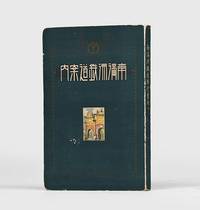
1917réf. 156891Dalian: Minami manshu tetsudo 1917. A rare guide to the South Manchuria Railway with 13 well-preserved maps First edition first printing of this scarce and profusely illustrated handbook for business and tourist travellers on the South Manchuria Railway the economic powerhouse of Japan's East Asian empire. WorldCat records only three copies all in Japanese institutions. The South Manchuria Railway Company was founded in 1906 under the direction of Goto Shinpei 1857-1929 to manage railway lines seized from Russia in the wake of the Russo-Japanese War. By the end of 1907 it already had 9000 Japanese and 4000 Chinese employees and during its first decade of operations the company invested in a range of industries including coal mining including the major mine at Fushun natural gas extraction shipping and hotels and hospitality. In 1917 the company took over management of the entire railway network in Japanese-controlled Korea cementing its position as the backbone of Japan's imperial expansion between the wars. This guide focuses on major stops along the railway including Dalian Fengtian Changchun and Yingkou together with descriptions of and directions to notable visiting spots. The maps and plans show the extent of the network the layout of important destination cities and the course of key battles in the Russo-Japanese war. A selection of the plates stress the vibrancy of Japanese economic development. Octavo. With 54 plates 11 colour 13 folding maps and plans 6 colour folding table of fares colour pagoda vignette on title page vignettes in text. Original illustrated green stiff card wrappers spine and front cover lettered in white pictorial endpapers. Covers bright extremities rubbed small closed tear to penultimate map professionally repaired with Japanese tissue maps otherwise exceptionally well-preserved small loss to p. 7 of table of contents slightly affecting text contents clean. A near-fine copy. Institutional holdings: National Diet Library Waseda and International Research Center for Japanese Studies. unknown
1978réf. 2110502150905045Kaimei shoin 1978. Soft Cover. Fine. Number of books: 12 Kaimei shoin paperback
1934réf. 1452111934. MANCHURIA. Saishin Manshu shashincho The latest Manchuria photograph album. By Kin'ichiro Yamazaki. Illustrated with two fold-out colour maps and 86 photographic plates some hand-coloured printed on various coloured papers interleaved with descriptive text in Japanese and English. Oblong 8vo. 135 x 195 mm bound in publisher's pictorial cloth two-hole binding with string ties. Wakayama: Kobun-Do-Shoten 1934. A fine copy of this very scarce guide book to Manchuria under the Japanese occupation. Among other things the guide covers the main sites in the major cities of Mukden Dairen Harbin and Port Arthur. By printing the guide in a slightly larger format than is usual for such works the publishers were able to illustrate it with larger and better photographs than are usually found in works of a similar nature. hardcover books
190410 parts in 3 vols., roy. 8vo., First Edition, text in English, with very numerous chromolithographed and tinted plates (original tissue guards present where called for), many large folding maps on japon, and some hundreds of monochrome photographs (a number full-page), and maps in the text; original salmon cloth, backs lettered and tooled in gilt, red sprinkled edges, ORIGINAL WRAPPERS PRESERVED, expertly rebacked with old backstrips laid down, a remarkably bright, clean set. This magnificent record of one of the earliest major international conflicts of the twentieth century is remarkable on several counts. In essence an early partwork, it was compiled and issued whilst the war was still in progress, enabling its readers to follow the course and consequences of the fighting in a manner previously unparalleled. Certainly it is unique is the comprehensiveness and detail of its coverage, and in the variety and extent of its illustrations, the two together constituting a truly massive documentary resource. COMPLETE SETS OF THIS NOTABLE WORK ARE RARE, THE MORE SO IN ORIGINAL CLOTH IN THIS CONDITION. Wenckstern II,140.
1923réf. 188890Perhaps Tokyo: Mantetsu tetsudobu c. 1923. The backbone of Japan's overseas empire A large and colourful tourist map of the mainline running from Jilin and Changchun to Lushun Port Arthur recording stations branchlines rivers and the belt of mountains skirting the mainline's south side. The text on the verso provides essential information on major destinations along the route. This map was issued during a period when Japan both consolidated its economic and political hold over South Manchuria but also faced heightened Chinese opposition in the form of strikes and protests. Tourist traffic however flowed unabated. Colour map formed from 2 joined sheets each 750 x 250 mm text and tipped-on errata slip on verso. Folding away into original illustrated wrappers. General creasing 55 mm split at head of first fold archival tape repair to wrappers: very good. unknown
1940réf. 2091502135701770Manmon Materials Association 1940. Soft Cover. Fine. The book is in fine condition. Manmon Materials Association paperback
1992réf. 2080502106402950Green Shadow Book 1992. Soft Cover. Fine. The book is in fine condition. Green Shadow Book paperback
1938réf. 2091502135500850Not Available 1938. Soft Cover. Fine. Number of pages: 1135 pages of thick text 35 pages 50 pages of index Size: 19 x 27 cm Not Available paperback