Manchuria - CLYDE, Paul HibbertAntiquariat.de

230 résultats
1966réf. 142370New York. Octagon Books Inc. 1966. XV, (2), 323 pages and one folded map. Green, illustrated original cloth binding in good condition. 21x14 cm
1932réf. JA9-319Dairen [Dalian], The South Manchuria Railway, 1932 / 1934. 2 B?nde original flexible Leinenb?nde, 4?, mit zahlreichen Abb. und Karten; Zustand: gut Vorsatz gestempelt
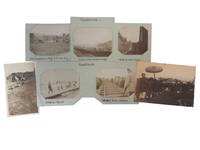
1903réf. 236401903. Chinese Eastern Railway and rural Manchuria photo archive depicting railway travel across Manchuria in 1903 documenting the rapid transformation of northeastern China into one of the most contested transportation corridors of the early twentieth century. Created only months before the outbreak of the Russo-Japanese War the photographs record a landscape where imperial railway construction traditional village life and foreign travel briefly occupied the same space. The French captions identify the photographer as part of the growing community of European travelers who crossed northern China by rail during the final years of the Qing dynasty when newly completed railway lines made regions previously reached only by caravan or river increasingly accessible. Photo archive of 7 silver gelatin photographs ranging from approximately 3 x 4 to 4 x 6.25 inches Manchuria and northern China 1903. Most prints bear contemporary handwritten French captions identifying locations and events including "Montée des monts Kingan" "Passage du Liao-Ho" "Attendant le train de secours" and "Scène champêtre au village de Che-San-Ling." The photographs show passenger trains winding through the forested slopes of the Khingan Mountains travelers gathered beside railway tracks awaiting a rescue train pedestrians crossing the Liao River by ferry expansive mountain vistas viewed from the railway a rural farming scene with villagers pack animal and harvested fields near Che-San-Ling and a ceremonial procession led by musicians carrying traditional instruments and parasols while foreign uniformed soldiers in white tropical helmets march behind. The photographs were made as Manchuria became the focal point of international competition following construction of the Chinese Eastern Railway between 1897 and 1903 a Russian-financed line that connected the Trans-Siberian Railway with Port Arthur and opened the interior of Manchuria to unprecedented commercial and military movement. By 1903 Russia's expanding railway presence and continued military occupation had become an international diplomatic crisis with negotiations over withdrawal collapsing only months before war erupted with Japan in February 1904. These photographs preserve the region immediately before that transformation showing railway travel functioning alongside agricultural villages river crossings and ceremonial life that had defined Manchuria long before foreign concessions arrived. The French captions also reflect the wave of French-speaking diplomats missionaries engineers businessmen and independent travelers who moved through China after the Boxer Rebellion using the expanding railway network to record landscapes and communities that had only recently become accessible to European visitors. Light surface wear minor edge wear and expected age toning; several photographs mounted with original manuscript captions. Overall in very good condition. A visual record of railway expansion cross-cultural travel and everyday life in Manchuria at the moment the region stood on the threshold of the Russo-Japanese War. unknown books
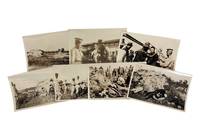
1940réf. 234221940. Chinese prisoner execution photo archive from Japanese-occupied Manchuria circa 1940s recording the custody restraint killing and aftermath of Chinese prisoners under Japanese military control. Japan's occupation of Manchuria followed the Mukden Incident of September 18 1931 when Japanese forces used an explosion along the South Manchurian Railway as the pretext for military conquest; in 1932 Japan established Manchukuo a puppet state that drew international condemnation through the League of Nations' Lytton Commission. By the 1940s Manchuria remained a central zone of Japanese military power in northeast China where occupation authority puppet-state policing and anti-guerrilla campaigns produced summary punishments prisoner shootings and public terror against local Chinese populations. Photo archive of 7 silver gelatin photographs each 4" x 6.5" Manchuria circa 1940s. Japanese soldiers in field uniforms and peaked caps surround blindfolded Chinese captives seated in open ground near an earthen bank; in one scene soldiers level rifles toward bound or blindfolded prisoners at close range. Several men lie face down or on their sides at the base of the embankment with soldiers and civilian onlookers standing above them; plain wooden boxes or planks sit nearby suggesting prepared burial or removal. Another scene records a prisoner being physically restrained in a courtyard or village setting with tiled rooflines uniformed soldiers and civilian men crowded around him. The sequence moves between armed custody execution ground bodies on the earth and prisoner handling under guard giving the group a direct evidentiary relationship to Japanese military violence in occupied Manchuria. Manchuria was not a peripheral theater in Japan's war in China; it was the region where the Kwantung Army transformed a railway-security pretext into territorial occupation state building under Manchukuo and a long-running military presence that helped bring international crisis in the 1930s and full-scale war in Asia. The scenes preserved here are not battlefront combat views but close-range records of prisoners controlled by armed soldiers making the archive especially significant for the study of occupation violence Japanese military practice wartime China and the fate of Chinese civilians or irregular fighters labeled enemies under Japanese authority. Light edge wear and minor fading to some areas; images remain primarily clean; overall very good condition. The archive preserves a compact but stark record of military force in Japanese-occupied Manchuria grounded in the physical proximity between guards prisoners rifles and bodies. unknown books
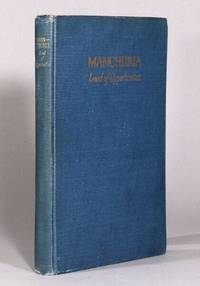
1924réf. 71397New York: South Manchuria Railway Company 1924. Revised edition 8vo pp. ix 1 98 2; color folding map 60 pages of plates; publisher's blue cloth gilt title on upper cover and spine; hinges cracked a touch of foxing very good. The South Manchuria Railway Company was founded and managed by the Japanese government and served as sort of imperial representative of the colonial project in China. They published many books aimed at a western audience touting the success of this project. From the preface: "The record of this achievement in colonial enterprise is here set forth in facts and figures with a careful avoidance of debatable questions of international politics. South Manchuria Railway Company unknown books
1925réf. 95101Ryuzan Chosen: Chosen Railways 1925. Very Good. single sheet folded several times to produce a 12 panel brochure on one side and a map of Heijo with a smaller map of Shingishu-Antung and various small 18 black and white photos around the edge on the other side. 19 x 9 cm. when folded and 38 x 44 cm. when fully unfolded. Text in English. Back cover of folded brochure heavily scuffed and lacking some of the text which briefly described hotels under the management of S.M.R. -- this damage probably occurred when this scarce item was "rescued" from an album or scrapbook. One of the photos surrounding the map shows the Railway bridge built by the Japanese 1909-1911 over the Yalu River between what is now Dandong on the Chinese side and Sinuiju in North Korea. Heij then a modest-sized city is known today as Pyongyang and is the capital of North Korea with a population of more than three million. Chosen Railways was under control of South Manchuria Railway between 1917 and 1925. Chosen Railways unknown books
19678vo., First US Edition, with 19 plates (one double-page) on 16; pictorial cloth in red and white, backstrip lettered in black, pictorial endpapers, uncut, a near fine copy in unclipped dustwrapper. Detailed account of the Japanese C-in-C hanged as a war criminal at the end of WWII. Enser, p.133.
190410 parts in 3 vols., roy. 8vo., First Edition, text in English, with very numerous chromolithographed and tinted plates (original tissue guards present where called for), many large folding maps on japon, and some hundreds of monochrome photographs (a number full-page), and maps in the text; original salmon cloth, backs lettered and tooled in gilt, red sprinkled edges, ORIGINAL WRAPPERS PRESERVED, expertly rebacked with old backstrips laid down, a remarkably bright, clean set. This magnificent record of one of the earliest major international conflicts of the twentieth century is remarkable on several counts. In essence an early partwork, it was compiled and issued whilst the war was still in progress, enabling its readers to follow the course and consequences of the fighting in a manner previously unparalleled. Certainly it is unique is the comprehensiveness and detail of its coverage, and in the variety and extent of its illustrations, the two together constituting a truly massive documentary resource. COMPLETE SETS OF THIS NOTABLE WORK ARE RARE, THE MORE SO IN ORIGINAL CLOTH IN THIS CONDITION. Wenckstern II,140.
19118vo., First Edition, with portrait frontispiece (original tissue guard present), numerous plates and plans, and large folding maps; original cloth, gilt back, covers mildly age-marked else a very good,bright, firm copy. First appearance in English of an important account, originally published in Russian in 1909. VERY SCARCE.
19878vo., First Edition, with plates; black cloth, gilt back, a near fine copy in unclipped dustwrapper, the latter sunned at backstrip.
19868vo., First Edition, with plates; red cloth, gilt back, a near fine copy in unclipped dustswrapper.
8vo., printed wrappers; 222pp.spine frayed, ow. good, broché, dos de le couverture abimé, autrement bon. en français.
1931Chez l'auteur, 1931. In-8 broché. 33 pages + carte "carte de Mandchourie. Emplacements des forces chinoises et groupements des bandits chinois". Joint une lettre de l'auteur. Couverture un peu brunie sinon bon exemplaire.
1932Cie Chemin de Fer Sud Mandchourien, 1932 In-4 broché sous couverture de tissus rouge très abimé. 267 pages. Bien complet des grands plans dépliants des ports de DAIREN et de VLADIVOSTOCK et de la grande carte dépliante de la MANDCHOURIE. La couverture est défraichie, le corps de l'ouvrage est en bon état.
1938Payot 1938, In-8 broché, 272 pages. Avec 38 dessins de l'auteur. Bon état.
1933Publication de la conciliation intrernaitonale, 1933. In-8 broché, carte dépliante. Bon état
1913Ecole Supérieur de Guerre, 1907. Cours ronéotypé de In-4 relié demi-toile chocolat à coins, titre doré en dos. 6 pages (erratum) + 1 ere partie : Couverture et exploration, 2ème partie : la cavalerie dans la bataille, 3ème partie Les opérations contre les lignes de communication de 327 pages et appendice : Destruction d'un pont de chemin de fer japonais au sud d'Haitcheng le 21 février 1905, 13 pages. Bien complet des 35 planches libres, certaines déplaintes. Bon état
1910Berger-Levrault & Cie éditeur, 1910. Fort In-8 relié demi-toile mauve, pièce de titre rouge, 712 pages. Très nombreuses cartes dépliantes. Septième année. Tome XIV. Juillet à décembre 1913. Petites taches en reliure et manque sur le haut du premier plat sinon bon état
19503 vols.: lxxxviii,380 + 333 + 326pp. + portrait, maps (of which some folding) and facsimiles, 23cm., cloth, G, text in Russian, [Bichurin of Beijing, monastic name: Iankinf, 1777-1853, was the ninth leader of the Russian Orthodox Mission to Beijing and one of the founding fathers of sinology; this collection of information about the peoples inhabiting Central Asia in Ancient Times - i.e. Central Asia, South Siberia, Manchuria, Corea, Japan, Middle Asia and Eastern Turkestan - is the result of his travels through Asia as a missiologist and scholar], OCLC 417573879, X72530
1985[8] + xiv + 79pp., 20cm., the Russian edition of St. Petersburg (1894) reprinted by the Research Group for Altaic Studies of the Hungarian Academy of Sciences, in the series "Debter, Deb-Ther, Debtelin: Materials for Central Asiatic and Altaic Studies" vol.2, softcover with some use, good condition, X71534
1979178pp. de bibliographie + 6 planches hors-texte, 25cm., br., bon état, X71611
2004932pp., 25cm., cloth, [multilingual: Tungusic entries with Russian, German and English translation], X69000
1932222pp., dans la série "Bibliothèque politique et économique", reliure cart. (dos en toile, avec titre doré), cachet, 22cm., bon état, X42311
1770[Suite du titre: "… On y joint une pièce de vers sur le Thé, composé par le même empereur. Traduit en françois par le p. Amiot, missionnaire à Peking et publié par m. Deguignes], xxiv + xxxviii + 381 + [iii] pp., avec table de matières détaillée aux pages 339 à 381, première et seule édition, 20cm., reliure plein-cuir d'époque (titre et décorations dorées au dos, vague trace de trois étiquettes enlévées, coins peu fatigués), feuilles de garde marbrées, tranches rouges, cachet d'une bibliothèque de Scheut (congrégation missionnaire très active en Chine) sur la page de titre et au verso de la première feuille de garde, texte frais avec très peu de rousseurs, bon exemplaire de cet ouvrage bien rare et curieux, [AMIOT Joseph Marie, Toulon 1718 - Péking 1793, "partit pour la Chine en 1740, il eut bientôt gagné l'estime et la confiance de l'empereur Kien-Long et il apprit en perfection la langue chinoise et celles des Tatars que parlait l'empereur… " (voir De Backer-Sommervogel I-295-6) / KIEN-LONG ou bien CHING KAO-TSUNG, 1710-1786, empereur de Chine en succession de son père en 1736 jusqu'à sa mort], X83682
PARIS, Lib.Arthur Rousseau, 1932 - In-8 - Broché - 137 pages - Exemplaire non coupé, Très propre