SONNERAT, Pierre.Livre Rare Book
891 résultats
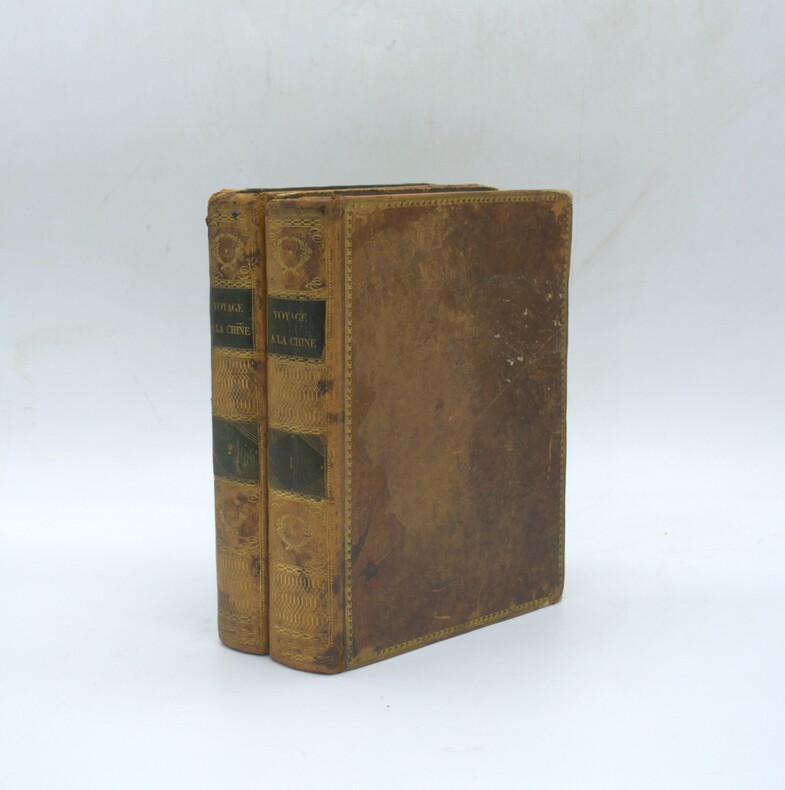
1782réf. PHO-2291A Paris, chez l'Auteur, Froulé, Nyon, Barrois, 1782.- 2 volumes in-4 (26x20,5cm) de XV, (8), 317, (1) pp., 80 pl. h.t. pour le tome 1 ; VIII, 298 pp., 60 pl. h.t. pour le tome 2 ; basane époque, dos lisse orné avec pièces de titre et tomaison vertes, frises aux plats. Frottements et épidermures, début de fentes (3cm) tome 2, coins et coupes usés, vieille mouillure claire, rousseurs et brunissures, 2 feuillets détachés, page 145 déchirée sans manque.
1899réf. 237631899. American Imperialism and the Colonization of the Philippines: Admiral Dewey Spanish-American War Military Victory Celebration Parade and New Rochelle Life Photo Album 1899-1900. An important photographic record of the public celebration of American imperial expansion following the Spanish-American War highlighted by approximately 38 photographs of the September 30 1899 New York parade honoring Admiral George Dewey and the American victory at Manila Bay. The celebration occurred as the United States was imposing colonial rule over the Philippines and fighting Filipino forces seeking independence giving the photographs particular significance as a visual record of American overseas conquest presented at home through patriotic pageantry military power and mass public celebration. Photo album of approximately 153 photographs including approximately 117 silver gelatin prints and 36 albumen photographs most 3.5 x 2.5 inches New York principally 1899 and 1900. The photographs are held in gray window mounts in a string-bound album and can be removed as they are not adhered to the leaves; handwritten captions and dates occur throughout. Approximately 38 photographs document the military parade celebration showing ranks of West Point cadets mounted cavalry identified as "Troop A" and "Troop C" artillery and horse-drawn equipment military bands American flags and enormous crowds lining the parade route. The official procession included 350 West Point cadets sailors and Marines from Dewey's fleet regular Army troops New York National Guard regiments Spanish-American War veterans and Governor Theodore Roosevelt and his staff. One view is captioned "Only woman in parade" while another photograph depicts the first American flag "hoisted over Morro Castle at Santiago." Dewey's May 1 1898 destruction of the Spanish fleet at Manila Bay helped open the Philippines to American occupation and transformed him into a national symbol of the country's new overseas power. Spain subsequently ceded the Philippines to the United States while Filipinos who had fought for independence resisted American rule resulting in the Philippine-American War beginning in 1899. The New York celebration therefore documented more than Dewey's military homecoming: its flags troops artillery bands political leaders and immense crowds embodied the popular celebration of America's emergence as an imperial power at the very moment it was establishing colonial control over the Philippines. The remainder of the album documents New Rochelle and Long Island Sound life including boating hunting fishing families dogs horses carriages substantial houses residential construction and waterfront recreation. Identified subjects include the launch of "Kathleen" Horseshoe Harbor Glen Island the Columbia Library and the Atlantic City Boardwalk. Bound album with severely worn spine; photographs generally clean and in very good condition with occasional corner wear creasing and small tears. Overall in good condition. unknown
1899réf. 237631899. American Imperialism and the Colonization of the Philippines: Admiral Dewey Spanish-American War Military Victory Celebration Parade and New Rochelle Life Photo Album 1899-1900. An important photographic record of the public celebration of American imperial expansion following the Spanish-American War highlighted by approximately 38 photographs of the September 30 1899 New York parade honoring Admiral George Dewey and the American victory at Manila Bay. The celebration occurred as the United States was imposing colonial rule over the Philippines and fighting Filipino forces seeking independence giving the photographs particular significance as a visual record of American overseas conquest presented at home through patriotic pageantry military power and mass public celebration. Photo album of approximately 153 photographs including approximately 117 silver gelatin prints and 36 albumen photographs most 3.5 x 2.5 inches New York principally 1899 and 1900. The photographs are held in gray window mounts in a string-bound album and can be removed as they are not adhered to the leaves; handwritten captions and dates occur throughout. Approximately 38 photographs document the military parade celebration showing ranks of West Point cadets mounted cavalry identified as "Troop A" and "Troop C" artillery and horse-drawn equipment military bands American flags and enormous crowds lining the parade route. The official procession included 350 West Point cadets sailors and Marines from Dewey's fleet regular Army troops New York National Guard regiments Spanish-American War veterans and Governor Theodore Roosevelt and his staff. One view is captioned "Only woman in parade" while another photograph depicts the first American flag "hoisted over Morro Castle at Santiago." Dewey's May 1 1898 destruction of the Spanish fleet at Manila Bay helped open the Philippines to American occupation and transformed him into a national symbol of the country's new overseas power. Spain subsequently ceded the Philippines to the United States while Filipinos who had fought for independence resisted American rule resulting in the Philippine-American War beginning in 1899. The New York celebration therefore documented more than Dewey's military homecoming: its flags troops artillery bands political leaders and immense crowds embodied the popular celebration of America's emergence as an imperial power at the very moment it was establishing colonial control over the Philippines. The remainder of the album documents New Rochelle and Long Island Sound life including boating hunting fishing families dogs horses carriages substantial houses residential construction and waterfront recreation. Identified subjects include the launch of "Kathleen" Horseshoe Harbor Glen Island the Columbia Library and the Atlantic City Boardwalk. Bound album with severely worn spine; photographs generally clean and in very good condition with occasional corner wear creasing and small tears. Overall in good condition. unknown books
Manila, La Oceanía Española, 1878, 20 x 14,5 cm., holandesa piel moderna, IX + 430 págs. (sello en portada de José Paredes Rodríguez, médico de sanidad militar. Rara obra de la que solo hemos localizado 3 ejemplares en en Catálogo Colectivo. "Advierte el editor en el Prólogo que quedándole 400 ejemplares de la edición de 1877, le añadió nuevos pliegos, con notas, para hacer un paralelo entre 1809 y 1878" Retana).
1818réf. 33498Paris Gide fils 1818 in-8 cartonnage d'attente de l'époque de papier noisette, pièce de titre cerise
1798réf. PHO-1110Paris, F. Buisson, An 6 de la République (1798). Cinq volumes in-8 (21x13,5cm) , relié plein cuir époque , dos lisse orné avec pièces de titre et de tomaison , filet en torsade sur les plats, coins et coiffes usés , charnières frottées (fente sur le tome 1) , (4) viij, 515pp. et (4) 412pp. et (4) 399pp. et (4) 326pp. et (4) ij, 402pp. ; (2) , illustré de 29 gravures (32) , 4 frontispices et 3 grandes cartes dépliantes gravés par Tardieu l’Ainé , pages de titre brunis . Édition originale du voyage de Macartney avec le 5eme volume ,en seconde édition, contenant le précis de l’histoire de Chine par Huttner (1-184) et la relation de son voyage (187-358) dans une reliure uniforme .
1725réf. PHO-1468Rouen & Amsterdam, Jean Baptiste Machuel le jeune , (T1, Étienne Roger,T2&8 Pierre le Boucher, Rouen) 1725 . 10 volumes in-12, ,relié plein veau époque , dos orné, pièces de titre et de tomaison rouges, tranches rouges , reliures tome 1 et 2 légèrement différentes, défauts d’usures, illustré de 5 frontispices et 42 gravures , la plupart dépliantes ,quelques défauts d’usages.
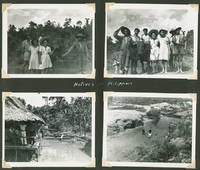
1938réf. 235471938. Large photograph album documenting the colonial Philippines China Japan Hawaii and the United States in the inter war period 1929 and 1930. Likely compiled by an American missionary the photographs are dated and captioned showing colonial education and missionary activities expatriate tourist and native communities village visits portraits of Indigenous Filipinos and well documented Pacific travel infrastructure including photos of early railways and steam ship travel. The album includes many named individuals identified locations typed and handwritten observations and captions with ethnographic and paternalistic undertones characteristic of colonial travel photography in 1929. Photo album of approximately 140 silver gelatin and sepia toned photographs all 2.5 x 4.5 inches Philippines Shanghai and Japan 1929 and 1930. The photographs show white men and women in pith helmets cloche hats field clothing and travel dresses; a man identified as "fellow teacher Mr. Paul Russel"; a group captioned "Miss Knape Mrs. Chillson Ms. Hawkins Ms. Lynch Mrs. Cash"; group photographs of travelers likely American teachers standing in dense tropical vegetation; men crossing streams with walking sticks and hats; indigenous families and children outside thatched or leaf covered dwellings. A typed verso caption identifies "the home in Tagbilaran" comparing it to a house in Albay giving domestic detail of expatriate residence and social life outside Manila. Philippine locations including Tagbilaran and Albay village houses coastal and river landscapes and jungle terrain; In China Shanghai's "native city"; and Japanese sites including Kamakura and Tokyo. A photo from Shanghai depicts a street scene with horse drawn carts and Chinese garden or pavilion architecture. Photographs from Japan show the Great Buddha at Kamakura temple and shrine buildings a large torii steps to a temple complex and a Tokyo Imperial Palace bridge view. The provincial Philippines images include repeated portraits of local and Indigenous peoples including women and girls captioned "These are the belles of the jungle" families outside thatched dwellings children gathered near village houses and residents approached by the travelers for staged photographs. These captions and scenes document Indigenous Filipino subjects through paternalistic and exoticizing language while recording houses clothing family groups and village life in Bohol and nearby provincial districts in the 1920s. One photograph is captioned "December 29 1929" and describes the travelers as "trying to convince Filipinos to allow their photograph to be taken." In the period after the Spanish American War when the United States governed the islands as a colonial possession and made public education one of the central instruments of American administration. American teachers had entered the colonial school system in large numbers after 1901 and by the 1920s their work housing mobility and social networks formed a recognizable expatriate layer in provincial towns as well as Manila. The English captions reference to a "fellow teacher" and named residences in Tagbilaran and Albay point to a likely American teaching or expatriate circle though no creator is identified in the visible material. The Shanghai and Japan views extend the itinerary across treaty port China and Japanese tourist sites moving from the "native city" of Shanghai to Kamakura's Buddhist monuments and Tokyo imperial architecture. Some tonal variation in the photographs some pages unbound from album. Every image remains legible those detached from the album carry the album residue and many have handwritten and typed captions en verso; there are likely many more inscriptions which remain concealed as they are adhered to the album leaves. Overall in very good condition. A large dated visual record of a teacher in the American colonial Philippines and other East Asian travel routes during the interwar consolidation of American power in the Pacific. unknown
1938réf. 235471938. Large photograph album documenting the colonial Philippines China Japan Hawaii and the United States in the inter war period 1929 and 1930. Likely compiled by an American missionary the photographs are dated and captioned showing colonial education and missionary activities expatriate tourist and native communities village visits portraits of Indigenous Filipinos and well documented Pacific travel infrastructure including photos of early railways and steam ship travel. The album includes many named individuals identified locations typed and handwritten observations and captions with ethnographic and paternalistic undertones characteristic of colonial travel photography in 1929. Photo album of approximately 140 silver gelatin and sepia toned photographs all 2.5 x 4.5 inches Philippines Shanghai and Japan 1929 and 1930. The photographs show white men and women in pith helmets cloche hats field clothing and travel dresses; a man identified as "fellow teacher Mr. Paul Russel"; a group captioned "Miss Knape Mrs. Chillson Ms. Hawkins Ms. Lynch Mrs. Cash"; group photographs of travelers likely American teachers standing in dense tropical vegetation; men crossing streams with walking sticks and hats; indigenous families and children outside thatched or leaf covered dwellings. A typed verso caption identifies "the home in Tagbilaran" comparing it to a house in Albay giving domestic detail of expatriate residence and social life outside Manila. Philippine locations including Tagbilaran and Albay village houses coastal and river landscapes and jungle terrain; In China Shanghai's "native city"; and Japanese sites including Kamakura and Tokyo. A photo from Shanghai depicts a street scene with horse drawn carts and Chinese garden or pavilion architecture. Photographs from Japan show the Great Buddha at Kamakura temple and shrine buildings a large torii steps to a temple complex and a Tokyo Imperial Palace bridge view. The provincial Philippines images include repeated portraits of local and Indigenous peoples including women and girls captioned "These are the belles of the jungle" families outside thatched dwellings children gathered near village houses and residents approached by the travelers for staged photographs. These captions and scenes document Indigenous Filipino subjects through paternalistic and exoticizing language while recording houses clothing family groups and village life in Bohol and nearby provincial districts in the 1920s. One photograph is captioned "December 29 1929" and describes the travelers as "trying to convince Filipinos to allow their photograph to be taken." In the period after the Spanish American War when the United States governed the islands as a colonial possession and made public education one of the central instruments of American administration. American teachers had entered the colonial school system in large numbers after 1901 and by the 1920s their work housing mobility and social networks formed a recognizable expatriate layer in provincial towns as well as Manila. The English captions reference to a "fellow teacher" and named residences in Tagbilaran and Albay point to a likely American teaching or expatriate circle though no creator is identified in the visible material. The Shanghai and Japan views extend the itinerary across treaty port China and Japanese tourist sites moving from the "native city" of Shanghai to Kamakura's Buddhist monuments and Tokyo imperial architecture. Some tonal variation in the photographs some pages unbound from album. Every image remains legible those detached from the album carry the album residue and many have handwritten and typed captions en verso; there are likely many more inscriptions which remain concealed as they are adhered to the album leaves. Overall in very good condition. A large dated visual record of a teacher in the American colonial Philippines and other East Asian travel routes during the interwar consolidation of American power in the Pacific. unknown books
1962réf. 2383All volumes near fine in blue cloth. First editions thus. Consisting of the following: Volume 1: GIRONIERE PAUL DE LA. Twenty Years in the Philippines. Frontispiece is "Una Mestiza de Manila" with tissue guard intact. 1962. Volume 2: CARERI GIOVANNI FRANCESCO GEMELLI. A Voyage to the Philippines. Frontispiece is a water color by Alfredo Carmelo b.1896 depicting Manila galleons moored at the mouth of the Pasig River. 1963. Volume 3: BOWRING SIR JOHN. A Visit To The Philippine Islands. Frontispiece is a black and white portrait of Bowring. 1963. Volume 4: SALEEBY NAJEEB M. The History of Sulu. Frontispiece is black and white photo of Saleeby. 1963. The Filipiniana Book Guild publications expanded to 24 volumes in the first series. These first four volumes are extremely rare. The Princeton library has all volumes except these four. Only digital copies are located in the National Archives of the Philippines. Manila, Philippines, Filipiniana Book Guild, 1962-1963. hardcover
1945réf. 64628Los Angeles CA: 40th Infantry Division ca. 1945. Oblong 4to. 120 pp unpaginated. with 200 silver gelatin photographs all mounted and numbered in lower corner w/in negative keyed to indices inserted after the title page occasional creasing to corners. Brick-red publisher’s cloth post-binder two hidden nickel-plated screwposts at gutter margin 40th Infantry Division sunburst emblem patch on front cover in gilt on blue field minor thumbing edgewear slightly shaken occasional fraying to a couple leaves at fore-edge still a VG copy. First edition thus of this 40th Infantry Division regimental souvenir album visually recording the Western National Guard “Sunshine Division’s” participation in the grueling and bloody island hopping campaign during World War II from Guadalcanal to The Philippines often involved in heavy fighting and credited with capturing or killing over 11000 Japanese troops while suffering 715 casualties. These photographs follow the 40th Division’s arrival and activities in Hawaii followed by their movement to Guadalcanal and arrival at Kukum Dock. Photos depict wrecked Japanese ships beached nearby the typical bare-breasted shots of New Britain Indigenous Peoples arrival of nurse units and training on New Britain. As depicted in these images the bloody Philippine Islands campaign opened with multiple regiments from the 40th Division landing at the Lingayen Gulf on Luzon in order to retake the main Philippine Island in January 1945 including views of Tarlac Bamban battle damage artillery pieces war dogs used by segregated African-American patrols on Luzon well-prepared Japanese positions built to repel the American forces machine gunners Japanese casualties and the results of Japanese troops using grenades to commit Hari Kari.The next phase of the campaign involved the 40th Division participating in the Panay & Guimaras Invasion landing at Tigbauan on Panay Island securing Iloilo City and nearby airfields coordinating with Philippine guerrilla forces with photos of the guerrillas views of the landing craft Philippine peoples and guerrillas wounded by Japanese snipers being treated by American forces and the Division artillery. The 40th Division later came together with other forces and moved onto Negros Island from the end of March through August 1945 pushing deep into Negros Island capturing Bacolod and its airfield before continuing on in the heavy surrounding jungle dislodging Japanese troops in the surrounding area. Their artillery and tank battalions proved particularly effective and many of these photographs depict not only the movements and equipment but the aftermath as well. This album does not include the National Guard Division’s participation in the enforcement of the orders to round up and illegally incarcerate Japanese-Americans throughout the West into War Relocation Centers and Internment Camps for the duration of the War. No copies in Worldcat -- this volume should not be confused with the regimental history published in Baton Rouge LA by the Army & Navy Publishing Company -- “40th Infantry Division: the years of World War II 7 December 1941-7 April 1946. 40th Infantry Division, hardcover
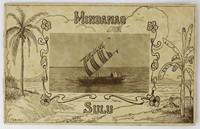
1905réf. 5045Manila: Sugar News Press 1905. Very good. 22pp. Illustrated. Oblong quarto. Original pictorial wrappers stapled. Moderate dust-soiling and edge wear. Light even toning to text. An early and seemingly-unrecorded promotional touting the people and scenery in Mindanao and Sulu in the southern Philippines in the first decade of the 20th century. The work opens with a Foreword detailing the positive aspects of Mindanao particularly its principal city described here as the "Metropolis of Mindanao and Sulu" with "a population of more than thirty thousand a mixture of Moros or Mohammedan Filipinos Christian Filipinos Chinese Japanese and Europeans." Following the Foreword the remainder of the work is mostly comprised of thirty-four duotone photographic prints printed mostly two per page but occasionally with from one to five per page. The photographs feature numerous scenic and street views in and around Zamboanga including various "Moro houses" and about fifteen portraits of indigenous Filipinos such as a "Moro woman weaving materials for head-turbans and sarongs" a view inside a "weaving school" "Yakan Moros on the island of Basilan" "Muhammad Jamallul Sultan of Sulu" "Joloano Warriors" "Moro Kulintang" and their musical instruments Bogobo and Cotabato warriors "Bajaos - the sea gypsies of Sulu" and "Bogobo musicians." The final two pages of the work are taken up with two poems -- the first is a traditional Filipino poem entitled "No Te Vayas" noted as "Zamboanga's 'Auld Lang Syne" and one titled simply "Zamboanga" by Susan Hart Dyer. The front cover is decorated with a central photograph of an indigenous sailing vessel surrounded by an illustrated beach scene signed at bottom left "Jh. Mendoza." The inside front cover contains an illustration of the Philippine Islands from Batanes down to Sulu. We could locate no other copies of the work by title and imprint information in OCLC. Sugar News Press unknown
1905réf. 5045Manila: Sugar News Press 1905. Very good. 22pp. Illustrated. Oblong quarto. Original pictorial wrappers stapled. Moderate dust-soiling and edge wear. Light even toning to text. An early and seemingly-unrecorded promotional touting the people and scenery in Mindanao and Sulu in the southern Philippines in the first decade of the 20th century. The work opens with a Foreword detailing the positive aspects of Mindanao particularly its principal city described here as the "Metropolis of Mindanao and Sulu" with "a population of more than thirty thousand a mixture of Moros or Mohammedan Filipinos Christian Filipinos Chinese Japanese and Europeans." Following the Foreword the remainder of the work is mostly comprised of thirty-four duotone photographic prints printed mostly two per page but occasionally with from one to five per page. The photographs feature numerous scenic and street views in and around Zamboanga including various "Moro houses" and about fifteen portraits of indigenous Filipinos such as a "Moro woman weaving materials for head-turbans and sarongs" a view inside a "weaving school" "Yakan Moros on the island of Basilan" "Muhammad Jamallul Sultan of Sulu" "Joloano Warriors" "Moro Kulintang" and their musical instruments Bogobo and Cotabato warriors "Bajaos - the sea gypsies of Sulu" and "Bogobo musicians." The final two pages of the work are taken up with two poems -- the first is a traditional Filipino poem entitled "No Te Vayas" noted as "Zamboanga's 'Auld Lang Syne" and one titled simply "Zamboanga" by Susan Hart Dyer. The front cover is decorated with a central photograph of an indigenous sailing vessel surrounded by an illustrated beach scene signed at bottom left "Jh. Mendoza." The inside front cover contains an illustration of the Philippine Islands from Batanes down to Sulu. We could locate no other copies of the work by title and imprint information in OCLC. Sugar News Press unknown books
1945réf. 54321Philippines; Okinawa; San Diego. 1945. Photo Album of a Seabee in the Philippines in 1945 A fascinating photographic account of military service in the Philippines compiled by a member of the 142nd U.S. Naval Construction Battalion the Seabees in 1945. Most of the images approximately three-quarters of the album were taken in Guiuan on Samar Island in the central Philippines where the photographer was stationed: Guiuan city square the Seabees' camp numerous portraits of local girls who sometimes pose with American soldiers local families and their activities indigenous architecture and other local scenes. They also show the Immaculate Conception Church with shots of the exterior and detailed views of the silver altar - built in 1595 to 1844 but completely destroyed by Typhoon Haiyan in 2013. Several other photos evidently portray the album's compiler posing next to an American fighter plane while boiling sea shells in front of his tent etc. The final portion of the album contains photos taken during the operations aboard the U.S.S. "Monrovia" and "President Harris" in October-November 1945 including views of Okinawa on the way to China and snapshots of soldiers unloading cargo in China before returning to Manila. There are also eight clear views of Manila showing destroyed Japanese cranes and boats in the harbor American army headquarters and a warehouse. The album concludes with a few photos of the homeward voyage and shows soldiers discharged in San Pedro California. Overall a very good album depicting local life and the activities of the 142nd U.S. Naval Construction Battalion in the Philippines and Yellow Sea in the last months of the World War II. 133 silver gelatin photographs most 2½ x 4 inches but ranging from 2½ x 2½ to several 10 x 7 inches. Oblong folio. Black leatherette album strong tied. Light wear. Photos in corner mounts with many captions. Very good. hardcover
1945réf. 54321Philippines; Okinawa; San Diego. 1945. Photo Album of a Seabee in the Philippines in 1945 A fascinating photographic account of military service in the Philippines compiled by a member of the 142nd U.S. Naval Construction Battalion the Seabees in 1945. Most of the images approximately three-quarters of the album were taken in Guiuan on Samar Island in the central Philippines where the photographer was stationed: Guiuan city square the Seabees' camp numerous portraits of local girls who sometimes pose with American soldiers local families and their activities indigenous architecture and other local scenes. They also show the Immaculate Conception Church with shots of the exterior and detailed views of the silver altar - built in 1595 to 1844 but completely destroyed by Typhoon Haiyan in 2013. Several other photos evidently portray the album's compiler posing next to an American fighter plane while boiling sea shells in front of his tent etc. The final portion of the album contains photos taken during the operations aboard the U.S.S. "Monrovia" and "President Harris" in October-November 1945 including views of Okinawa on the way to China and snapshots of soldiers unloading cargo in China before returning to Manila. There are also eight clear views of Manila showing destroyed Japanese cranes and boats in the harbor American army headquarters and a warehouse. The album concludes with a few photos of the homeward voyage and shows soldiers discharged in San Pedro California. Overall a very good album depicting local life and the activities of the 142nd U.S. Naval Construction Battalion in the Philippines and Yellow Sea in the last months of the World War II. 133 silver gelatin photographs most 2½ x 4 inches but ranging from 2½ x 2½ to several 10 x 7 inches. Oblong folio. Black leatherette album strong tied. Light wear. Photos in corner mounts with many captions. Very good. hardcover books
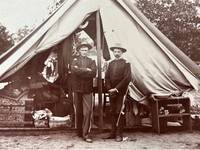
1898réf. 236541898. Spanish American and Philippine American war US military photographs circa 1898 to 1901 documenting the Spanish American War mobilization and the subsequent American occupation of the Philippines. A caption identifying "Co. B Pa. Vol. Mt. Gretna" places one image within Pennsylvania's 1898 volunteer encampment where state militia companies entered federal service during the Spanish American War. A separate inscription "Vigan Philippine Islands Christmas 1901" establishes an American military presence in northern Luzon during the Philippine American War. The photographs record how soldiers were assembled housed transported armed and sustained across stateside and overseas settings. Photo archive of 11 photographs seven silver gelatin and two sepia toned photographs most mounted to cardstock ranging from approximately 5 x 4 to 8 x 10 inches Pennsylvania the Philippine Islands and unidentified locations circa 1898 to 1901. A large company portrait before a conical tent is captioned "Co. B Pa. Vol. Mt. Gretna" among the assembled officers and enlisted men. Other photographs show soldiers standing in opposing ranks along a wooded camp street; five armed men before numbered canvas tents; a mounted officer amid trees and tentage; a long formation carrying an American flag beside railroad tracks telegraph poles freight cars and industrial buildings; and uniformed men posed near a railroad water tower. Two soldiers stand before an open tent crowded with trunks bedding shelving cookware and personal effects while another view records enlisted men seated on the steps of a raised tent furnished with cots. An interior scene shows three soldiers eating smoking pipes and preparing food around a carved table with rifles resting across their laps and beside their chairs. One mount is inscribed "Chas. W. Grammes 925 Maple St. Allentown Pa." while another bears the dated inscription "Vigan Philippine Islands Christmas 1901." Mount Gretna served as Pennsylvania's principal volunteer encampment during the 1898 mobilization but Pennsylvania regiments received different assignments after mustering into federal service. Some units remained stateside or served in Puerto Rico while the 10th Pennsylvania Volunteer Infantry deployed to the Philippines and later fought Filipino forces after the war with Spain had formally ended. Because the Mount Gretna caption omits a regiment number the company shown cannot be securely identified with Philippine service yet the image preserves the state level mobilization from which such overseas assignments were made. By late 1901 Vigan functioned as an American controlled provincial center in Ilocos Sur where military authority and the new colonial administration operated amid continuing resistance elsewhere in the archipelago. Light surface wear and silvering to several images; tonal variation edge wear and staining to some cardstock mounts. Overall good condition. A concentrated visual record of American military organization from Pennsylvania's 1898 volunteer camps to the daily realities of occupation service in the Philippines. unknown
1898réf. 236541898. Spanish American and Philippine American war US military photographs circa 1898 to 1901 documenting the Spanish American War mobilization and the subsequent American occupation of the Philippines. A caption identifying "Co. B Pa. Vol. Mt. Gretna" places one image within Pennsylvania's 1898 volunteer encampment where state militia companies entered federal service during the Spanish American War. A separate inscription "Vigan Philippine Islands Christmas 1901" establishes an American military presence in northern Luzon during the Philippine American War. The photographs record how soldiers were assembled housed transported armed and sustained across stateside and overseas settings. Photo archive of 11 photographs seven silver gelatin and two sepia toned photographs most mounted to cardstock ranging from approximately 5 x 4 to 8 x 10 inches Pennsylvania the Philippine Islands and unidentified locations circa 1898 to 1901. A large company portrait before a conical tent is captioned "Co. B Pa. Vol. Mt. Gretna" among the assembled officers and enlisted men. Other photographs show soldiers standing in opposing ranks along a wooded camp street; five armed men before numbered canvas tents; a mounted officer amid trees and tentage; a long formation carrying an American flag beside railroad tracks telegraph poles freight cars and industrial buildings; and uniformed men posed near a railroad water tower. Two soldiers stand before an open tent crowded with trunks bedding shelving cookware and personal effects while another view records enlisted men seated on the steps of a raised tent furnished with cots. An interior scene shows three soldiers eating smoking pipes and preparing food around a carved table with rifles resting across their laps and beside their chairs. One mount is inscribed "Chas. W. Grammes 925 Maple St. Allentown Pa." while another bears the dated inscription "Vigan Philippine Islands Christmas 1901." Mount Gretna served as Pennsylvania's principal volunteer encampment during the 1898 mobilization but Pennsylvania regiments received different assignments after mustering into federal service. Some units remained stateside or served in Puerto Rico while the 10th Pennsylvania Volunteer Infantry deployed to the Philippines and later fought Filipino forces after the war with Spain had formally ended. Because the Mount Gretna caption omits a regiment number the company shown cannot be securely identified with Philippine service yet the image preserves the state level mobilization from which such overseas assignments were made. By late 1901 Vigan functioned as an American controlled provincial center in Ilocos Sur where military authority and the new colonial administration operated amid continuing resistance elsewhere in the archipelago. Light surface wear and silvering to several images; tonal variation edge wear and staining to some cardstock mounts. Overall good condition. A concentrated visual record of American military organization from Pennsylvania's 1898 volunteer camps to the daily realities of occupation service in the Philippines. unknown books
1706réf. PHO-1901Amsterdam, Jacques Desbordes, 1706. 3 volumes in-12° (sur 3), 10ff-405pp-3pp (catalogue); 2ff-402pp-14ff( table) ; 4ff.-388pp.-10ff., illustré de 3 frontispices, 1 portrait et 30 (32) cartes et planches dépliantes dont une belle carte (25x36cm), manque la page de titre tome 1. Relié plein veau époque, dos à nerfs ornés avec pièce de titre et tomaison, tranches rouges, charnières frottées, début de fente (tome 1), coiffes usées, petit manque de cuir au dos, mouillure au tome 3, traces de restauration, manque la grande carte mais la carte de Ceylan est bien présente.
1781réf. 0042251781 Genève, Pellet, 1781. Dix volumes in-8 (130 X 207 mm) basane fauve marbrée, dos lisse orné à la grotesque de motifs dorés, pièces de titre et de tomaison grenat et vert, coupes ornées d'une guirlande dorée, coiffes filetées, tranches jaspées (reliure de l'époque). Tome I : portrait, XVI pages de faux-titre, titre, avertissement et table, 348 pages, (1) f. d'errata, (2) tableaux dépliants ; Tome II : frontispice, XII pages de faux-titre, titre et table, 378 pages, (1) f. d'errata, (4) tableaux dépliants ; Tome III : frontispice, VII pages de faux-titre, titre et table, 372 pages, (1) f. d'errata ; Tome IV : frontispice, XII pages de faux-titre, titre et table, 308 pages, (1) f. d'errata, (3) tableaux dépliants ; Tome V : frontispice, VII pages de faux-titre, titre et table, 259 pages, (1) f. d'errata, (1) tableau dépliant ; Tome VI : frontispice, XII pages de faux-titre, titre et table, 308 pages, (1) f. d'errata ; Tome VII : frontispice, XVI pages de faux-titre, titre et table, 359 pages, (1) page d'errata, (5) tableaux dépliants ; Tome VIII : frontispice, XII pages de faux-titre, titre et table, 352 pages ; Tome IX : frontispice, VIII pages de faux-titre, titre et table, 262 pages, (1) f. blanc, (1) f. d'errata, (9) tableaux dépliants ; Tome X : frontispice, V pages de faux-titre, titre et table, 348 pages, (1) f. d'errata. Quelques petites restaurations à la reliure.
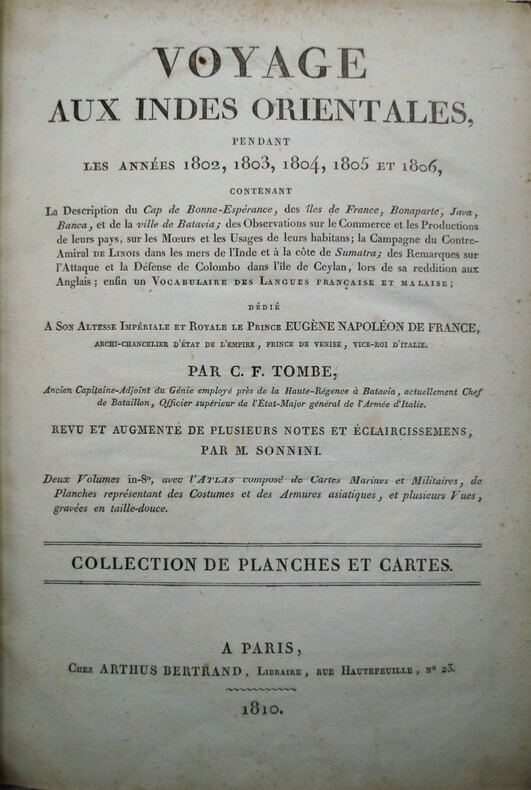
1810réf. PHO-1157Paris: Arthus Bertrand, 1810. — Atlas in-4, (295x200) (2 ff.), 18 cartes et planches , la plupart dépliantes ,relié demi veau ,dos lisse avec fers de navire , manque au dos .
Barcelona - Madrid, Instituto Padre Enrique Florez - Consejo Superior de Investigaciones Científicas, 1957 - 1989. Cincuenta y tres volúmenes en 4to., con un promedio de 350 pp. por volúmen. Cubiertas originales.
1848réf. 24537Paris A. Franck 1848 in-4 demi-chagrin vert, dos à nerfs, caissons de filets et fleurons dorés au dos, tranches mouchetées [Rel. de l'époque], qqs très lég. épidermures et rouss. pâles éparses
1839réf. PHO-1704Paris, Pourrat frères, 1839. 2 volumes in-8 (220x150), plein veau raciné époque, dos lisse orné avec pièces de titre, auteur et tomaison, frises aux plats et aux coupes, , 2ff.-510pp.-1f. , 2ff.-547pp.-2ff. , illustré d’un frontispice et de 41 planches dont 19 en couleurs d’époque représentant des animaux, des poissons et des oiseaux, un cahier (tome 2) dérelié, 1 planche volante, petits frottements, 1 coin usé, quelques rousseurs .
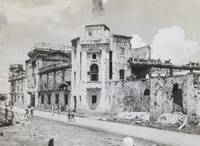
réf. PD10Oblong Octavo album ca.182x295 cm or 7 ¼ x 11 ½ in. 30 card stock leaves with 2 free endpapers. With 105 original gelatin silver photographs including one loose from ca. 104x75 cm 4 x 3 in to 47x64 cm 1 ¾ x 2 ½ in. All photos with white ink captions in English on the mounts seven photos captioned in negatives some photos dated. Period dark green half leather binding with raised bands; guilt-tooled ornaments on the front cover and the spine. Seven photos missing one page lacks fragments at the right margin several pages with minor tears but otherwise a very good album with strong interesting photos. Historically interesting collection of original photographs mostly documenting the technical reconstruction of Manila’s communication networks after the end of World War II. As follows from the photographs the compiler was a technician or lineman with the U.S. Army Signal Corps. First stationed in Pittsburgh in 1943 he likely underwent specialized technical training at one of the city's industrial or academic centers before being deployed to Finschhafen New Guinea. There he was tasked with establishing the communications infrastructure for the Allied base following the recapture of the town from Japanese forces. Finally he was sent to Manila in the fall of 1945 where he assisted in the massive effort to reconstruct the city’s destroyed telephone and telegraph systems during the initial months of the post-war occupation. The album contains 105 rare early photographs from the Pacific Theatre with most images taken in Manila in the fall of 1945. The photos capture Japanese ships sunk by U.S. forces in Manila Bay and the city’s architecture before and after the artillery bombardment Escolta Street Jones Bridge the ruins of City Hall the University of the Philippines the Manila Hotel San Vicente de Paul Parish Department of Finance Building today’s National Museum of Anthropology Commerce & Agriculture Building today’s National Museum of Natural History and Legislative Building today’s National Museum of Fine Arts. Especially interesting are about fifteen candid photographs documenting the technical reconstruction of Manila’s communication networks. Outdoor scenes show the compiler’s companions with climbing spikes and safety belts repairing overhead trunk lines. Interior views depict a “Test Desk” with technicians both American and Philippian operating specialized consoles and patch cords the massive Main Distribution Frame MDF with thousands of line terminations and heavy power panel equipment. The series also includes several photographs from Clark Field showing “Ralph” and “Eddie” posing beside wrecked aircraft. The other interesting photos from the collection show “a Native of New Guinea” posing with American soldiers as well as the compiler and his friends in military uniforms in Finschhafen and Pittsburgh beside their tents barracks and orderly room. Overall historically interesting collection of original gelatin silver photographs illustrating rare scenes from the service of the U.S. Army Signal Corps in the Pacific Theatre of World War II. hardcover
1715réf. PHO-1978Rouen : Jean-Baptiste Machuel le jeune, 1715. 4 volumes in-12 (160 x 97 mm). 3 frontispices gravés sur cuivre et 42 cartes, plans et figures dont de nombreux dépliants. Plein veau époque, dos à nerfs ornés avec tomaison et pièce de titre, tranches rouges. Tome 1, 7ffnch (préface)408pp-12ff (table), illustré d’un frontispice par Scotin le jeune, 3 cartes dont la mappemonde et 6 planches. Tome 2 ,2ff (titre et chapitre) 396pp-5ff (table), contient le traité des vents (p275), illustré d’un frontispice et 9 planches dont la rose des vents et les cartes des 2 hémisphères. Tome 3 ,393pp,5ff (table), illustré d’un frontispice par Scotin le jeune, 2 cartes et 6 planches. Tome 4, 20pp-381pp-8ff (table), illustré de 18 planches dont 3 cartes. L'illustration se compose de 3 titres-frontispices et de 42 planches hors texte, souvent dépliantes : mappemonde, cartes des différentes îles, profils de côtes, vues de ports (Manille, Bahia, Scio) et vues d'îles (Canaries, Cap Vert), monuments, Indiens, scènes de bataille, naufrage, flore (abricotier, cacaotier), oiseaux, poissons, insectes et une curieuse représentation de la « vache de la montagne ou cheval marin ».