829 results
1884ref. 1708030617xbvkManilae, apud typographiam vulgo 'Amigos del Pais', 1881-1884. (12) 526 (1) / 424 / 317 / 512 / 531 pages. - Heavy treecalf-marbled full leather bindings of the period with gently gilt-decorated spines and two red gilt-decorated and -titled spinelabels (each), 'dizzily' purple-ornamented endpapers; Folio (ca. 30 x 21 x 17 cm; ca. 7,9 kg.).
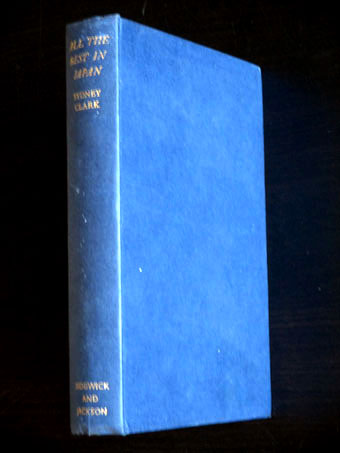
1959ref. 32001Sidgwick and Jackson, London, 1959. First published in this edition, XI, 305 Seiten / pp., mit einigen Abbildungen / with some illustrations; 8° , ca. 21 x 14 cm, Leinen / Cloth
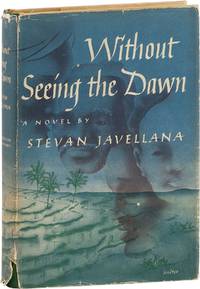
1947ref. 82279Boston: Little Brown & Company 1947. First Edition. First Printing. Octavo 21cm; khaki cloth-covered boards blocked and titled in green and gilt on spine and decorations embossed to spine and front cover; dustjacket; xvi34-3591pp. Pictorial bookplate to front pastedown. Very slight waviness to lower edge of textblock; two very small nicks on rear endpaper and rear pastedown; Near Fine. Dustjacket designed by George Salter unclipped priced $2.75 shelf-worn with 1.5" closed tear to rear spine fold with several tiny chips small tears and attendant creases; Very Good. The Filipino author's only published novel later released under the title The Lost Ones. Javellana's experience as a guerrilla during the Japanese invasion of the Philippines is evident in his two-part novel "Day" and "Night" describing events before and during the war. He focuses on the struggle of his people through farmer folk characters feeling that was ".the most sincere most accurate and most moving story about the Philippines would be the story of those who dug their plows into the rich earth and prayed for the coming of rain and whose sons were with the guerrillas" from rear panel. A film adaptation Santiago! was directed by Filipino director Lino Brocka 1939-1991 who co-founded the Free the Artist Movement and the Concerned Artists for Phillipines CAP; he was appointed by President Corazon Aquino for Constitutional Commission to draft the country's new constitituion. Without Seeing the Dawn also received an award-winning TV mini-series adaptation Malayo Pa Ang Umaga. 82279. Little, Brown & Company unknown books
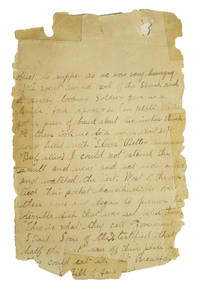
1902ref. 311327np 1902. 5-67 manuscript pages on the rectos of unbound sheets. 8 x 5 inches. Lacking the first 4 leaves and an indeterminate number at end several leaves quite worn each crudely taped or pasted to modern paper and then crudely cropped at the top edge without loss of text. 5-67 manuscript pages on the rectos of unbound sheets. 8 x 5 inches. This account consists of pages five to sixty-seven of what appears to be a diary or copied letters of an unnamed soldier in the 21st United States Infantry. The author who may have been a corporal remains unidentified by name. The account begins in August 1898 at Camp Hobson Lithia Springs GA; in September he is transferred to Plattsburgh NY rejoining the bulk of his regiment which had suffered heavy losses in Cuba. The Philippine-American war ran from February 1899 to July 1902 and was regarded as a continuation of a war for independence by the Philippines and as an insurrection by the United States of America. This account spans the duration of it providing rich detail on topics ranging from food to the war-ravaged environment and American-Philippino interactions both on and off the battlefield. An epic train ride across the country and then a boat from San Francisco brought the 21st US Infantry to Manila on 11 May 1899 in the fourth month of the conflict. The author mentions shipboard conditions an engine breaking down and comments "We caught 4 sharks in our trip. The largest was 12 feet long and took the whole crowd to land him aboard. the men used the bones for rings and pen holders and in fact every thing you could think." Their first combat was the capture of an insurgent outpost at Guadaloupa Ridge on 9 June 1899 where they "joined General Lauter's Flying Column . with eight chinamen to carry our rations." The description of this combat and its aftermath pages 33-41 is the most dramatic passage in the memoir. The writer was sent with another soldier to gather up some supplies that had been left behind but they were separated from the regiment with no food or water. They made a makeshift fort from some old haversacks and brush when they were unable to return to the trenches that night. The author describes scavenging after battle as follows: "About 10:00 oclock there was several chinamen came looking around and picking up what-ever they seen. They came to close to us to suit me and we shot 4 and the rest ran away." Going out in search of water at about four in the morning despite ongoing fire the author found several dead and mortally wounded soldiers from a black regiment including a graphic description of one man who had been shot at close range and had a hole the size of a fist in his belly and was covered in blood. Of the only survivor the author says: "Found one poor cuss shot through the hip. He could not move. I gave him some hard tack and he gave me water then I went back to our haversacks." Another disoriented soldier whom the author names as H. McBain was found wandering without most of his clothing brandishing a bottle of wine and an axe. After waiting until the 11th for a reclamation detail the author and his companion crawled through the brush for a mile to San Peter McCarty and eventually rejoined their regiment at Los Penes where their captain threatened to have them court-martialed for losing their haversacks. Later while hospitalized the author was befriended by Señora Edna Luna cousin of an insurgent general who took him out riding daily: "She was stuck on me and that is no lie. I think I ought to go back and hook up with her as she has all that is required. She is hansome & plenty of money" page 45. The author -- first too ill to be moved then put in a wheel chair and with trouble with his vision -- was transferred back to the States on 15 May 1900 page 48 by way of Nagasaki May 21 1900 and Yokohama arrived in San Francisco on June 9 1900 then was sent to recover at Hot Springs Arkansas concluding in Vancouver Barracks Washington circa July 1901. Some of the pages are torn and some text is lost at the bottom edges due to wear but the handwriting is clear and the voice of the author shines through. This narrative though it took place before World War One reads more akin to a Vietnam War narrative than a Civil War diary in tone and disregard for authority and the morality of war. unknown books
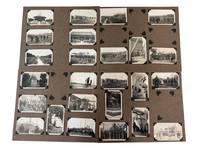
1910ref. 235901910. Late Qing China and Philippines photo archive depicting military authority public punishment foreign presence and imperial architecture circa 1910 in the years immediately before the Xinhai Revolution ended dynastic rule in China. The Chinese photographs show Beijing monuments urban crowds soldiers execution spectators and foreign personnel at a moment when Qing authority remained visible but unstable. The group places tourist views of imperial architecture beside scenes of coercion and military order linking travel photography to the political crisis of the late Qing state. Photo archive of 32 silver gelatin photographs each 2.5 x 4.25 inches cornered in on 11 x 13.5 inch brown album leaves mainly China with several Philippines views circa 1910. The images show Beijing landmarks including the Temple of Heaven palace buildings imperial gates stone lions carved walls ceremonial terraces walled compounds and garden architecture. Several views show Chinese crowds gathered near military or judicial scenes including a public execution aftermath with a severed head displayed from a pole before laughing onlookers and children with a placard stating the events transpired. Other photographs show Chinese soldiers and civilians in open grounds foreign military or naval personnel a group of men in white naval style uniforms seated in a circle Chinese junks harbor traffic street scenes rickshaws and colonial buildings. The Philippines photographs appear to include Manila street and harbor views a woman and girl a domed theater or civic building tropical shoreline and American colonial urban scenes. China in 1910 stood between the punitive settlement that followed the Boxer Rebellion and the republican revolution that began in Wuchang in October 1911. Foreign troops remained in North China under treaty rights imperial and provincial authorities tried to preserve order through policing army reform and public punishment and revolutionary societies used anti Manchu and anti foreign resentment to attack the legitimacy of Qing rule. The execution photographs show law as spectacle with the punished body displayed before civilians and soldiers rather than hidden within prison administration. The Beijing views record the ceremonial architecture of the dynasty at the same time that its political power was nearing collapse while the Philippines views place China within a wider American and European imperial geography of ports garrisons and colonial travel. Light surface wear toning and occasional fading; mounted with photo corners on album leaves. Overall very good condition. A concentrated visual record of military order public punishment foreign presence and imperial space in East Asia immediately before the fall of the Qing dynasty. unknown books
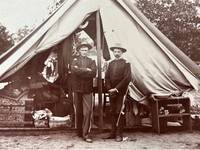
1898ref. 236541898. Spanish American and Philippine American war US military photographs circa 1898 to 1901 documenting the Spanish American War mobilization and the subsequent American occupation of the Philippines. A caption identifying "Co. B Pa. Vol. Mt. Gretna" places one image within Pennsylvania's 1898 volunteer encampment where state militia companies entered federal service during the Spanish American War. A separate inscription "Vigan Philippine Islands Christmas 1901" establishes an American military presence in northern Luzon during the Philippine American War. The photographs record how soldiers were assembled housed transported armed and sustained across stateside and overseas settings. Photo archive of 11 photographs seven silver gelatin and two sepia toned photographs most mounted to cardstock ranging from approximately 5 x 4 to 8 x 10 inches Pennsylvania the Philippine Islands and unidentified locations circa 1898 to 1901. A large company portrait before a conical tent is captioned "Co. B Pa. Vol. Mt. Gretna" among the assembled officers and enlisted men. Other photographs show soldiers standing in opposing ranks along a wooded camp street; five armed men before numbered canvas tents; a mounted officer amid trees and tentage; a long formation carrying an American flag beside railroad tracks telegraph poles freight cars and industrial buildings; and uniformed men posed near a railroad water tower. Two soldiers stand before an open tent crowded with trunks bedding shelving cookware and personal effects while another view records enlisted men seated on the steps of a raised tent furnished with cots. An interior scene shows three soldiers eating smoking pipes and preparing food around a carved table with rifles resting across their laps and beside their chairs. One mount is inscribed "Chas. W. Grammes 925 Maple St. Allentown Pa." while another bears the dated inscription "Vigan Philippine Islands Christmas 1901." Mount Gretna served as Pennsylvania's principal volunteer encampment during the 1898 mobilization but Pennsylvania regiments received different assignments after mustering into federal service. Some units remained stateside or served in Puerto Rico while the 10th Pennsylvania Volunteer Infantry deployed to the Philippines and later fought Filipino forces after the war with Spain had formally ended. Because the Mount Gretna caption omits a regiment number the company shown cannot be securely identified with Philippine service yet the image preserves the state level mobilization from which such overseas assignments were made. By late 1901 Vigan functioned as an American controlled provincial center in Ilocos Sur where military authority and the new colonial administration operated amid continuing resistance elsewhere in the archipelago. Light surface wear and silvering to several images; tonal variation edge wear and staining to some cardstock mounts. Overall good condition. A concentrated visual record of American military organization from Pennsylvania's 1898 volunteer camps to the daily realities of occupation service in the Philippines. unknown books
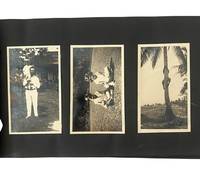
1938ref. 235471938. Large photograph album documenting the colonial Philippines China Japan Hawaii and the United States in the inter war period 1929 and 1930. Likely compiled by an American missionary the photographs are dated and captioned showing colonial education and missionary activities expatriate tourist and native communities village visits portraits of Indigenous Filipinos and well documented Pacific travel infrastructure including photos of early railways and steam ship travel. The album includes many named individuals identified locations typed and handwritten observations and captions with ethnographic and paternalistic undertones characteristic of colonial travel photography in 1929. Photo album of approximately 140 silver gelatin and sepia toned photographs all 2.5 x 4.5 inches Philippines Shanghai and Japan 1929 and 1930. The photographs show white men and women in pith helmets cloche hats field clothing and travel dresses; a man identified as "fellow teacher Mr. Paul Russel"; a group captioned "Miss Knape Mrs. Chillson Ms. Hawkins Ms. Lynch Mrs. Cash"; group photographs of travelers likely American teachers standing in dense tropical vegetation; men crossing streams with walking sticks and hats; indigenous families and children outside thatched or leaf covered dwellings. A typed verso caption identifies "the home in Tagbilaran" comparing it to a house in Albay giving domestic detail of expatriate residence and social life outside Manila. Philippine locations including Tagbilaran and Albay village houses coastal and river landscapes and jungle terrain; In China Shanghai's "native city"; and Japanese sites including Kamakura and Tokyo. A photo from Shanghai depicts a street scene with horse drawn carts and Chinese garden or pavilion architecture. Photographs from Japan show the Great Buddha at Kamakura temple and shrine buildings a large torii steps to a temple complex and a Tokyo Imperial Palace bridge view. The provincial Philippines images include repeated portraits of local and Indigenous peoples including women and girls captioned "These are the belles of the jungle" families outside thatched dwellings children gathered near village houses and residents approached by the travelers for staged photographs. These captions and scenes document Indigenous Filipino subjects through paternalistic and exoticizing language while recording houses clothing family groups and village life in Bohol and nearby provincial districts in the 1920s. One photograph is captioned "December 29 1929" and describes the travelers as "trying to convince Filipinos to allow their photograph to be taken." In the period after the Spanish American War when the United States governed the islands as a colonial possession and made public education one of the central instruments of American administration. American teachers had entered the colonial school system in large numbers after 1901 and by the 1920s their work housing mobility and social networks formed a recognizable expatriate layer in provincial towns as well as Manila. The English captions reference to a "fellow teacher" and named residences in Tagbilaran and Albay point to a likely American teaching or expatriate circle though no creator is identified in the visible material. The Shanghai and Japan views extend the itinerary across treaty port China and Japanese tourist sites moving from the "native city" of Shanghai to Kamakura's Buddhist monuments and Tokyo imperial architecture. Some tonal variation in the photographs some pages unbound from album. Every image remains legible those detached from the album carry the album residue and many have handwritten and typed captions en verso; there are likely many more inscriptions which remain concealed as they are adhered to the album leaves. Overall in very good condition. A large dated visual record of a teacher in the American colonial Philippines and other East Asian travel routes during the interwar consolidation of American power in the Pacific. unknown books
1899ref. 237631899. American Imperialism and the Colonization of the Philippines: Admiral Dewey Spanish-American War Military Victory Celebration Parade and New Rochelle Life Photo Album 1899-1900. An important photographic record of the public celebration of American imperial expansion following the Spanish-American War highlighted by approximately 38 photographs of the September 30 1899 New York parade honoring Admiral George Dewey and the American victory at Manila Bay. The celebration occurred as the United States was imposing colonial rule over the Philippines and fighting Filipino forces seeking independence giving the photographs particular significance as a visual record of American overseas conquest presented at home through patriotic pageantry military power and mass public celebration. Photo album of approximately 153 photographs including approximately 117 silver gelatin prints and 36 albumen photographs most 3.5 x 2.5 inches New York principally 1899 and 1900. The photographs are held in gray window mounts in a string-bound album and can be removed as they are not adhered to the leaves; handwritten captions and dates occur throughout. Approximately 38 photographs document the military parade celebration showing ranks of West Point cadets mounted cavalry identified as "Troop A" and "Troop C" artillery and horse-drawn equipment military bands American flags and enormous crowds lining the parade route. The official procession included 350 West Point cadets sailors and Marines from Dewey's fleet regular Army troops New York National Guard regiments Spanish-American War veterans and Governor Theodore Roosevelt and his staff. One view is captioned "Only woman in parade" while another photograph depicts the first American flag "hoisted over Morro Castle at Santiago." Dewey's May 1 1898 destruction of the Spanish fleet at Manila Bay helped open the Philippines to American occupation and transformed him into a national symbol of the country's new overseas power. Spain subsequently ceded the Philippines to the United States while Filipinos who had fought for independence resisted American rule resulting in the Philippine-American War beginning in 1899. The New York celebration therefore documented more than Dewey's military homecoming: its flags troops artillery bands political leaders and immense crowds embodied the popular celebration of America's emergence as an imperial power at the very moment it was establishing colonial control over the Philippines. The remainder of the album documents New Rochelle and Long Island Sound life including boating hunting fishing families dogs horses carriages substantial houses residential construction and waterfront recreation. Identified subjects include the launch of "Kathleen" Horseshoe Harbor Glen Island the Columbia Library and the Atlantic City Boardwalk. Bound album with severely worn spine; photographs generally clean and in very good condition with occasional corner wear creasing and small tears. Overall in good condition. unknown books
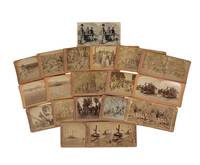
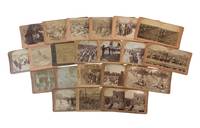
1898ref. 231701898. Stereoview archive documenting the rapid overseas deployment of American troops at the moment the Spanish American War gave way to a longer and more revealing imperial presence in the Philippines. This archive marks the transition from the 1898 defeat of Spain to the far more sustained American military occupation that followed. After the U.S. victory over Spain the Treaty of Paris transferred the Philippines to the United States for $20 million. This resulted in a battle between American forces and Filipino nationalists under Emilio Aguinaldo in February 1899 when Filipino hopes for independence collided with the reality of a new colonial ruler. This collection of photos preserves the process of colonialism through troop deployment provisioning medical treatment and the routines of military presence. Archive of 19 stereoview cards most published by B. W. Kilburn and James M. Davis centered on American military activity in the Philippines with additional views from Puerto Rico Cuba and the United States. Each measure 3.5" x 7". The core of the images remain in Philippine occupation; "The 17th Infantry crossing the river P.I." shows movement through tropical terrain; "Our Volunteers awaiting orders under the tropical sun in the Philippines" captures the idleness and bodily strain of expeditionary service; "2nd Division Hospital established in Angeles Church P.I." reveals improvised medical infrastructure inside a colonial religious building; "Dealing out pork and beans to the Oregon Volunteers P.I." appears in multiple variants and preserves the logistics of feeding American troops in camp; and "The Insurgent House of Congress on Fire Malolos P.I." places the war directly in relation to the destruction of Filipino political institutions. The remaining cards broaden that story outward: "Troop D 5th U.S. Cavalry lining up for dinner Mayaguez P.R." points to U.S. military operations in Puerto Rico; "Modern Krupp Gun Morro Castle Havana Cuba" preserves the Spanish imperial military landscape at Havana just as U.S. power displaced it; and the exhibition drill cards including "The Little Commodore" Boston '98 and "Grand Stand Exhibition Drill Boston '98" connect the overseas war to patriotic spectacle and military display at home. Stereographs were a common late nineteenth century format for circulating military imagery and was used to render mobilization and drill into mass-viewed visual media. Minor toning edge wear and rubbing; images and printed captions remain legible; overall very good condition. This collection preserves the American campaign in the Philippines not as abstract policy but as a contemporary visual record of how troops were deployed housed fed and sustained while the United States transformed victory over Spain into colonial rule in the Pacific. unknown books
1898ref. 231301898. Spanish-American War stereoview archive circa 1898-1899 documenting how the war was pictured through mass-produced photographic views that followed U.S. mobilization battlefield action occupation and military life across both Cuba and the Philippines. These stereoviews preserves the visual system by which the war was circulated to American audiences showcasing camp organization troop movement burial hospital care naval power and overseas deployment. Particularly notable is the archive's coverage of the Rough Riders the Santiago campaign in Cuba and U.S. presence in Manila and Malate showing how stereoview photography helped normalize the war's expansion from anti-Spanish conflict into a broader American imperial presence. Archive of 21 stereoviews Various publishers. Spanish-American War stereoview archive. Cuba the Philippines and the United States circa 1898-1899. each measuring 3" x 7". The views are drawn from multiple phases and theaters of the war including camp and drill scenes in the United States embarkation and troop arrivals at Tampa battlefield and occupation imagery from Cuba and extensive and some grisly scenes from Manila and surrounding areas in the Philippines. Captions and images show soldiers in formation cavalry drill military reviews naval artillery hospital interiors encampments burial grounds and troops in active position. Cuban views include Morro Castle after bombardment dead and wounded on the battlefield of Santiago U.S. soldiers preparing to invade Cuba and troops dining near Cabañas Fortress. Philippine views include a departure for Manila American pickets routing a Filipino reconnoitering party the 18th Infantry engaged by Filipino outposts volunteers awaiting orders under the tropical sun Army Hospital Manila and "Our Boys in Camp at Malate P.I." One stereoview identifies Roosevelt's Rough Riders in the mobilization phase linking the archive to one of the war's most publicly mythologized units. As a group the stereoviews demonstrate the process by which the Spanish-American War was framed not simply as a short military victory over Spain but as a sustained structure of U.S. troop deployment and occupation extending from Cuba into the Philippines. The Manila and Malate scenes are especially important in this regard since they place American soldiers within the opening phase of the Philippine conflict where U.S. military presence quickly moved beyond liberation rhetoric into imperial control. The archive's mixture of battlefield casualties camp routine naval spectacle and celebratory review scenes shows how stereoscopic publishing converted war into a domestic viewing experience while reinforcing the legitimacy of American expansion abroad. Wear to mounts some toning; overall very good condition. A strong cross-theater visual archive of the Spanish-American War and the emergence of U.S. imperial power in Cuba and the Philippines. unknown books
1944ref. 224221944. Olson Laverne Edwin vernacular photo album circa 1944-1946 documents U.S. Navy enlisted service across the Philippines and Hawaii during the final phase of World War II and the immediate postwar occupation period providing direct visual and documentary evidence of military presence local communities and wartime social life in the Pacific Theater. The album is anchored by Olson's official U.S. Navy Certificate of Satisfactory Service confirming duty from December 18 1944 through April 23 1946 situating the material within the aftermath of the U.S. return to the Philippines following the Leyte landings and the transition into occupation and reconstruction. The photographs support research into Pacific War military infrastructure American servicemen's daily life and interactions with local populations in recently contested and strategically critical regions. Album titled "Snapshots: The Philippines and The Islands of Hawaii" compiled circa 1944-1946 contains 25 items: 23 silver gelatin photographs one wallet-sized U.S. Navy Certificate of Satisfactory Service and one Roosevelt Commemorative Birthday Ball exchange coupon dated January 30 1946. Album measures approximately 4.5 x 3.5 inches with most photographs approximately 4 x 2.5 inches. Images include candid and landscape views from the Philippines likely including Leyte depicting rural villages shoreline activity docked naval vessels and local labor such as fishing and canoe transport. One photograph shows a group of Filipino children and young men gathered along a beach while another captures men and boys navigating shallow coastal waters in a canoe. Hawaiian images include group recreation scenes and coastal landscapes reflecting off-duty life within a major U.S. naval hub. The Roosevelt Birthday Ball coupon printed with the slogan "Dance That Others May Walk" provided access to multiple Honolulu venues and connects the album to wartime charitable campaigns supporting polio treatment through organized social events. Created during the closing campaigns of the Pacific War and the first year of U.S. postwar presence in the Philippines the album situates an enlisted sailor within a broader military and geopolitical transformation that included amphibious warfare territorial reoccupation and the reestablishment of American administrative and logistical systems. The Philippines served as a critical site of both combat and reconstruction while Hawaii functioned as a central staging and support base for naval operations. The inclusion of both official documentation and leisure-related ephemera demonstrates how military service encompassed bureaucratic recordkeeping mobility across strategic locations and participation in organized morale and fundraising activities tied to the American home front. Light wear to album covers minor handling and edge wear to photographs with images remaining sharp; service certificate shows toning and wear; pages largely intact. Overall very good condition. unknown books
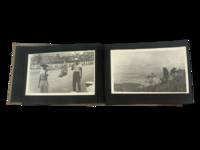
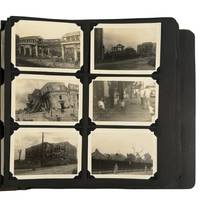
1945ref. 212431945. World War II Philippines photo album 1940s documenting United States Army Forces Far East activity and civilian conditions in Luzon during Japanese occupation and subsequent military operations. The album records military presence infrastructure damage and daily life among Filipino civilians providing visual evidence of the Pacific Theater at a critical stage of conflict. The material captures both organized military environments and surrounding local landscapes situating the campaign within its geographic and social context. Album comprises 48 silver gelatin photographs each measuring approximately 3" x 4.25" mounted on 8 loose black album pages within faux brown leather covers measuring approximately 10.5" x 12". The photographs depict a range of wartime and civilian scenes including damaged buildings rural and urban environments and Filipino civilians engaged in daily activity. Several images show U.S. soldiers stationed at an encampment with rows of tents including one photograph of a Filipino man possibly affiliated with the Philippine Scouts posed in front of a tent. Additional photographs depict large U.S. naval vessels alongside smaller wooden boats occupied by Filipino men and women approaching or departing from these ships. Other images capture natural landscapes including volcanic terrain and cloud formations above Luzon. The sequence of photographs reflects both military occupation and local life with visual emphasis on interaction between American forces and Filipino civilians. Created during the prolonged conflict in the Philippines where American and Filipino forces resisted Japanese occupation from 1941 to 1945 these photographs provide a record of conditions during one of the most significant campaigns in the Pacific Theater. The images reflect both the presence of U.S. military operations and the lived environment of the island during wartime. Album pages are loose within covers; photographs remain clean and well-preserved with minimal wear; overall very good condition. This album offers a concentrated visual record of wartime Luzon and the intersection of military and civilian experience. unknown books
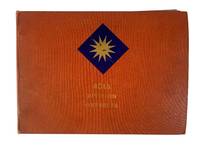
1944ref. 220931944. 40th Infantry Division Pacific campaign photograph album documenting combat operations and daily military life of U.S. Army forces during World War II. The 40th Infantry Division served extensively in the Southwest Pacific Theater participating in campaigns across New Guinea New Britain and the Philippines as Allied forces advanced against Japanese defensive positions. The photographs record amphibious landings artillery operations destroyed towns and the collaboration between American troops and Filipino guerrilla forces during the campaign to liberate the Philippines. The album therefore documents the operational environment of Pacific warfare including jungle terrain fortified Japanese defensive networks and the logistical systems required to sustain prolonged combat across island battlefields. Photograph album containing approximately 200 original black and white photographs documenting operations of the 40th Infantry Division during the Pacific campaigns of World War II. Each photograph is sequentially numbered in white ink at the lower corner and corresponds to descriptive entries in a photographic index within the album. Early images depict American Red Cross workers disembarking from landing craft and greeted by U.S. soldiers illustrating the presence of female support personnel assigned to medical and relief operations. Additional photographs record amphibious landing scenes aerial views of destroyed towns in Luzon artillery and tank operations and soldiers operating mounted machine guns overlooking jungle valleys. Several images depict Japanese military casualties reflecting the intense close combat that characterized fighting across the Pacific islands. A printed military map within the album shows Japanese tunnel and cave fortifications in the Zambales Mountains illustrating defensive positions encountered during operations in the Philippines. The album also documents logistical and civilian dimensions of the campaign. Photographs show ships unloading cargo Filipino guerrilla units marching through urban streets and groups of local porters assisting Allied forces in moving supplies through mountainous terrain. Weapons and equipment visible in the images include field artillery pieces mortars and armored vehicles such as the M4 Sherman. One photograph depicts African American soldiers accompanied by scout dogs operating in jungle terrain illustrating the presence of Black servicemen serving within the segregated structure of the wartime U.S. Army. Other photographs show tent encampments mess areas interactions with local populations and the recovery of prisoners of war following combat operations. The photographs collectively present a visual record of combat logistics and daily military life during the Pacific campaigns. Album contains approximately 200 photographs with indexed numbering. Light handling wear visible to album and photographs consistent with wartime field compilation. Overall condition very good. unknown books
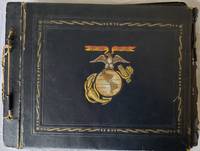
1944ref. 159501944. United States Marine Corps photo album 1944-1945 documenting Marine service in the Pacific Theater during the final campaigns against Japanese forces including visual evidence of combat environments military infrastructure and daily life during Allied advances toward the Philippines. Compiled by an active Marine the album records conditions faced by servicemen during a decisive phase of World War II when United States forces intensified operations to dismantle Japanese control across strategic island territories. The photographs show armed Marines in field settings encampments and operational zones alongside damaged urban structures marked by bullet impacts aircraft staged on active airfields and transportation along jungle rivers providing direct visual documentation of wartime movement occupation and destruction. Photograph album containing 93 silver gelatin photographs and approximately 30 postcards assembled by a United States Marine serving in the Pacific Theater. Images depict Marines in group portraits at base camps informal scenes of soldiers at rest and aircraft on airfields including fighter planes with visible nose art. Additional photographs document jungle landscapes river travel using local barges and built environments showing structural damage consistent with recent combat. The album includes interactions between American servicemen and local civilian populations as well as images of local animals such as dogs and monkeys. Postcards depict illustrated views of Marine bases and wartime scenes several addressed to the compiler's family in Georgia. Laid into the album are photographic negatives newspaper clippings reporting wartime developments military documents and a ribbon extending the documentary scope beyond the mounted photographs. Produced during the closing phase of World War II this album aligns with major United States Marine Corps operations supporting the liberation of the Philippines in 1944 and 1945 and the broader Allied campaign across the Pacific. Marine aviation and ground units operated from forward airfields and temporary encampments such as those depicted here sustaining continuous engagement with Japanese forces while navigating tropical terrain and heavily damaged urban zones. The inclusion of civilian encounters and informal group scenes adds dimension to the study of occupation dynamics and servicemen's daily routines within active war zones. Album pages detached from original ties with some tearing and evidence of missing photographs light wear throughout; overall fair to good. A substantial primary visual record of Marine experience during the final stage of the Pacific War. unknown books
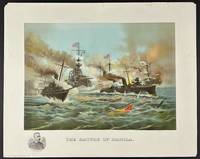
1898ref. 13092New York: Muller Luchsinger & Co 1898. Color chromolithograph 16 x 20 inches printed on thick glossy paper. Corners a bit chipped several short closed edge tears minor surface wear. Image area still vibrant and clean. Very good overall. A striking and very rare lithograph capturing an important moment during the Spanish-American War specifically the American Navy's assault on Manila Bay in the Philippines in 1898. In the present scene three U.S. warships from the Asiatic Squadron in the left and middle including Admiral Dewey's flagship the U.S.S. Olympia fire their guns toward a few retreating ships flying the Spanish flag. A Spanish ship at middle right is almost completely sunken with just a portion of the flag peaking above the water. The scene depicts the first major engagement of the Spanish-American War a decisive victory for the American Navy that stands as one of the most lop-sided naval battles in history. During the course of the encounter the Spanish Pacific Squadron was destroyed and effectively ended Spanish colonial rule in the Philippines. The bombardment was commanded by Rear Admiral George Dewey 1837-1917 whose head-and-shoulders portrait appears in the bottom left corner. The work was accomplished by the New York firm of Muller Luchsinger & Company a prolific but still somewhat obscure producer of prints lithographs and chromolithographs in the latter-19th and early-20th centuries. OCLC records just two institutional copies at the Library of Congress and the Clements Library. A dynamic and patriotic American naval scene picturing the United States Navy's obliteration of the Spanish Navy in Manila. Muller, Luchsinger & Co unknown books
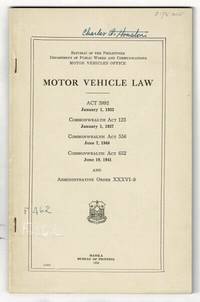
1950ref. 72990Manila: Bureau of Printing 1950. 8vo pp. 95 1; self-wrappers side-stapled; inoffensive accession number and previous owner's name Charles O. Houston on upper wrapper; near fine. Incorporating Act 3992 Commonwealth Acts 123 556 652 and Administrative Order XXXVI-9 January 1 1933 thru June 19th 1941 with revisions. Concerns registration license plates limits of operation student permits freight and passengers vehicle accessories traffic rules limits of use penalties fees taxes trucks and trailers etc. Not found in OCLC. Bureau of Printing unknown books
1941ref. 52747Manila: Bureau of Printing 1941. First edition 8vo pp. 59 1; self wrappers; front wrapper unevenly toned; an Ayer Linguistics duplicate with a Newberry release stamp inside the front wrapper; no other markings. Text is in both Cebuano and English and was prepared for publication as the United States entered World War II. Bureau of Printing unknown books
ref. 72760Philippines: np np. Hardcover. Very good. Hardcover. Oblong plastic bound photograph album. 10.5 x 7.5". 52 photographs measuring approximately 3.75" x 2.5". Inside the front cover is written "31st Div USMC New Britain Philippines." Album is clean and in very good condition. Photographs depict soldiers in camp and jungle settings riding oxen and posing with jeeps equipment and tents as well as downed aircraft and local inhabitants. No dates or names are recorded and the location is unidentified. The 31st Division served in the Philippines and New Guinea during World War II. np hardcover books
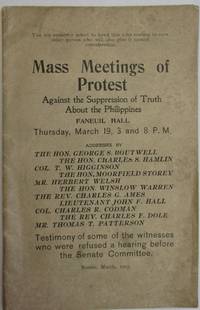
1903ref. 37755Boston 1903. Original printed wrappers with wrapper title as issued and original staples. At head of title: "You are earnestly asked to hand this after reading to some other person who will also give it careful consideration." Rear wrapper repeats the first sentence of the title. 56 pages. Wrappers lightly dusted else Fine. An anti-imperialist protest against American efforts to "to conquer a foreign nation and to impose our sway upon it against its will. We are departing from the principles upon which our government is founded and which we have always held to be self-evident truths." The Philippine conflict was a guerilla war of unbridled brutality instigated by the American decision to become a Pacific power. unknown books
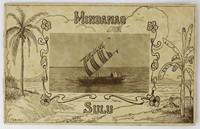
1905ref. 5045Manila: Sugar News Press 1905. Very good. 22pp. Illustrated. Oblong quarto. Original pictorial wrappers stapled. Moderate dust-soiling and edge wear. Light even toning to text. An early and seemingly-unrecorded promotional touting the people and scenery in Mindanao and Sulu in the southern Philippines in the first decade of the 20th century. The work opens with a Foreword detailing the positive aspects of Mindanao particularly its principal city described here as the "Metropolis of Mindanao and Sulu" with "a population of more than thirty thousand a mixture of Moros or Mohammedan Filipinos Christian Filipinos Chinese Japanese and Europeans." Following the Foreword the remainder of the work is mostly comprised of thirty-four duotone photographic prints printed mostly two per page but occasionally with from one to five per page. The photographs feature numerous scenic and street views in and around Zamboanga including various "Moro houses" and about fifteen portraits of indigenous Filipinos such as a "Moro woman weaving materials for head-turbans and sarongs" a view inside a "weaving school" "Yakan Moros on the island of Basilan" "Muhammad Jamallul Sultan of Sulu" "Joloano Warriors" "Moro Kulintang" and their musical instruments Bogobo and Cotabato warriors "Bajaos - the sea gypsies of Sulu" and "Bogobo musicians." The final two pages of the work are taken up with two poems -- the first is a traditional Filipino poem entitled "No Te Vayas" noted as "Zamboanga's 'Auld Lang Syne" and one titled simply "Zamboanga" by Susan Hart Dyer. The front cover is decorated with a central photograph of an indigenous sailing vessel surrounded by an illustrated beach scene signed at bottom left "Jh. Mendoza." The inside front cover contains an illustration of the Philippine Islands from Batanes down to Sulu. We could locate no other copies of the work by title and imprint information in OCLC. Sugar News Press unknown books
1903ref. 20122Manila: Philippines: Dept. of the Interior - Bureau of Government Laboratories 1903 / 1904. First Editions. . Original printed wrappers; stapled as issued. Very good; front wrapper of Dictionary is detached. 8vo I - 4 5 - 193pp.; II & III - 4 5 - 36 pp. Merrill was an American botanist resident in the Philippines from 1902 - 1924. He then took up successive positions at Berkeley the New York Botanical Garden and finally at Harvard 1935 - 1948. At least ten different species bear his name. Stafleu / Cowan III 425 - 429. Philippines: Dept. of the Interior - Bureau of Government Laboratories unknown books
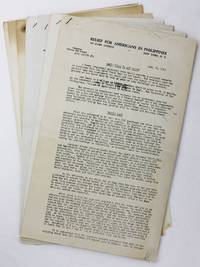
1945ref. 4668New York 1945. Very good. Sixteen issues totaling 75pp. Legal-size sheets stapled. Previously folded. Light wear and toning. An extensive run of newsletters by a New York-based aid group Relief for Americans in the Philippines. Included here are issues 9 12 14 through 18 and 20 through 28 which were published between 1942 and 1945. The organization was devoted to the support of Americans who were imprisoned at San Tomas Gabuio and other camps after Japan occupied the Philippines during World War II. At the outset of the war the Philippines were a commonwealth of the United States but within three weeks of the attack on Pearl Harbor the Japanese seized control. The 20000 American and 80000 Filipino troops on the ground departed and any remaining American or British citizens were rounded up in Manila and transferred to the University of Santo Tomas where they were left to fend for themselves. The only exceptions were a 7:30 pm roll call each night and the use of room monitors. The background of the captives varied wildly from business executives and retired soldiers to prostitutes. At the end of the war the total number of prisoners liberated was 3785 2870 of which were American. Issue 14 remarks on the first anniversary of the non-profit organization: “On May 8th 1942 just a year ago and two days after the fall of Corregidor our organization came into being for furthering plans for the shipment of food medical supplies and other necessities for the internees and also to serve as a clearing house and point of dissemination for information concerning the welfare of these internees.” The monthly newsletter prints news and developments from the camps in the Pacific and documents the efforts of the organization to provide aid to the prisoners there. The issues also print a running list of all those believed to be in the Philippines “solely for the purpose of obtaining names and addresses of the nearest relatives of who we have no record.” A scarce record of this little-known relief effort during World War II. unknown books
1975ref. 90050Quezon City: Task Force on Human Settlements Developments Academy of the Philippines 1975. Paperback. Good. illustrations 166p. Softcover in original wrapper. 28 cm. Text printed on one side. Some cover foxing/spotting. Modest staining along fore-edge. Institutional stamp on cover and title-page. Contents sound. Task Force on Human Settlements, Developments Academy of the Philippines paperback books
1939ref. 88381Manilla: Bureau of Printing 1939. Paperback. Good. 334p. Softcover in original wrapper. 24 cm. Light library markings Department of the Interior on front cover. Some wrinkling of cover and text. Cover edges slightly wrinkled and and spotted. Some dog-earing. Bureau of Printing paperback books
1959ref. 85194Manilla 1959. Paperback. Very Good. 141p. Softcover in original wrapper. 33cm. Former owner's name on cover. 43 pump systems were installed in 42 pump sites under Project No. 909's Pump Irrigation Program during the period covered by this report. paperback books