887 results
1974ref. 85211Manila 1974. Paperback. Good. maps xxiv 589p. Softcover in original wrapper. 30 cm. Light stain on fore-edge. Name "whited-out" on front cover. At head of title: Final Report. Vol. I. paperback books
1951ref. 85206Manila: Bureau of Printing 1951. Paperback. Good. frontis 2 folding maps 258p. Softcover in original blue wrapper. 25 cm. Ends of backstrip chipped. Bureau of Printing paperback books
1990ref. 70828Manila 1990. Paperback. Very Good. map xv 167p. Oblong 28 x 21cm. These books were probably issued for each of the 73 provinces. According to OCLC this appears to have been No. 60 in the series. paperback books
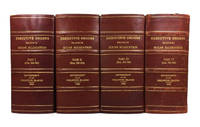
1936ref. 74073Manila: Bureau of Printing 1936. Hardcover. Very Good. Parts 1-4 in 4 vols. Red 1/2 leather with marbled boards. 19cm. Edges rubbed. No Jackets. These four very thick volumes contain Executive Orders Nos. 543-895; each Executive Order is separately paginated. Bureau of Printing hardcover books
1990ref. 70829Manila 1990. Paperback. Very Good. map xiv 203p. Oblong 28 x 22cm. These books were probably issued for each of the 73 provinces. According to OCLC this appears to have been No. 29 in the series. paperback books
1962ref. 23324Manila 1962. Hardcover. Very Good. 2 vols. now bound in 1. Each provincial report separately numbered. Blue cloth. 28 cm. Modest cover wear. No Jacket. hardcover books
1969ref. 70835Diliman 1969. Paperback. Very Good. iv 397 leaves. Wrapper. 28cm. Text printed on one side. Research Guide No. 6. paperback books
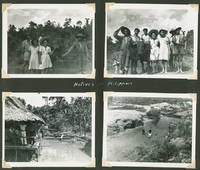
1945ref. 54321Philippines; Okinawa; San Diego. 1945. Photo Album of a Seabee in the Philippines in 1945 A fascinating photographic account of military service in the Philippines compiled by a member of the 142nd U.S. Naval Construction Battalion the Seabees in 1945. Most of the images approximately three-quarters of the album were taken in Guiuan on Samar Island in the central Philippines where the photographer was stationed: Guiuan city square the Seabees' camp numerous portraits of local girls who sometimes pose with American soldiers local families and their activities indigenous architecture and other local scenes. They also show the Immaculate Conception Church with shots of the exterior and detailed views of the silver altar - built in 1595 to 1844 but completely destroyed by Typhoon Haiyan in 2013. Several other photos evidently portray the album's compiler posing next to an American fighter plane while boiling sea shells in front of his tent etc. The final portion of the album contains photos taken during the operations aboard the U.S.S. "Monrovia" and "President Harris" in October-November 1945 including views of Okinawa on the way to China and snapshots of soldiers unloading cargo in China before returning to Manila. There are also eight clear views of Manila showing destroyed Japanese cranes and boats in the harbor American army headquarters and a warehouse. The album concludes with a few photos of the homeward voyage and shows soldiers discharged in San Pedro California. Overall a very good album depicting local life and the activities of the 142nd U.S. Naval Construction Battalion in the Philippines and Yellow Sea in the last months of the World War II. 133 silver gelatin photographs most 2½ x 4 inches but ranging from 2½ x 2½ to several 10 x 7 inches. Oblong folio. Black leatherette album strong tied. Light wear. Photos in corner mounts with many captions. Very good. hardcover books
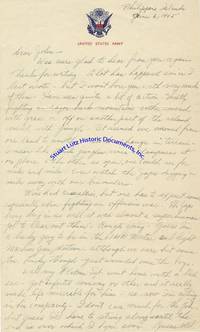
ref. 4410WORLD WAR II IN THE PHILIPPINES. ALS. 3pg. 6 x 10 . June 6 1945. Philippine Islands. An autograph letter signed Claude an American GI stationed in the Philippines. He wrote on United States Army stationery to his friend John about fighting the Japanese: Dear John Was sure glad to hear from you again Thanks for writing. A lot has happened since I last wrote - but I won't bore you with very much of them - Have seen quite a bit of action. Mostly fighting n razor back mountains either covered with grass or off on another part of the island covered with jungle - It seemed we moved from one land to another - such a change in terrain - I mean like thick jungles vines & dampness at one place & the other so open one could see for miles and miles - even watch the japs digging in miles away with our binoculars. Weve had casualties but one has to expect some especially when fighting an offensive war - The japs being dug in so well it was almost a superhumanjob to clear out them - Rough going - guess I'm a lucky guy to be in the 60MM Mortar and light Machine Gun platoon - although we were hit some too. Lucky though just wounded were the boys. Well my Platoon Sgt. Went home with a bad ear - got infected someway or other and it really made life miserable for him - so now I'm acting in his compacity - I don't care much for the job but guess I'll have to string along until the end is over which I hope soon. Guess old Nick here was lucky - Had a few close one's too close for comfort. just hope my luck holds on. Guess as far as the point system goes - I'll be in the Army quite awhile yet. Only can figure out 69 points - Quite a jump to dig up 16 more And I've been in this Army 38 months already - Seems like half my life - When I get home I won't know how to act like a civilian - ha - I know one thing I'll have to learn to control my Army slang or else - I'm writing this in our rest area - although we aren't resting as yet - A lot of hard work to build it up & get it in shape first - Havent been her long - but it's a nice area - About like Fort Lewis. Pine trees - cold at night need three blankets still my pups get cold and now that the rainy season has set in it reminds me of Fort Lewis more so as we had so much rain there. Have one camp on a golf course - Been quite some time since I played golf - last tie in the Hawaiian Is. on the isle of Moloka! - More or less pasture. I'd send you a v-mail but as far as I know yet they go straight home with out being photographed and I don't think you'd want that kind. So am using the borderless airmail variety - No two cent overprints have showed up in this area as but if they do I'll remember you - Some of my other friends were asking about them too. Mr. Weltack has been sending me a first day cover now and then and I really appreciate it - as I have no way or time to bother with them. Hope I can continue after the war as I really get a kick out of FD. 's F.Fs F.AM's & all the other better covers. I belonged to the AAMS at one time and have been thinking about joining the MACC in the future. Its been a long time since I saw a good game of baseball- Was in 1939 I guess - In Chicago at the Cub park - The Cubs were playing the Giants at the time. My dad & cousin are great Cub fans but me I like to see a good game - The best men win - I used to play a little too. You know how young guys are - getting up a team & trying to lick the neighboring town teams a log of good clean fun. Well John write when you have time. I enjoy hearing from you. Best of Wishes Sincerely Claude. The letter is in fine condition. unknown books
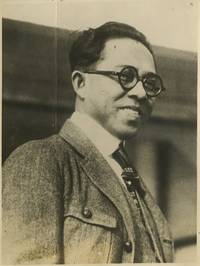
1920ref. List38122New York City: Keystone View Co. Inc 1920. Photo measuring 5 ⅞ x 7 ¾ inches. With caption Keystone stamp manuscript and later sticker verso. Fold along left third of image with several pinholes around margins and one small hole in photo; very good. A portrait of Hadji Gulamu Rasul around the 1920s. Rasul was the son of Filipino statesman Abd ul-Bagui Butu Rasul and some sources state that he was the adopted son of Jamalul Kiram II the last sultan of Sulu. The sultanate was a Sunni Muslim state that ruled parts of what are now the Philippines Malaysia and Indonesia from the 1400s until the 1915 Carpenter Agreement was signed in the American-occupied Philippines. Under American rule Rasul represented the district of Sulu in the Philippines' congress from 1938-1941 and 1949-1953. The caption on this photograph states that he was in Seattle "in search of his white wife who deserted him when she found he had several native wives"; however other newspaper articles from the same period state that he was in Washington to study law. Keystone View Co., Inc unknown books
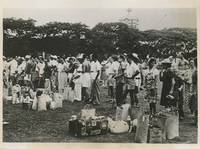
1945ref. List38144N.p.: Central Press Association and International News Photos 1945. Photograph measuring 9 ¾ x 7 ¼ inches. With manuscript on negative; caption Central Press Association and International News Photos stamps manuscript and later sticker verso. Some wear and wrinkling; excellent. Japan invaded the Philippines in early December 1941 defeating the islands and the US military by May of the following year. The University of Santo Tomas was used as a civilian internment camp housing a number of Americans and Brits. The camp was crowded and conditions were poor with shortages of food and other rations and harsh weather; it was liberated when American Filipino Australian and Mexican forces retook the Philippines in 1945. Offered here is a photograph allegedly "taken by a Japanese serviceman" showing "life in the Santo Tomas internment camp". A crowd of people mill around the grounds with their baggage with the university building visible above the trees in the background. Central Press Association and International News Photos unknown books
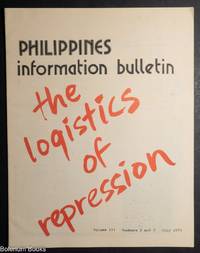
1975ref. 345369Cambridge: Philippines Information Bulletin 1975. Magazine. 23p. stapled wraps 8.5x11 inches some b&w illustrations; minor soiling to front cover paper toned otherwise in very good condition. Subtitle: "A report on the volume forms and functions of U.S. military assistance to the martial law regime in the Philippines." The first printing of an essay that would later be published in a paperback edited by Walden Bello and Severina Rivera. The committee included representatives from the FFP KDP etc. Philippines Information Bulletin unknown books
ref. List2928Luzon Philippines likely early 20th century. Seventeen photographs: six measuring 3 ½ x 8 inches five measuring 4 ¾ x 6 ½ inches five measuring 3 ¼ x 3 ¾ inches and one measuring 4 x 5 inches. With Brown Brothers stamps and captions verso; some with editorial overpainting. Worn with some folding missing corners and small tears; excellent contrast; overall very good plus. The US occupation of the Philippines began with Spain’s cession of the islands to the US in 1898 and ended with the Treaty of Manila of 1946. Offered here is a small collection of photographs likely shortly postdating the Philippine-American war showing civilian life and industry in occupied Philippines especially the island of Luzon. The photos show copra processing—dried coconut flesh from which coconut oil is made—timber cutting and cigar and cigarette production. All three were and are important industries in the Philippines but tobacco in particular seems to have had a hold on the populace. Several of the photographs show young children smoking large cigars; one is captioned “A youthful smoker of Manila. The Filipinos smoke cigarettes from the cradle and cigars not long after.” Others show well-dressed young schoolgirls toddlers playing in a miniature nipa hut and panoramic views of the Pasig River and Manila Bay. Of interest to historians of the Philippines’ American colonial period especially its agricultural and productive history. unknown books
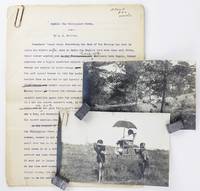
1905ref. 5191N.p. 1905. About very good. 3pp. rectos only. About 900 words. Folio. Typescript with manuscript corrections and notations. Light wear and soiling slight creasing. Together with two silver gelatin photographs. A short but interesting essay on the mountain city of Baguio. It reads a bit like a travel article or potential newspaper puff piece for tourism and has been edited by hand with manuscript notations and corrections. It opens "Somewhere 'round about Petersburg the Czar of the Russias has what he calls his winter palace; down in Indian the English have what they call Simla their summer capital and here we Americans have Baguio." The author goes on to discuss the oppression of the tropics and therefore the need for cooler cities to enable functional government discussing the needs of the "white man" for livable conditions in such a place: "In the Philippines there are some months of the year that are extraordinarily summer summer in all the sense that the word implies summer until one can't rest and do it comfortably. It is during this time that the summer capital comes in as a life-saving station for the overworked and rundown public servant and such others as care to take advantage of the rural pueblo. . drudging all year in a comparatively warm atmosphere and then to be hit with a blast that seems like a draft from the furnace of the place that has its main thoroughfare paved with good resolutions is more than the average Anglo-Saxon can stand." He continues: "Shortly after the arrival of the civil commission in the islands the Governor wasn't long in deciding.that the English were pretty wise in having their summer capitals. He also decided the Philippines must have one. It was necessary if the white man was to stay indefinitely." He describes the process of locating Baguio in the pine forests and establishing a small town there despite the lack of a road and precipitous ascent to the area: "The committee reported the climate fine incomparable just like that of the United States in late fall and that one had to sleep under heavy blankets at night to keep warm. . despite skepticism . it proved a fact and one that was a blessing. Think of the pleasure of residing in the Philippines where flies seldom bother where mosquitos as a rule are few where patent leather shoes never crack.and having a delightfully hilly resort not ninety miles away to go to when one's spleen enlarges from a languid life or the malaria attacks with unrelenting persistence." He goes on to note that it costs nearly as much to go to Baguio as it does to travel to China "so that its full benefit has not yet been felt by the more humble in life". The typescript is accompanied by two photographs of the Philippines one depicting a trail through a pine forest presumably around Baguio and the other showing a Filipino woman being carried by two Filipino men in a sedan chair. unknown books
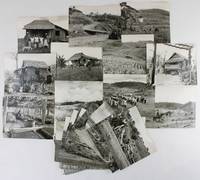
1950ref. 3741Philippines 1950. Very good. Thirty-one original photographs each measuring 4 x 5 inches. Minor wear and dust soiling. Mostly sharp clean images. Fascinating group of over thirty candid photographs depicting Philippine settlers and their homes on the large southern island of Mindanao just after World War II. Over half over these show settlers and their homes in the Panguantucan and Nabaliwa areas of Bukidnon province in the center of the island as wells as images of coffee and soybean farms a poultry enterprise rural roads and bridges and more. Additional photographs show similar scenes in Lanao del Sur also on Mindanao and a few in the Tinambac municipality of the more central Camarines Sur province -- farmers with their products by the road agricultural families at work a plant nursery and settlers' children in the fields. Mindanao is one of the principal centers of agricultural production in the Philippines and the island was subject to a series of resettlement efforts across the 20th century by both colonial and independent governments aimed at increasing production. The photos are captioned in manuscript in English on the versos and scattered images of crude roads and construction equipment suggest that these images were taken by a U.S. Army engineer or a private contractor after the war. unknown books
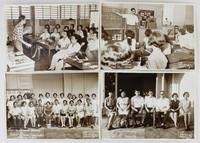
1969ref. 3754Lucena City: Garcia's 1969. Very good plus. Fifteen sepia-toned photographs most 5 x 7 inches a couple slightly smaller all but one captioned in the negative. Minor wear otherwise very nice condition. A collection of fifteen photographs featuring the participants in the 1968 Division Science Workshop in the Philippine city of Lucena. The workshop appears to have concentrated on teacher training for instructors from grades 1 through 11. The present images capture the various training classes during instruction broken out by grade level with classes of Filipino men and women taught in English by two white men. Information on chalk boards can be seen in a couple of images. Six of the photographs feature group photographs featuring either the entire population of teacher-trainees or individual grade-level classes. One image features a Division Science Seminar for District Science Coordinator. An interesting assortment of photographs capturing teacher training in a notable Filipino city at the end of the 1960s. Garcia's unknown books
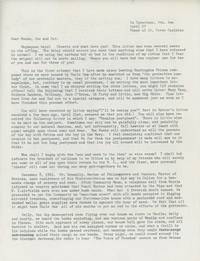
1945ref. List2748Philippines 1945. Single letter; five 8.5 x 11” pages. Pinhole at top of first page missing final pages overall fine. The unknown author of this letter was an American Jesuit missionary in the Philippines who before the war was a novice living in Novaliches just outside Manila. He apparently had not written a significant letter home for a long time: in this letter written in April of what is likely 1945 he recounts his experiences from between December 8 1941 and early January of 1945 shortly before the civilian POW camp in which he was interned was liberated. After the “Nips” bomb Pearl Harbor “A feverish month ensued”: “We proceeded to put the Community on ‘war-time alert’ with all hands occupied in digging air-raid trenches camouflaging our fortress-like house with a garlanded roof and mud-daubed walls; grain supplies were rushed in against the hour of need. We felt that all it might take Uncle Sam all of six months to put an end to the efforts of the pretender.” Around Christmas they evacuated to the Jesuit Ateneo Grade School then in Intramuros as the Japanese were advancing quickly towards Novaliches. Of course this did not prove to be much safer: “When darkness came the Japs began their bombing of the Port Area. The bombs began to bounce off the pavement; bombers just skimming our roof-top on their way. We spent the night on our tummies and how we prayed. We thought that each decade of the beads would be our last this side of Purgatory. . When the church sto Domingo was hit the floor beneath us did some tricks and we were lifted up a bit and let down amidst the dust and smoke that poured in from above.” The missionaries try to “salvage important papers and other valuables from the Mission House prior to abandoning it to the fire which threatened the entire Walled City.” During this time they and “a thousand refugees” live in the Ateneo while “Dawn and night raids were supplied by the Japs with nary an American plane to say to them no” – American forces had taken a serious hit and withdrawn outside Manila. It was declared an open city before “the little scrawny but arrogant Japs came into the city and took over” in January of 1942. The missionaries persuade the Japanese to let them stay in the Ateneo: “We convinced them that it was impossible for us to give up the building because it belonged to the Pope and the Vatican State would hold us responsible. This argument with many ingenious trimmings enabled us to hold on to the Ateneo until June ‘43 when the main building was taken for a military hospital”. The author describes how despite what he calls his “partial internment” in Manila he is able to get around checkpoints by pretending to be Belgian. He finishes his studies and begins work at a Belgian convent in Paranaque in February of 1943 living between there and Manila: “Incidentally none of this would have been possible if the Japs had gumption enough to find out that I was one of the hated Americans. . All vehicles were obliged to stop here a checkpoint at Baclaran and all passengers get down and file between a Jap sentry and a Filipino constabulary soldier to be searched for hidden arms etc. Since several Belgian Fathers not considered enemy aliens frequently passed this way I was able to walk through unmolested as an unoffending Belgian. . I carefully kept my helmet covering the tell-tale red arm-band which was worn on the arm furtherest away from the Jap. The Filipino would do no more than give me a knowing grin.” On July 10 1944 all of the American civilian POWs are taken to internment camps in Santo Tomas and then Los Baños. In Los Baños the POWs cut wood repair roads and farm. Los Baños would be liberated in February of 1945; the author paints a slightly confusing picture of the leadup to this: “Conditions generally ‘worsened’ when on Jan. 8th about the time that the American troops landed at Mindero an island just across from Batangas the Japs got jittery believing that the Yanks were going to do the obvious and cross over the bay to Batangas and they the Japs at Batanga decamped! ‘You are free but remain in camp until the Americans come. Outside your camp Japanese troops will shoot any who leave.’ Great was the joy in Mudville. From nowhere came flag poles on which we quickly unfurled American and British flags .; a short-wave radio was set up and we enjoyed daily Frisco broadcasts .” It sounds as if the missionary was reporting contrary to the usual narrative of the Los Baños raid that the Japanese had essentially given up control of the camp and were like the prisoners simply waiting for the Americans to come get their people. Perhaps something further happened in the nearly two intervening months; however the remainder of the letter is missing. Of interest to scholars of modern Jesuit history and of the civilian POW experience during the Second World War. unknown books
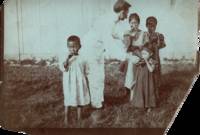
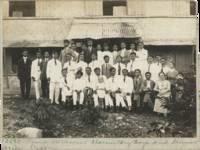
ref. List3148Vigan The Philippines early 20th century. Photograph measuring 5 x 6 ¾ inches mounted on heavy cardstock. Manuscript caption recto. Wear and some damage to edges; excellent. A photograph of a group of young Filipino men in suits with two white women and a child posing in front of a building. The caption reads “Grove Methodist Dormitory Boys and Missionaries Vigan”. The Methodist Episcopal Church began planning its missionary outreach to the Philippines shortly after the 1898 American victory in the Spanish Civil War when the Philippines became an American colony. The mission center in Vigan the capital of Ilocos Sur on the island of Luzon was opened in 1904 headed by Kansan Berndt O. Peterson.1 Missionaries opened schools—with the aim of both educating and Americanizing their students—and made Vigan the base for evangelizing around the region. According to the UMC’s history of their activities in Asia many Filipinos saw the church’s activities as an extension of American imperialism leading to Nicolás Zamora’s foundation of the Iglesia Evangelica Metodista en las Islas Filipinas in 1909. 1 Wade Crawford Barclay History of Methodist Missions Vol. 4 The Board of Missions and Church Extension of the Methodist Church 1949. unknown books
1764ref. 1400London: J. Dodsley 1764. Scare first edition of this document relating to the British occupation of Manila during the Anglo-Spanish War of 1762-3 and an interesting case of international law. In September of 1762 under the command of Draper and Cornish a British fleet of 13 ships containing over 6000 men attacked Manila and following a difficult landing quickly dispatched the Spanish garrison which they outnumbered 10 to 1.They entered the city on October 5 and part of the terms of capitulation was that Spain would pay the British an indemnity of 4 million pesos roughly a million pounds for not pillaging the city. The British evacuated in 1764 when hostilities ceased and Draper enjoyed the highly unusual privilege of presenting the standards of Spain taken in Manila to his alma mater Kings College Cambridge. But the Spanish did not honor this gentlemans agreement claiming that Draper dealt with an unauthorized agent that he himself broke the terms of the agreement etc. In order to press his claim which amounted to £25000 he published the present tract to pressure his government to collect. The tract contains a brief letter to the British Secretary of State outlining his grievance; a bilingual summary in English and French of the Spanish ambassadors grounds for not complying with the terms of the agreement; extracts from the treaty; a refutation by Draper of the claim that he dealt with an unauthorized agent; and an English language treaty signed by the original parties in Manila. But with hostilities over and their attention occupied by other foreign adventures chief among them America the British were in no position to insist and the suit was eventually abandoned.Griffin Bibliography of the Philippines p. 125; Dictionary of National Biography compact ed. I.573. 8vo. 43 pp. Bound in blue wrappers and housed in protective buckram case with title gilt on spine. Minor foxing in margins of final leaves but otherwise absolutely mint. J. Dodsley hardcover books
20013 vols., 8vo., First Edition, with coloured frontispieces, coloured and monochrome plates, illustrations, maps and endpaper maps; original Society binding of blue cloth, gilt backs, a near fine set in unclipped dustwrapper. Hakluyt Society, Series III, vols. 8, 11, 13. The set comprises: Vol. I: Cadiz to Panama; Vol. II: Panama to The Philippines; Vol. III: Manila to Cadiz.
19778vo., First Edition, with numerous photographs and illustrations in the text, and endpaper maps; green cloth, gilt back, a near fine copy in unclipped dustwrapper. The author was a young nurse fighting the Japanese in New Guinea and the Philippines. Uncommon, especially in this condition.
19848vo., First Edition thus; green cloth, backstrip lettered in silver, green endpapers, a fine copy in unclipped dustwrapper. Harrowing account of Japanese captivity in the Philippines. Enser, p.141 (recording the UK edition).
19608vo., Second Edition, with plates and maps, small neat signature on front free endpaper; maroon cloth, upper board and backstrip lettered in gilt, a near fine copy in unclipped, mildly age-soiled dustwrapper. First published in 1956. VERY SCARCE IN THIS CONDITION.
19128vo., First Edition thus, with frontispiece (original tissue guard present) and numerous illustrations; original red cloth, gilt back, a remarkably well-preserved, bright, crisp, clean copy. The US edition was published in the previous year. SCARCE IN THIS CONDITION
19458vo., First Edition, with plates and endpaper maps; black cloth, backstrip lettered in silver, a very good, bright, clean copy. Covers Task Force 58 in the concluding phase of the First Battle of the Philippines, particularly Air Group 16 from USS LEXINGTON. SCARCE. Enser, p.154.