969 Ergebnisse
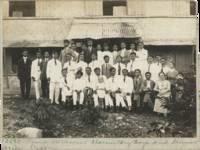
Best.-Nr. List3148Vigan The Philippines early 20th century. Photograph measuring 5 x 6 ¾ inches mounted on heavy cardstock. Manuscript caption recto. Wear and some damage to edges; excellent. A photograph of a group of young Filipino men in suits with two white women and a child posing in front of a building. The caption reads “Grove Methodist Dormitory Boys and Missionaries Vigan”. The Methodist Episcopal Church began planning its missionary outreach to the Philippines shortly after the 1898 American victory in the Spanish Civil War when the Philippines became an American colony. The mission center in Vigan the capital of Ilocos Sur on the island of Luzon was opened in 1904 headed by Kansan Berndt O. Peterson.1 Missionaries opened schools—with the aim of both educating and Americanizing their students—and made Vigan the base for evangelizing around the region. According to the UMC’s history of their activities in Asia many Filipinos saw the church’s activities as an extension of American imperialism leading to Nicolás Zamora’s foundation of the Iglesia Evangelica Metodista en las Islas Filipinas in 1909. 1 Wade Crawford Barclay History of Methodist Missions Vol. 4 The Board of Missions and Church Extension of the Methodist Church 1949. unknown books
Best.-Nr. List3148Vigan The Philippines early 20th century. Photograph measuring 5 x 6 ¾ inches mounted on heavy cardstock. Manuscript caption recto. Wear and some damage to edges; excellent. A photograph of a group of young Filipino men in suits with two white women and a child posing in front of a building. The caption reads “Grove Methodist Dormitory Boys and Missionaries Vigan”. The Methodist Episcopal Church began planning its missionary outreach to the Philippines shortly after the 1898 American victory in the Spanish Civil War when the Philippines became an American colony. The mission center in Vigan the capital of Ilocos Sur on the island of Luzon was opened in 1904 headed by Kansan Berndt O. Peterson.1 Missionaries opened schools—with the aim of both educating and Americanizing their students—and made Vigan the base for evangelizing around the region. According to the UMC’s history of their activities in Asia many Filipinos saw the church’s activities as an extension of American imperialism leading to Nicolás Zamora’s foundation of the Iglesia Evangelica Metodista en las Islas Filipinas in 1909. 1 Wade Crawford Barclay History of Methodist Missions Vol. 4 The Board of Missions and Church Extension of the Methodist Church 1949. unknown
Aranjuez, 9 de Junio de 1807. Una hoja manuscrita firmada por Caballero.
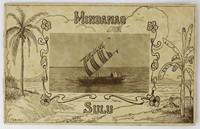
1905Best.-Nr. 5045Manila: Sugar News Press 1905. Very good. 22pp. Illustrated. Oblong quarto. Original pictorial wrappers stapled. Moderate dust-soiling and edge wear. Light even toning to text. An early and seemingly-unrecorded promotional touting the people and scenery in Mindanao and Sulu in the southern Philippines in the first decade of the 20th century. The work opens with a Foreword detailing the positive aspects of Mindanao particularly its principal city described here as the "Metropolis of Mindanao and Sulu" with "a population of more than thirty thousand a mixture of Moros or Mohammedan Filipinos Christian Filipinos Chinese Japanese and Europeans." Following the Foreword the remainder of the work is mostly comprised of thirty-four duotone photographic prints printed mostly two per page but occasionally with from one to five per page. The photographs feature numerous scenic and street views in and around Zamboanga including various "Moro houses" and about fifteen portraits of indigenous Filipinos such as a "Moro woman weaving materials for head-turbans and sarongs" a view inside a "weaving school" "Yakan Moros on the island of Basilan" "Muhammad Jamallul Sultan of Sulu" "Joloano Warriors" "Moro Kulintang" and their musical instruments Bogobo and Cotabato warriors "Bajaos - the sea gypsies of Sulu" and "Bogobo musicians." The final two pages of the work are taken up with two poems -- the first is a traditional Filipino poem entitled "No Te Vayas" noted as "Zamboanga's 'Auld Lang Syne" and one titled simply "Zamboanga" by Susan Hart Dyer. The front cover is decorated with a central photograph of an indigenous sailing vessel surrounded by an illustrated beach scene signed at bottom left "Jh. Mendoza." The inside front cover contains an illustration of the Philippine Islands from Batanes down to Sulu. We could locate no other copies of the work by title and imprint information in OCLC. Sugar News Press unknown books
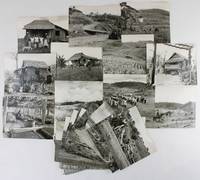
1950Best.-Nr. 3741Philippines 1950. Very good. Thirty-one original photographs each measuring 4 x 5 inches. Minor wear and dust soiling. Mostly sharp clean images. Fascinating group of over thirty candid photographs depicting Philippine settlers and their homes on the large southern island of Mindanao just after World War II. Over half over these show settlers and their homes in the Panguantucan and Nabaliwa areas of Bukidnon province in the center of the island as wells as images of coffee and soybean farms a poultry enterprise rural roads and bridges and more. Additional photographs show similar scenes in Lanao del Sur also on Mindanao and a few in the Tinambac municipality of the more central Camarines Sur province -- farmers with their products by the road agricultural families at work a plant nursery and settlers' children in the fields. Mindanao is one of the principal centers of agricultural production in the Philippines and the island was subject to a series of resettlement efforts across the 20th century by both colonial and independent governments aimed at increasing production. The photos are captioned in manuscript in English on the versos and scattered images of crude roads and construction equipment suggest that these images were taken by a U.S. Army engineer or a private contractor after the war. unknown books
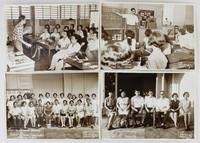
1969Best.-Nr. 3754Lucena City: Garcia's 1969. Very good plus. Fifteen sepia-toned photographs most 5 x 7 inches a couple slightly smaller all but one captioned in the negative. Minor wear otherwise very nice condition. A collection of fifteen photographs featuring the participants in the 1968 Division Science Workshop in the Philippine city of Lucena. The workshop appears to have concentrated on teacher training for instructors from grades 1 through 11. The present images capture the various training classes during instruction broken out by grade level with classes of Filipino men and women taught in English by two white men. Information on chalk boards can be seen in a couple of images. Six of the photographs feature group photographs featuring either the entire population of teacher-trainees or individual grade-level classes. One image features a Division Science Seminar for District Science Coordinator. An interesting assortment of photographs capturing teacher training in a notable Filipino city at the end of the 1960s. Garcia's unknown books
2003Best.-Nr. 124089Paris, Seven Orients, Paul Geuthner 2003 In-8 24 x 16 cm. Broché, couverture blanche, auteur & titre en rouge et noir sur le dos et le premier plat de couverture illustré, 183 pp., 5 illustrations, table des matières. Exemplaire en bon état.
2000Best.-Nr. 122626Manila, Ateneo de Manila University Press 2000 In-8 22,5 x 14,5 cm. Broché, couverture illustrée, 360 pp., notes, bibliographe, index, sommaire. Exemplaire en très bon état.
1764Best.-Nr. 1400London: J. Dodsley 1764. Scare first edition of this document relating to the British occupation of Manila during the Anglo-Spanish War of 1762-3 and an interesting case of international law. In September of 1762 under the command of Draper and Cornish a British fleet of 13 ships containing over 6000 men attacked Manila and following a difficult landing quickly dispatched the Spanish garrison which they outnumbered 10 to 1.They entered the city on October 5 and part of the terms of capitulation was that Spain would pay the British an indemnity of 4 million pesos roughly a million pounds for not pillaging the city. The British evacuated in 1764 when hostilities ceased and Draper enjoyed the highly unusual privilege of presenting the standards of Spain taken in Manila to his alma mater Kings College Cambridge. But the Spanish did not honor this gentlemans agreement claiming that Draper dealt with an unauthorized agent that he himself broke the terms of the agreement etc. In order to press his claim which amounted to £25000 he published the present tract to pressure his government to collect. The tract contains a brief letter to the British Secretary of State outlining his grievance; a bilingual summary in English and French of the Spanish ambassadors grounds for not complying with the terms of the agreement; extracts from the treaty; a refutation by Draper of the claim that he dealt with an unauthorized agent; and an English language treaty signed by the original parties in Manila. But with hostilities over and their attention occupied by other foreign adventures chief among them America the British were in no position to insist and the suit was eventually abandoned.Griffin Bibliography of the Philippines p. 125; Dictionary of National Biography compact ed. I.573. 8vo. 43 pp. Bound in blue wrappers and housed in protective buckram case with title gilt on spine. Minor foxing in margins of final leaves but otherwise absolutely mint. J. Dodsley hardcover books
Best.-Nr. 7777Philippines, years 50/60. 1 set of original photographs from Philippines, depicting natural sceneries, buildings, houses and people. Some pictures wear the Gerald Thomson (Masonic Temple) stamp, some others by Hamilton Wright from New York. All photographs in good condition. 12 photographs (26*20 cm) and 6 photographs (18*13 cm)
Best.-Nr. 4883Philippines, years 50/60. 1 set of original photographs from Philippines, depicting natural sceneries, buildings, houses and people. Some pictures wear the Gerald Thomson (Masonic Temple) stamp. All photographs in good condition). Sold separately 40 each.
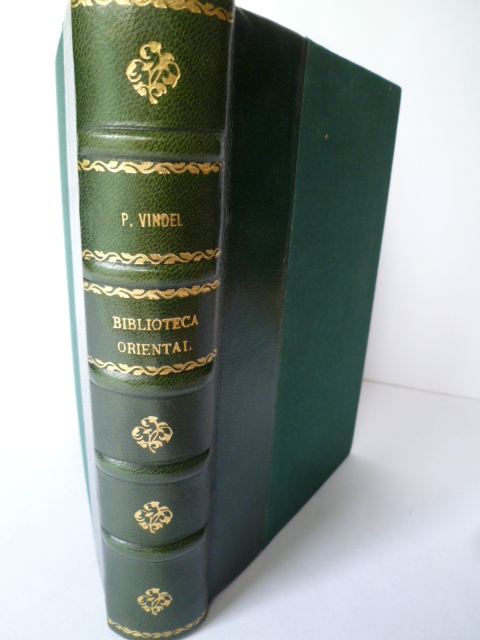
Best.-Nr. 3750Madrid, P. Vindel, Librero-Anticuario, MCMXI (1911). 1 volume in-12, 436+251 pp., half-leather new binding, with cloth-boards, Illustrated with 14 fold out facsimiles and some drawings. Text in Spanish. Paper is toned, cover page of Tome I has been restored and is brittle, inside pages are clean but yellowed by time, a good copy.
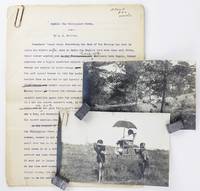
1905Best.-Nr. 5191N.p. 1905. About very good. 3pp. rectos only. About 900 words. Folio. Typescript with manuscript corrections and notations. Light wear and soiling slight creasing. Together with two silver gelatin photographs. A short but interesting essay on the mountain city of Baguio. It reads a bit like a travel article or potential newspaper puff piece for tourism and has been edited by hand with manuscript notations and corrections. It opens "Somewhere 'round about Petersburg the Czar of the Russias has what he calls his winter palace; down in Indian the English have what they call Simla their summer capital and here we Americans have Baguio." The author goes on to discuss the oppression of the tropics and therefore the need for cooler cities to enable functional government discussing the needs of the "white man" for livable conditions in such a place: "In the Philippines there are some months of the year that are extraordinarily summer summer in all the sense that the word implies summer until one can't rest and do it comfortably. It is during this time that the summer capital comes in as a life-saving station for the overworked and rundown public servant and such others as care to take advantage of the rural pueblo. . drudging all year in a comparatively warm atmosphere and then to be hit with a blast that seems like a draft from the furnace of the place that has its main thoroughfare paved with good resolutions is more than the average Anglo-Saxon can stand." He continues: "Shortly after the arrival of the civil commission in the islands the Governor wasn't long in deciding.that the English were pretty wise in having their summer capitals. He also decided the Philippines must have one. It was necessary if the white man was to stay indefinitely." He describes the process of locating Baguio in the pine forests and establishing a small town there despite the lack of a road and precipitous ascent to the area: "The committee reported the climate fine incomparable just like that of the United States in late fall and that one had to sleep under heavy blankets at night to keep warm. . despite skepticism . it proved a fact and one that was a blessing. Think of the pleasure of residing in the Philippines where flies seldom bother where mosquitos as a rule are few where patent leather shoes never crack.and having a delightfully hilly resort not ninety miles away to go to when one's spleen enlarges from a languid life or the malaria attacks with unrelenting persistence." He goes on to note that it costs nearly as much to go to Baguio as it does to travel to China "so that its full benefit has not yet been felt by the more humble in life". The typescript is accompanied by two photographs of the Philippines one depicting a trail through a pine forest presumably around Baguio and the other showing a Filipino woman being carried by two Filipino men in a sedan chair. unknown books
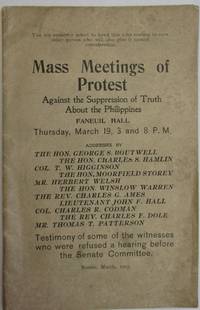
1903Best.-Nr. 37755Boston 1903. Original printed wrappers with wrapper title as issued and original staples. At head of title: "You are earnestly asked to hand this after reading to some other person who will also give it careful consideration." Rear wrapper repeats the first sentence of the title. 56 pages. Wrappers lightly dusted else Fine. An anti-imperialist protest against American efforts to "to conquer a foreign nation and to impose our sway upon it against its will. We are departing from the principles upon which our government is founded and which we have always held to be self-evident truths." The Philippine conflict was a guerilla war of unbridled brutality instigated by the American decision to become a Pacific power. unknown books
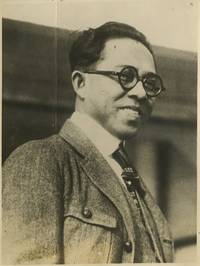
1920Best.-Nr. List38122New York City: Keystone View Co. Inc 1920. Photo measuring 5 ⅞ x 7 ¾ inches. With caption Keystone stamp manuscript and later sticker verso. Fold along left third of image with several pinholes around margins and one small hole in photo; very good. A portrait of Hadji Gulamu Rasul around the 1920s. Rasul was the son of Filipino statesman Abd ul-Bagui Butu Rasul and some sources state that he was the adopted son of Jamalul Kiram II the last sultan of Sulu. The sultanate was a Sunni Muslim state that ruled parts of what are now the Philippines Malaysia and Indonesia from the 1400s until the 1915 Carpenter Agreement was signed in the American-occupied Philippines. Under American rule Rasul represented the district of Sulu in the Philippines' congress from 1938-1941 and 1949-1953. The caption on this photograph states that he was in Seattle "in search of his white wife who deserted him when she found he had several native wives"; however other newspaper articles from the same period state that he was in Washington to study law. Keystone View Co., Inc unknown books
1945Best.-Nr. 61658Manila P.I.: 25th Infantry Division 1945. Folio. 9 x 13 in. 92 pp unpaginated. consisting of illustrated title introduction leaf and then 176 numbered illustrated panels 2 to a page tracking the campaign. Blue publisher’s cloth colour plate title mounted on front cover w/ 25th Division “Tropic Lightning” badge minor dustsoiling slight fraying a little thumbing still a VG bright copy. First edition of this fascinating and well-illustrated graphic novel regimental history executed by the artist while serving with the 3rd Brigade 25th Infantry Division and filled with drawings depicting the life of a doughboy fighting the Japanese across Luzon. The book covers the 35th “Cacti” 27th “Wolfhounds” and 161st Infantry Regiments the famous Battle of Balete Pass offering an essential first-hand visual record while they set the combat record of 165 consecutive days. The record would not be broken until later when the 3rd Brigade of the 25th Division went 235 consecutive days in combat operations during the Vietnam War in 1966. Rutherfoord 1919-2001 was a commercial artist from Roanoke VA who served from 1942-1946 in the 25th Infantry Division and later as commercial artist in New York who also illustrated a number of titles in the popular Little Golden Books series as well as later a successful painting career in and around Roanoke. 25th Infantry Division, hardcover
1945Best.-Nr. 64628Los Angeles CA: 40th Infantry Division ca. 1945. Oblong 4to. 120 pp unpaginated. with 200 silver gelatin photographs all mounted and numbered in lower corner w/in negative keyed to indices inserted after the title page occasional creasing to corners. Brick-red publisher’s cloth post-binder two hidden nickel-plated screwposts at gutter margin 40th Infantry Division sunburst emblem patch on front cover in gilt on blue field minor thumbing edgewear slightly shaken occasional fraying to a couple leaves at fore-edge still a VG copy. First edition thus of this 40th Infantry Division regimental souvenir album visually recording the Western National Guard “Sunshine Division’s” participation in the grueling and bloody island hopping campaign during World War II from Guadalcanal to The Philippines often involved in heavy fighting and credited with capturing or killing over 11000 Japanese troops while suffering 715 casualties. These photographs follow the 40th Division’s arrival and activities in Hawaii followed by their movement to Guadalcanal and arrival at Kukum Dock. Photos depict wrecked Japanese ships beached nearby the typical bare-breasted shots of New Britain Indigenous Peoples arrival of nurse units and training on New Britain. As depicted in these images the bloody Philippine Islands campaign opened with multiple regiments from the 40th Division landing at the Lingayen Gulf on Luzon in order to retake the main Philippine Island in January 1945 including views of Tarlac Bamban battle damage artillery pieces war dogs used by segregated African-American patrols on Luzon well-prepared Japanese positions built to repel the American forces machine gunners Japanese casualties and the results of Japanese troops using grenades to commit Hari Kari.The next phase of the campaign involved the 40th Division participating in the Panay & Guimaras Invasion landing at Tigbauan on Panay Island securing Iloilo City and nearby airfields coordinating with Philippine guerrilla forces with photos of the guerrillas views of the landing craft Philippine peoples and guerrillas wounded by Japanese snipers being treated by American forces and the Division artillery. The 40th Division later came together with other forces and moved onto Negros Island from the end of March through August 1945 pushing deep into Negros Island capturing Bacolod and its airfield before continuing on in the heavy surrounding jungle dislodging Japanese troops in the surrounding area. Their artillery and tank battalions proved particularly effective and many of these photographs depict not only the movements and equipment but the aftermath as well. This album does not include the National Guard Division’s participation in the enforcement of the orders to round up and illegally incarcerate Japanese-Americans throughout the West into War Relocation Centers and Internment Camps for the duration of the War. No copies in Worldcat -- this volume should not be confused with the regimental history published in Baton Rouge LA by the Army & Navy Publishing Company -- “40th Infantry Division: the years of World War II 7 December 1941-7 April 1946. 40th Infantry Division, hardcover
1905Best.-Nr. 5191N.p. 1905. About very good. 3pp. rectos only. About 900 words. Folio. Typescript with manuscript corrections and notations. Light wear and soiling slight creasing. Together with two silver gelatin photographs. A short but interesting essay on the mountain city of Baguio. It reads a bit like a travel article or potential newspaper puff piece for tourism and has been edited by hand with manuscript notations and corrections. It opens "Somewhere 'round about Petersburg the Czar of the Russias has what he calls his winter palace; down in Indian the English have what they call Simla their summer capital and here we Americans have Baguio." The author goes on to discuss the oppression of the tropics and therefore the need for cooler cities to enable functional government discussing the needs of the "white man" for livable conditions in such a place: "In the Philippines there are some months of the year that are extraordinarily summer summer in all the sense that the word implies summer until one can't rest and do it comfortably. It is during this time that the summer capital comes in as a life-saving station for the overworked and rundown public servant and such others as care to take advantage of the rural pueblo. . drudging all year in a comparatively warm atmosphere and then to be hit with a blast that seems like a draft from the furnace of the place that has its main thoroughfare paved with good resolutions is more than the average Anglo-Saxon can stand." He continues: "Shortly after the arrival of the civil commission in the islands the Governor wasn't long in deciding.that the English were pretty wise in having their summer capitals. He also decided the Philippines must have one. It was necessary if the white man was to stay indefinitely." He describes the process of locating Baguio in the pine forests and establishing a small town there despite the lack of a road and precipitous ascent to the area: "The committee reported the climate fine incomparable just like that of the United States in late fall and that one had to sleep under heavy blankets at night to keep warm. . despite skepticism . it proved a fact and one that was a blessing. Think of the pleasure of residing in the Philippines where flies seldom bother where mosquitos as a rule are few where patent leather shoes never crack.and having a delightfully hilly resort not ninety miles away to go to when one's spleen enlarges from a languid life or the malaria attacks with unrelenting persistence." He goes on to note that it costs nearly as much to go to Baguio as it does to travel to China "so that its full benefit has not yet been felt by the more humble in life". The typescript is accompanied by two photographs of the Philippines one depicting a trail through a pine forest presumably around Baguio and the other showing a Filipino woman being carried by two Filipino men in a sedan chair. unknown
1764Best.-Nr. 1400London: J. Dodsley 1764. Scare first edition of this document relating to the British occupation of Manila during the Anglo-Spanish War of 1762-3 and an interesting case of international law. In September of 1762 under the command of Draper and Cornish a British fleet of 13 ships containing over 6000 men attacked Manila and following a difficult landing quickly dispatched the Spanish garrison which they outnumbered 10 to 1.They entered the city on October 5 and part of the terms of capitulation was that Spain would pay the British an indemnity of 4 million pesos roughly a million pounds for not pillaging the city. The British evacuated in 1764 when hostilities ceased and Draper enjoyed the highly unusual privilege of presenting the standards of Spain taken in Manila to his alma mater Kings College Cambridge. But the Spanish did not honor this gentlemans agreement claiming that Draper dealt with an unauthorized agent that he himself broke the terms of the agreement etc. In order to press his claim which amounted to £25000 he published the present tract to pressure his government to collect. The tract contains a brief letter to the British Secretary of State outlining his grievance; a bilingual summary in English and French of the Spanish ambassadors grounds for not complying with the terms of the agreement; extracts from the treaty; a refutation by Draper of the claim that he dealt with an unauthorized agent; and an English language treaty signed by the original parties in Manila. But with hostilities over and their attention occupied by other foreign adventures chief among them America the British were in no position to insist and the suit was eventually abandoned.Griffin Bibliography of the Philippines p. 125; Dictionary of National Biography compact ed. I.573. 8vo. 43 pp. Bound in blue wrappers and housed in protective buckram case with title gilt on spine. Minor foxing in margins of final leaves but otherwise absolutely mint. J. Dodsley hardcover
1950Best.-Nr. 3741Philippines 1950. Very good. Thirty-one original photographs each measuring 4 x 5 inches. Minor wear and dust soiling. Mostly sharp clean images. Fascinating group of over thirty candid photographs depicting Philippine settlers and their homes on the large southern island of Mindanao just after World War II. Over half over these show settlers and their homes in the Panguantucan and Nabaliwa areas of Bukidnon province in the center of the island as wells as images of coffee and soybean farms a poultry enterprise rural roads and bridges and more. Additional photographs show similar scenes in Lanao del Sur also on Mindanao and a few in the Tinambac municipality of the more central Camarines Sur province -- farmers with their products by the road agricultural families at work a plant nursery and settlers' children in the fields. Mindanao is one of the principal centers of agricultural production in the Philippines and the island was subject to a series of resettlement efforts across the 20th century by both colonial and independent governments aimed at increasing production. The photos are captioned in manuscript in English on the versos and scattered images of crude roads and construction equipment suggest that these images were taken by a U.S. Army engineer or a private contractor after the war. unknown
1969Best.-Nr. 3754Lucena City: Garcia's 1969. Very good plus. Fifteen sepia-toned photographs most 5 x 7 inches a couple slightly smaller all but one captioned in the negative. Minor wear otherwise very nice condition. A collection of fifteen photographs featuring the participants in the 1968 Division Science Workshop in the Philippine city of Lucena. The workshop appears to have concentrated on teacher training for instructors from grades 1 through 11. The present images capture the various training classes during instruction broken out by grade level with classes of Filipino men and women taught in English by two white men. Information on chalk boards can be seen in a couple of images. Six of the photographs feature group photographs featuring either the entire population of teacher-trainees or individual grade-level classes. One image features a Division Science Seminar for District Science Coordinator. An interesting assortment of photographs capturing teacher training in a notable Filipino city at the end of the 1960s. Garcia's unknown
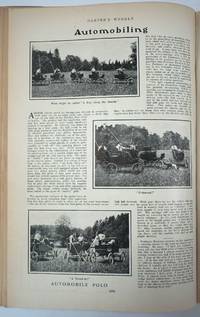
1902Best.-Nr. 28399New York: Harper's 1902. First printing. Hardcover. Good overall. Content on the Russo-Japanese & Spanish American War; Automobiling early cars playing polo!; Teddy Roosevelt Chinese rugby cartoon Blackwell Island Bridge Thomas Nast cartoon Henley regatta. Half year bound volume of Harper's Weekly with woodblock illustrations throughout. Color supplements were included in the Christmas issue. Chinese playing rugby cartoon p1582; US Naval Academy p1498; Blackwell Island Bridge p1308; Wall Street p1180; Thomas Nast p1972. Folio 1155pp. Weekly issues bound up into a large single volume with 3/4 leather and marbled boards. Leather spine chipped cracked at hinge binding firm internally very clean. Harper's hardcover
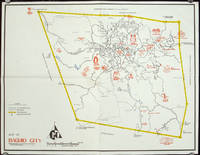
1960Best.-Nr. 206510circa1960. Printed pictorial map 44.8 x 58 cm 46.7 x 60.3 cms sheet original folds a little wear but in very good condition. Attractive 1960s tourist map of Baguio city when it was the "Summer Capital" of the Philippines. Tourist attractions are shown pictorially in red blue triangles denote wood carving shops the city boundaries outlined in yellow sealed and unsealed roads are also shown. . unknown
1903Best.-Nr. 37755Boston 1903. Original printed wrappers with wrapper title as issued and original staples. At head of title: "You are earnestly asked to hand this after reading to some other person who will also give it careful consideration." Rear wrapper repeats the first sentence of the title. 56 pages. Wrappers lightly dusted else Fine. An anti-imperialist protest against American efforts to "to conquer a foreign nation and to impose our sway upon it against its will. We are departing from the principles upon which our government is founded and which we have always held to be self-evident truths." The Philippine conflict was a guerilla war of unbridled brutality instigated by the American decision to become a Pacific power. unknown
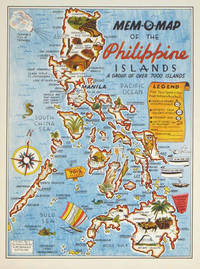
1945Best.-Nr. 204557U.S.A.: Mem-O-Map Co. 1945. Colour pictographic / pictorial map 32.1 x 23.8 cms; 35.4 x 26.6 cms sheet very good condition. Rare pictorial map published in 1945 by John G. Drury aTechnical Officer who served with the 214th Ordnance Battalion to mark the end of World War II as souvenirs for the military. Military personnel could fill in banners "came in on good ship." and "departed on good ship." their name organisation and "Line of Advance or movement" blank in this example. Pictographs mark various memorable spots and wildlife including larger-than-life insects. A "Terrible Tillie Typhoon" looms over the coast at Luzon. Drury published a series of five maps: Philippines and Okinawa in 1945; Japan and Korea Oahu and Europe in 1946. They are all scarce. “These almost whimsical maps are designed to support the creation of personalised geographies. At a time when digital mapping is beginning to experiment with the creation of personalised content that would render the same map in different ways for different users Mem-O-Maps demonstrate the principle in action." Kenneth Field ICA Commission on Map Design. . Mem-O-Map Co. unknown