26 427 résultats
2000réf. 35513Tokyo: National Museum of Art Tokyo 2000. Softcover. VG. White ill. wraps. 99 pp. Profuse color plates. Text in Japanese and English. Survey of early 20th century Japanese graphic designer. Includes examples from posters magazine covers book designs postcards as well as other media. National Museum of Art, Tokyo paperback books
1997réf. 209871997. Softcover. VG. Bw wraps. 237 pp. 87 color plates. Text in Japanese and English. A thorough and inviting examination. Wonderfully illustrated. paperback books
1963réf. 107349Tokyo: The Japan Ukiyo-e Society 1963. Number Four. Softcover. Fair - front stained. White illus. wraps; 1 color and numerous bw illus. includes advertisements; text in English and Japanese. The Japan Ukiyo-e Society paperback books
2005réf. 1019952005. Softbound. As New. Color illustrated wraps. 285 pp. Profusely illustrated in color. Text is presented in Japanese and French. Extensively illustrated and annotated and significant addition to the literature on La Tour. paperback books
réf. 35566nd. Softcover. VG- plastic coating wrinkled at cover edge. Black ill. wraps. 116 pp. Profuse color plates. Price list laid in. Text in Japanese and English. paperback books
1978réf. 109351978. Softcover. VG- some mild wear along spine. White wraps. 31 pp. 26 bw plates. Written dually in Japanese and English this volume contains an introduction by Kakuzo Tatehata a listing of 12 works a personal history/exhibition listing and an original poster promoting advertising the exhibition. paperback books
1996réf. 326011996. Softcover. VG light bumping to rear corner. Pictorial wraps. 322 pp. 181 color plates. Text in Japanese. paperback books
réf. 26909Softcover. VG. Ill. wraps. 95 pp. 67 color plates. Text in Japanese and English. Includes biographical documentation of the 14 artists many luscious color plates and and essay by Yoko Imai. paperback books
1996réf. 172831996. Softcover. VG. White wraps. 270 pp. Numerous color and bw plates. Text in Japanese and English. paperback books
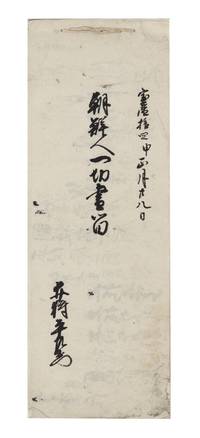
réf. 1113722 folding leaves. Narrow tall 8vo 343 x 123 mm. orig. self-wrappers orig. stitching. Japan: on upper wrapper in trans.: “28 January 1764.” During the Edo period 12 Korean delegations were sent to Japan mostly to congratulate a new Tokugawa shogun. The missions which normally included 300-500 Koreans accompanied by roughly 1500 Japanese escorts symbolized the amicable relationship between the two nations and in the early years served to legitimize the Tokugawa shogunate. These delegations which usually took nine or ten months round-trip were enormously expensive undertakings for both countries. The Koreans brought many luxurious presents both public and private offerings and the Japanese in turn furnished equally lavish gifts including large quantities of silver. During the Korean mission’s stays the Japanese government was responsible for all expenses and provisions for their guests. The present manuscript is an account of the diplomatic mission sent by the Koreans in 1763-64. The mission totaled 497 people and took 382 days. The members of the embassy included chief and auxiliary envoys a document official three translating officials with assistants ten translators two copyists a poet a painter three doctors army officers musicians horsemen clerks captains pilots servants commissariat officials gift guardians trumpeters six for each of the three principal envoys soldiers and sailors. The mission sailed from Pusan to Osaka stopping at Tsushima on the way and then travelled by land to Edo via Kyoto. Our manuscript provides menus of the elaborate banquets the Japanese offered to their guests accounts of the special ceramics created at the kilns of Shigaraki used at banquets itemized lists of the provisions and their quantities including rice seasonings condiments and miso routes and stops along the way from Osaka to Edo housing arrangements official proceedings distribution of horses to the delegation itemized balance sheets detailing expenses of the mission etc. The cost of this mission was so enormous for both countries that the next and final mission of the Edo period was a toned-down meeting in 1811 on Tsushima island conveniently located in between both countries. On the upper wrapper we find the name Imochi Heizaemon 井æŒå¹³å·¦è¡›é–€ and on the penultimate leaf we find the place-name Hachiman 江州八幡町 which is in today’s Shiga Prefecture. Nice fresh condition. Some worming carefully repaired. â§ George M. McCune “The Exchange of Envoys Between Korea and Japan During the Tokugawa Period” in The Far Eastern Quarterly Vol. 5 No. 3 May 1946 pp. 308-25. unknown books
1997réf. 335234Tokyo: Flat Glass Manufacturers Association of Japan 1997. hardcover. fine. Illustrated throughout in b/w and color. 200 pages with Japanese text. 4to shiny blue silkcloth with silver lettering. Tokyo: Flat Glass Manufacturers Association of Japan 1997. A fine copy with just the slightest bumping pf corners. Flat Glass Manufacturers Association of Japan unknown books
1953réf. List2954Tokyo Japan 1953. Cardboard binder containing thirty-six 8 ¼ x 11 ½ inch sheets; sixteen pages mimeographed and twenty with photos 4 ½ x 6 ½ inches and smaller. Photos near fine with fine contrast; pages folded with some marginal damage; overall excellent. Tokyo Keiki Seizosho was established in 1896 and manufactured measuring devices. It soon began to manufacture navigation equipment particularly compasses. Following World War II it also began working in radar and hydraulics. Offered here is a 1953 report on the company’s activities especially its aircraft instrument manufacturing. The report also discusses the re-establishment of relationships with American companies including Sperry Gyroscope Company Bendix Aviation Corporation and Walter Kidde. The report includes twenty photographs including exterior views of the plant its shops and equipment testing. unknown books
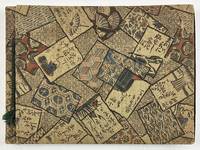
1928réf. 12860Various locations in Hawaii and Japan 1928. 12 leaves illustrated with 123 mounted sepia-toned photographs many captioned in the image area occasional manuscript captions on the album leaves. Oblong folio. Contemporary pictorial cloth illustrated with various Japanese motifs string tied. Minor wear to cloth. Internally clean. Very good. An attractive and informative vernacular photograph album memorializing the experiences of Protestant missionaries in the Pacific. Protestant missionaries came to Hawaii starting in the 1820s and eventually became quite socially and politically influential. The first Protestant missionaries arrived in Japan in the mid-1840s. They were relegated to treaty ports and prohibited from proselytizing but once these restrictions were lifted they were fairly successful with 300 churches and 34000 converts by 1889. Their main avenue was education and by the 1920s they were well established in this sector. The present album of photographs were taken by an American missionary in Hawaii and Japan in 1927 and 1928. It is not entirely clear whether the photographer did any missionary work in Hawaii or if it was just a stop on the way to Japan; the photos from Hawaii show Honolulu harbor from the deck of the President Madison the "Club House" and Diamond Head. The photographs from Japan are more clearly missionary. The photographer was involved in teaching in Kyoto; captions include "Kami Kyoku Bishamon Cho" listed as a theological school in the 1928 Japan Mission Year Book "Japanese Language School" "The Faculty" "Nihongo Faculty" and "St Agnes Ena -- Music." There are two St. Agneses in the Year Book both middle schools one in Tokyo and one in Kyoto. Two photos of an older Japanese man in a clerical collar captioned "Mr Hayakawa" suggest this is the St. Agnes in Kyoto as Mr. K. Hayakawa is listed as the head of that school. Other individuals listed in the Year Book include Sally Rembert Thora Johnson and "Maxine" who is probably Maxine Schannep with the ABCFM. Generally the school shots are exteriors of buildings and people posing outside of them; there are also shots of Christmas trees at St. Agnes the students of "Helen’s Kindergarten" in Koriyama girls in school uniform with deer at Nara Park and several of the nurse's home at St. Luke's Hospital in Tokyo. Other photos show life around Kyoto and other cities including Nikko and Fukui. Most of the men are in Western dress while the women and children wear kimono. Two photos of Buddhist monks included in the album were taken by Japanese photographer Kurokawa Suizan; these show a KomusÅ in a tengai hat playing the flute and a kasa-hatted monk on the steps of a building. Finally some uncaptioned shots show a procession taking place in front of an audience. Some in the procession carry flags a few are on horseback and a few carry plants on their heads and part of the procession carries a litter. Overall the album documents both religious education and everyday life in late 1920s Japan; of particular interest to historians of Protestant missionaries. unknown books
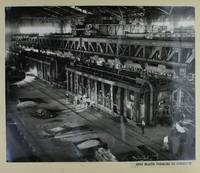
1957réf. 3436Chiba Japan 1957. Very good plus. Title leaf plus 18 leaves illustrated with forty-three large photographs between 4 x 6 and 8 x 10 inches including a few small panoramic images most with typed captions mounted beneath the pictures. Oblong folio. Contemporary light brown leather. Minor scuffing and edge wear. A unique photograph album created for an American businessman named Richard F. Quandt "In Remembrance of Your Visit to Chiba Iron and Steel Works on May 14 1957" according to the printed dedication on the title leaf. The printed message is signed by the founder of Kawasaki Steel Yataro Nishiyama. The album is populated by over forty photographs featuring the construction and operation of Kawasaki Steel's new integrated steel mill in Chiba City Japan. The photographs picture the staff of Chiba Works a schematic of the plant aerial views of the plant images of the blast furnace coke oven ore yard and other exteriors. Some of the exterior shots include small panoramas of the plant's construction most notably a three-panel panorama showing the "Entire View of Hot & Cold Strip Mill Plant's Construction Work." The interior photographs document the heat control center open heart furnaces soaking pits and several candid shots of Mr. Quandt touring the plant with the managers of Kawasaki Steel. According to his 1974 obituary in The New York Times Richard Frederick Quandt was a Hungarian-born businessman who emigrated to the United States after World War II. He first worked for the Hambro Trading Company in 1949. At the time he visited the Chiba Iron and Steel Works he was serving as a loan officer for the International Bank for Reconstruction and Development the lending arm of the World Bank. He was quite likely visiting the Chiba Works at the request of their principal Yataro Nishiyama in search of funding for the steel mill. Nishiyama was an engineer who built Kawasaki Steel into one of the most important steel manufacturing companies in Japan in the ensuing decades. A wonderful and informative photographic artifact of American economic diplomacy in postwar Japan. unknown books
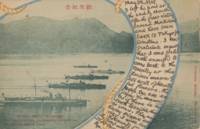
1905réf. List3150Tokyo Japan 1905. Two postcards measuring 3 ½ x 5 ½ inches. Near Fine. Two postcards from Kyoske Uyeda in Japan to his friend Bessie Mulkey in San Francisco dated May and July 1905. At the time the Russo-Japanese War fought over the Russian and Japanese Empires’ imperial ambitions for Manchuria and Korea was nearing its end. Uyeda had been on the front; in his earlier postcard he writes: “May 5th 1905 I left the front at the end of March after the great victory around Mukden and have been back to Tokyo for sometime. I congratulate myself that I was fortunate enough to come back to the country at this glorious season of all sorts of beautiful flowers. The people too are enjoying the seasons as if there is no such terrible thing as war. They are having picnics every day. I will leave the country for the front within a short time. Kyo.” Mukden—present-day Shenyang Liaoning province—was the site of the war’s final land battle fought from February to March 1905 and resulting in a decisive victory for Imperial Japan. In his second postcard Uyeda is set to depart for another significant location in the war: “I will leave here for Port Arthur to-morrow and having stayed there a day or two and coming back here am probably to go to our Headquarters at Mukhden to attend to the annual celebration of the day in which our Manchurian Expedition Army organised that is on the 6th of July 04. I expect a grand time there Marshal Oyama Gen. Baron Kodama Gen. Kuroki and many other grand chieftains will assemble at the Capital of Manchuria.” Port Arthur now Lüshunkou District in Liaoning province China was seized by the Japanese in 1894 during the First Sino-Japanese War; returned to China in 1895; and then leased in an unequal treaty by the Russian Empire in 1898. Japan’s surprise attack against the Russian fleet at Port Arthur launched the war in February 1904 and resulted in Japan retaking the port. Uyeda’s notes are written on interesting themed postcards depicting the Imperial Japanese Navy; one reads “Our Combined Squadron steaming towards the enemy” and the other “Our torpedoboat squadron returning to a naval base after fighting with the enemy.” How Uyeda and Mulkey would have met and begun a correspondence is unclear. unknown books
1941réf. List3158Japan: Brown Brothers 1941. Five photographs. Photos measuring 6 ½ x 8 ½ inches. With typed captions previously affixed typed captions verso or manuscript captions verso; with Brown Brothers stamps verso. Fine contrast and slight marginal damage; overall excellent to Near Fine. Following the outbreak of the Second Sino-Japanese War the United States imposed a number of economic sanctions against Japan including the 1939 termination of its trade treaty with the country 1940 oil export embargo and 1941 executive order freezing Japanese assets in the US. Great Britain followed suit shortly thereafter. Offered here is a collection of press photographs documenting the effects of the US and UK’s economic sanctions on Japanese industry. One caption explains: “The industries of Japan veritable bee hives until the trade treaty abrogatio by the United States followed by the freezing of funds belonging to the Niponese Government resulting in the dripping of exports from Japan from $18000000 to $500 in the past year has brought about the condition seen in this series of photos.” The factories pictured include a locomotive plant textile mill match factory and crockery exporter. The sanctions had a devastating impact on Japan’s economy which is partly blamed for their attack on Pearl Harbor. Brown Brothers unknown books
1966réf. 301341New York: Cooper Union Museum 1966. hardcover. near fine. Numerous black & white illustrations slim 4to red & black printed wrappers staple bound exhibition catalog . New York: Cooper Union Museum 1966. Near Fine. Comes with 26 stapled pages entitled "Catalogue THE JAPANESE SWORD AND ITS FITTING From the collections of the members of the Japanese Sword Society of N.Y.". Cooper Union Museum unknown books
1989réf. 267375Tokyo: Toppan 1989. hardcover. fine/very good. Text in English and Japanese. 561 pages thick square 4to grey cloth black glossy French fold dust wrapper. Tokyo: Toppan 1989. A fine copy in a very good dust wrapper just some light surface rubbing to wrapper. In protective cardboard sleeve Toppan unknown books
1986réf. 206804New York: Japan Society 1986. First. hardcover. fine/fine. Numerous photographic illustrations in color & in black & white. 193 pages. 4to red cloth d.w. New York: Japan Society 1986. First Edition. Fine in fine dust wrapper. Japan Society unknown books
réf. 104438hardcover. near fine. 8vo boards d.w. Tokyo 1976. 10 essays from The Japan Interpreter. A near fine copy unknown books
1935réf. 4409Various locations in Hawaii and Japan 1935. Good. 21 leaves illustrated with ninety-four black-and-white and sepia-toned photographs. Small oblong octavo. Contemporary leatherette photograph album string tied. Covers lacking spine chipped. Bottom corner of most leaves chipped with no loss to captions or photos minor occasional dust-soiling. Photographs generally well preserved. A wonderful annotated vernacular photograph album assembled by a young woman named Viola documenting her trip from California to Japan in 1935. A small card on the front flyleaf is inscribed: "Dear Viola Please use this album to paste pictures of your visit to Japan &c. With sincere regard Pete Takahashi." Viola visited Hawaii and Japan with a half dozen family members and friends including her mother each of whom is pictured and identified throughout the album. The pictures show Viola herself referred to both by her name and as "Me" as well as her traveling companions in Honolulu Waikiki and Nuuanu Pali in Hawaii. A few pages contain photographs of the travelers aboard ship before arriving first in Hiroshima about halfway through the album. Most of the photographs from Viola's visit to Japan emanate from Hiroshima where Viola and her mom pose with various Japanese elders she visits the beach and takes portraits of numerous identified locals. The final portion of the album emanates from Lake Nojiri where Viola visited a summer camp and posed for a few additional pictures along with her mother and other Japanese women. A humble but informative travel album memorializing a young Japanese-American woman's trip to the mother country where she visited Hiroshima a decade before the devastating bombs were dropped there at the end of World War II. unknown books
réf. 8616119th century Japan - Album of 42 original tinted albumen photographs of Japan Alaska and Sir G. Baden-Powell and Sir G. Dawson seal expedition in 1891 N.p. N.d. c. late 19th C 1891 Oblong 14 x 18.5cm album disbound accordion style. Paper mache over wood boards with an intricate embossed design and gold and red pigment. Stiff card pages are bordered in pale blue with mounted tinted album photographs 10.8 x 14cm. Most are captioned in pencil in English in the margins of the card mounts. The leaves are disbound/unhinged. 25pp 42 photos. 8 of the 50 sides are blank with no photo mounted. There is no evidence of any photos having been removed. The posed Japanese photos appear to be from photography studios in Japan that catered to tourists. Among these studio portraits are photos of sumo wrestlers women with umbrellas in a rickshaw washing and applying makeup and posing as dancers. There are also picturesque views of Nagasaki. A photo of the bronze horse statue at Suwa Shrine è«è¨ªç¥žç¤¾ Suwa Jinja in Nagasaki mislabeled a ‘temple’ in the album does not have an enclosure around it dating it to between 1870 when it was first dedicated and 1913 as a corral was built around it during the Meiji period. Scenes of villages from the Aleutian Islands of Alaska are pictured as well as locations in Russia. Included are photos of people on a rustic main street in Petropavlovsk Russia the SSS Danube in Avacha Russia a seal rookery and a group photo that includes Sir George Smyth Baden-Powell 1847–1898 and scientist and explorer Sir George Dawson 1849– 1901. On June 23 1891 an article appeared in the NY Times stating that the two men were made British Commissioners in the Bering Sea seal question and an October 22 1891 article from the same newspaper announced the arrival of Baden-Powell and Dawson in Ottawa Canada after returning from the expedition to observe seal hunters dating the photos from late June to October of 1891. This expedition was important in gaining evidence that was used in arbitration that voted in favor of England against the U.S. As the expedition was an official one undertaken largely in secret it is possible that the photos of the area were taken by a member of that expedition likely a Westerner and skilled amateur or professional photographer. A full report of that expedition undertaken on the chartered steamer Danube also in the photos was accessed 1.2.23. https://babel.hathitrust.org/cgi/ptid=hvd.hwyprv&view=1up&seq=11 The British Man-O’-War Porpoise which is included in the photographs is mentioned as accompanying the group. Photos overall are in good condition a few are slightly faded some with tissue guards interleaved. Chipping to edge of cover. An unusual combination of studio and candid photos with historic significance in stunning lacquer paper-mache covers. unknown books
1922réf. 409811922. NATIONAL RESEARCH COUNCIL OF JAPAN. JAPANESE JOURNAL OF BOTANY. Transactions and Abstracts. Tokyo: 1922-1941. Volumes 1-11 the serial continued until 1970. Vols. 2-11 bound in black cloth vol.1 #1-4 in wrappers. Wrappers torn at spines front wrapper missing of vol.1 #2. Some soiling at boards. Very good. unknown books
1939réf. 866111939. ADVERTISING ART - JAPAN. KOKOKKAI. ADVERTISING AND COMMERCIAL ART. Volume 16 number 9. Tokyo Seibundo Showa 14 1939. Decorated wrappers. 26.3 x 19 cm. 96 pp. Kokokkai was the premier professional journal on the art and science of advertising in Japan at the time of its publication. Ken Domon was in charge of photography. The issues were full of scientific and perceptive articles and illustrated with color and bw plates and reproductions of posters ads signboards etc. etc. Despite a bi-lingual title on the title page inside the text is entirely in Japanese. Ephemeral issues from early Showa have largely disappeared. unknown books
1939réf. 866041939. ADVERTISING ART - JAPAN. KOKOKKAI. ADVERTISING AND COMMERCIAL ART. Volume 16 number 6. Tokyo Seibundo Showa 14 1939. Decorated wrappers. 26.3 x 19 cm. 96 pp. Kokokkai was the premier professional journal on the art and science of advertising in Japan at the time of its publication. Ken Domon was in charge opf photography. The issues were full of scientific and perceptive articles and illustrated with color and bw plates and reproductions of posters ads signboards etc. etc. Despite a bi-lingual title on the title page inside the text is entirely in Japanese. Ephemeral issues from early Showa have largely disappeared. The fragile paper is in nice condition overall. unknown books