MONNIER (Marcel)Livre Rare Book
Antiquariat.de
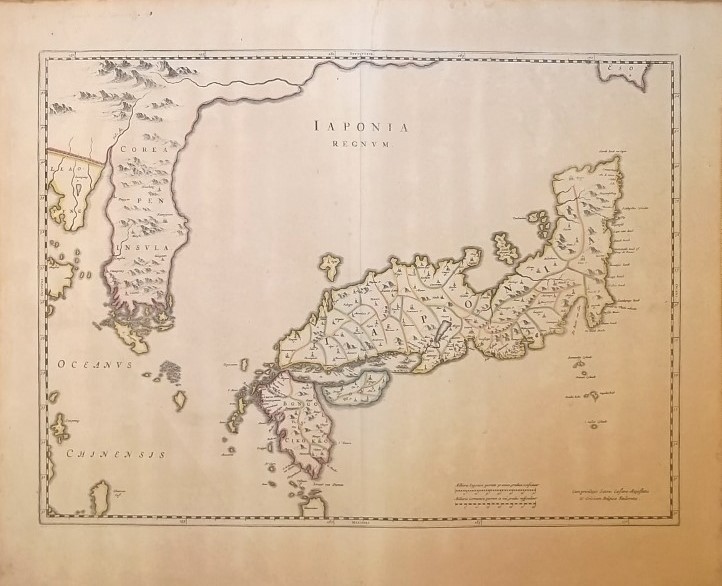
"Iaponia Regnum". Altkolorierte Kupferstichkarte von Martino Martini.
1655rif. 10114Amsterdam, Blaeu, 1655. Aus: Novus Atlas Sinensis. Ca. 42 cm x 57 cm.
Matthäus Truppe · Austria1605,00 €
2138 risultati
rif. 13774Paris, Librairie Plon, Plon-Nourrit et Cie, Imprimeurs-Editeurs, sans date, 1900. 1 volume in folio (28*38 cm), reliure demi-chagrin, à coins, plats cartonnés marbrés, composé de 28 feuilles doubles, très bon état.
rif. 9775Paris, Librairie Plon, Plon-Nourrit et Cie, Imprimeurs-Editeurs, sans date, 1900. 1 volume in folio (28*38 cm), reliure demi-chagrin, à coins, plats cartonnés marbrés, composé de 28 feuilles doubles, très bon état.
1655rif. 10114Amsterdam, Blaeu, 1655. Aus: Novus Atlas Sinensis. Ca. 42 cm x 57 cm.
1866Korea, Tonkin [Vietnam], circa 1866. Carte-de-visite albumen photographs of some of the earliest and most prominent Catholic priest martyrs who were tortured, maimed and killed in Korea and Tokin during persecution in the 1830s and 1860s. Thirteen (13) photographs, pasted onto a single nineteenth century framing matt, ensconced behind a window mount for an elegant presentation. Photographs vary slightly in size, the smallest measuring approximately 5,25 cm x 7,5 cm, and the largest 6 cm x 9,5 cm. Notable age-toning to some of the images, otherwise in very good condition, extraordinarily scare. The Kingdom of Korea, then an isolationist nation, was forbidden to foreigners and did not tolerate Christians. When a Chinese priest managed to secretly enter the country in the 1740s, he found 4,000 Catholics, none of whom had ever seen a priest. The dynamic Catholic communities were led almost entirely by educated laypeople from the aristocracy, as they were the only ones who could read the books that were written in Hanja. In 1801, during King Sunjo of Joseon's reign, Queen Jeongsun ordered a mass attack of Korean Catholics and suppressed Catholicism, in the belief that it conflicted with the tenets of Confucianism. Since the persecution of 1801, also known as the Sinyu Persecution, there had been no priest to care for the Christian community. Serious dangers awaited the missionaries who dared to enter Korea. The bishops and priests who confronted this danger, as well as the lay Christians who aided and sheltered them, were in constant threat of losing their lives. Eventually, two Chinese priests were sent from Beijing, but their ministry was short-lived, and another forty years passed before the Paris Foreign Mission Society began its work in Korea with the arrival of Father Maubant in 1836 who snuck in carefully guarding their purpose. Many arrived discreetly via China. All met and performed their missions in secrecy. Upon the authorities' learning of clandestine Christian activities, an edict was issued in April 1839 and followed by fierce persecution. It is estimated that 8,000 to 10,000 were killed for their faith in 19th-century Korea. Photo
1932rif. 2091502135403752Not Available 1932. Soft Cover. Fine. Volume: 37 Not Available paperback
1984rif. 2091502135421260Korea Seongsa 1984. Soft Cover. Fine. Volume: 11 (Korea) Seongsa paperback
rif. Z1-F-048-01076Springer Verlag. Used - Good. Ships from UK in 48 hours or less usually same day. Your purchase helps support Sri Lankan Children's Charity 'The Rainbow Centre'. Ex-library so some stamps and wear but in good overall condition. 100% money back guarantee. We are a world class secondhand bookstore based in Hertfordshire United Kingdom and specialize in high quality textbooks across an enormous variety of subjects. We aim to provide a vast range of textbooks rare and collectible books at a great price. Our donations to The Rainbow Centre have helped provide an education and a safe haven to hundreds of children who live in appalling conditions. We provide a 100% money back guarantee and are dedicated to providing our customers with the highest standards of service in the bookselling industry. Springer Verlag unknown
1955rif. 16415ABJapan, The Zauho Press & The Kawada Shobo., 1955-1958. 31,5 : 22,5 cm. With many colour plates and b/w illustrations Original cloth in original board slipcase. 16 volumes (all).
1736A Paris, Chez Julien-Michel Gandouin, 1736, Quai de Conti, aux trois Vertus. Chez Jean-Baptiste Lamesle, rue vieille Bouclerie, à la Minerve. Chez Pierre-François Giffart, rue S.Jacques, à Sainte Thérese. Chez Rollin fils, Quai des Augustins près de la rue de Hurpois, à Saint Athanase. Chez Nyons fils, rue de Hurpois, à l’Occasion. Avec Approbation & Privilège du Roi. Ou l'on trouvera tout ce qu'on a pu apprendre de la nature & des Productions du Pays, du Gouvernement & du Commerce, de Révolutions arrivées dans l’Empire & dans la Religion; & l’examen de tous les Auteurs,qui ont écrit sur le même sujet. Avec les fastes chronologiques de la découverte du nouveau monde. Enrichie de Figures en taille-douce. 9 volumes in-12 reliés plein veau de l'époque. Dos ornés à 5 nerfs, pièce de titre et de tomaison maroquin rouge. Coiffes et queues faibles ou parfois manquantes, mors fendus, coins parfois émoussés, reliures frottées, rousseurs. Tome 1 : 1 ff. b, faux-titre, titre, XXXII + 418 pages, 2 ff (privilège), 1ff.blanc,. 1 carte dépliante (Empire du Japon, déchirure sans manque), 10 planches dépliantes. Petit manque au bas de la page 3 avec perte de texte partielle sur la dernière ligne. Tome 2 : 1 ff. b, faux-titre, titre, X (table), 1 ff. non chiffré d'errata, 586 pages, 1 ff.blanc. 1 planche dépliante (Plan de la ville de Meaco). Tome 3 : 1 ff. b, faux-titre, titre, XII (table), 590 pages, 1 ff. non chiffré d'errata, 1 ff. blanc. 2 planches dépliantes (Plan de la ville et chateau d'Anzuquiama, plan de la ville Dozaca et de son chateau). La page 215 est paginée 115 par erreur. Tome 4 : 1 ff. b, faux-titre, titre, XII (table et errata), 493 pages, 1 ff. blanc.1 carte dépliante (Corée), 1 planche dépliante. Tome 5 : 1 ff. b, faux-titre, titre, XVI (table et errata), 575 pages, 1 ff. blanc. 1 carte dépliante (Plan de Jédo). Tome 6 : 1 ff. b, faux-titre, titre, VIII (table), 432 pages, 1 ff. non chiffré d'errata, 1 ff. blanc. 1 carte dépliante (Isles du Japon). Tome 7 : 1 ff. b, faux-titre, titre, VIII (table et errata), 475 pages, 1 ff. blanc. Tome 8 : 1 ff. b, faux-titre, titre, II (table), 407 pages, 1 ff. blanc. 1 carte dépliante (Plan du port et de la ville de Nagansaki), 9 planches dépliantes, 28 planches hors-texte. Tome 9 : Faux-titre, titre, 442 pages, 1 ff. blanc (bibliographie et une liste alphabétique des "auteurs qui ont écrit du japon". Chronologie de la découverte du nouveau monde depuis 1363, table générale des matières). Exemplaire bien complet des 55 cartes, planches et plans. Malgré les défauts aux reliures mentionnés ci-dessus et dont notre prix tient compte, exemplaire très frais intérieurement. Très rare.
1937rif. 2091502135421511Not Available 1937. Soft Cover. Fine. Volume: 11 Not Available paperback
1918rif. 2091502135420922Not Available 1918. Soft Cover. Fine. Number of books: 2 Not Available paperback
1911rif. 2092902138301906Not Available 1911. Soft Cover. Fine. Number of pages: 8242p Size: 23cm Not Available paperback
1939rif. 2091502135500430Geumgangsan Electric Railway Co. Cheolwon-gun Gangwon-do Korea 1939. Soft Cover. Fine. Number of pages: Many photographs 181 text pages Size: 19 x 26 cm Geumgangsan Electric Railway Co., Cheolwon-gun, Gangwon-do, Korea paperback
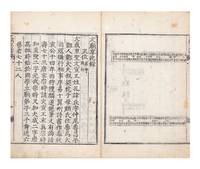
rif. 9430Four leaves of illus. 30 folding leaves. Large 8vo 305 x 208 mm. orig. yellow semi-stiff wrappers upper wrappers somewhat soiled both wrappers with some worming new stitching. Korea: 1765. First edition of this book published on royal command by King YÅngjo of ChosÅn. The book was compiled by Kim Kwi-ju 金龜柱 1740-86 the older brother of Queen Consort ChÅngsun 1745-1805. The royal Preface is furthermore written in Kim’s standard script calligraphy. Years after the compilation of this book factional intrigue under YÅngjo’s successor ChÅngjo led to Kim being exiled after which he soon died. Our book outlines sacrifices at the Confucian temple in Seoul including the KyesÅng å•“è–ç¥ and SongjÅl 崇節祠 shrines. The KyesÅng shrine built in 1669 was the site of sacrifices to the fathers of several Confucian sages including Confucius and Mencius. At the temple as a whole a number of Chinese and Korean Confucian sages and worthies were worshipped. The book contains illustrations outlining the layout of the shrines with the placement of the tablets for the various Confucian scholars marked with their names. The royal Preface is dated 1765. Ordering the compilation of a record of past exemplars apparently made the king reflect on his own character and actions. He wrote “when I with my shallow learning recite the writings of the sages and worthies but remain unable to learn the Way of the sages and worthies and when I admire the deeds of the sages and worthies but cannot act in their manner it is like knowing what something tastes like but not get to eat it or like knowing the road but being unable to follow it. Even though I might laugh at people of the past why would people of the future not laugh at me too” Minor worming mostly marginal towards end. See WorldCat 855527023 for a digital copy. unknown
rif. 9430Four leaves of illus. 30 folding leaves. Large 8vo 305 x 208 mm. orig. yellow semi-stiff wrappers upper wrappers somewhat soiled both wrappers with some worming new stitching. Korea: 1765. First edition of this book published on royal command by King YÅngjo of ChosÅn. The book was compiled by Kim Kwi-ju 金龜柱 1740-86 the older brother of Queen Consort ChÅngsun 1745-1805. The royal Preface is furthermore written in Kim’s standard script calligraphy. Years after the compilation of this book factional intrigue under YÅngjo’s successor ChÅngjo led to Kim being exiled after which he soon died. Our book outlines sacrifices at the Confucian temple in Seoul including the KyesÅng å•“è–ç¥ and SongjÅl 崇節祠 shrines. The KyesÅng shrine built in 1669 was the site of sacrifices to the fathers of several Confucian sages including Confucius and Mencius. At the temple as a whole a number of Chinese and Korean Confucian sages and worthies were worshipped. The book contains illustrations outlining the layout of the shrines with the placement of the tablets for the various Confucian scholars marked with their names. The royal Preface is dated 1765. Ordering the compilation of a record of past exemplars apparently made the king reflect on his own character and actions. He wrote “when I with my shallow learning recite the writings of the sages and worthies but remain unable to learn the Way of the sages and worthies and when I admire the deeds of the sages and worthies but cannot act in their manner it is like knowing what something tastes like but not get to eat it or like knowing the road but being unable to follow it. Even though I might laugh at people of the past why would people of the future not laugh at me too” Minor worming mostly marginal towards end. See WorldCat 855527023 for a digital copy. unknown books
1973rif. 2092902141600506Masterpiece publication 1973. Soft Cover. Fine. Size: 42.3x30.8 cm Number of books: 15 Masterpiece publication paperback
1968rif. 2081402109800259Not Available 1968. Soft Cover. Fine. Volume: 13 Not Available paperback
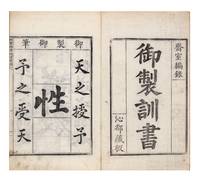
rif. 942941 folding leaves. Large 8vo 337 x 206 mm. orig. semi-stiff wrappers new stitching. Korea: Simdo æ²éƒ½ 1756. First edition and rare; WorldCat lists only one printed copy at Berkeley. This book of exhortations on good government with striking royal calligraphy was written by King YÅngjo or Yeongjo of ChosÅn 1694-1776 in 1756. At this time YÅngjo was commemorating the death of his father the previous king. According to Fang Chaoying 1908-85 YÅngjo then in his 65th year “could not foresee that he was to live twenty more years and so it appears that he was trying to justify himself in his own mind with regard to posterity as well as to the ancestors whom he expected to face any day” The Asami Library 115. YÅngjo offered three main principles for a king to follow: “to venerate Heaven to love the people and to treat the officials with respect” ibid. Large standard script characters written by the king himself are reproduced in the beginning of the book. The king’s brush records Confucian assertions such as “the following of human nature is called the Way / the cultivation of the Way is called instruction.” Accepting the Mencian dictum that human nature is inherently good the king continues: “I possess the good human nature / to realize the bright mandate of Heaven.” The main text of the book is reproduced in the handwriting of the important scholar-official SÅ MyÅng-ŭng or Seo Myeong-eung å¾å‘½è†º 1716-87. SÅ wrote in many genres and had a cosmopolitan outlook. For example he wrote a Preface to one of the major multilingual lexicographical works produced in ChosÅn in the 18th century see Söderblom Saarela “Mandarin over Manchu” 379-80. Very fine and fresh copy beautifully printed. References Fang Chaoying. The Asami Library: A Descriptive Catalog. Edited by Elizabeth Huff. Berkeley: University of California Press 1969. Söderblom Saarela Mårten. “Mandarin over Manchu: Court-Sponsored Qing Lexicography and Its Subversion in Korea and Japan.” Harvard Journal of Asiatic Studies 77.2 2017. unknown
rif. 942941 folding leaves. Large 8vo 337 x 206 mm. orig. semi-stiff wrappers new stitching. Korea: Simdo æ²éƒ½ 1756. First edition and rare; WorldCat lists only one printed copy at Berkeley. This book of exhortations on good government with striking royal calligraphy was written by King YÅngjo or Yeongjo of ChosÅn 1694-1776 in 1756. At this time YÅngjo was commemorating the death of his father the previous king. According to Fang Chaoying 1908-85 YÅngjo then in his 65th year “could not foresee that he was to live twenty more years and so it appears that he was trying to justify himself in his own mind with regard to posterity as well as to the ancestors whom he expected to face any day” The Asami Library 115. YÅngjo offered three main principles for a king to follow: “to venerate Heaven to love the people and to treat the officials with respect” ibid. Large standard script characters written by the king himself are reproduced in the beginning of the book. The king’s brush records Confucian assertions such as “the following of human nature is called the Way / the cultivation of the Way is called instruction.” Accepting the Mencian dictum that human nature is inherently good the king continues: “I possess the good human nature / to realize the bright mandate of Heaven.” The main text of the book is reproduced in the handwriting of the important scholar-official SÅ MyÅng-ŭng or Seo Myeong-eung å¾å‘½è†º 1716-87. SÅ wrote in many genres and had a cosmopolitan outlook. For example he wrote a Preface to one of the major multilingual lexicographical works produced in ChosÅn in the 18th century see Söderblom Saarela “Mandarin over Manchu” 379-80. Very fine and fresh copy beautifully printed. References Fang Chaoying. The Asami Library: A Descriptive Catalog. Edited by Elizabeth Huff. Berkeley: University of California Press 1969. Söderblom Saarela Mårten. “Mandarin over Manchu: Court-Sponsored Qing Lexicography and Its Subversion in Korea and Japan.” Harvard Journal of Asiatic Studies 77.2 2017. unknown books
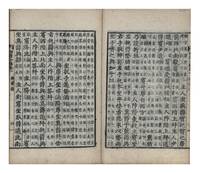
1797rif. 111991797. Woodblock-printed. 4 1 16 39; 40 33 2 folding leaves. Three kwÅn in two volumes. Small folio 341 x 216 mm. orig. semi-stiff patterned wrappers handwritten title on upper covers old stitching. HansÅng: Chujaso Preface dated 1797. Very rare Korean collection of community rituals K. hyangnye 鄉禮 compiled by and printed for the King of Korea. We find no copy in Korea and only three copies in WorldCat Berkeley Columbia and Harvard. The reign of King ChÅngjo of Korea r. 1776-1800 witnessed a shift in the sovereign’s role in relation to Confucian teachings. “ChÅngjo sought to formulate the sage-king as an active ruler who instructed his ministers rather than received instruction from them was directly involved in the administration of the state and exercised discretion when and how he in his sagely wisdom deemed fit.”–Christopher Lovins King ChÅngjo SUNY: 2019 p. 29. As the guardian and propagator of Confucian learning he oversaw various editorial and printing projects carried out by the royal publishing house the Chujaso 鑄字所. The compilation and publication of the Collected Community Rituals reflected King ChÅngjo’s belief that a king’s ritual transformation of his people must begin at the local level. The Collected Community Rituals opens with the royal edict dated 1797 followed by a list of community ritual records compiled throughout Chinese and Korean history. The bulk of the work is devoted to the rituals of the banquet and archery competitions followed by coming-of-age K. kwanrye 冠禮 and marriage rituals. Detailed interlinear commentaries were compiled by scholars of the Kyujanggak 奎章閣 the Royal Library of the Korean court under the leadership of Yi PyÅng-mo 1742-1806. Their names are listed at the end of volume two. The original printing used the chÅngyuja ä¸é…‰å— kabinja style of movable metal type of 1777 and copies were distributed to localities throughout Korea. They were also sent to regional governmental printing houses where they were cannibalized to produce woodblocks for further printing. Nice set preserved in a jil. Our copy also has prayers for ancestral mountain and land deities as well as instructions for offering rites all handwritten in black ink on the endpapers. Red leaf-shaped seals on the first leaf of both volumes read 逸民山水 . ⧠Asami Library 4.14. King ChÅngjo Hongjae chÅnsÅ 弘齋全書 in Han’guk munjip ch’onggan 韓國文集å¢åˆŠ digital access via krpia.co.kr. unknown
1797rif. 111991797. Woodblock-printed. 4 1 16 39; 40 33 2 folding leaves. Three kwÅn in two volumes. Small folio 341 x 216 mm. orig. semi-stiff patterned wrappers handwritten title on upper covers old stitching. HansÅng: Chujaso Preface dated 1797. Very rare Korean collection of community rituals K. hyangnye 鄉禮 compiled by and printed for the King of Korea. We find no copy in Korea and only three copies in WorldCat Berkeley Columbia and Harvard. The reign of King ChÅngjo of Korea r. 1776-1800 witnessed a shift in the sovereign’s role in relation to Confucian teachings. “ChÅngjo sought to formulate the sage-king as an active ruler who instructed his ministers rather than received instruction from them was directly involved in the administration of the state and exercised discretion when and how he in his sagely wisdom deemed fit.”–Christopher Lovins King ChÅngjo SUNY: 2019 p. 29. As the guardian and propagator of Confucian learning he oversaw various editorial and printing projects carried out by the royal publishing house the Chujaso 鑄字所. The compilation and publication of the Collected Community Rituals reflected King ChÅngjo’s belief that a king’s ritual transformation of his people must begin at the local level. The Collected Community Rituals opens with the royal edict dated 1797 followed by a list of community ritual records compiled throughout Chinese and Korean history. The bulk of the work is devoted to the rituals of the banquet and archery competitions followed by coming-of-age K. kwanrye 冠禮 and marriage rituals. Detailed interlinear commentaries were compiled by scholars of the Kyujanggak 奎章閣 the Royal Library of the Korean court under the leadership of Yi PyÅng-mo 1742-1806. Their names are listed at the end of volume two. The original printing used the chÅngyuja ä¸é…‰å— kabinja style of movable metal type of 1777 and copies were distributed to localities throughout Korea. They were also sent to regional governmental printing houses where they were cannibalized to produce woodblocks for further printing. Nice set preserved in a jil. Our copy also has prayers for ancestral mountain and land deities as well as instructions for offering rites all handwritten in black ink on the endpapers. Red leaf-shaped seals on the first leaf of both volumes read 逸民山水 . ⧠Asami Library 4.14. King ChÅngjo Hongjae chÅnsÅ 弘齋全書 in Han’guk munjip ch’onggan 韓國文集å¢åˆŠ digital access via krpia.co.kr. unknown books
rif. 2091502135500199Not Available N.A. Soft Cover. Fine. Size: B5 size Not Available paperback
rif. 889392.5; 95 folding leaves. Two vols. Small folio orig. yellow-brown patterned wrappers some soiling to wrappers old stitching. ChÅnju today’s Jeonju: 1795 or possibly later. A selection of 100 letters written by Zhu Xi 1130-1200 the great synthesizer of the philosophical school known as Neo-Confucianism. Zhu Xi who lived in southeastern coastal China far from the center of power became extremely influential in East Asia for centuries following his death. His interpretation of Neo-Confucianism a metaphysically argued philosophy of the self the family and the state became official orthodoxy in late imperial China and ChosÅn Korea promulgated largely through the civil service examination system. However there were challenges to its primacy from intellectuals especially from the 18th century onward. “In the opinion of many historians the Song’s preeminent philosopher Zhu Xi outshined Confucius himself. He was the only person in Chinese history apart from Confucius and Mencius whom the official hagiography addressed as Master” Kuhn The Age of Confucian Rule 103. Given Zhu Xi’s standing in Korea several collections of excerpts from his works were published beginning in the 16th century. On account of its authorship Royally Authorized Selection of One Hundred Letters by Zhu Xi became one of the most widely circulated such collections for the last century of the ChosÅn period. According to the court chronicle the culturally ambitious King ChÅngjo 1752-1800 himself made the selection on the basis of Zhu Xi’s collected works a voluminous oeuvre that numbered 2354 pieces of writing in one scholar’s recent count. Text-critical notes e.g. on place names personal names official titles and expressions that might be unfamiliar to Korean readers were then added by four high civil officials which were printed in the upper margin of the text. The book was finished on the 25th day of the 12th month of the 18th year of ChÅngjo’s reign Qianlong 59 which corresponds to 15 January 1795. While most of the 18th year corresponds to 1794 it is incorrect to date the book to that year. The book was first printed in Seoul with metal movable type — the so-called chÅng’yu cha ä¸é…‰å— set of type cast in 1777 the chÅng’yu year when ChÅngjo ascended the throne. Further editions were subsequently published at several provincial offices using woodblocks intended for wide dissemination among the educated elite. Our copy belongs to one of these provincial woodblock editions. The title-page says ŭlmyo wanyÅng kan’in ä¹™å¯å®Œç‡ŸåˆŠå° meaning that it was printed in 1795 the ŭlmyo year in the provincial government offices at ChÅnju Jeonju in what is now southern South Korea. However it is possible that the actual copy was struck later than that date as the blocks remained on the site. They were moved to the local official Confucian school in 1899 where they remain today. Fine set of a very rare book. Minor staining and soiling at beginning and end of each volume. ⧠WorldCat accession number 874756267. References Kuhn Dieter. The Age of Confucian Rule: The Song Transformation of China. Cambridge: Mass.: Harvard University Press 2011. unknown
rif. 889392.5; 95 folding leaves. Two vols. Small folio orig. yellow-brown patterned wrappers some soiling to wrappers old stitching. ChÅnju today’s Jeonju: 1795 or possibly later. A selection of 100 letters written by Zhu Xi 1130-1200 the great synthesizer of the philosophical school known as Neo-Confucianism. Zhu Xi who lived in southeastern coastal China far from the center of power became extremely influential in East Asia for centuries following his death. His interpretation of Neo-Confucianism a metaphysically argued philosophy of the self the family and the state became official orthodoxy in late imperial China and ChosÅn Korea promulgated largely through the civil service examination system. However there were challenges to its primacy from intellectuals especially from the 18th century onward. “In the opinion of many historians the Song’s preeminent philosopher Zhu Xi outshined Confucius himself. He was the only person in Chinese history apart from Confucius and Mencius whom the official hagiography addressed as Master” Kuhn The Age of Confucian Rule 103. Given Zhu Xi’s standing in Korea several collections of excerpts from his works were published beginning in the 16th century. On account of its authorship Royally Authorized Selection of One Hundred Letters by Zhu Xi became one of the most widely circulated such collections for the last century of the ChosÅn period. According to the court chronicle the culturally ambitious King ChÅngjo 1752-1800 himself made the selection on the basis of Zhu Xi’s collected works a voluminous oeuvre that numbered 2354 pieces of writing in one scholar’s recent count. Text-critical notes e.g. on place names personal names official titles and expressions that might be unfamiliar to Korean readers were then added by four high civil officials which were printed in the upper margin of the text. The book was finished on the 25th day of the 12th month of the 18th year of ChÅngjo’s reign Qianlong 59 which corresponds to 15 January 1795. While most of the 18th year corresponds to 1794 it is incorrect to date the book to that year. The book was first printed in Seoul with metal movable type — the so-called chÅng’yu cha ä¸é…‰å— set of type cast in 1777 the chÅng’yu year when ChÅngjo ascended the throne. Further editions were subsequently published at several provincial offices using woodblocks intended for wide dissemination among the educated elite. Our copy belongs to one of these provincial woodblock editions. The title-page says ŭlmyo wanyÅng kan’in ä¹™å¯å®Œç‡ŸåˆŠå° meaning that it was printed in 1795 the ŭlmyo year in the provincial government offices at ChÅnju Jeonju in what is now southern South Korea. However it is possible that the actual copy was struck later than that date as the blocks remained on the site. They were moved to the local official Confucian school in 1899 where they remain today. Fine set of a very rare book. Minor staining and soiling at beginning and end of each volume. ⧠WorldCat accession number 874756267. References Kuhn Dieter. The Age of Confucian Rule: The Song Transformation of China. Cambridge: Mass.: Harvard University Press 2011. unknown books