YŎNGJO, King of Korea 英祖Biblio.com
2127 risultati
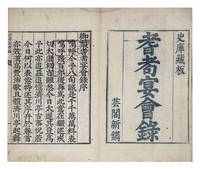
rif. 11384. 1 46 folding leaves. Small folio 346 x 227 mm. orig. yellow semi-stiff wrappers lightly rubbed title in manuscript on upper cover old stitching. HansÅng: Un'gak 1773. First and apparently only printing of the official record of "linked songs" composed at the royal banquet of elders on the occasion of King YÅngjo's r. 1724-76 80th birthday in 1773 printed the day after the banquet and presented to its guests. The title is not in WorldCat or KORCIS; we locate only two other copies both in Korea. In the intercalary third month of the 50th year of his reign King YÅngjo - the longest reigning monarch in ChosÅn history - held two birthday banquets within the KyÅnghŭigung 慶熙宮 palace complex. According to the colophon the first was a banquet of high-ranking officials held at the SungjÅng Hall 崇政殿 on the first day of the month. The second which took place a day later was a gathering of elders at the Kimsang Gate 金商門 "to reminisce about the events of the kingdom's past." The suggestion for these banquets came from the Grand Heir wangseson 王世孫 enthroned as King ChÅngjo in 1776 and was accepted by King YÅngjo only reluctantly. The high-ranking official SÅ MyÅng-ŭng å¾å‘½è†º 1716-87 who composed the colophon describes the festive banquet of elders as follows: "On this day the rain ceased and the sky cleared. A gentle breeze blew softly. Looking up at the throne one saw the King standing tall beneath the colorful canopies the table to his left and staff to his right. Looking down at the banquet hall one saw white-haired elders and toothless seniors their faces glowing amidst the delicacies. When the bells and drums were about to sound and the cups were not yet raised the elderly commoners delighting in this joyous gathering cast aside their staffs and rose to dance. Stooping and stumbling they advanced forward while shouting: 'May the King live a thousand years!'" King YÅngjo smiling at this sight composed a short verse that invoked the famous Song of Great Wind Ch. dafeng ge 大風歌 of Liu Bang 劉邦 256-195 B.C.E. the first king of the Han dynasty likewise written during an auspicious gathering of elders. He then asked the Grand Heir and other officials at the banquet to each compose a song echoing his own in three enneasyllabic lines ending with the sinographs sul 述 baek 百 and Åk 億 respectively. The sequence of "linked songs" thus composed - together with the names and positions of their authors - were collected and printed to ensure the longevity of their transmission. The colophon continues "King Gao of the Han in the prime of his life happily celebrated with the elders of his village. This was of course a common occurrence. Yet he did not know that throughout the four quarters of the realm ritual and music take precedence; instead he was preoccupied with recruiting fierce warriors.Now our sovereign achieving the seniority of Yao and Shun observes the flourishing rites of Yu and Xia. The sagely ruler honors the longevity of his subjects and his subjects likewise revere the longevity of the sage ruler. This is truly something unheard of among the rulers of the Han and Tang dynasties." SÅ MyÅng-ŭng believes that the format of linked songs which brought together King YÅngjo and his subjects through reciprocal "winds of transformation" K. p'unghwa 風化 elevated this Korean banquet above its various Chinese precedents and into closer proximity to the sagely rites of old. Writing on the transregional tradition of linked songs in East Asia Amy Y. Zhang observes the "ubiquitousness of linked verse as a potential means of constructing defining and negotiating community" and when adapted by the Korean monarchy it became "a way to cultivate harmonious relations with his subjects and to ensure continued prosperous rule"-Zhang "Writing Communities into Being: The Art of Linked Verse" PhD diss. Harvard 2025 pp. 243-44. Based on the presentation inscription on the front endpaper in our and another copy see below the woodblocks for the Record were likely carved overnight so that imprints could be distributed to guests of the banquet the next day "the third day of the intercalary third month of the 38th year of the Qianlong reign." The title-page states that the woodblocks were carved at Un'gak 芸閣 i.e. the kyosÅgwan 校書館 the royal printing house and kept within the royal archives K. sago å²åº«. Our copy was presented to Sin U-sang 申禹相 1730-99 the Assistant Director of the Ministry of War K. pyÅngjo chwarang 兵曹ä½éƒŽ whose name together with the song he had composed at the banquet appears on f. 36r of the Record. Facing the title-page and on the first leaf of the royal Preface is the Seal of Presentation K. naesa'in å…§è³œå° which reads sÅnsajigi 宣賜之記. The oldest of five seals of presentation used throughout ChosÅn history the sÅnsajigi seal appears in royal presentation copies from 1534 to 1778 as Lee & Song demonstrate in "A Study on Naesabon Preserved in Kyujanggak" in Journal of Korean Library and Information Science Society 43 no. 2. The title though recorded in traditional Korean bibliography is not in WorldCat or KORCIS. We locate only two other copies one held at the Academy of Korean Studies in SÅngnam call no. MF35-2211 and the other at the Sudang kot'aek ä¿®å ‚å¤å®… residence of the Yi clan in Yesan. The front endpaper of the Academy of Korean Studies copy is not digitized while the Sudang kot'aek copy bears a similar royal presentation inscription dated to the same day as our copy. It was presented to Yi Su-il æŽç§€é€¸ 1705-79 whose composition is recorded on f. 30r-v. Excellent copy a few leaves lightly stained on upper corner. unknown
rif. 38009901Korea late 18th-early 19th century 1780-1810. Eight color gouache pastel tinted maps ca. 57.5 x 90.1 cm.contemporary re-backing very solid clean examples complete set of all provinces hand-painted gouache manuscripts. RARE & OBSCURE . . . . A RARE & COMPLETE SET OF ANTIQUARIAN MANUSCRIPT KOREAN . . . YI PERIOD PROVINCIAL MAPS . . "P'ALTO CHIDO" OR "EIGHT PROVINCES MAPS" . . . DELUXE ELEPHANT FOLIO SIZE SHEETS . . . HAND-COLORED GOUACHE PASTELS . This is a very RARE & COMPLETE set of eight Korean provincial manuscript maps. Drawn circa 1780-1810 by an unsigned Korean cartographer. These maps are of historical importance giving place names isolating the time frame. . Painted on very thin finely hand-made mulberry-fiber tissue paper contemporary re-backed with a stiff hand-made paper. Beautifully hand-painted & colored in gouache pastels. . The record shows several reliable verities of manuscript maps showing the eight ancient Korean provinces. . Commonly these maps had no title cartographer's name date or other critical bibliographic colophon data. This is a common theme with Korean manuscript maps. . Political divisions of Korea are by and large mostly stable making name comparisons easier. . PROBABLE MAP TITLES INCLUDE: . a. The "SINJUNG-TONGGUK-YOJI-SUNGNAM:" "EIGHT SEPARATE MAPS EACH SHOWING ONE COMPLETE PROVINCE OF THE EIGHT KOREAN PROVINCES similar in intention to the "P'ALTO CHIDO." . The eight provinces were established during the Chosen dynasty 1392-1910 alternately and commonly called the Yi dynasty. . The eight provinces are from the north to south: . 1. Hamgyong 2. P'yong'an 3. P'yongyang 4. Kangwon 5. Hwanghae 6. Kanghwa 7. Kyongsang 8. Cholla'ungch'ong . During the Sejo reign 1455-68 Yang Songji made the first "P'Alt-do "P'ALTO CHIDO" type maps of the eight provinces this type and style became the "standard" for future examples. There after his style and format were copied by others for centuries. . b. A second version and style of the above eight provinces maps is called "TONGGUK CHIDO: MAP OF THE EASTERN COUNTRY i.e. KOREA" showing a compressed northern frontier along Manchuria the characteristic "CHONG CH'OK" style. . c. A third similar map: "P'ALDO-CHONGDO: A SINGLE MAP SHOWING THE EIGHT PROVINCES OF KOREA." . These maps are pictorially beautiful and artistically drawn in detail. Graphics expressing a primitive naive folk charm depicts prominent geological landscape features. Mountain ranges hills forests in green streams/rivers blues political district seats distinctively painted cartouches box-like in various differing colors for each province. Roads paddy coastal shore line & islands in blue tints with other features nicely colored. . There are a large number of name throughout each map all written in Hanzi traditional Chinese characters called "Hanja" in Korean as was the common practice at that time for Koreans. There are no Hangul characters at all. The Hanja identify navigational directions names of surrounding ocean harbors beaches geographical names city towns villages mountains rivers roads and the like. . Each of the eight maps illustrates a complete single province. Within each of the various political divisions and boundaries outlined and named. . RARITY OF KOREAN ANTIQUITIES: Antiquarian Korean examples are sparse when compared to items of the same period in China and Japan. Korean works are less than 10% of those created elsewhere. . Fewer Korean items were made survived and preserved. The attrition rate: bad weather unstable ancient mud building structures fires natural disasters earthquakes war and other factors diminished the remaining examples. . Those the numbers that come to marked are steadily reduced while the value continues to appreciate. Many never return to market when acquired by institutions or private collectors who eventually donate to museums. . DATING THESE MAPS: These were mostly undated. . There are three possible methods of dating. . a. BY PLACE NAME: there are details in the reference books about county seat names being colored or put in various kinds of 'boxes' on the map depending on that according to the resources approximate dates can be derived. . b. PAPER TECHNOLOGY & FIBERS: Koreans have been using hand-made mulberry bark and fiber paper from the Zhenguan period AD 627-649 printing Buddhist sutras by woodblocks on similar kinds of paper. . These two technologies papermaking and woodblock printing was transmitted to Japan around 700 AD. . Since that time both Koreans & Japanese have utilized mulberry paper Washi in Japanese to woodblock print and paint a large variety of items including maps books and single page works. . By comparing the paper of these maps with known dated printed Japanese books a very close approximate date can be derived. . These Korean map papers are nearly identical to dated woodblock-printed Japanese examples we have. It is therefore highly possible these maps were painted on hand-made mulberry paper from circa 1780-1810 period. . In ancient times sheet size was limited to a small size then joined to other sheets to create a large size single sheet. These maps are of that format. See McCune below where he states the kind of paper used which matches our examples. . CONDITION: Per McCune we summarize: as usual these maps were folded several times from their creation time so they could be safely stored and carried in small 'book' format in covers with a tied string. See McCune below. . Being painted on very fine & thin hand-made mulberry paper most all examples were eventually re-backed. Ours as typical have period re-backing using the same character hand-made mulberry fiber paper of a thicker quality. . They are well preserved however nevertheless as usual there remains some old original wear at the folds the expected light water stains dustiness with other typical very minor flaws for an item of this grand size being 200 years old. These do not detract from the overall excellent impression and stunning appeal. . RARITY: . The complete set is RARE! The work is nicely executed in a firm hand with artistic value illustrating artistically hills mountains and other features of the map pictorially. It is not only a map but a work of art. Tastefully colored in subtle pastels nice representation of water rives and sea. . Such early and beautifully artistic examples seldom come to market. . A RARE AND FRESH EXAMPLE NEVER BEEN ON THE MARKET IN THE LAST 120 YEARS ! . PROVENANCE: These items were acquired from a former missionary's estate who was stationed in Korea from circa 1900-1930's. They have been in this private collection since and have never been on the market. . Color scans are posted to our website. . REFERENCES: . TOOLEY Ronald V. et al.: Article: Shannon McCune: SOME KOREAN MAPS pp.70-102 with illustrations. McCUNE Shannon.: KOREAN MAPS OF THE YI DYNASTY KOREAN CULTURE Korean Consulate General L.A. Ca. Sept. 1983 pp.21-31 34 back cover color plate color & b.w. illustrated. . He discusses "P'ALTO CHIDO""EIGHT PROVINCES MAP" origins maps without scale and were copies of a Korean scholar named Won his title was: Haksaeng works based on Chong Ch'ok's 1390-1475 TONGGUK CHIDO MAP OF THE EASTERN COUNTRY then modified by Won to be the more typical "P'ALTO CHIDO" "EIGHT PROVINCES MAP" but in his new style. This new style clearly resembles our maps in layout format color of county seats and similar boxes around them and other critical details. KOREAN CONSUL GENERAL KOREAN CULTURE September 1983 pp.21-31 34 color map on back cover color and b.w. illustrated. . It was from these maps that the later versions similar to ours eventually emerged mostly by Imperial Order by the ".Yi Dynasty court specifically decreed that both magistrates and governors should prepare up-to-date maps of their territories udder their supervision." p.25. HARLEY J.B. ed. et al.: CARTOGRAPHY IN THE TRADITIONAL EAST AND SOUTHEAST ASIAN SOCIETIES. Ahead of Title: THE HISTORY OF CARTOGRAPHY Vol. 2 Book 2 an excellent article by Gari Ledyard: CARTOGRAPHY IN KOREA pp. 235-345239 figures 10.23 10.24 et al. NAKAMURA Hiroshi.: EAST ASIA IN OLD MAPS. . --. NIHON KO CHIZU TAISEI: GREAT COLLECTION OF OLD JAPANESE MAPS MONUMENTA CARTOGRAPHICA JAPONICA . --. OLD CHINESE WORLD MAPS PRESERVED BY THE KOREANS. Article in IMAGO MUNDI IV 1958. LEE Chan. CH'AN Yi.: OLD MAPS OF KOREA. Han'guk ko chido. By: Ch'an Yi Hong-gyu Che Han'guk Tosogwanhak Yon'guhoe. He discusses and illustrates a good number of similar examples. On pp.226-27 he outlines an early Yi Dynasty example of: THE MAP OF EIGHT provinces found in TONGGUK YOJI SUNGNAM Chong Sang-gi's Tongguk Chido. These manuscripts were on large paper one province per sheet. Many other fine related examples are illustrated & discussed. . --. OLD MAPS OF KOREA: HISTORICAL SKETCH. He traces the early origins of Early Yi dynasty1392-1910 Eight Provinces Map origins and progressions excellent lucid article with illustrations and references to Yi HOE's MAP OF EIGHT PROVINCES. Excellent essay on provincial maps. SHIN Michael D. ed.: KOREAN HISTORY IN MAPS: From Prehistory to the Twenty-First Century. British Museum similar examples cited: commons-wikimedia-org/wiki/Category:Room_67_British_Museum# /media/File:Map_of_the_Jeolla_Province_British_Library_c.27. f.14_fol.12_n02.jpg Library of Congress: Young Il Kim: dong-kookyu-do: A RECENTLY DISCOVERED MANUSCRIPT OF A MAP OF KOREA. Imago Mundi vol.21 1967 pp.31-49 illustrated. . . unknown
