2 946 résultats
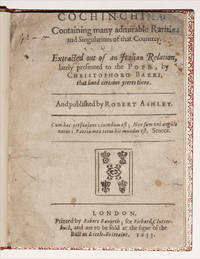
1633réf. 4531London: Robert Raworth for Richard Clutterbuck 1633. Hardcover. Very Good. 4to - over 9¾ - 12" tall. Tastefully bound in ruled red morocco interior gilt dentelles; title-page dusty and trimmed at upper & outer margins; repaired corner of prelims. Otherwise very good. Rare first edition of the first book on Vietnam in English an eyewitness account of the commerce government and cultural life of Cochin-China central Vietnam written by the Jesuit missionary Cristoforo Borri and first published in Italian in 1631.Borri begins by marking the kingdom's boundaries identifying it as a narrow strip of land between Laos and the South China Sea bordered to the north by Tongking and to the south by Champa. A discussion of the kingdom's fertile land and rich natural resources follows emphasizing the abundance of fruits nuts rice fish textiles domestic stock and "all other things requisite for the entertainement of a man's life." Silk is produced in such quantities that "the baser sort of people wear it dayly." Gold and silver mines abound and "the Wood and Timber of this countrey is the best of all the world." Having piqued his readers' curiosity the author goes on to describe Cochin-China's vibrant commercial climate declaring it free of the red tape and bureaucratic hostility that so often greeted European traders in East Asia.Borri's 1631 Relazione a Jesuit missions letter directed at his Catholic superiors and lay readers was already unusual among works in its genre for devoting a substantial part exclusively to non-religious content. Ashley the translator executed further changes of his own in order to render the present work more attractive to Protestant business interests-most notably by omitting the part where Borri testified to the struggle and success of his Jesuit missions particularly the conversion of Pulucambi province. The translation also cheerfully elides two disastrous episodes in recent European trade with Cochin-China: the 1601 massacre of 23 members of an envoy from the VOC and a similar massacre in 1613 of the crew of an English trading vessel. This attempt to coax England's notoriously skittish merchants into commerce with Cochin-China is also borne out by Ashley's choice of dedicatee: Maurice Abbot the newly-elected governor of the British East India Company. According to Pollard and Redgrave the work's last signature is in 3 rather than 4 because the unsigned title-page was printed as the 4th and final leaf.Cristoforo Borri 1583-1632 a Milanese astronomer lived in Cochin-China from 1617-1622 where he learned enough of the language to hear confession. By 1633 two years after its first appearance his Relatione had been translated into French German Dutch and English. This is the first copy to appear on the market since 1988 Christie's sale of John Fleming 11.08.88.STC 1504; Lach.III v. 3 p. 1250-1266; Dror & Taylor Views of 17th C Vietnam pp. 66. Not in Löwendahl who nonetheless records translations in French German and Dutch. Robert Raworth for Richard Clutterbuck hardcover
réf. H87342 pp written on medium sized notebook sheets. "Dear Unk I'm sorry that I haven't written for awhile but I've been pretty busy lately. Right now I'm on CQ. It's pretty easy. All yuou do is sit in our orderly room all night and monotor radio transmissions and telephone calls. I'm getting a new dog. The Vet thinks Pinger is to old and can't keep the pase. I'm getting one of my friends dogs. This guy was Medivaced out of here after he was stabbed in the chest by some gook downtown. One of my buddies down here in another unit got me some camoflaged fatigues. These would really be great for bow hunting. I hope I can get a few sets of these. The hard part is getting them back into the states. Your not allowed to take them back. Pinger is getting shi9pped back to Long Binh tomorrow. Poor dog. I really feel sorry for that animal. One of the corporals who's going back home on special leave is taking her. For the last three days not counting tonite we were expected to gret hint. There expecting anything from May 1st till at least the 20th. Are you still taking it easy. Better watch out you don't get lazy. Next year I'll keep you busy. Me and Denny will shoot another hole in your garage door just for something to do. Well Unk I hate to cut this short but I've got a few minor things to get done ASAP. I'll write again as soon as possible. Take care. Your nephew Joey. PS: ASAP means 'As soon as possible.' unknown
1966réf. 73196U. S. Government Printing Office 1966. Presumed First Edition First printing. Wraps. Good. 2 ii 169 3 pages. Illustrations. Diagrams. Maps. 5 inches by 3.75 inches. Cover has some wear and soiling. Name in ink on front cover. Spine has small tears. U.S. Military Assistance Command Vietnam MACV was a joint-service command of the United States Department of Defense. MACV was created on 8 February 1962 in response to the increase in United States military assistance to South Vietnam. MACV was first implemented to assist the Military Assistance Advisory Group MAAG Vietnam controlling every advisory and assistance effort in Vietnam but was reorganized on 15 May 1964 and absorbed MAAG Vietnam to its command when combat unit deployment became too large for advisory group control. MACV was disestablished on 29 March 1973. The first commanding general of MACV COMUSMACV General Paul D. Harkins was also the commander of MAAG Vietnam and after reorganization was succeeded by General William C. Westmoreland in June 1964 followed by General Creighton W. Abrams July 1968 and General Frederick C. Weyand June 1972. Summarized in this handbook are certain basic techniques and procedures which have evolved out of several years of combat operations against the enemy. The guidance was to increase the effectiveness of U.S. forces and preclude a repetition of past mistakes. Chapters include information on the Republic of Vietnam the Viet Cong tactics and techniques and combat support. U. S. Government Printing Office paperback
1969réf. 67474South Viet Nam: Giai Phong Editions 1969. Presumed first edition/first printing. Wraps. Good. 66 pages. 26 cm. Music and lyrics to "Let's Liberate the South". Stamp of former owner on fep. Cover has some wear and soiling. From Wikipedia: "The Provisional Revolutionary Government of the Republic of South Vietnam or PRG was formed on June 8 1969 as an underground government opposed to the South Vietnamese government of President Nguyen Van Thieu. Delegates of the National Liberation Front the Vietcong as well as several smaller groups participated in its creation. The PRG was recognized as the government of South Vietnam by most communist states. It agreed to the 1973 Paris Peace Treaty as a separate party. It became the provisional government of South Vietnam following the military defeat of the Army of the Republic of Vietnam on April 30 1975. On July 2 1976 the PRG and North Vietnam merged to form the Socialist Republic of Vietnam.Predating the PRG was the Alliance of National Democratic and Peace Forces made up of anti-government forces and headed by Trinh Dinh Thao. The Alliance were a collection of individuals who wanted a new South Vietnamese Government but disagreed with the ever present Northern Communist presence. There had been talk of setting up an Alliance as early as 1966 but the South Vietnamese Intelligence had arrested an anti-government organizer Ba Tra. Ba Tra gave the South Vietnamese government extensive information on anti-government forces working in the city. This setback was compounded by his identification of one of the key cadre in the financial division. Under torture Ba Tra identified more figures in the underground. These were then rounded up. By 1967 the entire Saigon organization had been sent further underground. The Tet Offensive during 1968 triggered a wave of oppression forcing many people into the jungle. These people businessmen middle class doctors and other professionals started The Alliance. The then-new American president Richard Nixon started a process of Vietnamization to allow the American to withdraw from Vietnam. One of the tenets of Vietnamization was responsible government in South Vietnam. To prevent the Americans from installing their own government a conference was held on June 6 8 1969 off Route 22 in Cambodia's Fishhook area. The Alliance as well as other groups met and formed the Provisional Revolutionary Government on June 8 1969. According to Justice Minister Truong Nhu Trang the new group's main purpose was to help the Vietcong "acquire a new international stature." There were delegates from the NLF the Alliance of National Democratic and Peace Forces the People's Revolutionary Party the South Vietnamese communist party and "the usual assortment of mass organizations ethnic groups and geopolitical regions." "South Vietnam is independent democratic peaceful and neutral" according to one banner displayed prominently at the convention. The PRG reflected a number of nationalist anti-imperialist and communist political viewpoints including those of the Vietnam Workers Party the North Vietnamese communist party. Following the military and political results of the 1968 Tet Offensive and related military offensives in the South in which the Vietcong suffered serious military losses the PRG was envisioned as a political counter-force that could influence international public opinion in support of national independence and in opposition to the United States and the Republic of Vietnam. The declared purpose of the PRG was to provide a formal NLF governmental structure and enhance its claim of representing "the Southern people". Included in this strategy was the pursuit of a negotiated settlement to the war leading to reunification organized during the initial phase of Vietnamization. During the period 1969-1970 most of the PRG's cabinet ministries operated near the Cambodia border. Starting on March 29 to late April 1970 the South Vietnamese army and Cambodian government forced the PRG to flee deep into Cambodia. The stressful escape caused many of the PRG officials such as Truong Nhu Tạ ng to need extensive medical furloughs. Giai Phong Editions paperback
1972réf. 67771Saigon Republic of Viet-Nam: Ministry of Foreign Affairs 1972. Presumed first edition/first printing. Wraps. Good. Format is approximately 8.25 inches by 10.5 inches. Unpaginated by 32 pages plus covers. Decorative cover.with some color. Illustrations Maps color. This contemporary propaganda material is ephemeral and relatively few copies have survived in private hands in the more than four decades since it was published. From Wikipedia: "South Vietnam officially the Republic of Vietnam was a state which governed southern Vietnam until 1975. It received international recognition in 1949 as the "State of Vietnam" 1949-55 and later as the "Republic of Vietnam" 1955-75. The term "South Vietnam" became common usage in 1954. South Vietnam's origins can be traced to the French colony of Cochinchina a subdivision of French Indochina. After World War II the Vietminh led by Ho Chi Minh proclaimed the establishment of a Communist nation in Hanoi. In 1949 non-communist Vietnamese politicians formed a rival government in Saigon led by former emperor Bao Dai. Bao Dai was deposed by Prime Minister Ngo Dinh Diem in 1955 who proclaimed himself president after a referendum. After Diem was deposed in a military coup in 1963 there was a series of military governments. General Nguyen Van Thieu led the country from 1967 until 1975. The Vietnam War began in 1959 with an uprising by Viet Cong forces. Fighting climaxed during the Tet Offensive of 1968 when there were over 1.5 million South Vietnamese soldiers and 500000 U.S. soldiers in South Vietnam. Despite a peace treaty concluded in January 1973 fighting continued until the North Vietnamese army overran Saigon on 30 April 1975." This document from the Ministry of Foreign Affairs was aimed as the English-speaking audience was was aimed at rallying support against the North Vietnamese onslaught. Had it not been for the U.S. Air Force and Navy the Vietnam War might have ended in the spring of 1972 with North Vietnamese tanks in the streets of Saigon. On March 29 1972 fourteen North Vietnamese divisions backed by more than three hundred tanks crossed the Demilitarized Zone into South Vietnam. It was an assault every bit as ferocious as the Tet Offensive in 1969 and perhaps even more so: where Tet had been an uprising by Viet Cong guerrillas backed by regular North Vietnamese troops the Easter Offensive of 1972 was a blitzkrieg a conventional mechanized assault by troops well-equipped with armor artillery and antiaircraft weapons. Several North Vietnamese Army or NVA divisions crossed the DMZ into the northern tip of South Vietnam. Other forces struck from their bases in ostensibly neutral Cambodia into the southwest part of South Vietnam perilously close to Saigon. Unlike Tet the South Vietnamese army or ARVN would not have U.S. ground troops fighting beside them or instead of them. American advisers could assist the South Vietnamese but with America in the midst of withdrawing its ground troops and the American public tired of casualties ground combat units would not be committed to the battlefield. The ARVN would have to fight its own battle. The key northern border town of Quang Tri fell and the NVA advanced to the gates to the vital city of Hue. The ARVN and South Vietnam were in trouble. Then salvation came from the skies. Airpower had always been a key factor—actually the key factor—factor in America's favor during the war in Indochina. But this time it was the only politically feasible means by which the United States could aid South Vietnam in 1972. By that time the American air fleet in Southeast Asia had dwindled to about eight hundred combat aircraft in Vietnam and Thailand including two U.S. Navy carrier air wings. Illustrating the flexibility of airpower by the end of May an additional four hundred Air Force fighters had arrived plus four more carriers. Most significantly the aerial armada included more than two hundred B-52s. Ministry of Foreign Affairs paperback
1999réf. 36499Washington DC: National Academy Press 1999. very good. 24 cm 611 tables references appendices index front board slightly soiled. National Academy Press unknown
réf. 8308Both items by 'FOLKSINGERS FOR FREEDOM IN VIETNAM/BROADSHEET KING 1967'. Excessively scarce survivals with no copies of either item appearing on COPAC or WorldCat. Both are printed on one side of a leaf roughly 25 x 20 cm. In fair condition with light creasing to extremities. Item One on grey paper with illustration by Audrey Seyfang: 'Oh Brother did you weep words and music by Ewan MacColl'. Four verses the first reading: 'Disc of sun in the belching smoke Blazing huts where children choke Burning flesh and blackened blood Charred and blistered like smould'ring wood.' Item Two on grey paper with illustration by 'Catchpole': 'YANKEE DOODLE words: Ewan MacColl'. Nine verses the first reading '1. Yankee Doodle came to town H-bombs in his pocket Says "Chum if you don't toe the line: I'll blast you with a rocket!" Chorus: YANKEE DOODLE UNCLE SAM BATMAN ALSO SUPERMAN KNOWN FROM HERE TO VIET-NAM AS YANKEE DOODLE DANDY.' Concludes with reference to the British prime minister of the time 'And as he kills dear Mr. Wilson Murmurs little speeches.' According to Karl Dallas Morning Star 16 November 2007 it was he who 'first mooted the idea' of an anti-Vietnam War 'campaign in the folk scene' with the 'singers' group' being formed by Dallas in conjunction with Ewan MacColl and Gordon McCulloch. Both items by 'FOLKSINGERS FOR FREEDOM IN VIETNAM/BROADSHEET KING 1967'. unknown
1977réf. 044863NAM POWs. very nice copy; larger-format . Near Fine. Hardcover. 1st Edition. 1977. NAM POWs hardcover
1985réf. 134155Canberra: Australian Govt. Pub. Service 1985 8 volume set. The covers have minor shelf wear. The edges of the books have minor spotting and shelf wear. Books listed here are not stored at the shop. Please contact us if you want to pick up a book from Newtown. Paper Back. Very Good. Size F: 9"-10" Tall 228-254mm. Australian Govt. Pub. Service paperback
1974réf. 5000339Washington: National Academy of Sciences 1974. Bound in stiff green wraps stamped in black and dark green. A handsome tight copy of this massive book 275 pages with eight maps in the rear pocket as called for. Scarce in this protected condition. . First Edition. Soft Cover. Very Good /No Jacket. 4to - over 9¾" - 12" tall. National Academy of Sciences Paperback
1966réf. 728501PN. New. 1966. Soft Cover. Date is original print. This is a reprint edition. . PN paperback
1969réf. 736898PN. New. 1969. Soft Cover. Date is original print. This is a reprint edition. . PN paperback
1978réf. 756761PN. New. 1978. Soft Cover. Date is original print. This is a reprint edition. . PN paperback
1963réf. 723161PN. New. 1963. Soft Cover. Date is original print. This is a reprint edition. . PN paperback
1969réf. 736528PN. New. 1969. Soft Cover. Date is original print. This is a reprint edition. . PN paperback
1969réf. 737556PN. New. 1969. Soft Cover. Date is original print. This is a reprint edition. . PN paperback
1969réf. 737551PN. New. 1969. Soft Cover. Date is original print. This is a reprint edition. . PN paperback
1965réf. 726082PN. New. 1965. Soft Cover. Date is original print. This is a reprint edition. . PN paperback
1965réf. 727661PN. New. 1965. Soft Cover. Date is original print. This is a reprint edition. . PN paperback
1967réf. 731106PN. New. 1967. Soft Cover. Date is original print. This is a reprint edition. . PN paperback
1971réf. 742074PN. New. 1971. Soft Cover. Date is original print. This is a reprint edition. . PN paperback
1966réf. 730598PN. New. 1966. Soft Cover. Date is original print. This is a reprint edition. . PN paperback
1967réf. 732194PN. New. 1967. Soft Cover. Date is original print. This is a reprint edition. . PN paperback
1963réf. 721264PN. New. 1963. Soft Cover. Date is original print. This is a reprint edition. . PN paperback
1971réf. 742381PN. New. 1971. Soft Cover. Date is original print. This is a reprint edition. . PN paperback

