1,521 results
1935ref. 9030684New York: Macmillan 1935. 1st. Hardcover. Very good. Translated by Alec Brown. Bound in publisher's original blue cloth with spine and cover stamped in white. Illustrated with forty photographs drawings maps and diagrams in black-and-white. Moderate wear and fading to the extremities of cover. 6 1/4 x 9 1/4 inches. 324 pages. Macmillan hardcover books
1807ref. 83011807. MIRANDA EXPEDITION. The Trials of William S. Smith and Samuel G. Ogden for Misdemeanours had in the Circuit Court of the United States for the New-York District in July 1806 . By Thomas Lloyd Stenographer. New York: I. Riley and Co. 1807. xxxiii 3 287 p. Contemporary mottled sheep very skillfully rebacked in period style retaining original spine label. Occasional light browning else a fine copy. The trial of Smith and Ogden for organizing and underwriting the expedition of Francisco de Miranda from New York to South America to overthrow the Spanish government there and to separate the Spanish colonies from the mother country. unknown books
1857ref. 375531New York: G. P. Putnam & Co 1857. One of 150 copies of the unofficial issue. Text: 4 777 1pp. Atlas: 100 engraved plates. 4pp. 2 vols. 4to text and folio atlas. Modern half russet morocco and cloth covered boards. Heavy foxing to the plates in the atlas small chip at fore-edge of atlas title minor dampstaining at lower outer corner of plates tape repair to final leaf of text. Provenance: University of Chicago ink stamp and blindstamp deaccession stamp. One of 150 copies of the unofficial issue. Text: 4 777 1pp. Atlas: 100 engraved plates. 4pp. 2 vols. 4to text and folio atlas. A very rare set of the text and plates of Asa Gray's report on the botany of the Wilkes Expedition illustrated with 100 engraved plates of plants collected by the first scientific expedition conducted by the United States Navy. The United States Exploring Expedition circumnavigated the globe under the command of Charles Wilkes between the summer of 1838 and the summer of 1842. The Wilkes Expedition "was the first American scientific expedition of any size charged to 'extend the bounds of Science and promote the acquisition of knowledge' and was one of the most ambitious Pacific expeditions ever attempted" Forbes. The Expedition represents "the first governmental sponsorship of scientific endeavor and was instrumental in the nation's westward expansion. Specimens gathered by expedition scientists became the foundation collections of the Smithsonian Institution. Significant American contributions in the fields of geology botany conchology anthropology and linguistics came from the scientific work of the expedition. Wilkes's evaluations of his landfalls influenced later U.S. positions in those areas" DAB. The Narrative of the expedition was first published in 1844 but the separately-issued scientific reports and atlases for the United States Exploring Expedition were published over a long period of time; the Expedition returned in 1842 and the final volume did not appear until 1874. Because of their limited issue and historical importance all the separately-issued scientific reports and atlases from the Expedition are highly sought after though they very rarely appear on the market. Gray's report is specifically on the "phanerogamia" seed plants or flowering plants collected during the four year voyage. The history of the publication of the many scientific reports that resulted from the Wilkes Expedition is filled with difficulties in their writing and production and Gray's botanical report is exemplary of these difficulties. "The preparation of the reports on the botanical collections brought back by the Expedition proved to be one of the worst headaches encountered during the course of the entire publication" Haskell. Asa Gray was one of the most acclaimed botanists of his era and he was the original selection as botanist for the Wilkes Expedition. In the time between his appointment and the expedition's departure in 1838 however Gray accepted the position of Professor of Botany at the University of Michigan and so he resigned from Charles Wilkes's command and was replaced by William Rich. Rich completed his botanical report in 1846 and submitted it to Wilkes who found it wholly unacceptable. Eventually Asa Gray was asked to study the specimens gathered on the expedition and to produce this report which he agreed to do and which he worked on for three years. Gray initially planned for a two-volume text report and an atlas including 300 folio plates. In the end the text was issued in one large volume and the atlas contained 100 plates drawn by the talented botanical artist Isaac Sprague. The botanical specimens described in the text and depicted in the atlas come primarily from throughout the Pacific Rim including the islands of the South Pacific Hawaii Singapore the Philippines Australia New Zealand and several countries in South America - predominantly Brazil and Chile. The total number of texts published from the voyage of the United States Exploring Expedition is massive - a total of twenty-four volumes of narrative and scientific reports. Asa Gray's botanical report is designated as Volume XV. As with Charles Wilkes's narrative account of the United States Exploring Expedition Gray's botanical report was issued in "official" and "unofficial" editions. The official edition of Gray's report was published by Sherman & Son of Philadelphia in an edition of 100 copies each of text and plates and the unofficial edition was issued by Putnam of New York in an edition of 150 copies again as quarto text and folio plates. Either edition is exceedingly rare in commerce as they were mostly intended for presentation or for placement in research libraries. Sabin writing in 1875 comments that "owing to some mistake a large number of copies of the Atlas were sold by auction unbound and without the letterpress the result is that odd volumes are comparatively common - whole sets are scarce." Actually the text or atlas individually or the two volumes together are exceedingly rare in the market. A highly desirable scientific report from the Wilkes Expedition with an atlas of 100 attractive plates with text by the noted botanist Asa Gray. Haskell 61 and 63; Rosove 354-10.A2 and 355-6.A2 both text and atlas described as "rare"; Sabin 28368; Meisel II pp.668-669; Nissen 2153; Stafleu 2129 2130; Pritzel 3529; Forbes 1993. Not in Spence G. P. Putnam & Co unknown books
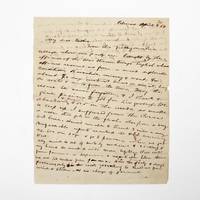
1854ref. 369733Palmas Panama 1854. 2pp. single 4to sheet. With: Carte-de-visite photograph of Mayo signed and inscribed to his sister on verso. Folds minor separations. 2pp. single 4to sheet. With: Carte-de-visite photograph of Mayo signed and inscribed to his sister on verso. Seeking a low-level train or canal route to bridge the Atlantic and Pacific Oceans in late 1853 President Franklin Pierce ordered a U.S. Naval exploring expedition to participate in an international attempt affiliated with a venture by the Atlantic and Pacific Junction Company. Although ships from Great Britain New Grenada and the United States were involved the principle overland portion of the expedition through 40 miles of dense jungle would be led by Lieutenant Isaac G. Strain who had previously led exploring expeditions in Brazil Baja California and Chile. With a party of 27 officers and men and including the author of the present letter they entered the jungle on January 20 1854. Problems began almost immediately. While puting ashore a boat was swamped and a portion of the party's provisions lost. Next the route Strain had been tasked with following contained no gap in the cordillera as had been previously believed. Led through the jungle by several groups of indigenous people the promise of a few days hike turned into months of wandering in the jungle before being abandoned by the guides. Subsisting on plantains and bananas and drinking river water Stain divided his men with an advance party striking out to seek rescue. On March 9 forty-nine days after starting from Caledonia Bay Strain and his advance party reached Yavisa; it would be another nearly three weeks before the main body was rescued but not before at least five had died of starvation or disease. Sometimes compared with the trials of the crew of the Essex or the members of the Donner Party the men on the Darien expedition endured extreme harship and resorted to unspeakable things. This remarkable letter was written by one of the expedition's survivors shortly after his rescue and return to civilization. George Upshur Mayo 1834-1896 was born into a prominent family in Norfolk VA. He attended the Virginia Military Institute served as an assistant engineer on the Strain Expedition was involved in the United States Geodetic Survey and was later a major in the Confederate Army. Here he writes: "My dear father From this filthy native village where our party are brought by the officers of the war steamer Virago English whose officers rescued us from a most deplorable condition starvation misery & want for about 70 days without bread or meat living on roots & nuts from the trees. May the rescue be never forgotten & I thank & give praises to God for his goodness. We abandoned & buried 4 or 5 in the woods as unable to keep up. I suffered from the cusano a worm that gets in the flesh also from a very bad knee. Almost unable to travel 3 miles a day. Unfavorable reports reached the U.S. concerning us. We are safe & go to Panama when we get well. My mind is out of sorts by medicine & sickness & my hand too weak to write more legibly. Will write from Panama or Aspinwall a respectable letter there. We are 100 miles from Panama. Had the party 8 days provisions only in the woods yet nothing to shield us from wind & storm & no change of garments. The suffering was intense & the rescue came at the most dreadful & important for our safety. I with 3 others on the river bank washing at sundown when the canoes came in sight. Captain Strain had no pants or underdraws to protect him from the briars & vermin. God be praised for rescue. Love to Annie. . . . In all probability will meet the Cyane at Aspinwall." A remarkable first-hand account of a desperate struggle for survival. unknown books
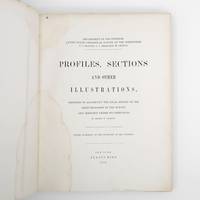
1872ref. 373132New York: Jules Bien 1872. First edition. Limited to 100 copies. 65 lithographed plates many folding preceded by 4pp. text. 4to. Original green cloth boards upper cover lettered in gilt rebacked endpapers renewed. Dampstaining. First edition. Limited to 100 copies. 65 lithographed plates many folding preceded by 4pp. text. 4to. This book was prepared to illustrate the work of the Hayden survey. It contains numerous panoramic illustrations many on folding sheets depicting sites in Wyoming Utah Colorado and Montana. This report contains the bulk of Henry Wood Elliott's art work for the Hayden Survey see preceding entry most of which was published nowhere else. These images are important because of their scientific contribution to several fields historical significance documentation of the Hayden expedition and their beauty and attention to detail. Elliott's illustrations were among the early images of many locations in the new territories of the West. From an edition of 100 copies issued in advance of the text. The Prefatory Note states p. 3: "A small edition of one hundred copies of the Profiles and Sections are issued in advance of the text for the purpose of placing them in the hands of the principal geologists in this country and in Europe. The first issue of two thousand copies in colors will be published with descriptions in about one year." We find no evidence that a subsequent edition in color was ever printed and it is stated of the present work in the Checklist of United States Public Documents 1789-1909 Washington: Government Printing Office 1909: "Originally intended to illustrate v. 4 of quarto series of reports but never thus used." The Hayden Survey was the most important of the four major government surveys of the American West undertaken after the Civil War the others being Powell King and Wheeler. Collectively these surveys filled in the map of the United States using accurate scientific methods to chart the land and investigate not only its geology but natural resources wildlife and plants as well. Schmeckebier Catalogue and Index of the Publications of the Hayden King Powell and Wheeler Surveys p. 32 #3 Jules Bien unknown books
1857ref. 324349New Haven 1857. Separately-issued offprint from the American Journal of Science and Arts 2nd series Vol. xxiv July 1857. 21-38 pp. plus folding map. 8vo. Period plain green wrappers stitched. Separately-issued offprint from the American Journal of Science and Arts 2nd series Vol. xxiv July 1857. 21-38 pp. plus folding map. 8vo. "Redfield's last contribution to meteorological science was a memoir upon the cyclones or typhoons of the north Pacific Ocean prepared at the request of Commodore Perry to accompany his Narrative of the United States Expedition to Japan; and was printed in the second volume of that work . He showed that the hurricanes of the Pacific followed the same general laws as those of the Atlantic and traced the paths of several remarkable storms among which was one of great force encountered by the steamer 'Mississippi' one of the vessels of Commodore Perry's squadron on route from Simoda to the Sandwich Islands in October 1854" Recollections of John Howard Redfield p. 302. Page 37 includes a description of the Kona or southerly winds of Hawaii as well as the effects of cyclones on the Hawaiian islands. Following its publication within Perry's Narrative in 1856 the work was issued in a slightly more condensed form within the July 1857 issue of the American Journal of Science and Arts. The present separately-issued offprint from the AJSA is the only separately-issued edition of the work. Scarce. Sabin 68512. Not in Forbes unknown books
ref. 50306For the lot of approximately 250 items $6000. a Correspondence with various government officials hunting guides and others involved with preparing and carrying out the trip including14 letters to Furlong typed and autograph one accompanied by four photographs of members of the expedition with trophies; five retained copies of letters from Furlong to the correspondents four telegrams seven typed and manuscript recapitulations of various aspects of the trip e.g. titles for the "Dance of the Nandi" film and a three page typed press release on the expedition dated Nairobi 27 March 1930 accompanied by a photograph of Furlong and two bearers with a leopard he has killed. b Two hunting licenses issued by the Uganda Protectorate to Furlong 22 April 1930 one "For a First Elephant" the other a "Visitor's Full Game License." c Three maps period road map of Kenya and Uganda published by Bullows and Roy for the Royal East Africa Automobile Assn.; Map Showing Cairo-Mombasa Route published by the Sudan Survey Dept Khartoum 1929; and a period National Geographic Society map of Africa. d An account book narrow 12mo 19 pp. 22 March - 8 June 1930 and approximately 125 receipts most partly printed for a wide range of services and material necessary for the trip. e 21 photographs in addition to those mentioned above many picturing Furlong in the field with his rifle and trophies some with Furlong's notations on verso and 34 unused photo postcards featuring tribesmen animals and scenery of East Africa. f 42 promotional pamphlets ca. 1925-1934 for the various parts of Africa along Furlong's route 36 of which are unrecorded on OCLC. The pamphlets were issued by African railway companies and governmental agencies outfitters e.g. Thomas Cook and "Safari Africa Limited" London ship lines and other travel agencies and taxidermy concerns. g A wooden carved string instrument from the Para Mountains in present day Tanzania with Furlong's ownership label "Col. Wellington Furlong / c/o Safariland Ltd. / Musical Instrument / Para Mountains" still attached; the instrument is shaped like a hollowed-out bread tray 27 x 7 1/2 inches three holes in the shape of crosses in the bottom six strings stretched across the opening. Furlong 1874-1967; American explorer army officer author artist and photographer embarked on this big game expedition in 1930 partly as an effort to recover relics of Sir Henry M Stanley in East and Central Africa. Gateway to the Sahara New York 1909 is among several books he published. A member of the Explorers Club he was the first American to explore the interior of Tierra del Fuego 1907-1908. Most of his personal papers are held by the Stefansson Collection at Dartmouth. unknown books
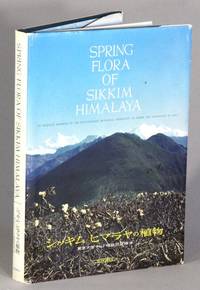
1963ref. 71837Osaka: Hoikusha Publishing Co. Ltd 1963. First edition large 8vo pp. 4 169 3; text in Japanese and English; text illustrations throughout many in color; original full blue cloth; previous owner's bookplate once tipped on the title page but now loose; very good sound and clean. From the preface: "The Indo-Japanese Botanical Expedition was sent to West Sikkim and the Darjeeling and Kalimpong districts in spring of 1960. It has been known that the flora of this region is very rich and is similar to that of Japan. So the main object of our expedition is to make more clear the botanical relationship between the region and Japan. The photographs compiled in this book were taken during the Expedition by the Japanese members under various difficult conditions excepting a few ones taken by Hara in March of 1963. Hoikusha Publishing Co., Ltd unknown books
1987ref. 69219Beijing: Science Press 1987. 8vo pp. 4 vi 510; printed from typescript; graphs maps tables illustrations throughout; previous owner's bookplate otherwise near fine in original blue cloth stamped in gilt on spine. "From May to September 1981 the Sino-W. German Joint Expedition to the Qinghai-Xizang Plateau made multi-disciplinary investigations of glaciology permafrost climatic geomorphology geology surveying and remote sensing in the Anyêmaqên Mountains Qilian Mountains and a part of the Kunlun Mountains. A symposium on the Qinghai-Xizang Plateau was held at Braunschweig in April 1982 . and scientists from West Germany China Switzerland and Austria took part in it. The following five topics relating to the Qinghai-Xizang Plateau were discussed: 1. Glaciers and glacier oscillations; 2. Ice and frost regions; 3. Geomorphological types; 4. Vegetations weather and climate; 5. Recent and ancient alpine climate in Asia" Preface. Science Press unknown books
1799ref. biblio160First French edition of Bartram's Travels which chronicled his explorations of the southern British colonies in North America from 1773–1777 2 volumes. 457 pages with frontispiece engraved portrait by Bovinet Mico Chlucco Grana King of the Seminoles and one folding plate; 436 pages without title with large folding map by J.B. Poirson engraved by Alexandre Blondeau and folding plate. Octavo 8 1/4" x 5 1/4" bound in half leather with six spine compartments with red and black labels in gilt over original marbled boards. Translated by Pierre Vincent Benoist. Sabin 3871; Palau 251346; Howes B223; Field 94 First French edition. William Bartram was an American naturalist. The son of the naturalist John Bartram. As a boy he accompanied his father on many of his travels to the Catskill Mountains the New Jersey Pine Barrens New England and Florida. In 1773 he embarked upon a four-year journey through eight southern colonies. Bartram made many drawings and took notes on the native flora and fauna and the native American Indians. In 1774 he explored the St. Johns River where he had memorable encounters with aggressive alligators and also visited a principal Seminole village at Cuscowilla where his arrival was celebrated with a great feast. He met Ahaya the Cowkeeper chief of the Alachua band of the Seminole tribe. When Bartram explained to the Cowkeeper that he was interested in studying the local plants and animals the chief was amused and began calling him Puc Puggy the flower hunter. Bartram continued his explorations of the Alachua Savannah or what is today Paynes Prairie. William Bartram wrote of his experiences exploring the Southeast in his book Travels through North & South Carolina East & West Florida the Cherokee Country the Extensive Territories of the Muscogulges or Creek Confederacy and the Country of the Chactaws Containing an Account of the Soil and Natural Productions of Those Regions Together with Observations on the Manners of the Indians published in 1791 and which is today simply known as Bartram's Travels. It was considered at the time one of the foremost books on American natural history. Many of Bartram's accounts of historical sites were the earliest records including the Georgia mound site of Ocmulgee. In addition to its contributions to scientific knowledge Travels is noted for its original descriptions of the American countryside. Bartram's writing influenced many of the Romantic writers of the day. William Wordsworth Samuel Taylor Coleridge and François René de Chateaubriand are known to have read the book and its influence can be seen in many of their works. Ephraim George Squier and Edwin Hamilton Davis in their book Ancient Monuments of the Mississippi Valley name Bartram as "the first naturalist who penetrated the dense tropical forests of Florida." Condition: Some rubbing to original boards page 143 of volume one has small burn mark affecting text half title bound upside down in back old water stain to plate of volume two. Fold-out map has repair to first fold internally pages are clean and free of toning and foxing else a very good copy. Chez Carteret et Brosson and Dogour Duran hardcover books
1856ref. E05603 volumes: xvii1537 pages with 90 lithographs plates including the usual expunged bathing plate many in color including 3 "facsimiles" of Japanese woodblock prints 2 folding; 6 maps and charts 2 folding; 79 woodcuts in the text; 2414414-1xi pages with 4 color lithographs of Chinese scenes; 2 uncolored natural history engraved plates; 6 hand-colored lithographs of birds; 10 hand-colored steel-engravings of fish; 5 lithographs of shells 2 hand-colored; 16 diagram plates of winds and currents; 14-page facsimile of Japanese language version of the U.S.-Japan treaty; 17 folding charts on 16 sheets; numerous woodcuts in the text; xliii17051 pages woodcut star charts throughout. Volume III titled "United States Japan Expedition. Observations on the zodiacal light from April 2 1853 to April 22 1855 . by Rev. George Jones A.M. chaplain United States Navy". Quarto 11½ x 8 ¾" bound in the original blind stamped cloth. Volume 1 rebacked with the original cloth spine laid down. Hill 1332; Sabin 30968 Stabbed signature of the author included. First edition of the House Issue. Detailed and profusely illustrated account of Perry's expedition to open Japan to the West; Upon his return to the U.S. his chief duty for the following year was to compile his reports of the expedition aided by Francis Hawks. The first volume has the account of the voyage and lithographs of the travel; the second volume has the natural history reports by D.S. Green and others and includes hand-colored plates of Japanese fishes and shells. In addition to the artist W. Heine from whose drawings a great number of the lithographs were made the daguerreotypist E. Brown Jr. went on the expedition taking what were undoubtedly the earliest photographic images of Japan many of them reproduced lithographically in this work. This copy with the nude bathing plate which was not included on the list of plates and not issued in all copies. In advance of his voyage to the Far East Commodore Perry read widely amongst available books about Tokugawa Japan. His research even included consultation with the increasingly well-known Japanologist Philipp Franz von Siebold who had lived on the Dutch island of Dejima for eight years before retiring to Leiden in the Netherlands. In 1852 Perry embarked from Norfolk Virginia for Japan in command of a squadron in search of a Japanese trade treaty. Aboard a black-hulled steam frigate he ported Mississippi Plymouth Saratoga and Susquehanna at Uraga Harbor near Edo modern Tokyo on July 8 1853. His actions at this crucial juncture were informed by a careful study of Japan's previous contacts with Western ships and what could be known about the Japanese hierarchical culture. He was met by representatives of the Tokugawa Shogunate who told him to proceed to Nagasaki where there was limited trade with the Netherlands and which was the only Japanese port open to foreigners at that time. Perry refused to leave and demanded permission to present a letter from President Millard Fillmore threatening force if he was denied. Perry ordered his ships to attack several buildings around the harbor to demonstrate US naval power. The Commodore was fully prepared for more hostilities if his negotiations with the Japanese failed and threatened to use unrestrained fire if the Japanese refused to negotiate. He sent two white flags to them telling them to hoist the flags when they wished a bombardment from his fleet to cease and to surrender. Perry's ships were equipped with new Paixhans shell guns capable of wreaking great destruction with every shell. The Japanese military forces could not resist Perry's modern weaponry; the term "Black Ships" in Japan would later come to symbolize a threat imposed by Western technology. Perry returned in February 1854 with twice as many ships finding that the delegates had prepared a treaty embodying virtually all the demands in Fillmore's letter. Perry signed the Convention of Kanagawa on March 31 1854 and departed mistakenly believing the agreement had been made with imperial representatives. The agreement was made with the Shogun the de facto ruler of Japan. On his way to Japan Perry anchored off Keelung in Formosa modern day Taiwan for ten days. Perry and crew members landed on Formosa and investigated the potential of mining the coal deposits in that area. He emphasized in his reports that Formosa provided a convenient mid-way trade location. Formosa was also very defensible. It could serve as a base for exploration as Cuba had done for the Spanish in the Americas. Occupying Formosa could help the US to counter European monopolization of the major trade routes. President Franklin Pierce declined the suggestion remarking such a remote possession would be an unnecessary drain of resources and that he would be unlikely to receive the consent of Congress. When Perry returned to the United States in 1855 Congress voted to grant him a reward of $20000 in appreciation of his work in Japan. Perry used part of this money to prepare and publish a report on the expedition in three volumes titled Narrative of the Expedition of an American Squadron to the China Seas and Japan. He was also advanced to the grade of rear-admiral on the retired list when his health began to fail as a reward for his services in the Far East. Condition: Wear and fading to cloth large map repair at with archival tape several others with stub tears and splitting to folds; light foxing spine ends rubbed with a few with chips corners bumped and rubbed through. Accompanied with encapsulated and graded signature of the author else good to very good. Due to the size and weight additional postage will be required. A O P Nicholson hardcover books
1950ref. 34823London: John Murray. First Edition; Seventh Printing. Hardcover. Near fine but for foxing to prelims and former owner's name John RLMalholm Christchurch N.Z. 1961 inked on the ffep with other signatures on the verso of the ffep the half title page the copyright page and the dedication page. The dust jacket is good only with chips one removing the first word of the title on the spine creases and soiling to the rear wrap. The words "Seventh Printing" are printed on the spine. This later printing contains 34 ink signatures occuring on four leaves evidently gathered during the 1961-62 USARP U.S. Antarctic Research Program season. 3 distinct scientific parties are represented here: an Ellsworth Land geophysical traverse led by USGS Geophysicist John C. Behrendt; The Camp Sky-Hi ionospheric research station; and the McMurdo Station science hub. Of the 34 signatures on this book roughly two dozen tentatively can be matched to documented personnel of that era. A striking number of these names correspond to men for whom Antarctic mountains glaciers and other features have since been officially named. More information on these men is available on request. aided by Perplexity; 8vo 8" - 9" tall; 219 pages . 1950. John Murray hardcover books
1925ref. 24120Oxford: Oxford Univ. Exploration Club by the Oxford University Press 1925 & 1929. First Editions. Original publisher's blue cloth with period press-mark at the base of the spine. Very good. This is the OUP's own copy of record. It has a call number on the spine that was the house location number. Royal 8vo; I - xi 1 - blank 33 individual offprints from various journals includes the Appendix; II - xi 1 - blank 25 individual offprints from various journals includes the Appendix. The OUP printed the title preface and then bound up the offprints as the "text" - the OUP purchased a number of copies of each of the offprints that make up the text. It is doubtful if more than 100 copies were produced. The reports of all three expeditions. Originally planned as a trip to study the bird life of the island it was soon enlarged to include an exploration of the interior. The original number of participants was 18 under the leadership of F C R Jourdain and was funded by subscription. A return trip occurred in 1922 by three of the original participants. This led to the organization of a second expedition in 1923 under the leadership of F G Binney devoted to exploration and a final expedition under Binney in 1924. Though Spitsbergen was a relatively well known area of the Arctic the interior had scarcely been seen.The goal of the expedition was a study of the "ecology" of the environment - something that was new. The Oxford University Expedition Club made small number of such trips to remote parts of the world prior to WWII issuing similar scientific reports. Oxford Univ. Exploration Club by the Oxford University Press hardcover books
1925ref. 22147London: Hutchinson & Co. 1925. First Edition. Original publisher's blue cloth. Good; backstrip sunned & a portion of the cloth scraped by label removal but no accessioning to the volume. 8vo 287 1 - blank pp. folding map and 47 halftone photographic plates inserted. A presentation Dec. 1925 copy from Binney to G R Delaforce on the front free endpaper. A laid in newspaper account of Binney winning a DSO in 1944. Also laid in is an ALs Oct. 9 1955 from someone named Cecil. Three Oxford Univ. Arctic expeditions took place between 1921 and 1924 utilizing the experiences of the preceding trip. The purpose of the final visit in 1924 was to explore the icecap and interior by sledging of North-East Land. The interior comprising appx. 8000 square miles remained unexplored prior to the expedition. Binney was the leader of the excursion that had 14 members including scientists. This is Binney's own narrative of the trip. Arctic Bibliography 1572; not in Howgego. Hutchinson & Co. hardcover books
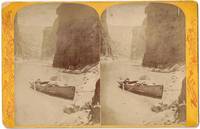
ref. 71876Washington DC: J. F. Jarvis. Photograph. Very Good. Albumen stereoview 11 cm x 15 cm on a yellow mount 11 cm x 17.5 cm with a printed paper label on the reverse No. 181. U. S. Topographical and Geological Survey of the Colorado River of the West. Corner wear and a bit of edge wear as well. J. F. Jarvis label on the reverse. Jack Hillers 1840-1882 was working as a teamster when he made the acquaintance of John Wesley Powell. The following year 1871 Powell hired him as a boatman for his second expedition down the Colorado River and through the Grand Canyon. Over time he replaced Clements Powell John's cousin as the assistant to the photographer first succeeding E. O. Beaman then James Fennemore. Hillers was a hard worker highly regarded by his peers and a fast learner when it came to the art of photography. After serving as the main photographer on Powell's trips Hillers would go on to work for the Bureau of American Ethnology for many years. J. F. Jarvis unknown books
1789ref. 48038Puerto Deseado Argentina. ca. 1789. Two Extraordinary Native American Portraits from the Malaspina Expedition A superb pair of highly finished red chalk portraits of two Patagonians made at Puerto Deseado in southern Argentina during the Malaspina expedition by one of the expedition's artists. The Malaspina Expedition was Spain's single effort at a voyage of exploration and discovery comparable to the great English and French voyages of the late 18th and early 19th centuries. More specifically it was designed to gain geographical knowledge and underpin Spain's territorial claims to the Northwest coast of America. It also had ambitious plans to publish its findings in the tradition of the other great European voyages. The Malaspina voyage is famous for the quality of the scientific material collected not least the anthropological drawings of peoples drawn at their many ports of call accurate and lifelike depictions very much in the tradition of the artists who accompanied James Cook William Hodges and John Webber. The expedition circumnavigated the globe leaving Cadiz on July 30 1789 visiting the coast of Patagonia in November working on the west coast of the Americas in 1790 and 1791 and ultimately returned to Spain in 1794 after a five-year voyage. Although unsigned both portraits offered here have been firmly attributed to voyage artist José de Pozo Ximénez 1757-1821 who made a series of drawings in Patagonia including one sketch in which he and his fellow artist Pineda are depicted in the act of drawing some of the local people. Pozo Ximénez was a native of Seville hired as an expedition painter by the Spanish government in June 1789. At the time of his recruitment he was described as "an excellent subject and perspective painter having a very good education with a wealth of geometry and is very robust for the age of 32" quoted in Puig-Samper p.18. A specialist in perspective and portraits his ethnological work is considered his greatest contribution to the results of the voyage but although Malaspina admired his "accuracy and speed" Journal of the Voyage p.140 the commander became increasingly infuriated with what he saw as the artist's laziness and indifference and forced him to leave the expedition in Callao in May 1790. Although ordered back to Spain Pozo in fact never left Peru founding a school of painting in Lima. The bulk of his Malaspina voyage originals are in the Museo Naval Madrid where much of the original material from the expedition resides. The portraits depict a man and woman drawn during a well-recorded encounter between the Spanish and the Patagonians in December 1789. It can be established that the man is a chief called "Junchar"; and the young woman is apparently the young woman called "Jujana" or "Cátama" who is described in detail in Malaspina's journal as having captivated the Spanish officers. The expedition had reached Puerto Deseado in late 1789 and Malaspina personally describes their interaction with a local tribe of some forty people on three separate occasions pp.85-90. Pozo joined Malaspina on the second of these visits drawing these portraits and a larger sketch of the encounter between the Spanish officers and a large group of Patagonians a sketch which seems to have an each-way bet on whether they were in fact giants: Pozo's Patagonians are strapping but not absurdly tall Serrano plate 36. Indeed it is plausible that the two present portraits are of people who are also in that larger scene: Junchar may be the man with a cloak over one shoulder talking to one of the Spanish men while the young woman could conceivably be the person standing at the far right of the Patagonians with dark eyes and parted hair. What is clear is that both subjects were described in detail by Malaspina personally. Of Junchar he notes: "In general they were all including the women and children very large and solidly built. Their height was not in proportion to their build but they were tall: the cacique Junchar who was carefully measured by Don Antonio Pineda and found to be six Burgos feet and ten inches in height and almost twenty-three inches broad from shoulder to shoulder" p.87. No doubt Junchar was singled out by Pozo because his large stature spoke to the ancient misconception of Patagonians as giants a myth which had gripped the European imagination since the time of Magellan. In a much longer passage Malaspina also describes how they singled out one particular woman to have her portrait taken: a "Patagonian girl aged about fourteen later referred to as Jujana by Malaspina whose good looks great charm and exceptional loquacity had made us choose to portray her rather than the other women was drawn to our attention even more when the time came for them to go ashore" as she struggled to modestly use her poncho to carry away some biscuits and vegetables that had been given to her as a gift p.89. In the catalogue raisonné of the art of the Malaspina voyage Carmen Sotos Serrano located two preliminary gridded sketches of these portraits "Patagon" and "contorno de la Patagone" respectively see cat. 39 and 40. Pozo also did a full-length study of Junchar and two other studies of a second woman with child cat. 41 and 42. All of these sketches are in the Museo Naval in Madrid which collection also includes two later oil paintings of Junchar and the young woman now called "Cátama." The oils were acquired by the museum in 1932. The drawings presently offered were originally in an album or portfolio entitled "Spanish Drawings" which had been acquired by Elizabeth Lady Holland when travelling extensively in Spain between 1802 and 1805. The Whatman paper into which they have been window-mounted for the album is watermarked 1801 confirming this approximate date of acquisition and their having been mounted in an album. Many of the other drawings in the collection were topographical works by another Malaspina voyage artist Fernando Brambila. When the present drawings were sold in the large sale of drawings from Holland House in 1979 they were attributed to Brambila with the rather telling comment that "no comparable drawings by the artist are recorded." However a comparison with the works illustrated by Serrano and a reading of the journals make it clear that Pozo Ximénez is the artist. Because Malaspina quickly fell into official disfavor and with the disruptions of the Napoleonic Wars the extensive planned publications of the expeditions never came to be. Virtually all of the archives of the voyage are now to be found in the Museo Naval in Madrid. These drawings acquired only a few years after the return of the voyage by Lady Holland are thus among the very few original works of the voyage to ever appear in the market. An extraordinary opportunity to acquire two significant portraits of Native Americans from one of the greatest voyages of the Second Age of Exploration. Two red chalk drawings: the young woman on a sheet 228 x 190 mm. paper watermarked with a combined "P" and smaller "L"; the man "Junchar" on a sheet 228 x 195 mm. Both drawings window-mounted probably about 1801 into a larger sheet of Whatman paper with ink borders added. Fine. HOWGEGO I M26. Carmen Sotos Serrano Los Pintores de la Expedicion de Alejandro Malaspina Madrid 1982 cat. 39-42. Miguel Ãngel Puig-Samper "Illustrators of the New World: The Image in the Spanish Scientific Expeditions of the Enlightenment" in Culture and History Digital Journal Vol. 1 no. 2 December 2012 pp.1-28. Andrew David et al. eds. The Malaspina Expedition 1789-1794 Journal of the Voyage by Alejandro Malaspina Vol. 1 Cadiz to Panama London: The Hakluyt Society 2001. unknown books
1856ref. 69186London. 1856. Parliamentary "Blue Book" on the Search for Franklin A rare Parliamentary paper relating to the lost Franklin expedition. This "blue book" a series of parliamentary reports named for their original blue paper wrappers contains a wealth of information about Franklin's expedition including detailed correspondence on the Second Grinnell Expedition with Kane's report and the Hudson's Bay Company's expedition down the Back River under Anderson and Stewart. Also includes Richard King's proposal to venture down the Back River to Montreal Island; the recovery and subsequent disposal of the Resolute; Collinson's report on Franklin relics; correspondence on the rewards for Franklin searches; and a list of American officers and men entitled to receive the Arctic Medal known today as the Polar Medal and given out by the British government to "all persons of every rank and class who have been engaged in the several Expeditions to the Arctic Regions whether of discovery or search between the years 1818 and 1855". Sir John Franklin's doomed 1845 expedition his fourth to the Arctic and third as commander set out in 1845 to search for the fabled Northwest Passage. In September 1846 the expedition's ships became trapped in the ice off of King William Island which would be their final resting place. The crew spent the next year and a half trapped there before attempting to walk south dying along the way in the arctic tundra hundreds of miles from the nearest European settlements. After three years without word the British Admiralty launched a massive search for the missing ships. Spurred by a large reward many expeditions from Britain and the United States set out on the hunt beginning in 1848 and continuing through the next decade. The British Parliament printed occasional reports of the various expeditions and related Arctic subjects during that time. These reports became known as the Arctic "blue books." One of the scarcer Franklin items rarely appearing on the market and with only a handful recorded in OCLC. Folio. Gathered signatures stitched. Soiling and edge wear to outer leaves minor scattered foxing else very good. ARCTIC BIBLIOGRAPHY 45249. TPL 3659. LANDE S910. unknown books
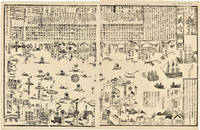
1855ref. 46844Tokyo ca. 1855. Japanese Print of Perry's Ships in Tokyo Harbor Large wood block print comprised of two sheets showing the disposition of the Japanese soldiers and ships in preparation for the arrival of Commodore Perry's American fleet seen sailing into Tokyo harbor at the right side of the image. The top third of the print is comprised of text in Japanese characters. Three large American ships dominate the right side of the print while several smaller boats dot the rest of the harbor. The whole is dotted with Japanese characters denoting various people and places around the harbor. Perry first arrived in Japan on July 8 1853 with a fleet of four ships flying his pennant on the steam frigate Susquehanna. This first visit lasted ten days and culminated on July 14 with Perry's presentation of a letter from the President of the United States to the Japanese commissioners. Perry then absented himself for seven months returning on February 11 1854 for a stay of over four months. He negotiated a treaty opening Japan to trade with the western world providing for a U.S. consul in Japan and protecting visiting ships and crews. Perry's visit to Japan remains one of the most important events in the diplomatic history between western and eastern nations. A handsome print showing the Japanese side of this important historic event. 24½ x 16 inches. Matted. Old fold lines some minor wear and soiling. Near fine. unknown books
1818ref. E0061323 pages with a portrait frontispiece and five colored aquatints. Octavo 8 3/4" x 5 1/2" bound in attractive half leather with marbled boards and gilt lettering to spine. Hill 1168 Second and best edition The Alceste brought Lord Amherst to China to serve as ambassador and specifically to negotiate the China trade at the time a matter of dispute between China and Great Britain. M'Leod who was surgeon on the ship describes the voyage out the various calls in the East Indies including touching at Batavia surveying off Korea the visit to Okinawa another to Manila and the shipwreck off the coast of Sumatra and subsequent rescue from Malay pirates. A brief but interesting interview with Napoleon at St. Helena is also included in the narrative. This was one of the most popular travel books of its time portraying the Far East to a much wider audience than had been reached by earlier accounts. The idyllic descriptions of Lewchew undoubtedly appealed to the romantic sensibilities of the era. Indeed buoyed by its success M'Leod published another work recounting his time as a slaver A Voyage to Africa with some Account of the Manners and Customs of the Dahomian People. Condition: Attractive half rebind some foxing through out with no spotting to plates else a very good copy. John Murray hardcover books
1787ref. E00402 volumes: 576xv pages; 499xv pages. Octavo 8 3/4" x 5 1/2" bound in 3/4 period leather. Translated from the first German edition 1781 which includes a chapter entitled: "Observations and additions to by Johann Gottlob Theaenus Schneider". Translated with additional notes and reviews by Jean Baptiste Lefebvre Villebrune. First Spanish edition published in 1772 Madrid. Sabin 36805 First French edition. Antonio de Ulloa 12 January 1716 – 3 July 1795 was a Spanish general explorer author astronomer colonial administrator and the first Spanish governor of Louisiana. He was born in Seville the son of an economist. Ulloa entered the navy in 1733. In 1735 he was appointed with fellow Spaniard Jorge Juan a member of the French Geodesic Mission a scientific expedition which the French Academy of Sciences was sending to Ecuador to measure a degree of meridian arc at the equator led by Pierre Bouguer. He remained there from 1736 to 1744 during which time the two Spaniards discovered the element platinum. In 1745 having finished their scientific labors Ulloa and Jorge Juan prepared to return to Spain agreeing to travel on different ships in order to minimize the danger of losing the important fruits of their labors. The ship upon which Ulloa was traveling was captured by the British and he was taken as a prisoner to England. In that country through his scientific attainments he gained the friendship of the men of science and was made a Fellow of the Royal Society of London. In a short time through the influence of the president of this society he was released and was able to return to Spain. He published an account of the people and the countries they have met 1748 which was translated into English as A Voyage to South America. He became prominent as a scientist and was appointed to serve on various important scientific commissions. He is to be credited with the establishment of the first museum of natural history the first metallurgical laboratory in Spain and the observatory of Cadiz. In 1758 he returned to South America as governor of Huancavelica in Peru and the general manager of the quicksilver mines there. He held this position until 1764. He arrived on 5 March 1766 in New Orleans to serve as the first Spanish governor of West Louisiana. The French colonists refused to recognize Spanish rule and de Ulloa was expelled from Louisiana by a Creole uprising during the Louisiana Rebellion of 1768. For the remainder of his life he served as a naval officer. In 1779 he became lieutenant-general of the naval forces. As a result of his scientific work in Peru he published Madrid 1784 Relación histórica del viaje á la América Meridional which contains a full accurate and clear description of the greater part of South America geographically and of its inhabitants and natural history. In collaboration with the Jorge Juan mentioned above he also wrote Noticias secretas de América giving valuable information regarding the early religious orders in Spanish America. Condition: Sever worming to spines exterior hinges cracked point chipped library stamps to title pages else a good copy of a scarce item. Chez Buisson hardcover books
1747ref. BOOKS00585324548 pages with three folding engraved maps present southern part of South America; part of the Pacific Ocean and the track of the Centurion round the world. Octavo 8 1/4" x 5 1/2" bound in full leather with five raised spine bands with red label to spine in gilt lettering with decorative blind-stamped ruled edges. Compiled from papers and other materials of the Right Honourable George Lord Anson and published under his direction by Richard Walter M.A. Chaplain of his Majesty's Ship the Centurion in that expedition. Hill I pp 317-138. Third edition. "This is the official account of Anson's voyage. England at war with Spain in 1739 equipped eight ships under the command of George Anson to harass the Spaniards on the western coast of South America for the purpose of cutting off Spanish supplies of wealth from the Pacific area. Lord Anson who was a friend and patron of Benjamin Robins after returning from the voyage around the world in the Centurion appears to have entrusted to Robins for revision the account of the voyage which had been compiled from the journals by his chaplain Richard Walter. It is probable that Robins revised and edited the work wrote an introduction and added dissertations." Hill. Perhaps the most popular account of maritime adventure of the eighteenth century. Anson's account of harrying the Spanish of South America and the taking of the Manilla galleon with treasure with a contemporary value of $800000 and his circumnavigation has long enjoyed a distinguished place as a masterpiece in descriptive travel. Condition: Some small closed tears at the edges of the maps. Rebound in tooled leather with raised bands. Over all a very good to fine copy. John and Paul Knapton and Office of the Lord High Admiral hardcover books
1853ref. 347471853. 9 3/4 x 6 7/8 inches. 31; 31; 61pp. plus a loose sheet. Worming not affecting legibility occasionally touching a letter. Some dampstaining and dust soiling. Original paper wrappers stitched as issued. Contemporary manuscript annotations in red ink in one volume Vital contemporary Japanese manuscript accounts of Commodore Matthew C. Perry's arrival in Uraga Bay in July 1853 preserving official documentary and observational responses by Japanese officials and participants to the encounter that transformed Japan's relations with the wider world. The first manuscript Uraga kurofune ni kansuru comprises an official account of events following Perry's arrival off Uraga. The volume is especially notable for its contemporary red-ink annotations indicating active correction or revision of the text. It records the encounter from within the administrative world of the Tokugawa shogunate as Japanese officials confronted an American squadron that included two steam frigates. The second account Edo Uraga Beikoku fune torai ikken records the arrival of the American ships and provides a contemporary Japanese narrative of the encounter. Its double-page manuscript sketch of the Uraga coastline with the arrangement of Perry's vessels offshore reflects the immediate effort of Japanese observers and officials to describe classify and understand the unfamiliar ships equipment and conduct of the American expedition. The third manuscript Gasshukoku shokan wage utsushi preserves contemporary texts associated with the shogunate's handling of the American communications. Abe Masahiro chief senior councillor in the Tokugawa shogunate accepted the American letter ordered translations of the official letter and related documents and circulated them among daimyo for advice. This manuscript includes Japanese translations of letters from President Millard Fillmore and Commodore Perry presented by the American expedition in July 1853. The accompanying loose manuscript sheet gives a description of one of the Black Ships. Together the three volumes and loose sheet offer a substantial Japanese record of Perry's first visit combining official reporting translated diplomatic correspondence visual observation and contemporary manuscript transmission. They belong to the immediate documentary culture produced by the arrival of the Black Ships before Perry's return in 1854 and the signing of the U.S.-Japan Treaty of Peace and Amity at Kanagawa. unknown books
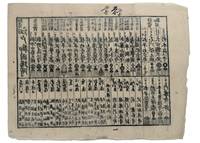
1853ref. 347481853. Three woodblock-printed sheets on mulberry paper. Mild edge wear old folds. A detailed revealing group of late Tokugawa samurai reference sheets recording the names ranks stipends heraldry standards and service obligations through which the shogunate and Edo public understood military readiness at the moment of Perry's arrival. Commodore Matthew C. Perry anchored off Uraga at the entrance to Edo Bay in July 1853. His arrival made visible the vulnerability of the Tokugawa capital and produced an immediate demand for information about coastal defence domain strength and the lords responsible for guarding the approaches to Edo. Kawaraban and related broadsides answered that demand in compressed visual form combining names crests military symbols income figures and geographical or administrative data. The first printed sheet appears to be an earlier roster of Edo office-holders or guard personnel. Its tabular format with names offices crests and standards records the recognitional system already in place within Tokugawa administration before the Perry crisis sharpened the public appetite for such information. The manuscript sheet is ruled into a large grid with headings formed from the twelve zodiac signs and the four seasons including Rat Ox Tiger Hare and the seasonal headings. The entries appear to record named houses Lords or retainers against recurring seasonal and cyclical categories probably for service attendance or ceremonial obligation. The third sheet is headed "Rekko yushinroku" here translated as "Register of Valiant Retainers of the Lords." It lists major daimyo houses and their principal retainers with domain or house headings names titles stipend figures in koku family crests standards and related insignia. Visible regional or house designations include "Kaga" "Owari" "Kii" "Satsuma" "Higo" and "Tosa." The sheet gives a graphic register of the daimyo world mobilised or imagined as mobilised around the defence of Edo Bay. Together the sheets preserve the administrative and visual language of Tokugawa defence at a moment of acute pressure. They are not formal shogunal orders and the first sheet may predate Perrys arrival but they show how late Edo Japan translated rank obligation military identity and coastal defence into portable tabular form. Their compression the names of Lords and retainers the scale of domains the crests and standards by which armed households could be recognised and the bureaucratic habits of a regime suddenly forced to account for its capacity to defend the country reveals these documents' immediacy and importance. unknown books
ref. 11288Japan: ca. 1854-55. An impressively assembled scroll that portrays the second American expedition to Japan February-March 1854 led by Commodore Perry; much of it is focused on the American vessels that anchored menacingly off the coast. Seven of the nine ships in the American fleet are carefully portrayed with notes on the estimated numbers of cannons and crewmembers. Steam-powered ships with black smoke gushing from the stacks and rows of powerful cannons shocked the Japanese most of whom had never seen such a demonstration of advanced military technology. The observations in this scroll must have been crucial to inform the decision-making of Japanese officials. "Black Ship Scrolls" conveying eyewitness reports were disseminated among the Japanese elite and kept top secret. Our scroll was presumably created for a high-ranking Japanese official since any information on the American interlopers was carefully controlled by the local authorities to maintain public order in the face of an anticipated foreign invasion. Compared to other depictions of the foreigners which frequently showed them as caricatures hairy oversized red-faced and blue-eyed the more dignified portraits in our scroll demonstrate the increasing familiarity between the Japanese and American contingents. In the years following Japan's opening to the West Japanese artisans produced countless scrolls commemorating the American expeditions catering to the tourist trade and as gifts to visiting dignitaries. Mass-produced with foreigners' preferences in mind these scrolls took liberties with the events that transpired straying far from the earliest accounts and sketches. They pale in comparison with the elaborate and scrupulous illustrations found in this early scroll. Though the later mass-produced scrolls are easily found on the market examples like ours presumably created for a Japanese official or nobleman remain greatly treasured for their revealing depictions. We have ordered the scroll into 15 individual scenes most of which have a contemporary manuscript caption translated below: I. Three sailors in the American marching band two of whom are uniformed drummer boys. The band led the American march to Yokohama where negotiations between the two nations were held in a newly constructed reception hall. The Japanese manuscript caption reads: "Illustration of musicians." II. Two sailors with swords sheathed are holding their muskets with bayonets fixed. A fine indigo ink has been employed to depict the uniform on the left. Caption: "Rank: Sergeant/Soldier." III. Commodore Perry on the right faces a sailor who may be the conductor of the American expedition's marching band. Perry is depicted rather sympathetically compared to exaggerated and even outlandish portraits that depict him as quite large hairy and red-faced. The artist has once more used a deep indigo to capture the color of the uniforms. Caption: "Ambassador Perry/Conductor Commandant." IV. A larger portrait of a lone sailor probably an officer clutching his sheathed sword and clenching his fist. Caption: "Foreigner Captain landed near Kanagawa." V. An elaborate and realistic portrait of Perry capturing even the individual hairs on his head and the wrinkles on his face. Caption: "American Envoy Perry." VI. A portrait of Perry's chief-of-staff Henry A. Adams done by the same artist as Perry's portrait. Caption: "American Vice Envoy Adams." VII. upper portion A very long horizontal painting of the American column marching to the Yokohama reception hall for negotiations regarding the opening of Japan to American trade. There are more than 100 armed Americans soldiers following the marching band. The top of this sheet has been slightly cropped cutting off part of the American flag in the middle. Caption: "Illustration of American landing column." VIII. lower right A sizable rendering of the USS Vandalia a sloop-of-war that joined the Perry Expedition in late 1853. Caption: "Name of ship: Vandalia 20 cannons 200 crewmembers." Minuscule mended wormholes to the image. IX. lower left The USS Saratoga another sloop-of-war. Caption: "Name of ship: Saratoga 20 cannons 200 crewmembers." Expertly mended wormholes touching the image hardly visible. X. upper portion A panoramic view with a fleet of 23 American rowboats headed to shore. Mending to the top of the scroll. XI. right lower portion The USS Mississippi a steam frigate that was part of the first expedition. Caption: "Name of ship: Mississippi 8 cannons 240 crewmembers." XII. left lower portion The USS Southampton a storeship. Caption: "Name of ship: Southampton 6 cannons 50 crewmembers." Expert mending of wormholes affecting the image. XIII. USS Supply a supply ship. Caption: "Name of ship: Supply 6 cannons 40 crewmembers." Wormholes repaired and with some foxing. XIV. USS Lexington a supply ship. Caption: "Name of ship: Lexington 26 cannons 50 crewmembers." Repaired wormholes and small sections of the white wash used for the sails have come off. XV. USS Susquehanna a steam frigate. Caption: "Name of ship: Susquehanna 6 cannons 240 crewmembers." Careful mending of wormholes to head and tail of scroll. In very good condition; there are a number of wormholes all expertly restored to the point that most are invisible to the naked eye and some browning and speckles to blank segments of the scroll. Two unidentified ownership seals next to the illustration of the USS Vandalia no. VIII. Housed in a custom-made 20th-century wooden box. ⧠Renata V. Shaw "Japanese Picture Scrolls of the First Americans in Japan" in The Quarterly Journal of the Library of Congress Vol. 25 No. 2 April 1968 pp. 134-53. For helpful recapitulations of accounts from the Japanese and Americans William McOmie The Opening of Japan 1853-1855: A Comparative Study of the American British Dutch and Russian Naval Expeditions to Compel the Tokugawa Shogunate to Conclude Treaties and Open Ports to Their Ships 2006. unknown books
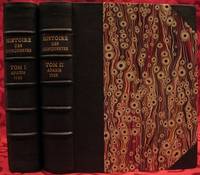
1733ref. E05532 volumes. 8xxiv616471 pages with 4 maps ad view one folding and 3 plates one folding; 2693892 pages with 1 map and 6 plates. Quarto 10 1/4" x 10 1/4" bound in half leather with raised spine bands and gilt lettering to spine over marbled boards. Borba de Moraes page I:453; European Americana 733/146; Sabin 38591 First edition. Joseph-François Lafitau was a French Jesuit missionary ethnologist and naturalist. He is best known for his use of the comparative method in the field of scientific anthropology the discovery of ginseng and his writings on the Iroquois. Lafitau was the first of the Jesuit missionaries in Canada to have a scientific point of view. Lafitau is considered the first of the modern ethnographers and a precursor of scientific ethnology for his work on the Iroquois. He developed a model of studying peoples that involved describing existing cultures on their own terms—not in comparison to European society. He distinguished generic and specific traits transforming the "generic savage" into specific tribal groups. He explained that "only from specific identities can genetic relations be inferred." Furthermore he was the first to declare "contemporary primitive cultures throw light upon the culture of ancient people and vice versa. Lafitau is remembered for applying the comparative method with a greater level of competency than any of his contemporaries. Through original field observations he was able to critique the works of earlier writers on Primitive peoples. By using the Comparative Method Lafitau rejected all theories of social and cultural change and instead used his study to demonstrate the similarities in customs practices and usages of the Native North Americans with diverse peoples from different continents and centuries. He consistently relied on the doctrine of degeneration: all men originally shared one religion with one God but over time as people migrated to separate margins of the earth where they then lost touch with the values and traditions of this one true religion and culture. Therefore Lafitau believed in the "psychic unity of mankind" and the doctrine of primitive monotheism. His major work written in French was first published in 1724 in Paris. It is entitled Customs of the American Indians Compared with the Customs of Primitive Times Moeurs des Sauvages Amériquains Comparées aux Moeurs des Premiers Temps and is 1100 pages in total. In 1974 William Fenton and Elizabeth Moore made the first translation into English available. Lafitau published two other works. One Histoire de Jean de Brienne Roy de Jérusalem et Empereur de Constantinople Paris 1727 was released before he returned to Canada; it is little known and seldom seen. A two-volume Histoire des découvertes et conquestes des Portugais dons le Nouveau Monde . . . 1733 appeared after he came home to France. Frequently found in libraries it is not just a compilation of original sources but an attempt to make available to French readers a story of exploration and adventure otherwise denied to them; in the chronicles he sees a long development of customs hitherto unnoticed such as he had reported in the Mœurs; from them understood only he says in the original languages of the people who practice them he builds his "system" or philosophy of history and once more he is concerned too with the relation between custom and natural history or ecology. Condition: Beautifully rebound in half leather. Faint dampening to second volume; early owner's signatures on title pages inked stamps of St Charles Borromeo Seminary on front paste-downs and first title page lacks frontispiece else a very good to fine set. Chez Saugrain pere, quai des Augustins, au coin de la rue Chez Saugrain pere, quai des Augustins, au coin de la rue Pavee, a la hardcover books