1 531 résultats
1959réf. 45728im Bertelsmann Lesering, (1959). Lizenzausgabe 375 Seiten , 21 cm geb. Pappeinband
1978réf. 35797Berlin: Volk und Welt Verlag, 1978. 5. Auflage 314 Seiten , 23 cm, Gewebeeinband mit Schutzumschlag
1975réf. 15498Radebeul : Neumann, 1975. 149 S. : Ill. (farb.) Gr. 8°. 1. Aufl. OLwd mit Buntpräg. ohne SU.
1984réf. 2741Altberliner Verlag Lucie Groszer Berlin. 1984. 219 Seiten. Oktav. 6. Auflage. Leinen mit Umschlag.
réf. 209554Paris, s.d. (1802) in-4 (23 x 17 cm), en feuille sous marie-louise, verre et baguettes de bois modernes. Rousseurs.
réf. 032526Bertelsmann, Gütersloh 0. Wie neu Hardcover Wie neu
réf. 032519Bertelsmann, Gütersloh 0. Sehr gut Hardcover Sehr gut
1979réf. KOS02900018Kodansha 1979. Soft Cover. Fine. KOS02900018 Kodansha paperback
1986réf. 18689Berlin: Verlag Das Neue Berlin, 1986. 311 Seiten , 21 cm Pappeinband mit Schutzumschlag
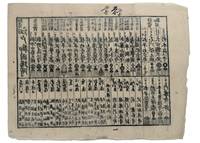
1853réf. 347481853. Three woodblock-printed sheets on mulberry paper. Mild edge wear old folds. A detailed revealing group of late Tokugawa samurai reference sheets recording the names ranks stipends heraldry standards and service obligations through which the shogunate and Edo public understood military readiness at the moment of Perry's arrival. Commodore Matthew C. Perry anchored off Uraga at the entrance to Edo Bay in July 1853. His arrival made visible the vulnerability of the Tokugawa capital and produced an immediate demand for information about coastal defence domain strength and the lords responsible for guarding the approaches to Edo. Kawaraban and related broadsides answered that demand in compressed visual form combining names crests military symbols income figures and geographical or administrative data. The first printed sheet appears to be an earlier roster of Edo office-holders or guard personnel. Its tabular format with names offices crests and standards records the recognitional system already in place within Tokugawa administration before the Perry crisis sharpened the public appetite for such information. The manuscript sheet is ruled into a large grid with headings formed from the twelve zodiac signs and the four seasons including Rat Ox Tiger Hare and the seasonal headings. The entries appear to record named houses Lords or retainers against recurring seasonal and cyclical categories probably for service attendance or ceremonial obligation. The third sheet is headed "Rekko yushinroku" here translated as "Register of Valiant Retainers of the Lords." It lists major daimyo houses and their principal retainers with domain or house headings names titles stipend figures in koku family crests standards and related insignia. Visible regional or house designations include "Kaga" "Owari" "Kii" "Satsuma" "Higo" and "Tosa." The sheet gives a graphic register of the daimyo world mobilised or imagined as mobilised around the defence of Edo Bay. Together the sheets preserve the administrative and visual language of Tokugawa defence at a moment of acute pressure. They are not formal shogunal orders and the first sheet may predate Perrys arrival but they show how late Edo Japan translated rank obligation military identity and coastal defence into portable tabular form. Their compression the names of Lords and retainers the scale of domains the crests and standards by which armed households could be recognised and the bureaucratic habits of a regime suddenly forced to account for its capacity to defend the country reveals these documents' immediacy and importance. unknown books
1853réf. 347481853. Three woodblock-printed sheets on mulberry paper. Mild edge wear old folds. A detailed revealing group of late Tokugawa samurai reference sheets recording the names ranks stipends heraldry standards and service obligations through which the shogunate and Edo public understood military readiness at the moment of Perry's arrival. Commodore Matthew C. Perry anchored off Uraga at the entrance to Edo Bay in July 1853. His arrival made visible the vulnerability of the Tokugawa capital and produced an immediate demand for information about coastal defence domain strength and the lords responsible for guarding the approaches to Edo. Kawaraban and related broadsides answered that demand in compressed visual form combining names crests military symbols income figures and geographical or administrative data. The first printed sheet appears to be an earlier roster of Edo office-holders or guard personnel. Its tabular format with names offices crests and standards records the recognitional system already in place within Tokugawa administration before the Perry crisis sharpened the public appetite for such information. The manuscript sheet is ruled into a large grid with headings formed from the twelve zodiac signs and the four seasons including Rat Ox Tiger Hare and the seasonal headings. The entries appear to record named houses Lords or retainers against recurring seasonal and cyclical categories probably for service attendance or ceremonial obligation. The third sheet is headed "Rekko yushinroku" here translated as "Register of Valiant Retainers of the Lords." It lists major daimyo houses and their principal retainers with domain or house headings names titles stipend figures in koku family crests standards and related insignia. Visible regional or house designations include "Kaga" "Owari" "Kii" "Satsuma" "Higo" and "Tosa." The sheet gives a graphic register of the daimyo world mobilised or imagined as mobilised around the defence of Edo Bay. Together the sheets preserve the administrative and visual language of Tokugawa defence at a moment of acute pressure. They are not formal shogunal orders and the first sheet may predate Perrys arrival but they show how late Edo Japan translated rank obligation military identity and coastal defence into portable tabular form. Their compression the names of Lords and retainers the scale of domains the crests and standards by which armed households could be recognised and the bureaucratic habits of a regime suddenly forced to account for its capacity to defend the country reveals these documents' immediacy and importance. unknown
réf. 98552aafCape Town, Howard Timmins, 1955, in-8vo, Frontispice + 248 p. + 12 p. with illustrations, / 256 p., ill., small legacy stamp on first free flyleaf ‘Guggisberg’, original wrappers with orig. ill. jacket.
réf. BN610349Karluk. Die Geschichte einer verratenen Expedition McKinlay William L and Seib Günter Karluk. Die Geschichte einer verratenen Expedition McKinlay William L and Seib Günter Karluk. Die Geschichte einer verratenen Expedition McKinlay William L and Seib Günter unknown
1937réf. 1693A. Brockhaus Leipzig, F, 1937. 191S., OLn m. OU (dieser mit Randläsuren und kleineren Fehlstellen), farbiger Kopfschnitt, Stockflecken auf den Vorsätzen, innen ordentlich, Priv NaV, mit einem Geleitwort von Sven Hedin, 100 bunten und einfarbigen Abbildungen und einer Karte. DEA. Ordentliches Exemplar. Good copy. 1. Auflage
1937réf. 19002Leipzig : F. A. Brockhaus 1937. 191 S. : 100 bunten u. einfarb. Abb. u. 1 Kt. ; gr. 8° Lw., gebundene Ausgabe, Leinen, Rücken etwas ausgeblichen einige Flecken, sonst Exemplar in gutem Erhaltungszustand
réf. 12649FLAMMARION PARIS 1938 Coll. LA VIE EN MONTAGNE. Photographies n&b h.t. 10e mille. 172 pp IN8 Broché Couverture illustrée,
1972réf. 15500Radebeul : Neumann, 1972. 192 S. : Ill. (z.T. farb.) Gr. 8°. 6. Aufl. OLwd mit Buntpräg. ohne SU.
1922réf. 18376Leipzig F. A. Brockhaus, 1922. XXXII + 744 S. Gr. 8° Groß-Oktav Ln. 2 Bände
1971réf. 18666Herford : Busse, 1971. 211 S. Gr. 8°. Bibl.- Einbd.
1994réf. 154042Hamburg : Carlsen, 1994. 46 S. ; 30 cm OPappband
1993réf. 11717Frieding-Andechs : Ambro Lacus, Buch- und Bildverlag, 1993. Expedition zu den letzten Buschleuten im südlichen Afrika 167, [77] S.; 24x21,5 cm illustrierter Pappband / gebundene Ausgabe
1828réf. 55033London John Murray Albamarle Street 1828. First Edition. Hardcover. Good Solid Copies Some Uniform Darkening At Spine Area Of All Volumes Label At Volume I I Has An Indentation Hole Some Pages Unopened Vol. V Has Pp.329 and 330 Bound In Twice. 24mo Five Volumes Blue Publisher Cloth Paper Label At Spine. Volume I I I Has Folding Map Labeled General Chart Showing The Discoveries of The Three Perry Voyages Ten Tissue Guarded Plates For All Volumes Images Include Parry The Ships And Eskimo Life. Provenance - These Five Volumes Are from the SItwell Family Library At Weston HALL U. K. THEIR FAMILY SEAT FOR 300 YEARS. THE BOOKs ARRIVED AT WESTON HALL DURING THE TIME OF HARRIET WRIGHTSON 1788-1864 AND COL. HENRY HELY- HUTCHInSON who was the nephew of General Lord Hutchinson later 2nd Earl of Donoughmore London, John Murray, Albamarle Street hardcover
1997réf. 23887Adelaide: Friends of the State Library of South Australia. Fine. 1997. First thus. Hardcover. 1876154101 . Sent by the colonists of South Australia with the sanction and support of the government; including an account of the manners and customs of the aborigines and the state of their relations with Europeans. In two volumes. Edition limited to 600 copies of which the first 99 are numbered and bound in quarter leather this being an unnumbered set bound in cloth. An as new set. ; Australiana Facsimile Editions No. 213; 225 x 145mm . Friends of the State Library of South Australia hardcover
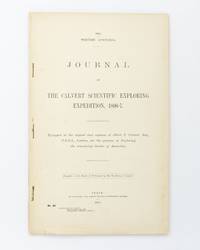
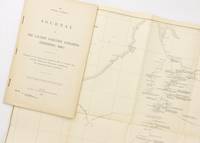
1902réf. 25076Perth: Wm. Alfred Watson Government Printer 1902. First Edition. Paperback. Very Good. Perth Wm. Alfred Watson Government Printer 1902. Foolscap folio 62 pages with 4 illustrations plus a very large folding map 625 × 865 mm. Title-wrappers relatively recently bound in half calf and cloth lettered in gilt on the spine; title leaf slightly marked with trifling loss to the bottom corner-tip; minimal signs of age and use; an excellent copy. Western Australian Parliamentary Paper Number 46 of 1902; only 1200 copies were printed. The 'expedition was fitted out to explore the remaining unknown regions of Australia on similar lines to the Elder expedition'. Lawrence Allen Wells third in command on the ill-fated Elder expedition of 1891-92 was leader. The party set out from Mullewa east of Geraldton on 13 June 1896; lack of water and the gruelling conditions brought the official expedition to an end on 6 November at Noonkanbah Station on the Fitzroy River with two men unaccounted for. It was not until late May of the following year that Wells located the bodies of the missing men his cousin Charles Wells and George Lindsay Jones nephew of the explorer David Lindsay. The detailed accounts of the three search expeditions undertaken by Wells accompanied by Nat Buchanan George Keartland and Sub-Inspector Ord respectively are included. Not least strong on contemporary race relations. Wm. Alfred Watson, Government Printer paperback
1902réf. 125441Perth: Wm. Alfred Watson Government Printer 1902. First Edition. Paperback. Very Good. Perth Wm. Alfred Watson Government Printer 1902. Foolscap folio 62 pages with 4 illustrations plus a very large folding map 625 × 865 mm. Stapled as issued without wrappers; minimal reinforcement to the map near the rusty staples; trifling signs of handling; an excellent copy. Western Australian Parliamentary Paper Number 46 of 1902; only 1200 copies were printed. The 'expedition was fitted out to explore the remaining unknown regions of Australia on similar lines to the Elder expedition'. Lawrence Allen Wells third in command on the ill-fated Elder expedition of 1891-92 was leader. The party set out from Mullewa east of Geraldton on 13 June 1896; lack of water and the gruelling conditions brought the official expedition to an end on 6 November at Noonkanbah Station on the Fitzroy River with two men unaccounted for. It was not until late May of the following year that Wells located the bodies of the missing men his cousin Charles Wells and George Lindsay Jones nephew of the explorer David Lindsay. The detailed accounts of the three search expeditions undertaken by Wells accompanied by Nat Buchanan George Keartland and Sub-Inspector Ord respectively are included. Not least strong on contemporary race relations. McLaren 16633. Wm. Alfred Watson, Government Printer paperback