1385 risultati
rif. DADAX0415397324New unknown
rif. DADAX0415405629New unknown
rif. DADAX0415545242New unknown
rif. DADAX0415955084New unknown
rif. DADAX0415609364New unknown
rif. DADAX0415665817New unknown
rif. DADAX0415955092New unknown
rif. DADAX0520235460New unknown
rif. DADAX0520245784New unknown
rif. DADAX0520214390New unknown
rif. DADAX0520260783New unknown
rif. DADAX0521614082New unknown
rif. DADAX0275945626New unknown
rif. DADAX0333741145New unknown
rif. DADAX0333548450New unknown
rif. DADAX0452284988New unknown
rif. DADAX0195039971New unknown
rif. DADAX0230614825New unknown
rif. DADAX0415700639New unknown
rif. DADAX0520265815New unknown
rif. SONG052111151XUsed: Good unknown
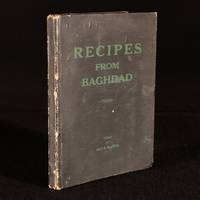
1946rif. 966F11Baghdad: The Indian Red Cross 1946 . First edition. Cloth. Good. 9" by 7". Suad Salim. The first edition of this very scarce mid 20th century cookery work presenting recipes hailing from Baghdad and Iraq. A vanishingly scarce first edition.With a folding table of weights and measures and a small number of vignette illustrations by Suad Salim.A very scarce cookery work presenting recipes popular in Iraq in the 1940s adapted for English tastes. With instructions for making various liqueurs Kubba Lebania Yuen Tsi Khankar Bakmadi and various other dishes.With an introduction from Her Majesty the Queen Mother of Iraq this work is edited by May H. Beattie with the assistance of Bedia Afnan Renée Al Kabir Helen Gaudin and Ann Walter.With bookplate of Martin and Pamela Finch to front free endpaper. They were antiquarian booksellers with an interest in antiquarian gastronomy.With a former owner's inscription to front free endpaper. In the publisher's original paper covered boards. Handling marks to boards. Rubbing to back strip head and tail and joints. Tail of front joint starting with board firmly held. Inscription and bookplate to front pastedown. Internally firmly bound. Pages lightly age toned due to paper type but generally clean with only the odd spot. Good The Indian Red Cross hardcover
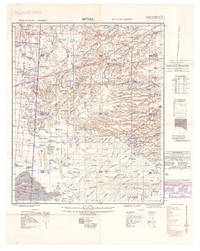
1940rif. L7VDM2ALRS81UK Government: Geographical Section General Staff War Office 1940. 2 topographic maps colour-printed. Scale 1:500000. 820 x 640 mm and 770 x 648 mm. Previously folded. Marked "Iraq Desert Sheet 1" and "Sheet 2". Generally well preserved. Compiled from 1930s surveys and produced by the British 512 Army Field Survey Company Royal Engineers for use in the Persian war theatre. These consecutive maps cover the south-western area of Iraq including Rutba and Fallujah with parts of Saudi Arabia Jordan and Syria approximately the area between 31° and 33°30 N and 39° and 44° E.Previously folded. Marked "Iraq Desert Sheet 1" and "Sheet 2". Generally well preserved. Geographical Section, General Staff, War Office, unknown
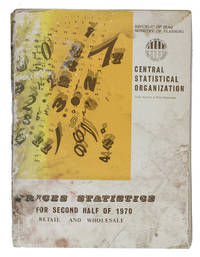
1970rif. ABC_46826Iraq: Central Statistical Organization 1970. Original printed publisher's wrappers. Folio 28.5 x 21 cm. With multiple graphs on 8 leaves most of them in the text. The main price-information is arranged in tables all tables and other introductory information are printed on 1 side of the leaves from right to left on the recto side of the leaves excluding the information in English which has from that perspective been printed on the verso side of the leaves. A statistical overview of the changes in wholesale and retail prices of among other things agricultural animal electronic and textile products in Iraq during the second half of 1970. The elaborate information gathered and presented in the present work by the index numbers & prices department of the central statistical organization of the ministry of planning of the Republic of Iraq has mostly been arranged in tables supplemented with some graphs. The information is organised by general geographical districts in the north middle and south of the country and assessing the prices of products on markets in Baghdad the capital of Iraq separately as its own densely populated district. The present work was published as a supplement to the original bulletin on prices for the first half of 1970 in an effort to bridge the gap in data supply as the Index numbers & Prices department tried to change the publishing frequency from once or twice a year to quarterly and eventually to monthly statements on the changing prices. The information is presented both in Arabic and in English for the purpose of providing a wider range of people and organisations with the information. The Arabic information of course reads from right to left and the tables with the information in both languages are oriented in the same way and the English list of contents and introductory information can be found at the back of the work to be read from left to right. Iraq experienced considerable economic development during the second half of the 20th century. By 1980 its complex central state-planned economy had become the second largest economy in the Arab world after Saudi Arabia. To achieve such development people had to keep a close eye on changing wholesale and retail prices in order to keep changes in inflation and purchasing power in check.Wrapper worn and stained with a blue stamp on the wrapper with the title in Arabic front or back wrapper some staining to the first 4-5 leaves at both English and Arabic ends of the work otherwise internally good and clean. Central Statistical Organization, unknown
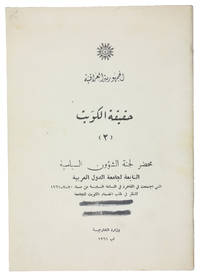
1961rif. ABC_47301Baghdad: Wizarat al-Kharijiyah = Ministry of Foreign Affairs 1961. Original printed wrappers stapled. 8vo. Arabic text. First edition of the second of two rare pamphlets published by the Iraqi government opposing the independence of Kuwait. The first pamphlet published in English and Arabic outlined Kuwait's historical connection to Iraq and analysed its "imperialist relations" with Britain. This second one in Arabic throughout prints the minutes of the Political Affairs Committee of the Arab League which met in Cairo on 20 July 1961 to consider Kuwait's request to join the League.Kuwait emerged as an independent state in June 1961 after sixty-two years as a British protectorate. With a new constitution it held its first parliamentary elections in 1963 thereby becoming the first Arab state in the Gulf to establish a parliament. Such political developments married with growing wealth and modernisations in health culture and finance helped to make Kuwait the most prosperous state in the Arabian Peninsula.The Iraqi government argued that the move toward independence was a continuation of Kuwait's relationship with Britain albeit under a new guise. Furthermore they felt that the historical links between Iraq and Kuwait entitled the former to control over the latter and one suspects a share of its growing wealth. This position partly detailed in the pamphlet led to a point of crisis with Iraq threatening invasion. To the relief of Kuwait the Iraqis were eventually deterred by the Arab League's promise of military opposition.The wrappers are a little dusty two thick black lines on the front wrapper seemingly erasing a stamp another stamp partially visible on the back wrapper most likely a bookseller's name and address "Baghdad" is legible. Internally clean and bright. Overall in very good condition.l Jisc LibraryHub 1 copy BL; WorldCat 219629380 3 copies. Wizarat al-Kharijiyah [= Ministry of Foreign Affairs], unknown