1980bross. edit. ill., lieve piega in 4a di cop.
1886Very Good Arabic Original cloth bdg. Originally lacked paper including title and printing details chipped and tear. Interior very good. Otherwise a good copy. [14], 378 p. Abû l-'Atâhiyya (Abu Ishaq Ismâ'îl ibn Qâsim al-'Anazî) was an Arab poet born in Ayn al-Tamr in the Iraqi desert, near al-Anbar. His ancestors were of the tribe of 'Anaza. His youth was spent in Kufa, where he was engaged for some time in selling pottery. During the time when he took the occupation of selling pottery, he saw the assembly of poets in a competition and he participated in it. Thus he became famous for his poetry. For uplifting his poetry he reached to Baghdad. Moving to Baghdad, he continued his business there, but became famous for his verses, especially for those addressed to 'Utba, a concubine of the Abbasid Caliph al-Mahdi. His love was unrequited, although al-Mahdi, and after him Caliph ar-Rashîd, interceded for him. Having offended the caliph, he was imprisoned for a short time. He died in 828 in the reign of Caliph al-Ma'mûn. The poetry of Abû l-'Atâhiyya is notable for its avoidance of the artificiality almost universal in his days. The older poetry of the desert had been constantly imitated up to this time, although it was not natural to town life. Abû l-'Atâhiyya was one of the first to drop the old qasîda (elegy) form. He was very fluent and used many metres. He is also regarded as one of the earliest philosophical poets of the Arabs. Much of his poetry is concerned with the observation of common life and morality, and at times is pessimistic. Thus he was strongly suspected of heresy. Compiled and prepared by Louis Cheikho. Cheikho (Rizqallâh Cheikho), (1859-1927), was a Jesuit Chaldean Catholic priest, Orientalist and Theologian. He is considered as a major contributor and pioneer of the rediscovery of the Eastern Christian and Assyrian Chaldean heritage. Louis Cheikho was born in Mardin, Turkey on February 5, 1859. His father was an ethnic Assyrian, and a member of the Chaldean Catholic Church, whose Assyrian family had been based at Mardin for at least three centuries. His mother was an Armenian named Elizabeth Schamsé, who took him on pilgrimage to the Holy Land when he was 9 years old. In 1868, Cheikhô joined his brother at the Maronite Jesuit Seminary in Ghazîr, Lebanon. At this date, the seminary was not merely preparing young men for the priesthood, but also acted as a secondary college for young Christian and especially Assyrian Chaldean men. Both groups followed a similar syllabus. There, he learned both ancient and modern European and Semitic languages. In 1874 he entered the Jesuit Order and started his novitiate training at Lons-le-Saunier, France. He adopted at that time the name of 'Louis' out of devotion for the young Jesuit saint Louis Gonzaga. In 1878, he returned to Lebanon and taught Arabic Literature at the Jesuit Saint Joseph College in Beirut for 10 years. During this period, Cheikho continued his studies of philosophy at Université Saint-Joseph, Beirut. In 1888, Cheikho travelled to Great Britain for theological studies in preparation for the priesthood. He was ordained priest by the Chaldean Church of the East on 8 September 1891. He then spent one year in Austria and another year in Paris. Those extended European stays allowed him to acquire the academic methodologies that helped him in his later works. Finally in 1894, he settled in Beirut, Lebanon, where he continued his academic career at Université Saint-Joseph. Cheikho died in Beirut in 1927. Cheikho is perhaps the founder of modern publications of unpublished Eastern Christian texts, especially Christian Arabic texts. He also founded, in 1898, the journal Al-Machriq, and contributed many articles and publications to its pages. His work was an inspiration for CEDRAC. (Wikipedia). First Edition. Extremely rare. This edition not in OCLC; for late editions see OCLC 404750229.
1990New Turkish Paperback. Roy. 8vo. (24 x 16 cm). In Turkish. 179, [5] p. Devletlerarasi sömürge Kürdistan.
1990Very Good English Paperback. Pbo. Roy. 8vo. (24 x 17 cm). In Turkish. 179, [5] p. Deletlerarasi sömürge: Kürdistan. As an international commonwealth: Kurdistan.
1977Very Good Turkish Paperback. Cr. 8vo. (20 x 14 cm). In Turkish. 247, [8] p. Kürtlerin 'mecburi iskân'i. Bilim Yöntemi Türkiye'deki Uygulama 1. First Edition.
1991429 pages. Numerous colour photographic plates and black and white reproductions of photos. Text in English. "Describes the stages of militant, intellectual and political life of one of the most distinguished existing leaders of the Arabian world and of the Third World. Tends to find and tell the truth to those who look for it far from fanaticism, resentments and prejudices." - from back cover. Unmarked with average wear. Binding intact. A sound copy. Book
1980réf. 109102Hachette Réalités, 1980, gr. in-8°, 393 pp, 68 photos en noir dans le texte et 12 pl. de photos en couleurs hors texte, index bibliographique, reliure simili-cuir éditeur, jaquette illustrée, très bon état
2014New English Paperback. Pbo. Cr. 8vo. (20 x 14 cm). In Turkish. 200 p. It ürür kervan yürür: Yürükler arasinda 3 hafta. Translated by Arin Bayraktaroglu. First Turkish Edition of Orga's 'Caravan moves on'. Orga was well-travelled, and wrote about his experiences. "The Caravan moves on" (first edition is 1958) is a story about the Yoruk nomads of the Taurus mountains in southeastern Turkey.
1988Very Good English Paperback. Cr. 8vo. (20 x 14 cm). In English and Turkish. [8] p., 4 p. teecxt in English and 4 p. text in Turkish. Information about settlement and population of Iraqi Turkmans and history and culture at the beginning, oppressions launched against the Iraqi Turkmans, demands of Iraqi Turkmans. At the end there's 1 map showing areas inhabited by Iraqi Turks. Extremely rare. First and Only Edition. A politic propaganda brochure.
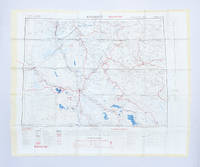
1951réf. 182329London: Ordnance Survey 1951. Later editions marked "restricted" revised from those produced by the War Office in 1941-42 and with isogonals correct to 1953. They show the international borders between Iran and Iraq but warn that they are still under negotiation. These maps are in a variety of later editions all printed in 1951 Baghdad fifth; Basra eighth; Tehran third; Bushehr fourth. This was a critical year in Iranian politics as the country underwent the Abadan Crisis saw the assassination of Razmara and the election of Mosaddeq. In the same period Iraq saw a number of anti-government protests including the 1952 Iraqi Intifada against the Anglo-Iraqi Treaty. Over these years British and American forces kept close watch on the region's development and likely printed these maps printed on rayon as escape items to issue to forces in case fighting broke out. Escape maps were first introduced by MI9 during the Second World War designed to be easily smuggled into POW camps. They were printed on silk and for "good reasons: silk is flexible and durable in a way that paper is not and it is noiseless when hidden about one's person" Bond. They continued to be issued throughout the 20th century and into the modern day especially during the 1960s and the Vietnam War. 2 sheets of rayon 596 x 715 mm; 610 x 676 mm colour map on each side key on map of Tehran; text in English and French. Sometime folded edges fraying more so to sheet of Baghdad and Basra: a very good copy. Barbara A. Bond "Escape and evasion maps of World War II" The British Library 2016. unknown
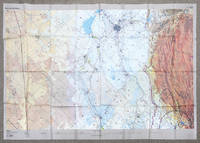
2002réf. 162482London: DGIA Ministry of Defence 2002. First edition stretching from Baghdad to Basrah and showing all of Kuwait. The sheet was likely issued to RAF pilots in the run up to the Iraq War and is printed on rayon for ease of use and durability. These charts produced by the Defence Geographic and Imagery Intelligence Agency feature many warnings about flying within controlled airspace in Iraq and Saudi Arabia. The RAF flew many missions over this region in the lead-up to the Second Gulf War and in Operation Telic. "The first documented intimations of UK involvement in the operation that became Telic can be traced to March 2002. In May the Chief of the Defence Staff CDS was advised of a potential RAF contribution to a future operation in Iraq comprising 88 fast jets and 38 support platforms - more aircraft than the RAF had deployed on a single operation since the First Gulf War and more in all probability than it will ever deploy again" Ritchie p. 5. A formal plan was drafted in August to overwhelm Hussein's government through multiple co-ordinated fronts of which the RAF's role was to eradicate the enemy air force destroy equipment support ground forces and strike important targets to shock the Iraqi people. According to the key there was another sheet issued charting northern Iraq. Single sheet of rayon 912 x 1300 mm colour map with key on recto and verso. Sometime folded and thinning along lines: a near-fine copy. Sebastian Ritchie "The Royal Air Force in Operation Telic: Offensive Air Power March-April 2003" 2021. unknown
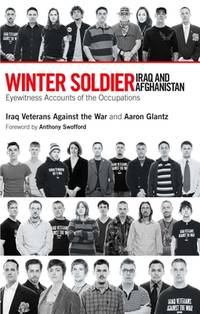
2008réf. Q-1931859655Haymarket Books 2008-09-01. Paperback. New. New. In shrink wrap. Looks like an interesting title! Haymarket Books paperback
réf. 1024291294.Ghardcover. Good. Access codes and supplements are not guaranteed with used items. May be an ex-library book. hardcover
réf. B9781015702929Hardback. New. hardcover
réf. 1015702929.Ghardcover. Good. Access codes and supplements are not guaranteed with used items. May be an ex-library book. hardcover
réf. 2h8810Railway Press Baghdad 1930. 317 pages with some glued corrections from the 30s and 40s hardcover spotted/some pencil markings. hardcover
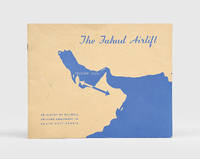
1955réf. 195609Hull: Newcom Press for Blackburn and General Aircraft Ltd after 1955. First edition recording the transport of over 129 tons of equipment from Umm Said in Qatar to Fahud in Oman the operational centre of Petroleum Development Oman. We have traced only two other copies: one at the Solway Aviation Museum and another we sold last year. The 365-mile journey "unique in the history of aviation" p. 3 was undertaken by a Blackburn "Universal" XB260 freighter the civilian equivalent of the RAF's "Beverley" model and was a collaboration between Blackburn and General Aircraft and Hunting-Clan Air Transport. The photographs illustrate the various phases of the operation as well as the drilling machinery and aircraft. Oblong octavo pp. 20. Illustrations throughout. Original pictorial wrappers wire-stitched as issued wrappers lettered in blue. Light creasing and marking: very good. unknown
1934réf. 194745London: Iraq Petroleum Company Limited 1934. Supplying Europe with Middle East oil First edition celebrating the construction of this critical oil artery. It discusses the history of the project its engineering and logistics challenges and the local diplomacy required to receive the necessary permissions. The many photographic illustrations show the pipeline at various stages of completion and profile the company employees that planned and organised this feat. In 1927 the Iraq Petroleum Company discovered a rich oilfield at Kirkuk and began to extract and transport crude at a never-before-seen scale. First the British proposed to connect Kirkuk with Haifa in Mandatory Palestine. However the French government demanded that the oil instead be sent to Tripoli so a twin pipeline was conceived that could service both ports. The pipes were 30.5 centimetres in diameter could carry a million tons of oil a year each and were supported periodically by 12 pumping stations. The two lines were constructed in parallel from Kirkuk to the city of Haditha the location of Pumping Station K-3 where they split into the northern "T Line" and the southern "H Line". Construction began in 1932 and was completed by 1934 on a budget of approximately £10000000. "Materials from overseas exceeded 200000 tons and building materials obtained locally at least equalled that" p. 2 The oil flowed until 1948 when the formation of the state of Israel led the Iraqi government to cut off the Haifa branch. This work details not just the construction of the pipeline but the communications infrastructure water supply transport routes and medical services that supported the workers. Chapter 13 discusses the company's land purchases employment of local labourers and artisans coverage in the press and work in the desert where they both employed and often had to guard against members of local tribes. Quarto. Folding map folding plan halftone photographic illustrations maps and tables in text. With publisher's compliments card loosely inserted. Original blue half leatherette spine gilt-lettered direct blue paper boards front board gilt-stamped with title and company logo blue endpapers. Spine sunned and a little soiled boards rubbed especially at extremities of front board small chip on front board top edge contents bright: a very good copy. hardcover
1969réf. IT-40FO-JC6L1969. Hardcover. Good. Oxford/RIIA 1969. Ex-library with the usual markings no jacket. Otherwise in nice shape with light wear clean pages firm binding. hardcover
1967réf. 90149Baghdad: Dar Al-Jumhuriya Press 1967. Paperback. Good. photos 16p. Softcover in original wrapper. 22cm. Heavy horizontal crease. Minor cover soil. Photos and claims concerning the use of Napalm Bombs by Israel during The Six-Day War. Dar Al-Jumhuriya Press paperback books
1967réf. 90149Baghdad: Dar Al-Jumhuriya Press 1967. Paperback. Good. photos 16p. Softcover in original wrapper. 22cm. Heavy horizontal crease. Minor cover soil. Photos and claims concerning the use of Napalm Bombs by Israel during The Six-Day War. Dar Al-Jumhuriya Press paperback
2004réf. 2091502135420122Gendaijin bun-sha 2004. Soft Cover. Fine. Number of books: 1 Gendaijin bun-sha paperback
1943réf. 84106Baghdad: Printed at the Government Press 1943. Paperback. Very Good. photo and 3 plans all grainy 9p. Softcover pamphlet in original stapled wrapper. 17 cm. Cover fading around edges. Printed at the Government Press paperback books
1943réf. 84105Baghdad: Printed at the Government Press 1943. Paperback. Very Good. 4 grainy photos amd plans 11p. Softcover pamphlet in original stapled wrapper. 17 cm. Printed at the Government Press paperback books
1943réf. IRAQ029525The Golden Cockerel Press London. 1943. First edition. Published by Permission of the War Office. Royal octavo. 127 pages. Photographs; endpaper map of the Levant-Caspian Front by the author. One of 500 numbered copies. Quarter blue morocco raised bands lettered in gilt. Top edge gilt. A sequel to The Golden Carpet a description of the British occupation of Baghdad. Some tanning to endpapers from the binder's glue. Very good indeed. The Golden Cockerel Press, London. hardcover