4 905 résultats
1961réf. 007445New York: Bollingen Series 1961. First Edition. wraps. Fine. Bloomfield & Mendelson B77. Published in an edition of 2500 copies none of which were for sale in white card covers with a grayish green printed wrapper. This is St.-John Perse's Nobel Acceptance Speech translated by Auden and printed here in both the original French and Auden's English translation. SIGNED by Auden on the title page. Quite uncommon especially signed. Bollingen Series paperback books
1963réf. 421121New York: Pantheon Books 1963. Hardcover. Very Good. Second edition revised with bibliography. Translated by Robert Fitzgerald. Quarto. 61pp. Black cloth. Light spray of paint flecks at the bottom of the top board else very good or better lacking the dustwrapper. Martha Graham's copy with her large ownership Signature. Bollingen Series LXIX. Pantheon Books hardcover
1963réf. 421121New York: Pantheon Books 1963. Hardcover. Very Good. Second edition revised with bibliography. Translated by Robert Fitzgerald. Quarto. 61pp. Black cloth. Light spray of paint flecks at the bottom of the top board else very good or better lacking the dustwrapper. Martha Graham's copy with her large ownership Signature. Bollingen Series LXIX. Pantheon Books hardcover books
1905réf. 144251905. Radiguet Arthur and T.H. McAllister collection of five lantern slides of Iran circa 1905 documents Qajar-era urban religious royal and archaeological sites as they were circulated through early twentieth-century photographic projection. The group records Tehran palace and garden settings Isfahan's Khaju Bridge Muslim worship inside a Persian mosque and the ruins of Persepolis giving the slides research value for the study of Iran's visual presentation to Western lecture audiences the commercial lantern-slide trade and the intersection of Qajar modernity with older Safavid and Achaemenid monuments. Qajar rule extended into the early twentieth century ending in 1925 making these images especially relevant to the final decades of the dynasty and to foreign visual consumption of Iranian architecture devotion and royal space. Five gelatin silver bromide positive glass lantern slides circa 1905 showing locations in Tehran Isfahan and Persepolis; each slide measures approximately 3 1/4 by 4 inches. The first image shows a Persian man in traditional dress walking within the Qajar Royal Palace and gardens; the second is an elevated view labeled "the Shah's gardens and the new neighborhoods" showing Tehran's royal garden landscape and adjacent urban development without enough evidence to confirm the method of photography. The third image shows the Khaju Bridge in Isfahan built under Shah Abbas II on the foundations of an earlier bridge and functioning as both bridge and weir across the Zayandeh River; the fourth shows a group of Muslims kneeling in prayer beneath a mosque archway; the fifth shows the ruins of Persepolis the Achaemenid capital founded by Darius I in 518 B.C. and later designated a UNESCO World Heritage Site. Three slides are attributed to Arthur Radiguet of Maison Molteni a French maker associated with lantern projection and slide production while the Khaju Bridge slide was produced by T.H. McAllister a New York firm known for selling magic lantern equipment and images. The set brings together dynastic Tehran Safavid civic architecture Islamic devotional practice and ancient imperial ruins offering a compact visual itinerary of Iran as framed for projected instruction or entertainment around 1905. The Khaju Bridge image is particularly useful for architectural history because the bridge linked the Khaju quarter with the Zoroastrian quarter and combined circulation water management and public gathering functions; the Persepolis image extends the group's chronology from modern Qajar Iran back to Achaemenid antiquity. Minor edge wear and light surface wear to glass mounts with images remaining legible; overall very good. A focused group of early photographic projection images of Iran useful for documenting how Qajar-era Tehran Isfahan mosque interiors and ancient Persian ruins were presented through the international lantern-slide market. unknown
1905réf. 144251905. Radiguet Arthur and T.H. McAllister collection of five lantern slides of Iran circa 1905 documents Qajar-era urban religious royal and archaeological sites as they were circulated through early twentieth-century photographic projection. The group records Tehran palace and garden settings Isfahan's Khaju Bridge Muslim worship inside a Persian mosque and the ruins of Persepolis giving the slides research value for the study of Iran's visual presentation to Western lecture audiences the commercial lantern-slide trade and the intersection of Qajar modernity with older Safavid and Achaemenid monuments. Qajar rule extended into the early twentieth century ending in 1925 making these images especially relevant to the final decades of the dynasty and to foreign visual consumption of Iranian architecture devotion and royal space. Five gelatin silver bromide positive glass lantern slides circa 1905 showing locations in Tehran Isfahan and Persepolis; each slide measures approximately 3 1/4 by 4 inches. The first image shows a Persian man in traditional dress walking within the Qajar Royal Palace and gardens; the second is an elevated view labeled "the Shah's gardens and the new neighborhoods" showing Tehran's royal garden landscape and adjacent urban development without enough evidence to confirm the method of photography. The third image shows the Khaju Bridge in Isfahan built under Shah Abbas II on the foundations of an earlier bridge and functioning as both bridge and weir across the Zayandeh River; the fourth shows a group of Muslims kneeling in prayer beneath a mosque archway; the fifth shows the ruins of Persepolis the Achaemenid capital founded by Darius I in 518 B.C. and later designated a UNESCO World Heritage Site. Three slides are attributed to Arthur Radiguet of Maison Molteni a French maker associated with lantern projection and slide production while the Khaju Bridge slide was produced by T.H. McAllister a New York firm known for selling magic lantern equipment and images. The set brings together dynastic Tehran Safavid civic architecture Islamic devotional practice and ancient imperial ruins offering a compact visual itinerary of Iran as framed for projected instruction or entertainment around 1905. The Khaju Bridge image is particularly useful for architectural history because the bridge linked the Khaju quarter with the Zoroastrian quarter and combined circulation water management and public gathering functions; the Persepolis image extends the group's chronology from modern Qajar Iran back to Achaemenid antiquity. Minor edge wear and light surface wear to glass mounts with images remaining legible; overall very good. A focused group of early photographic projection images of Iran useful for documenting how Qajar-era Tehran Isfahan mosque interiors and ancient Persian ruins were presented through the international lantern-slide market. unknown books
1902réf. 54881Publiées avec une introduction et des Notes par Charles Grolleau, un des 30 exemplaires sur papier du Japon (après 15 Chine) numérotés (n° 21), 1 vol. grand in-8 br. sous couv. rempliée, Charles Carrington, Paris, 1902, 158 pp. et 1 f.
1963Very Good Russian Original cloth bdg. Folio. (36 x 27 cm). In Russian. 23, [1] p., 45 numerous b/w nd color plates. Obrazchi kalligrafii Irana i Srednei Azii XV-XIX vv. Obrazchi miniatura i kalligrafiia v Leningradskikh sovraniiakh. Shapes of calligraphy of Iran and Central Asia in 15th-19th centuries.
2015New New English Original bdg. Dust wrapper. Folio. (32 x 23 cm). Text in Persian entirely, bilingual title in English and Persian. 445 p., color ills. (Richly illustrated). Kilim: Review of the history and art of Oriental flat woven carpets.= Gilîm: Chikîdah'î az târîkh va hunar-i takht bâftah'hâ-yi Sharqî. An oversize and very heavy volume.
réf. DADAX0199733309New unknown
1792réf. 22651(Wien, Schrämbl, 1792). 2 Bll., 299 S. Kl.-8°. HLdr. der Zeit mit goldgeprägtem Rückenschild (etw. berieben und bestoßen). [5 Warenabbildungen]
réf. 34523aafParis, Barrière frères, s.d. (ca. 1825), in-4to oblong, sans p. de titre + 37 planches gravées, (la gravure: 21x30 cm.) / ( la feuille 29x42 cm.), reliure en demi-cuir, fragile, pet. fente en bas de la charn. supér., plats recouverts de papier marbré, qqs lég. frottements et pet. taches.
réf. 102613Paris, Les Bibliophiles Franco-Suisses 1930, 300x240mm, 87pages, broché, en feuilles sous couverture à rabats et cartable rigide. Avec l’emboitage. Tirage à 125 exemplaires sur beau papier, n.° 73 imprimé pour Henri Gunthert. Bel exemplaire, hormis rousseurs sur le cartable et la couverture.
1827réf. 24377Paris Librairie orientale de Dondey-Dupré 1827 in-8 broché non coupé, sous couverture d'attente de papier bleu, étiquette de titre sur la première couverture
19358vo., First Edition, with a large folding map on japon as frontispiece, nd a folding map on japon; handsomely bound in burgundy full morocco, back gilt with five raised bands, second and fourth compartments lettered and ruled in gilt, all other compartments tooled and ruled in gilt, a most attractive copy ideal as a gift or for presentation. With small blind stamp on title. With 4pp contemporary catalogue from publisher John Murray loosely inserted. Lovely copy of a scarce and important work.
1929réf. 671643 numéros in-folio de 3 ff., s.d. [ circa 1929 -1930 ], Sétareh'yé-Djéhane. Journal quotidien persan-français, politique économique et littéraire (Trois numéros) Deuxième Année n° 192 (6 mars 1930) [ Contient notamment : ] La Perse d'aujourd'hui. La nouvelle ville de Chirvan ; Exécution de Grigor Khakaloff surnommé Gricha, à Kazvin ; n° 197 (12 mars 1930) : La commission de Contrôle des Devises étrangères ; Courteline et le Génie Comique ; La chute du cabinet iraquien. et numéro 200 (16 mars 1930) : Traité d'Amitié entre la Perse et les Pays-Bas ; Avis de la Banque Nationale de Perse sur le retrait des monnaies d'argent usagées.
réf. 184465Londres, Cooper et Wilson, pour Cadell et Davies, 1799 in-8, [4]-XXXVI-92 pp., texte farsi et traduction anglaise en regard, une collette d'errata "in fine", avec une vue dépliante en frontispice et une carte dépliante, demi-cartonnage d'attente, dos à faux-nerfs, étiquette de titre (reliure de l'époque). Rousseurs. Manque le dos.
1886réf. PHO-2098Paris, Klincksieck, 1886 (1887 sur la couverture). In-8, brochage éditeur avec petits défauts, VIII-413 pp. (introduction, traduction annotée et notes), suivies du texte persan imprimé en fin de volume, non coupé en partie.
réf. 217881Paris, Maison Quantin, (1887) in-4, [5]-453 pp., portrait en frontispice, de nombreuses illustrations in-t. et h.t., pleine percaline rouge illustrée, dos lisse, titre et illustration dorée sur le premier plat, tranches dorées (reliure de l'éditeur). Infimes usures. Bon exemplaire.
1798réf. LBW-7951[Paris, P.G. Chanlaire et E. Mentelle, An six de la République - 1798]. 328 x 430 mm, sur papier bleuté.
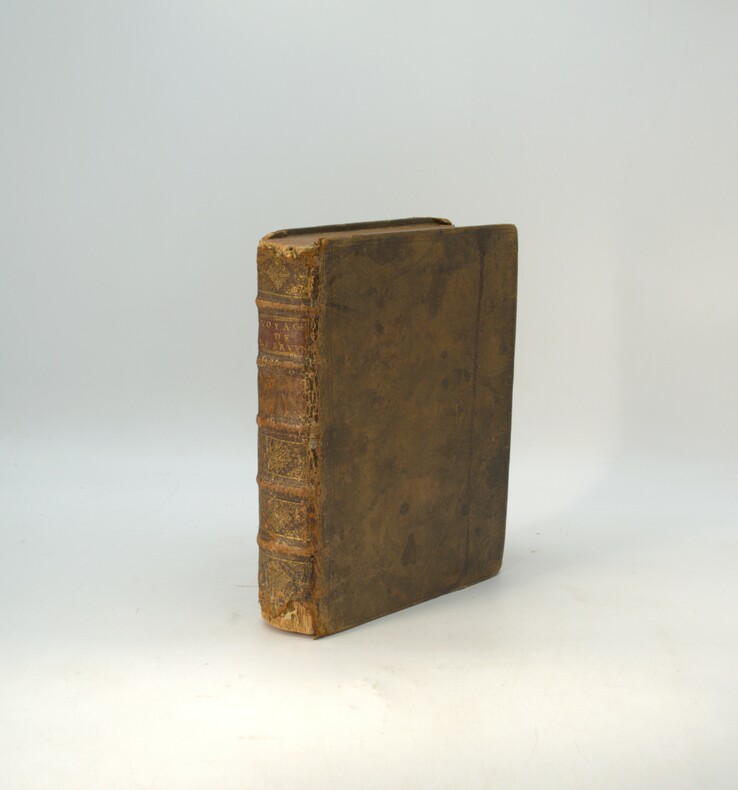
1686réf. PHO-1691Amsterdam et Paris, Daniel Horthemels, 1686. In-12 relié en plein veau d'époque, dos à nerfs, pièce de titre, 3 ff. avec déchirures marginales sans perte, 12 ff., 432 pp., 4 ff., illustré d'un titre frontispice, du portrait de Chardin, de 3 vignettes de chapitres, d'une carte dépl. du Pont-Euxin, et de 15 pll. (dont 13 dépl.). Les plans suivants sont incomplets (Téflis, Festin de Téflis, Kachan, Caravansérail de Kachan, Kom), trace d'adhésif sur une planche, mors fendu, épidermures, coiffe de tête arasée, cachet.
1725réf. PHO-2134Paris & Rouen, J.B.C Bauche, Ferrand, Machuel, 1725. 1 Volume in-4° (5) (25x19cm), 9ff.-648pp.-6ff., veau époque, dos à nerfs orné avec pièce de titre, tranches rouges, illustré d’un portrait gravé de l’auteur gravé par Scotin en frontispice, 1 carte dépliante, 12 planches gravées (dont 1 dépliante), frottements, manque au dos en pied et aux coupes, coiffes usées, coins usés, rousseurs, planches brunies, petit travail de ver, en marge, sans atteinte sur une trentaine de feuillets, tâche au titre, manque la pièce de tomaison.
réf. ORD-3162Edition préoriginale de la relation illustrée du premier voyage de Marcel et Jane DIEULAFOY, regroupement des articles parus dans le Tour du Monde en 1881-1882. In-f°(235 x 315mm) dos à 5 nerfs, titre or et coins chagrin tête de nègre, plats et gardes jaspés, tête dorée, 160 pages, puis pages 145 à 224, 97 à 144, 81 à 160 et 49 à 112 soit 432 pages, très nombreuses illustrations dans et hors texte en premier tirage. Menus défauts mais très bel exemplaire. Ex-libris Madame Léon.
1960réf. 78121Tehran: Majlis Printing House 1960 1961 1962. 3 books. 1 cloth and 2 wrappers. 530 pp. portrait 576 pp. & 260 pp.; 27x22 cm. With 6 large fold-out maps. Text in Persian. signs of use including wear to the bindings and a previous owner's stamp on the endpapers. The maps are in good condition with minor folds and discoloration typical of age. The set is being sold as-is w.a.f. - with all faults See pictures - rare Volume 1 This volume contains detailed statistical tables and administrative divisions but does not include maps. The focus is on providing geographic and administrative information for these specific provinces. Volume 2 576 pages covers regions 5 6 7 and 8 and includes four large fold-out maps. Volume 3 260 pages focuses on regions 9 and 10 with two large fold-out maps. The books provide detailed tabular data on villages including administrative divisions and geographic references supplemented by high-quality maps. Majlis Printing House hardcover
réf. 238200Paris, Firmin-Didot, 1895 grand in-8, [2] ff. n. ch., 368 pp., avec des illustrations dans le texte et 21 planches hors texte, dont un portrait-frontispice (le Shah), un plan de Persépolis, et une carte, demi-maroquin Bradel cerise, dos fleuronné (Carayon). Rousseurs.
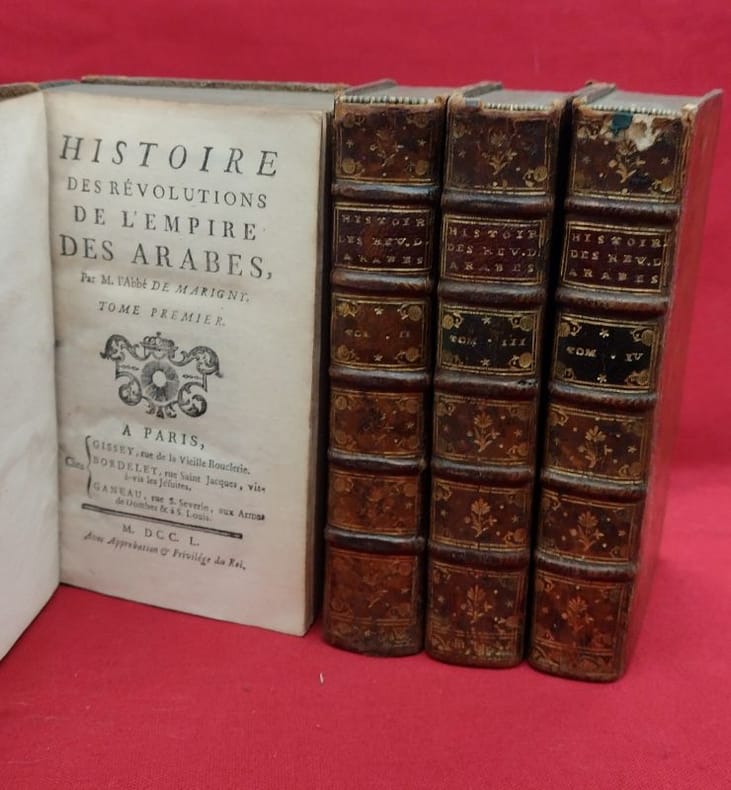
1750réf. 118710gisset, bordelet, ganeau 1750 4 in-12 A Paris, chez Gissey, Bordelet, Ganeau, 1752, 4 volumes in-12, (2) ff., LX, 58, 498 pages, (3) ff.-(2) ff., 519 pages - (3) ff., XIV, 540 pages - (2) ff., 525 pages. Plein veau marbré, dos à cinq nerfs portant titres et tomaisons dorés sur pièces de cuir, caissons ornés, filets d'encadrements des plats à froid, filet doré sur les coupes, roulette dorée sur les chasses, tranches mouchetées de rouges, gardes de papier marbré peigné. Cinq coiffes manquantes ou endommagées, coins frottés, rares rousseurs, sinon bon état général.