1926rif. 1238281Auckland, The Unity Press, 1926. 49, (1) S. m. 20 Abb., 2 mehrf. gefalt. Karten (davon 1 farbig). Illustr. OLwdbd (Vorsätze leimschattig).
1969rif. 1321032Oslo, Heirs of B. Kroepelien, 1969. 4to. Titelporträt, 68 S., 2 Bl., 455 S. OLwd.
1991rif. 214741Firenze Italy: FOS 1991. First edition and first printing. Hardcover. 71 pages. Text in Italian with contributions by Silvestro Serra and Giorgio Van Straten. Includes dramatic black and white photographs by Massimo Pacifico. A very near fine copy in a very near fine dust jacket. A beautifully printed and designed book. FOS unknown books
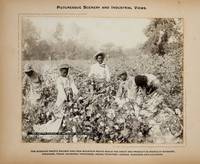
rif. 54049Seattle WA: Alaska Pacific Salmon. 12mo pp. 30. Index. Centerfold color illustration. Paper wraps. Coverand edges little spotted and worn o/w VG. Alaska Pacific Salmon unknown books
1970rif. 151354N.p.: N.p. 1970. Archive of 32 vintage photographs documenting the October 20 1970 collision of two trains along the Chicago Rock Island and Pacific Railroad line in Raytown Missouri. Also included in the archive is a single broadside reward poster offering $5000 for information pertaining to the accident. According to a contemporary newspaper article which appeared in nearby Jackson County's Independence Examiner the accident was believed to have been caused by juvenile vandalism to a nearby track switch. The collision and subsequent derailment resulted in the death of one engineer whose partial body is visible in several photographs. The photographs in the archive range from close-up shots of the mangled train cars and tracks to distance views of the surrounding woods. Frequently displayed in the images is a small handwritten police chalkboard noting the date location and case numbers. A vivid and interesting look at investigative photography and railway disasters in the late twentieth century. Photographs 10 x 8 inches housed in a manila envelope with the logo of Chicago Rock Island and Pacific Railroad Co. on the top left corner. Reward poster 9 x 12 inches. Poster and photographs Near Fine overall envelope Very Good plus. N.p. unknown books
1945rif. 346550The Pacific Theater 1945. Together 10 scattered issues of the above titled mimeographed typescript military newspapers. Small folio. Stapled as issued. Usual folds. Together 10 scattered issues of the above titled mimeographed typescript military newspapers. Small folio. Includes the following: The Noordam News. "Somewhere in the Pacific" i.e. aboard the transport ship Noordam II April 8 1943. Vol. 4 No. 2. 2pp. April 11 1943. Vol. 4 No. 6. 4pp. April 11 1943. Vol. 4 No. 7. 4pp. Warcast. Bougainville Island and elsewhere in the Pacific February 1 1944. 2pp. February 9 1944. 2pp. March 4 1944. 2pp. March 13 1944. 2pp. March 14 1944. 2pp. March 19 1944. 2pp Last Lap. USAT Etolin. October 23 1945. Issue No. 11. 4pp. Each of the above issues is inscribed in pencil "Co. G" possibly of the 182nd Infantry and several have the name "Milt Elberg" written on it. The news incudes general war news from the Pacific theater radio intercepts from Tokyon world news unrelated to the war humorous news from home and often "local news" or the heroics and humorous mishaps of soldiers. unknown books
1961rif. 224201961. U.S. Naval Missile Center Authors and Editors Handbook 1961 establishes standardized authorship formatting and editorial control for technical reports produced at the Pacific Missile Range documenting the internal communication systems that supported U.S. guided missile and early satellite programs during the Cold War. Issued for personnel at Point Mugu California the manual defines procedures for drafting reviewing and disseminating classified and technical material tied to weapons development providing direct evidence of how military knowledge was structured codified and circulated within federal defense infrastructure. The inclusion of a contemporaneous typescript insert History of the Pacific Missile Range February 1961 further situates the handbook within active missile testing and space recovery operations supporting research into Cold War science military bureaucracy and the integration of documentation practices into weapons development. Pacific Missile Range and U.S. Naval Missile Center. Authors and Editors Handbook. Point Mugu CA: U.S. Naval Missile Center 1 August 1961. First edition. Publication No. NMC-MP-61-9. Quarto format 218 pages with an additional 5-page typescript insert titled History of the Pacific Missile Range February 1961 issued by the Public Affairs Office. Three-hole-punched sheets bound with cloth tape and printed card wrappers. The handbook is organized into four sections: Report Preparation Manuscript Preparation Language Grammar and Punctuation and Matters of Style outlining requirements for technical clarity typographic consistency and standardized formatting across naval missile documentation. The inserted historical report traces the establishment of the Pacific Missile Range in 1957 under William Holaday and details its expansion into "an ocean-spanning instrumented network capable of supplying information on the launching guidance and impact of the nation's largest missiles and satellites." Documented events include "On 16 Dec 1958 the first REGULUS II missile was fired" and the recovery of "DISCOVERER XIII. making it the first man-made object ever recovered from orbit" providing a contemporaneous record of early U.S. missile and satellite operations. Produced during a period of rapid expansion in U.S. missile testing and space reconnaissance the manual demonstrates how technical writing standards were integrated into military systems to ensure uniformity precision and reliability in the production of strategic knowledge. References to parallel guides such as Guide for Air Force Writing and Preparation of Weapon-Test Reports indicate alignment across branches of the armed services in codifying technical communication. The Pacific Missile Range functioned as a central node in Cold War weapons testing linking launch sites tracking stations and recovery operations across the Pacific and the documentation practices outlined here formed part of the operational infrastructure supporting those activities. Chipping to spine tape light edge wear to wrappers and faint soiling to covers; interior clean and complete including all tables figures and inserted report. Overall very good condition. unknown books
1900rif. 373823St. Louis 1900. 34 photographs mounted recto and verso on 17 cards with printed album title on each the images captioned in the negative on linen guards. Oblong small folio 10-1/8x12-1/2 inches. Contemporary half calf and cloth covered boards titled in gilt on the upper cover leather perished contents loose. The images generally dark printings in good condition. Provenance: Battery Park Hotel Asheville NC presentation in gilt on the upper cover from H. C. Townsend Gen'l Pass'r and Ticket Agent St. Louis. 34 photographs mounted recto and verso on 17 cards with printed album title on each the images captioned in the negative on linen guards. Oblong small folio 10-1/8x12-1/2 inches. The images by an unindentifed photographer comprise lovely compositions of buildings and scenes along the route in Missouri Kansas Nebraska and Arkansas. OCLC locates only a single example at University of Texas Austin. unknown books
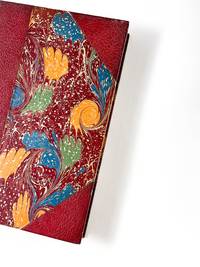
1885rif. 53538Paris: Imprimé pour Isadore Liseux et ses amis 1885. First edition thus. Near fine. First vernacular translation of these suppressed Latin elegies that include the most explicit poetic expressions of homosexual desire of the Italian Renaissance. The HECATELEGIUM was first published in Florence in 1489 by a poet so notorious for his open homosexuality that Machiavelli named him in a 1501 letter as one of those poets who would have been burned at the stake had they not been protected by powerful cardinals "qui nisi haberent refugium in asylum nunc huius nunc illius Cardinalis combusti iam essent". Massimi's fame during his long life was nearly extinguished over the centuries of suppression and silence that followed which saw a heavily bowdlerized edition of the HECATELEGIUM published in Parma in 1691 and this privately printed edition in French and Latin only in 1885 the first uncensored edition since 1523. Though the Latin of this edition is complete certain obscene Latin words are printed in Greek rather than French in the facing translation still deemed too filthy to be read by anyone without a protective classical education. Undertaken by the shadowy publisher Antoine-Isidore Liseux 1835-1894 it was printed in Liseux's elegant typographical style in a "private" edition of 120 copies. Rare and important. 9.75'' x 6.5''. Later three-quarter cherry-red calf over marbled boards signed "Canape Belz" with matching marbled endpapers. Edition of 120 copies this copy no. 80. Text in French and Latin. xvi 354 2 pages. Minor rubbing to extremities. Old shelf label removed from head of spine. Else bright clean and sound. Imprimé pour Isadore Liseux et ses amis unknown books
1870rif. 354323New York: E. & H.T. Anthony & Co 1870. Single stereocard 3½ x 7 inches. Stereo image mounted onto printed orange cardstock. Slight wear at edges. Very good. Single stereocard 3½ x 7 inches. An appealing stereocard image showing several long stretches of railroad track heading into the small town of Ogden Utah. It is a view of an important point crossing point in American railroad history as Ogden is the point at which the Union Pacific Railroad ends and the Central Pacific begins. A train can be seen on the tracks in the far distance as well as a few clapboard buildings. The New York photographic firm of E. & H.T. Anthony & Co. produced several stereoscopic views for the Central Pacific Railroad though few are known today. A nice image of an important railroad intersection. E. & H.T. Anthony & Co unknown books
1870rif. 354322San Francisco: Thomas Houseworth & Co 1870. Single stereocard 3½ x 7 inches. Stereo image mounted onto printed orange cardstock. Slight wear at edges. Very good. Single stereocard 3½ x 7 inches. A very attractive single stereocard image of the Central Pacific Railroad's "Long Ravine Trestle Bridge." The bridge is located in Nevada County California in the Sierra Nevada mountain range just west of the Nevada state line. The image comes from a set sixty-two stereocards created by Thomas Houseworth & Company for the railroad some time after the railroads completion in 1869. According to the website of the Central Pacific Railroad www.cprr.org the Houseworth company produced more than one hundred such stereocards for the railroad including more than a dozen views of the 878-foot long Trestle Bridge. A nice early stereoscopic image of an engineering wonder from an important American railroad. Thomas Houseworth & Co unknown books
1819rif. 249959N.p. Paris 1819. One page in French. 8vo. One page in French. 8vo. The Neapolitan-born Gaspare Luigi Pacifico Spontini 1774-1851 was a celebrated composer of operas in his day who made his career in Paris under the patronage of the Empress Josephine. His most famous opera LA VESTALE premiered in Paris in 1807 and according to Grove's Dictionary underwent over 200 performances in Paris by the year 1824. As late as 1954 in fact in celebration of the composer's 180th birthday it enjoyed a revival at La Scala with Maria Callas in the leading role. According to calendars only these two years during Spontini's time in Paris had a September 22 which fell on Wednesday. Spontini left Paris in 1819 to accept a position with the Dresden opera. unknown books
1946rif. 11530Raleigh North Carolina: Hillsborough House 1946. First Edition. Leather bound. Near fine. The Story of the Fifth Bombardment Group Heavy published in 1946. Octavo 104pp. Publisher's faux red leather title embossed on front cover. Light wear to tips some shelf wear solid text block. Free of any marks or notations. Complete with many black and white photographs maps and illustrations. Full title reads: The Story of the Fifth Bombardment Group Heavy. The History of the Bomber Barons of the Thirteenth "Jungle" Air Force as compiled by the 5th Group Historical Officer and released for publication by the 13th Air Force Public Relations Officer. Hillsborough House unknown books
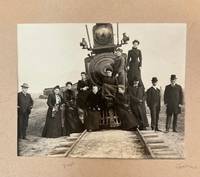
1902rif. 236271902. Early twentieth century American travel photograph album with accompanying handwritten identification notes circa 1900 to 1905 documenting the travels of the family of Texas & Pacific Railway official C. G. Warner through the railroad steamship and hotel networks that connected the American Southwest with Europe during the mature era of international leisure travel. The accompanying manuscript key identifies family members railroad scenes buildings and destinations throughout the album transforming anonymous travel photographs into a documented record of an identifiable railroad family. The notes further preserve family tradition explaining that Warner traveled to Europe in 1902 for medical treatment providing a narrative framework that links the railroad photographs Atlantic crossing and European views as a documented journey. Photo album of silver gelatin photographs various sizes most approximately 3.5 x 3.5 inches the largest approximately 6.25 x 8.25 inches United States Europe and Mexico circa 1900 to 1905 accompanied by four pages of handwritten identifications. The opening sequence depicts repeated group portraits posed around Texas & Pacific locomotive no. 21 including women standing on the pilot smokebox running boards and cab additional views of the locomotive in profile railroad employees passenger cars station scenes and the Railroad Young Men's Christian Association building. The handwritten notes identify C. G. Warner in multiple railroad photographs and suggest he served as a director of the Texas & Pacific identify Elizabeth W. Douglass in an early family portrait distinguish mail or express cars identify Warner's private railroad car and name additional family members including Aunt Libbet Anna Warner Clara K. Green Clara Kooser and H. B. Kooser. The journey continues aboard the American Line steamship SS St. Paul including deck scenes crew members harbor views and a large commercial photograph of the liner under way. European photographs include the Arc de Triomphe the Paris Opéra lakeside towns and grand hotels in Switzerland the Palace of Westminster and Big Ben in London streetscapes waterfronts public gardens and prominent civic buildings. Family members appear throughout in formal portraiture seaside recreation hotel grounds and informal gatherings while additional photographs record Juárez Mexico and substantial American residences photographed before departure. The handwritten notes record that C. G. Warner Aunt Juliett and Aunt Libbet sailed on April 2 1902 returning on June 3 after spending most of their journey in France with a shorter stay in England and state that Warner traveled abroad because of poor health to "take the baths." The notes further preserve family recollection that contemporary newspapers reported Warner "derived much benefit from two months' rest" before spending time in the Gould offices upon his return to New York placing the photographs within a documented episode in the life of a named railroad executive rather than an anonymous vacation. Viewed alongside the photographs the manuscript identifications establish people places transportation infrastructure and chronology substantially strengthening the documentary character of the album. Red stained leather album with black pasted decoration; pages 7 and 9 loose binding heavily worn album leaves toned photographs clear and firmly adhered. Overall in good condition. A documented visual record of one American railroad family's movement through the interconnected rail steamship and hotel systems that carried affluent travelers between Texas New York Mexico and Europe at the beginning of the twentieth century. unknown books
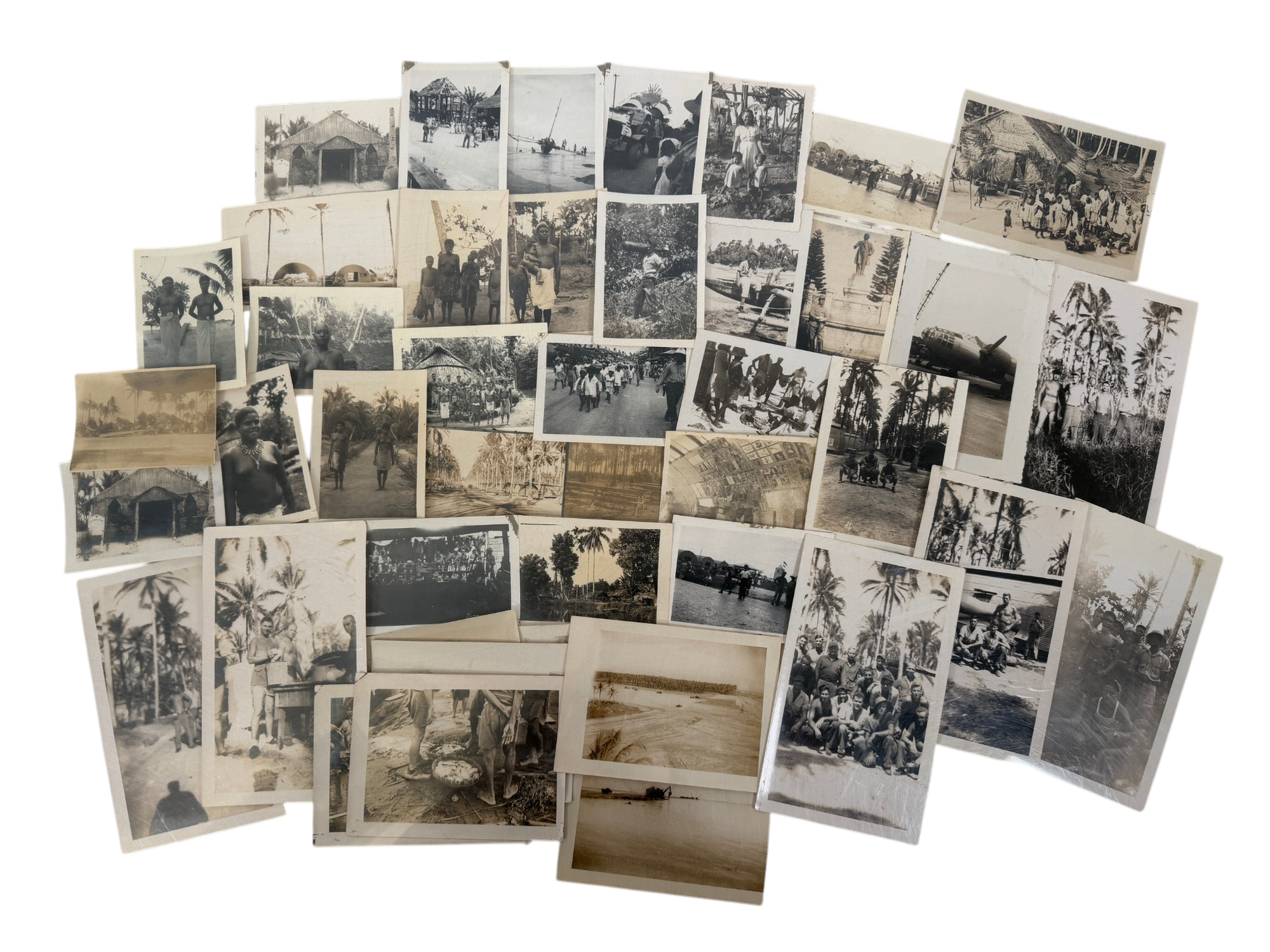
1944rif. 231791944. WWII Indigenous Peoples U.S. soldier photographs recording military occupation transport and daily movement across the Admiralty Islands Samar and the Philippines during World War II and its immediate aftermath establishing how American forces operated through island bases coastal landings aircraft facilities and encounters with local indigenous communities. Made and retained by an unidentified American serviceman the group follows the circulation of personnel through several linked wartime zones rather than a single camp with local captions on the versos anchoring parts of the sequence to "Admiralty Islands" "Samar Island" and the "Philippines." This archive showcases soldiers posed at encampments and beside aircraft landing craft and small boats military vehicles moved through settlements and photographs of Indigenous and Filipino civilians showing the human landscape through which U.S. forces advanced occupied and remained into the surrender period. Photo archive of 45 likely silver gelatin photographs ranging from 2.5 x 3 to 3.5 x 5.75 inches Admiralty Islands Samar and the Philippines circa 1944 to 1945. Numerous versos carry manuscript identifications including "on Admiralty Islands" "Natives on admiralty Islands" "Samar Island" "Samar Philippines" "Philippine" and "chapel in philippines" while several prints bear circular "Passed by Naval Censor" stamps and one caption reads "Jap bomber Betty Sept. 1945 Samar" fixing at least one portion of the group to the post surrender occupation moment. The images include shirtless American servicemen posed in palm lined camps group portraits outside Quonset huts or temporary structures a parked twin engine military aircraft a beached or near shore vessel soldiers gathered around tables and equipment and an Asian soldier who looks to possibly be in Japanese uniform standing in front a monument. Many photos show the local community with views of thatched buildings colonial era religious structures village crowds market or street scenes women and children gathered before huts and several close portraits of Indigenous islanders. The photographs belong to the final phase of the Pacific war when the Admiralty Islands served as a major Allied base complex after the 1944 campaign and Samar remained part of the wider Philippine theater retaken from Japanese control and held through the end of the war. This on the ground perspective shows how soldiers' photos moved through censorship channels recorded the built infrastructure of island warfare and fixed the asymmetrical encounter between U.S. servicemen and local populations. Minor surface and edgewear album glue residue en verso images remain clear and writing legible; overall very good condition. The combination of location notes naval censor stamps aircraft and coastal transport scenes and sustained views of local communities offer a raw visual representation of American military presence across the Southwest Pacific. unknown books
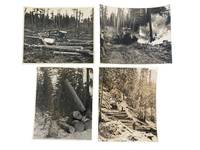
1920rif. 233311920. Logging Pacific Northwest logging industry photo archive documenting systems of timber extraction in Oregon Washington and Northern California during the early twentieth century illustrating how camps moved logs through cutover ground snowbound slopes skid roads and mechanized loading sites. The prints show the sequence of logging work: clearing hauling lifting sorting and burning slash as part of industrial forest production across the western lumber belt. Photo archive of 4 large silver gelatin photographs each approximately 8 x 9.5 inches Northern California Oregon and Washington circa 1920s-1940s. One photograph shows a jammer raising a massive log while a worker stands in the foreground with peavey in hand and freshly cut rounds stacked beside the machine; the verso reads "Jammer bringing in W.P. log / Park River Lbr. Co." Another records winter logging on a steep snow-covered hillside where a horse team and two workers move timber down a built log road; the verso notes "I-20 / winter logging at camp 23 PFI / 1019-CL." A third shows a bulldozer amid a broad cutover tract strewn with felled trunks and stumps emphasizing road building and ground clearing after cutting. The fourth captures active burning in the forest with smoke rising around a dozer and a handwritten verso caption reading "Burning out skid road with dozer." Captions include "PHOTO FROM / WESTERN PINE ASSOCIATION / Yeon Building Portland 4 Oregon / PLEASE RETURN" stamps a Rognon Studio Westwood California stamp and a Haas Brown Seattle studio mark preserving the circulation history of the prints within western forestry and commercial photography networks. These photographs come from the period when Pacific Northwest logging shifted across overlapping systems of machinery camp roads and organized slash disposal concrete evidence of how western timber companies converted forest land into transportable lumber under changing technological conditions. Creasing to corners and minor loss at corner margin on one image. Overall clear and sharp very good condition. The photographs preserve the working sequence of regional resource extraction and the transformation of forest landscapes in the Pacific Northwest. unknown books
1939rif. 71827Death Valley Junction California: Pacific Coast Borax Company 1939. 8vo pp. 64; frontispiece portrait with perforated stub maybe suitable for framing; original printed wrappers; very good clean and sound. A short-lived periodical - only this one issue published by the Pacific Coast Borax Company ever appeared - containing seven uncredited radio scrips for "Death Valley Days" all pertaining to Death Valley and the extraction of borax. "Borax first came into common use in the late 19th century when Francis Marion Smith's Pacific Coast Borax Company began to market and popularize a large variety of applications under the 20 Mule Team Borax trademark named for the method by which borax was originally hauled out of the California and Nevada deserts" Wikipedia. Yale and Bowling Green only in OCLC. Pacific Coast Borax Company unknown books
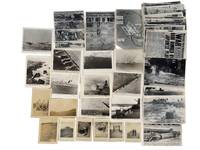
1945rif. 213921945. U.S. military operations in the Pacific Theater during World War II photograph and newspaper archive 1941-1945 documenting the Battle of Iwo Jima and the attack on Pearl Harbor. The archive pairs soldier-taken snapshots with official U.S. Navy and press photographs showing how combat equipment and battlefield conditions. The featured original snapshots contain handwritten notations en verso identifying dates specific locations soldiers and equipment. The archive comprises 39 silver gelatin photographs ranging from roughly 3.5 x 5 to 6 x 8 inches together with original wartime front pages of the Honolulu Star-Bulletin covering the attack on Pearl Harbor the fall of Italy and the Allied invasion of Europe. Images include amphibious landings on the black sand beaches of Iwo Jima with landing craft advancing under naval bombardment; U.S. Navy battleships destroyers and landing craft firing on shore defenses; and aerial scenes of dogfights and bombing runs. Close-up battlefield images depict the wreckage left in the wake of combat including destroyed landing craft craters from naval artillery and Japanese fortifications. Several photographs focus on the role of air power with images of Japanese aircraft under attack U.S. planes engaging in dogfights and B-29 Superfortresses bombing enemy positions. A particularly striking image captures a Japanese bomber scoring a direct hit on the USS Yorktown with billowing smoke rising from the carrier. Handwritten notations on some images identify U.S. servicemen locations such as Mount Suribachi and captured Japanese positions. The series of larger military-produced photographs and newspaper clippings have inscriptions on verso identifying locations and vessels depicted as well as the name tag "K .Benden." Among these are portraits of American soldiers posing at key strategic points inspecting captured bunkers and standing beside wrecked aircraft. Reconnaissance images show terrain and fortified positions; ground-level views show cratered landscapes wrecked landing craft and captured Japanese fortifications. One image shows the USS West Virginia during the Pearl Harbor attack with fire damage and crew visible; another shows a Japanese aircraft striking the USS Yorktown. Other photographs show servicemen near Mount Suribachi inspecting bunkers and beside wrecked aircraft. Many images carry printed captions within the negatives; others have handwritten verso annotations identifying locations dates vessels and personnel including one marked "K. Benden." Light wear minor edge creasing and occasional surface marks; overall in very good with strong image clarity. unknown books
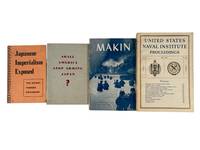
1939rif. 214021939. Four wartime pamphlets and periodicals 1939-1945 documenting American interpretations of Japanese expansionism prewar economic policy debates and U.S. military operations in the Pacific Theater. The materials illustratr how military governmental and institutional publications framed Japanese imperial strategy and justified American military response while also presenting technical and battlefield analysis intended for both military and informed civilian audiences. These works collectively offer insight into wartime messaging strategic interpretation and the evolving American understanding of Pacific conflict from prewar trade tensions through active combat operations. Four printed works issued between 1939 and 1945 including Shall America Stop Arming Japan 1939; Japanese Imperialism Exposed: The Secret Tanaka Document 1942; United States Naval Institute Proceedings Vol. 69 No. 485 May 1943; and Makin U.S. War Department 1944. Staple-bound and softcover formats illustrated with photographs maps charts and technical diagrams. Shall America Stop Arming Japan presents statistical charts detailing American exports of strategic materials noting that Japan sourced significant percentages of copper scrap iron and petroleum from the United States accompanied by arguments advocating embargo. Japanese Imperialism Exposed reproduces the controversial Tanaka Memorial describing a proposed sequence of territorial conquest beginning with China and extending across Asia and the Pacific. Makin issued by the War Department's Historical Division provides a detailed narrative of the U.S. Marine assault on Makin Atoll with photographs of tanks infantry movement and captured terrain alongside fold-out maps showing defensive positions and invasion routes. United States Naval Institute Proceedings includes articles analyzing naval aviation logistics and strategic doctrine with photographic illustrations of aircraft such as the XLRQ-1 seaplane glider and PV-1 Ventura patrol plane as well as discussions of wartime and postwar naval policy. Together these publications trace the progression of American engagement with Japan from economic and diplomatic tension to full-scale military conflict combining advocacy intelligence interpretation and operational reporting. The juxtaposition of prewar policy argument with wartime combat analysis and technical discussion demonstrates the range of printed materials used to inform persuade and document during the Pacific War. These works support research into wartime propaganda military strategy and the informational frameworks through which the United States understood and prosecuted the war against Japan. Light wear to spines and edges with minor toning to pages; overall very good condition. A cohesive grouping illustrating the intersection of policy debate ideological framing and battlefield documentation in World War II print culture. unknown books
1944rif. 186041944. Bilobran J. United States Navy sailor photograph album documenting naval service in the Southwest Pacific theater during World War II and preserving visual evidence of American naval personnel operating in the Pacific war zone. The album records daily life among U.S. Navy sailors as well as scenes from active military environments during the Pacific campaigns that followed the Japanese attack on Pearl Harbor in December 1941. The photographs include images of sailors aboard naval vessels wartime training and weapons operation and interactions with local populations encountered in Pacific combat zones. Several photographs depict American personnel arriving on the shores of Leyte in the Philippines a location central to the 1944 campaign in which Allied forces began the liberation of the Philippine Islands under the broader command structure of General Douglas MacArthur. Photograph album compiled by U.S. Navy sailor J. Bilobran during service aboard USS Douglas A. Munro in the Southwest Pacific theater during World War II. The album contains 203 black and white silver gelatin photographs mounted on black paper pages along with a pasted pamphlet from a Navy Day program and a hand drawn illustration. The photographs show sailors in uniform aboard naval vessels operating deck guns and handling firearms alongside informal scenes of recreation including dancing drinking and gatherings among crew members. Additional images depict sailors ashore in Pacific locations including Leyte in the Philippines where American forces conducted amphibious operations during the campaign to reclaim the islands from Japanese control. The album also includes photographs of Filipino civilians and guerrilla fighters along with images of Filipino women in traditional clothing illustrating encounters between American military personnel and local communities during wartime operations. Album containing 203 silver gelatin photographs measuring approximately 2.5 x 3.5 inches to 4.5 x 5.5 inches mounted in a brown faux leather photograph album bound with cord and measuring approximately 11.5 x 15.5 inches. Photographs accompanied by a Navy Day program pamphlet and a hand drawn illustration pasted onto the album pages. Minor wear consistent with age; photographs remain clear and well preserved overall. The album offers a substantial visual record of American naval presence in the Southwest Pacific during the Second World War and documents both combat environments and the daily experiences of sailors stationed in the Pacific theater. unknown books
1920rif. 88634Los Angeles 1920. Paperback. Very Good. 20p. Softcover in original stapled wrapper. 17cm. Minor cover soil. While Prince Hall affiliation does not appear to be mentioned in this constitution this came to us with other Prince Hall material. Harry Lewis is listed as chairman of the three member committee which created this constitution and a Harry Lewis is listed as Past Eminent Grand Commander 1914 on the website of the Pacific Prince Hall Grand Commandery of Knights Templar for the State of California. paperback books
1900rif. 51798Chicago: Curt Teich & Co. for the Van Noy Inter-State Co 1900. Oblong 4to unpaginated; 25 full-pg illustrations in color and mounted two pages of text containing illustration descriptions; tan pictorial wrappers lettered in black & gilt color illustration mounted on upper cover ribbon-bound; covers a bit toned at edges corners creased illustrations clean & bright overall very good. A picturesque view-book of "the most interesting views seen along the route" of Utah Nevada and California. Curt Teich & Co. for the Van Noy Inter-State Co unknown books
1918rif. 47858Restigouche P. Q.: Micmac Messenger 1918. First edition 12mo pp. 78; bound with as issued: Mesoi maoi alasotmamgeoel. Tapoooei neogtipongeg gis oen minoi sigentasit teli ginamot. Catechisme de preseverance 2 liturgique pp. 79 80-198; 56 zinc-block illustrations between both titles; title in French English and Micmac; table of contents in English main text in Mi'kmaq; cloth backed pink paper covered boards; corners bumped else near fine. Pacifique de Valigny née Henri-Joseph-Louis Buisson was a Capucin French missionary who wrote and published a number of religious materials for the benefit of the Mi'kmaq and Gaspe people. A version of the Petite histoire was also published without the second section. Micmac Messenger unknown books
1913rif. 47851Ristigouche P. Q.: Capucins 1913. 12mo pp. 128; bound with as issued: Gtapegiemgeoel = Canticles. pp. 32; 54 zinc-block illustrations; text in Mi'kmaq; green paper covered boards backed in blue cloth; covers lightly stained very good. The date on the cover is noted as 1921 though the text clearly comes from the same edition as other copies of the 1913 edition. It's likely that the gatherings were remainders bound just prior to the 1921 edition going to print. Pacifique de Valigny née Henri-Joseph-Louis Buisson was a Capucin French missionary who wrote and published a number of religious materials for the benefit of the Mi'kmaq and Gaspe people. Capucins unknown books
1908rif. 47879New York: J. Fischer & Bro 1908. Broadsheet title on recto musical notation on verso; lyrics in Micmac; paper evenly toned near fine. Pacifique de Valigny née Henri-Joseph-Louis Buisson was a Capucin French missionary who wrote and published a number of religious materials for the benefit of the Mi'kmaq and Gaspe people. J. Fischer & Bro unknown books