6 467 résultats
19304 pages. 7" x 5.5". Charming front cover color illustration of the Parliament Buildings in Victoria, B.C. Nostalgic color illustrations of vessel service staff inside. Dated Aug. 4 with Chief Steward A.E. Burnley and Commander Robert Marquart. Back cover doubles as back of postcard which guests are encouraged to complete and mail to family and friends, postage provided. Undated - probably circa 1930s. Was folded in half. Clean and unmarked with moderate wear. A nice vintage item. Book
1930réf. 652H2780USA: Pacific Steamship Company / The Admiral Line 1930. Book. Good. Pamphlet. First Edition. 12mo - over 6¾" - 7¾" tall. 4 pages. 7" x 5.5". Charming front cover color illustration of the Parliament Buildings in Victoria B.C. Nostalgic color illustrations of vessel service staff inside. Dated Aug. 4 with Chief Steward A.E. Burnley and Commander Robert Marquart. Back cover doubles as back of postcard which guests are encouraged to complete and mail to family and friends postage provided. Undated - probably circa 1930s. Was folded in half. Clean and unmarked with moderate wear. A nice vintage item. Pacific Steamship Company / The Admiral Line Paperback
194698 pages. Fiction: See you in the movies; The black devil; Papa played the cello; Bright message; A drive through the country; The outraged heart (part 3 of 4). Articles: Trieste - Battleground for Peace - article with photos; Message to Americans; One Hungry World; I Am a Spastic; Call Them Mister; Brass Hats and Blue Pencils - the Stars & Stripes Army newspaper; Benedict Bogeaus' Movies; A Million Miles of Fishing - a vast tuna industry awaits development in the Pacific Islands; Nice color ad for GE radios; Great color ad for International diesel tractor pulling a scraper; Sweet color one-page ad for the Mercury (Woody) Station Wagon; Great color Coke ad shows magician at work; Union Pacific ad featuresYellowstone National Park; Nice color Chrysler ad; Wonderful photo ad for Columbia sun Glasses; Nice GMC truck ad features G.I. Joe in barber shop; Nice one-page Borden's ad featuring Elsie the Cow; Nice Lucky Strike cigarette ad on back cover features tobacco farmer; and more. Moderate wear. Unmarked. A sound vintage copy. Book
194890 pages. Articles: How to Beat the Communists - by UAW (United Auto Workers') chief Walter Reuther; Walter Winchell - Aan American Phenomenon - a study of the fastest talker on the airwaves; Our Lights are Going Out - electrical power shortage; John N. Garner's Story (part 2) - the former Vice-President tells of his most serious disagreement with Mr. Roosevelt; Hot-Sun Hockey - The Pacific Coast goes for hockey in a big way - article with color photos including the Fresno Falcons playing the Los Angeles Monarchs; Boys at Work - this school reforms tough kids. Fiction: Jason Hazard's Swim; The Female Circumstance; Cupid Up the Bayou!; The Farmer's Face; The Mysterious Way; Interruptions, Interruptions. Nostalgic ads include: Old Thompson Whiskey; Packard cars; GMC trucks (nice!); Nash cars; Oldsmobile two-page color ad; Dodge Trucks; Lord Calver liquor ad featuring one-page color photo portrait of Richard C. Kettles, Jr. and his boxer Worlord; Chrysler color centerfold features cowboy scene; Chevrolet trucks; Botany 500; Samson card tables; Kleenex (featuring Little Lulu); Wow! - two-page color ad for Roma Wines features large image of Jane Russell; Camel cigarette ad on back cover features rodeo star Jerry Ambler, fisher Dorothy Allan Newstead, polo star Cecil Smith and table-tennis star Mary Reilly. Average wear. Unmarked. A sound vintage copy. Book
194790 pages. Articles: From Rags to Riches - Chaplin in a Bluebeard role; America's Number One Mystery Man (part 1 of 2) - the career of Frank Costello and his strange empire - great photos; John Bull Sees Red, White and Blue - Britain's privations give rise to bitter criticism of America; Dem Bums Abroad - Brooklyn Dodgers did their spring training in Havana, Cuba; Mr. Secretary Marshall (conclusiont) - his military background can help him achieve diplomatic victories; The Happy Gentleman - Frank Crowninshield - article with photo. Fiction: The Blast (part 1 of 2); The Blond Hairpin; Promise in the earth; The Flexible Mind; The Curse of the Krebils; White Man in the White Land. Includes these ads: "The Man Out" - great full-page movie ad - starring James Mason; Canadian Pacific Vacations; Santa Fe Railroad; The National Guard (two pages); Dubonnet; Oldsmobile cars (nice); Great full-page color-photo ad for Fortune shoes for men; Schick Electric Shaver "Fits Your Face" - full-page color-photo; Packard cars (classy); Washington State Tourism (color-photos); Chevrolet; Life Savers; Timely Clothes; Red Cap Ale; Hickok Belts; Canadian National Railways - travel; Red Top Ale; Queen Anne Pecan Roll; Puritan Sportswear; United Jewish Appeal full-page ad features photo of General Eisenhower and lengthy excerpt of his speech to the U.J.A. in Washington, D.C.; Eversharp pens; Coke ad on back over features three young office ladies. Average wear. Center page loose but present. A worthy vintage copy. Book
1888In 8, pp. 33-39 + (1b). Intonso. Br. ed. Saggio relativo ad alcuni oggetti custoditi nel Museo Preistorico appartenenti alla civilta' preistorica melanesiana delle isole dell'Ammiragliato, arcipelago situato nell'oceano Pacifico occidentale.
réf. 3861873419.GGood. Access codes and supplements are not guaranteed with used items. May be an ex-library book. unknown
198272 pages. Features: The quiet death of the Susan B. Anthony dollar; Glassmaking in America - the story of Steuben; The peaceful journey of Chen Chi; Lladro - creating new traditions in Spanish porcelain; Mary Moline's Rockwell-inspired dolls; In Memoriam - Marcel Moussalli; Why Gordon W. Jones collects books; The glass of Orrefors a look at a current traveling exhibit. Rubbing to front cover, otherwise average wear. Prior owner's name atop page 2. Binding intact. A sound copy. Magazine
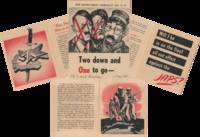
1945réf. List2747Paris France; and Washington D.C. 1945. Six 8 x 10 inch and smaller typed pages; one 4 x 5 inch card with two tickets; one twenty-six page 4 x 5.5 inch pamphlet; one six page 6 x 8.5 inch pamphlet; six 2.5 x 3.5 photographs and two 3 x 4.5 inch photographs. Of the printed matter most is affixed to paper some small tears and folds; overall excellent; photographs near fine. Mary J. Bremer 1917–2019 was a Technician fourth grade from Grant Township Nebraska. Her correspondents here include June Miller 1920–deceased an aviation cadet from Michigan and John Melotte 1919–deceased an artilleryman from Philadelphia. Bremer and Miller were members of the Women’s Army Corps WAC. Established in May of 1942 as the Women’s Army Auxiliary Corps the WAC converted to active duty in July of 1943. The women of WAC known as Wacs served in noncombatant roles across the various theaters of World War II. Offered here is a small archive of Bremer’s documents and photographs relating to WAC: a few letters including a description of Paris the day after the Nazi surrender; two pamphlets including the War Department pamphlet Two down and One to go –; and a collection of photographs of Eisenhower’s victory parade and Roosevelt’s funeral procession. On April 12 1945 President Roosevelt died of a stroke in Warm Springs Georgia. His body was returned to Washington two days later and a military procession escorted it from the train station to the White House. Two photographs of the funeral procession are included in the archive. One showing a woman at the start of a section of the parade is identified verso as “WACs led by Capt. Machen”. The following month the Nazis surrendered. Bremer’s friend June Miller was stationed in Paris at the time. She wrote to Bremer the next day describing the celebration: “It began the night before when we stood on the roof and watched the flares go off all over the city--just like the 4th of July; the Sacred Couer was blazing with lights and it looked like a miniature fairy-land. Last night all the famous old buildings including the Arc d’Triumph was all lit up the fountains in the parks at Concord in front of the Trocadero--they were all going and the kids were wading and splashing around having the time of their life. It was really something to see--something the French had been waiting a long time for. “Fini le guerre” they kept saying--the end of the war!” Miller also claims to have witnessed a bomber flying a celebratory loop through the Eiffel Tower: “When we came out of the Trocadéro the fountains were on and what a sight that is. Looking down over the water that looks like a miniature waterfall to the Eiffel Tower at the bottom of a small hill. And if I hadn’t seen it with my own eyes I would never have believed that I saw a small bomber come through the bottom but that’s just what it did--and just did clear it too. The planes seemed to be going as wild as the people on the ground--they were so thick up there that pretty soon we thought surely something would happen.” In June Dwight Eisenhower returned from Europe and a homecoming parade was held for him in Washington D.C. Six photographs of this parade are included in the archive including a shot of his plane arriving at the airport and one where he is visible standing in the back of a Jeep. Miller notes in her letter from Paris that “you wondered what was coming next; where we would go from here ‘cause in a sense there is still a war very definitely going on”. In fact John Melotte who seems to be Miller’s partner writes to Bremer that he “May be slated for that place they call the CBI but don’t tell June please. She does not want me to even mention the place in my letters so I let well enough alone” July 15 1945. Hostilities would continue in the CBI—the China-Burma-India theater—until September of that year. The process by which soldiers were selected to be sent to the Asia-Pacific theater is laid out in the War Department pamphlet Two down and One to go –. The pamphlet reminds them that there are still “a couple of big jobs ahead” the primary one being to “crush” or “smash” the “Japs” and the second one being to occupy and police “conquered lands . until the peril of future aggression is gone.” It is a visually striking piece with illustrations in a bold black and red color palette; its cover is a reproduction of a caricature of Hitler Mussolini and Hirohito by Polish-Jewish artist Arthur Szyk. Also included in the archive are a card from a friend with tickets to an American League baseball game; a humorous poem congratulating Wacs Ruth O.B. and Lenore I. Nier on new work assignments; and a Christmas 1945 WAC pamphlet with a dinner menu and list of WAC officers. The pamphlet assures the Wacs with a note from Colonel Kenton Cooley “Before another Christmas you all will have returned to civilian life and each of you will take with you my appreciation and my sincere admiration for a great job well done.” Of interest to scholars of women’s history especially in the military; and of the events leading up to the end of the Second World War. unknown books
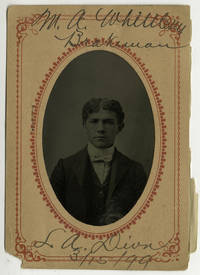
1890réf. COL26-181890. Tintypes 57. A remarkable typological assemblage of portraits showing employees of the Los Angeles division of the Southern Pacific and two of the company's Yuma division. The majority of the men are identified on the photographs' accompanying paper mats with many also noting their occupation division and date the photo was taken. A few also note the subject's date of birth. Occupations represented in the collection include fireman brakeman switchman night car sealer and more. Affixed to one of the paper mats is a some sort of health survey which has been filled out by the subject. There are a number of unusual and fascinating aspects of the collection. First the exact purpose of their creation. Given the relative uniformity of the information present on the mats these were clearly done for internal record-keeping and not created as the kind of "souvenir" one often associates with the tintype. Relatedly the second intriguing aspect of the collection is its chosen format. By the 1890s paper photography was readily available and we have encountered similar "in-house" photographic employee records from around time. These are usually albumen or silver prints tipped into an album similar to mugshot books. Why exactly the tintype was used is not entirely clear. It is possible due to the transient nature of railroad work that it was easier or more efficient to take their portrait in the field. Perhaps these were done in a tintype studio at a railway depot one usually catering to travelers or tourists. We have been unable to locate another collection of this kind. It is a compelling example of the use of the tintype and a fascinating compendium of Los Angeles railroad history. Each 5 x 3 inches overall ; Most with subject ID and occupation to paper mat. unknown
1945réf. List2747Paris France; and Washington D.C. 1945. Six 8 x 10 inch and smaller typed pages; one 4 x 5 inch card with two tickets; one twenty-six page 4 x 5.5 inch pamphlet; one six page 6 x 8.5 inch pamphlet; six 2.5 x 3.5 photographs and two 3 x 4.5 inch photographs. Of the printed matter most is affixed to paper some small tears and folds; overall excellent; photographs near fine. Mary J. Bremer 1917–2019 was a Technician fourth grade from Grant Township Nebraska. Her correspondents here include June Miller 1920–deceased an aviation cadet from Michigan and John Melotte 1919–deceased an artilleryman from Philadelphia. Bremer and Miller were members of the Women’s Army Corps WAC. Established in May of 1942 as the Women’s Army Auxiliary Corps the WAC converted to active duty in July of 1943. The women of WAC known as Wacs served in noncombatant roles across the various theaters of World War II. Offered here is a small archive of Bremer’s documents and photographs relating to WAC: a few letters including a description of Paris the day after the Nazi surrender; two pamphlets including the War Department pamphlet Two down and One to go –; and a collection of photographs of Eisenhower’s victory parade and Roosevelt’s funeral procession. On April 12 1945 President Roosevelt died of a stroke in Warm Springs Georgia. His body was returned to Washington two days later and a military procession escorted it from the train station to the White House. Two photographs of the funeral procession are included in the archive. One showing a woman at the start of a section of the parade is identified verso as “WACs led by Capt. Machen”. The following month the Nazis surrendered. Bremer’s friend June Miller was stationed in Paris at the time. She wrote to Bremer the next day describing the celebration: “It began the night before when we stood on the roof and watched the flares go off all over the city--just like the 4th of July; the Sacred Couer was blazing with lights and it looked like a miniature fairy-land. Last night all the famous old buildings including the Arc d’Triumph was all lit up the fountains in the parks at Concord in front of the Trocadero--they were all going and the kids were wading and splashing around having the time of their life. It was really something to see--something the French had been waiting a long time for. “Fini le guerre” they kept saying--the end of the war!” Miller also claims to have witnessed a bomber flying a celebratory loop through the Eiffel Tower: “When we came out of the Trocadéro the fountains were on and what a sight that is. Looking down over the water that looks like a miniature waterfall to the Eiffel Tower at the bottom of a small hill. And if I hadn’t seen it with my own eyes I would never have believed that I saw a small bomber come through the bottom but that’s just what it did--and just did clear it too. The planes seemed to be going as wild as the people on the ground--they were so thick up there that pretty soon we thought surely something would happen.” In June Dwight Eisenhower returned from Europe and a homecoming parade was held for him in Washington D.C. Six photographs of this parade are included in the archive including a shot of his plane arriving at the airport and one where he is visible standing in the back of a Jeep. Miller notes in her letter from Paris that “you wondered what was coming next; where we would go from here ‘cause in a sense there is still a war very definitely going on”. In fact John Melotte who seems to be Miller’s partner writes to Bremer that he “May be slated for that place they call the CBI but don’t tell June please. She does not want me to even mention the place in my letters so I let well enough alone” July 15 1945. Hostilities would continue in the CBI—the China-Burma-India theater—until September of that year. The process by which soldiers were selected to be sent to the Asia-Pacific theater is laid out in the War Department pamphlet Two down and One to go –. The pamphlet reminds them that there are still “a couple of big jobs ahead” the primary one being to “crush” or “smash” the “Japs” and the second one being to occupy and police “conquered lands . until the peril of future aggression is gone.” It is a visually striking piece with illustrations in a bold black and red color palette; its cover is a reproduction of a caricature of Hitler Mussolini and Hirohito by Polish-Jewish artist Arthur Szyk. Also included in the archive are a card from a friend with tickets to an American League baseball game; a humorous poem congratulating Wacs Ruth O.B. and Lenore I. Nier on new work assignments; and a Christmas 1945 WAC pamphlet with a dinner menu and list of WAC officers. The pamphlet assures the Wacs with a note from Colonel Kenton Cooley “Before another Christmas you all will have returned to civilian life and each of you will take with you my appreciation and my sincere admiration for a great job well done.” Of interest to scholars of women’s history especially in the military; and of the events leading up to the end of the Second World War. unknown
1998réf. 1305088PN. New. 1998. Soft Cover. Date is original print. This is a reprint edition . PN paperback
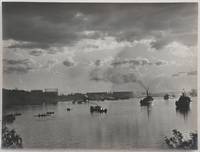
réf. PC71Thirteen unmounted gelatin silver prints ca. 155x205 cm 6x8 in. All with pencil titles in English on versos. This interesting collection of photos of New South Wales includes views of the Sydney Harbour taken from the deck of HMS “Powerful” Circular Quay taken from RMS “Orontes” two images of Bondi Beach and three rare views of the Parramatta River taken on a day of the famous scull boat race between George Towns and Jim Stanbury one of two races between them either in 1905 or in 1906. The photos show the Parramatta river full of canoes paddle boats and “steamers going up to the starting point” as well as “the Parramatta River after the finish of the Stanbury-Towns boat race the boats hurrying back to town.” The other images show the Hacking River taken from the Moombara district Port Hacking southern Sydney Jamberoo village on the Illawarra South Coast of New South Wales; Nowra Bridge over the Shoalhaven River built in 1881 and the Bomaderry Creek near Nowra South Coast. The last view shows the harbour of Hobart with HMS “Challenger” on the right taken from the deck of RMS “Orontes.” “George Towns was the Australian Single Sculls World Champion from 1901 to 1905 and 1906 to 1907. He was the last of the seven Australian World Sculling Champion who between them held the title almost uninterrupted from 1876 to 1909” Wikipedia. His two races with another famous Australian sculler James Stanbury 1868-1945 took place on 22 July 1905 and 28 July 1906. “Stanbury was a tough proposition as he had been World Champion from 1891 to 1896 and had held off several challenges before losing to Gaudaur. The race was agreed to be run on 22 July 1905 on the Parramatta with a stake of £500 a side. The water was smooth and the weather was fine with just a light breeze. Again large crowds were on hand to witness what was expected to one of the great sculling contests. At the start Stanbury at once went to the front and by Uhr’s Point was a length and a half ahead. Towns then spurted but could make no impression on the leader. For every effort Towns made Stanbury responded and he crossed the line by two lengths in a time of 19m.47s. Often when one sculler was beaten by another he was offered a return match to have the chance to get even – or go two down. Stanbury offered Towns and they had another Championship race on the same course almost a year later on 28 July 1906. After the start Towns took an early lead but was soon overhauled by Stanbury who then continued to widen the gap until he was two lengths ahead but at Cabarita he started to show signs of distress. It was evident that his right shoulder was troubling him and about which rumours had been circulating. He had to slow down considerably and Towns then managed to catch up. Stanbury’s shoulder finally gave out and from there on the race was a procession. Towns won by about twenty lengths in a time of 19m.53s. This was Stanbury’s final Championship race; he had raced in seven and won five” Wikipedia. unknown
1910réf. 17921Pacific Northwest Library Association. Very Good. 1910-1977. Pamphlet. Altogether a pile 2 1/4" thick. ; Ex-Library; 8vo 8" - 9" tall . Pacific Northwest Library Association unknown
réf. 339371 vol in-4 broché - N° 8 - illustrations noiret blanc et couleurs en et hors texte
1904réf. VV063241904-1976
1977réf. IA165281977-2007 Mainly papers on Polychaetes from Australia.
1982réf. EA238681982-1986 All reprints mounted in protective green covers. Ex library Dr. C.A.W. Jeekel.We acquired a large part of the Jeekel library including his reprint/separate-collection, only part of this is listed, please inquire!
1981réf. IT166641981-2007 Mainly describing material from Australia.
1878réf. EL425451878-1922 68, 20, 72, 84, 12, 24, 42, 24, 104, 13 p., all bound in one half morocco volume, with gilt author/title on spine. With the ex libris (book-plate) of A. Diakonoff. With typed list of papers at rear.Includes: Descriptions of Australian Microlepidoptera / Classification Australian Pyralidina / Descriptions of new Lepidopters from Australia and New Zealand / Descriptions of Australasian Microlepidoptera. XIX. Plutellidae, etc.
1901réf. EL425461901-1924 All bound in one half morocco volume, with gilt author/title on spine. Most papers have their original printed front covers. Some wear on upper end spine. With the ex libris (book-plate) of A. Diakonoff. Last paper (only 2 pp.) in xerox-copy. With typed index at rear.
1882réf. EL425501882-1923 68, 111, 82, 7, 12, 3, 8 p., all bound in one full cloth volume, with author/title in gilt on spine. The three smaller papers have their original printed covers. With the ex libris (book-plate) of A. Diakonoff.Includes: Descriptions of New Zealsnd Micro-Lepidoptera I & III & IV / Supplement to a Monograph of the New Zealand Geometrina / Notes and descriptions of New Zealand Lepidoptera, etc.
1924réf. EL425521924-1935 All bound in one half cloth volume, with author/title in gilt on spine (somewhat rubbed). Several papers have their original printed covers. Ex library A. Diakonoff (with his ex libris (book-plate)).
1961réf. MM260811961-2001 Mostly on New Zealand Nudibranchs. Several important papers on New Zealand Aeolid nudibranchs. One paper with author's dedication.
1948réf. 100151476Éditions rouff 1948 in8. 1948. Broché. Ce fascicule de 24 pages publié en 1948 aux éditions Rouff dans la collection Patrie relate la prise de l'atoll de Tarawa par les forces américaines pendant la Seconde Guerre mondiale. L'auteur Roger Buffet y décrit un épisode clé de la guerre du Pacifique